
Introduction
The L-amino acids and their compounds are used in biology, pharmacy, industry and labo-ratory reagents [1-3]. They also control transami-nation, decarboxylation and metabolism process-es in human body. On the other hand, L-ascorbic acid (vitamin-C) is an important drug used against cancer, scurvy and reduced the risk of bronchitis or wheezing [4-6]. It is also an impor-tant drug to help the patient to increase the immune system. The person who suffered from AIDS has low concentration of vitamin-C. Vitamin-C is also responsible for the functions of various body components and organs but also keeps in order the immune system [7, 8]. The
deficiency of vitamin-C causes anemia, dental cavities and thyroid insufficiency.
Cd (II) is the one of the toxic metal in the environment to which industrial civilization has exposed itself [9]. Cd (II) contents is fixed in human body but whenever the concentration of Cd increases, the human being suffers from several severe diseases like cancer of the bladder, breast, intestine, leukemic system and sometimes death can also occur. Till now, there is no suitable anti-dote available for Cd toxicity. At present, H4EDTA and its derivatives are used for Cd intoxication. Initially they reduce the toxicity of Cd (II) but eventually increase the nephrotoxicity therefore; the uses of these drugs against Cd (II) toxicity are questionable [10]. The present study is related with www.scielo.br/eq
www.ecletica.iq.unesp.br
Volume 33, número 2, 2008
Study of complexes of cadmium with some L-amino acids and
vitamin-C by voltammetric technique
F. Khan* and A. Khanam
Electrochemical Laboratory, Department of Chemistry Dr. H. S. Gour University, Sagar - 470003 (M.P.) India * [email protected]; [email protected]
Abstract:Voltammetric technique was used to study the binary and ternary complexes of cadmium with L-amino acids and vitamin-C (L-ascorbic acid) at pH =7.30 ± 0.01, µ = 1.0M KNO3at 25ºC and 35ºC. Cd (II) formed 1:1:1, 1:1:2 and 1:2:1 complexes with L-lysine, L-ornithine, L-threonine, L-ser-ine, L-phenylglycL-ser-ine, L-phenylalanL-ser-ine, L-glutamic acid and L-aspartic acid used as primary ligands and ascorbic acid used as secondary ligand. The trend of stability constant of complexes was L-lysine < L-ornithine < L-threonine < L-serine < L-phenylglycine < L-phenylalanine < L-glutamic acid < L-aspartic acid which can be explained on the basis of size, basicity and steric hindrance of ligands. The values of stability constant (log β) varied from 2.23 to11.33 confirm that these drugs i.e. L-amino acids or in combination with L-ascorbic acid or their complexes could be used against Cd (II) toxici-ty. The study has been carried out at 35ºC also to determine the thermodynamic parameters such as enthalpy change (∆H), Free energy change (∆G) and entropy change (∆S) respectively.
the formation of binary and ternary complexes of Cd (II) with selected L- amino acids and ascorbic acid by voltammetric technique with the view that these drugs or their metal complexes could be used against several severe diseases like cancer, AIDS and also metal toxicity.
Experimental
The following chemicals were used for all polarographic experiments: HNO3(Sigma), NaOH (Sigma), KNO3 (Fluka), gelatin (B.D.H.), Cd(NO3)2.4H2O (B.D.H.), L-amino acids (Lobachem) and vitamin-C (ascorbic acid) (Fluka) and their solutions were prepared in double distilled water. The purity of L-amino acids was checked by Chromatography method [11]. The concentration of metal, KNO3 and gelatin in test solution was 0.5 mM, 1.0 M and 0.001% respectively.
The depolarizer and ligands (i.e. amino acid and vitamin-C) were taken in the ratio 1:30:30 in the case of ternary complexes and current – voltage curves were obtained at dif-ferent pH values. It has been observed that the maximum shift of E1/2was obtained within the pH range 7.10-8.50 but pH 7.30 was selected for studying the complexes in human blood pH [12, 13].
Electrochemical experiments were made by simple DC polarography carried out on a man-ual polarograph using a (Toshniwal PL-50) polyflex galvanometer. The polarographic cell was of Laitinen and Lingane type in which polarographic capillary of 5.0 cm in length with 0.04 mm in diameter was used. The m2/3t1/6value was 2.40 mg2/3s-1/2at 60.02 cm effective height of mercury. A systronic pH meter 361 was used to measure the pH of the analyte at 7.30±0.01 adjusted by using dilute solutions of HNO3 or NaOH as required. Potassium dihydrogen phos-phate-sodium hydroxide buffer was added to sta-bilize the pH of the analyte.
Electrochemical measurement was per-formed in the solutions of physiological ionic strength (1.0 M) KNO3 as the supporting elec-trolyte while 0.001% gelatin was the maxima suppressor. The entire study was carried out at 298K and 308 K.
Result and discussion
Electrochemical investigation of Cd (II) complexes with L-amino acids and vitamin-C (L-ascorbic acid) was performed using simple polarography. Cd (II) gives a well defined two electron reversible reduction and diffusion con-trolled wave in 1.0M KNO3 at pH=7.3±0.010at 25ºC [14, 15]. The metal ion and ligands were taken in the ratio 1:30 in binary complexes and 1:30:30 in case of ternary complexes and polaro-grams were taken at different pH values, it has been observed that the maximum shift of E1/2was obtained at pH range 7.10-8.50 but pH 7.30 was selected for studying the complexes in human blood pH. All the waves of the complexes were reversible and diffusion controlled as clear from the plots between Ed.e.vs. log (id– i) / i and idvs √h respectively [16].
Binary complexes
[Cd _ L - amino acidate] system: The pK values of amino acids were determined by titra-tion method [17]. The concentratitra-tion of the free ligand was calculated from pK2value and pH of test solution. Deford and Hume [18] was used to determine the composition and stability constants of binary complexes of Cd(II) with lysine, L-ornithine, L-threonine, L-serine, phenyl-glycine, phenylalanine, glutamic acid and L-aspartic acid. The values of stability constants of binary complexes were given in Table 1. The study has already been done at pH = 8.50[19], however the present study has been done at pH = 7.30 to compare the values of stability constants.
[Cd_ vitamin-C] complexes: The concen-tration of vitamin-C (L-ascorbic acid) in the ana-lyte was varied from 50 mM to 200mM in 0.5 mM of Cd (II) in 1.0 M KNO3at pH = 7.30±0.01 at 25 ºC. Lingane method [20] confirmed the for-mation of 1:1 and 1:2 complexes of Cd (II) with vitamin-C with stability constants logβ01=2.23 and logβ02=3.11 respectively.
Ternary Complexes
[Cd _ L-amino acidate _ vitamin-C] com-plexes: The E1/2values became more negative with
show-ing the formation of ternary complexes. The centrations of the secondary ligand were kept con-stant at 0.025M and 0.05M while the concentration of primary ligand was varied from 0.50mM to 30.0 mM. The current voltage curves were drawn at pH=7.30±0.010. All the waves were found to be reversible and diffusion controlled. The Schaap and McMaster [21] method confirmed the formation of 1:1:1, 1:1:2 and 1:2:1 complexes of Cd (II) with
lysine, ornithine, threonine, serine, L-phenylglycine, L-phenylalanine, L-glutamic acid and L-aspartic acid and vitamin-C. The data and plots of Fij[X, Y] against [X] (where Fijis a Schaap and McMaster Function to evaluate the stability constant βij, X = L-lysine, Y=vitamin-C and i and j are their stoichiometric numbers respectively} for [Cd_L-lysinate_vitamin-C] system were given in Table 2 and Fig. 1 respectively. These functions
Table 1. Stability constants of ternary complexes, Metal ion Cd(II) = 0.5 mM; µ = 1.0 M; pH = 7.3±0.01; Temperature = 25°C.
(The values under bracket shows the values of stability constants calculated at pH = 8.50.)
were used to determine the stability constant of complexes.
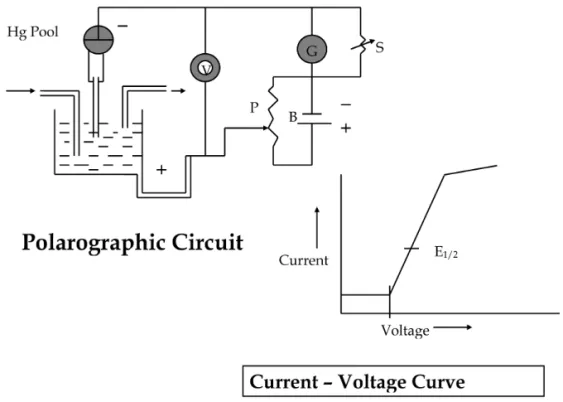
To know the values of β11and β12, the study has been carried out at two constant concentration of secondary ligand [Y] = [vitamin-C] at 0.025M and 0.05M respectively. The value of stability con-stants of complexes were given in Table 1. The cur-rent voltage curves of [Cd–L-lysinate–vitamin-C] at [vitamin-C] = 0.025M were given in Fig. 2 and Fig. 3 showed the polarographic experimental set up to study the interaction of Cd (II) with some L-amino acids and vitamin-C.
Comparison of stability of binary and ternary complexes
To compare the stability of binary and ter-nary complexes, the values of mixing constant log Km were calculated by the following equa-tion [21].
log Km=log β11-1/2[log β02+ log β20]
The values of log Km are -0.345, -0.250, -0.105, -0.010, 0.035, 0.130, 0.280, 0.375 respectively, for {Cd_L-lysinate_ vitamin-C}, {Cd_L-ornithinate_vitaminC}, {Cd_ L-thre-oninate_vitamin-C}, {Cd_L-serinate_vitamin-C, {Cd_L-phenylglycinate_vitamin-C}, {Cd_L-phe nylalaninate_vitamin-C}, {Cd_L-glutamate_ vita-min-},{Cd_L-aspartate_vitamin-C} complexes
respectively. The positive values of log Km indi-cate that the ternary complexes are more stable than the binary complexes, while the negative values indicate that the binary complexes are more stable than ternary complexes.
Trend of stability constants of Cd (II) complexes
phenylalanine causing greater repulsive forces in the former than in the latter.
The higher stability of L-aspartate com-plexes than L-glutamate complex is obvious from the chelate ring formation, in these amino acids, the aspartate forms one five and one six-membered ring with the metal while L-gluta-mate forming one five and one seven-membered ring. As the size of ring in amino acid increases, the stability of complex decreases [26]. The sta-bilities of L-glutamate and L-aspartate complex-es are greater than those of the lysinate, L-ornithinate, L-threoninate, L-serinate, L-phenyl-glycinate and phenylalaninate complexes due to large difference in their basic strength [27]. The same is evident from pK values of L-amino-acids [28].
In case of vitamin-C, oxygen of enediol group may take part in bond formation with CdII, formed a five membered ring [29].
It is clear from the values of stability con-stant of the complexes that vitamin-C and L-amino acids alone or in combination could be used to reduce the toxicity of CdIIin vivo. One also to con-sider the quantity of drugs that should not be com-plexed to the other essential metals present in vivo
and the same could be excreted easily from the body. On the other hand, the person who suffers from AIDS has low concentration of vitamin-C therefore; his resistance can be increased by ascor-bic acid therapy.
Thermodynamic parameters
The kind of complex species that can be measured with a mercury electrode depends on thermodynamic aspects [30]. Thermodynamic parameters such as enthalpy change (∆H), free energy change (∆G) and entropy change (∆S) of the complexes have been calculated by the fol-lowing equations [31].
∆H = 2.303R T1 T2(logK2- logK1) / T2 - T1 (1) ∆G = -2.303 RT logK (2) ∆G = ∆H- T∆S (3)
It is clear from the values of ∆S, ∆G and ∆H in Table 3 that the values of ∆S are more neg-ative at higher temperature and ∆G are less nega-tive at higher temperature confirmed that com-plexes are not stable at higher temperature [32, 33]. The negative values of ∆H show that reac-tions are exothermic in nature.
Conclusions
In the present paper, interaction of Cd (II) between L-amino acids and vitamin-C in pH 7.30±0.01 was investigated using simple DC polarography. The results indicated that current voltage curves were reversible and diffusion con-trolled in 1.0M KNO3at pH =7.30 ± 0.01 at 25ºC and 35ºC .The stability constants varied from 2.23 to 11.33 which is quite reasonable values therefore, either L-amino acids alone or vitamin-C or in combination or in the form of metal com-plex could be effective against Cd (II) toxicity and also be very much useful not only to control the aging process but also to prevent the HIV replication in vivo. The negative values of ?H indicated the exothermic nature of the metal-lig-ands interaction. The complexes were not stable at higher temperature which was confirmed by the values of µG and µS of complexes at higher temperature.
Acknowledgement
The authors are thankful to Head of the Department of Chemistry, Dr. H. S. Gour Uni-versity, Sagar for providing the laboratory facilities.
Received 03 January 2008 Accepted 29 April 2008
References
[1] J. Brosnan, J. Nutr. 130 (2000) 988S.
[2] K. Pisarewicz, D. Mora, F. Pflueger, G. Fields, F. Marí, J. Am. Chem. Soc. 127 (2005) 6207.
[3] G. Wu, Y. Fang, S. Yang, J. Lupton, N. Turner, J. Nutr.134 (2004) 489.
[4] M. W. Roomi, V. Ivanov, T. Kalinovsky, A. Niedzwiecki, M. Rath, J. Res. Commun Mol. Pathol. Pharmacol. (2004) 115. [5] H. Martha, W. B. Stipanuk, Biochemical and physiologi-cal Aspects of Human Nutrition, Sounders Company, 2000. [6] M. Levine, S. C. Rumsey, Y. Wang, J. B. Park, R. Daruwala, Biochemical and Physiological Aspects of Human Nutrition, Philadelphia, W B Saunders, 2000, p. 541.
[7] S. Fukuda, J. Curr. Med. Chem. 12 (2005) 2765; [8] S. Harakeh, R. Jariwalla, AIDS Res. Hum. Retroviruses 13 (1997) 237.
[9] I. Sisseoff, J. Grisvard, E. Guille, Prog. Bio. Phys., Mol. Biol. 31 (1976) 165.
[10] J. A. Vale, T. J. Meredith, Poisoning Diagnosis and Treatment, 1981, p. 33.
[11] A. A. Khan, W. U. Malik, J. Indian Chem. Soc.40 (1963) 565.
[12] F. Khan, Bull. Electrochem.19 (2003) 283.
[13] S. N. Chadar, F. Khan, J. Indian Chem. Soc. 83 (2006) 1242. [14] L. Meites, Polarographic Techniques, Interscience, New York, 2ndedn., 1965, p. 131.
[15] P. L. Sahu, F. Khan, Ultra Sci. phys. Sci. 12 (2000) 106. [16] D. R. Crow, Polarography of metal complexes, Academic press, London, 1969.
[17] S. Chaberek, A. E. Martel, J. Am. Chem. Soc.74 (1952) 5052.
[18] D. Deford, D. N. Hume, J. Am. Chem. Soc.73 (1951) 5812. [19] R. Dodke, F. Khan, Chem. Environ. Res. 1 (1992) 305. [20] J. J. Lingane, Chem. Rev.29 (1941) 1.
[21] W. B. Schaap, D. L. Mc Master, J. Am. Chem. Soc. 83 (1961) 4699.
[22] R. C. Kapoor, B. S. Agarawal, Principles of polarogra-phy, Wiley Eastern Ltd, New Delhi, 1991, p. 71.
[23] R. Dodke, F. Khan, J. Indian Chem. Soc.70 (1993) 15. [24] S. Vajhallya, F. Khan, Bull. Chem. Soc. (Japan) 72 (1999) 397.
[25] S. Vajhallya, F. Khan, J. Indian Chem. Soc.76 (1999) 294. [26] S. Vajhallya, F. Khan, Bull. Electrochem.16 (2000) 311. [27] A. E. Martell, M. Calvin, Chemistry of Metal Chelate Co mpounds, Prentice-Hall Inc., New York, 2nd edn, 1952, p. 155.
[28] B. V. Mrudula Rao, S. J. Swamy, P. Lingaish, Indian J. Chem.24 (1985) 887.
[29] R. N. Allen, M. K. Shukla, J. Leszczynski, Int. J. Quant. Chem. 106(2006) 2366.
[30] B. L. Lewis, G. W. Luther III, H. Lane, T. M. Church, Electroanalysis, 7 (1995) 166.
[31] J. C. F. Rossotti, H. Rossotti, The Determination of Stability Constants, McGraw Hill Book Co., London, 1961. [32] F. Khan, A. V. Mahajani, J. Indian Chem. Soc. 16 (1984) 165.
![Table 2. Polarographic data and Fij[X, Y] values of [Cd – L-lysinate –vitamin-C] system, Cd(II) = 0](https://thumb-eu.123doks.com/thumbv2/123dok_br/18977328.455756/3.892.117.799.309.612/table-polarographic-data-fij-values-lysinate-vitamin-system.webp)
![Table 3. Thermodynamic parameters of ternary complexes of [Cd-L-aminoacidate-vitamin-C] system.](https://thumb-eu.123doks.com/thumbv2/123dok_br/18977328.455756/7.892.119.801.98.573/table-thermodynamic-parameters-ternary-complexes-cd-aminoacidate-vitamin.webp)
