ORIGINAL
RES
EAR
CH
Correspondence to: Andressa Ribeiro Contreira – Rua Pioneiro Abílio Gaspar, 84 – Parque Avenida – CEP: 87025-550 – Maringá (PR), Brasil – E-mail: [email protected] Presentation: June 2013 – Accepted for publication: July 2014 – Financing source: Coordenação de Apoio de Pessoal de Nível Superior (CAPES) – Conflict of interests: nothing to declare – Approval at the Ethics Committee n. 224/2010.
ABSTRACT | This study aimed to characterize the lifestyle of schoolchildren aged 11 to 13 years with and without developmental coordination disorder (DCD). The study included 108 schoolchildren enrolled in a public school in Florianópolis (SC). For motor evaluation was used the Movement Assessment for Children 2; and lifestyle was assessed using the Inventory of Lifestyles in Childhood and Adolescents. The used Statistical tests were chi-square and Fisher exact test, with significance level of p<0.05. We found similar habits in most activities inside and outside home, as well as a significant association between probable DCD and the activity play video game. For sociocultural and sports, participation habits were similar, observing a lower participation of parents of children and adolescents with DCD in these activities.
Keywords | Life Style; Motor Skills Disorders; Child.
R E S U M O | Objetivou- se c arac terizar o es tilo de
vida de escolares de 11 a 13 anos com e sem trans-torno do desenvolvimento da coordenação (TDC). Participaram 108 escolares de uma escola pública de Florianópolis (SC). Para a avaliação motora, utilizou-se a Movement Assessment for Children 2 e o estilo de vida foi avaliado pelo Inventário de Estilo de Vida na Infância e Adolescência (EVIA). Os testes estatísticos utilizados foram o do χ2 e o exato de Fisher, com nível de
significân-cia de p<0,05. Foram verificados hábitos semelhantes na
Lifestyle in children with and without
developmental coordination disorder
Estilo de vida de escolares com e sem transtorno do desenvolvimento da coordenação
Estilo de vida de estudiantes com y sin trastornos del desarrollo de la coordinación
Andressa Ribeiro Contreira1, Renata Capistrano2, Annelise do Vale Pereira de Oliveira2,
Thais Silva Beltrame2
Study conducted at the Laboratory of Learning and Development Disorders, linked to the Center of Health and Sport Science at Universidade do Estado de Santa Catarina (UDESC) – Florianópolis (SC), Brazil.
1Universidade Estadual de Maringá (UEM) – Maringá (PR), Brazil. 2UDESC – Florianópolis (SC), Brazil.
maioria das atividades dentro e fora de casa, e associa-ção estatisticamente significativa entre provável TDC e a atividade jogar videogame. Para a participação socio-cultural e esportiva, os hábitos mostraram-se similares, observando-se uma menor participação dos pais das crianças e adolescentes com TDC nessas atividades.
Descritores | Estilo de Vida; Transtornos das Habilidades Motoras; Crianças.
RESUMEN | Este estudio tuvo como objetivo
caracteri-zar el estilo de vida de estudiantes de 11 a 13 años con o sin trastorno de desarrollo de la coordinación (TDC). Participaron 108 estudiantes de una escuela pública de Florianópolis (SC). Para la evaluación motora, se utilizó la Movement Assessment for Children 2 y el estilo de vida se evaluó por el Inventario de Estilo de Vida en la Infancia y Adolescencia (EVIA). Las pruebas estadísticas utilizadas fueron la del χ2 y la exacta de Fisher, con nivel de
signi-ficación de p<0,05. Se observaron hábitos similares en la mayoría de las actividades dentro y fuera del hogar, y la asociación estadísticamente significativa entre pro-bable TDC y la actividad de jugar el videojuego. Para la participación sociocultural y deportiva, los hábitos fue-ron similares, observándose una menor participación de los padres de los niños y adolescentes con TDC en esas actividades.
INTRODUCTION
Living habits and lifestyle are individual behaviors which comprise everyday aspects, care with feeding, hygiene and sleep, chores and tasks, leisure and physical activity1,2.
Due to economical and social changes, people’s habits have been going through changes which relect in their quality of life, such as an increase in professional obli-gations, technological availability, increase of insecurity and decrease of public spaces due to urbanization3,4. hese
changes limit the practice of physical activities and make living habits rather sedentary.
he transformations also relect in children and ado-lescents’ lifestyle, since they end up choosing more static activities such as the use of computer, electronic games and television5-8. hese behaviors impair obtaining the necessary
motor basis for the acquisition of more complex abilities, which may push them away from motor practices,
increas-ing the risk of overweight/obesity9. Regarding children
with motor deicit or developmental coordination disor-ders (DCD), the barrier to be transposed for the practice of physical activities is the poor motor coordination itself10.
Investigations have been developed in many countries in the attempt of getting to know the characteristics of children and adolescents as for their lifestyle, focusing on motor activities, evidencing the diferent preferences of activities, higher participation of males in physical activi-ties and also negative aspects of sedentary habits in rela-tion to motor performance and health5,11-19.
As evidenced by Poletto20, researches focused on
phe-nomena related to the routine of children and adolescents, rather than only on biological aspects, are necessary, con-sidering that in this stage of their lives, they are very sen-sitive to environmental conditions which may alter their behavior. Due to the shortage of researches verifying the
lifestyle of children with motor deicit18 and
consider-ing the relex of the environment on motor development, we tried to investigate the lifestyle of school children between 11 and 13 years of age with and without DCD in Florianópolis (SC).
METHODOLOGY
Location of the study
he study was carried out in a school of the state public network, in the central region of Florianópolis (SC), being considered one of the largest schools in Latin America.
The research was approved as for its ethics by the Research and Ethics Committee, No. 224/2010, and the data collection happened within the months of February and May, 2011.
Participants
he school children were part of a group of 590 students, of both gender, aged between 11 and 13 years old, and were selected in a non-probabilistic way. he pedagogi-cal team authorized the invitation of 400 students, thus, 400 Informed Consent Forms, from which there was a response of 130 terms signed up by parents and legal guardians, allowing the participation of the students in the research.
he inclusion criteria were: voluntary participation by students; established age range; authorization by parents or legal guardians; absence of physical problems of lower and upper limbs which would impair the conducting of the assessments (indicated by teachers).
Given these criteria, from the 130 terms handed in, it was possible to assess the lifestyle and motor performance of 108 students (72 girls and 36 boys), average age 11.31
years old (±0.54 years old). he sample loss occurred due
to school strikes, absence of the student in school on data collection days and some stakeholder, among them the participants’ health status and weather conditions.
Instruments
For the motor evaluation, we used the Movement
Assessment Battery for Children 221, whose tasks are
appropriate for the following age ranges: age range 1 (3 to 6 years of age); age range 2 (7 to 10 years of age); age range 3 (11 to 16 years).
he skills assessed are manual dexterity (time in sec-onds), launching/receiving (number of correct takes) and static and dynamic balance (time in seconds and num-ber of steps). According to the score obtained, the chil-dren and adolescents may be classiied into 3 categories: indication of motor impairment (≤5th score), borderline
motor impairment (scores between the 5th and the 16th)
and normal/typical motor development (≥16th score). In
this study, the term used in order to indicate motor prob-lems was “probable DCD”, which is indicated by the fact that a formal diagnosis by a pediatrician or occupational therapist was not established12.
and adolescents aged between 7 and 14 years old, consisting of question regarding living habits in the following aspects: daily life organization; sociocultural participation; partici-pation in sports activities. Two more questions regarding the participation of parents in physical or sports activi-ties (yes/no alternatives) and in physical education classes (yes/no alternatives) were included.
Data collection procedure
Meeting with the pedagogical staf were conducted in order to explain the objectives of the research, as well as information on shifts provided by the school for data collection. he assessments were performed in a proper and well lit school environment, since the school made available a wide room to be used during the study.
he motor assessment (MABC-2) lasted from 40 to 45 minutes, varying according to the ability of students in the performance of the tasks. he motor tests were performed individually by previously trained evaluators, following the protocol order, irst performing the man-ual dexterity tasks (inverting pins, forming triangles and tracing trails), then ability with a Ball (receiving the Ball with one hand, throwing the Ball at the target) and end-ing with balance tasks (balancend-ing on a plaque, walkend-ing on a line, hopping on carpets).
At the end of the motor assessments, the EVIA was applied. he use of the survey lasted, approximately, 15 minutes and it was conducted as an interview by the assess-ers, in an attempt to make data collection more dynamic and also to clarify students’ doubts as for the questions.
Data analysis
he data were analyzed in the statistics software SPSS, ver-sion 17.0, using a descriptive (mean, standard-deviation, simple frequency and percentage) and inferential statis-tic. In order to verify the association between the variables (motor classiication and lifestyle), we used the nonpara-metric χ2 and exacts Fisher tests with residual adjustment,
adopting a signiicance level of p<0.05.
RESULTS
It was veriied that 73 (67.6%) students presented typical motor development (TMD), 24 (22.2%), risk of devel-opmental coordinator disorder (risk of DCD), and 11 (10.2%), probable developmental coordinator disorder
(PDCD). Given the objectives of the study in compar-ing the livcompar-ing habits of students with and without DCD, the students presenting risk of DCD were not included in the analysis.
It is noteworthy that the variation of n in the distri-bution of frequencies in the answers in the EVIA ques-tionnaire was due to the students having chosen more than one alternative for some questions, which ended up invalidating their answers.
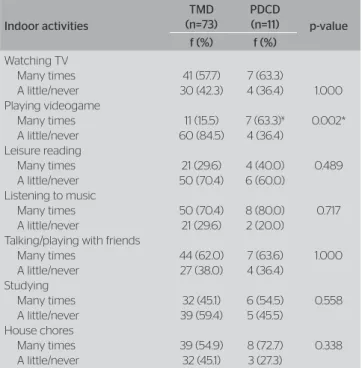
For the activities carried out inside their homes, it was found a statistically signiicant association between the PDCD motor classiication and the activity of play-ing videogame (Table 1). For the remainplay-ing activities, the characteristics were similar, according to the motor classiication.
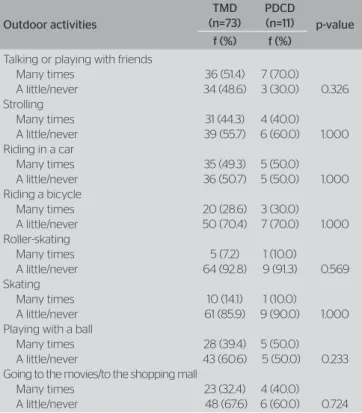
Regarding the activities performed outside home, the living habits of students with and without DCD proved to be similar, as presented in Table 2.
As for sociocultural participation, there was no asso-ciation between taking part in group activities (p=0.651), materials (p=0.993) and places for leisure (p=0.653) and the motor classiication of students. It was observed that 63.6% of students with PDCD and 56.3% of students with TMD declared participating in group activities, espe-cially religious/dancing activities and workshops at school. No associations between motor classiication and the practice of sports with guidance (p=0.349), partici-pation of parents in physical activities (p=0.173) and
Table 1. Association between indoor activities and the students’ motor classification
Indoor activities
TMD (n=73)
PDCD
(n=11) p-value
f (%) f (%)
Watching TV Many times A little/never Playing videogame
Many times A little/never Leisure reading
Many times A little/never Listening to music
Many times A little/never
Talking/playing with friends Many times
A little/never Studying
Many times A little/never House chores
Many times A little/never
41 (57.7) 30 (42.3)
11 (15.5) 60 (84.5)
21 (29.6) 50 (70.4)
50 (70.4) 21 (29.6)
44 (62.0) 27 (38.0)
32 (45.1) 39 (59.4)
39 (54.9) 32 (45.1)
7 (63.3) 4 (36.4)
7 (63.3)¥ 4 (36.4)
4 (40.0) 6 (60.0)
8 (80.0) 2 (20.0)
7 (63.6) 4 (36.4)
6 (54.5) 5 (45.5)
8 (72.7) 3 (27.3)
1.000
0.002*
0.489
0.717
1.000
0.558
0.338
participation in physical education classes (p=0.575) were found. However, it was observed that most students in both groups do not have the habit of practicing sports. It was observed higher participation in physical activities by parents of students with TMD; on the other hand, when observing the participation of students in physical education classes, it was observed that, in both groups, most f them have this habit.
DISCUSSION
here was no association between activities performed inside the house and the motor classiication; the most frequent activities were listening to music, talking/play-ing with friends and watchtalking/play-ing TV. Koerich et al.23 found
similar results for students with and without motor dif-iculties, which allows inferring that the habit of having indoor activities is common at this age range, regardless motor classiication.
For the activity of playing videogame, it was found a signiicant association with the PDCD classiication.
hese data are similar to those of studies18 in which the
relations between the psychomotor proile and the lifestyle of students in João Pessoa (PB), were evaluated, verifying
that 44.3% of children with motor disorders would rather have activities such as watching TV, suring the net and playing electronic games, while students without motor disorders would rather have dynamic activities (riding a bicycle/practicing sports).
he permanence before TV or other audiovisual media during childhood and adolescence contributed to seden-tary behavior of other daily activities and to the increase of body weight, relecting low performance in motor tasks11,24. Such aspects was observed in investigations5,11,16
conducted with Portuguese, Brazilian and German chil-dren, observing the association of motor skills to watch-ing TV, indicatwatch-ing that children with less time devoted to these activities presented superior motor performance than the ones who dedicated more time to it.
From these considerations, it is important to high-light current researches which have been pointing to evi-dences contrary to the present study, verifying that the
Exergames(exercises and game) or Nintendo Wii had
positive impact in the increase of physical activity prac-tice among children and adolescents, when compared to
traditional games, considered to be sedentary25,26. hese
review researches verify that these games contribute to the increase of caloric burn, improvement of psychologi-cal and motivational aspects and are also used by doctors and physical therapists in programs of motor rehabilita-tion, contributing to the improvement of motivation and adherence to the programs25,26.
he study carried out by Finco and Fraga27 meets
these information when recognizing the contribution
of theWii Fitgame to higher bodily interaction. he
authors veriied the perceptions in three virtual commu-nities as for the inluence of the game in their feeding and physical activities practices. he results revealed by the participants indicated positive points of view on the game, which increased their interest on physical activi-ties practice, better care as for body weight and health aspects, as well as the importance of having healthy eating habits. Backing up these indings, an interna-tional research investigated the associations between the electronic media (television and games) and the welfare (eating habits and lifestyle) of young children, observing worse results for watching TV, when
com-pared to the use of electronic games28.
he information in previously presented researches evidence the importance of knowing the kid of elec-tronic game used in the living habits of children and adolescents, for there is a diference between the
ben-eits from Exergamesand traditional games pointed as
stimulators of the sedentary life. In this study, the kind Table 2. Association between outdoor activities and the students’ motor
classification
Outdoor activities
TMD (n=73)
PDCD
(n=11) p-value
f (%) f (%)
Talking or playing with friends Many times
A little/never Strolling
Many times A little/never Riding in a car
Many times A little/never Riding a bicycle Many times A little/never Roller-skating
Many times A little/never Skating
Many times A little/never Playing with a ball
Many times A little/never
Going to the movies/to the shopping mall Many times
A little/never
36 (51.4) 34 (48.6)
31 (44.3) 39 (55.7)
35 (49.3) 36 (50.7)
20 (28.6) 50 (70.4)
5 (7.2) 64 (92.8)
10 (14.1) 61 (85.9)
28 (39.4) 43 (60.6)
23 (32.4) 48 (67.6)
7 (70.0) 3 (30.0)
4 (40.0) 6 (60.0)
5 (50.0) 5 (50.0)
3 (30.0) 7 (70.0)
1 (10.0) 9 (91.3)
1 (10.0) 9 (90.0)
5 (50.0) 5 (50.0)
4 (40.0) 6 (60.0)
0.326
1.000
1.000
1.000
0.569
1.000
0.233
of games used were not identiied, which may be con-sidered as a limitation.
However, adolescents with PDCD presented higher frequencies of these practices, which may indicate that those were traditional games.
For the outdoor activities, in both groups we veri-ied activities such as talking/playing with friends, walk-ing the dog, strollwalk-ing, playwalk-ing with a Ball and gowalk-ing to the movies, without association to motor classiication. Similar habits among students with and without motor
diiculties were found in a research23, given that the
most common activities were playing with a ball, riding in the car and talking/playing with friends. In another
instigation, however18, it was veriied that — most —
students with motor coordinator disorders reported not practicing any activities, while a great number of chil-dren with typical development reported participating in sports, which evidences their being more active than children with motor disorders.
As for the veriication of the participation by students with PDCD and TMD in group activities, it was found that most of them have such habit without signiicant association. he most frequent activities were the religious ones, dancing, theater, and workshops in school. In the
study by Silva29 assessing the living habits of students
with DCD from 10 to 11 years of age, it was observed that the most common activities were performed in their parish centers, dancing, and activities in sports clubs. A positive aspect observed in this study is the great partic-ipation of students with probable DCD in these activi-ties, since, as pointed out by the literature, they prefer
individual and lonely activities. Poulsen30 conirms this
when evaluating leisure physical activities of boys with DCD from 10 to 13 years of age, evidencing that those reported low participation in team-up activities and high participation in structured activities which demand low levels of physical aptitude and lower energy expenditure, such as singing groups in church.
As for the participation in sports with guidance, it was observed that, even with no signiicant association between sports participation and motor classiication, students with probable DCD had lower frequency of participation in these activities, which may be a result of the limited motor coor-dination itself. Children with diiculties in motor coordi-nation avoid places where physical activities are promoted, by the fact of their being unsuccessful in them, since the poor motor coordination limits the performance of
com-plex movements required in sports and games19.
About the participation of parents in physical activities and sports, there was a minority of parents of students
with TDCD practicing physical activities (27.3%), with-out signiicant association. When parents are physically active the children present higher probability of taking up physical activities or sports, and this participation depends on parental availability and encouragement, stimuli for going to places of leisure activities and equipment for the pactices31. Seabra et al.14 corroborate this idea when
observing that 70% of students revealed taking part in physical activities or sports because their parents, sib-ling and partners also did so. According to the authors, the family practicing sports has a great inluence in the sports practice of children and adolescents.
It was observed that, in both groups, most students took part in physical education classes, which is positive and con-trasts with the literature, since it evidences lower participa-tion of children with motor diiculties, lower self-conidence, as well as lack of interest for physical education classes12.
he limitations found in this study are related to the lack of identiication of the kind of electronic games played by the students, which could have indicated if the use of games really does characterize a sedentary practice.
CONCLUSION
Based on the results in this study, it is possible to con-clude that students with TMD and PDCD have simi-lar lifestyles and with sedentary characteristics in most activities both in and outdoors, and the activity of
play-ing videogames was associated to PDCD.
It is highlighted the relevance of lifestyle of students, that along with motor and health assessments serve as subsidies for the preparation of physical education classes in school, given the importance of these aspects in motor development.
It is suggested, for future studies the investigation of the kinds of electronic games are used, and the relation of these games to the motor characteristics of the stu-dents, as well as verifying the psychosocial factors which best explain the behavior of children and adolescents in the practice of physical activities.
ACKNOWLEDGEMENTS
The authors thank the Coordenação de Aperfeiçoa-
mento de Pessoal de Nível Superior (CAPES), for the
REFERENCES
1. Torres L. O estilo de vida em jovens atletas: estudo exploratório sobre a influência do gênero, do nível socioeconômico e do nível de prestação desportiva no perfil dos hábitos de vida [dissertação]. Porto Alegre: Escola Superior de Educação Física, Universidade Federal do Rio Grande do Sul; 1998.
2. Nahas MV. Atividade física, saúde e qualidade de vida: conceitos e sugestões para um estilo de vida ativo. 3ª ed. Londrina: Midiograf; 2003.
3. Azevedo Júnior MR, Araújo CLP, Pereira FM. Atividades físicas e esportivas na adolescência: mudanças de preferências ao longo das últimas décadas. Rev Bras Edu Fís Esp. 2006;20(1):51-8.
4. Ramos EC, Freitas EC, Maia JA, Beunem GP, Claessens AL, Gouveia
ER, et al. Associação do envolvimento à actividade física e à aptidão
em jovens madeirenses. Rev Port Cien Desp. 2008;8(2):229-40.
5. Graf C, Koch B, Kretschmann-Kandel E, Folkowski G, Christ H, Coburger S,
et al. Correlation between BMI, leisure habits and motor abilities in
childhood (CHILT- Project). Int J Obes Relat Metab Disord. 2004;28(1):22-6.
6. Hallal PC, AD Bertoldi, H Gonçalves, CG Victora. Prevalência de sedentarismo e fatores associados em adolescentes de 10-12 anos de idade. Cad Saúde Pública. 2006;22(6):1277-87.
7. Eculcas C, Mota J. Actividade física e práticas de lazer em adolescentes. Rev Port Cien Desp. 2005;5(1):69-76.
8. Lopes VP, Gouveia J, Rodrigues LP. Associação dos níveis de atividade física habitual com a coordenação motora, as habilidades motoras e a aptidão física em crianças. In: Vasconcelos O, Botelho M, Corredeira R, Barreiros J, Rodrigues P (Ed.). Estudos em desenvolvimento motor da criança III. Porto: FADE-UP; 2010. p. 217-28.
9. Pelozin F, Folle A, Collet C, Bootl M, Nascimento JV. Nível de coordenação motora de escolares de 09 a 11 anos da rede estadual de ensino da cidade de Florianópolis/SC. Revista Mackenzie de Educação Física e Esporte. 2009;8(2):123-32.
10. Faught BE, Hay JA, Cairney J, Flouris. Increased risk for coronary vascular disease in children with developmental coordination disorder. J Adolesc Health. 2006;37(5):376-80.
11. Stabelini Neto A, Mascarenhas LPG, Nunes GF, Lepre C, Campos W. Relação entre fatores do ambiente e habilidades motoras básicas em crianças de 6 e 7 anos. Revista Mackenzie de Educação Física e Esporte. 2004;3(3):135-40.
12. Cairney J, Hay JA, Faught BE, Wade TJ, Corna L, Flouris A. Developmental coordination disorder, generalized self-eficacy toward physical activity, and participation in organized and free play activities. J Pediatr. 2005;147(4):515-20.
13. Bergmann GG. Crescimento somático, aptidão física relacionada à saúde e estilo de vida de escolares de 10 a 14 anos: um estudo longitudinal [dissertação]. Porto Alegre: Escola Superior de Educação Física, Universidade Federal do Rio Grande do Sul; 2006.
14. Seabra AF, Mendonça DM, Thomis MA, Peters TJ, Maia JA. Associations between sport participation, demographic and socio-cultural factors in Portuguese children and adolescents. Eur J Public Health. 2008;18(1):25-30.
15. Elias RGM, Silva PG, Fernandes CAM, Rinaldi W. Estudo comparativo da coordenação entre crianças praticantes e não praticantes de atividade física além do ensino regular. Rev Educ Fis. 2007;18(Suppl):24-27.
16. Monteiro G, Mourão-Carvalhal I, Pinto J, Coelho E. Influência das variáveis biológicas e socioculturais na coordenação motora. In: Vasconcelos
O, Botelho M, Corredeira R, Barreiros J, Rodrigues P (Ed.). Estudos em desenvolvimento motor da criança III. Porto: FADE-UP; 2010. p. 141-50.
17. Mak KK, Day JR. Secular trends of sports participation, sedentary activity and physical self-perceptions in Hong Kong adolescents, 1995-2000. Acta Paediatr. 2010;99(11):1731-4.
18. Lucena NMG, Lucena LC, Aragão POR, Melo LGB, Rocha TV, Andrade SM. Relação entre perfil psicomotor e estilo de vida de crianças de escolas do município de João Pessoa/PB. Fisioter Pesqui. 2010;17(2):124-9.
19. Cairney J, Hay JA, Veldhuizen S, Missiuna C, Faught BE. Developmental coordination disorder, sex, and activity deficit over time: a longitudinal analysis of participation trajectories in children with and without coordination dificulties. Dev Med Child Neurol. 2010;52(3):e67-72.
20. Poletto AR. Hábitos de vida, estado nutricional, perfil de crescimento e aptidão física relacionada à saúde: subsídios para o planejamento de educação física e esportes na Escola Cidadã [dissertação]. Porto Alegre: Escola Superior de Educação Física, Universidade Federal do Rio Grande do Sul; 2001.
21. Henderson SE, Sugden DA, Barnett AL. Movement Assessment Battery for Children. 2nd ed. Londres: Pearson; 2007.
22. Torres E, Cardoso L. Hábitos de vida de alunos de uma escola da rede municipal de ensino de Porto Alegre [monografia]. Porto Alegre: Escola Superior de Educação Física, Universidade Federal do Rio Grande do Sul; 1995.
23. Koerich MP, Contreira AR, Capistrano R, Claumann GS, Silva J, Beltrame TS. Estado nutricional em escolares com e sem dificuldades motoras [Internet]. In: XVII Congresso Brasileiro de Ciências do Esporte; 2011 Set 11-17; Porto Alegre, Rio Grande do Sul. 2011. p. 1-12. [Citado em 20 jan. 2012]. Disponível em: <http://cbce.tempsite.ws/congressos/index. php/XVII_CONBRACE/2011/schedConf/presentations>
24. Gilbert-Diamond D, Li Z, Adachi-Mejia AM, McClure AC, Sargent JD. Association of a television in the bedroom with increased adiposity gain in a nationally representative sample of children and adolescents. JAMA Pediatr. 2014;168(5):427-34.
25. Vaghetti CAO, Botelho SSC. Ambientes virtuais de aprendizagem na educação física: uma revisão sobre a utilização de Exergames. Cien Cogn. 2010;15(1):76-98.
26. Souza FH. Uma revisão bibliográfica sobre a utilização do Nintendo® Wii como instrumento terapêutico e seus fatores de risco. Revista Espaço Acadêmico. 2011;123.
27. Finco MD, Fraga AB. Rompendo fronteiras na Educação Física através dos videogames com interação corporal. Motriz: Rev Educ Fís. 2012;18(3):533-41.
28. Hinkley T, Verbestel V, Ahrens W, Lissner L, Molnár D, Moreno LA, et al. Early childhood electronic media use as a predictor of poorer well-being: a prospective cohort study. JAMA Pediatr. 2014;168(5):485-92.
29. Silva EVA. Aplicação de um programa de intervenção motora e o desenvolvimento motor de escolares com indicativo de Transtorno do Desenvolvimento da Coordenação – TDC. [dissertação]. Florianópolis: Centro de Ciências da Saúde e do Esporte, Universidade do Estado de Santa Catarina; 2011.
30. Poulsen AA. Physical activity leisure-time participation of boys with Developmental Coordination Disorder [tese]. Queesland: School of Health and Rehabilitation Sciences, The University of Queensland; 2006.