Electronic database of arterial aneurysms
Base eletrônica de dados dos aneurismas arteriais
Fabiano Luiz Erzinger1, Osvaldo Malafaia2, Jorge Ruino Ribas Timi1
Abstract
Background: he creation of an electronic database facilitates the storage of information, as well as streamlines the exchange of data, making easier the exchange of knowledge for future research. Objective: To construct an electronic database containing comprehensive and up-to-date clinical and surgical data on the most common arterial aneurysms, to help advance scientiic research. Methods: he most important specialist textbooks and articles found in journals and on internet databases were reviewed in order to deine the basic structure of the protocol. Data were computerized using the SINPE© system for integrated electronic protocols and tested in a pilot study. Results: he data
entered onto the system was irst used to create a Master protocol, organized into a structure of top-level directories covering a large proportion of the content on vascular diseases as follows: patient history; physical examination; supplementary tests and examinations; diagnosis; treatment; and clinical course. By selecting items from the Master protocol, Speciic protocols were then created for the 22 arterial sites most often involved by aneurysms. he program provides a method for collection of data on patients including clinical characteristics (patient history and physical examination), supplementary tests and examinations, treatments received and follow-up care after treatment. Any information of interest on these patients that is contained in the protocol can then be used to query the database and select data for studies. Conclusions: It proved possible to construct a database of clinical and surgical data on the arterial aneurysms of greatest interest and, by adapting the data to speciic software, the database was integrated into the SINPE© system, thereby providing a standardized method for collection of data on these patients and tools
for retrieving this information in an organized manner for use in scientiic studies.
Keywords: aneurysm; database; data collection.
Resumo
Contexto: A criação de um banco de dados eletrônico facilita o armazenamento de informações e agiliza o cruzamento de dados, tornando mais fácil a troca de conhecimentos para futuras pesquisas. Objetivo: Criar uma base de dados clínicos e cirúrgicos informatizada, de uma forma abrangente e atualizada, dos aneurismas arteriais mais frequentes, para auxiliar na realização de estudos cientíicos. Métodos: Foram selecionados os principais livros-texto da especialidade e artigos retirados de revistas e de bases de dados ligados à rede internacional de computadores (Internet), para que servissem de base estrutural do protocolo. A informatização dos dados foi realizada através da interface do programa SINPE© (Sistema Integrado de Protocolos Eletrônicos) e testada por um projeto piloto. Resultados: Com
a informatização dos dados, criou-se o protocolo mestre, o qual abrange grande parte do conteúdo das doenças vasculares, sendo organizado em pastas principais; em seguida, foram criados 22 protocolos especíicos dos sítios arteriais aneurismáticos mais predominantes, originados das informações contidas no protocolo mestre. O programa permite a coleta de dados de pacientes com suas características clínicas (anamnese e exame físico), exames complementares, tratamento realizado e o seguimento pós-tratamento. Qualquer informação de interesse destes pacientes que conste no protocolo pode ser cruzada, de acordo com o estudo que se queira realizar. Conclusões: Foi possível a criação da base de dados clínicos e cirúrgicos, relacionada aos aneurismas arteriais de maior interesse, adaptando estes dados a software especíico; este dispositivo foi incorporado no SINPE©, possibilitando um meio para coleta de dados de
pacientes, assim como o resgate destas informações de forma organizada para uso em estudos cientíicos.
Palavras-chave: aneurisma; base de dados; coleta de dados.
1Instituto da Circulação, Vascular and Endovascular Surgery, Curitiba, PR, Brazil. 2Universidade Federal do Paraná – UFPR, Curitiba, PR, Brazil.
Financial support: None.
Conlicts of interest: No conlicts of interest declared concerning the publication of this article. Submitted: November 04, 2013. Accepted: July 21, 2014.
INTRODUCTION
Healthcare professionals and their specialist medical societies and also hospital managers are constantly seeking high quality medical literature that can be used to provide parameters for medical conduct and to help guide hospitals when buying
and making available new technologies to beneit
patients.1
In the ifth century BC, Hippocrates of Cos was
one of the pioneers of attempts to institutionalize the
science of medicine, demonstrating the importance
of keeping records on patients with the objective of
relecting the course of diseases in an exact manner and attempting to indicate their possible causes, and as such he is considered one of the irst people to begin to create medical scientiic literature and to
keep clinical records.2
As information technology has evolved over
recent years and access to computers and, in particular, the Internet, has become widespread,
it has become possible to immediately access the
most up-to-date results of clinical research. This, in turn, has facilitated application of the principles of evidence-based medicine, which is the link between good scientiic research and clinical practice.3
Similarly, application of protocols to the
construction of large-scale clinical databases can improve the quality of medical research by providing a trustworthy source of scientific research.4,5 One example of this is the way that the
University of Alabama has become an international leader with regard to patients with Acquired Immunodeficiency Syndrome (AIDS) through
publication of scientiic research based on clinical
data stored in a computerized system.6
In Great Britain, the Vascular Society of Great Britain and Ireland set up a national database in 1997 that can be accessed by the society’s members,
after registration. The objective is to accumulate
information on abdominal aortic aneurysms, revascularization of lower limbs and amputations,
with the aim of improving the quality of the services
provided to patients and, in the future, to aid with
treatment decisions.7
The development of a database in electronic format containing information on patients admitted with arterial aneurysms should prove a useful resource for future clinical research into the subject because aneurysmal arterial diseases have a highly
varied clinical presentation, since diagnosis can vary from emergency scenarios, in which there is risk of
loss of limbs or even of death, to cases in which the disease is discovered during routine examinations or
during work up for a different disease.8
The objectives of this study are as follows: 1- To create a wide-ranging and up-to-date database
(electronic protocol) on the most common arterial aneurysms involving 22 different arteries;
2- To computerize this database in a standardized
manner, adapting it to a speciic software program called the Multidisciplinary Vascular Diseases Pro
-tocol, designed for data collection, which is itself part of an Integrated Electronic Protocols System (SINPE©).
MATERIAL AND METHODS
Development of the electronic protocol was conducted in three stages. The first step was to
conduct a review of the literature in order to deine
the data structure. The second step was to input
this information into the system, initially creating a master protocol, which was then used to develop the speciic protocol. The inal step was to integrate the
electronic database of clinical and surgical data on 22
types of arterial aneurysm into the SINPE© system.
Literature review and data structure
Material on the chosen subject (arterial aneurysms) was selected for data collection. The most important
text books were consulted, as follows: Cirurgia Vascular (Vascular Surgery),9 Doenças Vasculares
Periféricas (Peripheral Vascular Diseases),10 Cirurgia
Endovascular (Endovascular Surgery),11 Vascular
Surgery,12 Mastery of Vascular and Endovascular
Surgery,13 Haimovici’s Cirurgia Vascular (Vascular
Surgery),14 Decision Making in Vascular Surgery15
and Aneurismas (Aneurysms).16 These books cover
the most recent updates and reviews and provided the initial structure for the protocol.
A total of 22 different arterial aneurysm sites were
chosen for speciic protocols on the basis of their prevalence and of academic research interest in them, excluding the intracranial arteries and the ascending aorta, since these are the preserve of the specialties of
neurosurgery and heart surgery respectively.
A speciic and detailed review of the literature was
then conducted on electronic medical libraries via the
Internet and in specialized vascular surgery journals, in addition to the textbooks mentioned above.
The following addresses were used for the Internet
because they offer the most complete searches of medical research archives. Articles used in this study
that were published before 1999 were identiied in the references of textbooks or of articles found in
earlier search stages.
The 22 arterial sites most often involved in aneurysmal disease according to the 2008 version
of the International Statistical Classification of
Diseases and Related Health Problems – ICD-1017
were also listed and saved in Microsoft Word XP
iles, as follows:
ABDOMINAL AORTIC ANEURYSM (I71.4,
I71.3)
THORACIC AORTIC ANEURYSM (I71.2,
I71.1)
T H O R A C O A B D O M I N A L A O R T I C ANEURYSM (I71.6, I71.5)
POPLITEAL ARTERY ANEURYSM (I72.4) ANEURYSM OF COMMON FEMORAL, FEMORAL PROFUNDIS AND SUPERFICIAL FEMORAL ARTERIES (I72.4)
ANEURYSM OF COMMON, INTERNAL AND EXTERNAL ILIAC ARTERIES (I72.4)
ANEURYSM OF CAROTID ARTERIES (I72.0) ANEURYSM OF VERTEBRAL ARTERIES
(I72.8)
ANEURYSM OF BRACHIOCEPHALIC
TRUNK (I72.8)
ANEURYSM OF SUBCLAVIAN ARTERIES
(I72.1)
ANEURYSM OF AXILLARY ARTERIES (I72.1) ANEURYSM OF SPLENIC ARTERY (I72.8) ANEURYSM OF RENAL ARTERIES (I72.2) ANEURYSM OF COMMON HEPATIC ARTERY
(I72.8)
ANEURYSM OF SUPERIOR MESENTERIC ARTERY (I72.8)
ANEURYSM OF INFERIOR MESENTERIC ARTERY (I72.8)
ANEURYSM OF GASTRODUODENAL ARTERY (I72.8)
ANEURYSM OF CELIAC TRUNK (I72.8)
Entry of data onto the system and creation of the Master and Specific protocols
The software responsible for management of the data has been in a process of constant improvement since the start of the 1990s. This software is the
intellectual property of Prof. Dr. Osvaldo Malafaia and has been registered with the Brazilian patents authority (INPI - Instituto Nacional de Propriedade Industrial) under number RS-6056-1. This software
is the backbone of a research project called the
Integrated Electronic Protocols System (SINPE©).18
The SINPE© database is managed by ACCESS©,
which facilitates storage and distribution of the
program on CD-ROM. The programming language employed is C# (C-Sharp), and the Microsoft. NET Framework is used to organize, populate and
manipulate stored data. The program is simple to install and the minimum system requirements are
32 megabytes of RAM memory and a 500 megabyte
hard drive.
The program’s developers granted the permissions necessary to create and modify databases to the administrator of the arterial aneurysm protocol.
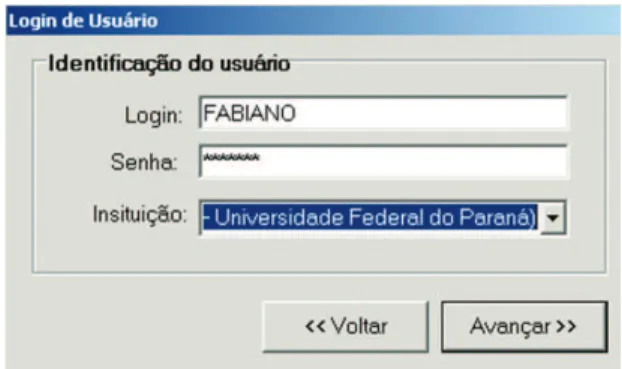
After installation of the program, a dialog box opens,
as shown in Figure 1, for the user to input their details. There are four levels of access permission:
administrator, researcher, data collector and read-only user. Common passwords are provided to researchers, data collectors and read-only users, i.e. those who need to view content, collect data or store information. However, it is only with administrative
permissions and passwords that it is possible to
develop and change the content of protocols. For the purposes of this study, administrator privileges
were granted.
The method chosen to organize the data acquired for the arterial aneurysm protocols on the computer was to allocate two different storage locations. All
5,092 data items related to the majority of vascular
diseases were stored in the irst of these, termed the Master protocol, duly organized into a series of top-level directories, classiied didactically into the following categories: patient history, physical examination, supplementary tests and examinations, diagnosis, treatment and clinical course.
The second storage location, containing the Speciic protocols, is subdivided into the 22 arterial aneurysm sites listed above, each populated with the relevant data from the Master protocol, and classiied
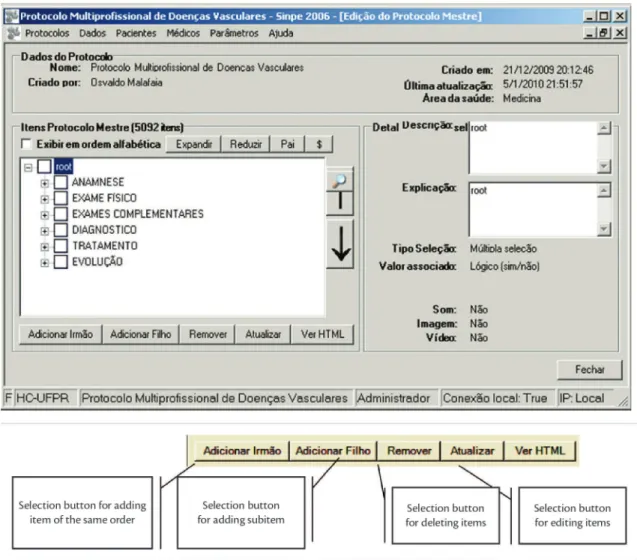
into the same directory structure as in the Master protocol. Each item is added using the buttons on the Master protocol taskbar (Figure 2). The program uses a tree directory structure and will automatically
display a plus sign (+) next to subject headings that have subitems (children). Once the speciic protocols had been created (for each of the 22 arterial sites),
the content for each disease and their characteristics
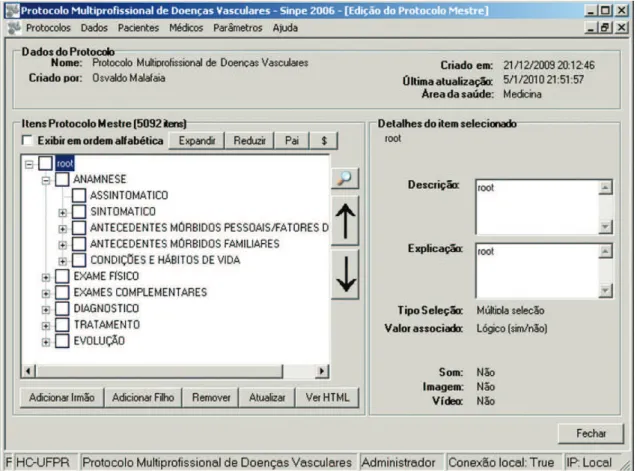
were added. Adding items to protocols is simple. The protocol editing screen has a drop-down list
of the 22 speciic protocols that have been created (Figure 3) and then the two arrows in the center of the form are used to add or remove the items stored in the Master protocol to or from the protocol for a
speciic disease. In this manner each speciic protocol
is constructed from the information contained in the Master protocol
Integration of the electronic database of clinical and surgical data on arterial aneurysms into the SINPE© system
The Master and Specific protocols had been populated with data in a manner that allowed for
integration into the SINPE© system. The underlying motive for creating this system was to enable other investigators at different centers to conduct research
and data collection and so the program can be controlled remotely. Access over the Internet is via www.sinpe.com.br. The program is hosted within
the Internet Explorer platform and can only be
accessed by users who have been issued a password. Other interfaces have also been developed for use on
mobile computing devices, such as tablets, PDAs and
smartphones. The wide variety of platforms that can
access SINPE© offers great ease and lexibility for data collection.
A pilot study was conducted at Hospital de
Clinicas da UFPR to test the protocol’s feasibility
by conducting retrospective data collection from medical records for the last 17 patients seen at the vascular surgery service who had undergone elective surgery to repair infrarenal abdominal
aortic aneurysms during the previous 5 years. The
electronic protocol was also tested for the last seven patients with infrarenal abdominal aortic
aneurysm, seen at Hospital São Lucas, with the
objective of including data on patients who had undergone elective endovascular treatment. After
data collection, another module called the SINPE Analyzer is used to interpret information, providing
an interface that enables a rapid overview of the
data items in the SINPE electronic protocols and
offering functions for plotting graphs, conducting statistical analysis, printing and saving results and exporting data.
The pilot project was approved by the Ethics
Committee, under number 2008023344.
RESULTS
With the Master protocol open, all of the top level directories can be seen, with the total number of items shown above. The plus sign (+) next to
the top-level directories show that they contain
subitems that can be opened. For example, the
subitems that comprise patient history are as follows: asymptomatic; symptomatic; personal history of
morbidity/risk factors; family history of morbidity, and living conditions and lifestyle habits. These, in turn, also have branches, so, for example, choosing the ‘SYMPTOMATIC’ subitem will reveal the 44 symptoms identiied as related to vascular diseases
and which may themselves also contain subitems. The same format is used for all of the subitems in
the Master protocol, although the number of branches
varies (Figure 4).
The six items shown in the main window are
termed ‘top level directories’ and each contains a
in order to facilitate the process of adding items to
speciic protocols. The program also has a “Médicos” menu which opens a dialogue box for registering the
physicians who will be responsible for entering data
(Figure 5) and another menu that opens a patient
registration form for inputting identiication details (Figure 6).
Each patient is assigned a unique code by the program to avoid the possibility of entering their data more than once. The system requires three obligatory
ields indicated in blue to create a new patient record, for name, sex and skin color (Figure 6), and will not
register a new patient if these details are identical to
an existing record. At the start of a data collection process, the program requires the user to choose a speciic protocol (for the disease in question), the
patients involved and the treating physician. After
entry of identiication details, a new screen opens
with check marks against the items related to each
patient. Once data entry is complete, the system
can be used to conduct data queries for statistical
purposes, returning lists of all the data collections
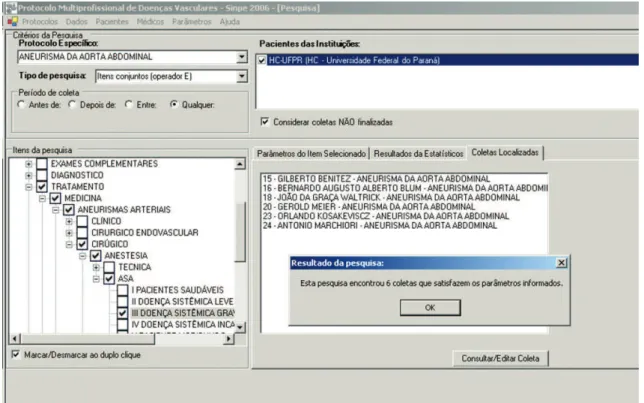
found for a given set of search criteria. The user selects the data items and type of search required
and then clicks on the “run search” button to view
the results (Figure 7).
Using searches provided within the program, data
that will be used for research can be retrieved and
grouped and divided by speciic criteria and queried
as soon as patient data has been entered via the protocols. The database can be queried automatically inside the program itself or data items can be grouped
manually, using an interface specially developed for
viewing the results and offering automatic generation
of graphs and tables (the SINPE Analyzer). Figure 4. Master protocol with items and subitems.
APPLICATION OF THE ELECTRONIC PROTOCOL
Data was input on a total of 24 patients with diagnoses of infrarenal abdominal aortic aneurysm who had received surgical treatment. Three of these
patients were female (12.5%) and the remaining 21 were male (87.5%). Age varied from 68 to 82 years with a predominance of 29.17% aged between 75
and 82 years (Figure 8) and a mean of 75 years.
The patients’ skin colors were yellow (n=1, 4.17%)
and white (n=23, 95.83%) (Figure 9). There was
a majority of male patients 87.5% and a minority (12.5%) of females (Figure 10).
Risk factors included smoking, found in 15 patients, followed by personal history of morbidity, systemic arterial hypertension, heart diseases and chronic
obstructive pulmonary disease as the most common diseases in this sample (Figure 11).
With relation (or relationship or ratio ) to diagnosis
of these patients, more than half were asymptomatic
(58.33%) (Figure 12). Of the ten symptomatic
patients, nine had exhibited abdominal pains, which, in the majority of cases, were chronic (Figure 13). Abdominal swelling was detected in all cases during
physical examination on admission and in 70.83% of cases tomographic imaging exams were used to conirm diagnosis and plan treatment (Figure 14).
The majority of patients (91.3%) had abdominal
aortic aneurysms with a fusiform morphological
classiication and just two patients had saccular
aneurysms (Figure 15).
The most common surgical treatment employed
was an aortoiliac shunt, in 40% of the patients (Figure 16), whereas bifurcated endoprostheses were
used in all patients who underwent endovascular repair.
Figure 6. Patient registration.
Figure 8. Distribution by age group.
Figure 9. Distribution by skin color.
Figure 10. Distribution by sex.
Figure 11. Risk factors.
Figure 12. Asymptomatic patients.
DISCUSSION
Digitalization of clinical data
The information about patients that is contained
in their iles is very important because it can be used to guide the health system of a country, which
in the medical record. Taken together, these data
describe the state of a population’s health and enable construction of policies and models of healthcare
provision and management. Longitudinal records that
cover individual patients’ entire lives can be used to
construct databases containing aggregated, clinical and administrative information, and which in turn
have been recognized as being highly effective and
beneicial for improving eficacy, eficiency, safety
and quality of practice in healthcare.19
The process of harvesting clinical data can be time consuming because of poor quality of many patient
medical records, among other reasons. Patients’
clinical histories may be incomplete and are often in the handwriting of many different professionals
(which is a common inding in university medical settings), making it much more dificult to correctly
evaluate the data items contained in the patient
records, compromising the credibility of the database
and throwing up barriers to high quality research.20,21
Also of relevance are the constant developments in
techniques for examinations, tests, diagnosis and Figure 13. Symptomatic patients with abdominal pains.
Figure 14. Supplementary tests and examinations.
Figure 15. Morphology of abdominal aortic aneurysms.
treatment, which generate increasing volumes of clinical information on each patient. The expansion
in clinical specialties has made it possible to widen patient care and involve a larger range of different
professionals, creating a need to ind a more rapid
and simpler method for these professionals to access patients’ medical records.
During the 1990s, the IT department at the Hospital das Clínicas da Universidade de São Paulo’s Heart Institute (InCor) pioneered implementation
of a digital hospital information system to store the institution’s administrative and clinical data. They developed an electronic medical records system using the Internet that provides an integrated system for accessing all patient data in a simple and standardized manner.22
For a long time computers were only seen in
the administrative and managerial departments of
hospitals, but nowadays the use of IT in medicine
is very well established. In the United States and
Europe, computers are used at the bedside and patient
visits are conducted with a laptop that can be used to access all data on patients’ vital signs and daily
clinical progress. Computers are also becoming more widely used in Brazilian hospitals, particularly by
the nursing teams and for access to electronic patient records.
Leape, Bates and Christalkis observed that the
switch from manual to electronic prescriptions for administration of medications to patients was
accompanied by a signiicant reduction in medical errors, bearing in mind that 50,000 deaths a year are
attributed to potentially avoidable medical errors in the United States alone.23-25
Implementation of an electronic data collection system for creation of patient medical records
facilitates searching and retrieval at a later date,
makes it possible to constantly update information in an organized manner and provides a foundation
for future research. However, the greatest barriers to
implementation are the cost of purchasing computers
and software and a lack of human resources, i.e. of
people trained to provide adequate maintenance after
implementation. Considering that both medicine and IT are in a permanent state of development, a good database must have a structure that can be modiied
in order to adapt to new developments.
Large medical centers in the United States and
Europe have turned to IT (in the form of electronic protocols) to solve the problems caused by
paper-based medical records, i.e. they have adopted routine
use of computers to create and update patient records while simultaneously collecting relevant clinical
data in a standardized manner, thereby avoiding the
limitations and subjective character of traditional medical records.26-28
However, electronic protocols alone are in no
way a substitute for patients’ medical records. The major difference between the two is that the protocol contains sources of information about a given group
of diseases, in contrast with the patient record, which is speciic to an individual patient and is not written
according to rigid rules. The patient record must be kept up-to-date by the physician for the purposes both of monitoring the patient and of creating a legal record of the patient’s care. In common with
research protocols, electronic versions of patient
medical records are becoming ever more common. The objective of this gradual process of change is to rationalize the use of the time available for medical consultations and improve ease of access to patients’ medical histories.29
Along the same lines, employing protocols
when compiling large databases of clinical data can improve the quality of medical research by providing
a trustworthy source of scientiic research.30-32 Data
bases can be used by individual universities alone or they can be pooled to construct multicenter
databases, as has been done in France, where 38
different intensive care units employ a standardized
data format and store their data in a single database,33
or in Italy, where there are multicenter studies related
to liver diseases using shared data.34
One example of such a database in Brazil is maintained by the Brazilian Association of Intensive Care Medicine (AMIB) and can be accessed on-line (www.amib.com.br), providing up-to-date
information on the most important intensive care
units (ICUs) in Brazil, allowing exchange of information and analysis between the member ICUs.
It is clear that digital collection of clinical data
encourages and facilitates multicenter studies,
increasing the quantity of data available and
improves the quality of scientiic studies, whilst also offering the beneits of reductions in time spent on research, larger study populations and faster and
more precise results.35
With regard to construction of electronic protocols using the SINPE© software
to produce scientiic articles, Masters Dissertations
and Doctoral Theses.
The electronic protocol was programmed in the Microsoft C# language, which facilitates adaptation of the system to use the Internet and for running on
platforms such as handheld computers (PDAs and tablets), offering portability and widening the scope of its applications. The ile created by Access was
employed to enable the electronic protocols program
to be employed independently on other computers,
which is itself the main reason for employing the
program’s local connection, offering a minimum risk
of incompatibility at runtime.
To date, more than 100 diseases have been registered on the SINPE© system and approximately
120,000 data items have been entered, covering
a wide range of the medical specialties and also
other healthcare disciplines, such as Physiotherapy,
Nursing and Nutrition.
Even taking into consideration the years of
research and the initial investments, the cost of implementing SINPE is relatively low in view of
its importance and scope. Research will always be the pillar that supports the development and advancement of Medicine.
With regard to the task of reviewing the literature and selecting bibliographic material
The idea of including all vascular diseases on this electronic protocol came up against the barrier of the
large number of such diseases, many of which are
not observed in daily practice because of their low incidence and diverse range of clinical presentations.
As such, the protocol would have contained a very
long list of diseases and the great majority of users
would have found dificulties with handling it.
The decision was therefore made to choose the diseases that are most frequently encountered in
clinical practice, according to the literature consulted,
and supplement them with a number of diseases
that are not so common, but are of epidemiological
importance and academic interest because they have been the subjects of few prospective studies. One
example of this is aneurysms of the renal arteries of hypertense patients, for which best practice has not yet been deined, since the impact this type of
aneurysm has on renal function is not yet known. Adoption of the electronic information system provides a method for collecting information on the subject and provide a basis for future studies.
Medical developments, inventions and discoveries
have not been forgotten in the design of the electronic
protocol, since it is possible to add new items
without affecting the database that is already in use.
However, due to issues related to the security of the data that have been input and their conidentiality,
such alterations can only be made by users with
administrator privileges and not by data collectors,
read-only users or researchers.
CONCLUSIONS
The electronic protocol for vascular diseases in arterial aneurysms was created after initially
constructing a database of clinical data, which was
done by entering all data onto a Master protocol that covers the majority of vascular diseases. This Master
protocol was then used to create a series of Speciic
protocols on each of the most common types of
arterial aneurysm, thereby providing a standardized
method for collection of data on these patients and tools for retrieving this information in an organized
manner for use in scientiic studies. The result is
a uniform and reliable method for acquisition and storage of clinical and surgical data that can then be made available for use in future research.
REFERENCES
1. Tunis SR, Stryer DB, Clancy CM. Practical clinical trials: increasing the value of clinical research for decision making in clinical and health policy. JAMA. 2003;290(12):1624-32. http://dx.doi. org/10.1001/jama.290.12.1624. PMid:14506122
2. Pereira MHR. Estudos de História da Cultura Clássica. 9 ed. Lisboa: Fundação Calouste Gulbenkian; 2003. vol. I. Cultura Grega.
3. Atallah AN. A incerteza, a ciência e a evidência. Diagn Tratamento. 2004;9:27-8.
4. Goonan KJ. he Juran prescription: Clinical Quality Management. San Francisco: Jossey-Bass; 1995.
5. Davidoff F. Databases in the next millennium. Ann Intern Med. 1997;127(8 Pt 2):770-4. http://dx.doi.org/10.7326/0003-4819-127-8_Part_2-199710151-00067. PMid:9382397
6. Lee JY. Uses of clinical databases. Am J Med Sci. 1994;308(1):58-62. http://dx.doi.org/10.1097/00000441-199407000-00012. PMid:8010340
7. Vascular Society. he National Vascular Database Report. 2009. [citado 2009 dez 16]. http://www.vascularsociety.org.uk.
8. Stanley JC. Abdominal visceral aneurysms. In: Haimovici, editor.
Vascular Emergencies. New York: Appleton-Century-Crofts; 1981. p. 387-96.
9. Brito CJ, Duque A, Merlo I, Murilo R, Fonseca VL Fo. Cirurgia vascular: cirurgia endovascular - angiologia. 2 ed. Rio de Janeiro: Revinter, 2008.
10. Maffei FU, Lastória S, Yoshida WB, Rollo HA, Giannini M, Moura R. Doenças vasculares periféricas. 4 ed. Rio de Janeiro: Guanabara Koogan; 2008.
12. Rutherford RB. Vascular Surgery. 6 ed. Philadelphia: WB Sauders; 2005.
13. Zelenock GB, Huber TS, Messina LM, Lumsden AB, Moneta GL.
Mastery of Vascular and Endovascular Surgery. Philadelphia:
Lippincott Williams & Wilkins; 2005.
14. Haimovici H, Ascher E, Hollier LH, et al. Cirurgia vascular. 5 ed. Rio de Janeiro: Revinter; 2006.
15. Cronenwett JL, Rutherford RB. Decision making in vascular surgery. Philadelphia: W.B. Saunders; 2001.
16. Bonamigo TP, Von Ristow A. Aneurismas. Rio de Janeiro: Assessoria Gráfica e Editorial LTDA; 1999.
17. Brasil. Ministério da Saúde. Classiicação Estatística Internacional de Doenças e Problemas Relacionados à Saúde. 2009. [citado 2009 ago 13]. http://www.datasus.gov.br/cid10/v2008/cid10.htm.
18. Malafaia O, Borsato EP, Pinto JSP. Gerenciamento do conhecimento em protocolos eletrônicos de coleta de dados. In: Anais do III Simpósio Internacional de Gestão do Conhecimento; 2003 ago; Curitiba, Brasil. Curitiba: PUC-PR; 2003.
19. Massad E, Marin HF, Neto RSA. O prontuário eletrônico do paciente
na assistência, informação e conhecimento médico. São Paulo:
Universidade Federal de São Paulo; 2003.
20. Dick IRS. The computer-based patient record – an essential
technology for health care. Washington: Institute of Medicine/
National Academy Press; 1991.
21. Rind DM, Kohane IS, Szolovits P, Safran C, Chueh HC, Barnett GO. Maintaining the confidentiality of medical records shared over the Internet and the World Wide Web. Ann Intern Med. 1997;127(2):138-41. http://dx.doi.org/10.7326/0003-4819-127-2-199707150-00008. PMid:9230004
22. Furuie SS, Gutierrez MA, Figueiredo JCB, et al. Prontuário eletrônico de pacientes: integrando informações clínicas e imagens médicas. Rev Bras Eng Biomed. 2003;19(3):125-37.
23. Leape LL, Berwick DM. Safe health care: are we up to it? BMJ. 2000;320(7237):725-6. http://dx.doi.org/10.1136/ bmj.320.7237.725. PMid:10720335
24. Bates DW. Using information technology to reduce rates of medication errors in hospitals. BMJ. 2000;320(7237):788-91. http://dx.doi.org/10.1136/bmj.320.7237.788. PMid:10720369
25. Christakis NA. Don’t just blame the system. BMJ. 2008;336(7647):747. http://dx.doi.org/10.1136/bmj.39534.461134.59. PMid:18390523
26. McDonald CJ, Tierney WN, Overhage M. The Regentrief Medical Record System: 20 years of experience in hospitals, clinics, and neighborhood health centers. Medical Data Computing. Shiffield. 1992;9(4):206-17.
27. Sittig DF. Grand challenges in medical informatics? J Am Med Inform Assoc. 1994;1(5):412-3. http://dx.doi.org/10.1136/ jamia.1994.95153429. PMid:7850565
28. Kohane IS, Greenspun P, Fackler J, Cimino C, Szolovits P. Building national electronic medical record systems via the World Wide Web. J Am Med Inform Assoc. 1996;3(3):191-207. http://dx.doi. org/10.1136/jamia.1996.96310633. PMid:8723610
29. Melo CP, Ferreira DP. Aspectos legais do registro médico eletrônico no Brasil. In: Anais do III Fórum Nacional de Ciência e Tecnologia em Saúde. 1996; São Carlos, Brasil. São Carlos; 1996. p. 657-58 30. Patrício CM, Machiavelli JL, Maia MM, Navaes MA. O prontuário
eletrônico do paciente no sistema de saúde brasileiro: uma realidade para os médicos? Scientia Medica. 2011;21(3):121-31.
31. Goonan KJ. he Juran prescription: clinical quality management. San Francisco: Jossey-Bass; 1995.
32. Davidoff F. Databases in the next millennium. Ann Intern Med. 1997;127(8 Pt 2):770-4. http://dx.doi.org/10.7326/0003-4819-127-8_Part_2-199710151-00067. PMid:9382397
33. Le Gall JR. Description of various types of intensive and intermediate care units in France. Intensive Care Med. 1989;15(4):260-5. http://dx.doi.org/10.1007/BF00271063. PMid:2501373
34. Coltorti M, Del Vecchio Blanco C, Caporaso N, Gallo C, Castellano L. Liver cirrhosis in Italy. A multicenter study on presenting modalities and the impact on health care resources. National project on liver cirrhosis Group. Italian Journal Gastroenterology. 1991;23(1):42-8. PMid:1747499.
35. Blumenstein BA . Medical Research data. Control Clin Trials. 1995;16(6):453-5. http://dx.doi.org/10.1016/S0197-2456(95)00076-3. PMid:8720022
Correspondence
Fabiano Luiz Erzinger Instituto da Circulação, Cirurgia Vascular e Endovascular Av. Sete de Setembro, 5348, conjunto 905 CEP 80240000- Curitiba (PR), Brazil Tel: + 55 (41) 3339.5620 E-mail: [email protected]
Author information
FLE - MSc in Surgical Medicine from Universidade Federal do Paraná (UFPR); Board certiied in Vascular and Endovascular Surgery from SBACV. OM - Tenured professor; Full professor of Surgery, Universidade Federal do Paraná (UFPR); Full professor of Scientiic Methodology and Head of the Graduate Program at Faculdade Evangélica do Paraná (FEPAR). JRRT - Adjunct professor of Vascular Surgery, Universidade Federal do Paraná (UFPR); Full member, SBACV.
Author contributions
Conception and design: FLE, OM Analysis and interpretation: FLE, OM, JT Data collection: FLE Writing the article: FLE Critical revision of the article: OM, JT Final approval of the article*: FLE, OM, JT Statistical analysis: JT Overall responsibility: FLE, OM, JRRT