Can the success of structured therapy for giggle incontinence
be predicted?
_______________________________________________
Onur Telli
1, Nurullah Hamidi
2, Aytac Kayis
2, Evren Suer
2, Tarkan Soygur
1, Berk Burgu
11 Department of Paediatric Urology, School of Medicine, Ankara University, Ankara, Turkey; 2 Department
of Urology, School of Medicine, Ankara University, Ankara, Turkey
ABSTRACT
ARTICLE
INFO
______________________________________________________________ ______________________
Introduction: To evaluate possible factors that can guide the clinician to predict po-tential cases refractoriness to medical treatment for giggle incontinence (GI) and to examine the effectiveness of different treatment modalities.
Material and methods: The data of 48 children referred to pediatric urology outpatient clinic between 2000 and 2013 diagnosed as GI were reviewed. Mean age, follow-up, GI frequency, associated symptoms, medical and family history were noted. Incontinence frequency differed between several per day to less than once weekly. Children were evaluated with uroflowmetry-electromyography and post-void residual urine. Clinical success was characterized as a full or partial response, or nonresponse as defined by the International Children’s Continence Society. Univariate analysis was used to find potential factors including age, sex, familial history, GI frequency, treatment modali-ty and dysfunctional voiding to predict children who would possibly not respond to treatment.
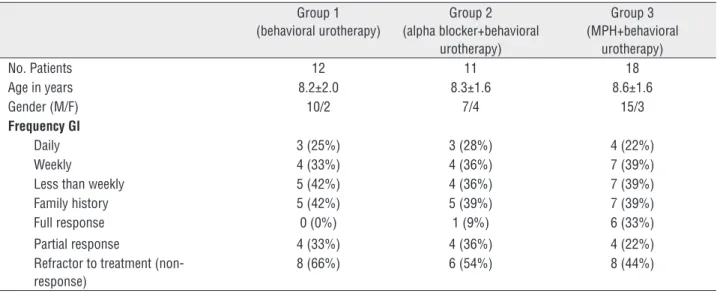
Results: Mean age of the patients was 8.4 years (range 5 to 16). Mean follow-up time and mean duration of asymptomatic period were noted as 6.7±1.4 years and 14.2±2.3 months respectively. While 12 patients were treated with only behavioral urotherapy (Group-1), 11 patients were treated with alpha-adrenergic blockers and behavioral uro-therapy (Group-2) and 18 patients with methylphenidate and behavioral urouro-therapy (Group-3). Giggle incontinence was refractory to eight children in-group 1; six chil-dren in-group 2 and eight chilchil-dren in-group 3. Daily GI frequency and dysfunctional voiding diagnosed on uroflowmetry-EMG were found as outstanding predictive factors for resistance to treatment modalities.
Conclusions: A variety of therapies for GI have more than 50% failure rate and a stan-dard treatment for GI has not been established. The use of medications to treat these patients would not be recommended, as they appear to add no benefit to symptoms and may introduce severe adverse effects.
Key words:
Urinary Incontinence; Methylphenidate; Laughter
Int Braz J Urol. 2016; 42: 334-8
_____________________ Submitted for publication: November 04, 2014 _____________________ Accepted after revision: September 09, 2015
INTRODUCTION
Giggle incontinence (GI) or enuresis riso-ria (ER) is characterized by complete or involuntary bladder emptying occurring only with giggling or laughing while awake with normal bladder function
been poorly understood and although giggle inconti-nence is thought to be fairly common, various phar-macological and behavioral therapies have limited success and it is generally considered that there is no known specific treatment for the disorder (2). Cur-rently, available treatment strategies include standard urotherapy, bladder and pelvic floor retraining and methylphenidate (MPH) (3-5). For patients in whom the MPH failed or was not tolerated, treatment fo-cuses on behavioral modifications such as frequent bladder emptying with alpha-blocker therapy (6).
The present study examined possible factors that can guide clinician to predict cases refractory to treatment of GI. The secondary outcome of the pre-sent study was to compare GI patients response to treatment modalities of urotherapy, alpha-adrenergic blockers and MPH.
MATERIALS AND METHODS
After approved by the institutional review board, the data of 48 children referred to pediatric urology outpatient clinic between 2000 and 2013 diagnosed as giggle incontinence were retrospecti-vely investigated. The diagnosis of giggle inconti-nence was made by definition of the International Children’s Continence Society (1). Detailed history and physical examination, including neurologic exa-mination, was performed in all children. Children were also personally interviewed on voiding and de-fecation habits, and giggle incontinence. Data were collected and analyzed on GI frequency, age, gender, voiding patterns, associated symptoms, medical and family history. Uroflowmetry with pelvic floor EMG was used to evaluate dysfunctional voiding and uri-nary ultrasound measurement of post-void residual urine. Children with other types of enuresis, urge in-continence, history of urinary tract infection or neu-rogenic voiding dysfunction and those with known structural urinary tract obstruction or complex uri-nary tract malformations were excluded from study.
Patients were grouped into 3 groups. Group-1 consisted of children who were treated with only behavioral urotherapy, Group-2 consisted of children who were treated with behavioral urotherapy and al-pha-adrenergic receptor antagonist (doxazosin) and Group-3 consisted of children who were treated with behavioral urotherapy and MPH.
Behavioral urotherapy consisted of hydra-tion; maintaining an empty bladder including timed and double voiding and avoiding bladder stimulants (coffee, tea, etc.); toilet training and bowel management. In Group-2 patients were treated with doxazosin, 0.5mg dose per day and in Group-3 patients were treated with MPH, 5mg dose per day, for at least a 6-month period (3, 6, 7). They had all been informed of the prescription and adverse effects.
Clinical success was characterized as a full response—100% decrease in symptoms or less than 1 occurrence monthly, a partial response—50% to 89% decrease, or a nonresponse—0% to 49% de-crease, as defined by the International Children’s Continence Society (1).
All statistical analysis was performed using SPSS ver.16.5 (Statistical Package for Social Sciences for Windows 16.5 Inc., Chicago, Il, USA). All values were expressed as mean±standard error (SEM). Between groups, analyses were performed using chi square test. Univariate Cox regression analysis was performed to evaluate the predictors for resistance to treatment modalities and the 95% CI was selected, and p value of 0.05 was set for statistically significance.
RESULTS
In Group-1, 8 children of 12 patients; in Group-2, 6 of 11 patients and 8 children of 18 pa-tients in Group-3 reported 0% to 49% decrease af-ter at least 6 months of treatment and therefore the outcome of treatment was considered refractor to treatment. Univariate analysis was used to find po-tential factors including age, sex, familial history, GI frequency and dysfunctional voiding (uroflowmetry--EMG) for predictive factors of treatment resistance. Daily GI frequency (OR; 1.910, 95% CI 1.338-2.845; p=0.041) and dysfunctional voiding, (OR; 2.128, 95% CI 1.244-3.196; p=0.012) were statistically significan-tly associated with resistance to medical treatment in univariate analyses (Table-2).
DISCUSSION
GI is a rare condition with unknown cause that is different from stress incontinence and overac-tive bladder. Typically GI patients report incontinen-ce only with laughter. The incidenincontinen-ce may be hidden because of affected patients modify their behavior to avoid embarrassments in social life. The pathophy-siology of GI has not been understood therefore a specific treatment has not been established and there is no widely accepted treatment of choice.
In the current study, we have determined the predictor factors of refractoriness to treatment moda-lities for GI and to the best of our knowledge, there is no study evaluating the predictors for resistance to
tre-atment modalities of GI that can guide the clinician to predict potential cases refractory to medical treat-ment. A second goal of our study was to evaluate the success of behavioral urotherapy, alpha-adrenergic blockers and MPH treatment for GI and we found that similar patient populations of study groups are refractory to treatments.
Present study reports that daily GI frequency and dysfunctional voiding diagnosed on uroflowme-try-EMG were the potential predictors of resistance to treatment modalities. Although GI is supplemen-ted by the absence of other voiding symptoms and usually established on history, similar to our study Richardson et al. (5) reported 40% of the patients had dysfunctional voiding sequel diagnosed with uroflo-wmetry-EMG. The children with GI improved sphinc-ter tone and muscle recruitment using biofeedback techniques, supplemented behavior modifications and pharmacotherapy or avoided the need for pharmacotherapy when at least 4 sessions were performed. Additionally, Chandra et al. (2) hypo-thesized that GI might be secondary to detrusor instability since 95% of their patients had conco-mitant dysfunctional voiding symptoms in con-trast to GI etiology as defined by the Internatio-nal Children’s Continence Society (1). Despite the majority of past studies GI showed some subjec-tive improvement in lower urinary tract function. Chang et al. (8) reported that MPH is one of the primary treatment related to increasing urethral
Table 1 - Characteristics of patients with GI.
Group 1 (behavioral urotherapy)
Group 2 (alpha blocker+behavioral
urotherapy)
Group 3 (MPH+behavioral
urotherapy)
No. Patients 12 11 18
Age in years 8.2±2.0 8.3±1.6 8.6±1.6
Gender (M/F) 10/2 7/4 15/3
Frequency GI
Daily 3 (25%) 3 (28%) 4 (22%)
Weekly 4 (33%) 4 (36%) 7 (39%)
Less than weekly 5 (42%) 4 (36%) 7 (39%)
Family history 5 (42%) 5 (39%) 7 (39%)
Full response 0 (0%) 1 (9%) 6 (33%)
Partial response 4 (33%) 4 (36%) 4 (22%)
Refractor to treatment (non-response)
closure pressure while the relationship between GI and detrusor overactivity was not possible to be established in their study even including uro-dynamic parameters. Botulinum toxin A injection has also been used for the treatment of GI that might be related to detrusor overactivity (9). Sher and Reinberg showed that GI has a functional relationship to cataplexy and narcolepsy with a common pathophysiological basis since laughter or emotion may trigger changes in muscle tone (10). They have shown that stimulant medication such as MPH may be successful in their 7 pedia-tric patients. Both GI and narcolepsy are centrally mediated disorders and share a common patho-physiological basis, which is related to receptor--mediated imbalance of cholinergic and mono-aminergic systems. Blockage of norepinephrine uptake mediates the anti-cataplectic effect of cur-rently prescribed antidepressants, while blockade of dopamine uptake and/or stimulation of dopa-mine release mediate the awake-promoting effect of central nerve system stimulants (11). Therefore, MPH, behaving mainly as a dopamine reuptake inhibitor, is a common therapy for GI and narco-lepsy. Berry et al. also reported an 80% cure rate
of MPH for GI in 12 of 15 patients. In our study, patients treated with MPH reported 44% failure rates (8/18). Our results with MPH were inferior to previous reports that may be related to single day 5mg MPH usage in our study; the drug is typically administered in multiple daily doses in other clini-cal settings, based on body weight or body surface area due to its short half-life.
In our daily practice, children with urinary incontinence have behavioral modifications such as frequent bladder emptying with alpha-blocker therapy as a treatment option. GI patients have the same alpha-blocker therapy with bladder emp-tying treatment and similar to the MPH treatment for GI, children may sometimes be presented with resistance to such therapies. Stimulation of the large concentration of alpha-receptors found in the region of the bladder neck and urethra results in increased outlet resistance. Cain and colleagues (6) reported on 55 consecutive children with urina-ry incontinence and inadequate bladder emptying treated with Doxazosin at a dose of 0.5-2mg/day in addition to other ‘standard’ therapy. They found an 88% reduction in post-void residual urine vo-lumes, improvement in urinary incontinence in
Table 2 - Univariate logistic regression analysis of predictors for resistance to medical treatment of GI.
Variable OR 95%Cl P value
Age 1.008 0.934-1.125 0.869
Sex
Male 1.000 0.952-2.146 0.074
Female 1.838
GI frequency
Less Than weekly 1.000 1.338-2.845 0.041
Weekly 1.000
Daily 1.910
Dysfunctional voiding
Negative 1.000 1.244-3.196 0.012
Positive 2.128
Family History 1.594 0.942-1.955 0.561
Treatment Modality
MPH+BU 1.000 0.836-2.024 0.362
Alpha blocker+BU 1.000
BU 1.322
83% and a reduction in urgency in 70% although convincing evidence is still awaited.
Population studies indicate that a major narcolepsy/cataplexy gene is linked to HLA--DR2, which may be related with the strong po-sitive family history of giggle incontinence (10, 12). A positive family history was reported in a previous study for giggle incontinence in 13% of the patients that it was not found as a predic-tor facpredic-tor for refracpredic-toriness to treatment of GI in our study (2).
Unfortunately, our study involved a relative-ly small number of study groups with unreachable lack of information, which is the major limitation of retrospective review. Future multicenter studies en-compassing larger sample size incorporating a pros-pective double-blind placebo control design with longer follow-up periods are needed to evaluate the success of treatment modalities, predictors that affect the success of treatment modalities and relationship between GI and detrusor inability.
CONCLUSIONS
Despite the retrospective and non-rando-mized nature, the results of the present study re-vealed that medical therapy for GI is accompanied with a failure rate of more than 50%, regardless of the association with any kind of drug therapy. Based on the data from the present study, the use of medication in these patients should be avoided because they appear to add no benefit to the pa-tients and may introduce severe adverse effects.
CONFLICT OF INTEREST
None declared.
REFERENCES
1. Austin PF, Bauer SB, Bower W, Chase J, Franco I, Hoebeke P, et al. The standardization of terminology of lower urinary tract function in children and adolescents: update report from the Standardization Committee of the International Children’s
Continence Society. J Urol. 2014;191:1863-1865.e13. 2. Chandra M, Saharia R, Shi Q, Hill V. Giggle incontinence
in children: a manifestation of detrusor instability. J Urol. 2002;168:2184-7.
3. Berry AK, Zderic S, Carr M. Methylphenidate for giggle incontinence. J Urol. 2009;182:2028-32.
4. Tekgul S, Dogan HS, Hoebeke PS, Kocvara R, Nijman JM, Radmayr C, et al. Guidelines on Paediatric Urology. European Association of Urology 2014 Update March 2013 Available at: http://www.uroweb.org/gls/pdf/23%20Paediatric%20 Urology _LR%20March%2025th.pdf Access date: 06 Jun 2014.
5. Richardson I, Palmer LS. Successful treatment for giggle incontinence with biofeedback. J Urol. 2009;182:2062-6. 6. Cain MP, Wu SD, Austin PF, Herndon CD, Rink RC. Alpha
blocker therapy for children with dysfunctional voiding and urinary retention. J Urol. 2003;170:1514-5.
7. Kramer SA, Rathbun SR, Elkins D, Karnes RJ, Husmann DA. Double-blind placebo controlled study of alpha-adrenergic receptor antagonists (doxazosin) for treatment of voiding dysfunction in the pediatric population. J Urol. 2005;173:2121-4.
8. Chang JH, Lee KY, Kim TB, Yoon SJ, Lee T, Kim KH. Clinical and urodynamic effect of methylphenidate for the treatment of giggle incontinence (enuresis risoria). Neurourol Urodyn. 2011;30:1338-42.
9. Wefer B, Seif C, van der Horst C, Jünemann KP, Braun PM. [Botulinum toxin A injection for treatment-refractory giggle incontinence]. Urologe A. 2007;46:773-5.
10. Sher PK, Reinberg Y. Successful treatment of giggle incontinence with methylphenidate. J Urol. 1996;156:656-8. 11. Nishino S, Okura M, Mignot E. Narcolepsy: genetic
predisposition and neuropharmacological mechanisms. Sleep Med Rev. 2000;4:57-99.
12. Parkes, J. D.: Disorders of sleep. In: Neurology in Clinical Practice. Edited by W. G. Bradley, R. B. Daroff, G. M. Fenichel and C. D. Marsden. Boston: Butterworth-Heinemann. 1989; pp. 1479-1506.