Theoretical Prediction of the Fractional ac Josephson
Effect in
p- and
d-Wave Superconductors
Hyok-Jon Kwon,
1K. Sengupta,
2and Victor M. Yakovenko
11
Department of Physics, University of Maryland, College Park, Maryland 20742-4111, USA
2
Department of Physics, Yale University, New Haven, Connecticut 06520-8120, USA
Received on 23 May, 2003.
For certain orientations of Josephson junctions between twopx-wave or twod-wave superconductors, the
sub-gap Andreev states produce a4π-periodic relation between the Josephson currentIand the phase difference φ:I ∝sin(φ/2). Consequently, the ac Josephson current has the fractional frequencyeV /~, whereV is the
dc voltage. In the tunneling limit, the Josephson current is proportional to the first power (not square) of the electron tunneling amplitude. Thus, the Josephson current is carried by single electrons, rather than by Cooper pairs.
1
Introduction
In many materials, the symmetry of the superconducting order parameter is unconventional, i.e. not s-wave. In the high-Tc cuprates, it is the singlet dx2−y2-wave [1]. There is experimental evidence that, in the quasi-one-dimensional (Q1D) organic superconductors(TMTSF)2X[2], the sym-metry is triplet [3], most likely the px-wave [4], with the xaxis is along the conducting chains. The unconventional pairing symmetry typically results in formation of subgap Andreev bound states on the surfaces of these supercon-ductors. Ford-wave cuprate superconductors, the midgap Andreev states were predicted theoretically in Ref. [5] and discovered experimentally as a zero-bias conductance peak in tunneling between normal metals and superconductors (see review [6]). For the Q1D organic superconductors, the midgap states were theoretically predicted to exist at the edges perpendicular to the chains [7, 8]. When two uncon-ventional superconductors are joined together in a Joseph-son junction, their Andreev surface states hybridize to form Andreev bound states in the junction. These states are im-portant for the Josephson current. Andreev bound states in high-Tc junctions were reviewed in Ref. [9]. The
Joseph-son effect between two Q1D p-wave superconductors was studied in Refs. [10, 11].
In the present paper, we predict a new effect for Joseph-son junctions between unconventional nonchiral supercon-ductors, which we call the fractional ac Josephson effect. Suppose both superconductors forming a Josephson junc-tion have surface midgap states originally. This is the case for the butt-to-butt junction between twopx-wave Q1D
su-perconductors, as shown in Fig. 1a, and for the 45◦/45◦ in-plane junction between twod-wave superconductors, as shown in Fig. 2a. (The two angles indicate the orientation of the junction line relative to the b axes of eachdx2−y2
superconductor.) We predict that the contribution of the
hy-bridized Andreev bound states produces a4π-periodic re-lation between the supercurrentIand the superconducting phase differenceφ: I ∝ sin(φ/2)[12]. Consequently, the ac Josephson effect has the frequencyeV /~, whereeis the electron charge, V is the applied dc voltage, and~ is the Planck constant. The predicted frequency is a half of the conventional Josephson frequency2eV /~originating from the conventional Josephson relationI ∝sinφwith the pe-riod of 2π. Qualitatively, the predicted effect can be un-derstood as follows. The Josephson current across the two unconventional superconductors is carried by tunneling of single electrons(rather than Cooper pairs) between the two resonant midgap states. Thus, the Cooper pair charge2eis replaced the single chargeein the expression for the Joseph-son frequency. This interpretation is also supported by the finding that, in the tunneling limit, the Josephson current is proportional to the first power (not square) of the electron tunneling amplitude [13]. Possibilities for experimental ob-servation of the fractional ac Josephson effect are discussed in Sec. 5.
The predicted current-phase relationI ∝ sin(φ/2) is quite radical, because every textbook on superconductivity says that the Josephson current must be a2π-periodic func-tion ofφ[12]. To our knowledge, the only paper that dis-cussed the4π-periodic Josephson effect is Ref. [14] by Ki-taev. He considered a highly idealized model of spinless fermions on a one-dimensional (1D) lattice with supercon-ducting pairing on the neighboring sites. The pairing po-tential in this case has thepx-wave symmetry, and midgap
experi-mentally realistic Josephson effect between known super-conducting materials.
2
The basics
We consider the case where the spin polarization vectorn
of the triplet pairing has a uniform, momentum-independent orientation [3, 4]. If the spin quantization axiszis selected alongn, then the Cooper pairing takes place between
elec-trons with the opposite z-axis spin projections σ and σ¯: hˆcσ(k)ˆcσ¯(−k)i ∝ ∆σ(k), wherecˆσ(k)is the annihilation
operator of an electron with momentumkand spinσ. The
pairing potential has the symmetry∆σ(k) = ∓∆¯σ(k) =
±∆σ(−k), where the upper and lower signs correspond to
the singlet and triplet cases.
We select the coordinate axis x perpendicular to the Josephson junction plane. We assume that the interface be-tween the two superconductors is smooth enough, so that the electron momentum componentkyparallel to the
junc-tion plane is a conserved good quantum number.
Electron states in a superconductor are described by the Bogoliubov operatorsγˆ, which are related to the electron operatorscˆby the following equations [15]
ˆ γnσky =
Z
dx[u∗
nσky(x) ˆcσky(x) +v ∗
nσky(x) ˆc † ¯
σk¯y(x)], (1) ˆ
cσky(x) =
X
n
[unσky(x) ˆγnσky +v ∗
nσ¯¯ky(x) ˆγ †
nσ¯k¯y], (2)
where ¯ky = −ky, and n is the quantum number of
the Bogoliubov eigenstates. The two-components vectors ψnσky(x) = [unσky(x), vnσky(x)]are the eigenstates of the Bogoliubov-de Gennes (BdG) equation with the eigenener-giesEnσky:
Ã
εky(ˆkx) +U(x) ∆ˆσky(x,ˆkx) ˆ
∆†σky(x,kˆx) −εky(ˆkx)−U(x)
!
ψn =Enψn,
(3) wherekˆx =−i∂xis thexcomponent of the electron
mo-mentum operator, and U(x)is a potential. In Eq. (3) and below, we often omit the indicesσandky to shorten
nota-tion where it does not cause confusion.
3
Junctions
between
quasi-one-dimensional superconductors
In this section, we consider junctions between two Q1D superconductors, such as organic superconductors (TMTSF)2X, with the chains along thexaxis, as shown in Fig. 1a. For a Q1D conductor, the electron energy dispersion in Eq. (3) can be written asε=~2kˆx2/2m−2tbcos(bky)−µ, wheremis an effective mass,µis the chemical potential,b andtbare the distance and the tunneling amplitude between
the chains. The superconducting pairing potentials in thes -andpx-wave cases have the forms
ˆ
∆σky(x,ˆkx) =
½ σ∆
β, s-wave,
∆βkˆx/kF, px-wave, (4)
where ~kF = √2mµ is the Fermi momentum, andσ is treated as+for↑and−for↓. The indexβ =R, Llabels the right (x >0) and left (x <0) sides of the junction, and ∆βacquires a phase differenceφacross the junction:
∆R= ∆0eiφ, ∆L= ∆0. (5) The potentialU(x) =U0δ(x)in Eq. (3) represents the junc-tion barrier located atx= 0. Integrating Eq. (3) overxfrom –0 to +0, we find the boundary conditions atx= 0:
ψL=ψR, ∂xψR−∂xψL=kFZ ψ(0), (6) Z = 2mU0/~2kF, D= 4/(Z2+ 4), (7)
whereDis the transmission coefficient of the barrier. A. Andreev bound states
A general solution of Eq. (3) is a superposition of the terms with the momenta close to αkF, where the index α=±labels the right- and left-moving electrons:
ψβσ=eβκx
·
Aβ
µ
uβσ+ vβσ+
¶
ei˜kFx+B
β
µ
uβσ− vβσ−
¶
e−i˜kFx
¸
.
(8) Hereβ =∓forRandL. Eq. (8) describes a subgap state with an energy|E|<∆0, which is localized at the junction and decays exponentially in xwithin the length1/κ. The coefficients(uβσα, vβσα)in Eq. (8) are determined by
sub-stituting the right- and left-moving terms separately into Eq. (3) forx6= 0, whereU(x) = 0. In the limitkF ≫ κ, we
find uβσα vβσα
= ∆βσα
E+iαβ~κvF, κ= p
∆2 0− |E|2 ~vF , (9) where vF = ~kF/m is the Fermi velocity, and ∆βσα is
equal to σ∆β for s-wave and to α∆β for px-wave, with
∆βgiven by Eq. (5). Theky-dependent Fermi momentum
~˜kF = ~kF + 2tbcos(bky)/vF in Eq. (8) eliminates the dispersion inkyfrom the BdG equation.
Substituting Eq. (8) into the boundary conditions (6), we obtain the linear homogeneous equations for the coef-ficientsAβ andBβ. The compatibility condition for these
equations gives an equation for the energies of the Andreev bound states. There are two subgap states with the energies Ea =aE0(φ)labeled by the indexa=±:
E0(s)(φ) = −∆0
q
1−Dsin2(φ/2), s-sjunction(10), E(0p)(φ) = −∆0
√
Dcos(φ/2), px-pxjunction.(11)
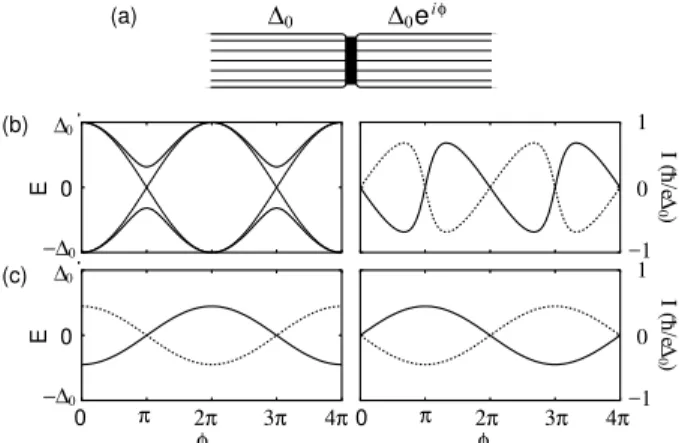
same and consist of two crossing curvesE=∓∆0cosφ/2, shown by the thin lines in the left panel of Fig. 1b. A non-zero barrier (D < 1) changes the energies of the Andreev bound states in thes-sandpx-pxjunctions in different ways.
In thes-scase, the two energy levels repel nearφ=πand form two separated2π-periodic branches shown by the thick lines in the left panel of Fig. 1b [15, 16]. In contrast, in the px-pxcase, the two energy levels continue to cross atφ=π,
and they separate from the continuum of states above+∆0 and below−∆0, as show in the left panel of Fig. 1c. The absence of energy levels repulsion indicates that there is no matrix element between these levels atφ=πin thepx-px
case, unlike in thes-scase.
0 π 2π 3π 4π0 π 2π 3π 4π
φ φ
−∆ −∆
0 0
∆ ∆
E
E
0
0 0
0
I (h/e )
∆
0
−
0 1
−1
I (h/e )
∆
0
−
0 1
−1
∆0eiφ
∆0
(c) (b)
(a)
Figure 1. (a) Josephson junction between two Q1Dpx-wave
su-perconductors. (b) The energies (left panel) and the currents (right panel) of the subgap states in thes-sjunction as functions of the phase differenceφforD = 1(thin lines) andD = 0.9(thick lines). (c) The same as (b) for thepx-pxjunction atD= 0.2.
As shown in Sec. 4, the45◦/45◦junction between two d-wave superconductors is mathematically equivalent to the px-pxjunction. Eq. (11) was derived for the45◦/45◦
junc-tion in Ref. [13].
B. Fractional ac Josephson effect
It is well known [15] that the current carried by a quasi-particle stateais
Ia=
2e ~
∂Ea
∂φ . (12)
The two subgap states carry opposite currents, which are plotted vs. φ in the right panels (b) and (c) of Fig. 1 for thes-sandpx-pxjunctions. At zero temperature, only the
subgap state with the lower energy is occupied in the s-s junction. Substituting Eq. (10) into Eq. (12), we recover the conventional formula for the Josephson current in the tun-neling limitD≪1for thes-sjunction:
Is≈ De∆0
2~ sinφ. (13)
Now let us consider thepx-pxjunction at zero
tempera-ture in the initial stateφ= 0, where the two subgap states (11) with the energies±E0(p)are, correspondingly, occupied and empty. Suppose a small voltageeV ≪∆0is applied to
the junction, so the phase difference acquires dependence on timet:φ(t) = 2eV t/~. Ifφ(t)changes sufficiently slowly (adiabatically), the occupation numbers of the subgap states do not change. In other words, the states shown by the solid and dotted lines in Fig. 1c remains, correspondingly, occu-pied and empty. The occuoccu-pied state (11) produces the cur-rent (12):
Ip(t) =
√ De∆0
~ sin µ
φ(t) 2
¶ =
√ De∆0
~ sin µ
eV t ~
¶
.
(14) The frequency of the ac current (14) is eV /~, a half of the conventional Josephson frequency2eV /~. This can be traced to the fact that the energies Eq. (11) and the corre-sponding wave functions have the period4πinφ, rather than conventional2π.
The4πperiodicity is the consequence of the energy lev-els crossing atφ=π. (In contrast, in thes-wave case, the levels repel atφ = π in Fig. 1b, thus the energy curves are2π-periodic.) As discussed at the end of Sec. 3, there is no matrix element between the energy levels atφ = π. Thus, there are no transitions between them, so the occu-pation numbers of the solid and dotted curves in Fig. 1c are preserved. To show this more formally, we can write a general solution of the time-dependent BdG equation as a superposition of the two subgap states with the time-dependent φ(t): ψ(t) = P
aCa(t)ψa[φ(t)]. The matrix
element of transitions between the states is proportional to ˙
φhψ+|∂φψ−i = ˙φhψ+|∂φHˆ|ψ−i/(E− −E+). We found that it is zero in thepx-wave case, thus there are no
transi-tions, and the initial occupation numbers of the subgap states atφ= 0are preserved dynamically.
As one can see in Fig. 1c, the system is not in the ground state whenπ < φ <3π, because the upper energy level is occupied and the lower one is empty. In principle, the sys-tem might be able to relax to the ground state by emitting a phonon or a photon. We do not have an estimate for such inelastic relaxations time, but we expect that it is quite long. To observe the ac Josephson effect with the frequencyeV /~, the period of Josephson oscillations should be set shorter than the inelastic relaxations time, but not too short, so that the time-dependent BdG equation can be treated adiabati-cally.
C. Tunneling Hamiltonian approach
In the infinite barrier limitD →0, the energies±E0(p) of the two subgap states (11) degenerate to zero, i.e. they become midgap states. The wave functions (8) simplify as follows:
ψ±0 = [ψL0(x)∓ψR0(x)]/ √
2, (15)
ψL0 = √
2κsin(kFx)eκx
µ 1
i
¶
θ(−x), (16)
ψR0 = √
2κsin(kFx)e−κx
µ
eiφ/2 −ie−iφ/2
¶
θ(x).
Since atD= 0the Josephson junction consists of two semi-infinite uncoupledpx-wave superconductors,ψL0andψR0 are the wave functions of the surface midgap states [7] be-longing to the left and right superconductor. Let us examine the properties of the midgap states.
If(u, v)is an eigenvector of Eq. (3) with an eigenvalue En, then(−v∗, u∗)fors-wave and(v∗, u∗)forp-wave are
the eigenvectors with the energy E¯n = −En. It follows
from this relation and Eq. (1) that ˆγnσk† y = Cγˆn¯σ¯¯ky with |C|= 1. Notice that in thes-wave case, because(u, v)and (−v∗, u∗)are orthogonal for anyuandv, the statesnandn¯ are always different. However, in thep-wave case, the vec-tors(u, v)and(v∗, u∗)may be proportional, in which case they describe the same state withE = 0. The states (16) and (17) indeed have this property:
vL0=iu∗L0, vR0=−iu∗R0. (18) Substituting Eq. (18) into Eq. (1), we find the Bogoliubov operators of the left and right midgap states
ˆ
γL†0σky =iγˆL0¯σ¯ky, γˆ †
R0σky =−iγˆR0¯σ¯ky. (19) Operators (19) correspond to the Majorana fermions dis-cussed in Ref. [14]. In the presence of a midgap state, the sum over n in Eq. (2) should be understood as P
n>0+(1/2)
P
n=0, where we identify the second term as the projectionPˆcof the electron operatorcˆonto the midgap state. Using Eqs. (18), (19), and (2), we find
Pˆcσky(x) =u0(x)ˆγ0σky =v ∗ 0(x)ˆγ
†
0¯σ¯ky. (20) Let us consider two semi-infinite px-wave
supercon-ductors on a 1D lattice with the spacing l, one occupying x ≤ ¯l = −l and anotherx ≥ l. They are coupled by the tunneling matrix elementτbetween the sites¯landl:
ˆ Hτ =τ
X
σky
[ˆc†Lσky(¯l) ˆcRσky(l) + ˆc †
Rσky(l) ˆcLσky(¯l)]. (21)
In the absence of coupling (τ = 0), the subgap wave func-tions of each superconductor are given by Eqs. (16) and (17). Using Eqs. (20), (18), (16), and (17), the tunneling Hamil-tonian projected onto the basis of midgap states is
PHˆτ=τ[uL∗0(¯l)uR0(l) + c.c.] (ˆγ†L0↑ˆγR0↑+ H.c.) = ∆0
√
D cos(φ/2) (ˆγL†0↑γˆR0↑+ ˆγR†0↑ˆγL0↑), (22) where√D = 4τsin2kFl/~vF is the transmission
ampli-tude, and we omitted summation over the diagonal index ky. Notice that Eq. (22) is4π-periodic inφ[14].
Hamiltonian (22) operates between the two degenerate states of the system related by annihilation of the Bogoli-ubov quasiparticle in the right midgap state and its creation in the left midgap state. In this basis, Hamiltonian (22) can be written as a2×2matrix
PHˆτ= ∆0 √
Dcos(φ/2) µ
0 1 1 0
¶
. (23)
The eigenvectors of Hamiltonian (23) are (1,∓1), i.e. the antisymmetric and symmetric combinations of the right and left midgap states given in Eq. (15). Their eigenenergies are E±(φ) = ∓∆0
√
Dcos(φ/2), in agreement with Eq. (11). The tunneling current operator is obtained by differentiating Eqs. (22) or (23) with respect toφ. Becauseφappears only in the prefactor, the operator structures of the current opera-tor and the Hamiltonian are the same, so they are diagonal in the same basis. Thus, the energy eigenstates are simultane-ously the eigenstates of the current operator with the eigen-values I± = ±(
√
De∆0/~) sin(φ/2), in agreement with Eq. (14). The same basis(1,∓1)diagonalizes Hamiltonian (23) even when a voltage V is applied and the phaseφis time-dependent. Then the initially populated eigenstate pro-duces the current Ip =
√
D(e∆0/~) sin(eV t/~)with the fractional Josephson frequencyeV /~, in agreement with Eq. (14).
D. Josephson current carried by single electrons, rather than Cooper pairs
In the tunneling limit, the transmission coefficientDis proportional to the square of the electron tunneling ampli-tudeτ: D ∝τ2. Eq. (14) show that the Josephson current in thepx-pxjunction is proportional to the first power ofτ.
This is in contrast to thes-sjunction, where the Josephson current (13) is proportional to τ2. This difference results in the big ratio Ip/Is = 2/
√
D between the critical cur-rents in thepx- ands-wave cases. The reason for the
differ-ent powers ofτ is the following. In thepx-wave case, the
transfer of just one electron between the degenerate left and right midgap states is a real (nonvirtual) process. Thus, the eigenenergies are determined from the secular equation (23) already in the first order ofτ. In thes-wave case, there are no midgap states, so the transferred electron is taken from below the gap and placed above the gap, at the energy cost 2∆0. Thus, the transfer of a single electron is a virtual (not real) process. It must be followed by the transfer of another electron, so that the pair of electrons is absorbed into the condensate. This gives the current proportional toτ2. This picture implies that the Josephson supercurrent is carried by single electrons in thepx-pxjunction and by Cooper pairs
in thes-sjunction. Because the single-electron chargeeis a half of the Cooper-pair charge2e, the frequency of the ac Josephson effect in thepx-pxjunction iseV /~, a half of the
conventional Josephson frequency2eV /~for thes-s junc-tion. These conclusions also apply to a junction between two d-wave superconductors in such orientation that both sides of the junction have surface midgap states, e.g. to the 45◦/45◦junction.
4
Josephson junctions between
d
-wave superconductors
coordinatexperpendicular to the junction line and assume
that the electron momentum component ky parallel to the
junction line is a conserved good quantum number. Then, the 2D problem separates into a set of 1D solutions (8) in
thexdirection labeled by the indexky. Using an isotropic
electron energy dispersion lawε = ~2(kx2+ky2)/2m−µ,
we replace the Fermi momentum kF and velocityvF by
theirx-componentskF x=
q
k2
F −ky2andvF x=~kF x/m.
Thus, the transmission coefficient D in Eq. (7) becomesky
-dependent. The total Josephson current is given by a sum over all occupied subgap states labeled byky.
(a) a
b
a b ky kx
a b
a b ky
kx
A
B D C
(b) A
C
D
B
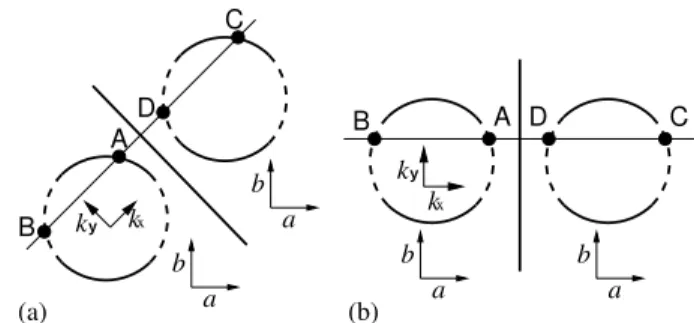
Figure 2. Schematic drawing of the45◦/45◦junction (panel a) and
0◦/0◦ junction (panel b) between twod-wave superconductors.
The thick line represents the junction line. The circles illustrate the Fermi surfaces, where positive and negative pairing potentials ∆are shown by the solid and dotted lines. The points A, B, C, and D in the momentum space are connected by transmission and reflection from the barrier.
For the cuprates, let us consider a junction parallel to the[1,¯1]crystal direction in thea-bplane and select thex axis along the diagonal[1,1], as shown in Fig. 2a. In these coordinates, thed-wave pairing potential is
ˆ
∆σky(x,ˆkx) =σ2∆βkyˆkx/k 2
F, (24)
where the same notation as in Eq. (4) is used. Direct com-parison of Eqs. (24) and (4) demonstrates that thed-wave su-perconductor with the45◦junction maps to thep
x-wave
su-perconductor by the substitution∆0→σ2∆0ky/kF. Thus,
the results obtained in Sec. 3 for thepx-pxjunction apply
to the45◦/45◦ junction between twod-wave superconduc-tors with the appropriate integration overky. The energies
and the wave functions of the subgap Andreev states in the 45◦/45◦junction are4π-periodic, as in Eqs. (11). Thus the ac Josephson current has the fractional frequencyeV /~, as in Eq. (14).
On the other hand, if the junction is parallel to the[0,1] crystal direction, as shown in Fig. 2b, then∆ˆσky(x,kˆx) = σ∆β(ˆkx2−ky2)/k2F. This pairing potential is an even
func-tion ofkˆx, thus it is analogous to thes-wave pairing
poten-tial in Eq. (4). Thus, the0◦/0◦junction between twod-wave superconductors is analogous to thes-sjunction. It should exhibit the conventional2π-periodic Josephson effect with the frequency2eV /~.
For a generic orientation of the junction line, thed-wave pairing potential acts like px-wave for some momenta ky
and likes-wave for otherky. Thus, the total Josephson
cur-rent is a sum of the unconventional and conventional terms
[12]:
I=C1sin(φ/2) +C2sin(φ) +. . . , (25) with some coefficientsC1andC2. We expect that both terms in Eq. (25) are present for any real junction betweend-wave superconductors because of imperfections. However, the ra-tioC1/C2should be maximal for the junction shown in Fig. 2a and minimal for the junction shown in Fig. 2b.
5
Experimental observation of the
fractional ac Josephson effect
Conceptually, the setup for experimental observation of the fractional ac Josephson effect is very straightforward. One should apply a dc voltageV to the junction and measure fre-quency spectrum of microwave radiation from the junction, expecting to detect a peak at the fractional frequencyeV /~. Josephson radiation at the conventional frequency2eV /~ was first observed experimentally almost 40 years ago in Kharkov [17, 18], followed by further work [19, 20]. In Ref. [18], the spectrum of microwave radiation from tin junctions was measured, and a sharp peak at the frequency2eV /~ was found. Without any attempt to match impedances of the junction and waveguide, Dmitrenko and Yanson [18] found the signal several hundred times stronger than the noise and the ratio of linewidth to the Josephson frequency less than 10−3. More recently, a peak of Josephson radiation was ob-served in Ref. [21] in indium junctions at the frequency 9 GHz with the width 36 MHz. In Ref. [22], a peak of Joseph-son radiation was observed around 11 GHz with the width 50 MHz inBi2Sr2CaCu2O8single crystals with the current along thecaxis perpendicular to the layers.
To observe the fractional ac Josephson effect predicted in this paper, all it takes is to perform the same experiment with the45◦/45◦cuprate junctions shown in Fig. 2(a). For control purposes, it is also desirable to measure frequency spectrum for the0◦/0◦ junction shown in Fig. 2(b), where a peak at the frequencyeV /~should be minimal. It should be absent completely in a conventionals-sjunction, unless the junction enters a chaotic regime with period doubling [23]. The high-Tcjunctions of the required geometry can be
manufactured using the step-edge technique. Bicrystal junc-tions are not appropriate, because the crystal axesaandbof
the two superconductors are rotated relative to each other in such junctions. As shown in Fig. 2(a), we need the junction where the crystal axes of the two superconductors have the same orientation. Unfortunately, attempts to manufacture Josephson junctions from the Q1D organic superconductors (TMTSF)2Xfailed thus far.
is not very useful to study the effect that we predict. In-deed, our results are effectively obtained by the substitu-tion2e → e. Thus, we expect to see the Shapiro steps at the voltagesVm =m~ω/e = 2m~ω/2e, i.e. we expect to
see onlyevenShapiro steps. However, when both terms are present in Eq. (25), they produce both even and odd Shapiro steps, so it would be difficult to differentiate the novel ef-fect from the conventional Shapiro efef-fect. Notice also that the so-called fractional Shapiro steps observed at the voltage V1/2 =~ω/4ecorresponding ton = 1/2 have nothing to do with the effect that we propose. They originate from the higher harmonics in the current-phase relationI∝sin(2φ). The fractional Shapiro steps have been observed in cuprates [24], but also in conventionals-wave superconductors [25]. Another method of measuring the current-phase relation in cuprates was employed in Ref. [26], but connection with our theoretical results is not clear at the moment.
6
Conclusions
In this paper, we study suitably oriented px-px or d-d
Josephson junctions, where the superconductors on both sides of the junction originally have the surface Andreev midgap states. In such junctions, the Josephson current I, carried by the hybridized subgap Andreev bound states, is a 4π-periodic function of the phase differenceφ: I ∝ sin(φ/2), in agreement with Ref. [14]. Thus, the ac Joseph-son current should exhibit the fractional frequency eV /~, a half of the conventional Josephson frequency2eV /~. In the tunneling limit, the Josephson current is proportional to the first power of the electron tunneling amplitude, not the square as in the conventional case [13]. Thus, the Josephson current in the considered case is carried by single electrons with chargee, rather than by Copper pairs with charge2e. The fractional ac Josephson effect can be observed exper-imentally by measuring frequency spectrum of microwave radiation from the junction and detecting a peak ateV /~.
The work was supported by NSF Grant DMR-0137726. KS thanks S. M. Girvin for support.
References
[1] D. J. Van Harlingen, Rev. Mod. Phys. 67, 515 (1995); C. Tsuei and J. Kirtley,ibid.72, 969 (2000).
[2] TMTSF stands for tetramethyltetraselenafulvalene, and X represents inorganic anions such asClO4orPF6.
[3] I. J. Leeet al., Phys. Rev. Lett.88, 017004 (2002); I. J. Lee, M. J. Naughton, G. M. Danner, and P. M. Chaikin,ibid.78, 3555 (1997); I. J. Lee, P. M. Chaikin, and M. J. Naughton, Phys. Rev. B62, R14669 (2000).
[4] A. G. Lebed, Phys. Rev. B59, R721 (1999); A. G. Lebed, K. Machida, and M. Ozaki,ibid.62, R795 (2000).
[5] C.-R. Hu, Phys. Rev. Lett.72, 1526 (1994).
[6] S. Kashiwaya and Y. Tanaka, Rep. Prog. Phys. 63, 1641 (2000).
[7] K. Sengupta, I. ˇZuti´c, H.-J. Kwon, V. M. Yakovenko, and S. Das Sarma, Phys. Rev. B63, 144531 (2001).
[8] Y. Tanuma, K. Kuroki, Y. Tanaka, and S. Kashiwaya, Phys. Rev. B 64, 214510 (2001); Y. Tanumaet al., 66, 094507 (2002).
[9] T. L¨ofwander, V. S. Shumeiko, and G. Wendin, Supercond. Sci. Technol.14, R53 (2001).
[10] Y. Tanaka, T. Hirai, K. Kusakabe, and S. Kashiwaya, Phys. Rev. B60, 6308 (1999).
[11] C. D. Vaccarella, R. D. Duncan, C. A. R. S´a de Melo, cond-mat/0302080.
[12] The current-phase relation I ∝ sin(φ/2)that we propose
should not be confused with another unconventional current-phase relationI ∝ sin(2φ) with the periodπ, which was
predicted theoretically for junctions betweens- andd-wave superconductors [27, 28], s- and p-wave superconductors [27, 29], and for the0◦/45◦junctions between twod-wave
superconductors [30].
[13] Y. Tanaka and S. Kashiwaya, Phys. Rev. B53, 9371 (1996); R. A. Riedel and P. F. Bagwell,ibid.57, 6084 (1998); Yu. S. Barash,ibid.61, 678 (2000); Y. Tanaka and S. Kashiwaya,
ibid.56, 892 (1997).
[14] A. Yu. Kitaev, cond-mat/0010440.
[15] A. M. Zagoskin, Quantum Theory of Many-Body Systems
(Springer, New York, 1998).
[16] A. Furusaki, Superlattices Microstruct.25, 809 (1999). [17] I. K. Yanson, V. M. Svistunov, and I. M. Dmitrenko, Sov.
Phys. JETP21, 650 (1965).
[18] I. M. Dmitrenko and I. K. Yanson, JETP Lett.2, 154 (1965). [19] D. N. Langenberg, D. J. Scalapino, B. N. Taylor, and R. E.
Eck, Phys. Rev. Lett.15, 294 (1965).
[20] I. M. Dmitrenko, I. K. Yanson, and I. I. Yurchenko, Sov. Phys. Solid State9, 2889 (1968).
[21] A. K. Jain, K. K. Likharev, J. E. Lukens, and J. E. Savageau, Phys. Repts.109, 309 (1984).
[22] R. Kleiner, F. Steinmeyer, G. Kunkel, and P. M ¨uller, Phys. Rev. Lett.68, 2394 (1992).
[23] R. F. Miracky, J. Clarke, and R. H. Koch, Phys. Rev. Lett.50, 856 (1983); C. B. Whan, C. J. Lobb, and M. G. Forrester, J. Appl. Phys.77, 382 (1995).
[24] E. A. Early, A. F. Clark, and K. Char, Appl. Phys. Lett.62, 3357 (1993); L. C. Kuet al., Physica C229, 320 (1994); I. V. Borisenkoet al., Physica C368, 328 (2002).
[25] J. Clarke, Phys. Rev. Lett.21, 1566 (1968). [26] E. Il’ichevet al., Phys. Rev. Lett.86, 5369 (2001). [27] S. Yip, J. Low T. Phys.91, 203 (1993).
[28] Y. Tanaka, Phys. Rev. Lett.72, 3871 (1994); A. M. Zagoskin, J. Phys. Condens. Matter9, L419 (1997).
[29] N. Yoshida, Y. Tanaka, S. Kashiwaya, and J. Inoue, J. Low T. Phys.117, 563 (1999).