vol. 38, n. 3, jul./set., 2002
Essential oils from
Calyptranthes concinna, C. lucida
and
C. rubella
(Myrtaceae)
Renata Pereira Limberger1, Cláudia Avello Simões-Pires1, Marcos Sobral1, Chantal Menut2, Jean-Marie Bessiere2, Amélia Terezinha Henriques1*
1Faculdade de Farmácia, Universidade Federal do Rio Grande do Sul, 2Laboratoire de Chimie Organique-Physique.
Université de Montpellier II, Sciences et Techniques du Languedoc, Montpellier, France
Essential oils from Calyptranthes concinna, C. lucida and C. rubella, collected in Southern Brazil, were analyzed by GC and GC/MS. Sixty-two compounds were identified representing about 98% of the oil contents. All samples were rich in cyclic sesquiterpenes (more than 90 %), mainly those from cadinane, bisabolane and germacrane cyclization pathway. The mainly components characterized were bicyclogermacrene (22.1% in C. concinna;11.7% in C. rubella), cis-calamenene (10.3% in C. concinna), beta-caryophyllene (16.5% in C. rubella; 9.4% in C. lucida), beta-bisabolene (25.5% in C. lucida), spathulenol (15.4% in C. rubella) and caryophyllene oxide (7.6% in C. concinna).
*Correspondence: A. T. Henriques Faculdade de Farmácia
Universidade Federal do Rio Grande do Sul
Av. Ipiranga 2752 - RS, Brasil 90.610-000 – Porto Alegre - RS E-mail: [email protected]
Uniterms:
• Calyptranthes concinna
• Calyptranthes lucida
• Calyptranthes rubella
• Myrtaceae • Essential oil
INTRODUCTION
The american myrtaceous genus Calyptranthes
comprises about 100 species, ranging from Mexico to Uruguay (McVaugh, 1968). Six species grow in the state of Rio Grande do Sul (Brazil; Marchiori, Sobral, 1997): C. concinna DC., C. grandifolia O.Berg, C. lucida Martius ex DC., C. pileata D.Legrand, C. rubella (O.Berg) D.Legrand and C. tricona D.Legrand.
We had previously analyzed the oil composition of fresh leaves of C. concinna, C. grandifolia (Menut et al., 1997) and C. tricona (Menut et al., 2000). The oil from C. grandifolia showed predominance of pinenes (55.9%) and beta-caryophyllene (10.5%). C. concinna oil contained a high amount of elemicine (76%). C. tricona was characterized by the presence of two new alpha-monomethyl chromenes derivatives, where a new biosynthetic pathway could be proposed to explain their formation in the plant.
Another Brazilian species, C. spruceana (Silva et al., 1984), showed two chemical varieties: high contents of limonene, geranial and perillaldehyde for the variety A, and pinenes and citral to the variety B.
MATERIAL AND METHODS
Plant material and isolation procedure
The studied species of Calyptranthes were collected in Rio Grande do Sul, Brazil. C. lucida and C. rubella were collected in Dom Pedro de Alcântara, and C. Concinna, in São Francisco de Paula. Voucher specimens were deposited in the ICN Herbarium (UFRGS, Porto Alegre), and are as follows: C. concinna: Sobral et al. 8886; C. lucida: Sobral, Apel 8384a; and C. rubella: Sobral, Apel 8650.
The oils were obtained from fresh leaves by hydrodistillation for five hours using a Clevenger-type apparatus.
Qualitative and quantitative analysis
Quantitative and qualitative analyses of the oils were performed by capillary GC/FID and GC/MS, respectively.
Gas Chromatography: GC analysis was performed in a chromatograph (Shimadzu GC-17A) equiped with Shimadzu GC 10 software, using a fused silica capillary column (30 m x 0.25 mm x 0.25 m, coated with DB-5). Injector and detector temperatures were set at 220 ºC and 250 ºC, respectively; the oven temperature was programmed from 60º - 300 ºC at 3 ºC/min and helium was employed as carrier gas (1 mL/min). The percentage compositions were obtained from electronic integration measurements using flame ionization detection without taking into account relative response factors.
Gas Chromatography - Mass Spectrometry: All the samples were analyzed by GC/MS in the same apparatus and chromatographic conditions as described above, using a quadrupole MS system (QP 5000) operating at 70 eV. Compound identification was based on a comparison of retention indices (determined relatively to the retention times of a series of n-alkanes) and mass spectra with those of authentic samples and with literature data (Jennings, Shibamoto, 1980; Henriques et al., 1993; Adams, 1995; Henriques et al., 1997).
RESULTS AND DISCUSSION
The oil contents of all species were 0.1%.
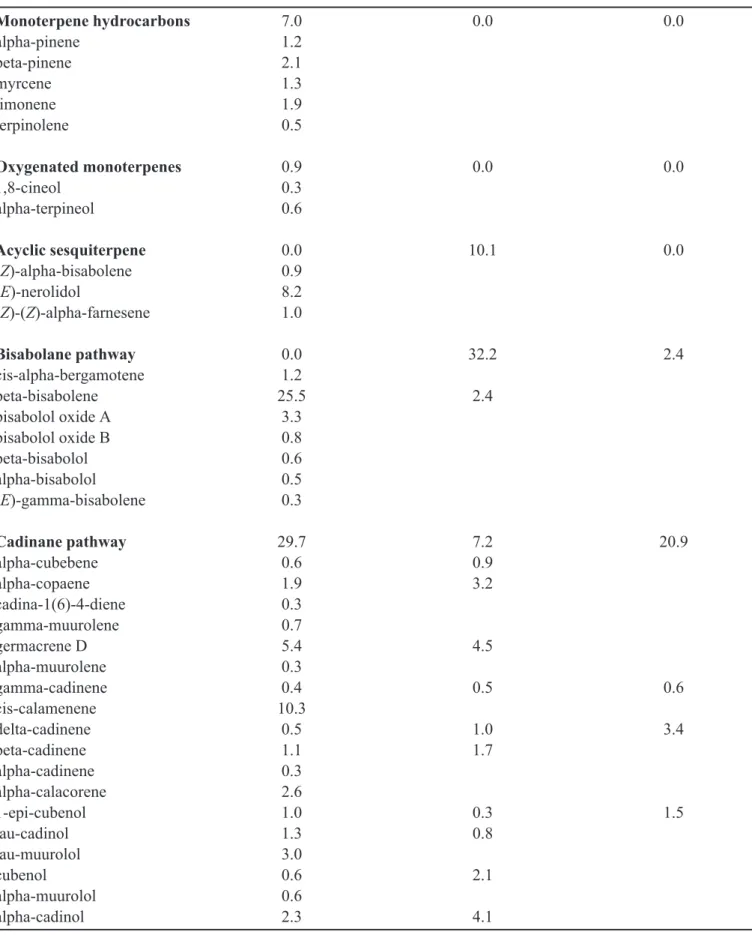
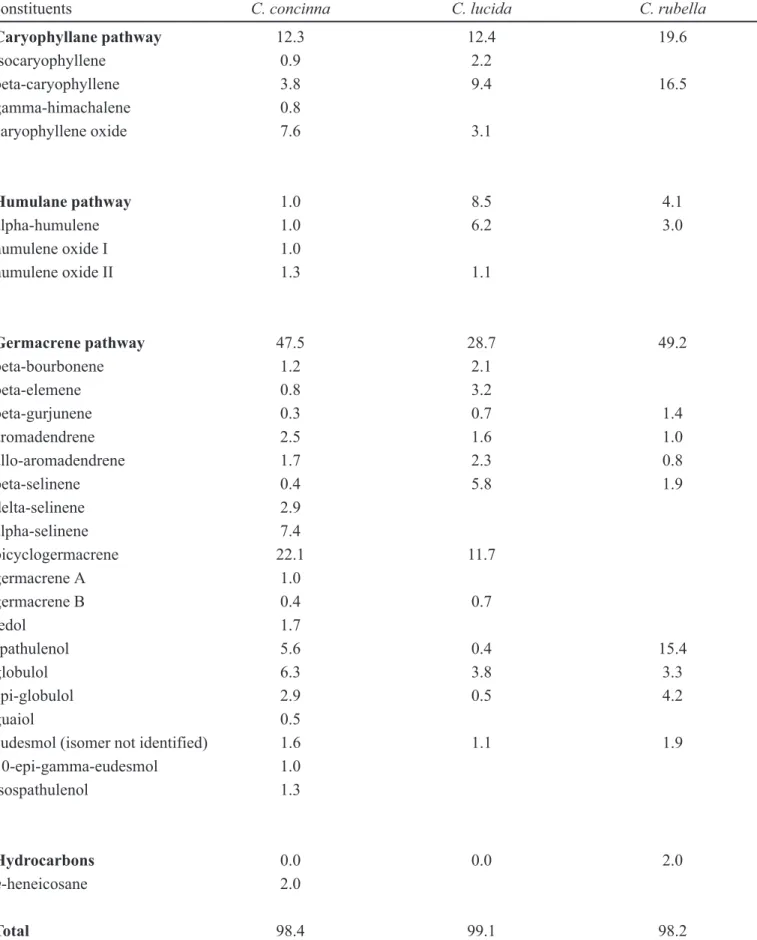
The relative amounts of each identified constituent,
accounting for the range 98.2 – 99.1% of the oils contents, according to its cyclization pathway, are presented in Table I.
The analyzed samples were characterized by presence of cyclic sesquiterpene (91.6% in C. concinna; 98.0% in C. lucida and 98.2% in C. rubella), with predominance of hydrocarbon sesquiterpenes of the bisabolane group (25.5% of beta-bisabolene in C.lucida), the caryophyllane group (9.4% of beta-caryophyllene in
C.lucida and 16.5% in C. rubella) and the germacrane group (22.1% of bicyclogermacrene in C. concinna and 11.7% in C.rubella). Within the oxygenated fraction, spathulenol (skeleton aromadendrane, germacrane group; 15.4 % in C. rubella) was the most representative.
The monoterpene fraction could not be detected in any species. Only in C. lucida a small fraction of acyclic sesquiterpene (10.1%) could be characterized, where the sesquiterpene (E)-nerolidol (8.2%) was the most abundant.
C. lucida showed predominance of products from the bisabolane (32.2%) and germacrane (28.7%) cyclization pathway, while C. concinna and C. rubella
were characterized by germacrane (47.5% and 49.2 7%, respectively) and cadinane (29.9 and 20.9%, respectively) groups. The caryophyllane/humulane groups were present in important amount in all species (13.3 7% in C. concinna, 20.9 7% in C. lucida and 23.7% in C. rubella). The carotane group could not be detected in any sample. It is important to remark that C. concinna did not present elemicine as previously reported by Menut et al. (1997). It may be a result of the different location the samples were collected. However, to confirm the existence of two different chemotypes, further investigation should be conducted.
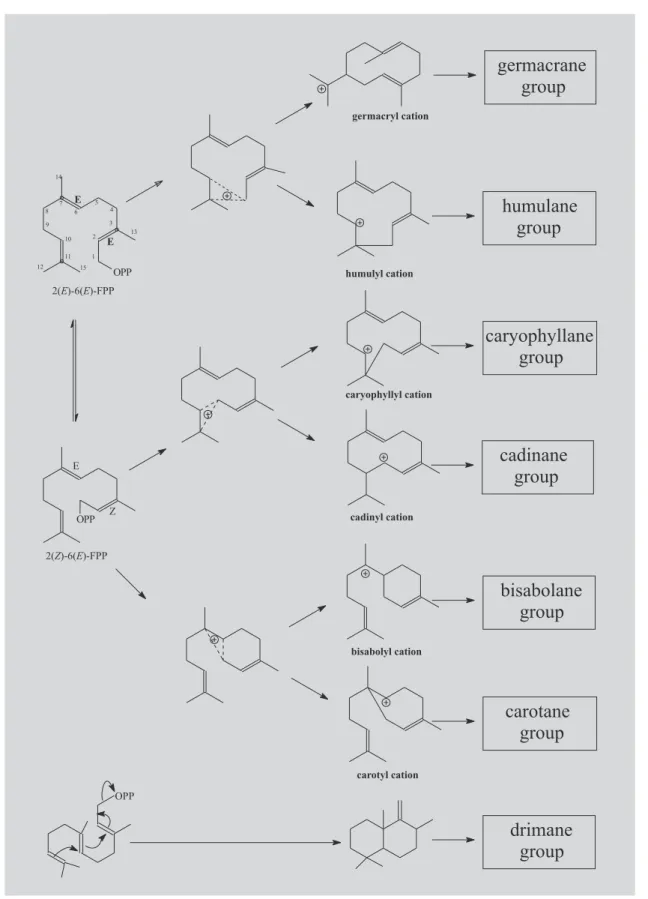
A scheme of the sesquiterpene pathway can be seen in Figure 1.
CONCLUSION
TABLE I- Composition of essential oils (%) from Calyptranthes concinna, C. lucida and C. rubella
constituents C. concinna C. lucida C. rubella
Monoterpene hydrocarbons 7.0 0.0 0.0
alpha-pinene 1.2
beta-pinene 2.1
myrcene 1.3
limonene 1.9
terpinolene 0.5
Oxygenated monoterpenes 0.9 0.0 0.0
1,8-cineol 0.3
alpha-terpineol 0.6
Acyclic sesquiterpene 0.0 10.1 0.0
(Z)-alpha-bisabolene 0.9 (E)-nerolidol 8.2 (Z)-(Z)-alpha-farnesene 1.0
Bisabolane pathway 0.0 32.2 2.4
cis-alpha-bergamotene 1.2
beta-bisabolene 25.5 2.4
bisabolol oxide A 3.3 bisabolol oxide B 0.8
beta-bisabolol 0.6
alpha-bisabolol 0.5 (E)-gamma-bisabolene 0.3
Cadinane pathway 29.7 7.2 20.9
alpha-cubebene 0.6 0.9
alpha-copaene 1.9 3.2
cadina-1(6)-4-diene 0.3 gamma-muurolene 0.7
germacrene D 5.4 4.5
alpha-muurolene 0.3
gamma-cadinene 0.4 0.5 0.6
cis-calamenene 10.3
delta-cadinene 0.5 1.0 3.4
beta-cadinene 1.1 1.7
alpha-cadinene 0.3
alpha-calacorene 2.6
1-epi-cubenol 1.0 0.3 1.5
tau-cadinol 1.3 0.8
tau-muurolol 3.0
cubenol 0.6 2.1
alpha-muurolol 0.6
TABLE I- Composition of essential oils (%) from Calyptranthes concinna, C. lucida and C. rubella (continuation)
constituents C. concinna C. lucida C. rubella
Caryophyllane pathway 12.3 12.4 19.6
isocaryophyllene 0.9 2.2
beta-caryophyllene 3.8 9.4 16.5
gamma-himachalene 0.8
caryophyllene oxide 7.6 3.1
Humulane pathway 1.0 8.5 4.1
alpha-humulene 1.0 6.2 3.0
humulene oxide I 1.0
humulene oxide II 1.3 1.1
Germacrene pathway 47.5 28.7 49.2
beta-bourbonene 1.2 2.1
beta-elemene 0.8 3.2
beta-gurjunene 0.3 0.7 1.4
aromadendrene 2.5 1.6 1.0
allo-aromadendrene 1.7 2.3 0.8
beta-selinene 0.4 5.8 1.9
delta-selinene 2.9
alpha-selinene 7.4
bicyclogermacrene 22.1 11.7
germacrene A 1.0
germacrene B 0.4 0.7
ledol 1.7
spathulenol 5.6 0.4 15.4
globulol 6.3 3.8 3.3
epi-globulol 2.9 0.5 4.2
guaiol 0.5
eudesmol (isomer not identified) 1.6 1.1 1.9 10-epi-gamma-eudesmol 1.0
isospathulenol 1.3
Hydrocarbons 0.0 0.0 2.0
n-heneicosane 2.0
RESUMO
Óleos essenciais de Calyptranthes concinna, C. lucida and C. rubella (Myrtaceae)
Os óleos essenciais de Calyptranthes concinna, C. lucida
e C. rubella, coletadas no sul do Brasil, foram analisados por GC/FID e GC/MS. Sessenta e dois constituintes foram identificados representando cerca de 98% do óleo. Todas as amostras mostraram-se ricas em sesquiterpenos cíclicos (mais de 90%), principalmente aquelas da via de ciclização dos cadinanos, bisabolanos e germacranos. Os principais constituintes caracterizados foram biciclogermacreno (22,1% em C. concinna; 11,7% em C. rubella), cis-calameneno (10,3% em C. concinna), beta-cariofileno (16,5% em C. rubella; 9,4% em C. lucida), beta-bisaboleno (25,5% em C. lucida), espatulenol (15,4% em C. rubella) e óxido de cariofileno (7,6% em C. concinna).
UNITERMOS: Calyptranthes concinna. Calyptranthes
lucida. Calyptranthes rubella. Myrtaceae. Óleo essencial.
ACKNOWLEDGEMENT
This work was supported by FAPERGS and the fellowships from CNPq.
REFERENCES
ADAMS, R. P. Identification of essential oils by ion trap mass spectrometry. New York: Acad. Press, 1995. 469 p.
HENRIQUES, A. T., SOBRAL, M., BRIDI, R., LAMATY, G., MENUT, C., BESSIÈRE, J. M.Essential oils from five southern brazilian species of Myrcia (Myrtaceae). J. Essent. Oil Res., Winston-Salem ,v.9, p.13-18, 1997.
HENRIQUES, A. T., SOBRAL, M., CAUDURO, A. D., SCHAPOVAL, E. E. S., BASSANI, V. L., LAMATY, G., MENUT, C., BESSIERE, J. M. Aromatic plants from Brazil. II. The chemical composition of someEugenia
essential oils. J. Essent. Oil Res., Winston-Salem, v.5, p.501-505, 1993.
JENNINGS, W., SHIBAMOTO, T. Qualitative analysis of flavor and fragrance volatiles by glass capillary gas chromatography. New York: Acad. Press,1980. 472 p.
LEGRAND, C. D., KLEIN, R. M. Myrtáceas –
Calyptranthes. In: Reitz, R., org. Flora Ilustrada Catarinensis. Itajaí: Herbário Barbosa Rodrigues, 1971. p.490-552.
MARCHIORI, J. N. C., SOBRAL, M. Dendrologia das angiospermas - Myrtales. Santa Maria: Editora UFSM, 1997. 304 pp.
McVAUGH, R. The genera of american Myrtaceae - an interim report. Taxon, Berlin, v.17, p.354-418, 1968.
MENUT, C., VERIN, P., LAMATY, G., BESSIÈRE, J. M., HENRIQUES, A.T., VON POSER, G., SOBRAL, M. Huiles essentielles de deux espèces de Calyptranthes
(Myrtaceae) du Brèsil. Compte Rendue des 15èmes Journèes Internationales Huiles Essentielles. Riv. Ital. Eppos, Digne le Bains, nº especial, p.561-565, 1997.
MENUT, C., BESSIERE, J. M., NTALANI, H., VERIN, P., HENRIQUES, A. T., LIMBERGER, R. Two new chromenes derivatives from Calyptranthes tricona. Phytochemistry, Oxford, v.53, p.975-979, 2000.
SILVA, M. L., LUZ, A. I., ZOGHBI, M. G., RAMOS, L. S., MAIA, J. G. Essential oil variation in Calyptranthes spruceana. Phytochemistry, Oxford, v.23, p.2515-2516, 1984.
Recebido para publicação em 25 de julho de 2001.