Brazilian Journal of Physics, vol. 36, no. 4B, December, 2006 1379
Trajectory Effects in Coulomb Excitation
F. W. Fernandes and B. V. Carlson
Departamento de F´ısica, Instituto Tecnol´ogico de Aeron´autica,
Centro T´ecnico Aeroespacial, 12228-900 S˜ao Jos´e dos Campos, S˜ao Paulo, Brazil
Received on 18 March, 2006
We compare the cross sections for Coulomb excitation of multiple giant dipole resonances in208Pb +208Pb scattering using Coulomb trajectories and straight-line trajectories that have the same point of closest approach as the Coulomb one. We find the effects of the Coulomb deflection relative to the straight line trajectory to be small at incident energies above about 500 MeV/nucleon.
Keywords: Multiple giant dipole resonances;208Pb +208Pb scattering
I. INTRODUCTION
Coulomb excitation has proven itself as an important tool for studying the structure of both stable and exotic nuclei.[1– 4] The phenomenon has been well-studied in a nonrelativistic context[5] and studied perturbatively in a relativistic one[6] by Alder and Winther. More recent experimental studies have considered multiple Coulomb excitation at relativistic energies.[2–4]
Many calculations of high-energy Coulomb excitation in-clude the effects of Coulomb deflection, but only through the effective impact parameter used in a straight-line trajectory.[7–11] The curvature of the trajectory is usually not taken into account. The curvature of the Coulomb trajectory increases the distance between the projectile and target, rel-ative to a straight-line trajectory, and is thus expected to de-crease Coulomb excitation, which is strongly dependent on the separation. In the following, we derive the semiclassical coupled-channel equations for Coulomb excitation and then use them to compare excitation cross sections obtained using straight-line and Coulomb trajectories.
II. THE SEMICLASSICAL COUPLED EQUATIONS
The scattering between two heavy ions can be well-approximated semi-classically when the wavelength of rela-tive motion is much smaller than the length scales on which the interaction varies. We will assume this to be the case here. For a localized wave-packet, we can then determine the ex-pectation values
x(t) =x and p(t) =p directly from the classical equations of motion,
dx(t)
dt = p(t)
m and
dp(t)
dt =− ∇V(x) ≈ −∇V(x(t)).
In the following, we reduce the coupled wave equations for Coulomb excitation to coupled equations for the average tra-jectory and for the occupation amplitudes of the ground and excited states.
We begin with the Schrdinger equation for the relative and internal motion,
2∇2
2m +h(α) +Uo( − →x) +V
c(−→x,α)
ψ=i∂
∂tψ, (1) whereh(α)is the Hamiltonian of the internal degrees of free-dom, represented byα,U0(x)is a complex optical potential that depends on the relative coordinate alone andVc(x,α)is the interaction coupling the relative and internal motion. We will assume that the Coulomb-excited states can be expressed as eigenstates of this Hamiltonian,
h(α)|n=εn|n, (2)
withεnbeing the energy of the excited state|n. For unifor-mity, we represent the ground state as|0with energyε0.
We write the wavefunction of the system as a linear combi-nation of the ground and excited states,
ψ(x,t) =exp[iS(x,t)]
∑
n
an(t)|n, (3)
where exp[S(x,t)]describes the average relative motion and an(t)is the occupation amplitude of state|n. Before the col-lision, ast→ −∞and|x| →∞, only the ground state is occu-pied, so that
an(t→ −∞) =δn0. (4) Substituting the wavefunction ψ(x,t) in the Schrdinger equation and taking the matrix element of the statem|, we obtain
− 2
2m∇ 2+ε
m
am(t)eiS(
− →x,t)
+
+
∑
n
Vmn(−→x)an(t) +Uo(−→x)am(t)
eiS(−→x,t) (5)
=
i∂
∂tam(t) +i d dtam(t)
eiS(−→x,t),
where we have defined
1380 F. W. Fernandes and B. V. Carlson
To isolate the equation of relative motion, we multiply the above expression bya∗m(t)and sum overm. We obtain
− 2
2m∇ 2+
∑
mεm|am(t)|2
eiS(−→x,t) +
+
Uo(−→x)
∑
m|am(t)|2
eiS(−→x,t) +
+
∑
n,ma∗m(t)Vmn(−→x)an(t)
eiS(−→x,t) +
=
i∂
∂t+i
∑
m a∗
m(t)
d dtam(t)
eiS(−→x,t), where we assume that
∑
m|am(t)|2=1. (7)
We can rewrite this equation as,
− 2
2m∇ 2+U
0(−→x) +Vc(x,t) =i
∂ ∂t
eiS(−→x,t), (8) by defining the contribution of the coupling to the potential for relative motion as,
Vc(x,t) =
∑
n,ma∗m(t)Vmn(−→x)an(t) +
+
∑
m
εm|am(t)|2+Im
∑
ma∗m(t)d
dtam(t)
, (9)
where we have used Eq. (7) to obtain
∑
ma∗m(t)d
dtam(t) =−
∑
m d dta∗
m(t)am(t) and thus
−i
∑
m
a∗m(t) d
dtam(t) =Im
∑
m
a∗m(t) d
dtam(t)
.
We observe that Vc(x,t) is real and the coupling matrix
Vmn(−→x) is hermitian when the coupling potentialVc(−→x,α) is real.
We write the phaseS(x,t)as an expansion inand retain
only the first term,
S(−→x,t) =1
(Sr(
− →x,t) +iS
i(−→x,t)) +....
When this is substituted in the equation for the relative mo-tion, Eq.(8), we find, to order 0 in,
1
2m(∇Sr+i∇Si) 2+U
0(−→x) +Vc(x,t)
=−∂
∂tSr−i
∂ ∂tSi
We separate this into its real and imaginary parts,
1 2m
(∇Sr)2−(∇Si)2 + Re(U0) + (10)
+Vc(x,t) +
∂
∂tSr = 0
and
1
m∇Sr·∇Si+Im(U0) =−
∂ ∂tSi
If we neglect the term(∇Si)2in the first of these, it becomes the Hamilton-Jacobi equation, the solution of which provides the trajectory,x(t)and→−p(t) =∇Sr.
Substitutingp(t)in the second equation, we have d
dtSi=
∂ ∂tSi+
p(t)
m ·∇Si=−Im[U0( − →x(t),t)],
which yields
Si(t) =−
t
−∞Im[
U0(−→x(t),t)]dt.
The factorSi(t) furnishes absorption along the trajectory due to the imaginary part of the optical potentalU0.
To obtain the coupled equations for the occupation ampli-tudes, we multiply Eq. (8) byam(t)and subtract it from Eq. (5).
The expression that results can be reduced to
−Vc(x(t),t) (t) +εm
am(t) +
∑
nVmn(−→x(t))an(t)
=id
dtam(t). Defining
am(t) =exp i
Vc(−→x(t),t)dt
am(t), (11) and substituting in the previous equation, we obtain
id
dtam(t) =εmam(t) +
∑
n Vmn( − →x(t))an(t) (12)
which is the equation we solve numerically to obtain the oc-cupation amplitudes. Since the cross sections depend on the occupation probabilities rather than the amplitudes, the over-all phase factor provided by the real potentialVc(x(t),t)is ir-relevant and can be ignored. The trajectory dependence of the occupation amplitudes can be represented as a dependence on the impact parameterb. We then obtain the cross section for excitation of the statenby integrating the product of the ab-sorption factor due toSiand the asymptotic occupation prob-ability of statenover the impact parameter,
σn =
db2exp
2
∞
−∞Im[U0(
−
→x(t),t)]dt
×an
t→∞,b 2. (13)
III. COMPARISON BETWEEN LINEAR AND COULOMB TRAJECTORIES
The Coulomb trajectory for relative motion between a pair of ions of reduced massµand chargesZPandZT satisfies
p2r 2µ+
L2 2µr2+
ZPZTe2
Brazilian Journal of Physics, vol. 36, no. 4B, December, 2006 1381
FIG. 1: Coulomb and effective straight-line trajectories that are used to calculate Coulomb excitation.
wherepr is the radial component of the relative momentum,
Lthe conserved angular momentum andEthe center-of-mass energy.
We can rewrite this in terms of the impact parameterbas p2r
2µ+E
b r
2
+ZPZTe
2
r =E.
The minimum value of the radial distance between the ions rminoccurs where the radial momentumpr=0. In a head-on collision, for whichb=0, this is
rmin(b=0) =2a where a=
ZPZTe2 2E . It can be easily shown that for arbitrary values of the impact parameter, the minimum separation is given by
rmin(b) =a+
a2+b2.
We perform straight-line Coulomb excitation calculations using the effective trajectory for which the minimum separa-tion is the same as that of the Coulomb trajectory, as shown in Fig. 1. This is done by using a be f f(b) =rmin(b)in the straight-line trajectory calculation of the the damping factor and occupation probabilities in the expression for the cross sections, Eq. (13) (but not in the aread2b). The additional effects of the Coulomb trajectory will then be due to its cur-vature relative to the straight line one, as illustrated in Fig. 1.
In the numerical calculations, we use the instantaneous Coulomb interaction and a dipole coupling interaction,
Vc(x,α) =−d·E(x),
whereE(x)is the electric field anddthe isovector dipole oper-ator of the nucleus208Pb, with the dipole strength given by the energy-weighted sum rule. The excited states were assumed to be harmonic with the first excited state at 13.4 MeV. We used the So Paulo potential[12] for the real part of the optical potential and an imaginary part given by 0.78 times the real part. We note however that the real part of the nuclear poten-tial plays an extremely limited role in the calculations shown here. The important contributions to the scattering come from the Coulomb deflection and the absorption due to the imagi-nary part of the optical potential. The latter was included in both the Coulomb and straight-line trajectory calculations.
0 200 400 600 800 1000
E/A {MeV} 10
100 1000
σ
[mb]
V=V0Γ=0
V=0Γ=0 V=0Γ=4 V=V0Γ=4
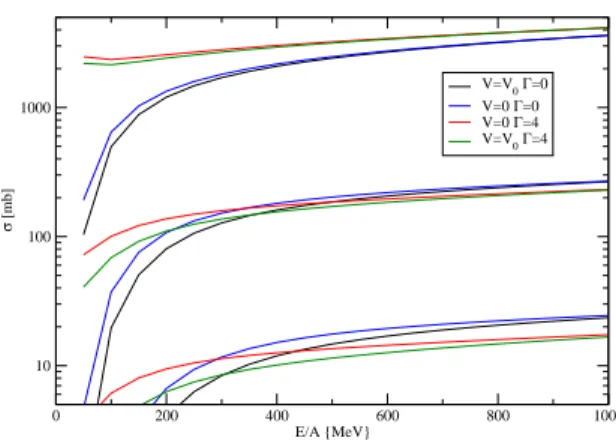
FIG. 2: Single (top curves), double (middle curves) and triple (lower curves) giant dipole excitation cross sections in208Pb +208Pb as a function of incident energy/nucleon.
Our results, as a function of the incident energy per nu-cleon, are shown in Fig. 2. There, we present calculations in which the excited states are stable and others in which they have non-zero widths. In both cases, as expected, we find the excitation cross sections to be smaller when the tra-jectory is a Coulomb one. The single giant dipole reso-nance (GDR) cross section is almost identical for straight-line and Coulomb trajectories at energies above about 500 MeV/nucleon. In the case of zero width, the GDR cross sec-tion for a Coulomb trajectory is about 20% below its straight-line value at 100 MeV/nucleon and about a factor of two smaller at 50 MeV/nucleon. The deviation between the the two GDR cross sections is much smaller in the case of states with widths.
The discrepancy between the cross sections obtained with Coulomb and straight-line trajectories increases with the number of modes excited. At an incident energy of 500 MeV/nucleon, the difference between the two double giant dipole cross sections is about 5% and for the triple giant di-pole cross sections is about 15%. These differences are even larger at lower energies and are of about the same order of magnitude for states with and without widths.
In conclusion, we can say that the Coulomb trajectory cor-rections are negligible for the one and two giant dipole reso-nance cross sections in the incident energy range in which they have been observed (above about 600 MeV/nucleon).[2, 4] These corrections become more important at lower incident energies and should certainly be taken into account at ener-gies below about 200 MeV/nucleon.
1382 F. W. Fernandes and B. V. Carlson
[1] C. A. Bertulani and G. Baur, Phys. Rep.163, 299 (1988). [2] H. Emling, Progr. Part.Nucl. Phys.33, 792 (1994). [3] Ph. Chomaz and N. Frascaria, Phys. Rep.252, 275 (1995). [4] T. Aumann, P.F. Bortignon, and H. Emling, Ann. Rev. Nucl. Sci
48, 351 (1998).
[5] K. Alder and A. Winther, Coulomb Excitation, (Academic Press, New York, 1965).
[6] A. Winther and K. Alder, Nucl. Phys. A319, 518 (1979). [7] C. A. Bertulani, L. F. Canto, M. S. Hussein, and A. F. R. de
Toledo Piza, Phys. Rev. C53, 334 (1997).
[8] B.V. Carlson, L.F. Canto, S. Cruz-Barrios, M.S. Hussein, and
A.F.R. de Toledo Piza, Phys. Rev. C59, 2689 (1999).
[9] B.V. Carlson, L.F. Canto, S. Cruz-Barrios, M.S. Hussein, and A.F.R. de Toledo Piza, Ann. Phys.(N.Y.)276, 111 (1999). [10] B.V. Carlson, M.S. Hussein, A.F.R. de Toledo Piza, and L.F.
Canto, Phys. Rev. C60, 014604 (1999).
[11] M.S. Hussein, B.V. Carlson, and L.F. Canto, Nucl. Phys. A731, 163 (2004).