572
BRAZILIAN JOURNALOF OTORHINOLARYNGOLOGY 72 (4) JULY/AUGUST 2006
http://www.rborl.org.br / e-mail: [email protected] CASE REPORT
Rev Bras Otorrinolaringol 2006;72(4):572.
Autoimmune hearing loss and ulcerative colitis
Renato Prescinotto1, Raul Vitor Rossi Zanini2, Priscila
Bogar Rapoport3 , Carlos Augusto Anadão4, Renata
Ribeiro de Mendonça5, Roberta Borges Novais Petrilli6
INTRODUCTION
McCabe first described autoimmune hearing loss in 19791.
Summers and Harker described the first case of dysacusis associated with ulcerative colitis in 1982. Since then other cases have been reported2,3.
CASE PRESENTATION
This is a male 23-year-old patient presenting with right tinnitus, ipsilateral hypoacusis and dizziness following three months of diarrhea and weight loss. The patient was taking deflazacort and budesonide, which improved his intestinal, hearing and postural symptoms, but not the tinnitus.
Initial audiometry revealed mild right sensorineural dysacusis.
Laboratory exams included a posi-tive ANF, an increased C-reacposi-tive protein, mucoproteins and HSV. Otoneurology sug-gested a right peripheral vestibular deficit syndrome. Magnetic resonance imaging was normal.
Colonoscopy showed colon and rectal hyperemia with erosions and ulcers, distal transverse colon and distal rectal stenosis; pathology disclosed non-specific
chronic rectocolitis.
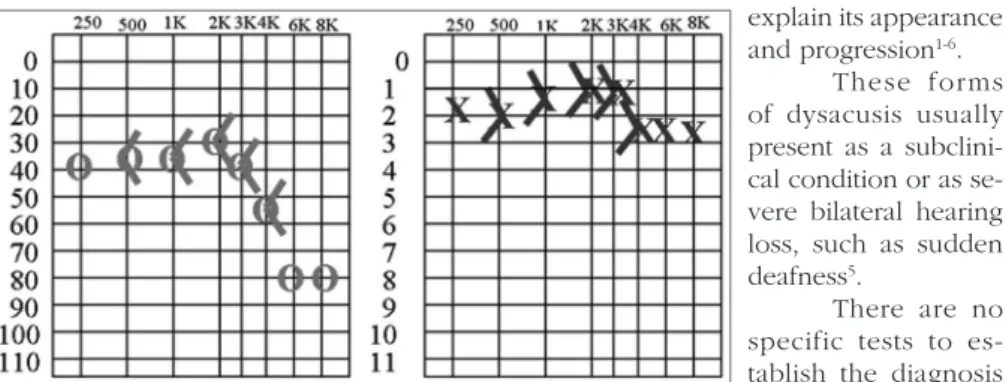
The patient used medication during one month and remained clinically stable for a further three months before recur-ring. Audiometry revealed a right auditory decline in all frequencies, mostly for higher frequency sounds. (Figure 1)
Prednisone (60 mg per day) was introduced, with clinical improvement, after which the dose was reduced to 20 mg per day. Follow-up audiometry revealed audiometric improvement, especially at 1 and 2KHz. Mild asymptomatic left dysacu-sis for lower frequency sounds was also observed.
The patient remained with oc-casional right hypoacusis and constant tinnitus, although this did not interfere in his daily activities; intestinal symptoms also regressed. At present the patient is taking mesalazine and prednisone.
DISCUSSION
Sensorineural hearing loss has fre-quently been described in association with a variety of autoimmune diseases3-6.
Although the pathophysiology of sensorineural deafness remains obscure, the autoimmune nature of the disease strengthens some proposed theories that explain its appearance and progression1-6.
These forms of dysacusis usually present as a subclini-cal condition or as se-vere bilateral hearing loss, such as sudden deafness5.
There are no specific tests to es-tablish the diagnosis
of autoimmune dysacusis. A few proteins are being isolated and may have a strong connection with the autoimmune condi-tion, such as the HSP 70 protein, although these findings are of little practical value at present5,6.
Treatment includes aggressive use of immunosuppressants, usually corticoste-roids. Other immunosuppressants have also been suggested by some authors3-5.
The differential diagnosis is re-quired for cases of sensorineural dysacu-sis. However, exams will not necessarily confirm a specific etiology. In such cases a treatment may be given as a test to confirm the diagnosis.
FINAL COMMENTS
Autoimmune dysacusis is one of the few sensorineural conditions in which clinical improvement may be obtained, as long as the diagnosis is promptly made and treatment is adequately employed.
REFERENCES
1. McCabe B. Autoimmune hearing loss. Ann Otol Rhinol Laryngol 1979;88:585.
2. Summers RW, Harker L. Ulcerative colitis and sensorineural hearing loss: is there a relation-ship? J Clin Gastroenterol 1982;4:251. 3 Weber RS, Jenkins HÁ, Coker NJ.
Sensori-neural hearing loss associated with ulcerative colitis. Arch Otolaryngol 1984;110:810-2. 4 Hollanders D. Sensorineural deafness - a new
complication of ulcerative colitis? Postgrad Med J 1986;62:753-5.
5 Herdman RC, Hirari M, Ramsden RT. Autoim-mune inner ear disease and ulcerative colitis. J Laryngol Otol 1991;105(4):330-1.
6 Kumar BN, Walsh RM, Wilson OS, Carlin WV. Sensorineural hearing loss and ulcerative colitis. J Laryngol Otol 1997;111(3):277-8. Keywords: hearing loss, autoimmune diseases, colitis,
ulcerative.
1 MD, Otorhinolaryngology Resident - Medical School of the ABC. 2 MD, Otorhinolaryngology Resident - Medical School of the ABC.
3 MD, Otorhinolaryngologist, PhD in Otorhinolaryngology - FMUSP. Full Professor of Otorhinolaryngology - Medical School of the ABC. 4 MD, Otorhinolaryngologist, Assistant Professor of Otorhinolaryngology - Medical School of the ABC.
5 MD, Otorhinolaryngology Resident - Medical School of the ABC.. 6 MD, Otorhinolaryngology Resident - Medical School of the ABC..
Paper submitted to the RBORL - SGP (Publication Management System of the Brazilian Journal of Otorhinolaryngology) on March 11th, 2005 and approved on May 31st, 2006. Paper submitted to the ABORL-CCF SGP (Management Publications System) on March 11th, 2005 and accepted for publication on May 31st, 2006.