0103 - 5053 $6.00+0.00
Short Report
*e-mail: [email protected]
Synthesis of C
60(OH)
18-20in Aqueous Alkaline Solution Under O
2-Atmosphere
Gustavo Catão Alves,*,a Luiz Orlando Ladeira,a Ariete Righi,a Klaus Krambrock,a Hállen Daniel Calado,b Rossimiriam Pereira de Freitas Gilb and Maurício Veloso B. Pinheiroa
a
Departamento de Física and bDepartamento de Química, ICEx, Universidade Federal de Minas Gerais, Av. Antônio Carlos 6627, 31270-901 Belo Horizonte-MG, Brazil
Neste trabalho apresentamos uma variação da síntese de derivados hidro-solúveis de fullerenos, também conhecidos como fullerols, visando aplicações biomédicas. Esta síntese foi baseada em um processo que utiliza poli-etileno glicol (PEG400) como catalisador de transferência de fase entre uma solução de fullerenos em benzeno e outra solução aquosa de NaOH. A polihidroxilação dos fullerenos ocorreu na solução de NaOH sob um fluxo contínuo de O2 visando aumentar o ganho da reação. Os produtos foram caracterizados com espectroscopia na região do infravermelho, ressonância magnética nuclear do 13C, análise termogravimétrica e
absorção óptica. A formação de fullerols C60(OH)18-20, com alta eficiência, foi demonstrada.
In this work we report on an alternative synthesis of water-soluble fullerenes known as fullerols, aiming for biomedical applications. The synthesis is based on a process in which polyethylene glycol (PEG400) is used as phase-transfer catalyst between fullerene/benzene and aqueous NaOH solutions. The polyhydroxylation of the fullerenes occurs in the NaOH solution under a continuous flow of O2 to enhance the reaction yield. The resulting compound was characterized with infrared spectroscopy, nuclear magnetic resonance, thermo-gravimetric analysis and optical absorption. The formation of C60(OH)18-20 in high yields was confirmed.
Keywords: fullerene, fullerol, polyhydroxylation, FTIR, NMR, TG
Introduction
Fullerenes are a large family of super-aromatic
three-dimensional molecules. They contain dozens of sp2
-hybridized carbon atoms arranged in hexagons and pentagons. The latter are responsible for distributing the strain caused by the unique molecular shape of the carbon
cage. The most prominent fullerene is the Buckyball C60,
a truncated icosahedron of Ih symmetry discovered twenty
years ago.1 Due to their electronic structure the fullerene
can be decorated exohedrally with a large number of different functional groups. On the other hand, because of its spherical shape with nanometric diameter, several atoms and smaller molecules can be virtually trapped in its cage. The combination of these two unusual properties makes the fullerenes a very attractive family of molecules for a vast range of biomedical applications: drug carriers; the inhibition of enzymes of the HIV virus; contrasts for MRI and X-ray computer tomography; radio-immuno-therapy; as well as drugs against neurodegenerative
disorders such as Parkinson’s, Alzheimer’s and Lou Gehrig’s, in which the fullerenes can act as free-radical scavengers (For a complete review on the field see Bosi
et al.).2
One of the key drawbacks for the applications of fullerenes in biomedicine is their low solubility in water. In order to make them water-soluble, one needs to functionalize them with polar groups like -OH and -COOH. From all water-soluble fullerenes, the ones with several -OH groups attached, usually known as fullerols or fullerenols, are by far the most intensively investigated. They are excellent free-radical scavengers, and have their anti-oxidant properties already
tested in cortical neurons.3-6
There are several ways to synthesize the fullerols. However, most of these methods are based on the complex
hydrolysis of fullerene derivatives.7-13 The most simple
method by far, is based on the phase-transfer of C60 in
benzene or toluene to an aqueous solution of NaOH, where the polyhydroxylation takes place. This phase-transfer is usually accomplished with tetrabutyl-amonium hydroxide
(TBAH) as the phase-transfer catalyst.14-16 Recently, this
electron paramagnetic resonance (EPR) and magnetic susceptibility measurements, the fullerol so produced was shown to be a complex paramagnetic salt of chemical
formula Na+
2-3[C60O7-9(OH)12-15](2-3)–, rather than simply
polyhydroxylated fullerenes. Almost at the same time, a new synthesis was reported in which the TBAH catalyst
was substituted by polyethilene-glycol (PEG).18 In this
work the authors claimed that a simple fullerol with an average number of OH groups of 27 was produced with a yield of 80.4%. The characterization of water-soluble products was based on mass spectroscopy analysis, Fourier-transform infrared spectroscopy (FTIR) and nuclear magnetic resonance (NMR). With a 300 MHz
NMR and using (CD3)2SO as a solvent, a signal with a
chemical shift of 3.35 ppm was observed. This shift was attributed to the hydroxyl protons of the fullerol. However, this conclusion must be questioned since water impurities
in the (CD3)2SO may result in a signal line with a similar
chemical shift.19
In this paper, we present a modification of the method
by Zhang et al.18 for a large scale production of fullerols,
from sublimated C60, in O2-rich environment. We obtained
fullerols with an average number of OH of ~18 to 20 and with a yield of 87%. The products were characterized with
FTIR, 13C NMR, optical absorption and
thermo-gravimetric analysis (TGA).
Experimental
Materials and methods
The synthesis of fullerenes was performed in an arc discharge chamber adapted from a Czochralski crystal growing furnace from Arthur D. Little, Inc. Modifications followed standard carbon nanotube and fullerene growth
conditions widely described in the literature.20 High purity
graphite electrodes were purchased from Carbone Lorraine Co., with 10 mm in diameter and 100 mm in length. Sublimation of extracted soot took place in a homemade
tubular quartz furnace under high-vacuum (~ 10-4 Pa). For
polyhydroxylation of purified fullerenes, we utilized 99.8% pure methanol from Vetec Química Fina Ltda, 97.0% pure sodium hydroxide and 99.0% pure benzene from Labsynth Ltda. Polyethilene glycol (PEG-400) was purchased from Aldrich Chemical Company Inc. The filtrations were done with P42 paper filters from JProlab Ltda. Infrared spectra for sublimated fullerenes were acquired in a standard Fourier Transform Infrared Spectrometer (FTIR). The TGA measurements were done with a TA-Instruments 2100 Thermal Analysis equipment
with a 50 mL min-1 nitrogen flow. The optical absorption
spectra were recorded with a Jenway spectrometer. The
13CNMR spectrum of the fullerol was measured in a 400
MHz NMR spectrometer operated at frequency of
100MHz with D2O as solvent.
Synthesis of fullerenes
Fullerenes were produced by arc discharge, as usually
described in the literature.20 Synthesis conditions were He
pressure between 13 – 20 Pa, with a 15 – 20 V, 100 A current. These conditions are often cited in the literature as ideal for high fullerene yield, and generate around 1 g of carbon soot. Purification of the collected soot was carried out via sublimation of the fullerenes, where an initial mass of 2.5 g of soot is gradually heated to 650 ºC
at 10-4 Pa. This temperature is kept for 48 hours, causing
the sublimated fullerenes to deposit on the quartz walls of the tube. A second quartz tube is inserted in the system to provide a deposition area that is easier to remove for fullerene extraction. The above described sublimation process generates about 120 mg (~ 5% yield) of a high
purity C60/C70 mixture, as confirmed by IR spectroscopy
(see Figure 1). Purification was carried out via Soxhlet
extraction, but the obtained materials showed contamination from the solvents used in the process. Thus for the fullerol synthesis we used sublimated fullerenes.
Polyhydroxylation of fullerenes
After obtaining and characterizing the purified fullerenes, the production of fullerols was performed using a slight modification of the process detailed by
Zhang et al.18 The process consists of slowly adding 5
mL of a NaOH solution (25 mol L-1) to a C
60/C70 benzene
solution (125 mg in 175 mL) followed by the phase transfer of the fullerenes to the aqueous solution by adding drop-wise 5 mL of the diluted catalyst PEG 400 in water (1:1 vol). The mixture was magnetically stirred for 6 h with a constant oxygen flux bubbled through the solution. Although the precipitation of the solution occurred in less than an hour, reaction times were extended to ensure that a high percentage of fullerenes reacted with the aqueous NaOH. A brown sludge precipitated from the mixture forming two phases, a water soluble brown sludge and a transparent benzene solution. The resulting mixture was further stirred and gently heated for 48 h in order to remove all benzene.
After that, 40 mL of de-ionized H2O was added and the
magnetic stirring continued for 1 hour in the presence
of O2. The mixture was then dried in air to remove any
residual benzene and diluted in 80 mL of de-ionized H2O.
Due to excess of NaOH the pH was 14. After filtering, a water-insoluble fullerene/fullerol mixture was retained in the filters. Once filtered, the solution was reduced to 10 mL, and 690 mL of methanol was added. This mixture was stirred for 5 minutes and another filtration procedure took place. The material retained in the filters was diluted in 100 mL of water. The process of methanol addition, filtration and dilution in water was repeated several times until pH 7 was reached. At this point the solution was concentrated, filtered through an ordinary paper filter and dried. This process resulted in 161 mg of water-soluble fullerol, a yield of 87% with respect to the amount of fullerenes initially used.
Results and Discussion
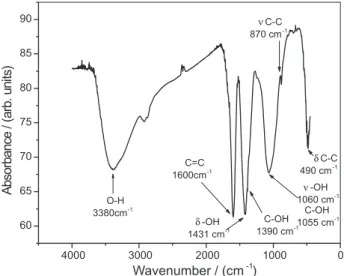
Figure 2 shows the IR spectrum of a fullerol synthesis.
The spectrum is dominated by a broad band at 3380 cm-1
due to the stretching mode of the OH groups, as well as
other peaks at 1600 cm-1 (C=C), 1390 cm-1 (C-OH) and
1055 cm-1 (C-O). All these bands have been reported
before for the compound as belonging to the fullerol
molecules.21-25
Figure 3 shows the 13C NMR spectrum measured at
400 MHz operating at 100 MHz and room temperature
with D2O as a solvent. The signal to the left (at δ = 166
ppm) has a typical chemical shift of carbons with sp2
hybridization in alkenes and probably belongs to the carbons without OH of the distorted cage of the
fullerol.19 For comparison, in the undistorted C
60 cage
with Ih symmetry, the 13C NMR spectrum has a single
signal at δ = 143 ppm, both for liquids and for solids
(see, e.g. Johnson et al.26), due to the 60 equivalent
carbons in the structure. The other three signals, at δ =
72, 70 and 60 ppm, are in the range of 13C NMR
chemical shifts for C-O in either heteroaromatic
alcohols or ethers.19 Although the three signals indicate
that there are definitively three different C-O bonds in the material, their origin is yet unclear. They can be caused by a mixture of fullerols with different numbers
of OH, isomerism and polyhydroxylation of C70 (also
present in lower concentrations in the starting sublimated material, see e.g. in the insert of Figure 4), among other possibilities. Further experiments are still required to clarify this point. However the presence of
13C NMR signals due to carbons bond to oxygen is
totally consistent with the presence of the infrared lines from C-OH and C-O vibrations.
Figure 2. Fourier-Transformed Infrared (FTIR) absorption spectrum of a fullerol sample. Peaks marked ν and δ refer to stretching and bending modes, respectively.
Figure 3.13C NMR spectrum of a fullerol solution in D
2O, measured at
In order to estimate the number of hydroxyl groups attached to each fullerene cage, TGA analysis was performed,
following the method published in Goswami et al.27 and
assuming that a simple polyhydroxylation occurred leading
to a product like C60(OH)n. The TGA runs and their first
derivative showed the separation of the OH groups from the fullerene cages, starting above 150 ºC, in accordance to reference 26. Between 150 ºC and 570 ºC, no fullerene sublimation occurs at atmosphere pressure and measured weight loss by dehydroxylation was 24.3%. Above 570 ºC
the weight loss was 54.5% due to degradation of C60. With
these results the number of hydroxyl groups per fullerene molecule (n) could be estimated according to:
(1)
The values in equation (1) are related to the ratio
between the molecular weight of C60 (mol wt (C60)) and
its measured relative mass (mr(C60)), times the ratio
between the measured relative mass of each hydroxyl
group (mr(OH)) and its molecular weight (mol wt (OH)),
which gives the average number of hydroxyl groups per fullerene. This average number of 19 hydroxyl groups per fullerene matches several results in the literature that describe functionalizations in the range of 6 to 28 OH
groups.21-25 The deviation of ∆N = ± 1 appears when the
presence of C70 in relative concentration ratios of [C70]/
[C60] up to 10%, is taken into account. This upper limit
for [C70]/[C60] ratio was estimated by the optical absorption
spectra in toluene solution.
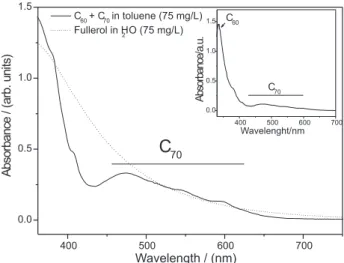
In the Figure 4 the optical absorption spectra of solutions of pristine fullerenes (in toluene) and the fullerol
product (in water) are shown (75 mg L-1). The fullerene
spectra consist of a strong ultraviolet (UV) band due to
C60 and much weaker lines due to C70 in the visible range
(see e.g. reference 20). The insert shows these bands in
detail for a more diluted solution of C60+C70 in toluene
(15 mg L-1). The yellow color of the fullerol solution is
due to a broad band, probably centered in the UV, whose tail extends into the visible range.
Conclusions
A wide variety of techniques was employed to successfully characterize the fullerenes and fullerols C60(OH)18-20 synthesized in high yields (87%) by our group
in an alkaline aqueous solution under an O2-rich
atmosphere. The combination of spectroscopic and gravimetric techniques has shown that these are complementary in the study of functionalized fullerenes, a necessary step in order to achieve an efficient and well controlled method for the production of these structures. For instance, controlling the number of hydroxyl groups attached to each fullerene molecule will allow us to synthesize structures with different water-solubility as well as reactivity against free-radicals, properties which are fundamental for biomedical applications. Purification of fullerenes via sublimation was confirmed as a reliable and practical procedure.
Acknowledgments
The authors would like to acknowledge the CNPq, FAPEMIG and the Instituto do Milênio em Nanociências for financial support. We are also grateful to Juliana Antunes de Sene, Sérgio de Oliveira e Érick Souza de Ávila for useful discussions and laboratorial support.
References
1. Kroto, H. W.; Heath, J. R.; O’Brien, S. C.; Curl, R. F.; Smalley, R. E.; Nature1985, 318, 162.
2. Bosi, S.; Ros, T. D.; Spalluto, G.; Prato, M.; Eur. J. Med. Chem. 2003, 38, 913.
3. Chiang, L. Y.; Lu, F.-J.; Lin, J.-T.; J. Chem. Soc., Chem. Commun. 1995, 1283.
4. Lai, H. S.; Chen, W. J.; Chiang, L. Y.; World J. Surg.2000, 24,
450.
5. Jeng, U. S.; Lin, T. L.; Chang, T. S.; Lee, H. Y.; Hsu, C. H.; Hsieh, Y. W.; Canteenwala, T.; Chiang, L. Y.; Prog. Colloid Polym. Sci. 2001, 118, 232.
Figure 4. Optical absorption spectra of the starting material (sublimated C60+C70) in toluene and the fullerol sample in water, both with absolute concentrations of 75 mg L-1. The insert shows the spectrum of the fullerene
mixture with a lower concentration (15 mg L-1) revealing in more detail
6. Dugan, L. L.; Gabrielsen, J. K.; Yu, S. P.; Lin, T.-S.; Choi, D. W.; Neurobiol. Dis. 1996, 3, 129.
7. Chiang, L. Y.; Upasani, R. B.; Swirczewski, J. W.; J. Am. Chem. Soc.1992, 114, 10154.
8. Chiang, L. Y.; Swirczewski, J. W.; Hsu, C. S.; Chowdhury, S. K.; Cameron, S.; Creegan, K. J.; J. Chem. Soc., Chem. Commun. 1992, 1791.
9. Chiang, L. Y.; Upasani, R. B.; Swirczewski, J. W.; Soled, S.; J. Am. Chem. Soc.1993, 115, 5453.
10. Chen, B.-H.; Huang, J.-P.; Wang, L. Y.; Shiea, J.; Chen, T.-L.; Chiang, L. Y.; J. Chem. Soc.1998, 1171.
11. Chen, B.-H.; Canteenwala, T.; Patil, S.; Chiang, L. Y.; Synth. Commun.2001, 31, 1659.
12. Chiang, L. Y.; Bhonsle, J. B.; Wang, L.; Shu, S. F.; Chang, T. M.; Hwu, J. R.; Tetrahedron1996, 52, 4963.
13. Schneider, N. S.; Darwish, A. D.; Kroto, H. W.; Taylor, R.; Walton, D. R. M.; J. Chem. Soc.,Chem. Commun.1994, 463. 14. Li, J.; Takeuchi, A.; Ozawa, M.; Li, X.; Saigo, K.; Kitazawa,
K.; J.Chem. Soc., Chem. Commun.1993, 1784.
15. Li, T.; Li, X.; Huang, K.; Jiang, H.; Li, J.; J. Cent. South Univ. Technol. (Engl. Ed.)1999, 6, 35.
16. Gonzalez, K. A.; Wilson, L. J.; Wu, W.; Nancollas, G. H.;
Bioorg. Med.Chem.2002, 10, 1991.
17. Husebo, L. O.; Sitharaman, B.; Furukawa, K.; Kato, T.; Wilson, L. J.; J. Am. Chem. Soc.2004, 126, 12055.
18. Zhang, J. -M.; Yang, W.; He, P.; Zhu, S. -Z.; Chin. J. Chem. 2004, 22, 1008.
19. Silverstein, R. M.; Bassler, G. C.; Morrill, T. C.; Spectrometric Identification of Organic Compounds, 5th ed., Wiley & Sons:
Singapore, 1991.
20. Dresselhaus, M. S.; Dresslhaus, G.; Eklund, P. C.; Science of Fullerenes and Carbon Nanotubes, 1st ed., Academic Press:
San Diego, 1996.
21. Chiang, L. Y.; Upasani, R. B.; Swirczewski, J. W.; J. Am. Chem. Soc.1992, 114, 10154.
22. Chiang, L. Y.; Swirczewski, J. W.; Hsu, C. S.; Chowdhury, S. K.; Cameron, S.; Creegan, K.; J. Chem. Soc., Chem. Commun. 1992, 1791.
23. Chiang, L. Y.; Upasani, R. B.; Swirczewski, J. W.; Soled, S.; J. Am. Chem. Soc.1993, 115, 5453.
24. Chen, B.-H.; Huang, J.-P.; Wang, L. Y.; Shiea, J.; Chen, T.-L.; Chiang, L. Y.; J. Chem. Soc., Perkin Trans. 11998, 1171. 25. Chen, B.-H.; Canteenwala, T.; Patil, S.; Chiang, L. Y.; Synth.
Commun.2001, 31, 1659.
26. Johnson, R.D.; Meijer, G.; Salem, J.R.; Bethune, D. S.; J. Am. Chem. Soc.1991, 113. 3619.
27. Goswami, T. H.; Singh, R.; Alam, S.; Mathur, G. N.;
Thermochimica Acta2004, 419, 97.
Received: January 25, 2006