BRAZILIAN JOURNAL OF OCEANOGRAPHY, 58(special issue, IGCP526):31-41, 2010
PALEOPRODUCTIVITY CHANGES DURING THE LATE QUATERNARY IN THE SOUTHEASTERN BRAZILIAN UPPER CONTINENTAL MARGIN OF THE SOUTHWESTERN ATLANTIC*
Renata Hanae Nagai1**, Silvia Helena de Mello e Sousa2, Rafael André Lourenço1, Márcia Caruso Bícego2 and Michel Michaelovitch de Mahiques2
1Instituto Oceanográfico da Universidade de São Paulo
Programa de Pós-graduação em Oceanografia Química e Geológica (Praça do Oceanográfico, 191, 05508-120 São Paulo, SP, Brasil)
2
Instituto Oceanográfico da Universidade de São Paulo Departamento de Oceanografia Física, Química e Geológica (Praça do Oceanográfico, 191, 05508-120 São Paulo, SP, Brasil)
**
Corresponding author: [email protected]
A
B S T R A C TChanges in the Brazilian continental margin’s oceanic productivity and circulation over the last 27,000 years were reconstructed based on sedimentological and microfaunal analyses. Our results suggest that oceanic paleoproductivity and the supply of terrigenous sediments to the Brazilian continental margin were higher during the Last Glacial Maximum (LGM) than during the Holocene. These changes may have been primarily influenced by significant sea level fluctuations that have occurred since the late Pleistocene. During the LGM, the lower sea level, higher productivity and lower sea-surface paleotemperatures may have been the result of the offshore displacement of the main flow of the Brazil Current. However, during the Holocene, the warm waters of the Brazil Current were displaced toward the coast. This displacement contributed to the increase in water temperature and prevented an increase in oceanic productivity. The decrease in terrigenous supply since the LGM could be related to the increase of the extension of the continental shelf and/or drier climatic conditions.
R
E S U M OMudanças na produtividade e circulação oceânica da margem continental Brasileira foram reconstituídas a partir de análises sedimentológicas e microfaunísticas realizadas em sedimentos de um testemunho representativo dos últimos 27 000 anos. Nossos dados sugerem maior produtividade oceânica e suprimento de sedimento terrígeno na área de estudo no Último Máximo Glacial (UMG) do que no Holoceno. Estas mudanças foram principalmente influenciadas por flutuações do nível relativo do mar. Durante o UMG, num cenário de nível relativo do mar mais baixo, a maior produtividade oceânica e menor temperatura da superfície do mar, podem ter sido produtos do deslocamento para o largo da Corrente do Brasil. No Holoceno, o deslocamento para a costa das águas quentes da Corrente do Brasil contribuiu para o aumento na temperatura da água e menor produtividade oceânica. A diminuição do aporte de sedimentos terrígenos desde o UMG pode estar relacionado ao aumento da extensão da plataforma continental e/ou a condições climáticas mais secas no continente.
Descriptors: Foraminifera, Brazil Current, Late Quaternary, Southwestern Atlantic. Descritores: Foraminiferos, Corrente do Brasil, Quaternário Tardio, Atlântico Sudoeste.
I
NTRODUCTIONUnderstanding the mechanisms that influence the balance of carbon between oceans and
__________
(*) Paper presented at the INTERNATIONAL GEOLOGICAL CORRELATION PROGRAM PROJECT NO. 526 - RISKS, RESOURCES, AND RECORD OF THE PAST ON THE CONTINENTAL SHELF: MINING LATE QUATERNARY GEOLOGICAL EVIDENCE, 2., 2008, Natal, UFRN.
the atmosphere is one of the main goals of modern science, due to the social and economic impacts of global warming. Oceanic productivity plays an important role in this balance. For instance, it has been proposed that increased strength and efficiency of the oceanic biological pump is one of the mechanisms responsible for lower atmospheric CO2
The Last Glacial Maximum (LGM) is the largest manifestation of natural climate change that remains relatively well preserved in the geological record, and understanding it represents a long-standing goal of paleoclimatologists (MIX et al., 2001).
Few studies that focus on the LGM have been developed in the Brazilian continental margin, and the studies that have been conducted have concerned processes such as oceanic circulation and productivity linked to climatic changes (i.e., MOLLENHAUER et al., 2004; CLAUZET et al., 2007; TOLEDO et al., 2007a, 2008; MAHIQUES et al., 2007).
Based on planktonic microfossils, Toledo et al. (2007a; 2008) found evidence of increased productivity during the LGM and during the deglaciation. Toledo et al. (2007a) speculated that benthic communities would be favored by this increase in productivity. Additionally, Mahiques et al. (2007) reported an increase in productivity during the LGM in the upper slope of the Southeastern Brazilian continental margin. However, they attributed this difference in productivity to changes in oceanic circulation related to mean sea-level fluctuations. Higher organic carbon accumulation during the LGM might also be related to changes in bottom water circulation, and not just the enhancement of the exported productivity (MOLLENHAUER et al., 2004).
Foraminifera are widely employed as proxies in paleoceanographic reconstructions (i.e.,
HERGUERA; BERGER, 1991; EBERWEIN;
MACKENSEN, 2008; TOLEDO et al., 2008). These
planktonic or benthic shelled organisms change their distribution, community structure and standing stocks in response to environmental changes (i.e., temperature, organic carbon flux to the sea floor, bottom current velocity, etc.). For example, the distribution of benthic foraminifera is mainly controlled by the variability of organic carbon flux to the sea floor in terms of quantity and quality of organic matter, as well as by redox conditions at the sediment-water interface and in the sedimentary
pore-waters (LOUBERE; FARIDUDDIN, 1999;
HERGUERA; BERGER, 1991; SCHMIEDL et al., 2000; FONTANIER et al., 2002). Planktonic foraminifera distribution and abundance is controlled by multiple biotic and abiotic factors, including food availability, predation, algal symbionts, light, temperature, salinity, turbidity and circulation (HEMLEBEN et al., 1989).
The aim of this study was to evaluate the use of a multi-proxy (sediment and microfossil) approach in order to better understand oceanic productivity and circulation changes that occurred in the Southeastern Brazilian continental margin during the Late Quaternary.
Present Oceanographic Conditions
The study area comprises the shelf break region of the Southeastern Brazilian continental margin. Specifically, the study was carried out in the morphologic sector known as São Paulo Bight that extends from Cabo de Santa Marta (28ºS) to Cabo Frio (23ºS) (ZEMBRUSCKI, 1979) (Fig. 1).
The oceanic circulation processes in the study area are dominated by the Brazil Current (BC). This current flows southward and meanders around the 200 meter isobath (CAMPOS et al., 2000). The BC transports Tropical Water (TW, T > 20ºC and S > 36.40) at upper levels and South Atlantic Central Water (SACW, T < 20ºC and S < 36.40) at pycnocline levels (SILVEIRA et al., 2000; MAHIQUES et al., 2002).
According to Campos et al. (2000), the BC develops a convoluted meandering pattern around the Cabo Frio area, mainly due to the change in orientation of the Brazilian coastline. The clockwise meander formed in this process is also associated with the seasonal cycle of prevailing NE winds. This combination establishes shelf break upwelling along the SE Brazilian continental margin (CAMPOS et al., 2000). During summer, the dominant NE wind direction favors Coastal Water (CW) movement offshore and the subsurface penetration of the SACW to shallower areas (CASTRO, 1996). In the São Sebastião Island area, the movement of the CW offshore causes the transport of suspended terrigenous material to the outer shelf (MAHIQUES et al., 1999).
On the middle shelf, outer shelf and upper slope, the sedimentary processes are influenced by the flow of the BC along the western Atlantic continental margin (MAHIQUES et al., 2002, 2004). The BC has a “floor polisher effect” that leads to a sea bottom where coarse sands, carbonate gravel and boulder prevail. Radiocarbon dating has led to the identification of a relict facies beyond the 140 meter isobath (MAHIQUES et al., 2002).
Past Oceanographic Conditions
The Brazilian continental margin has experienced relative sea level (RSL) changes during the Last Glacial Cycle that were caused by glacioeustasy. According to Giannini et al. (2007), at least two phases of rise and highstands linked to Quaternary global glacioeustatic changes have been recorded in the RSL change curves calculated for the Brazilian coast (Fig. 2). The oldest high phase occurred in the Last Interglacial period (approximately 120 kyr BP) when the RSL reached 8±2 m above the present sea level (MARTIN et al., 1988). The oldest low phase occurred during the Last Glacial Maximum (approximately 18 kyr BP) when the RSL was approximately 130 m below the present level (CORRÊA, 1996).
According to Toledo et al. (2007b), only moderate sea surface temperature (SST) changes (approximately ~2ºC occurred in the Brazilian continental margin in the past 25 kyr. Toledo et al.
(2007b) also reported the occurrence of higher temperatures in the Holocene (between 26 and 27.5°C) than in the LGM (approximately 25.5°C). According to some authors (e.g., LEDRU et al., 2005; JACOB et al., 2007; SYLVESTRE, 2009), moisture conditions in South America were higher in the LGM than in the Holocene. These humid conditions are attributed to the intensification and/or a southern shift of the Intertropical Convergence Zone (ITCZ) across northern Brazil (JACOB et al., 2007). Higher moisture rates were also reported by Ledru et al. (2005) for southern Brazil, probably reflecting a displacement of the circum-polar vortex toward the equator. This displacement may have induced a northern shift of the westerlies on the Pacific side of South America and the polar jets on the Atlantic side of South America.
Fig. 2. RSL (Relative sea level) curve for the Brazilian continental margin in the last 35 000 years for the Brazilian coastal zone and adjacent continental shelf (after Angulo et al., 2006 (circles); Correa, 1996 (squares)).
The Brazilian continental margin oceanic circulation was influenced by both climatic changes and RSL fluctuations during the LGM. According to Clauzet et al. (2007), the subtropical gyre intensified, and the South Equatorial Current (SEC) bifurcation shifted north during the LGM. This northern shift of the SEC was a result of a northern shift of the Subtropical Convergence Zone (CLAUZET et al., 2007). These changes led to the increased intensity of southern transport by the BC and its associated BC recirculation cell in the southern Atlantic basin (CLAUZET et al., 2007).
Changes in oceanic circulation have been derived from RSL fluctuations for the Campos Basin continental margin (VIANA et al., 1998), which is north of our study area. During the last RSL lowstand, sedimentary and oceanographic processes experienced a basin-wide shift that was accompanied by changes in the facies related to ocean circulation (i.e., sandy contourites to shallow-water bottom-current sands).
M
ATERIALS ANDM
ETHODSThis study is based on the analysis of the piston core 7486, collected at the southeastern Brazilian upper continental margin. This core was collected during a 2003 oceanographic survey on board the R.V. Prof W. Besnard (Oceanographic Institute of University of São Paulo). The core was collected at 24º24.24’S and 044º19.80’W in 223 meters of water (96 cm recovery). Magnetic susceptibility measurements were performed on board using a Bartington MS2C Sensor. The core was sampled continuously at 2 cm intervals, and sediment samples were frozen and subsequently freeze-dried.
The age model for core 7486 was based on five AMS radiocarbon sediment dating (Table 1). All datings were performed at Beta Analytic Inc. (USA). The SW Atlantic Reservoir correction ( R = 87, U = 46, corresponding to the average value of the three samples from that reported area; ANGULO ET AL., 2005) was applied to the samples. The age-depth relationship was obtained by using the cubic-spline approach and the age-model of sedimentation rates values.
Grain size was determined from de-carbonated samples using a Malvern Masterizer 2000 analyzer. Carbonate content was calculated by the difference in weight prior to and after acidification (using a 10% hydrocholoric acid solution) of 2 g of the sample. Organic carbon and total nitrogen were determined using a LECO CNS2000 analyzer.
The foraminiferal contents of Core 7486 were also investigated. Samples of 10 cm3 were taken 5 cm apart along the core. These samples were washed through a set of 125 m and 63 m sieves. The sample fraction greater than125 m was examined for its benthic foraminifera content. Samples were split and sorted until a minimum of 300 foraminifera specimen had been counted. This process provided foraminifera abundance data. Tests for benthic foraminifera analysis were identified based on previous literature (e.g., VAN MORKHOVEN, 1986; LOEBLICH; TAPPAN, 1988; JONES, 1994; BARBOSA, 1998).
For planktonic foraminiferal analysis, the ratio between two species, Globigerinoides ruber and Globigerina bulloides, was obtained in the sample fraction greater than 125 m. Tests were identified based on Hemleben et al. (1989).
Productivity and Temperature Proxies
Considering that benthic foraminifera are sensitive to changes in organic carbon flux, oxygenation and near-bottom current velocity, we used two benthic foraminifera indices to identify periods characterized by a higher supply of organic carbon to the sea floor. The Benthic Foraminifera
High Productivity (BFHP) index is based on the total percentage of species related to a high flux of organic matter (adapted from Martins et al., 2007). The Benthic Foraminifera Accumulation Rate (BFAR) index is represented as tests•10cm-2•ka-1 (adapted from
Wollenburg and Kuhnt, 2000). The BFAR index is commonly applied to deep-sea sites and is correlated with the exported organic carbon flux to the sea floor. Therefore, the index is correlated with primary production. However, the BFAR index has limitations such as the dependence on sedimentation rates and the assumption that lateral supply of organic carbon is low or absent. Thus, the BFAR index should be applied to paleoproductivity change and trend studies with caution.
Basin-wide mapping of sea-surface paleotemperatures are commonly estimated based on species abundance of fossil plankton and on organic geochemistry (i.e., alkenone unsaturation indices, typically Uk’37; MIX et al., 2001). Thus, to
better understand the possible changes in paleotemperature, we examined the ratio between two planktonic foraminifera species (G. ruber and G. bulloides) and compared these data with unpublished alkenones-based temperature data calculated for core 7485 (collected at 24°39.27’S and 044°27.74’W; Figure 1).
The G. ruber/G. bulloides ratio was calculated by modifying methodology proposed by Toledo et al. (2008). The ratio is considered to be both a paleotemperature and paleoproductivity proxy. This qualitative proxy is based on the fact that the broad-scale distribution of planktonic foraminifera is mainly related to water temperature and strongly influenced by nutrient availability (KEMLE-VON MÜCKE; HEMLEBEN, 1999; MOREY et al., 2005). Therefore, higher G. ruber/G. bulloides values reflect periods of a stronger influence by warm and oligotrophic tropical waters, and lower G. ruber/G. bulloides values reflect periods of a stronger influence by colder and nutrient-richer waters.
R
ESULTSTable 1. Results of radiocarbon dating determined for core 7486 in the Laboratory Beta Analytic Inc. (Miami, FL - USA).
Depth (cm) BETA number
Conventional Radiocarbon Age
(yr B.P.)
1 215807 2 840 ± 50
21 215808 19 110 ± 90
41 215809 22 890 ± 140
71 215810 26 030 ± 190
95 215811 25 790 ± 180
Fig. 3. Age-depth model for core 7486, squares represent AMS radiocarbon dates.
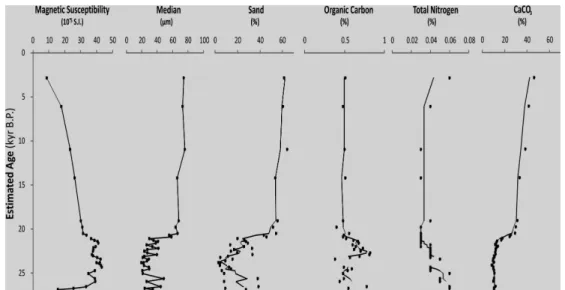
Magnetic susceptibility changes were observed between Pleistocene and Holocene sediments. Higher values of magnetic susceptibility were found in sediments older than 18 cal. kyr Grain size distribution, represented by median size (in m), and sand content (%) presents a trend of coarsening from the LGM (average median of 32 m and approximately 20% of sand) toward the Holocene (average median of 70 m and more than 64% of sand) (Fig. 4). We also observed low
calcium carbonate concentration values (approximately 11%) in LGM sediments, with concentrations increasing post-LGM (average of 36% in post-LGM sediments).
Similar to the calcium carbonate concentration trend, the benthic foraminiferal density (number of specimens in 10 cc of sediment) also increased in post-LGM sediments. Values ranged between 96 and 62,720 tests (Fig. 5). A total of 168 taxa were recognized (Appendix). These specimens were mainly calcareous, with no apparent evidence of dissolution or shattered chambers in the sediments (which could be caused by freeze-drying after sediment sampling).
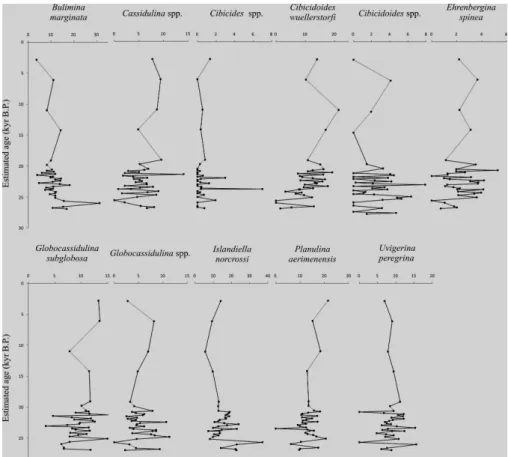
Eleven species had frequencies higher than 3% in at least 10% of samples and were considered “representative species.” Their distribution along the sedimentary column is represented in Figure 6.
Between 10 and 25 cal. kyr, higher frequencies of the infaunal species Bulimina marginata, Islandiella norcrosi and Uvigerina peregrina were observed. Species frequencies of epifauna (Cibicidoides wuellerstorfi, Cibicidoides spp. and Planulina ariminensis d' Orbigny 1826) and shallow infauna (Cassidulina spp., Globocassidulina subglobosa and Globocassidulina spp.) increased in the post-LGM sediments. In contrast, Cibicides spp. and Ehrenbergina spinea had consistently low frequencies throughout the entire core (only 2% - 3%; Fig. 6).
During the LGM, the presence of B. marginata and U. peregrina (Fig. 6) was accompanied by higher BFHP and BFAR values (29%, at 23,000 cal. yr BP and approximately 92,922 tests•cm-2•ka-1, respectively; Fig. 5).
Fig. 4. Along-core distribution of magnetic susceptibility, grain size (median and sand content), calcium carbonate (CaCO3), organic carbon and total nitrogen contents for core 7486.
Fig. 5. Along-core distribution of sedimentation rates, benthic foraminifera density, and indexes BFAR (Benthic Foraminifera Accumulation Rates) and BFHP (Benthic Foraminifera High Productivity), indicating a decrease in productivity towards present time and relatively higher productivity duringthe Pleistocene; and alkenone based SSTs (Sea SurfaceTemperatures) estimated for core 7485 (unpublished data) and G.ruber/G.bulloidesratio for core 7486, suggesting anoverall increase in SSTs towards present time.
The frequencies of infaunal species, the productivity proxies (BFAR and BFHP), and organic carbon contents diminished in post-LGM sediments. For example, organic carbon contents ranged from 0.60% (~20,540 cal. yr BP) to 0.51% in Holocene sediments (Fig. 4). Low values of nitrogen in the sediments during this interval resulted in anomalously high C/N ratios. Post-LGM sediments were also characterized by higher frequencies of shallow infaunal and epifaunal benthic foraminifera species G. subglobosa, C. wuellerstorfi and P. ariminensis (Fig. 6). Pleistocene samples had an average G ruber/G. bulloides ratio of 1.3. This ratio increased toward present time (Fig. 5).
D
ISCUSSIONSedimentation rates appear to have been higher during the LGM, with a decrease toward present time. This could be related to a more effective action of the BC during the Holocene. This hypothesis was proposed by Mahiques et al. (2007) based on the analysis of sedimentological data from core 7485 (see Figure 1 for location). Thus, an evident change in the sedimentation pattern of the study area marks the LGM-Holocene transition. This change is also observed in the magnetic susceptibility, sedimentological and microfaunal data when Holocene and Late Pleistocene sediments are compared.
Magnetic susceptibility changes between Pleistocene and Holocene sediments reflect changes in the terrigenous input pattern in the study area in the last 27,000 years. Higher values of magnetic susceptibility indicate a higher input of terrigenous sediments during the LGM. This higher terrigenous input could be function of: (i) lower RSL conditions (CORRÊA, 1996) that decreased the distance between core site and terrigenous sediment source and/or (ii) more humid climatic conditions over the continent during the LGM (see Sylvestre, 2009 for a review). We favor lower RSL conditions as the predominant factor influencing the increase in terrigenous input at core sites. Humid climatic conditions may be a secondary factor, since more humid climatic conditions have been reported as a source of higher terrigenous input during the LGM (ARZ et al., 1998).
Unfortunately, the origin of the organic matter cannot be confirmed by C/N ratio values, due to the low correlation between organic carbon and total nitrogen (r = 0.04). This low correlation does not guarantee the organic character of the nitrogen. The hypothesis that low calcium carbonate concentrations observed during the LGM can be attributed to dilution by terrigenous sediments (ARZ et al., 1998; MAHIQUES et al., 2007) also supports higher terrigenous input during this period.
During the LGM, the presence of species that were considered to be indicative of high food availability in the environment (B. marginata and U. peregrina; see Martins et al., 2007 for a review) suggests higher input of organic matter to the benthic environment. This is supported by the higher BFHP and BFAR values in LGM sediments (Fig. 5).
Increased benthic productivity is also supported by the higher organic carbon contents in LGM sediments.
The planktonic foraminifera (reflected in the G. ruber/G. bulloides ratio) apparently responded to both productivity and temperature variations. Our data show a positive relationship between the G. ruber/G. bulloides ratio and alkenone-based SST estimates over the last 27 kyr. This relationship enables us to infer that the Brazilian continental margin experienced changes in SST during the LGM. Fossil plankton and organic geochemistry proxies support that there were lower SSTs during the LGM than during the present time. Additionally, higher calcium carbonate contents in Holocene sediments support a warmer scenario during this period (ARZ et al., 1998). These findings are in accordance with the results of Toledo et al. (2007b). These authors found a sharp decrease of SST by approximately 2°C at 21,000 years BP based on planktonic foraminifera data and reconstructed SST for the Southwestern South Atlantic.
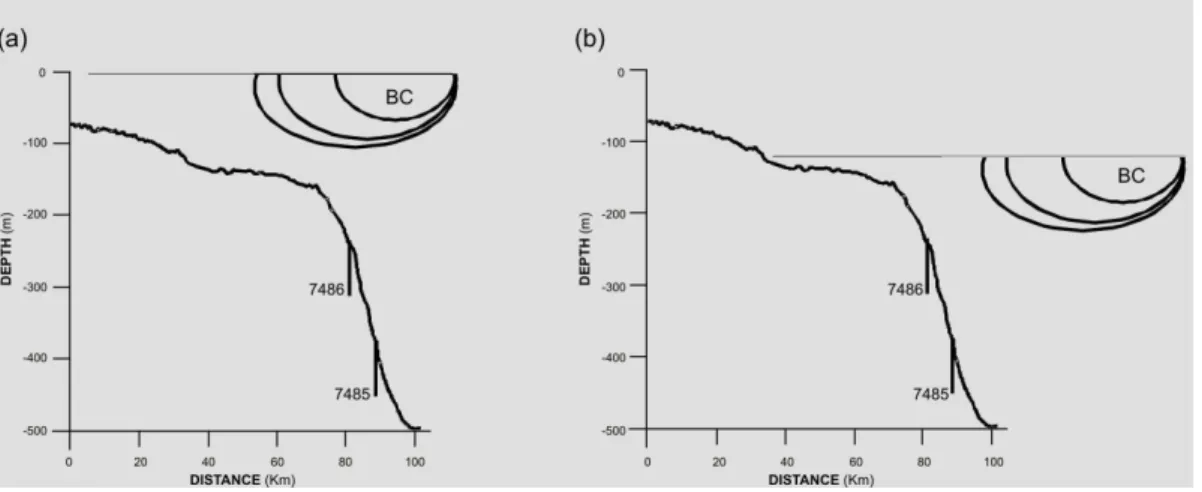
The G. ruber/G. bulloides ratio also suggests the occurrence of a stronger influence of warm and oligotrophic tropical waters in the study area after the LGM. This strong influence of warmer waters, coupled with the trend of grain-size coarsening toward the Holocene, suggests changes in the study area’s hydrodynamic regime. These changes should have been induced by RSL variations. The change in SST observed in our data is also in accordance with a model proposed by Mahiques et al. (2007). This model states that the offshore displacement of the BC under low sea-level conditions resulted in a less intense action of the BC on the outer shelf and upper slope (Fig. 7). We found that during higher RSL conditions, the upper slope was once again covered by the warm waters of the BC (Fig. 7). This, in turn, would have prevented the increase of oceanic productivity during the Holocene.
In a large scale modeling study, Clauzet et al. (2007) reported a strengthening in the flow of the BC during the LGM as a consequence of changes in large scale atmospheric processes. However, changes in the intensity of the BC flow in the Southeastern Brazilian continental margin might not be recorded in our cores if this current displaced offshore during the LGM.
The increased input of organic matter during the LGM might have been caused contributed by BC’s diminished capability of sediment remobilization
(MAHIQUES et al., 2007) leading to higher rate of organic carbon sediment entrapment. In contrast, the post-LGM sediments have lower infaunal species frequencies, lower productivity proxies (BFAR and BFHP) and lower organic carbon contents. This suggests diminished productivity. Toledo et al. (2008) also found a decrease in the productivity through the Holocene. They attributed this decrease to a progressive strengthening of the BC as a result of a southern displacement of the ITCZ, due to insolation changes related to the precessional cycle (TOLEDO et al., 2008). Mahiques et al. (2007) found that this decrease in productivity was due to a displacement of the BC towards land, resulting in a more intense action of the current in the upper slope and outer shelf of the Southeastern Brazilian continental margin (Fig. 7). Thus, the maintenance of the BC warm waters on the upper slope would have prevented a higher productivity during the Holocene.
Grain size distribution also points to more intense action of the BC in the study area after the
LGM. Post-LGM sediments are characterized by higher frequencies of shallow infaunal and epifaunal benthic foraminifera species, such as G. subglobosa, C. wuellerstorfi and P. ariminensis. These species are usually found inhabiting coarser sediments and environments with low nutrient availability, and thus are considered proxies of strong bottom currents (MURRAY, 1991; MACKENSEN et al., 1995; SCHMIEDL; MACKENSEN, 1997; MARTINS et al., 2007). This decrease in productivity in the time post-LGM is also supported by higher G. ruber/G. bulloides ratios.
Apparently, the change in water temperature during the LGM was not restricted to the superficial layers of the water column. During this interval, the presence of the infaunal benthic foraminifera species I. norcrosi is noted. This species is generally found inhabiting low temperature environments (MURRAY, 1991). We found a positive relationship with both benthic foraminifera productivity and geochemical temperature proxies.
Fig. 7. Schematic model showing cores 7486 (this study) and 7485 (Mahiques et al., 2007) positions, and the position of the Brazil Current (BC) under different climatic conditions (a) Present and Isotope Stage 3 and (b) Last Glacial Maximum. (Modified from: Mahiques et al., op cit.).
During the LGM, humid climatic conditions could have increased terrigenous sediment input, thereby influencing water turbidity, decreasing water column light penetration, and altering sea surface salinity.
Salinity changes have also been reported for the Southwestern Atlantic in the last 30 kyr (see Toledo et al., 2007a for a review). Based on three cores from the Southeastern Brazilian continental margin, Toledo et al. (2007a) reported higher sea surface salinity values. These values were highest between 22 and 28 kyr BP and gradual decreased during the Holocene. The observed salinity variations were related to hydrological balance and global
circulation (TOLEDO et al., 2007a). However, the planktonic and benthic foraminifera record (community structure) in our core does not point to salinity changes in the study area over the last 27,000 years.
C
ONCLUSIONSLate Quaternary. During the LGM, higher input of terrigenous sediments and the increase in productivity were due to the offshore displacement of the BC, as a consequence of lower RSL conditions, and to humid climatic conditions over the continent. In contrast, during the Holocene (a period of higher RSL), the increase in water column temperature and more intense action of the BC suggest a displacement of the warm waters of the Brazil Current toward the coast. This displacement prevented the increase in water productivity. Our findings support the conceptual model proposed by Mahiques et al. (2007).
A
CKNOWLEDGEMENTSThe authors wish to acknowledge the crew of the R.V. “Prof. W. Besnard” and the researchers who joined the “Buzios project” cruise in September 2003 and Thaisa Marques for her help in manufacturing the location map figure. This manuscript was substantially improved by the comments of two anonymous reviewers. Financial support was provided by the Fundação de Amparo à Pesquisa do Estado de São Paulo (FAPESP) through grants 01/13490-9 and 04/12693-1.
R
EFERENCESANGULO, R. J.; SOUZA, M. C.; REIMER, P. J.; SASAOKA, S. K. Reservoir effect of the southern and southeastern Brazilian coast. Radiocarbon, v. 47, p. 67– 73. 2005.
ANGULO, R.; LESSA, G. C.; SOUZA, M. C. A critical review of mid- to late-Holocene sea-level fluctuations on the eastern Brazilian coastline. Quat. Sci. Rev., v. 25, p. 486–506. 2006.
ARZ, H. W.; PÄTZOLD, J.; WEFER, G. Correlated Millennial-Scale Changes in Surface Hydrography and Terrigenous Sediment Yield Inferred from Last-Glacial arine Deposits off Northeastern Brazil. Quat. Res., v. 50, p. 157–166. 1998.
BARBOSA, V. P. Foraminíferos Bentônicos Quaternários do talude continental da Bacia de Santos: Sistemática, Paleobatimetria e Paleoecologia. 1998. 427 p. Dissertação de Mestrado - Instituto de Geociências, Universidade Federal do Rio Grande do Sul, Rio Grande, RS., 1998.
BROECKER, W. S.; PENG, T.-H. Carbon cycle: 1985— Glacial to interglacial changes in the operation of the global carbon cycle. Radiocarbon, v. 28, p. 309–327, 1986.
CAMPOS, E. J. D.; VELHOTE, D; SILVEIRA, I. C. A. Shelf break upwelling driven by Brazil Current cyclonic meanders. Geophys. Res. Letts, v. 27, n. 6, p. 751-754, 2000.
CASTRO, B. M. Correntes e massas de água da plataforma continental norte de São Paulo. 1996. 248 p. Tese de livre-docência - Instituto Oceanográfico, Universidade de São Paulo, São Paulo, SP, 1996.
CLAUZET, G.; WAINER, I.; LAZAR, A.; BRADY, E.; OTTO-BLIESNER, B.. A numerical study of the South Atlantic circulation at the Last Glacial Maximum. Palaeogeogr. Palaeoclimatol. Palaeoecol., v. 253, p. 509–528, 2007.
CORRÊA, I. C. S. Les variations du niveau de la mer durant les derniers 17 500 ans BP: l'exemple de la plate-forme continentale du Rio Grande do Sul – Brésil. Mar. Geol., v. 130, p. 163–178, 1996.
EBERWEIN, A.; MACKENSEN, A. Last Glacial Maximum paleoproductivity and water masses off NW-Africa: Evidence from benthic foraminifera and stable isotopes. Mar. Micropal., v. 67, p. 87–103, 2008.
FONTANIER, C.; JORISSEN, F. J.; LICARI, L.; ANSCHUTZ, A.; CARBONEL, P. Live benthic foraminiferal faunas from the Bay of Biscay: faunal density, composition, and microhabitats. Deep-Sea Res. I, v. 49, p.751–785, 2002.
GIANNINI, P. C. F.; SAWAKUCHI, A. O.; MARTINHO, C. T.; TATUMI, S. H. Eolian depositional episodes controlled by Late Quaternary relative sea level changes on the Imbituba–Laguna coast (southern Brazil). Mar. Geol., v. 237, p.143–168, 2007.
HEMLEBEN, C.; SPINDLER, M.; EERSON, O. R. Modern planktonic foraminifera. New York: Springer-Verlag, 1989. 363 p.
HERGUERA, J. C.; BERGER, W. H. Paleoproductivity from benthic foraminifera abundance; glacial to postglacial change in the west-equatorial Pacific. Geology, v. 19, p. 1173–1176, 1991.
JACOB, J.; HUANG, Y.; DISNAR, J.-R.; SIFEDDINE, A.; BOUSSAFIR, M., ALBUQUERQUE, A. L. S.; TURCQ, B. Paleohydrological changes during the last deglaciation in Northern Brazil. Quat. Sci. Rev., v. 26, p.1004–1015, 2007.
JONES, R. W. The Challenger foramifera. London: Oxford Science Publications; The Natural History Museum; Oxford University Press, 1994.149 p.
KEMLE-VON MÜCKE, S.; HEMLEBEN, C. Foraminifera. In: BOLTOVSKOY, D. (Ed.). South Atlantic Zooplankton. Leiden: Backhuys Publishers, 1999. p. 43-73.
LEDRU, M.-P.; ROUSSEAU, D.-D.; CRUZ JR., F. W.; RICCOMINI, C.; KARMANN, I.; MARTIN, L. Paleoclimate changes during the last 100 000 yr from a record in the Brazilian Atlantic rainforest region and interhemispheric comparison. Quat. Res., v. 64, p. 444 – 450, 2005.
LOEBLICH JR., A. R.; TAPPAN, H. Foraminiferal genera and their classification – PLATES. New York: Van Nostrand Reinhold, 1988. 2 v. 970 p.
LOUBERE, P.; FARIDUDDIN, M. Benthic Foraminifera and the Flux of Organic Carbon to the Seabed. In: SEN GUPTA, B. K. (Ed.). Modern Foraminifera. London:Kluwer Academic Press, 1999. p.181-200. MACKENSEN, A.; SCHMIELD, G.; HARLOFF, J.; GIESE,
M. Deep-sea foraminifera in the South Atlantic Ocean: Ecology and assemblage generation. Mar. Micropal., v.41, p. 342-358. 1995.
MAHIQUES, M. M.; MISHIMA Y.; RODRIGUES, M. Characteristics of the sedimentary organic matter on the inner and middle continental shelf between Guanabara Bay and São Francisco do Sul, eastern Brazilian margin. Cont. Shelf Res., v.19, p.775– 798, 1999.
MAHIQUES, M. M.; SILVEIRA, I. C. A.; SOUSA, S. H. M.; RODRIGUES, M. Post-LGM sedimentation on the outer shelf-upper slope of the northermost part of São Paulo Bight, southeastern Brazil. Mar. Geol., v.181, p. 387-400, 2002.
MAHIQUES, M. M.; TESSLER, M. G.; CIOTTI, A. M.; SILVEIRA, I. C. A.; SOUSA, S. H. M.; FIGUEIRA, R. L.; TASSINARI, C. C. G.; FURTADO, V. V.; PASSOS, R.F. Hydrodynamically-driven patterns of recent sedimentation in the shelf and upper slope off southeast Brazil. Cont. Shelf Res., v. 24, p. 1685-1697, 2004. MAHIQUES, M. M.; FUKUMOTO, M. M.; SILVEIRA, I.
C. A.; FIGUEIRA, R. C. L.; BÍCEGO, M. C.; LOURENÇO, R.A.; SOUSA, S.H.M. Sedimentary changes on the Southeastern Brazilian upper slope during the last 35 000 years. An. Acad. Bras. Cienc., v.79, n. 1, p. 171-181, 2007.
MARTIN, L.; SUGUIO, K.; FLEXOR, J. N. Hauts niveaux marins pleistocenes du litoral bresilien. Palaeogeogr. Palaeoclimatol. Palaeoecol., v. 68, n. 3, p. 231–239, 1988.
MARTINS , V.; DUBERT, J.; JOUANNEAU , J.; WEBER, O.; SILVA, E. F.; PATINHA, C.; DIAS, J. M. A.; ROCHA, F. A multiproxy approach of the Holocene evolution of shelf–slope circulation on the NW Iberian Continental Shelf. Mar. Geol., v. 239, p.1–18, 2007. MIX, A. C. Influence of productivity variations on long-term
atmospheric CO2 . Nature, v.337, p. 541-544, 1989. MIX, A. C.; BARD, E.; SCHNEIDER, R. Environmental
processes of the ice age: land, oceans, glaciers (EPILOG). Quat. Sci. Rev., v.20, p.627-657, 2001. MOLLENHAUER, G.; SCHNEIDER, R. R.;
JENNERJAHN, T.; MÜLLER, P. J.; WEFER, G. Organic carbon accumulation in the South Atlantic Ocean: its modern, mid-Holocene and last glacial distribution. Glob. Planet. Change, v. 40, p. 249–266, 2004.
MOREY, A. E.; MIX, A. C.; PISIAS, N. G. Planktonic foraminiferal assemblages preserved in surface sediments correspond to multiple environmental variables. Quat. Sci. Rev., v. 24, p. 925-950, 2005. MURRAY, J.W. Ecology and palaeoecology of benthic
foraminifera. New York: Longman Scientific & Technical, 1991. 397 p.
SARNTHEIN, M.; WINN, K.; DUPLESSY, J.-C.; FONTUGNE, M.R. Global variations of surface ocean productivity in low and mid latitudes: Influence on CO2 reservoirs of the deep ocean and atmosphere during the last 21,000 years. Paleoceanography, v.3, n. 3, p. 361– 399, 1988.
SCHMIEDL, G.; MACKENSEN, A. Late Quaternary paleoproductivity and deep water circulation in the eastern South Atlantic Ocean: Evidence from benthic foraminifera. Palaeogeogr. Palaeoclimatol. Palaeoecol., v. 130, p. 43-80, 1997.
SCHMIEDL, G.; DE BOVÉE, F.; BUSCAIL, R.; CHARRIÈRE, B.; HEMLEBEN, C.; MEDERNACH, L.; PICON, P. Trophic control of benthic foraminiferal abundance and microhabitat in the bathyal Gulf of Lions, western Mediterranean Sea. Mar. Micropal., v. 40, n. 3, p.167-188, 2000.
SILVEIRA, I. C. A.; SCHIMIDT, A. C. K.; CAMPOS, E. J. D.; GODOI, S. S.; IKEDA, Y. A Corrente do Brasil ao largo da costa Leste Brasileira. Rev. Bras. Oceanogr., v. 48, n. 2, p. 171- 183, 2000.
SYLVESTRE, F. Moisture Pattern During the Last Glacial Maximum in South America. In: VIMEUX F. et al. (Ed.). Past climate variability in South America and surrounding regions: From the Last Glacial Maximum to the Holocene, v. 14: Developments in Paleoenvironmental Research. New York: Springer-Verlag, 2009, p. 3-28.
TOLEDO, F. A. L.; CACHÃO, M.; COSTA, K. B.; PIVEL, M. A. G. Planktonic foraminifera, calcareous nannoplankton and ascidian variations during the last 25 kyr in the Southwestern Atlantic: A paleoproductivity signature? Mar. Micropaleont., v. 64, p.67–79, 2007a. TOLEDO, F. A. L., COSTA, K. B., PIVEL, M. A. G.
Salinity changes in the western tropical South Atlantic during the last 30 kyr. Glob. Planet. Change, v.57, p.383–395, 2007b.
TOLEDO, F. A. L.; COSTA, K. B.; PIVEL, M. A. G.; CAMPOS, E. J. D. Tracing past circulation changes in the western south Atlantic based on planktonic foraminifera. Rev. Bras. Paleontol., v. 11, n. 3, p.169-178. 2008.
VAN MORKHOVEN, F. P. C. M.; BERGGREN, W. A.; EDWARDS, A. S. Cenozoic cosmopolitan deep-water benthic foraminifera. Bull. Cent. Rech. Explor.-Prod. Elf- Aquitaine, 421 p., 1986.
VIANA, A. R.; FAUGÈRES, J.-C.; STOW, D. A. V. Bottom-current-controlled sand deposits — a review of modern shallow- to deep-water environments. Sedim. Geo., v. 115, p. 133-157, 1998.
WOLLENBURG, J. E.; KUHNT, W. The response of benthic foraminifers to carbon flux and primary production in the Arctic Ocean. Mar. Micropal., v. 40, p. 189-231, 2000. ZEMBRUSCKI, S. G. Geomorfologia da margem continental
sul brasileira e das bacias oceânicas adjacentes. In: CHAVES, H. A. F. (Ed.). Geomorfologia da margem continental brasileira e das bacias oceânicas adjacentes. Rio de Janeiro: PETROBRAS-CENPES-DINTEP BRAZIL, 1979. Série Projeto REMAC, v. 7, p. 129-177.
Appendix - Along-core distribution of representative benthic foraminifera species densities (tests cm-3). (Supplementary data, available online only).
C o re d ep th ( cm ) E st im a te d a g e (y rs B P ) B u cc el la p er u vi a n a B u li m in a a cu le a ta B u li m in a m a rg in a ta C a ss id u li n a s p p . C ib ic id es s p p . C ib ic id o id es w u el le rs to rf i C ib ic id o id es s p p . E h re n b er g in a s p in ea G lo b o ca ss id u li n a su b g lo b o sa G lo b o ca ss id u li n a s p p . Is la n d ie ll a n o rc ro si L en ti cu li n a s p p . P la n u li n a a er em in en si s P u ll en ia b u ll o id es U vi g er in a p er eg ri n a
0 2840 384 0 1664 3584 640 6528 0 1024 6144 1280 6528 128 9984 256 3200 4 6095 0 0 6912 5888 0 6400 2560 2304 8448 5120 5888 256 9472 256 5632 10 10980 256 0 3712 3968 256 9856 896 1024 3584 3200 2560 0 8448 128 3584 14 14230 128 0 5248 1792 128 6272 0 1152 4224 1792 3584 0 4736 256 3456 20 19110 256 0 1952 1888 160 2144 288 224 2304 640 2592 32 2656 0 2208 22 19825 384 128 1920 1216 64 3584 768 832 2368 960 3008 64 3200 128 1984 24 20540 192 0 1344 896 0 2112 0 256 1408 1024 1664 64 2048 64 1216 26 20723 512 0 2560 1920 0 3968 1280 1664 3584 1152 6016 0 5760 0 0 28 20906 1024 0 5120 1280 128 4992 2048 896 4096 2048 8576 0 6144 0 3072 30 21090 0 128 640 544 0 2080 0 288 1248 672 1920 64 1184 0 1312 32 21275 32 0 896 160 0 576 288 96 1152 448 1280 0 800 32 800
34 21460 0 8 72 264 0 304 0 24 88 48 352 16 320 0 224
36 21640 32 64 1184 192 64 896 256 0 896 512 1824 0 1184 0 960 38 21820 32 24 224 88 0 208 96 72 272 64 392 0 344 0 280 40 22000 88 0 464 216 96 408 8 32 280 144 440 8 408 0 296 42 22180 32 32 528 176 16 752 96 64 544 160 576 0 496 0 368 44 22360 0 0 240 88 0 144 136 72 216 184 184 0 296 0 120 46 22543 8 24 304 160 0 456 0 88 280 152 456 0 312 0 216 48 22726 64 0 120 112 8 344 88 96 248 120 616 8 320 16 224 50 22910 0 0 272 128 24 272 40 72 144 88 344 8 176 8 120 52 23090 40 8 352 128 0 192 72 24 64 120 248 0 192 0 200
54 23270 0 1 31 6 0 50 0 3 32 9 28 2 35 11 43
56 23453 3 0 18 18 1 22 3 4 19 9 53 0 0 0 18
58 23636 1 0 29 14 1 34 3 6 24 23 39 0 35 0 17
60 23820 1 7 18 2 17 20 0 5 28 21 18 1 38 0 30
62 23838 256 128 1664 576 64 1344 384 704 1984 1344 2304 0 2368 64 1536
64 24180 2 0 23 17 0 6 12 4 15 7 26 3 23 18 9
66 24363 3 3 105 60 3 78 43 35 98 68 93 0 115 3 65
68 24546 32 0 200 32 0 144 112 72 200 176 272 8 328 0 200
70 24730 0 0 83 60 5 68 23 15 55 80 70 5 118 0 50
74 25090 0 0 92 36 0 96 0 28 116 36 64 12 160 12 84
80 25640 2 12 24 0 3 0 0 0 12 0 57 1 16 0 0
84 26000 0 0 30 2 0 0 3 1 6 3 22 1 6 0 15
90 26550 0 0 34 12 0 29 0 4 15 10 32 6 39 0 17
92 26730 1 1 16 12 0 8 7 3 10 14 33 1 15 1 9
94 26910 0 5 23 9 1 2 2 1 16 3 31 0 13 0 12