Article
J. Braz. Chem. Soc., Vol. 22, No. 9, 1727-1735, 2011. Printed in Brazil - ©2011 Sociedade Brasileira de Química
0103 - 5053 $6.00+0.00
A
*e-mail: [email protected]
Fast and Simultaneous Determination of Pb
2+and Cu
2+in Water Samples using
a Solid Parafin-Based Carbon Paste Electrode Chemically Modiied with
2-Aminothiazole-Silica-Gel
Daiane H. Silva, Dayane A. Costa, Regina M. Takeuchi and André L. Santos*
Faculdade de Ciências Integradas do Pontal, Universidade Federal de Uberlândia, Av. José João Dib no. 2545, Progresso, 38302-000 Ituiutaba-MG, Brazil
Um eletrodo de pasta de carbono preparado com parafina sólida como aglutinante e quimicamente modiicado com sílica funcionalizada com grupos 2-aminotiazol foi empregado na quantiicação simultânea de Pb2+ e Cu2+ em amostras de água por meio de voltametria de
redissolução anódica. O presente método emprega um tempo curto de pré-concentração (180 s), o qual permitiu a quantiicação simultânea e coniável de Pb2+ e Cu2+ de maneira bastante rápida.
Foram obtidos limites de detecção de 7,3 e 90 nmol L−1 para Pb2+ e Cu2+, respectivamente. Estes
valores estão abaixo das concentrações máximas permitidas destes metais em água potável segundo a legislação brasileira, indicando que o método proposto é aplicável para o monitoramento de Pb2+
e Cu2+ em amostras de água. Estudos de recuperação foram realizados em quatro amostras de água
enriquecidas, sendo obtidas porcentagens de recuperação próximas a 100% para todas as amostras analisadas, demonstrando a boa acuracidade do método proposto.
A solid parafin-based carbon paste electrode modiied with 2-aminothiazole functionalized silica-gel was used for simultaneous quantiication of Pb2+ and Cu2+ in water samples by anodic
stripping voltammetry. The present method uses short preconcentration time (180 s), which allowed reliable and simultaneous quantiication of Pb2+ and Cu2+ in a very fast way. Detection limits of
7.3 and 90 nmol L−1 were obtained for Pb2+ and Cu2+, respectively. These values are below their
maximum concentrations allowed in drinking water by Brazilian legislation, indicating that the proposed method is useful to monitoring Pb2+ and Cu2+ in water samples. Recovery studies were
performed in four spiked water samples and the results shown recovery percentages close to 100% for all analyzed samples, demonstrating the good accuracy of the proposed method.
Keywords: anodic stripping voltammetry, carbon paste electrode, 2-aminothiazole-functionalized silica gel, lead and copper determination, water samples
Introduction
Environmental contamination by heavy metals is a growing concern because they are very toxic, bioaccumulative and totally non-degradable. Therefore, environmental monitoring of heavy metals is of great importance for many reasons, such as identiication of pollutant sources, understanding pollutant dissemination, anticipation of remediation procedures, etc. Copper and lead are two very important metallic pollutants because they are toxic and abundant. Contamination of natural waters by anthropogenic activities is one of the main ways to introduce heavy metals in the environment. Therefore, quantiication
of metallic ions in water samples is very important in order to preserve safe water resources for world population. In all regions around the world, legislative instruments are very restrictive regarding copper and lead contents in water for human consumption. In Brazil, for example, limits for Pb2+ and Cu2+ in drinking water are 0.01 mg L−1 (48 nmol L−1) and 2 mg L−1 (31 μmol L−1) , respectively.1
Electrochemical techniques are promising alternative methods for heavy metals quantiication because they are able to provide high sensitivity and high precision with a relatively inexpensive instrumentation and low operator training requirements. These attractive characteristics have encouraged applications of electrochemical techniques in several areas such as biomedical analysis, industrial quality control and environmental monitoring.2 Potentiometry3-5 and potentiometric stripping methods,6 the simplest electroanalytical techniques, have been successfully used for quantiication of some metallic species in different samples. However, stripping voltammetry is by far the most used electrochemical technique for heavy metals quantiication.
Stripping voltammetry is characterized by very low detection limits, extremely high sensitivity, multielement and speciation capability, suitability for on site and in situ
applications and minimal sample treatment requirements. The contributions of stripping voltammetry combined with the use of microelectrodes for quantiication of metals in water samples were revised by Xie et al.7 Examples of using of stripping voltammetry for quantiication of heavy metals include: determination of Cu2+ in ethanol fuel,8,9 Pb2+ in ethanol fuel,8,10 gasoline11 and fruit juice,12 As3+ in natural water,13 cadmium in natural14 and sea water,15 zinc in sea water,16 etc.
The use of chemically modiied carbon paste electrodes (CPEs) combined to stripping voltammetry has brought impressive advances in electroanalysis of heavy metals. CPEs have become one of the most popular electrode materials due to their attractive properties such as low residual current, wide useful potential window, chemical inertness, ease surface renewal, low cost and easiness of prepare. However, the most attractive feature of CPE is the easiness to perform the chemical modiication of electrode. A CPE can be modified simply adding the chemical modiier to the mixture carbon powder/binder agent with no need of speciic interactions between the chemical modiier and the electrode material. The chemical modiication of a CPE modulates its chemical and/or physical properties establishing interactions between the analyte and the electrode surface leading to an electrode with improved analytical performance. In 2008, it was exactly ifty years since Professor Ralph Norman Adams introduced CPEs. Svancara et al,17 a team of experts in electroanalysis/electrochemistry, wrote a very instructive celebrative review. Some authors from this group are also responsible for the most complete and recent review about the advances in the use of CPEs in electroanalysis.18
Among chemical modiiers used to prepare CPEs, organofunctionalized silica has received special attention
due to the extremely advantageous features presented by silica such as high adsorption capacity, chemical and mechanical stability, insolubility in virtually all solvents and possibility of functionalization with a large variety of groups. Walcarius presented very comprehensive reviews about the contributions of silica-based electrodes to electroanalysis.19-21 Another advantageous feature presented by CPEs chemically modiied with organofunctionalized silica is their high stability since chemical modiier is covalently bonded to silica which avoids its loss by dissolution or leaching.
Nanostructured22-24 and mesoporous25-30 silica have been widely used to prepare chemically modiied electrodes for quantiication of several metallic ions. Conventional silica (amorphous and silica gel) have also been used and it has allowed the reliable and low level quantiication of Cu2+ and Ni2+ in ethanol fuel samples,31-33 Hg2+ and Cd2+ in natural waters,34,35 etc. An advantageous feature of conventional silica is the fact that they are commercially available at relatively low cost. Among organic groups used to functionalize silica, aminothiazole derivatives are the most extensively employed. These groups enable fast preconcentration of metallic ions by chelation at their S and N atoms. In addition, they are stable in conditions of use and they have high afinity to silica allowing its functionalization in a very eficient and simple way.
In this context, this work describes the use of a solid parafin-based CPE (SPCPE) chemically modiied with 2-aminothiazole-silica gel (SiAt-SPCPE) for fast and simultaneous quantiication of Pb2+ and Cu2+ in water samples.
Experimental
Reagents
Stock solutions of copper and lead were prepared from the respective 1000 mg L−1 atomic absorption standard solutions (Fluka). All electrochemical experiments were performed by using 0.1 mol L−1 acetate buffer solution as supporting electrolyte which was prepared from acetic acid (Vetec) and sodium acetate (Merck). All used solutions were prepared using ultrapure water (ASTM type I, 18 MΩ cm of resistivity) produced from a Megapurity® water puriication system.
described by Roldan et al.36 Spectroscopic carbon powder with 1-2 μm particle size from Merck was used to obtain the SPCPEs. Solid parafin from Synth was used as the binder agent. For comparison purposes, conventional CPEs were prepared using mineral oil Nujol® from Aldrich as binder agent.
Apparatus
Differential pulse stripping voltammetry was performed using a μAUTOLAB type III potentiostat/galvanostat coupled to a microcomputer and controlled by GPES 4.9 software. Electrochemical experiments were performed at room temperature using a one-compartment electrochemical cell filled with 10 mL of analyzed solution. A three electrode system comprising a platinum wire auxiliary electrode, a KCl saturated-Ag/AgCl (AgClsat) reference electrode and a homemade SPCPE working electrode was used in all electrochemical experiments.
Electrode preparation
SiAt-SPCPEs were prepared by hand-mixing 2-aminothiazole functionalized silica and carbon powder at the ratio 20%:40% (m/m). This mixture was homogenized in a mortar and pestle for 20 min and it was subsequently added to melted parafin whose mass percentage was always kept at 40%. This new mixture was again homogenized in a thermostated bath (65-75 oC) for 10 min. This inal mixture was placed in an insulin syringe (internal diameter of 5 mm) containing a copper rod as electrical contact. Appropriate packing was achieved by pressing the electrode surface against a weighing paper placed on a lat piece of glass. Before their use, the electrodes were hand-polished on a weighing paper until a smooth surface was obtained.
Analytical procedure
Before their utilization, SiAt-SPCPEs were preconditioned by applying +0.35 V vs. Ag/AgClsat for 60 s in 0.1 mol L−1 acetate buffer solution.
The analytical procedure comprised three steps: (i) the electrodeposition of the metallic ions at SiAt-SPCPE, (ii) the recording of the differential pulse anodic stripping voltammograms and (iii) the electrochemical surface regeneration by applying +0.35 V vs. Ag/AgClsat for 60 s in 0.1 mol L−1 acetate buffer solution.
Four water samples were analyzed: river water (Paranaíba River, Minas Gerais State, MG, Brazil), rain water, tap water and drinking water. Rain and river water samples were collected in polypropylene bottles and storage
in a fridge at 4 ºC until the analysis. These samples were spiked with exactly known amounts of Pb2+ and Cu2+ and they were submitted to addition/recovery experiments performed by standard addition method. In order to keep the sample properties approximately unchanged, acetate buffer was directly prepared in the sample. This procedure avoids sample dilution because just 58 μL of glacial acetic acid and a small amount of a solid reagent were added to 10 mL of the sample. No additional sample pretreatment was performed.
Results and Discussion
Preliminary studies
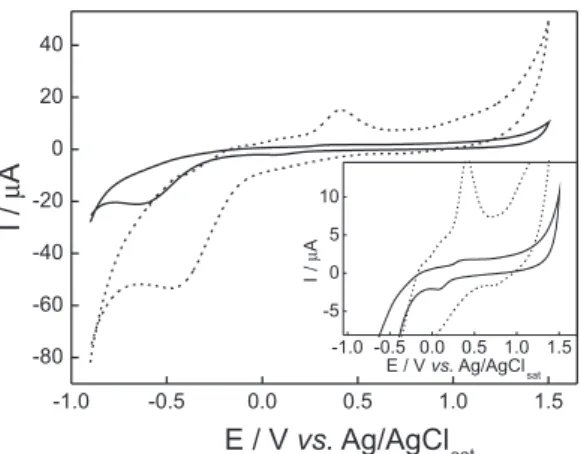
Conventional CPEs are inappropriate for use in totally non-aqueous media due to the binder agent instability in organic solvents. The main strategy adopted to overcome this limitation is to replace mineral oil, the binder agent used to prepare conventional CPEs, by another one able to produce more rigid and stable composites. Thus, the literature presents several promising alternative binder agents such as epoxy resins,37,38 silicone,39 Telon®,40 polyurethane,24 etc. Solid parafin is a very attractive binder agent introduced by Petit and Kauffman41,42 and presents low cost and can be easily handled allowing electrode preparation in a simple and fast way. Recently, we demonstrated that SPCPEs are totally stable in ethanol media, which allowed their use for quantiication of copper32 and nickel33 directly in commercial ethanol fuel samples. The attractive features of solid parafin suggest that this binder agent is advantageous even for analytical applications in aqueous solutions. The composite obtained by using solid parafin as binder agent presents better mechanical strength than conventional CPEs. Thus, SPCPEs are more robust what is important for practical applications. In addition, SPCPE is a more compact composite leading to lower background currents which may signiicantly improve the sensitivity of the electroanalytical method. Figure 1 presents cyclic voltammograms recorded with a SiAt-SPCPE and with a SiAt-conventional CPE (SiAt-CPE).
present any voltammetric peak in this potential range. These voltammetric peaks are more pronounced and broader at SiAt-CPE demonstrating that this electrode is less appropriated for analytical applications because at SiAt-CPE the probability of overlapping SiAt and analyte voltammetric peaks is very high.
In our previous works, we determined copper32 and nickel33 in commercial ethanol fuel samples by anodic stripping differential pulse voltammetry. In these works, the preconcentration step was performed directly in the commercial ethanol fuel sample. Subsequently, the SiAt-SPCPE was transferred to an electrochemical cell containing a support electrolyte in which the electrochemical reduction of accumulated metal ion and its anodic stripping voltammetric detection were carried out. This was an efficient strategy not only to extract metal ions from ethanol fuel sample but also to provide a cleaner media for voltammetric detection, minimizing matrix effects. However, this approach required very high preconcentration time (20 min) leading to extremely low analytical frequency. Recently, Cesarino et al.24,31 used CPEs chemically modiied with organofunctionalized silica for determination of metal ions in different samples by anodic stripping voltammetry. These authors performed the accumulation step at controlled potential conditions directly in the analyzed sample in which the voltammetric detection was also carried out. This procedure allowed the use of very short preconcentration times and it was able to provide very high sensitivity. This seems to be a very interesting strategy since it combines two eficient factors to accumulate metal ions at electrode surface,
i.e. electrodeposition and chelation at organofunctionalized silica. In order to evaluate the possibility of using this strategy, anodic stripping differential pulse voltammograms were recorded using both SiAt-SPCPE and SPCPE in presence of Pb2+ and Cu2+. These voltammograms are shown in Figure 2.
Figure 2 shows that both SiAt-SPCPE and SPCPE present stripping anodic voltammetric peaks for Pb2+ and Cu2+ which enables the simultaneous quantiication of these metallic ions. Besides these anodic stripping peaks, it can be observed that both electrodes present a broad peak centered at −0.25 V which can be attributed to intermetallic species, since this peak is absent when anodic striping voltammograms are record in presence of only one metallic ion. Some authors also observed secondary anodic stripping voltammetric peaks when lead was electrodeposited in the presence of copper on glassy carbon electrodes.43 These secondary peaks were observed between the main peaks of pure metals and they were attributed to the anodic stripping of deposited lead on copper.43 SiAt-SPCPE also present another anodic peak at +0.33 V which was already detected in cyclic voltammetric studies (Figure 1 inset). This voltammetric peak is probably attributed to an oxidation process of 2-aminothiazole since it is absent at SPCPE. Another possibility is that this peak is associated with a copper adsorption post-peak caused by the larger amount of copper accumulated at SiAt-SPCPE surface.
It can also be observed from Figure 2, that SiAt-SPCPE presents higher peak current (ip) values for both metallic ions, therefore allowing the development of a more sensitive voltammetric method. It can be concluded for Pb2+ that the main factor responsible for its accumulation at electrode surface is the electrodeposition process, since the peak current obtained with SiAt-SPCPE is only slightly higher than that produced by SPCPE. This result demonstrates that chelation at SiAt is not so important to Pb2+ accumulation at electrode surface. On the other hand, it was observed a large increase in ip values for Cu2+ when SiAt-SPCPE is used. This result indicates a true synergic effect of Cu2+ electrodeposition and its chelation at SiAt, being this Figure 1. Cyclic voltammograms recorded in 0.1 mol L−1 acetate buffer
solution at 50 mV s−1, (—) SiAt-SPCPE and (----) SiAt-CPE (Nujol® as
binder agent).
Figure 2. Anodic stripping differential pulse voltammograms recorded in 0.1 mol L−1 acetate buffer solution containing 1.0 μmol L−1 Pb2+ and
5.0 μmol L−1 Cu2+, (—) SiAt-SPCPE and (----) SPCPE. Parameters:
last factor even more important for Cu2+ accumulation at electrode surface than electrodeposition. This result is in agreement with previous works32 which demonstrated that 2-aminothiazole groups present higher afinity for Cu2+ ions than for other metallic cations. Therefore, SiAt-SPCPE clearly presents advantages over SPCPE because provides higher sensitivity for both metallic ions allowing the simultaneous and sensitive quantiication of Pb2+ and Cu2+.
Study of operational parameters
The CPE composition has a signiicant effect on the voltammetric performance of the electrode. In a previous work,32 we demonstrated that SiAt-SPCPEs containing 40% (m/m) of solid parafin, 40% (m/m) of carbon powder and 20% (m/m) of SiAt presented the best analytical performance for Cu2+ quantification in commercial ethanol fuel samples. In this previous work, we observed that SiAt contents higher than 20% (m/m) decreased the peak current values due to the replacement of conductive carbon powder by SiAt which is an isolator. On the other hand, SiAt contents lower than 20% (m/m) lead to lower sensitivity for Cu2+. Therefore, based on our previous experience, SiAt-SPCEs containing 40% (m/m) of solid parafin, 40% (m/m) of carbon powder and 20% (m/m) of SiAt were also used in the present work.
Several works showed that acidic medium is the most eficient for metal ions determination by anodic stripping voltammetry.11,14,15,24 Based on this information we selected acetate buffer 0.1 mol L-1 (pH 4.75) as supporting electrolyte. Lower pH values were avoided in order to minimize hydrogen evolution during preconcentration step, which could damage the electrode surface. In addition, high H+ concentration causes protonation of S and N atoms from 2-aminothiazole groups, compromising the preconcentration of Cu2+ and Pb2+ by chelation. Higher pH values were avoided in order to prevent Cu2+ and Pb2+ hydrolysis. Thus, pH values close to 5 seem to be more adequate to prevent intensive hydrogen evolution and to avoid hydrolysis. Acetate buffer is very effective at this pH region and therefore it was selected as supporting electrolyte in the present work.
All other operational parameters involved in the analytical procedure were submitted to optimization studies. The first parameter to be optimized was the preconcentration time. This study was performed in 0.1 mol L−1 acetate solution containing 0.5 μmol L−1 Pb2+ and 1.0 μmol L−1 Cu2+, keeping preconcentration potential equal to −0.8 V. Preconcentration time was studied in the range from 1 to 20 min. This study showed that ip values increase rapidly until 10 min and then they become almost
constant. In order to obtain a high analytical frequency, a preconcentration time of 180 s was adopted in the subsequent experiments. Preconcentration potential was the second parameter to be optimized. This study was performed using the same experimental conditions that were described above (keeping preconcentration time at 180 s). Preconcentration potential was evaluated in the range from −1.2 to −0.6 V. It was observed that the reduction potential values more negative than −0.8 V did not signiicantly increase ip values. Moreover, these highly negative potentials produced very intensive hydrogen evolution, damaging the electrode surface and leading to poor repeatability. Preconcentration potentials less negatives than −0.8 V produced anodic stripping voltammetric peaks with low intensity (mainly for Pb2+) compromising the sensitivity of the analytical method. Based on these results, −0.8 V was adopted as preconcentration potential in all subsequent experiments. The parameters involved in DPV were also submitted to optimization studies, keeping Pb2+ and Cu2+ concentration equal to 0.5 and 1.0 μmol L−1, respectively. The other operational parameters were kept at the previously optimized values. Pulse amplitude effect was evaluated from 10 to 150 mV. It was observed that 50 mV provided the best voltammetric proile because higher pulse amplitudes produced unacceptable broad peaks. Therefore, pulse amplitude of 50 mV was adopted in the subsequent experiments. Pulse width was evaluated from 5 to 100 ms and it was observed that the best voltammetric proile was obtained with 25 ms, which was adopted in this work. Scan rate was studied in the range from 2 to 25 mV s−1 and the optimized value was 10 mV s−1.
the electrochemical regeneration procedure is adopted. Adopting this electrochemical regeneration procedure and using the same electrode surface, it was observed a relative standard deviation (RSD) for ip values of 3.7% and 4.2% for Pb2+ and Cu2+, respectively. When the same electrode was used with surface renewal, RSD for ip values were 4.8% and 4.6% for Pb2+ and Cu2+, respectively. Finally, when different electrodes were employed a RSD of 6.7% was obtained for both metallic ions. These results indicate that SiAt-SPCPE provides very precise results even when different electrodes are used. Moreover, all optimization studies were performed using the same electrode, showing that SiAt-SPCPEs are very stable, being able to keep their voltammetric performance for months.
Analytical studies
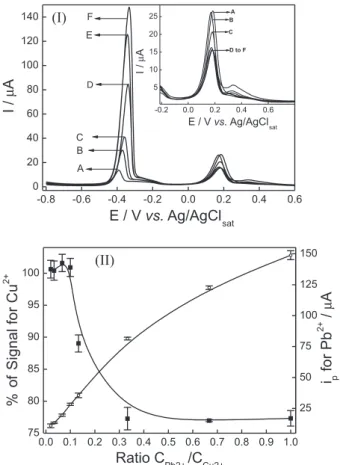
The mutual interference of Cu2+ and Pb2+ was evaluated keeping the concentration of one metallic ion constant while the concentration of the other was gradually increased. The anodic stripping differential pulse voltammograms obtained in the evaluation of Pb2+ interference on Cu2+ signal are presented in Figure 3I. The inluence of the ratio CPb2+/CCu2+ on percentage of signal for Cu
2+ and i p for Pb
2+
is shown in Figure 3II.
Figure 3 shows that Pb2+ does not interfere on Cu2+ signal when Pb2+ concentration is up to ten times smaller than Cu2+ concentration. For higher Pb2+ concentrations, it was observed a signiicant decrease on the percentage of signal for Cu2+. When Cu2+ and Pb2+ are present at the same concentration, it was observed a Cu2+ signal loss of 33%. The evaluation of Cu2+ interference on Pb2+ signal was performed keeping Pb2+ concentration equal to 0.5 μmol L−1. It was observed that Cu2+ did not interfere on Pb2+ signal even when Cu2+ concentration is ifty times higher than Pb2+ concentration. These results indicate that the proposed method can be successfully employed to analyze samples in which Cu2+ is present at higher concentrations than Pb2+. This condition is expected to be found in water samples. Moreover, the interference of Pb2+ on Cu2+ signal could be overcome by using standard addition method, since Cu2+ anodic stripping peak is still observed even when Cu2+ and Pb2+ are present at the same concentration.
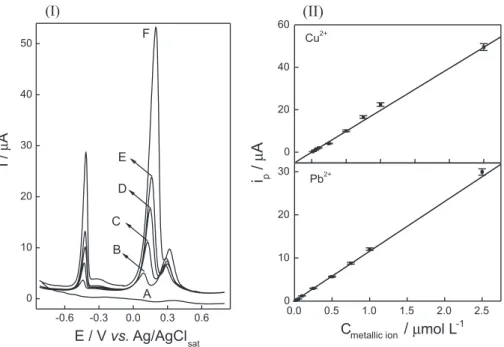
In order to keep the calibration conditions close to that found in water samples, an analytical curve was construct keeping the ratio CPb2+/CCu2+ equal to 0.1. The anodic stripping differential pulse voltammograms employed to construct the analytical curves are presented in Figure 4I. The analytical curves obtained for Cu2+ and Pb2+ are shown in Figure 4II.
It was observed for Pb2+ a linear relationship between ip and Pb2+ concentration from 0.015 to 2.5 μmol L−1. The
analytical curve for this metal ion was linear according to the equation: ip (μA) = 0.02 + 11.5 CPb2+ (μmol L−1) with linear correlation coeficient (R) equal to 0.9944. The obtained LOD was 7.3 nmol L−1 and the limit of quantiication (LOQ) 24 nmol L−1. The analytical curve obtained for Cu2+ was linear from 0.15 to 25 μmol L−1 according to the equation: ip (μA) = 0.002 + 1.98 CCu2+ (μmol L
−1), R = 0.9972. The
obtained LOD was 0.09 μmol L−1 and LOQ 0.30 μmol L−1. The obtained LOD and LOQ values are bellow the maximum concentration allowed of Pb2+ (48 nmol L−1) and Cu2+ (31 μmol L−1) in drinking water, indicating that the proposed method is adequate to quantify simultaneously Pb2+ and Cu2+ in water samples. LOD values obtained for Pb2+ and Cu2+ are close to those reported in literature using other electroanalytical methods.12,22,23,26,27,30 The main positive aspects of the proposed method are the very short accumulation time and the use of a silica commercially available at relatively low cost. In addition, solid parafin is an inexpensive binder agent able to produce robust electrodes in a very simple and fast way. Therefore, the Figure 3. (I) Anodic stripping differential pulse voltammograms recorded in 0.1 mol L−1 acetate buffer solution containing 7.5 μmol L−1 Cu2+ and
(A) 0.15, (B) 0.25, (C) 0.5, (D) 0.75, (E) 5.0 and (F) 7.5 μmol L−1 Pb2+.
Parameters: accumulation potential of −0.8 V, accumulation time of 180 s, scan rate of 10 mV s−1, pulse amplitude of 50 mV and pulse width of
25 ms. (II) Inluence of the ratio CPb2+/CCu2+ on percentage of signal for Cu2+ () and i
practicality of the proposed analytical method, the easiness and low cost associated with SiAt-SPCPEs preparation, their robustness and low background currents are the main advantages of the proposed method compared to other works from literature.
Water samples analysis
SiAt-SPCPEs were employed for the simultaneous determination of Pb2+ and Cu2+ in four water samples: drinking water, tap water, rain water and river water. No Cu2+ or Pb2+ were detected in these samples, indicating that these metal ions are absent or their content in the analyzed samples was below the LOD of the proposed method. In order to evaluate the accuracy of the proposed method, these samples were spiked with exactly known amounts of Pb2+ and Cu2+. The spiked samples were submitted to recovery studies performed by standard addition method. It was observed that the river water was the sample that presented more pronounced matrix effects. In this sample, it was observed a signiicant decrease on anodic stripping peaks for both Pb2+ and Cu2+. The anodic stripping differential pulse voltammograms obtained in recovery studies performed at spiked river water sample are presented in Figures 5I and 5II.
It can be observed from Figure 5 that, besides Pb2+ and Cu2+ peaks, the river water sample presents a voltammetric peak at −0.27 V which did not increase with standard additions of Pb2+ and Cu2+. This voltammetric peak was also independent on preconcentration time, suggesting that
the electroative specie associated with this peak cannot be accumulated at electrode surface by electrodeposition. Despite the partial overlap of the peak at −0.27 V with Pb2+ peak, ip values for this metal could be reliably determined. Since the peak at −0.27 V did not interfere on Pb2+ peak, no additional studies about its nature were conducted. It can be also observed from Figure 5 the previously discussed voltammetric peak at +0.33 V, which could be attributed to an oxidation process of 2-aminothiazole or a Cu2+ adsorption post-peak. The other water analyzed samples Figure 4. (I) Anodic stripping differential pulse voltammograms recorded in 0.1 mol L−1 acetate buffer solution containing (A) 0, (B) 0.25, (C) 0.5,
(D) 0.75, (E) 1.0 and (F) 2.5 μmol L−1 Pb2+. The Cu2+ concentration was kept ten times higher than Pb2+ concentration. Parameters: accumulation potential
of −0.8 V, accumulation time of 180 s, scan rate of 10 mV s−1, pulse amplitude of 50 mV and pulse width of 25 ms. (II) Analytical curves for Cu2+ and Pb2+.
Figure 5. Anodic stripping differential pulse voltammograms recorded in a river water sample containing 0.1 mol L−1 acetate buffer solution.
(I) (---) River water sample and (---) river water sample spiked with 50 nmol L−1 Pb2+ and 500 nmol L−1 Cu2+. (II) Successive standard addition
of 15 nmol L−1 Pb2+ and 150 nmol L−1 Cu2+. Parameters: accumulation
potential of −0.8 V, accumulation time of 180 s, scan rate of 10 mV s−1,
presented only voltammetric peaks attributed to Pb2+ and Cu2+ and the voltammetric peak at +0.33 V.
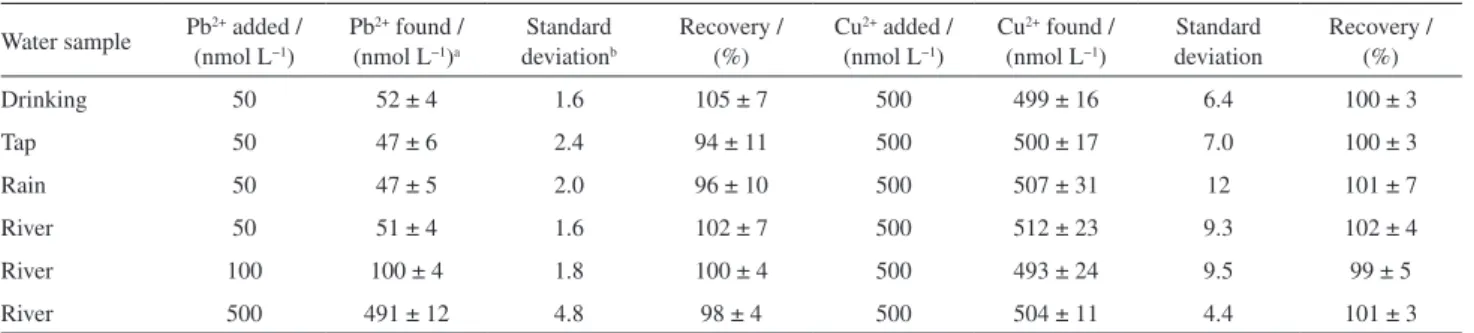
For each one of the spiked samples, three replicate determinations by standard addition method were performed and the obtained results are shown in Table 1. The concentrations and recovery percentages are presented as mean value ± conidence interval (CI) at a conidence level of 95% and n = 3.44 For most of these experiments, samples were spiked with 50 nmol L−1 Pb2+ because this value is very close to the maximum concentration of Pb2+ allowed in drinking water. The level of Cu2+ added to the samples was very smaller than its maximum allowed, since this value is extremely high for the proposed method.
Table 1 shows that confidence intervals obtained for all analyzed samples always contain the nominal concentrations of Pb2+ and Cu2+ added to the samples. This result demonstrates that, at 95% confidence level, there are no statistical differences between the concentrations added and that found by standard addition method. As a consequence, recovery percentages were always close to 100%. Therefore, these results are a very important demonstration of the good accuracy of the proposed method. Moreover, these results indicate that eventual matrix effects presented by the different water samples are successfully overcome by adopting standard addition method. Finally, Table 1 shows that the ratio CPb2+/CCu2+ = 0.1 is not required for the reliable simultaneous determination of these metal ions in water samples. Two additional CPb2+/CCu2+ ratios (0.2 and 1.0) were studied in the river water sample, the most complex analyzed water sample. The obtained results using these CPb2+/CCu2+ ratios were equally satisfactory as shown in Table 1.
Conclusions
This work demonstrated that the use of solid parafin as binder agent is an eficient strategy to prepare carbon based composite electrodes more robust and with lower background currents than conventional CPEs. SiAt was a
good modiier presenting both long-term stability and better sensitivity than a conventional CPEs.
The use of an accumulation potential directly in the analyzed sample enables using very short preconcentration time and allowing the development of a very fast and sensitive voltammetric method for simultaneous determination of Cu2+ and Pb2+ in water samples. Despite some interference of Pb2+ on Cu2+ signal, it was observed that these ions can be reliably determined simultaneously in water samples when standard addition procedure is adopted. For only 3 min of preconcentration time, LOD values obtained for Pb2+ and Cu2+ were 7.3 and 90 nmol L−1, respectively. LOD values for both metal ions are well below their maximum concentration allowed in drinking water samples, indicating that the proposed method seems to be adequate to monitoring water quality in respect contamination by Cu2+ and Pb2+.
Acknowledgements
The authors are grateful to Fundação de Amparo à Pesquisa do Estado de Minas Gerais (FAPEMIG, contract no. CEX APQ-00291-09) and Conselho Nacional de Desenvolvimento Cientíico e Tecnológico (CNPq) for inancial support. The students D. H. Silva and D. A. Costa are especially grateful for the scholarships received from PIBIC/UFU/CNPq program. We also acknowledge Prof. Dr. Pedro M. Padilha from UNESP (Universidade Estadual de São Paulo, Botucatu-SP) for kindly supply us SiAt. Finally, A. L. Santos and R. M. Takeuchi are especially grateful to Prof. Dr. Nelson R. Stradiotto from UNESP (Araraquara-SP) for all lessons, friendship and support at these initial stages of our academic career.
References
1. Ministério da Saúde, Portaria No. 518 de 2004, available at <http://dtr2001.saude.gov.br/sas/PORTARIAS/Port2004/GM/ GM-518.htm>, accessed in January 2011.
Table 1. Analytical results of simultaneous determination of Pb2+ and Cu2+ in different water samples
Water sample Pb2+ added / (nmol L−1)
Pb2+ found /
(nmol L−1)a
Standard deviationb
Recovery / (%)
Cu2+ added /
(nmol L−1)
Cu2+ found /
(nmol L−1)
Standard deviation
Recovery / (%)
Drinking 50 52 ± 4 1.6 105 ± 7 500 499 ± 16 6.4 100 ± 3
Tap 50 47 ± 6 2.4 94 ± 11 500 500 ± 17 7.0 100 ± 3
Rain 50 47 ± 5 2.0 96 ± 10 500 507 ± 31 12 101 ± 7
River 50 51 ± 4 1.6 102 ± 7 500 512 ± 23 9.3 102 ± 4
River 100 100 ± 4 1.8 100 ± 4 500 493 ± 24 9.5 99 ± 5
River 500 491 ± 12 4.8 98 ± 4 500 504 ± 11 4.4 101 ± 3
2. Wang, J.; Analytical Electrochemistry; Wiley: New York, 2001, chapter 1.
3. Javanbakht, M.; Badiei, A.; Ganjali, M. R.; Norouzi, P.; Hasheminasab, A.; Abdouss, M.; Anal. Chim. Acta2007, 601, 172.
4. Abu-Shawish, H. M.; J. Hazard. Mater.2009, 167, 602. 5. Vahl, K.; Kahlert, H.; Scholz, F.; Electroanalysis2010, 22,
2172.
6. Almeida, E. S.; Monteiro, M. A. N. A.; Montes, R. H. O.; Mosquetta, R.; Coelho, N. M. M.; Richter, E. M.; Muñoz, R. A. A.; Electroanalysis2010, 22, 1846.
7. Xie, X.; Stueben, D.; Berner, Z.; Anal. Lett.2005, 38, 2281. 8. Muñoz, R. A. A.; Angnes, L.; Microchem. J.2004, 77, 157. 9. Takeuchi, R. M.; Santos, A. L.; Medeiros, M. J.; Stradiotto,
N. R.; Microchim. Acta2009, 164, 101.
10. Bergamini, M. F.; Vital, S. I.; Santos, A. L.; Stradiotto, N. R.;
Eclet. Quim.2006, 31, 45.
11. Cardoso, W. S.; Fonseca, T. C. O.; Marques, A. L. B.; Marques, E. P.; J. Braz. Chem. Soc.2010, 21, 1733.
12. El Mhammedi, M. A.; Achak, M.; Bakasse, M.; Chtaini, A.;
Chemosphere2009, 76, 1130.
13. Giacomino, A.; Abollino, O.; Lazzara, M.; Malandrino, M.; Mentasti, E.; Talanta2011, 83, 1428
14.Cesarino, I.; Marino, G.; Matos, J. R.; Cavalheiro, E. T. G.;
J. Braz. Chem. Soc.2007, 18, 810.
15. Muñoz, C.; Zúñiga, M.; Arancibia, V.; J. Braz. Chem. Soc.2010,
21, 1688.
16.Arancibia, V.; Zúñiga, M.; Zúñiga, M. C.; Segura, R.; Esteban, M.; J. Braz. Chem. Soc.2010, 21, 255.
17. Svancara, I.; Vytras, K.; Kalcher, K.; Walcarius, A.; Wang, J.;
Electroanalysis2009, 21, 7.
18. Svancara, I.; Walcarius, A.; Kalcher, K.; Vytras, K.; Cent. Eur. J. Chem.2009, 7, 598.
19. Walcarius, A.; Electroanalysis2008, 20, 711. 20. Walcarius, A.; Electroanalysis2001, 13, 701. 21. Walcarius, A.; Electroanalysis1998, 10, 1217.
22. Cesarino, I.; Marino, G.; Matos, J. R.; Cavalheiro, E. T. G.;
Talanta2008, 75, 15.
23. Javanbakht, M.; Divsar, F.; Badiei, A.; Fatollahi, F.; Khaniani, Y.; Ganjali, M. R.; Norouzi, P.; Chaloosi, M.; Ziarani, G. M.;
Electrochim. Acta2009, 54, 5381.
24. Cesarino, I.; Cavalheiro, E. T. G.; Brett, C. M. A.; Electroanalysis
2010, 22, 61.
25. Cesarino, I.; Cavalheiro, E. T. G.; Brett, C. M. A.; Electroanalysis
2008, 20, 2301.
26. Yantasee, W.; Charnhattakorn, B.; Fryxell, G. E.; Lin, Y.; Timchalk, C.; Addleman, R. S.; Anal.Chim. Acta2008, 620, 55.
27. Morante-Zarcero, S.; Sánchez, A.; Fajardo, M.; Hierro, I.; Sierra, I.; Microchim. Acta2010, 169, 57.
28. Xia, F.; Zhang, X.; Zhou, C.; Sun, D.; Dong, Y.; Liu, Z.;
J. Autom. Methods Manage. Chem. 2010, ID824191 (doi: 10.1155/2010/824197).
29. Sánchez, A.; Morante-Zarcero, S.; Pérez-Quintanilla, D.; Sierra, I.; Hierro, I.; Electrochim. Acta2010, 55, 6983.
30. Goubert-Renaudin, S.; Moreau, M.; Despas, C.; Meyer, M.; Denat, F.; Lebeau, B.; Walcarius, A.; Electroanalysis2009, 21, 1731.
31. Cesarino, I.; Marino, G.; Cavalheiro, E. T. G.; Fuel2010, 89, 1883.
32. Takeuchi, R. M.; Santos, A. L.; Stradiotto, N. R.; Talanta2007,
71, 771.
33. Takeuchi, R. M.; Santos, A. L.; Stradiotto, N. R.; Anal. Chim. Acta2007, 584, 295.
34. Dias-Filho, N. L.; Carmo, D. R.; Rosa, A. H.; Electrochim. Acta
2006, 584, 965.
35. Marino, G.; Bergamini, M. F.; Teixeira, M. F. S.; Cavalheiro, E. T. G.; Talanta2003, 59, 1021.
36. Roldan, P. S.; Alcântara, I. L.; Castro, G. R.; Rocha, J. C.; Padilha, C. C. F.; Padilha, P. M.; Anal. Bional. Chem.2003,
375, 574.
37. Teixeira, M. F. S.; Pinto, A. Z.; Fatibello-Filho, O.; Talanta
1997, 45, 249.
38. Moreno-Baron, L.; Merkoçi, A.; Alegret, S.; Electrochim. Acta
2003, 48, 2599.
39. Ballesteros, Y.; Huebra, M. J. G.; Quintana, M. C.; Hernandez, P.; Hernandez, L.; Microchem. J.2003, 74, 193.
40. Prada, A. G.-V.; Pena, N.; Parrado, C.; Reviejo, A. J.; Pingarrón, J. M.; Talanta2004, 62, 896.
41. Petit, C.; Kauffmann, J.-M.; Anal. Proc.1995, 11.
42. Petit, C.; Gonzalez-Cortes, A.; Kauffmann, J.-M.; Talanta1995,
42, 1783.
43. Sousa, M. F. B.; Sanchez, E. M. S.; Bertazzoli, R.; J. Braz. Chem. Soc.2011, 22, 1082.
44. Miller, J. C.; Miller, J. N.; Statistic for Analytical Chemistry, 3rd ed., Ellis Horwood Limited, Prentice Hall: New York, 1993,
p. 53.