From the Division of Urology of the Department of Surgery, Hospital das Clínicas, Faculty of Medicine, University of São Paulo and University of Pennsylvania, School of Medicine.
REVIEW
EVALUATION AND TREATMENT OF THE OVERACTIVE
BLADDER
Eric S. Rovner, Cristiano M. Gomes, Flavio E. Trigo-Rocha, Sami Arap and Alan J. Wein
RHCFAP/3067 ROVNER ES et al. – Evaluation and treatment of the overactive bladder. Rev. Hosp. Clín. Fac. Med. S. Paulo 57(1):39-48, 2002.
The overactive bladder is characterized by symptoms of frequency, urgency, and urge incontinence, substantially affecting the quality of life of millions of people throughout the world. The symptoms are associated with significant social, psychological, occupational, domestic, physical, and sexual problems. Despite the considerable impact of this condition on quality of life, sufferers are often unwilling to discuss their problem with family members or health care professionals. This situation is unfortunate, for much can be done to alleviate the symptoms of this distressing condition. It is therefore of utmost importance that medical education about symptoms of the overactive bladder and other related problems be improved to help health care professionals identify and treat patients who will benefit from therapy. This article reviews current thinking regarding definition, epidemiology, quality of life effects, evaluation, and management of the overactive bladder.
DESCRIPTORS: Bladder diseases. Urinary incontinence. Urodynamics.
The overactive bladder (OAB) is a highly prevalent disorder that impacts the lives of millions of people world-wide. Despite its high prevalence, most sufferers do not seek medical attention and are unaware that OAB is treatable. Notwithstanding the recently increased medical and media attention given to it in many countries, OAB remains vastly underreported and its sufferers untreated. The purpose of this manu-script is to update the definition of OAB for the clinicians involved with the treatment of patients with voiding dysfunction and to present a clinically relevant approach for the evaluation and treatment of this disorder. Further, expanded information may be found in recently published reviews and confer-ence proceedings1-3.
SYMPTOMS AND DEFINITION
Typical symptoms of the overactive bladder include an increased number of micturitions (frequency—emptying the bladder more often than 8 times a day), a strong and sudden desire to void (ur-gency), and if the urge cannot be sup-pressed, urinary urge incontinence. Symptoms of OAB presumably occur because the detrusor muscle is overactive and contracts inappropriately
during the filling phase4-7. Frequency
can occur as a result of reduced func-tional bladder capacity. It can also be
"
The definition of the overactive bladder by the International Conti-nence Society (ICS) is based on urodynamics and is currently being
re-evaluated6,8,9. The ICS definition
in-cludes the presence of involuntary
bladder contractions that are provoked
during a filling cystometrogram while
the patient is attempting to suppress
them8. The reasons why the definition
must be changed are twofold: (1) on a worldwide basis, it is impractical, un-necessary, and impossible for all pa-tients with symptoms of bladder overactivity to be treated by urologists and undergo urodynamic studies, a necessary step in the diagnosis of this condition based on the present defini-tion of the ICS, and (2) urodynamic studies can have both false-positive and false-negative results, and these mis-taken test results can include normal patients in the diagnosis of bladder overactivity or exclude patients who clearly have overactive bladder symp-toms based on a false-negative urodynamic study.
It should be possible to define
blad-der overactivity based on symptoms3.
A reasonable symptom-based defini-tion would be a condidefini-tion referring to the symptoms of frequency and ur-gency, with or without urge or reflex incontinence, when appearing in the absence of local pathological factors (e.g. cancer, carcinoma-in-situ, urinary tract infection, stones, interstitial cys-titis) as explanations for these symp-toms. Patients with overactive bladder can include individuals with and with-out a possible neurologic cause for their symptoms. Urodynamic bladder overactivity would then describe the phenomenon of involuntary bladder contractions causing symptoms or signs. The distinction between detrusor hyperreflexia and instability is not as clear-cut as it once seemed, however. Does an individual with involuntary bladder contractions with no gross neu-rological signs or symptoms but with
a cerebral imaging abnormality have hyperreflexia or instability? Does it matter?
PREVALENCE
It is difficult to estimate the true prevalence of bladder overactivity for two reasons: (1) Despite the consider-able impact of bladder storage symp-toms on quality of life, many patients never seek medical help and are thus uncounted; (2) There have been very few epidemiologic surveys carried out on the symptoms of urgency and fre-quency alone without incontinence. Surveys on the prevalence of urinary incontinence have been done, and es-timates of the prevalence of bladder overactivity have been obtained by adding together the fraction of urge in-continent patients to the number of
those with mixed incontinence6,9,10.
Thus, the most prevalent figures that are available significantly underesti-mate the extent of the problem. A re-cent survey has found that the vast ma-jority of people with chronic, bother-some symptoms of bladder overactivity complained of frequency and urgency, while only a third complained of urge
incontinence11. The survey found that
the total prevalence of OAB within the general population aged 40 years and over ranged from 12% to 22% in a sample of some 17 000 people in 6 Eu-ropean countries. It demonstrated that the risk of developing OAB increases with age. In the group of people 75 years and older, the prevalence ranged
between 30% and 40%11. Another
problem that one encounters is exactly how to define urgency and frequency. For instance, if one defines frequency as simply voiding over 8 times per day, one will conclude that an incredible proportion of the world’s population has overactive bladder. Furthermore, most of us experience significant ur-gency on one occasion or another, but
it is not a chronic problem for us. Thus, the way that questions are asked re-garding frequency and urgency makes a great difference with respect to re-ported prevalence.
QUALITY OF LIFE; SOCIAL COSTS
Urinary incontinence is associated with reduced levels of social and per-sonal activities, increased psychologi-cal distress, and overall decreased qual-ity of life (QOL) as measured by
nu-merous indices12-16. Urinary
inconti-nence is, however, only one aspect of OAB. Little data exists on the QOL impact of OAB in general or of ur-gency and/or frequency without incon-tinence17.
Emerging studies and studies in progress have shown that patients with OAB do suffer significantly poorer QOL than an age matched popula-tion11,18. Those with OAB have been
found to experience a lower QOL in the social and functional domains than diabetics. Other studies have shown that the QOL of patients with symp-toms caused by the overactive bladder is more adversely affected than that of stress incontinence sufferers. This find-ing presumably reflects the differences in the symptoms experienced. Com-pared with stress incontinence, the overactive bladder is harder to predict, is more likely to disrupt sleep and daily activities, and more often leads to the loss of large volumes of urine14,19.
The overactive bladder and stress incontinence are problems that both sufferers and their physicians often fail to discuss. In a survey conducted in the UK, it has been shown that although approximately half of all sufferers would welcome some form of treat-ment, there is a reluctance to seek help11. Only one-third of regularly
Up to two-thirds of patients first seek-ing medical advice have had their symptoms for over 2 years. The rea-sons cited for this marked reluctance to seek help include low expectations of treatment and being too embarrassed.
The medical profession has often done little to dispel patients’ common misconceptions about the condition. Research in this area has shown that although the majority of patients who discuss their condition with their pri-mary care physician feel that they are treated sympathetically, 30% of those who discuss their problems with a health care professional receive no as-sessment and about 80% are not exam-ined. Dismissing incontinence and re-lated symptoms as minor ailments is misguided.
These symptoms can be the cause of great discomfort, shame, and loss of confidence, causing withdrawal from social life and affecting physical and mental health. In addition to the nega-tive impact on the quality of life of those affected, a considerable financial burden is placed on society as a result of neglecting to diagnose and treat the condition20. Studies of health care costs
in the USA and Sweden estimate that urinary incontinence accounts for at least 2% of the national health care
budgets11. Wagner and Hu estimated
that the societal cost of incontinence for individuals in the USA aged 65 years and older in 1995 was a stagger-ing 26.3 billion dollars21.
PATHOPHYSIOLOGY
Ultimately, whatever the primary cause of OAB, the mechanism for bladder overactivity must be either
neurogenic or myogenic22,23. The
cen-tral nervous system mechanisms con-trolling the lower urinary tract are or-ganized in the brain and spinal cord as simple on-off switching circuits under voluntary control. Damage to central
pathways that are normally inhibitory (stroke, Parkinson’s disease, multiple sclerosis, spinal cord injury, etc.) or sensitization of peripheral afferent ter-minals in the bladder can unmask primitive voiding reflexes that trigger bladder overactivity. This neurogenic
basis is fully explored by deGroat23.
Brading summarizes evidence for
myo-genic basis for OAB22. She describes
spontaneous contractile (electrical) ac-tivity in detrusor strips from all species that is myogenic (originating in the muscle itself) but that fails to produce fused tetanic contractions because of poor electrical coupling between blad-der smooth muscle cells. Precipitating factors such as bladder outlet obstruc-tion can cause a partial denervaobstruc-tion of smooth muscle, leading to a state of decreased responsiveness to activation of intrinsic nerves but supersensitivity to contractile agonists and direct elec-trical activation24-26. Spontaneous
activ-ity increases, and there is an increase in cell-to-cell electrical coupling. Fill-ing, under these circumstances, could cause synchronous activation of the smooth muscle of the bladder wall and an increase in intravesical pressure. The most plausible situation for this type of phenomenon to occur would be in the male with bladder outlet obstruction, a condition in which 50% of affected in-dividuals exhibit detrusor instability27-30.
Each theory has its proponents, and doubtless, neither can account for all in-stances of OAB. It is often difficult to separate neurogenic and myogenic ori-gin, and often they seem to be intercon-nected and complementary.
EVALUATION
Identifying patients with lower uri-nary tract symptoms caused by an OAB, and differentiating between OAB and other types of urinary incon-tinence (i.e. stress inconincon-tinence, etc) is paramount to selecting appropriate
treatment for the individual patient. National and international urological societies recommend that the initial evaluation should include, at a mini-mum (1) an assessment of the patient’s symptoms; (2) physical examination; and (3) urinalysis31,32. A holistic
ap-proach should be employed, in which confounding conditions are identified and addressed. Once urinary tract in-fection has been excluded, it is possi-ble in most cases to establish a work-ing diagnosis based on the patient’s description of symptoms and initiate therapy. In some patients, particularly those with symptoms of difficulty emp-tying, it may be desirable to measure post-void residual urine by catheteriza-tion or ultrasound to exclude incom-plete bladder emptying as a cause of the patient’s symptoms. In cases where there is uncertainty regarding the diag-nosis, more advanced investigations, such as urodynamic assessment and/or cystoscopy should be carried out.
Symptom Assessment. When
tak-ing the patient’s history, the aim is to both make a working diagnosis and to assess the impact of the symptoms on the patient’s quality of life. As dis-cussed previously, the typical symp-toms of OAB include frequency, ur-gency, and urge incontinence. How-ever, symptoms are not always diag-nostic. Patients with stress inconti-nence, for example, may void fre-quently in an attempt to avoid leakage, since this condition is generally worse when the bladder is full. A careful his-tory of the condition, with special em-phasis on onset, progression/regres-sion, response/nonresponse to treat-ments, is valuable. The use of a diag-nostic aid is sometimes helpful for dis-tinguishing between the symptoms of OAB and stress incontinence (Table 1). However, these two conditions often
coexist9. Symptoms of bladder
"
symptoms should concentrate on fac-tors potentially related to etiology (neu-rologic, metabolic, medications, etc).
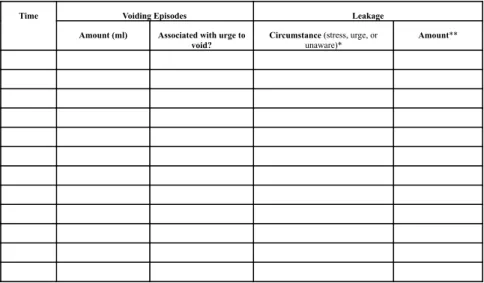
Frequency of micturition, the sen-sation of urgency and leakage episodes can be assessed by patient recall at the time of interview, or by
self-monitor-ing usself-monitor-ing a frequency/volume chart or
voiding diary (Fig. 1). Self-monitoring
on a daily basis, using a chart, is a sim-ple and practical method of obtaining information on voiding behavior. The point in time and volume of all voids over a specified period, together with
subjective information regarding sensa-tions of urgency and leakage episodes, are recorded in the individual’s own environment under normal conditions. To quantitate the amount of urine loss, if incontinence exists, a variety of pad tests are available and can serve as a baseline for subsequent outcome as-sessment33.
Physical Examination. Physical examination should ideally include an abdominal exam to exclude a distended bladder, a neurologic assessment of the perineum and lower extremities, a
pel-vic exam in women (looking especially for evidence of prolapse or hormonal deficiency), and a genital and prostate exam in men. In females, an assess-ment of anterior vaginal wall prolapse (i.e. urethral hypermobility) and a Marshall-Bonney test may be per-formed to exclude coexistent stress in-continence in those patients with symp-toms of mixed urinary incontinence. In both sexes, digital rectal exam provides an opportunity to check ambient rec-tal tone, the integrity of the sacral re-flex arc (e.g. anal wink, etc.), as well as to assess the patient’s ability to per-form a voluntary pelvic floor muscle contraction (i.e. “Kegel” exercise), which may be an important factor in deciding on appropriate therapy.
Urinalysis. Altered bladder
sensa-tion during urinary tract infecsensa-tions can cause symptoms similar to those of OAB. Urine microscopy and culture are the diagnostic gold standard, but reagent strip testing of urine is a sen-sitive and cheaper screening method. Tumors of the lower urinary tract may likewise cause urgency, frequency, and urge incontinence. Hematuria merits further urologic investigation. Irritative symptoms may prompt a voided urine sent for cytology, which, if positive for tumor or dysplastic cells, should like-wise mandate further urologic evalua-tion. Significant glucosuria or proteinu-ria should prompt further medical or nephrologic evaluation or referral.
Residual Urine Measurement. It
is desirable to measure post-void re-sidual urine in some patients, particu-larly in the elderly with voiding symp-toms and/or recurrent or persistent uri-nary tract infections, in those with neu-rological disease and voiding dysfunc-tion, and in those with symptoms that suggest poor bladder emptying. Ultra-sound or catheterization may be used to measure the volume of urine re-maining in the bladder after voiding with distinct advantages to each method34,35.
Table 1 - Differentiating OAB from stress incontinence (After Abrams and Wein,
1998) 11.
SYMPTOMS Overactive Bladder Stress Incontinence
Urgency (strong, sudden Yes No
desire to void)
Frequency with urgency Yes Rarely
Leaking during physical No Yes
activity e.g., coughing, sneezing, lifting, etc.
Amount of urinary leakage Large Usually
with each episode of incontinence if present small
Ability to reach the toilet in No or Yes
time following an urge to void just barely
Nocturnal incontinence (presence of Yes Rarely
wet pads or undergarments in bed)
Nocturia (waking to pass urine at night) Usually Seldom
*Stress incontinence is leakage when coughing, sneezing, or with physical activity; urge incontinence is leakage associated with a strong desire to void that cannot be suppressed, and unaware incontinence is leakage that is not perceived by the patient when it happens. ** large (soaked underwear), medium (damp), or small (few drops)
Other Studies. Urodynamic
stud-ies quantitate data referable to the ac-tivity of the bladder and bladder out-let during the filling/storage and emp-tying phases of micturition. This tech-nique allows exact characterization of any voiding dysfunction as well as the demonstration of lower urinary tract obstruction and its secondary effects on the bladder. A great deal of information regarding the function of the lower uri-nary tract is readily available from a properly performed urodynamic study, but its interpretation should be made within the context of the patient’s pre-senting symptoms. Clearly, not all pa-tients presenting with complaints of the OAB require sophisticated or even sim-ple urodynamics. These studies are generally reserved for patients with mixed symptomatology or those who have failed initial therapy.
Other studies including cystos-copy, measurement of serum PSA, se-rum chemistries, including creatinine and radiographic imaging, should be done in a selective and judicious man-ner when clinically indicated.
MANAGEMENT
Transient or reversible conditions that result in OAB-type symptoms should immediately be addressed. These will be readily identified from a properly performed history, physical examination, and initial evaluation as described previously (e.g. urinary in-fection, hormone deficiency, drug side effects, excessive urine output, fecal impaction, altered mental state). Ap-propriate treatment of other conditions that can contribute to or be associated with OAB (bladder outlet obstruction, vaginal prolapse, significant stress in-continence, diabetes) should always be considered, since therapy of these problems may often improve or allevi-ate symptoms completely.
Except in those cases where OAB
is clearly secondary and reversible by correction of a primary cause (bladder outlet obstruction, etc.), one does not cure OAB. One rebalances lower uri-nary tract function with the help of behavioral, pharmacologic, neurosti-mulatory, or surgical modalities. Actual management options for OAB are fairly easy to characterize and are de-signed to facilitate bladder filling/urine storage by decreasing contractility, in-creasing capacity, or dein-creasing sensa-tion (Table 2). We will consider only some of these in detail and refer the reader to other sources for a more com-plete discussion and references1,2,36-41.
Behavioral therapy
This rubric includes: (1) patient edu-cation about lower urinary tract func-tion; (2) fluid management; (3) bladder training or retraining; (4) pelvic floor physiotherapy; and (5) for physically or mentally challenged individuals, sched-uled and/or prompted voiding. For the average community-dwelling indi-vidual, the aim of behavioral therapy is to help regain bladder control by in-creasing the effective capacity of the bladder and thereby reducing the symp-toms of the overactive bladder. Keeping a record in the form of a frequency/vol-ume chart, plays a central role in blad-der training, as well as looking at the urine output in relation to the patient’s fluid intake, which may need to be re-duced. The patient is asked to gradually increase the intervals between voiding by maneuvers that inhibit the micturi-tion reflex (i.e. pelvic floor exercise or “Kegel” exercises), resulting in a gradual increase in bladder capacity. These exercises are taught in such a way that patients can use this physiologic mechanism to inhibit an impending or beginning bladder contraction (micturi-tion reflex). A properly timed “Kegel” exercise (voluntary contraction of the striated muscle of the pelvic floor) may have the dual benefit of increasing
out-let resistance as well as inhibiting the micturition reflex and sacral arc during an involuntary bladder contraction. Of-ten patients are initially unable to “find” and voluntarily contract their pelvic floor effectively. Biofeedback and/or electrical stimulation may be quite ben-eficial as adjunctive measures in ena-bling patients to locate and utilize their pelvic floor in an effective manner. The frequency/volume chart is used through-out therapy in order to monitor its suc-cess. Initially, in some cases, it may be useful to ask the patient to void hourly by the clock. Once this is managed without leakage, the interval is increased by 15 minutes at a time, until the inter-val between voiding is between 2 and 4 hours.
Results with behavioral therapy are quite good. Fantl et al. recorded a 57% reduction in incontinent episodes and a 54% reduction in the quantity of urine loss in older women42. The
reduc-tion in incontinence episodes was simi-lar in patients with OAB and stress
in-Table 2 - Therapy to facilitate bladder
filling and urine storage.
Inhibiting bladder contractility, decreasing sensory input and/or increasing bladder capacity
Behavioral therapy Timed bladder emptying Bladder training; biofeedback Pharmacologic therapy Anticholinergic agents Musculotropic relaxants Calcium antagonists Potassium channel openers Prostaglandin inhibitors Beta-adrenergic agonists Alpha-adrenergic antagonists Tricyclic antidepressants Dimethyl sulfoxide (DMSO) Polysynaptic inhibitors
Therapy decreasing sensory input Bladder overdistention
Electrical stimulation (reflex inhibition); neuromodulation
Acupuncture
Interruption of Innervation Central (subarachnoid block)
""
continence; the reduction in quantity of loss was better in OAB patients than those with stress incontinence. Fantl reviewed several studies and concluded that behavioral therapy for OAB re-sulted in complete resolution of symp-toms in less than 15% of patients but a 50 to 75% reduction of symptoms in
50%43. Behavioral therapy can be
uti-lized by any health care professional. It is simple, inexpensive, and effective. It does, however, require patient and caregiver motivation and a time com-mitment14,44. It can and should be
eas-ily combined with other nonsurgical regimens.
Pharmacotherapy
Pharmacotherapy and behavioral therapy are the mainstays of treatment of OAB. Although there are multiple central and peripheral sites and mecha-nisms that can influence bladder func-tion, few are clinically useful. The problems are: (1) how to affect blad-der function without interfering with the function of other organ systems (uroselectivity) and (2) how to elimi-nate overactivity without disturbing normal micturition36. Multiple types of
drug therapies are potentially useful for decreasing bladder contractility or de-crease sensation, but antimuscarinic medication remains the most com-monly prescribed treatment (Table 3)32,39,45.
Parasympathetic impulses travel to the bladder along the efferent fibers of the pelvic nerves. Contractions of the detrusor muscle are mediated mainly by muscarinic receptors. There are 5 known subtypes of these receptors. Muscarinic receptors are widely dis-tributed throughout the body. However, it is the M-3 variety that is responsible for involuntary bladder contractions and for the emptying contraction of a normal micturition46.
Thus, most antimuscarinic therapy is primarily anti–M-3 based. Atropine is the reference anticholinergic compound; however, it is not readily absorbed from the GI tract and has the potential to cause significant adverse effects. Cur-rently, there are many anticholinergic preparations available for the phar-macologic treatment of the OAB. Some of these pharmaceuticals have an addi-tional and varying component of direct-acting smooth muscle relaxant proper-ties (musculotropic smooth muscle re-laxant or antispasmodic properties). Whether these agents exert their clini-cal effects primarily through an anti-cholinergic mechanism or by way of a direct action on smooth muscle is un-known. In addition, the molecular mechanism by which these direct-acting smooth muscle relaxants act is un-known, but it is generally felt to be somewhere metabolically distal to the muscarinic receptor, perhaps in altering the intracellular handling of calcium.
Several recent reviews cover these medications and their effects on the lower urinary tract in more detail39,47. In
patients with involuntary bladder con-tractions, anticholinergic agents will in-crease the volume to the first involun-tary bladder contraction, decrease the amplitude of that contraction, increase bladder capacity, but will not change the “warning time”. Thus, drug therapy must always be combined with behavioral therapy to achieve optimal results in OAB39.
The problem with current anticho-linergics has been the incidence of side effects, particularly related to salivary gland secretion and bowel function, which are significant enough to cause the patient to discontinue taking the medication. In one study, it was esti-mated that only approximately 18% of patients remained on anticholinergic therapy for over 6 months48. Activation
of the M-3 receptors is responsible for bladder contraction, but M-3 receptors are also responsible for salivary gland smooth muscle contraction and gut smooth muscle contraction. Receptor selectivity alone does not seem to be a terribly practical concept for developing new agents unless an agent preferen-tially inhibits bladder M-3 receptors over those of the salivary gland or gut. Tolterodine is a recently introduced agent that is not receptor specific but that is relatively tissue-specific, in the sense that it has a greater effect on blad-der smooth muscle than on salivary gland smooth muscle. Oxybutynin is the most prescribed anticholinergic drug and appears to have the opposite profile. In trials to date, tolterodine has pro-duced beneficial therapeutic effects equivalent to oxybutynin with signifi-cantly fewer adverse effects than cur-rently used oxybutynin preparations49-51.
Reductions in OAB incontinence epi-sodes with anticholinergic therapy range from 40% to 70%, with reductions in urinary frequency being statistically sig-nificant but numerically less49-51. Table 3 - Commonly utilized anticholinergic/antispasmodic preparations.
Anticholinergic agents Dose (adults)
Hyoscyamine sulfate (Levsin)* 0.125 mg 3-4x/day
Propantheline bromide (Probantine)** 7.5-30 mg 3-4x/day
Tolterodine (Detrusitol) 1-2 mg 2x/day
Antispasmodics (variable amounts of anticholinergic properties)
Oxybutinin chloride (Retemic, Incontinol, Urazol, Frenurin) 2.5-5 mg 3x/day Oxybutinin chloride extended release (Ditropan XL)* 5-10 mg 1x/day
Dicyclomine hydrochloride (Bentyl) 10-20 mg 3x/day
Flavoxate hydrochloride (Genurin) 200 mg 3-4x/day
*Not available in Brasil
Estrogen therapy has the potential for successful treatment of OAB symp-tomatology in postmenopausal women. Although there are multiple mecha-nisms by which estrogen might favorably affect lower urinary tract function, opinion is divided as to whether low dose local therapy or sys-temic therapy can per se ameliorate ir-ritative lower urinary tract symptoms in
the postmenopausal female52-55.
Peripheral electrical stimulation
Electrical stimulation has been used by some investigators with success56-59.
Peripheral electrical stimulation is thought to act through a mechanism involving reflex inhibition of motor output to the bladder and by activating inhibitory sympathetic fibers. However, there are disclaimers. Reported results have been mostly in patients with ur-gency incontinence, since incontinence episodes are generally associated with involuntary bladder contractions (a measurable parameter) and since in-continence episodes themselves are relatively easy to quantitate. Vaginal, anal, and lower extremity electrodes have produced “cure” rates of as high as 20% and improvement rates as high
as 50% to 60%56-59. Duration of
therapy, duration and intensity of stimulus, ideal delivery modality, and other parameters are not standardized and vary considerably between institu-tions. Often, in series such as these (not just electrical stimulation), it is difficult to figure out exactly what “improve-ment” means, and for how long im-provement lasts, and whether patients believe that, overall, their quality of life is significantly improved.
Other therapies
Bladder overdistention, transvagi-nal alcohol/phenol injections, and transvaginal dissection, such as the Ingelman-Sundberg procedure, are all
forms of peripheral denervation/neuro-logic decentralization. Each has its ad-vocates. Following the progression of the algorithm to this stage with unsuc-cessful results, and excluding sacral rhizotomy or dorsal ganglionectomy in patients other than spinal cord injury patients, the two modalities of therapy that remain are an implantable stimulator for neuromodulation and augmentation cystoplasty. Catheteriza-tion or urinary diversion can each be thought of as methods for circumvent-ing the condition, not treatcircumvent-ing it47.
Neuromodulation is a term used to describe alteration of reflex pathways. Sacral nerve stimulation with an implantable stimulator has been used with success for urge incontinence60-63.
This minimally invasive procedure is a 2-step process. Initially, the patient has percutaneous placement of a wire elec-trode into the S3 foramina alongside of the nerve root as an outpatient proce-dure. The wire is then attached to an external pulse generator, and the pa-tient is sent home. If the papa-tient has a suitable response after 3 days of therapy, a permanent implant is then scheduled. The surgery for the perma-nent implant involves an incision in the lower back with a wire advanced into the S3 foramina under direct vision. The wire is then tunneled around to the flank. A pulse generator is then placed into the subcutaneous tissues on the anterior abdominal wall. The pulse generator is connected to the previ-ously placed wire as it is tunneled sub-cutaneously around the flank. The pulse generator can be programmed by an external device and magnet in a similar manner as for a cardiac pace-maker. Trials are still ongoing with this device (Interstim®) for urge inconti-nence and other lower urinary tract dysfunctions.
Surgery may improve severe overactive bladder symptoms when more conservative management has failed. Augmentation cystoplasty refers
to procedures that increase bladder ca-pacity. In enterocystoplasty, a portion of bowel is removed from the fecal stream and is incorporated into the dome of the bladder. Thus, although detrusor overactivity may remain, con-tractions in the filling phase do not re-sult in a rise in detrusor pressure suffi-cient to cause leakage. However, sub-sequent complications that may arise include inadequate emptying resulting in recurrent urinary tract infections, urinary retention, mucous accumula-tion and stones, electrolyte imbalance, and rarely, malignant change. Not all patients are candidates for augmenta-tion cystoplasty, and the possibility of the need for lifetime clean intermittent catheterization must be discussed with the patient prior to the consideration of surgery. The potential complications ensure that surgical procedures are re-served for severe cases of urge intinence that have been resistant to con-servative therapy64.
Auto-augmentation refers to a type of cystoplasty that involves excision of a large portion of detrusor muscle with preservation of the underlying mucosa (detrusor myomectomy). This proce-dure allows a bladder diverticulum to form with consequent increase in ca-pacity64. The procedure avoids the
mor-bidity associated with bowel resection and incorporation of bowel in the uri-nary tract, but there is far from unani-mous agreement that the results ap-proach those of enterocystoplasty.
in-"$
vasive method of neuromodulation. Fi-nally, ongoing research in biotechnol-ogy and tissue engineering may pro-duce a functional, stable, compatible
tissue substitute suitable for bladder augmentation that is produced entirely in the laboratory, thereby precluding
the need for bowel interposition in the urinary tract and its attendant morbid-ity65-70.
RESUMO RHCFAP/3067
ROVNER ES e col. - Avaliação e tratamento da bexiga hiperativa.
Rev. Hosp. Clín. Fac. Med. S. Paulo 57(1):39-48, 2002.
A bexiga hiperativa é caracterizada pelos sintomas de freqüência, urgência e urge-incontinência e afeta de forma significativa o estilo de vida de milhões de pessoas em todo o mundo. Os sin-tomas são responsáveis por problemas
nas esferas social, psicológica, ocupa-cional, doméstica, física e sexual dos pacientes. Apesar do considerável im-pacto desta condição sobre a qualida-de qualida-de vida, granqualida-de parte dos pacientes reluta em discutir o problema com membros da família ou profissionais de saúde. Esta situação é lamentável, já que existem muitas maneiras de aliviar os sintomas da hiperatividade vesical. Por essa razão, é fundamental que se aprimore a educação médica sobre os
sintomas de hiperatividade vesical e outros problemas relacionados, de modo a preparar os profissionais de saúde a identificar e tratar os pacien-tes com esta condição. Este artigo é uma revisão dos conceitos atuais, de-finição, epidemiologia, efeitos sobre a qualidade de vida, avaliação e trata-mento da bexiga hiperativa.
DESCRITORES: Bexiga.
Inconti-nência urinária. Urodinâmica.
REFERENCES
1. OVERACTIVE Bladder and its Treatments Consensus Conference. London, United Kingdom, July 4, 1999. Urology 2000;55:1-84. 2. THE Overactive Bladder: From Basic Science to Clinical Management
Consensus Conference. Proceedings. London, England, June 29, 1997. Urology 1997; 50:1-114.
3. WEIN AJ & ROVNER ES - The overactive bladder: an overview for primary care health providers. Int J Fertil Womens Med 1999; 44:56-66.
4. BOSCH JL - The overactive bladder: current aetiological concepts. BJU Int 1999; 83 (Suppl 2):7-9.
5. ARTIBANI W - Diagnosis and significance of idiopathic overactive bladder. Urology 1997; 50:25-32.
6. PAYNE CK - Epidemiology, pathophysiology, and evaluation of urinary incontinence and overactive bladder. Urology 1998; 51:3-10.
7. SULLIVAN J & ABRAMS P - The overactive bladder: neuropharmacological basis of clinical management. Curr Opin Obstet Gynecol 1999; 11:477-483.
8. ABRAMS P, BLAIVAS JG, STANTON SL et al. - The standardisation of terminology of lower urinary tract function. The International Continence Society Committee on Standardisation of Terminology. Scand J Urology Nephrol 1988; 114:5-19.
9. HAMPEL C, WIENHOLD D, BENKEN C et al. - Definition of overactive bladder and epidemiology of urinary incontinence. Urology 1997; 50:4-14.
10. HAMPEL C, WIENHOLD D, BENKEN N et al. - Prevalence and natural history of female incontinence. Eur Urol 1997; 32(Suppl 2):3-12.
11. ABRAMS P & WEIN AJ - The overactive bladder: A widespread but treatable condition. Stockholm, Sparre Medical Group, 1998.
12. DIOKNO AC - Epidemiology and psychosocial aspects of incontinence. Urol Clin North Am 1995; 22:481-485.
14. JACKSON S - The patient with an overactive bladder—symptoms and quality- of-life issues. Urology 1997; 50:18-22.
15. TEMML C, HAIDINGER G, SCHMIDBAUER J et al. - Urinary incontinence in both sexes: prevalence rates and impact on quality of life and sexual life. Neurourol Urodyn 2000; 19:259-271. 16. WYMAN JF, HARKINS SW, CHOI SC et al. - Psychosocial impact
of urinary incontinence in women. Obstet Gynecol 1987; 70:378-381.
17. GIRMAN CJ, JACOBSEN SJ, TSUKAMOTO T et al. - Health-related quality of life associated with lower urinary tract symptoms in four countries. Urology 1998; 51:428-436.
18. KOBELT-NGUYEN G, JOHANNESSON M, MATTIASSON A et al. - Correlations between symptoms of urge incontinence and scores of a generic quality of life instrument (SF36) and health status measurements (EuroQoL) and between changes in symptoms and QoL scores. Annual Meeting, 27th, of the International Continence
Society 1997; September 23-27.
19. KOBELT G, KIRCHBERGER I & MALONE LJ - Review. Quality-of-life aspects of the overactive bladder and the effect of treatment with tolterodine. BJU Int 1999; 83:583-590.
20. FITZGERALD ST, PALMER MH, BERRY SJ et al. - Urinary incontinence. Impact on working women. AAOHN 2000; 48:112-118.
21. WAGNER TH & HU TW - Economic costs of urinary incontinence in 1995. Urology 1998; 51:355-361.
22. BRADING AF - A myogenic basis for the overactive bladder. Urology 1997; 50:57-67.
23. DE GROAT WC - A neurologic basis for the overactive bladder. Urology 1997; 50:36-52.
24. TURNER WH & BRADING AF - Smooth muscle of the bladder in the normal and the diseased state: pathophysiology, diagnosis and treatment. Pharmacol Ther 1997; 75:77-110.
25. ELBADAWI A, YALLA SV & RESNICK NM - Structural basis of geriatric voiding dysfunction. III. Detrusor overactivity. J Urol 1993; 150:1668-1680.
26. ELBADAWI A - Pathology and pathophysiology of detrusor in incontinence. Urol Clin North Am 1995; 22:499-512.
27. ABRAMS PH, FARRAR DJ, TURNER WR et al. - The results of prostatectomy: a symptomatic and urodynamic analysis of 152 patients. J Urol 1979; 121:640-642.
28. ANDERSEN JT - Prostatism. III. Detrusor hyperreflexia and residual urine. Clinical and urodynamic aspects and the influence of surgery on the prostate. Scand J Urol Nephrol 1982; 16:25-30. 29. BLAIVAS JG - Pathophysiology and differential diagnosis of benign
prostatic hypertrophy. Urology 1988; 32:5-11.
30. CUCCHI A - Detrusor instability and bladder outflow obstruction. Evidence for a correlation between the severity of obstruction and the presence of instability. Br J Urol 1988; 61:420-422. 31. I CONSENSO Brasileiro - Incontinência urinária, Uroneurologia e
disfunções miccionais. Sao Paulo, BG Cultural, 1999.
32. FANTL JA, NEWMAN DK, COLLING J et al. - Urinary incontinence in adults: Acute and chronic management. Rockville,MD: U.S. Department of Health and Human Services., Public Health Service, Agency for Health Care Policy and Research., 1996.
33. BLAIVAS JG - Outcome measures for urinary incontinence. Urology 1998; 51:11-19.
34. NWOSU CR, KHAN KS, CHIEN PF et al. - Is real-time ultrasonic bladder volume estimation reliable and valid? A systematic overview. Scand J Urol Nephrol 1998; 32:325-330.
35. ALNAIF B & DRUTZ HP - The accuracy of portable abdominal ultrasound equipment in measuring postvoid residual volume. Int Urogynecol J Pelvic Floor Dysfunct 1999; 10:215-218.
36. ANDERSSON KE - The overactive bladder: pharmacologic basis of drug treatment. Urology 1997; 50:74-84.
37. BO K & BERGHMANS LC - Nonpharmacologic treatments for overactive bladder-pelvic floor exercises. Urology 2000; 55:7-11. 38. BRUBAKER L - Electrical stimulation in overactive bladder. Urology
2000; 55:17-23.
39. WEIN AJ - Pharmacologic options for the overactive bladder. Urology 1998; 51:43-47.
40. CARDOZO LD - Biofeedback in overactive bladder. Urology 2000; 55:24-28.
41. PAYNE CK - Behavioral therapy for overactive bladder. Urology 2000; 55:3-6.
42. FANTL JA, WYMAN JF, MCCLISH DK et al. - Efficacy of bladder training in older women with urinary incontinence. JAMA 1991; 265:609-613.
43. FANTL JA - Behavioral intervention for community-dwelling individuals with urinary incontinence. Urology 1998; 51:30-34. 44. BURGIO KL, LOCHER JL, GOODE PS et al. - Behavioral vs drug
treatment for urge urinary incontinence in older women: a randomized controlled trial. JAMA 1998; 280:1995-2000. 45. CHAPPLE CR - Muscarinic receptor antagonists in the treatment of
overactive bladder. Urology 2000; 55:33-46.
46. ANDERSSON KE - The overactive bladder: pharmacologic basis of drug treatment. Urology 1997; 50:74-84.
47. WEIN AJ - Neuromuscular Dysfunction of the Lower Urinary Tract and its treatment. In: WALSH PC, RETIK AB, VAUGHAN EDJR et al. (Eds.) - Campbell’s Urology. Philadelphia, Saunders, 1998. p.953-1006.
48. KELLEHER CJ, CARDOZO LD, KHULLAR V et al. - A medium-term analysis of the subjective efficacy of treatment for women with detrusor instability and low bladder compliance. Br J Obstet Gynaecol 1997; 104:988-993.
49. ABRAMS P, FREEMAN R, ANDERSTRÖM C et al. - Tolterodine, a new antimuscarinic agent: as effective but better tolerated than oxybutynin in patients with an overactive bladder. Br J Urol 1998; 81:801-810.
"&
51. DRUTZ HP, APPELL RA, GLEASON D et al. - Clinical efficacy and safety of tolterodine compared to oxybutynin and placebo in patients with overactive bladder. Int Urogynecol J Pelvic Floor Dysfunct 1999; 10:283-289.
52. CARDOZO LD & KELLEHER CJ - Sex hormones, the menopause and urinary problems. Gynecol Endocrinol 1995; 9:75-84. 53. FANTL JA, BUMP RC, ROBINSON D et al. - Efficacy of estrogen
supplementation in the treatment of urinary incontinence. The Continence Program for Women Research Group. Obstet Gynecol 1996; 88:745-749.
54. KARRAM MM, PARTOLL L & RAHE J - Efficacy of nonsurgical therapy for urinary incontinence. J Reprod Med 1996; 41:215-219.
55. ULMSTEN U - Some reflections and hypotheses on the pathophysiology of female urinary incontinence. Acta Obstet Gynecol Scand 1997; 166:3-8.
56. SIEGEL SW, RICHARDSON DA, MILLER KL et al. - Pelvic floor electrical stimulation for the treatment of urge and mixed urinary incontinence in women. Urology 1997; 50:934-940.
57. FALL M - Advantages and pitfalls of functional electrical stimulation. Acta Obstet Gynecol Scand 1998; 168:16-21.
58. BO K - Effect of electrical stimulation on stress and urge urinary incontinence. Clinical outcome and practical recommendations based on randomized controlled trials. Acta Obstet Gynecol Scand 1998; 168 Suppl:3-11.
59. APPELL RA - Electrical stimulation for the treatment of urinary incontinence. Urology 1998; 51:24-26.
60. VAN KERREBROECK PE - The role of electrical stimulation in voiding dysfunction. Eur Urol 1998; 34 Suppl 1:27-30.
61. BOSCH JL & GROEN J - Sacral nerve neuromodulation in the treatment of patients with refractory motor urge incontinence: long-term results of a prospective longitudinal study. J Urol 2000; 163:1219-1222.
62. RUUD BJ & GROEN J - Treatment of refractory urge urinary incontinence with sacral spinal nerve stimulation in multiple sclerosis patients. Lancet 1996; 348:717-719.
63. SHAKER HS & HASSOUNA M - Sacral nerve root neuromodulation: an effective treatment for refractory urge incontinence. J Urol 1998; 159:1516-1519.
64. APPELL RA - Surgery for the treatment of overactive bladder. Urology 1998; 51:27-29.
65. KIM BS, BAEZ CE & ATALA A - Biomaterials for tissue engineering. World J Urol 2000; 18:2-9.
66. OBERPENNING F, MENG J, YOO JJ et al. - De novo reconstitution of a functional mammalian urinary bladder by tissue engineering. Nat Biotechnol 1999; 17:149-155.
67. ATALA A - Engineering tissues and organs. Curr Opin Urol 1999; 9:517-526.
68. CHENG EY & KROPP BP - Urologic tissue engineering with small-intestinal submucosa: potential clinical applications. World J Urol 2000; 18:26-30.
69. KERSHEN RT, FEFER SD & ATALA A - Tissue-engineered therapies for the treatment of urinary incontinence and vesicoureteral reflux. World J Urol 2000; 18:51-55.
70. DESGRANDCHAMPS F & GRIFFITH DP - The artificial bladder. Eur Urol 1999; 35:257-266.