(LIM-02) and Pediatric Surgery (LIM-30), Hospital das Clínicas, Faculty of Medicine, University of Sao Paulo.
ORIGINAL ARTICLES
PRENATAL TRACHEAL LIGATION OR
INTRA-AMNIOTIC ADMINISTRATION OF SURFACTANT OR
DEXAMETHASONE PREVENTS SOME STRUCTURAL
CHANGES IN THE PULMONARY ARTERIES OF
SURGICALLY CREATED DIAPHRAGMATIC HERNIA IN
RABBITS
Consuelo J. Rodrigues, Uenis Tannuri, Ana Cristina A. Tannuri, João Maksoud-Filho and Aldo J. Rodrigues Junior
RHCFAP/3061
RODRIGUES CJ et al. - Prenatal tracheal ligation or intra-amniotic administration of surfactant or dexamethasone prevents some structural changes in the pulmonary arteries of surgically created diaphragmatic hernia in rabbits. Rev. Hosp. Clín. Fac. Med. S. Paulo 57(1):1-8, 2002.
PURPOSE:Characterization of the structural changes occurring in the pulmonary arteries resulting from surgically produced congenital diaphragmatic hernia in rabbits, with particular emphasis on the preventive effects of prenatal tracheal ligation or administration of intra-amniotic dexamethasone or surfactant.
METHODS:Twenty rabbit fetuses underwent surgical creation of a left-sided congenital diaphragmatic hernia on the 24th or 25th gestational day. They were divided according to the following procedures: congenital diaphragmatic hernia (n = 5), congenital diaphragmatic hernia plus tracheal ligation (n = 5), congenital diaphragmatic hernia plus intra-amniotic administration of dexamethasone 0.4 mg (n = 5) or surfactant (Curosurf 40 mg, n = 5). On gestational day 30, all the fetuses were delivered by caesarean section and killed. A control group consisted of five nonoperated fetuses. Histomorphometric analysis of medial thickness, cell nuclei density, and elastic fiber density of pulmonary arterial walls was performed.
RESULTS: Arteries with an external diameter > 100 mm have a decreased medial thickness, lower cell nuclei density, and greater elastic fiber density when compared with arteries with external diameter £ 100 mm. Congenital diaphragmatic hernia promoted a significant decrease in medial thickness and an increase in cell nuclei density in artery walls with external diameter > 100 mm. Prenatal treatments with tracheal ligation or intra-amniotic administration of dexamethasone or surfactant prevented these changes. In arteries with external diameter £ 100 mm, congenital diaphragmatic hernia promoted a significant increase in medial thickness and in cell nuclei density and a decrease in elastic fiber density. The prenatal treatments with tracheal ligation or intra-amniotic administration of dexamethasone or surfactant prevented these changes, although no effect was observed in elastic fiber density in the congenital diaphragmatic hernia plus dexamethasone group.
CONCLUSIONS:Congenital diaphragmatic hernia promoted different structural changes for large or small arteries. The prenatal intra-amniotic administration of dexamethasone or surfactant had positive effects on the lung structural changes promoted by congenital diaphragmatic hernia, and these effects were comparable to the changes induced by tracheal ligation.
DESCRIPTORS: Congenital diaphragmatic hernia. Persistent pulmonary hypertension. Pulmonary hypoplasia. Surfactant. Glucocorticoid.
Patients with congenital diaphrag-matic hernia (CDH) have a high mor-tality rate, which has been attributed to pulmonary hypoplasia, pulmonary hy-pertension, and biochemical and struc-tural immaturity of the lungs1-4. We
have previously shown that fetal
tra-cheal ligation (TL) reverses pulmonary hypoplasia in a rabbit model of CDH
Clinical and animal studies have shown that lungs with CDH are less compliant than normal lungs6,7. This low compliance
is attributable to a higher surface tension caused by surfactant deficiency and abnor-mal stiffness of lung parenchyma, which may be caused by an increased concentra-tion of collagen and decreased density of elastic fibers5,8. Hedrick et al.9 demonstrated
that prenatal glucocorticoid therapy im-proves pulmonary maturity parameters in rodent and sheep models of CDH. Taira et al.10 reported that the administration of
glucocorticoids has no effect on pulmonary tropoelastin and procollagen expression in lungs with CDH. However, in a previous study of lung glycogen content, elastic fiber density, and collagen content, we verified that the effects of prenatal intra-amniotic administration of surfactant or dexametha-sone are comparable to changes induced by TL; therefore, these drug therapies may be substitutes for TL8.
The pulmonary vascular abnormali-ties that have been implicated in pulmo-nary hypertension in CDH are a decrease in the number of pulmonary arteries per unit lung volume, an increase in the me-dial thickness, and primarily the muscularization of small arteries11.
Fur-thermore, some authors have recently re-ported that in addition to the changes in the medial thickness of small pulmonary arteries, increased adventitial thickness is also a consistent feature. These structural changes may result from an increase in intramural pressure12-14.
The purpose of the current study was to investigate the structural changes in the pulmonary arteries of surgically created diaphragmatic hernia in rabbits and the preventive effects of prenatal TL or intra-amniotic administration of dexamethasone or surfactant on these alterations.
MATERIALS AND METHODS
Experimental Animals
Twenty-five fetuses from 25
preg-nant New Zealand rabbits were distrib-uted into 5 groups. For the experimen-tal groups, 20 fetuses underwent surgi-cal creation of a left-sided CDH on the 24th or 25th gestational day as previ-ously described5,8,15 (the normal full
ges-tation time is 31 days). They were di-vided according to the following proce-dures: CDH (n = 5), CDH plus TL (n = 5), CDH plus intra-amniotic administra-tion of a single dose of dexamethasone (0.4 mg, n = 5) and CDH plus intra-am-niotic administration of surfactant (40 mg of Curosurf, Pharmalab-Chiesi, São Paulo, Brazil, n = 5). After the surgical manipulations, each one received 400 mg of cephalothin intravenously and 5 mg of Depo-Provera® (NV, Upjohn,
Belgium) intramuscularly.
On gestational day 30, all the fe-tuses were delivered by cesarean sec-tion and killed by intraperitoneal injec-tion of thiobarbiturate. A control group consisted of 5 nonoperated fetuses.
Tissue
Lung tissue specimens were ob-tained from the central region of the lower lobe of the left lung of each ani-mal. The lungs were previously perfu-sed through the trachea with buffered formalin solution (6%) at a pressure of 20 cm of H2O for 2 hours and immersed in the same formalin solution. The lung samples were embedded in historesin embedding medium (Leica) and sec-tioned at a setting of 1 mm on a
micro-tome (Leica RM 2035). The slides were stained for 10 minutes in a Meyer hematoxylin stain and for 1 hour in a resorcin-fuchsin (Weigert) stain for the nuclei and elastic fibers respectively.
Morphometric Assessment of Pulmo-nary Arteries
To determine whether the charac-teristic structural changes were size-re-lated, arteries were grouped according to Brenner16: (i) external diameter (ED)
> 100 mm (the muscular arteries or
pre-acinar arteries that accompany con-ducting airways); (ii) ED £ 100 mm
(the arterioles or intra-acinar arterioles associated with the respiratory bronchi and saccules).
Morphometric measurements were performed with an optical electronic image analysis system (Kontron 300, UK). A blinded investigator then stud-ied lung sections from 5 fetuses in each of the 5 groups. The transversely sec-tioned pulmonary arteries present in the tissue were examined to measure the following parameters: external di-ameter (ED), the didi-ameter between the external elastic lamina; internal diam-eter (ID), the diamdiam-eter between the in-ternal elastic lamina; elastic fiber den-sity in the arterial wall (EF), expressed as a fraction of the area; and cell nu-clei density in the arterial wall (CD), expressed as cell nuclei/µm2. The
me-dial wall thickness (MT) was calcu-lated as half the difference between the mean ED and ID, divided by ED, ac-cording to Best and Heath17. Therefore,
MT was expressed as a percentage of the external diameter of the vessel to nullify the effects of vasodilatation or vasoconstriction on the measurements, as previously discussed18. Large
arter-ies were measured on the monitor from the microscope image with x20 or x40 objectives, and the smaller ones were measured with a x100 objective.
Statistical Analysis
!
RESULTS
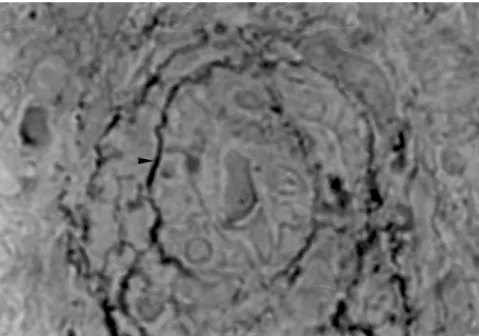
In all groups, pulmonary arteries with ED > 100 mm exhibited an evident
internal elastic laminae with some oth-ers exhibiting elastic laminae in the medial wall (Fig. 1). Arteries with ED
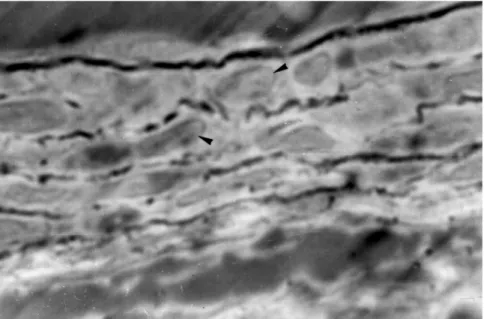
£ 100 mm exhibited evident internal
elastic laminae and some elastic fibers in the medial wall that may or may not constitute an elastic lamina. The small ones showed some elastic fibers in their medial wall (Fig. 2). Between these elastic laminae or fibers, we could see the nuclei of the smooth muscle cells arranged in concentric layers (Fig. 3).
The data from the morphometric analyses of pulmonary arteries with ED > 100 mm and ED £ 100 mm are
ex-pressed in tables 1 and 2 and in figs. 4 to 6.
In all groups, the comparisons of the parameters for arteries with ED > 100 mm and arteries with ED £ 100 mm
showed significant differences (P < .05). The muscular arteries (ED > 100
mm) revealed lower MT and lower CD,
but greater EF (P < .05).
The comparison of the parameters of the arteries with ED > 100 mm
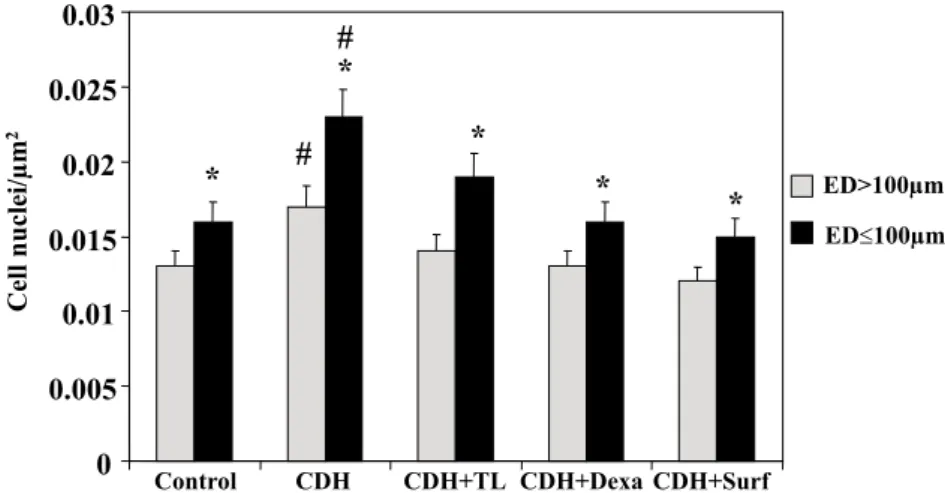
be-tween control and experimental groups showed that the CDH promoted a sig-nificant decrease (P < .05) in MT. Con-sidering the number of cell nuclei per square micrometer, we found that CDH promoted an increase in the cell den-sity, in comparison to control animals. This change may be due to a decrease of the medial surface area of these ar-teries in the CDH lungs. The prenatal treatments with TL or intra-amniotic administration of dexamethasone or surfactant prevented these changes.
There was no difference between the control and experimental groups in EF in the walls of the pulmonary arter-ies with ED > 100 mm, although a
non-significant decrease was observed in the CDH group.
The comparison between control
and experimental groups showed that CDH promoted a significant increase (P < .05) in MT of the arteries with ED
£ 100 mm. We found that CDH
pro-moted an increase in CD in compari-son to that found in the control ani-mals. This change may provide an ex-planation for the increased MT of these vessels. The prenatal treatments with TL or intra-amniotic administration of
surfactant or dexamethasone prevented these changes.
CDH induced a decrease in EF in arteries with ED £ 100 mm. There was
no production of elastic fibers with the increased number of cells. The prenatal treatments with TL or administration of surfactant prevented this change, al-though no effect was observed in the CDH plus dexamethasone group.
Figure 2 - Micrograph of a small pulmonary artery (ED £ 100 mm) showing some elastic fibers (arrowhead) in the medial wall (Weigert-hematoxylin, x2000).
"
DISCUSSION
Experimental model: We chose
the rabbit model of CDH because it was previously standardized in our laboratory and shown to produce pul-monary hypoplasia8,15. In the current
study, we aimed to study whether natal therapeutic procedures could pre-vent the structural changes in the pul-monary arteries induced by surgically created CDH. To date, the only method that effectively treats or prevents all the changes of the herniated viscera on the developing lung in CDH fetus is tra-cheal occlusion, an invasive procedure. In 2 previous investigations, we pro-posed a new noninvasive therapeutic strategy, which consisted of prenatal intra-amniotic administration of high doses of swine surfactant (40 mg) or dexamethasone (0.4 mg), and we have proved that these treatments have posi-tive effects on the immature lung of the fetal rabbit with CDH5,8, although we
could not explain the mechanisms by which the intra-amniotic administered drugs produce their effects.
We chose the intra-amniotic route for administering the surfactant sub-stance in the prenatal period to prevent pulmonary hypoplasia, since most in-vestigations have used surfactant therapy prophylactically, i.e., before the onset of ventilation19. It has been
suggested that when exogenous sur-factant is considered for the newborn
Table 1 - Values of morphometric data of arteries with external diameter > 100 µm.
Control Congenital Congenital Congenital Congenital
diaphragmatic diaphragmatic hernia diaphragmatic diaphragmatic
hernia + Tracheal ligation hernia+Dexa hernia+Surf
External diameter(mean±SD) 243.4±160.13 181.5±65.41 170.7±65.58 213.4±78.22 183.9±75.45
Internal diameter(mean±SD) 155.3±98.46 136.3±54.75 117.1±47.15 156.2±63.67 127.7±58.59
Table 2 - Values of morphometric data of arteries with external diameter £ 100 µm.
Control Congenital Congenital Congenital Congenital
diaphragmatic diaphragmatic hernia diaphragmatic diaphragmatic
hernia + Tracheal ligation hernia+Dexa hernia+Surf
External diameter(mean±SD) 64.6±18.93 44.5±20.66 52.7±19.61 51.1±18.04 57.1±21.77
Internal diameter(mean±SD) 37.6±11.76 22.8±19.21 27.7±16.88 27.5±15.71 32.5±18.65
Figure 4 - Medial thickness (MT) of pulmonary arteries. (*) P < .05 – The comparisons between arteries with external diameter (ED) > 100 mm and ED £ 100 mm demonstrate that the muscular arteries (ED > 100 mm) have a decreased MT; (#) P < .05 - relative to the control group. All the therapeutic procedures prevented the changes induced by congenital diaphragmatic hernia. The type of error bar (SD) should be noted.
#
with CDH, it should be administered as early as possible, preferably before the infant’s first breath20. Concerning the
route of antenatal administration of glucocorticoids, we also chose the in-tra-amniotic one because we had pre-viously noted that the intramuscular injection of dexamethasone into the pregnant does had a significant labor-inducing effect, causing a high inci-dence of spontaneous abortion.
The respiratory movements of the fetus with inflow of the amniotic fluid
begin early in pregnancy, and in addi-tion to being a normal funcaddi-tion of the fetus, play an important role in the de-velopment of the lungs21. Although
many previous studies suggest that the fetal lungs produce a fluid that flows constantly from the lungs to the amni-otic cavity22,23, there is some evidence
that drugs infused into the amniotic cav-ity may be aspirated by the fetus. In ex-periments of transamniotic fetal feeding using a rabbit model and lipid emulsion as the nutrient, it was observed that the
fetal alveoli were filled with lipid glob-ules, which proved that amniotic fluid is chronically aspirated by the fetus24. In
addition, in a previous similar investiga-tion, we infused a mixture of porcine surfactant with microparticles of coal into the amniotic cavities of fetuses with CDH and of nonoperated littermates, and we noted that in all fetuses, the coal was massively aspirated into the lungs and trachea8.
It has been shown that CDH pro-motes alveolar hypoplasia, decreases the total size of the pulmonary vascu-lar bed and the number of vessels per unit area of lung, and increases the muscularization of the arterial tree 11,25-27. Levin28 demonstrated that there is
increased medial width and smooth muscle in resistance vessels in all lungs of patients with left-sided CDH and al-veolar hypoplasia. Recently, Shehata et al.12 showed that raised levels of
vas-cular endothelial growth factor occur in the medial smooth muscle cells of large and small pulmonary arteries in pa-tients with CDH.
In the present study, we demon-strated morphometric changes of the components of pulmonary arteries in rabbits with CDH, and we verified a reversal of these changes with prena-tal feprena-tal treatments, utilizing TL or in-tra-amniotic administration of dexam-ethasone or surfactant. Emphasis was given here on the quantitative mor-phological differences between large and small arteries in control and ex-perimental animals.
Morphometric measurements –
medial wall thickness (MT): In
previ-ous experiments, some authors reported that the hypoplasia of both large and capillary pulmonary vessels is related to a muscularization of pulmonary arterial vessels in animals with CDH. They re-ported that fetal TL is capable of revers-ing these effects by acceleratrevers-ing both large vessel growth and capillary growth based on total large vessel area and to-tal capillary number1,28. The TL treat-Figure 5 - Density of cell nuclei (CD) in the pulmonary arterial wall. (*) P < .05 – The comparisons
between arteries with external diameter (ED) > 100 mm and ED £ 100 mm demonstrate that the muscular arteries (ED > 100 mm) have fewer cell nuclei per square micrometer; (#) P < .05 – relative to the control group. All the therapeutic procedures prevented the changes induced by CDH.
$
ment also appears to accelerate the lung maturation process19.
We also demonstrated that in the muscular pulmonary arteries with ED > 100 mm, CDH promoted a decreased
MT, probably as a result of a vasodila-tation phenomenon, similar to what occurs in patients with atrial septal de-fect and other congenital heart diseases characterized by the presence of high pulmonary blood flow over a pro-longed period prior to the onset of pul-monary hypertension. A dilatation oc-curs in pulmonary vessels with a thin-ning of the media as an expression of the compensation to severe pulmonary resistance29.
Elastic fiber density and cell nu-clei density in the pulmonary arterial wall: By definition, elastic arteries are those with one or more elastic laminae between internal and external elastic laminae, whereas the muscular arteries have only the internal and external elastic laminae16,30. In our study, the
pulmonary arteries with ED > 100 mm
were characterized as muscular arter-ies and exhibited one or more addi-tional elastic laminae between the in-ternal and exin-ternal elastic laminae. In contrast, the smaller arteries with ED
£ 100 mm had only a crescent of
smooth muscle, and the internal elas-tic laminae disappeared, with some elastic fibers being observed between the muscle cells. This phenomenon may be caused by a reduced capacity for response to the physiological ac-tions of contraction or dilatation, since we have demonstrated that these small vessels have a greater density of cell nuclei than do the muscular arteries with ED > 100 mm. We suggest that the
large arteries control the blood flow, while the small ones are responsible for the resistance of the flow.
The walls of the arteries with ED
£ 100 mm are thicker and have more
cells per unit area than the muscular ar-teries with ED > 100 µm, and this find-ing agrees with those of previous stud-ies1,25,28. The small arteries also have a
lower tensile strength and thus can stretch farther to accommodate the higher interior pressure. The presence of abnormally thick-walled pulmonary ar-teries in stillborns with CDH suggests that the intrapulmonary arteries in CDH may become excessively muscularized during fetal life, becoming unable to adapt normally at birth31.
A previous investigation reported that some prenatal treatments improve these structural changes in the pulmo-nary arteries promoted by CDH. Lipsett et al.32 demonstrated that tracheal
occlu-sion performed in the lamb model of CDH stimulates lung development and restores lung structure and maturity to-wards normal levels by gestational term. There was also an increased volume density of parenchyma, airspace, and gas-exchange surface. Okoye et al.11
studied the effect of prenatal gluco-corticoids on pulmonary vascular mus-cularization in experimental CDH. They verified an increased MT ratio of pre-acinar and intra-pre-acinar arteries in CDH and demonstrated that maternal admin-istration of dexamethasone inhibits this medial hypertrophy. The same observa-tion was made in rats with nitrofen-in-duced CDH33. However, Shehata et al.12
showed that treatment with extracorpor-eal membrane oxygenation (ECMO) did not improve this increase in arterial medial thickness in newborns with CDH. The ECMO-treated newborns with CDH showed a thinner arterial ad-ventitia than did patients with CDH who did not receive this treatment.
We observed that there is an in-crease in cell density and a dein-crease in the density of elastic fibers in small pulmonary arteries of animals with CDH. The prenatal treatments with TL or administration of surfactant or dex-amethasone are capable of preventing the structural changes in arteries of all sizes, except that the administration of dexamethasone does not prevent any loss of elastic fibers in small pulmo-nary arteries. This last change may re-sult in a less compliant arterial wall better suited to resisting the higher in-tra-arterial pressure. Yamataka and Puri reported similar results13,14, which
showed an active synthesis of collagen in the media and adventitia of pulmo-nary arteries in patients with CDH complicated by persistent pulmonary hypertension.
In conclusion, the present study demonstrates that animals with CDH have different structural changes in large and small pulmonary arteries, confirming their diverse physiological function. Furthermore, this is the third study showing that prenatal intra-am-niotic administration of dexamethasone or surfactant has positive effects on the lung structural changes promoted by CDH, and that these effects are com-parable to the changes induced by TL. Further studies in lambs must be undertaken to confirm these results be-fore embarking in a clinical trial in hu-mans.
FINANCIAL SUPPORT
%
RESUMO RHCFAP/3061
RODRIGUES CJ e col. - Ligadura de traquéia no período pré-natal ou administração intra-amniótica de surfactante ou dexametasona evi-tam algumas alterações estruturais nas artérias pulmonares de fetos de coelho com hérnia diafragmática congênita produzida com cirurgia.
Rev. Hosp. Clín. Fac. Med. S.
Paulo 57(1):1-8, 2002.
OBJETIVO: Caracterização das
alterações estruturais que ocorrem nas artérias pulmonares de fetos de coelho com hérnia diafragmática congênita produzida com cirurgia, com destaque especial aos efeitos preventivos da li-gadura de traquéia ou administração intra-amniótica de dexametasona ou surfactante.
MÉTODOS: Vinte fetos de coelho
foram submetidos a cirurgia para pro-dução de hérnia diafragmática no 24o ou
25o dia de gestação. Os animais foram
divididos de acordo com os procedi-mentos: hérnia diafragmática congêni-ta (n = 5), hérnia diafragmática
congê-nita com ligadura de traquéia (n = 5), hérnia diafragmática congênita com administração intraamniótica de 0,4mg de dexametasona (n = 5) ou surfactante (40mg de Curosurf, n = 5). No 30o dia
de gestação, todos os fetos foram reti-rados por cesariana e mortos. O grupo controle consistiu de 5 fetos normais não operados. Foram realizadas análises histomorfométricas da parede das arté-rias pulmonares: espessura da camada média, contagem do número de núcle-os celulares e densidade de fibras elás-ticas.
RESULTADOS: As artérias com
diâmetro externo > 100 mm
apresenta-ram diminuição da espessura da cama-da média, menor número de núcleos celulares por micrômetro quadrado e maior densidade de fibras elásticas em comparação com as artérias com diâ-metro externo diâdiâ-metro externo £ 100 mm. A hérnia diafragmática congênita
provocou significativa redução na es-pessura da camada média e aumento do número de núcleos nas artérias com diâmetro externo > 100 mm. Os
méto-dos terapêuticos, ligadura de traquéia e administração intraamniótica de dro-gas promoveram reversão destas alte-rações. Nas artérias com diâmetro ex-terno £ 100mm a hérnia diafragmática
congênita provocou aumento da espes-sura da camada média e na contagem de núcleos e decréscimo da densidade de fibras elásticas. A ligadura de tra-quéia e a administração intraamniótica de surfactante ou dexametasona rever-teram estas alterações embora esta úl-tima não tenha tido efeito sobre a den-sidade de fibras elásticas.
CONCLUSÃO: A hérnia
diafrag-mática congênita provoca diferentes al-terações estruturais nas pequenas e grandes artérias pulmonares. A admi-nistração intraamniótica de surfactante ou dexametasona tem efeitos positivos nestas alterações estruturais, compará-veis à ligadura de traquéia.
DESCRITORES: Hérnia diafrag-mática congênita. Hipertensão monar persistente. Hipoplasia pul-monar. Surfactante. Glicocorticóide.
REFERENCE
1. KITIKAWA M, HISLOP A, BOYDEN E et al. - Lung hypoplasia in congenital diaphragmatic hernia. Br J Surg 1971;58:342-346 2. NGUYEN L, GUTTAM F & DE-CHADEREVIAN JP et al. - The
mortality in congenital diaphragmatic hernia. Is total pulmonary mass inadequate no matter what? Ann Surg 1983;198:766-770. 3. GEGGE RL, MURPHY JD, LANGLEBEN D et al. - Congenital
diaphragmatic hernia: Arterial structure changes and persistent pulmonary hypertension after surgical repair. J Pediatr 1985;107:457-464.
4. SUEN HC, LOSTY P, DONAHOE PW et al. - Biochemical immaturity of lungs in congenital diaphragmatic hernia. J Pediatr Surg 1993;28:471-477.
5. TANNURI U, MAKSOUD FILHO JG, SANTOS MM et al. - The effects of prenatal intra-amniotic surfactant or dexamethasone administration on lung development are comparable to changes induced by tracheal ligation in an animal model of CDH. J Pediatr Surg 1998;33:1198-1205.
6. LOTZE A, KNIGHT GR, ANDERSON KD et al. - Surfactant (Beractant) therapy for infants with congenital diaphragmatic hernia on ECMO: Evidence of persistent surfactant deficiency. J Pediatr Surg 1994;29:407-412.
7. WILCOX DT, GLICK PL, KARAMANOUKIAN HL et al. -Pathophysiology of congenital diaphragmatic hernia IX: Correlation of surfactant maturation with fetal cortisol and triiodothyronine concentration. J Pediatr Surg 1994;29:825-827. 8. TANNURI U, RODRIGUES CJ, MAKSOUD FILHO JG et al. - The effects of prenatal intraamniotic surfactant or dexamethasone administration on lung development are comparable to changes induced by tracheal ligation in an animal model of CDH: Studies of lung glycogen content, elastic fiber density and collagen content. J Pediatr Surg 1998;33:1776-1783.
&
10. TAIRA Y, OUE T, SHIMA M et al. - Increased tropoelastin and procollagen expression in the lung of nitrofen-induced DH in rats. J Pediatr Surg 1999;34:715-719.
11. OKOYE BO, LOSTY PD, LLOYD DA et al. - Effect of prenatal glucocorticoids on pulmonary vascular muscularization in nitrofen-induced CDH. J Pediatric Surg 1998;33:76-80.
12. SHEHATA SMK, SHARMA HS, VAN DER STAAK FH et al. -Remodeling of pulmonary arteries in human CDH with or without extracorporeal membrane oxygenation. J Pediatr Surg 2000; 35:208-215.
13. YAMATAKA T & PURI P - Pulmonary arterial structural changes in pulmonary hypertension complicating congenital diaphragmatic hernia. J Pediatr Surg 1997;32:387-390.
14. YAMATAKA T & PURI P - Active collagen synthesis by pulmonary arteries in pulmonary hypertension complicated by CDH. J Pediatr Surg 1997;32:682-687.
15. FAUZA DO, TANNURI U, AYOUB AAR et al. - Surgically produced congenital diaphragmatic hernia in fetal rabbits. J Pediatr Surg 1994;29:882-886.
16. BRENNER O - Pathology of vessels of pulmonary circulation. Arch Int Med 1935;56:211.
17. BEST PV & HEATH D - Interpretation of the appearance of the small pulmonary blood vessels in animals. Circ Res 1961;9:288-294. 18. HOSODA Y - Pathology of pulmonary hypertension: a human and
experimental study. Pathol Int 1994;44:241-267.
19. O’TOOLE SJ, KARAMANOUKIAN HL & MORIN III FC - Surfactant decreases pulmonary vascular resistance and increases pulmonary blood flow in the fetal lamb model of congenital diaphragmatic hernia. J Pediatr Surg 1996;31:507-511.
20. O’TOOLE SJ, KARAMANOUKIAN HL, SHARMA A et al. -Surfactant rescue in the fetal lamb model of congenital diaphragmatic hernia. J Pediatr Surg 1996;31:1105-1109. 21. POTTER EL & BOHLENDER GP – Intrauterine respiration in relation
to development of the fetal lung. Am J Obstet Gynecol 1941;42 :14-21.
22. SHERMETA DW & OESCH I - Characteristics of fetal lung fluid production.. J Pediatr Surg 1986;16:943-946.
23. ALCORN D, ADAMSON T, LAMBERT T et al. – Morphologic effects of chronic tracheal ligation and drainage in the fetal lamb. J Anat 1976;122:649-660.
24. HARRISON MR & VILLA RL – Trans-amniotic fetal feeding I. Development of an animal model: Continuous amniotic infusion in rabbits. J Pediatr Surg 1982;17:376-380.
25. DIFIORI JW, FAUZA DO, SLAVIN R et al. - Experimental fetal tracheal ligation and congenital diaphragmatic hernia: a pulmonary vascular morphometric analysis. J Pediatr Surg 1995;30:917-924. 26. MURPHY JD, RAVINOVITCH M, GOLDSTEIN JD et al. - The structural basis of persistent pulmonary hypertension of the newborn infant. J Pediatr 1981; 98: 962-967.
27. GEGGEL RL & REID LM - The structural basis of PPHN. Clin Perinatolm 1984;3:525-549.
28. LEVIN DL - Morphologic analysis of the pulmonary vascular bed in congenital left-sided diaphragmatic hernia. J Pediatr 1978;92 :805-809.
29. HEATH D & EDWARDS JE - The pathology of hypertensive pulmonary vascular disease. Circulation 1958;18:533-547. 30. HARRIS P & HEATH D - The Human Pulmonary Circulation. In:
___________ 3rd ed. Edinburgh, Churchill, 1986. p 30-47.
31. TAIRA Y, YAMATAKA T, MIYAZAKI E et al. - Comparison of the pulmonary vasculature in newborns and stillborns with CDH. Pediatr Surg Int 1998;14:30-35.
32. LIPSETT J, COOL JC, RUNCIMAN SI et al. - Effect of antenatal tracheal occlusion on lung development in the sheep model of CDH: morphometric analysis of pulmonary structure and maturity. Pediatr Pulmonol 1998;25:257-269.
33. TAIRA Y, MIYAZAKI E, OHSHIRO K et al. - Administration of antenatal glucocorticoids prevents pulmonary artery changes in nitrofen-induced CDH. J Pediatr Surg 1998;33:1052-1056.