R e v is ta d a S o c ie d a d e B r a s ile ir a d e M e d ic in a T ro p ic a l 2 8 (1 ):5 3 , j a n - m a r , 1 9 9 5 .
COMUNICAÇÃO
NO CHANGE IN ONE BIOLOGICAL PARAMETER FOR
D 1P E TA LO G A STERM A X IM U S
AFTER 20 YEARS OF LABORATORY COLONISATION
D .J. Meirelles, F.L. Hasten, M .T.À . Garcia-Zapata and P.D. Marsden
The value of D i p e t a l o g a s t e r m a x im u s as a
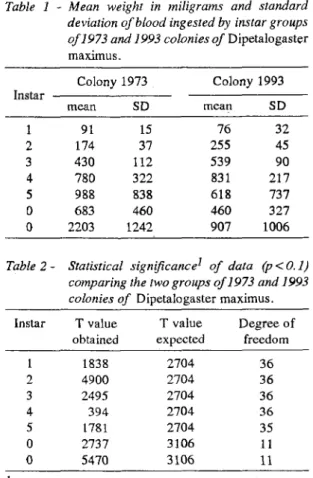
xenodiagnostic agent has been reviewed2. We have always worried that the due to inbreeding in our laboratory colony our off-spring would suck less blood. An opportunity to test this risk arrived with 60 eggs retrieved from a wild caught female of the Baja California Peninsula. Instars from these eggs were weighed before and after each meal. A control group of same instar bugs from the Brasilia colony which has been in existence twenty years was investigated at the same time. All bugs were maintained at 26°C and 70% humidity and fed on chicken blood. They were weighed individually on a balance sensitive to 0.5 milligram. Thirty individuals of each juvenile instar were used and ten of .both sex adults for the two colonies 1973 and 1993. The results are shown in the Tables. The statistical analysis is that of Levine1 for comparing samples of different size.
Table 1 shows the summarised data of blood meal weight in the two colonies 1973 and 1993. Table 2 records the T values (actual and expected) and the degree of freedom related to this data. Only two instars were significantly different in the two colonies. The second instar fed significantly more in the 1993 group and adult females the reverse (a stage of more relevance to our colony needs). Possibly if the groups had been larger these differences would also disappear. The data suggest that after twenty years in colony blood ingestion of the different instars of D . m a x im u s has not changed.
Núcleo de Medicina Tropical e Nutrição, Universidade de Brasília, Brasília, DF, Brazil and Departamento de Medicina Tropical, Universidad de G uadalajara, Guadalajara, Jalisco, Mexico.
A d d r e s s to: Dr. Marco Tulio A. Garcia-Zapata. NMTN/UnB. Caixa Postal 04-475, 70919-970 Brasília, DF, Brasil. Recebido para publicação em 30/06/94.
Ta b le 1 - M e a n w e ig h t in m ilig ra m s a n d sta n d a r d d e v ia tio n o f b lo o d in g e ste d by in sta r g ro u p s o f 1 9 7 3 a n d 1 9 9 3 c o lo n ie s o f Dipetalogaster maximus.
Colony 1973 Colony 1993
mean SD mean SD
1 91 15 76 32
2 174 37 255 45
3 430 112 539 90
4 780 322 831 217
5 988 838 618 737
0 683 460 460 :327
0 2203 1242 907 1006
Tab le 2 - S ta tistic a l s ig n ific a n c e 1 o f d a ta ( p < 0 .1 ) co m p a rin g th e tw o g r o u p s o f 1 9 7 3 a n d 1 9 9 3 c o lo n ie s o f Dipetalogaster maximus.
Instar T value T value Degree of
obtained expected freedom
1 1838 2704 36
2 4900 2704 36
3 2495 2704 36
4 394 2704 36
5 1781 2704 35
0 2737 3106 11
0 5470 3106 11
1 Note: only instar II and females show significance.
ACKNOWLEDGEMENTS
We wish to thank Prof3. Vanize Macedo, Coordinator of the Núcleo de Medicina Tropical e Nutrição for laboratory facilities and Dr J. A. Dória for the use of his sensitive balance.
REFERENCES
1. LevineJ. Applied Statistics for the Social Sciences.
Harper & Row, New York, 1977.
2. M arsden PD. D i p e t a l o g a s t e r m a x i m a or
D ip e ta lo g a ste r m a x im u s as a xenodiagnostic agent. Revista da Sociedade Brasileira de Medicina Tropical 19:205-207, 1986.