Andréia De Conto GarbinI Frida Marina FischerII
I Programa de Pós-Graduação em Saúde
Pública. Faculdade de Saúde Pública (FSP). Universidade de São Paulo (USP). São Paulo, SP, Brasil
II Departamento de Saúde Ambiental.
FSP-USP. São Paulo, SP, Brasil Correspondence: Andréia De Conto Garbin Faculdade de Saúde Pública – USP 1º andar – Sala 105 (HSA) Av. Dr. Arnaldo, 715
01246-904 São Paulo, SP, Brasil E-mail: [email protected] Received: 5/24/2011 Approved: 12/8/2011
Article available from: www.scielo.br/rsp
Representations of workplace
psychological harassment in
print news media
ABSTRACT
OBJECTIVE: To analyze discourses on workplace psychological harassment in print media.
METHODOLOGICAL PROCEDURES: Documental study on workplace
psychological harassment that analyzed news stories published in three major newspapers of the State of São Paulo (southeastern Brazil) between 1990 and 2008. Discourse analysis was performed to identify discursive practices that refl ect the phenomenon of psychological harassment in today’s society, explanations for its occurrence and impact on workers’ health.
RESULT ANALYSIS: This theme emerged in the media through the
dissemination of books, academic research production and laws. It was initially published in general news then in jobs and/or business sections. Discourses on compensation and precautionary business practices and coping strategies are widespread. Health-related aspects are foregone under the prevailing money-based rationale. Corporate cultures are permissive regarding psychological harassment and confl icts are escalated while working to achieve goals and results. Indifference, embarrassment, ridicule and demean were common in the news stories analyzed.
CONCLUSIONS: The causal explanations of workplace harassment tend to
have a psychological interpretation with emphasis on individual and behavioral characteristics, and minimizing a collective approach. The discourses analyzed trivialized harassment by creating caricatures of the actors involved. People apprehend its psychological content and stigmatization which contributes to making workplace harassment an accepted practice and trivializing work-related violence.
DESCRIPTORS: Social Behavior. Working Environment. Psychology,
Social. News. Newspapers. Qualitative Research. Moral harassment.
INTRODUCTION
If your boss makes you cry in the bathroom it is more harmful to your health than you think. It is the opening line of a news story published in the Folha de São Paulo newspaper on November 25, 2000. It illustrates how one of the leading newspapers in Brazil approaches the issue of psychological harassment. Civil society, the academia, trade unions, the media and the judiciary, among other social actors, are also involved and have guided the debate on this issue.10,11
The discussions have primarily focused on workplace harassment.
phenomenon and old elements are being reexamined using new productive and aesthetic languages.9,10
Historically, “The harassed worker” by Carroll Brodsky was published in the United States in 1976, and was the fi rst book to address workplace harassment.15 In
Brazil, workplace harassment has gained in relevance in 2000,3,6 although studies in other countries show the
1990s as a starting point for addressing this issue.1,15
Violence at work refers to any unreasonable action, behavior or attitude directed towards an employee at the workplace or because of his/her work which is intended to intimidate, degrade, humiliate or undermine.13 This
violence is expressed through psychological or sexual harassment, improper management strategies, discrimi-natory practices and other behaviors that undermine human dignity.6,11,20
Workplace psychological harassment involves perse-cution attitudes intended to harming and forcing employees in their workplace so that they will be dismissed or removed. Sexual harassment is a criminal offense in Brazil, and is the use of a position of power to obtain non-consenting, unwanted sexual favors.6,11,20
Organizational violence7,11,20 involves management
strategies rooted on insulting, intimidating, stressful,
abusive behaviors, including disrespect, constant threats, confl icts and competition among workers and ethically inappropriate behaviors.
Leymanna pioneered research on psychological
harassment describing hostile situations at work. He introduced the concept of mobbing, which means to mistreat, to attack, to harass, to siege. It involves hostile and unethical communication which is directed in a systematic manner mainly toward one or more indi-viduals, who is pushed into a helpless and defenseless position. These actions occur on a very frequent basis (at least once a week) and over a long period of time (at least six months). Because of the high frequency and long duration of hostile behavior, this maltreat-ment results in considerable maltreat-mental, psychosomatic and social misery.15 At the same time, the concept of
bullying, defi ned as lack of civility and rude treatment, was used mainly in England. This term was fi rst used by Lazarus in 1984 in studies on social stress.14 The
concepts of threats, attacks and abuse incorporated to bullying and mobbing have made them near-synonyms in current use.b
Hirigoyen10,11 described moral harassmentas an
inten-tional act directed against an individual by another individual within the workplace that is designed to harass, humiliate or undermine the individual, leading
a Leymann H. The mobbing encyclopedia. Bullying; Whistle blowing. A selection of English literature on mobbing with short presentations.
Germany [cited 2008 Jan 27]. Available from: http://www.leymann.se/English/61100E.HTM
b Di Martino V. Relationship between work stress and work violence in the health sector. ILO/ICN/WHO/PSI. Geneva; 2003[cited 2008 Jan
25]. Available from: http://www.who.int/violence_injury_prevention/violence/interpersonal/WVstresspaper.pdf
to adverse health effects. For the author, the word ‘moral’ has a double meaning: it signals psychological assault and culturally defi ned notions of good and evil. For Barreto,3 moral violence or harassment means
engaging in a repetitive course of vexations, embar-rassing conduct against an employee by a hierarchical superior or coworkers at the workplace over a working day. It is characterized by ethically inappropriate inhumane relationships as the victim is not considered equal in rights.
The visibility of this concept prompted the analysis of content published in print news media in the state of São Paulo, Brazil. The present study aimed to analyze discourses on workplace psychological harassment in print news media.
METHODOLOGICAL PROCEDURES
A documental study was carried out on workplace harassment based on primary sources of information. Information was collected from print news of three major newspapers in the state of São Paulo published from January 1990 to September 2008. Data sources were defi ned based on criteria including coverage and target audience.
A qualitative approach based on discourse analysis.12
News stories were analyzed as discursive practices that express the way people make sense of the world and of themselves,12,21 in a given context, in a certain time and
place, which allows the production of other practices adapted to social standards.22
Discourse analysis makes it possible to apprehend social concepts as discourses in newspapers, books and on television refl ect everyday life circumstances refl ecting a particular social context. Through the media it is possible to rebuild interaction spaces, redesigning the modalities of meaning production,12,21 and versions
of the world, which occupy a social and historical place, and are constantly changing.19,23
routines and use of related technologies. Search was based on the key word “psychological harassment” and other terms commonly cited as a synonym for moral harassment.3,6,11,15
RESULT ANALYSIS AND DISCUSSION
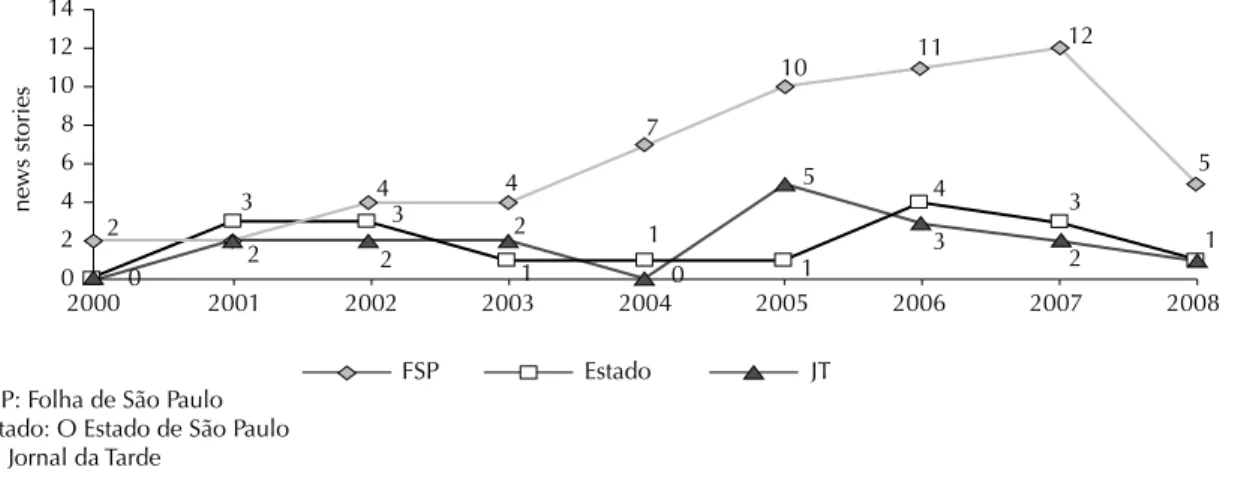
This theme emerged in the media through the dissemi-nation of books, academic research production and laws about workplace harassment from the year 2000. There were no news stories on workplace harassment before 2000. During the study period there were identifi ed 91 news stories whose contents addressed directly or indi-rectly the theme of workplace harassment (Figure 1). When workplace harassment was addressed in a broad manner, there were also addressed various aspects of work organization, work-related conditions, reporting of workplace misconduct, laws, protection and claims for both employees and employers and businesses. The issue was focused on a special Sunday supplement of
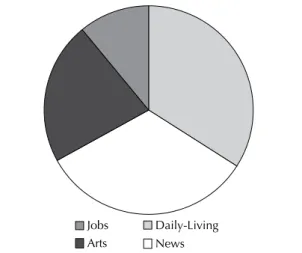
Folha de São Paulo. News stories reported on degrading working conditions and helped introduce and establish it as an accepted issue among readers. They refl ected the contradictions of the society that on one hand give visibility to injustices and humiliations at the workplace and on the other hand promote business protection. Most news stories on workplace harassment (78%) were for the general reader. They were initially guided by the agenda of everyday issues, and protection of rights and well-being (Figure 2). The issue moved with time to jobs and business sections. This editorial approach was not a mere coincidence, but rather an intention to disseminate the theme among distinct audiences, serving to specifi c interests of the business sector and labor market. A clear warning message was sent when legal compen-sations for workplace harassment appeared in the
media, making it more visible in jobs, business and money sections of the tree newspapers selected. A subject indexing search of the O Estado de São Paulo
and Jornal da Tarde from 2005 showed that the most frequently cited work following workplace harassment was compensation. The issue of workplace harassment was published mainly in the money and jobs sections of Folha de São Paulo (Figure 3).
A repertoire of claims and compensations interacts in the construction of meanings preventing careful refl ec-tion as strategies of fi ling lawsuits as a primary recourse for eliminating the problem became regular.
The reference to union mobilization in the business section of the Jornal da Tarde introduced the perspec-tive of workers’ fi ght against workplace harassment. A few days later this approach was refuted in this same paper by claiming that fi ling lawsuits and claims for compensation was an immoral practice. The representa-tion of workers’ organizarepresenta-tion is deconstructed by the discourse of morality and alleged misuse of the law for improperly claiming for damages.
As for the days of the week when the issue was reported, reports were mostly published on Sunday in the jobs sections of the Folha de São Paulo. Readers usually buy the Sunday paper as it includes a summary of the topics of the week and in-depth reviews by columnists. Many sections are published only on Sundays and more copies are sold on Sundays than any other day of the week.19,22
It is noteworthy that workplace harassment is described as a private, personal issue between those involved, with an emphasis on the author’s intentionality in the defi nition of this phenomenon:
People are harassed not because the intention is to criticize their work as well or badly done, but to target
Figure 1. Distribution of news materials on psychological harassment published in the newspapers analyzed by year. São Paulo, Southeastern Brazil, 1990-2008.
FSP: Folha de São Paulo Estado: O Estado de São Paulo JT: Jornal da Tarde
14 12 10 8 6 4
2 2
2000
news stories
FSP Estado JT
2001 2002 2003 2004 2005 2006 2007 2008
2
3 43 4 5
7
2
2
1
1
1 0
4
3
3
2 1
5 12
11 10
them personally consciously or unconsciously willing to attack them. (O Estado de São Paulo, March 21, 2001, Caderno 2 section)
The interpretation of the issue with a focus on people defl ects the understanding of the phenomenon from work organization and abridges the debate on working conditions. By focusing on a particular intentional interpretation of workplace harassment a discourse is produced that strips from work the idea of a social right, therefore, the right for decent working conditions. The recurrent explanations on a personal nature of workplace harassment found in the reports analyzed contrast with fi ndings of other studies. They found that workers reported psychological harassment at work as a management’s control mechanism that is humiliating.4
The discursive practices call for an analysis of the embedded interests in profi ling bosses as “uncon-trolled,” “tyrant,” “perverse,” etc. On the one hand, social reality is read from a psychiatric perspective that relates social issues to the structure of personality and naturalizes the association between violence and a person’s disorder or traits. On the other hand, the organizational system seeks to preserve its business image, and relies on the assumed personal disinte-gration of high management to fi ght against work-place harassment as shown in the following excerpt:
The company fi led an appeal claiming it could not be held responsible for moral damages because of the use of cursing by an employee. Boththe Brazilian
Labor High Court and the 17th Regional Labor Court
rejected the appeal. (O Estado de São Paulo, April 5, 2005, Business section)
Rey17 underlines that focusing the attack
represen-tation on the perpetrator favors naturalization and individualization of violence supported in a paradigm that has served as a basis for common sense over the last four centuries. Social exclusion involves disqualifi cation of one’s experiences and appropriation of subjectivity. Under the heading “Victims may create a situation in which harassment may ensue, says psychologist,” a profi le of a moral masochist, i.e., an individual who experiences harassment, is presented, suggesting that this individual either internalizes or accepts the imposed circumstance. “Moral masochism” would be an active pursuit of personal failure and suffering to meet a need for punishment,10 as revealed in the excerpt below: “If a person submits her/himself to some extent to suffering that is caused by another person, s/he may
create a situation in which harassment may ensue,”
says Maria Aparecida Schirato Rhein, from Armando
Figure 3. Distribution of news stories on harassment published in the Folha de São Paulo by section. São Paulo, Southeastern Brazil, 1990-2008.
0 2 4 6 8 10 12 14 16
Business Jobs
Daily Living Arts
Nation
Technology
Health News Opinion
Latest news International Figure 2. Distribution of news stories on harassment published
in the newspapers analyzed by section. São Paulo, Southeas-tern Brazil, 2000-2001.
Daily-Living News Arts
Álvares Penteado Foundation, author of a doctoral thesis on harassment. “S/he is a ‘moral masochist.’ S/ he knows her/his weaknesses, but instead of trying to overcome them, s/he disguises them up.” For Rhein, harassers know how to identify these victims. (Folha de São Paulo, July 2, 2006, Jobs sections)
A collective perspective for both harassers and their victims is apparently neglected in the news materials and references analyzed. It reinforces the perception that this phenomenon is restricted to an individual level, to the parties involved, at the expense of workers’ collective. Collective workplace harass-ment has been increasingly addressed in the literature related to the indivisible rights and concepts of wide-spread common collective and individual interests. The health effects of harassment are widely addressed in the news stories and the process of suffering and illness is often reported.
Bit by bit, however, humiliation undermines workers’ mental and physical forces. That’s what happened to EP, 47, a seamstress who was ‘morally tortured’ by the head of her work division. ‘She would spy on me in the bathroom, threaten and humiliate me in front of my colleagues,’ she recalls. After a year experiencing harassment, during an argument with her supervisor, EP had a heart attack. (Folha de São Paulo, March 26, 2006, Jobs section)
I was under such a strong pressure that I started losing hair. I got to the point of having diffi culty breathing in the offi ce. (Folha de São Paulo, December 17, 2006, Money section)
Many harassment events manifest through verbal abuse. But isolation, lack of communication, indifference are also recurrent manifestations.5 The behaviors reported
in the news stories analyzed are remarkable for their negatively strong content, appalling indifference, and invisible suffering shaping an experience of acts that embarrass, disqualify, debase, ridicule, belittle a person, and attribute mistakes to them in a “journey of humili-ation” as described by Barreto.3
The literature has described harassment as involving constant criticism, intentional indifference and isola-tion, vexation and demoralizing acts,3,11,14,20 which is
illustrated in the following report:
He tells his female boss would pick about anything. For an example, he was reprimanded once for arranging the icons on the computer [report of a trainee]. (Folha de São Paulo, September 29, 2002, Jobs section) Other harassment events are towards a person’s image including acts of debasement and provocations. Accept violence as natural makes any act even more violent. It takes on a life of its own and no longer causes revul-sion because people become desensitized to violence
and its effects, making the social world insignifi cant in their lives.2,3,16
Psychological harassment is often associated to the notion of a “sick,” “depressive” society because of behavioral patterns that are strictly required in the workplace. Thus, without ignoring the suffering related to the experience of harassment, the exaggerated discussion of symptoms promotes the categorization of psychological harassment as a medical condition, removing the social and historical aspect of the disease process and disguising degrading working conditions. Psychological harassment can occur in organizations because permissive control behaviors are accepted for business purposes. They take advantage and benefi t from confl ict escalation to achieve goals and results, but feel uncomfortable when it affects business image and produces reparation lawsuits. Companies are lenient about abusive behaviors of certain individuals when they ensure profi ts with no strong protest.10
This becomes evident with the implementation of a prevention program by some companies taking busi-ness precaution actions against harassment in view of increased complaints related to personnel manage-ment. Consistent with a strong legal discourse there is a discourse favoring cost control (and preventing compensations). The actions for cost control suggest that the reparatory discourse (monetization of the issue) alarms businesses and demands prompt interventions. Unfortunately these are economic and fi nancial inter-ventions rather than actual changes in work organiza-tion, as exemplifi ed in the excerpt below:
A company specialized in business insurance, reported a 67% increase of liability policy for executives in the fi rst half of this year. This policy covers legal costs and damages a company has to pay when their top manage-ment is involved in wrongdoing. The insurance company has investigated the reasons for this growth and found companies were looking for a safeguard againstliability for psychologicalharassment, the systematic persecu-tion of a person by another in the workplace. (Folha de São Paulo, July 26, 2005, Folha Sinapse section) Harassment can occur because is preceded by deprecia-tion of the “victim” by the “evil.”10 Violence is
trivial-ized when it is regarded as natural and it legitimated by humiliating and degrading organizational policies. Workplace harassment is undermined and incorporated as a natural expression of social violence.
they are expendable.18 Companies undergoing business
restructuring treat people as disposable, mistaking a sense of belonging and need.
The news materials analyzed address guidelines for individual actions, for example, resist, record, avoid, require in writing. The discourses reinforce that harassers should undergo training and rehabilitation supported by education strategies aimed at behavioral change. These reparatory interventions conceal sick-ening working conditions.
The news stories disseminate manuals, guides and books including behaviors and standards, many of them produced by human resources managers to control the reactions of head managers in the workplace. The publishing market has been swamped with materials focusing on personnel training with a playful, ironic, and disrespectful content, as published in the Jornal da Tarde (August 23, 2005, Your Money section) under the heading “How to deal with a moron as a boss”.
“Quite often your boss is not a bad person, but it’s having a bad day. This realization can be of great help. Avoid heated arguments. Remember that arguing with someone in a more powerful position will put you at great disadvantage. Do not endure humiliation. If you suffer any personal attacks, make it clear this is an inap-propriate attitude. Avoid speaking ill about your boss to colleagues. (...) Tips on how not to be a moron as a boss. A good boss praises her/his team. This ‘positive reinforcement’ will encourage employees to do it well.”
(Jornal da Tarde, August 23, 2005, Your Money section)
(...) a guide that helps prevent, endure and fi ght against workplace harassment. S/he has more attributes than petty tyrants, engage in serial harassment, in the destruction of employees. S/he is vindictive in private, but innocent in front of witnesses. Doctor and monster, a Dr. Jekyll and Mr. Hyde nature. A convincing compulsive liar. When called to account, aggressively denies every-thing (Jornal da Tarde, June 3, 2002, General section). Caricatures of bosses are created and bosses and subordinates become stigmatized and ridiculed, as in the following example:
An extreme case is the story of ‘Pit bull,’ nickname of the head of production of a chemical company in São Paulo (...)
How to deal with tyrant bosses: the most common types Caveman: harsh and aggressive, does not accept any different opinions. Humble in public as he needs an audience to satisfy his ego (...)
Big Brother: sensitive to the problems of his subordi-nates. Give them a pat on the back, knows particulars of their life, and when least expected, use against them (...)
Throat: not familiar with the work, but boasts. Does not admit any subordinate who knows more than he does so he frequently assigns him minor tasks (....)
Confused: insecure, hides his ignorance with confl icting tasks. Demands constant unnecessary changes in proj-ects or reports, which end in the trash. (...) (Folha de São Paulo, July 1, 2001, Jobs section)
FINAL CONSIDERATIONS
Violence, especially workplace psychological harass-ment, affects one’s dignity, emotions and feelings, life perspectives and relations causing suffering. Workplace harassment calls for a broader discussion on the degradation and decay of the work environment, criticizing openly abusive treatment and other forms of psychological violence experienced on a regular basis. The individualization of workplace harassment backs individual-blaming explanations for this phenomenon. The experience of humiliation causes distress and has a negative impact as if a message of one’s inferiority is reiterated.8 There are disqualifi cation of one’s
experi-ences and an appropriation of subjectivity so that the victims fi nd themselves socially unfi t.
Psychological explanations and stigmatization are socially meaningful and make workplace harassment a natural event and an accepted form of violence. Indeed, these explanations reverberate in the discourses that exempt companies from the responsibility for main-taining the good health of their employees.
From an organizational perspective the discourses analyzed disguise the degrading working conditions with a legal discourse. Production restructuring requires workers to meet demands and encourage their involve-ment and participation through the use of subjectivity as a resource for work management and moral harass-ment as well.4
1. Adams A. Bullying at work: how to confront and overcome it. London: Virago Press; 1992.
2. Arendt H. Sobre a violência. Rio de Janeiro: Relume Dumará; 1994.
3. Barreto MMS. Violência, saúde, trabalho: uma jornada de humilhações. São Paulo: EDUC; 2003.
4. Bernardo MH. Trabalho duro, discurso fl exível: uma análise das contradições do toyotismo a partir da vivência de trabalhadores. São Paulo: Expressão Popular; 2009.
5. Cassito MG, Fattorini E, Gilioli R, Rengo C. Raising awareness of psychological harassment at work: advice to health professionals, decision makers, managers, human resources directors, legal community, unions and workers. Geneva: World Health Organization; 2003. (Protecting Workers’ Health Serie, 4). 6. Freitas ME. Assédio moral e assédio sexual: faces
do poder perverso nas organizações. Rev Adm
Empres. 2001;41(2):8-19.
DOI:10.1590/S0034-75902001000200002
7. Freitas ME, Heloani JRM, Barreto M. Assédio moral no trabalho. São Paulo: Cengage; 2008.
8. Gonçalves-Filho JM. Humilhação Social: um problema político em Psicologia. Psicol USP. 1998;9(2):11-67. DOI:10.1590/S0103-65641998000200002 9. Heloani JRM. Vivendo no limite: quem são nossos
formadores de opinião. Rev USP. 2005;65:148-68. 10. Hirigoyen MF. Assédio moral: a violência perversa no
cotidiano. 7.ed. Rio de Janeiro: Bertrand Brasil; 2005. 11. Hirigoyen MF. Mal-estar no trabalho: redefi nindo o
assédio moral. 2.ed. Rio de Janeiro: Bertrand Brasil; 2005.
12. Íñiguez L. Manual de análise do discurso em Ciências Sociais. Petrópolis: Vozes; 2005.
13. Khalef A. ¿Es la violencia en el trabajo una fatalidad? In: Khalef A. La violencia en el trabajo. Educ Obrera. 2003[cited 2007 Oct 19];133:13-19. Available from: http://www.ilo.org/wcmsp5/groups/public/---ed_dialogue/---actrav/documents/publication/ wcms_117581.pdf
14. Lazarus RS, Folkman S. Stress, appraisal and coping. Nova York: Springer; 1984.
15. Leymann, H. The content and development of mobbing at work. Eur J Work Organ Psychol. 1996;15(2):165-84. DOI:10.1080/13594329608414853
16. Minayo MCS. Violência e saúde. Rio de Janeiro: Fiocruz; 2006.
17. Rey FLG. A violência: gênese, manipulação e ocultamento social. In. Spink MJ, Spink P. Práticas cotidianas e a naturalização da desigualdade: uma semana de notícias nos jornais. São Paulo: Cortez; 2006. p.143-64.
18. Sennet R. Corrosão do caráter. São Paulo: Record; 2001. 19. Silva EMA. Notícias da violência urbana: um estudo
antropológico. Niterói: Editora da Universidade Federal Fluminense; 2010.
20. Soboll LAP. Assédio Moral/Organizacional: uma análise da organização do trabalho. São Paulo: Casa do Psicólogo; 2008.
21. Spink MJP, Medrado B. Produção de sentidos no cotidiano: uma abordagem teórico-metodológica para análise das práticas discursivas. In: Spink MJP, organizador. Práticas discursivas e produção de sentidos no cotidiano: aproximações teóricas e metodológicas. São Paulo: Cortez; 1999. p.41-61. 22. Thompson JB. Ideologia e Cultura Moderna. Petrópolis:
Vozes; 1995.
23. Vieira MPA, Peixoto MRC, Khoury YMA. A pesquisa em história. São Paulo: Ática; 2007.
REFERENCES
Paper presented at the 4th ICOH-WOPS Conference - Work Organization and Psychosocial Factors (WOPS) of the International Commission on Occupational Health held in Amsterdam, 2010.