Reduced version of the scale of attitudes
towards alcohol, alcoholism, and
alcoholics: primary results
O
r
i
g
i
n
a
l
a
r
ti
c
le
Versão reduzida da escala de atitudes frente ao álcool, alcoolismo e ao alcoolista: resultados preliminares
Versión reducida de la escala de actitudes frente al alcohol, alcoholismo y al alcohólico: resultados preliminares
RESUmo
Este estudo teve como objeivo analisar os itens da Escala de Aitudes frente ao Ál
-cool, ao Alcoolismo e ao Alcoolista, a im de elaborar uma versão reduzida, man
-tendo as propriedades psicométricas do instrumento. Em sua versão preliminar, a escala foi consituída por 165 itens, sendo aplicada a uma amostra de 144 estudantes de enfermagem. O processo de avaliação dos itens deu-se pela análise da correlação do item total e a coniabilidade do instru
-mento foi esimada pelo coeiciente alfa de Crombach. Os resultados obidos indica
-ram a permanência de 83 itens, divididos em cinco fatores que apresentaram valores saisfatórios nos diferentes coeicientes de consistência interna. Concluiu-se que o resultado do estudo abre perspecivas para novas pesquisas, com a necessidade de ampliação da amostra com vistas a dar coninuidade ao processo de validação da EAFAAA entre proissionais da saúde.
dEScRitoRES
Escalas Aitude Alcoolismo
Estudos de validação
AbStRAct
This study aimed to analyze the items of the Scale of Aitudes toward Alcohol, alco
-holism and alcoholics in order to prepare a reduced version keeping the instrument’s psychometric properies. The preliminary version of the Scale composed by 165 items was tested in a sample with 144 nursing student. The evaluaion process of the items consisted of the total-item coeicient correlaion and reliability of the instrument was esimated by Cronbach’s alpha coeicient. Results indicate the per
-manence of 83 items, divided into ive fac
-tors that showed saisfactory values in the diferent coeicients of internal consisten
-cy. Further studies are needed with larger samples in order to give coninuity to the process of scale validaion among health professionals.
dEScRiPtoRS
Scale Aitude Alcoholism Validaion studies
RESUmEn
Este estudio objeivó analizar los ítems de la Escala de Acitudes frente al Alcohol, al Alcoholismo y al Alcohólico, a in de ela
-borar una versión reducida manteniendo las propiedades psicométricas del instru
-mento. En su versión preliminar, la escala se consituyó de 165 ítems, aplicándose a muestra de 144 estudiantes de enfermería. El proceso de evaluación de ítems se reali
-zó por análisis de correlación de ítem total; la coniabilidad del instrumento se esimó por coeiciente alfa de Crombach. Los re
-sultados obtenidos indicaron la permanen
-cia de 83 ítems, divididos en cinco factores que presentaron valores saisfactorios en los diferentes coeicientes de consistencia interna. Se concluyó en que el resultado del estudio abre perspecivas para nuevas invesigaciones, con necesidad de amplia
-ción de la muestra, a in de dar coninuidad al proceso de validación de EAFAAA entre profesionales de la salud.
dEScRiPtoRES
Escalas Acitud Alcoholismo
Estudios de validación
intRodUction
According to the World Health Organizaion(1), about
10% of the populaion in urban centers all of the world misuse some psychoacive substance, independently of gender, age, social and instrucion level. Alcohol and to -bacco use are more frequent, as these are considered legal drugs, permited by society and encouraged by the media. Internaional and Ministry of Health (MH)(2) esi
-mates appoint that, in Brazil, between 6% and 8% of the populaion, about 16 million people, need regular care due to alcohol and other drugs misuse-related disorder(2).
Despite this inding, diferent impediments exist to diag -nose, treat or forward people with complicaions deriving from alcohol consumpion at health services. At a cogni -ive level, health workers display lack of knowledge on the range of symptoms caused by alcohol misuse and depen -dence, and also on means to facilitate their diagnosis, in addiion to a negaive view on paients and their evolu -ion perspecives regarding the problem(3).
This negaive view, manifested through health professionals’ negaive aitudes towards individuals with alcohol-related problems, has been well documented in Brazilian(4-5) and internaional(6-7) literature
and has consituted, among others, one of the main obstacles for treaing these cli -ents, as professionals’ aitudes and per -cepions afect treatment response, in case of organic as well as psychic disorders and strongly inluence the quality and quanity of care delivery(8). Health workers’ negaive
aitudes are expected to inluence the type and quanity of care delivered to individuals with problems related to alcohol and other drugs use(7,9).
Aitudes are afecive and relaively
stable arrangements, which imply the posiive or nega -ive trend to answer the target or object (symbol, phrase, person, insituion, idea, belief, ideal, anything that exists for the individual). They are culturally learned and orga -nized by experience(10). An aitude can also be deined as
an acquired and long-lasing predisposiion to act always in the same way, in view of a certain class of objects or a persistent mental and/or neural condiion of readiness to react in view of a certain class of objects, not as they are, but as they are conceived(11).
For data collecion, most Brazilian studies(5,12-13) used
scales constructed in other cultures and languages, trans -lated for applicaion in the country. According to the au -thors who used these instruments(12-13), they entail limi
-taions, such as the fact that their full version was never published, there are few studies of their psychometric properies(12) and no cross-cultural research about them
is available with a view to their applicaion in Brazil(14).
Experts(12-13) have also reported inadequacies in the trans
-lated scales, such as: duplicated quesions, hard to adapt or biased translaions and overlapping among available scales, causing dissaisfacion with their use in Brazil.
Dissaisfacion with available instrument to measure a certain construct consitutes one of the main jusiica -ions to build a new instrument(15). Deparing from this
theory, in 2005, the irst Brazilian scale was constructed to measure aitudes towards alcohol, alcoholism and alco -holics(14). The Aitude Scale Towards Alcohol, Alcoholism
and Alcoholics (EAFAAA)(14), in line with recommendaions
found in literature(12), was constructed to assess the main
groups of health professionals’ aitudes towards alcohol and alcoholism (moral factor, disease factor, causal factor, professional factor and human factor).
An earlier study(16) aimed at tesing the factor valid
-ity and reliabil-ity of the EAFAAA through factor analysis evidenced its reliability to assess aitudes towards the theme. The results achieved through iniial psychometric analysis(16) resulted in a sais
-factory reliability raio for a not yet reined instrument. Despite its good psychometric qualiies at the end of the validaion pro -cess, however, some EAFAAA factors sill coninued to present low internal consis -tency rates, and the instrument showed to be too long. Among the reasons for these results, the author appointed the technique chosen for data analysis (factor analysis), which may have been hampered by the small number of respondents (144)(16), as
specialized literature on the theme(15,17) rec
-ommends that, for this type of analysis, the sample should be calculated, guaranteeing between ive and ten respondents for each instrument item.
The results concluded that the EAFAAA was uninished and that further research would be nec -essary to obtain a shorter instrument with more saisfac -tory psychometric properies. Therefore, the analysis of EAFAAA data was suggested, using other staisical tech -niques that would be more adequate for the analysis model, with a view to guaranteeing a preliminary instru -ment with more saisfactory psychometric properies(16).
Thus, the instrument’s psychometric properies need -ed to be studi-ed through other staisical techniques and it was uninished, considering that the instrument valida -ion process should involve a range of inter-related stud -ies, aiming for empirical veriicaion, through diferent staisical test, of the relaion among the variables the instrument aimed to measure(15,17). This study aims to
analyze the items of the Aitude Scale Towards Alcohol, Alcoholism and Alcoholics, in order to elaborate a short version while preserving the instrument’s psychometric properies.
despite its good psychometric qualities
at the end of the validation process,
however, some attitude scale towards
alcohol, alcoholism and alcoholics factors
still continued to present low internal consistency rates, and the instrument showed
mEtHod
Subjects
The study subjects were 144 nursing students from the inal semester of the undergraduate program at two private colleges in the North of São Paulo State. Eighty-four of them came from College A and 60 from College B. The respondents’ age ranged from 19 to 51 years and students were predominantly women.
Ethical aspects
The ethical aspects complied with in this research were approval of the project by the Insituional Review Board at the University of São at Ribeirão Preto Medical School Hospital das Clínicas and the signing of the In -formed Consent Term by subjects who paricipated in all study phases.
Scale construcion
As this paper did not intend to present the instrument construcion process, already published in a previous study(16), the scale construcion phases will be presented
succinctly. The construcion of the instrument items was based on the contents of the interviews held with 30 clini -cal nurses. From the interview analysis, 225 statements were selected that consituted the EAFAAA items, distrib -uted in seven factors. Ten judges (validators) experienced in the content area assessed the material and veriied whether the items and factors adequately represented the construct under analysis (alcohol, alcoholism and al -coholics). The experts’ assessment process resulted in a scale that comprised 165 items, distributed across ive factors.
Material
In its preliminary version, the EAFAAA contained 165 items that assessed ive factors related to alcohol, alco -holism and alcoholics. Each factor or subscale contains a diferent number of items, assessing moral, eiological, professional and human factors related to alcoholism(10).
Next, these factors will be presented. Thus, Factor 1: The alcoholic: work and interpersonal relaions, joins the larg -est number of items (66), regarding percepion, opinions and feelings towards the alcoholic, as well as working with and relaing to the paient. Factor 2, Eiology, includes 28 items, related to concepions, opinions and aitudes to -wards the eiology of alcoholism, with psychic, moral and biological factors being atributed as causes of alcoholism. Factor 3, Disease, adds up 18 items related to aitudes, percepions and feelings towards alcoholism as a disease. Its items express opinions on alcoholics’ psychological characterisics, psychiatric treatment and professional management during treatment and care. Factor 4, Reper -cussions deriving from alcohol use/misuse, comprises 31 items that refer to aitudes towards the psychic and so
cial consequences of alcohol use/abuse, involving the in -dividual, the family and other social relaionship spheres (work, friendships, etc.). Finally, Factor 5, the Alcoholic Beverage, contains 22 items that relate to the profession -al’s opinions, feelings and conducts towards the alcoholic beverage; consequences the consumpion of beverages entails for the individual; the limit between normal and pathological drinking and the efects of drinking on peo -ple’s behavior(5).
Procedures
To apply the instrument, it was applied to the subject group in class, in one single booklet, with the 165 items distributed at random. Quesions could be answered through a ive-point Likert scale, in which subjects should express their opinion on each asserion according to the following scheme: (1= I totally disagree; 2 = I disagree; 3 = indiferent; 4 = I agree; 5 = I totally agree). Maximum response ime was 30 minutes and all subjects accepted to paricipate in the study.
Item analysis
To conirm instrument validity, one important phase is to determine the construct validity, which, among others, analyzes an instrument’s items, checking whether they are actually represening the psychological construct they intend to measure. To check the instrument’s construct validity, iniially, staisical tests were performed to ideni -fy its inter-item correlaion consistency. As the simple size was smaller than the number of variables; the irst step to analyze the items in order to minimize the problem was to use Conirmatory Factor Analysis(15). To use this tech
-nique, the ive previously deined EAFAAA factors were used. The product of this analysis was not saisfactory though, as the model did not adjust well, in view of the high degree of freedom among data. The result increased the probability that the model would be rejected, so that other techniques were sought to permit this analysis. In that sense, the second step to analyze the items was the use of the total item coeicient technique.
Item-total coeicient
The item-total correlaion technique has been the most indicated to analyze items while elaboraing a mea -surement instrument, as experts consider it a reinement of the more commonly used technique for item analy -sis(18). Item-total correlaion aims to verify the item’s cor
-relaion with the proposed factor and involves correlaing each item score with the sum of other instrument items’ scores(18). That measure is called the Item-total Coei
-cient, and is calculated as follows:
2 2
1
) ( ) (
) ( ) (
n k ik n
k ik
k ik n
i
k ik k
Y Y X
X
Y Y X X
ik
X
: score of the k-eth item in the i-eth sample member;
k
X
: mean score of the k-eth item in the sample;
k
Y
: sum of the i-eth individual’s scores, removing the k-eth item;
k
Y
: mean sum of scores, removing the k-eth item from the sample;
n: sample size.
To maintain the item in the Scale, a factor loading of 0.30 was set as the cut-of point, considered adequate for an item to represent a factor well(7-9).
Internal consistency
The items’ internal consistency, i.e. the instrument’s reliability level, was esimated through Cronbach’s Alpha coeicient, which measures whether a set of items or variables is actually related with one single construct or factor. Hence, this reliability (or consistency) coeicient aims to test the proposed items, determining the aver -age correlaion among them(15,17-18). The higher the mean
correlaion found among the items, the higher Cronbach’s alpha. Hence, if the internal correlaion among a certain number of items is high, that means that this set of items or variables will measure the same construct(17-18).
With a view to comparing the outcomes, the internal consistency of the full scale and each EAFAAA factor was esimated through Cronbach’s Alpha, before and ater the item reducion process through the item-total correlaion coeicient.
All analyses were performed in Staisical Package for the Social Sciences(SPSS) sotware, version 13.0.
RESULtS
By idenifying the most consistent EAFAAA items, the item-total correlaion in each of the factors the scale as -sesses was esimated. According to the exclusion criteria, only those items with a item-total correlaion of 0.30 or more were maintained in the instrument. The product of this analysis was the exclusion of 82 (49%) of the 165 items. In that process, it was observed that all iniially pro -posed factors were sill represented, with between 25 and 53% of the iniial items. The percentage of items main -tained was 53% in Factor 1; 25% in Factor 2; 38% in Factor 3; 38% in Factor 4 and 50% in Factor 5.
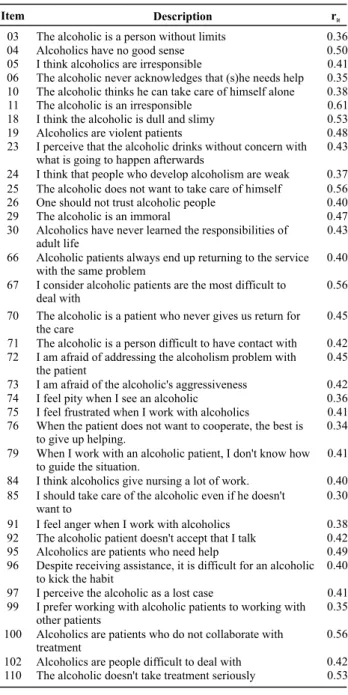
In Factor 1 - The alcoholic: work and interpersonal re-laions, 31 items,i.e. 46.9% of the total were eliminated due to non-compliance with the inclusion criteria, i.e. their item-total correlaion coeicient was less than 0.30. Despite the large number of items that were eliminated, ater the analysis, Factor 1 was sill the scale factor with the largest number of items (35). Regarding the item-to
-tal correlaion coeicients, 22 out of 35 remaining items scored more than 0.40. The highest coeicient (0.61) was found for item 11 The alcoholic is irresponsible, and the lowest (0.30) for item 85 I should take care of the alcoholic even if he does not want to (Table 1).
Table 1 - Item-total coeficients of items in Factor 1 - The alcoho
-lic: work and interpersonal relations - São Paulo, SP - 2010
Item 03 04 05 06 10 11 18 19 23 24 25 26 29 30 66 67 70 71 72 73 74 75 76 79 84 85 91 92 95 96 97 99 100 102 110
The alcoholic is a person without limits Alcoholics have no good sense I think alcoholics are irresponsible
The alcoholic never acknowledges that (s)he needs help The alcoholic thinks he can take care of himself alone The alcoholic is an irresponsible
I think the alcoholic is dull and slimy Alcoholics are violent patients
I perceive that the alcoholic drinks without concern with what is going to happen afterwards
I think that people who develop alcoholism are weak The alcoholic does not want to take care of himself One should not trust alcoholic people
The alcoholic is an immoral
Alcoholics have never learned the responsibilities of adult life
Alcoholic patients always end up returning to the service with the same problem
I consider alcoholic patients are the most difficult to deal with
The alcoholic is a patient who never gives us return for the care
The alcoholic is a person difficult to have contact with I am afraid of addressing the alcoholism problem with the patient
I am afraid of the alcoholic's aggressiveness I feel pity when I see an alcoholic
I feel frustrated when I work with alcoholics
When the patient does not want to cooperate, the best is to give up helping.
When I work with an alcoholic patient, I don't know how to guide the situation.
I think alcoholics give nursing a lot of work. I should take care of the alcoholic even if he doesn't want to
I feel anger when I work with alcoholics The alcoholic patient doesn't accept that I talk Alcoholics are patients who need help
Despite receiving assistance, it is difficult for an alcoholic to kick the habit
I perceive the alcoholic as a lost case
I prefer working with alcoholic patients to working with other patients
Alcoholics are patients who do not collaborate with treatment
Alcoholics are people difficult to deal with The alcoholic doesn't take treatment seriously
Description rit 0.36 0.50 0.41 0.35 0.38 0.61 0.53 0.48 0.43 0.37 0.56 0.40 0.47 0.43 0.40 0.56 0.45 0.42 0.45 0.42 0.36 0.41 0.34 0.41 0.40 0.30 0.38 0.42 0.49 0.40 0.41 0.35 0.56 0.42 0.53
Table 2 - Item-total coeficients of items in Factor 2 - Etiology -
São Paulo, SP - 2010
Item Description rit
Social and economic problems trigger binge drinking. 116 117 118 119 120 122 123 124 125 126 127 129 130 133 134 135 136 137 139 140 141
Alcoholics are people who seek solutions to affective problems in liquor
I think that going through a family disagreement leads to alcoholism
Alcohol is used as an escape
Timid or inhibited people have a greater chance of developing alcoholism
I think that all alcoholics have something unsolved I think there is a gene responsible for the development of alcoholism
There is something in the alcoholic's past that makes him drink
The lack of self-control leads to alcoholism
I think that depression leads to alcoholism People drink to feel happier. looser Alcohol is used as an escape valve The alcoholic drinks to flee from reality What is missing in the alcoholic is willpower Social issues make people drink
Alcoholism starts under the influence of friends. People without a fixed job develop alcoholism Children of alcoholics tend to drink
Unresolved people become alcoholics Dissatisfied people misuse alcohol
I think that people who use alcohol are fleeing from some problem 0.54 0.44 0.44 0.37 0.44 0.33 0.45 0.51 0.50 0.62 0.30 0.48 0.47 0.32 0.50 0.32 0.46 0.38 0.54 0.54 0.49
Factor 3 – Disease – includes the smallest number of items (7). Out of this factor’s iniial 18 items, 11 (61%) were eliminated ater the analysis. The highest item-total corre -laion coeicient was observed in item 109 – The alcoholic should be forwarded to the Psychiatrist. In Factor 4- Reper-cussions deriving from alcohol use and abuse, item analy -sis through the item-total correlaion coeicient resulted in the eliminaion of 21 (67%) out of 31 iniial items. Thus, the factor included ten items, with correlaion coeicients ranging between 0.33 and 0.53 and 60% of items with a factor-item correlaion ≥ 0.40 (Table 3).
Table 3 - Item-total coeficients of items in Factors 3 - Disease and
4 - Repercussions deriving from alcohol use - São Paulo, SP - 2010
Item Description 07 27 32 57 59 93 109 146 149 150 153 154 157 159 162 163 165
The alcoholic is sick
Alcoholics are psychologically disturbed people I think that the alcoholic is guilty of his health problems
Alcoholism is a disease
Alcoholism is not a disease, as a person can control him/herself
I perceive alcoholics and psychiatric patients in the same way
The alcoholic should be forwarded to the psychiatrist
Alcoholism causes physical and psychic dependence The alcoholic does not perform well in any sector of life
Alcoholics do not have a job
Alcoholism leads to a loss of identity and morale Alcoholics have a precarious life situation Many alcoholics just want to enjoy life and are irresponsible
An individual who drinks gets disoriented Most alcoholics end up alone
Alcohol leads to madness and death Alcoholics drag along relatives and friends
r F3it r F4it
0.34 0.39 0.31 0.31 0.32 0.34 0.61 0.35 0.53 0.38 0.40 0.46 0.40 0.33 0.46 0.48 0.33
Factor 5 The alcoholic drink included 22 items at the start of the analysis. At the end of the process, 50% of these scored correlaion coeicients below 0.30 and were excluded from the instrument. Ater terminaing item analysis in this factor, 11 items were maintained with cor -relaion coeicients ranging between 0.31, for item 33- I think that people have the right to drink if they want to 0.55 for item 55 – There are people who drink and are able to control themselves (Table 4).
Table 4 - Item-total coeficients of items in Factor 5 - The alcoho
-lic drink - São Paulo, SP - 2010
33 I think that people have the right to drink if they want to 34 Alcoholic drinks are pleasant and offer wellbeing 35 Using alcoholic beverages is something normal
38 I think that having a shot of whisky is considered social drinking
41 Any amount of drinking will make the person dependent.
42 Moderate drinking is not harmful
46 Alcohol relaxes daily tensions 47 I am in favor of moderate drinking
48 Small doses of alcohol can cause dependence 55 There are people who drink and are able to control
themselves Item Description 0.31 0.37 0.42 0.39 0.34 0.42 0.48 0.52 0.40 0.55
r F5it
Instrument reliability
The next phase of the EAFAAA item analysis process was to verify the instrument’s internal consistency, ater correlaion analysis through the item-total coeicient. The internal consistency of the items that coninued in the scale was esimated using Cronbach’s Alpha coeicient(17-18). The
reliability of the complete instrument and each of its fac -tors was calculated before and ater the item analysis pro -cess through the item-total correlaion coeicient. Ater excluding items with low consistency rates from the factor, the scale’s reliability coeicient increased from 0.87 in the earlier version to 0.90 in the inal 83-item version. A similar result was found for individual factors, with increasing reli -ability factors for four out of ive scale factors, except for Factor 3, whose reliability coeicient did not change ater excluding the items; Cronbach’s Alpha coeicients, how -ever, was ≥ 0.75 on all factors (Table 5).
Table 5 - Comparison between internal consistency coeficients
of ive EAFAAA factors before and after the item reduction pro
-cess through the item-total coeficient - São Paulo, SP - 2010
Factor 1 Factor 2 Factor 3 Factor 4 Factor 5
Initial version Short version
diScUSSion
This study aimed to analyze the items of the Aitude Scale Towards Alcohol, Alcoholism and Alcoholics, inves -igate the internal consistency of the subscales and the item-total correlaion between each item and the instru -ment. Results evidenced the scale’s theoreical consis -tency (construct validity) and ability to precisely assess (reliability) aitudes towards alcohol, alcoholism and al -coholics. Although almost 50% of items were withdrawn, a result wanted in this study, all factors from the prelimi -nary version(16) coninued in the scale ater the analysis. In
an earlier study(16), in which EAFAAA factors were analyzed
through factorial analysis, it was observed that 42% of items from the iniial version were withdrawn. A compari -son between both study results showed that the analy -sis through the item-total correlaion coeicient method reduced the number of items by almost 10% more than through the technique used in the irst study, showing its adequacy for the intended goals(16).
Also in comparison with an earlier study(16), 11 items
that had demonstrated adequate factor loadings and had hence been maintained ater the irst analysis were elimi -nated ater item analysis, which were: (1 – Alcoholics are individuals who depend on liquor for everything; 2 – Con -tainment is needed to deliver care to alcoholics; 3 – One only inds alcoholic paients for care at primary care units in the suburbs 4 – Alcoholics are revolted; 5 – I think that hereditary factors inluence alcohol misuse; 6 – I perceive that alcoholism is related with the individual’s instrucion level; 7 – I perceive that alcoholics have low self-esteem; 8 – It’s no use being aggressive to alcoholic paients; 9 – The team needs training to work with alcoholics; 10 – Individu -als who drink get disoriented and 11 – I perceive alcohol-ics as marginalized people). On the other hand, items that had been eliminated in the earlier analysis(16) were again
added to the EAFAAA, including: (1 – Alcoholics never ac-knowledge that they are in need of help; 2 – Alcoholics think they can take care of themselves alone. 3 –I feel pity when I see an alcoholic; 4 – Alcoholics are paients who need help; 5 – Despite receiving assistance, it is diicult for an alcoholic to kick the habit; 6 –I perceive alcoholics and psychiatric paients in the same way; 7 – Alcoholism is not a disease, as individuals can control themselves). Ac -cording to experts(15,17-18), changes due to the coninuaion
of diferent numbers of items and the allocaion of items to other factors are expected results in research on scales’ psychometric properies. That phenomenon could be ob -served here, as the analysis of EAFAAA items through the item-total coeicient modiied the number of items in the factors in comparison with the results of the earlier analysis(14-16). In the comparison, the number of items in
Factors 1, 3 and 5 decreased from 42, 13 and 12 items in the earlier version to 35, 07, 10 items, respecively, in the current version. On the other hand, a slight increase was observed in the number of items in Factors 2 and 4. Factor 2 increased from 20 to 21 items(14,16) and Factor 4 from 9 to
11 items from the previous to the current version. Another relevant observaion with regard to item anal -ysis regards the item-total correlaion coeicients that were found. For 40 out of 83 scale items, correlaion coef -icients ≥ 0.40 were found, indicaing that almost 50% of EAFAAA items are saisfactorily correlated with the enire instrument, which suggests consistent correlaion pat -terns for other instrument items.
To check the items’ internal consistency, that is, the instrument’s reliability raio, ater reducing the items through the item-total coeicient, Cronbach’s Alpha was used(17); this coeicient is applied when the instru
-ment comprises items on an ordinal scale, with the same number of response levels: alpha coeicient bor -dering on 1 indicate good internal consistency(17). It was
evidenced that, ater item analysis and coninuaion of those items with a factor loading ≥ 0.30, a increased for all factors, demonstraing an increase in the scale’s in -ternal consistency, whose reliability raio corresponded to 0.90, which experts on the theme consider saisfac
-tory(15,17-18), recommending that alpha coeicients ≥
0.70 are adequate to conclude that internal consistency exists for an instrument. In line with the reliability ob -served for the full 83-item scale, saisfactory reliability coeicients were observed for all EAFAAA factors, with Cronbach’s Alpha coeicients ≥ 0.75. The most signii -cant increase was observed for Factor 5, from a = 0.47 in the irst study(16) to a =0.75, based on which a signiicant
improvement in the instrument’s internal consistency is veriied, ater analyzing the items through the item-total correlaion coeicient.
In this study, the proposal of a staisical model that showed to be eicient and reliable(18), despite consider
-ing the subject sample involved in the previous valida -ion of the scale, evidences the advances on the earlier study, which involved the EAFAAA assessment and valida -ion process. In addi-ion, the previous results(16) support
it, evidencing that the EAFAAA is reliable to measure at -itudes towards the issue, independently of the staisical technique used for analysis. This fact is considered sais -factory, as the instrument is sill under construcion. An -other signiicant advance presented in this study was that more saisfactory reliability raios were obtained for all instrument factors, especially Factor 5 The alcoholic drink. In the irst analysis, this factor did not reach expected in -ternal consistency coeicients and, therefore, jeopardized the reliability of that factor and the EAFAAA as a whole. Besides, item analysis through the item-total correlaion coeicient permited reducing the iniial version by 82 items, more than the 69 items eliminated in earlier stud -ies(14,16). A comparison between the results of the previous
analysis and the present study shows that the inal scale included 83 items, 13 less than the 96 resuling from the previous analysis(16), showing that the selected analysis
The limitaions that can be appointed in this research include the size of the iniially recruit sample to assess the instrument, which was minimized by the choice of the item assessment method, in view of the obtained results. Besides, the sample comprised senior Nursing students, although professionally acive nurses would be desirable. This procedure was adopted due to the fact that literature on the theme suggests that scales under development be iniially applied to students representaive of the inal populaion for whom the instrument is being construct -ed. In this sense, it was constructed for nurses and other health professionals, due to easy and rapid data collec -ion(18). Despite these limitaions, one cannot lose out of
sight that this is a preliminary study and that the scale needs to be applied to other samples of nurses and other health professionals, which is already happening and will give rise to new publicaions on the validity and applica -ion of the scale presented here as, in this study, it was limited to a preliminary exploraion of the scale’s psycho -metric properies through the analysis of its items.
Nevertheless, this study is important, mainly when con -sidering the contemporary reality, which raises care deliv -ery to paients with alcohol and other drugs-related prob -lems as a new challenge for health care pracice. Besides, the Ministry of Health itself acknowledges that health pro -fessionals’ aitudes, allied with a lack of knowledge and preparaion to act on this problem have resulted in low detecion levels of these problems. These represent an
obstacle for professionals’ more efecive acion, demand -ing research on the theme, also regard-ing the availability of reliable instruments that are capable of idenifying such aitudes. Moreover, the use of the EAFAAA should not be limited to the mere ideniicaion of aitudes; on the op -posite, the scale can be used to enhance professionals’ relecion when discussing their answers, hence analyz -ing their aitudes towards the issue.
concLUSion
The analysis of the items in the Aitude Scale towards Alcohol, Alcoholism and Alcoholics showed high internal consistency, item-total correlaion and Cronbach’s alpha coeicients, which demonstrate its factor validity and through which the instrument’s good psychometric pa -rameters can be airmed, raising perspecives for future research. Based on the premise of maintaining the most representaive items in the inal scale version, 49% of items from the iniial version were eliminated. Nevertheless, the scale is sill extensive, demanding further research with a view to ofering a shorter scale with more reined psycho -metric qualiies. Although the scale has demonstrated its reliability to measure aitudes towards alcohol, alcoholism and alcoholics, further applicaions to health professional and a consequent broadening of the sample are necessary to improve the scale’s psychometric qualiies and coninue its validaion process in diferent populaions.
REFEREncES
1. Organização Mundial da Saúde (OMS). Relatório Sobre a Saúde do Mundo. Saúde mental: nova concepção, nova espe
-rança. Genebra; 2001.
2. Brasil. Ministério da Saúde. Saúde Mental e Atenção Básica: o vínculo e o diálogo necessários [Internet]. Brasília; 2003 [cita
-do 2009 nov. 28]. Disponível em: htp://portal.saude.gov.br/ portal/arquivos/pdf/diretrizes.pdf
3. Brasil. Ministério da Saúde. A Políica do Ministério da Saúde para Atenção Integral a Usuários de Álcool e Outras drogas. Brasília; 2004.
4. Cruz MS, Silva Filho JF. A formação de proissionais para a as
-sistência de usuários de drogas e a consituição de um novo habitus de cuidado. J Bras Psiquiatr. 2005;54(2):120-6.
5. Vargas D, Labate RC. Trabalhar com pacientes alcoolistas: sat
-isfação de enfermeiros de hospital geral. Rev Gaúcha Enferm. 2005;26(2):252-60.
6. Happell B, Taylor C. Negaive aitudes towards clients with drug and alcohol related problems: inding the elusive solu
-ion. Aust N Z J Ment Health Nurs. 2001;10(2):87-96.
7. Berger M, Wagner TH, Baker LC. Internet use and sigmaized illness. Soc Sci Med. 2005;61(8):1821-7.
8. Rassool GH, Luis MAV, Carraro TE, Lopes G. Undergradu
-ate nursing students’ percepions of substance use and misuse: a Brazilian posiion. J Psychiatr Ment Health Nurs. 2006;13(1):85-9.
9. Vargas D, Luis MAV. Alcohol, alcoholism and alcohol addicts: concepions and aitudes of nurses from district basic health centers. Rev Laino Am Enferm. 2008;16(n.esp):543-50.
10. Pimenta CAM, Cruz DALM. Crenças em dor crônica: valida
-ção do Inventário de Aitudes frente à Dor para a língua por
-tuguesa. Rev Esc Enferm USP. 2006;40(3):365-73.
11. Biblioteca Virtual em Saúde. DeCS - Descritores em Ciências da Saúde [Internet]. São Paulo; 2009 [citado 2009 dez. 15]. Disponível em: htp://decs.bvs.br/
12. Pillon SC, Dunn J, Laranjeira RR. Nurses Aitudes Towards Alcoholism: factor analysis of three commonly used scales. São Paulo Med J. 1999;116(2):1661-6.
14. Vargas D. A construção de uma escala de aitudes frente ao álcool, ao alcoolismo e ao alcoolista: um estudo psicométri
-co [tese doutorado]. Ribeirão Preto: Es-cola de Enfermagem de Ribeirão Preto, Universidade de São Paulo; 2005.
15. Streiner DL, Norman GR. Health measurement scales: prac
-ical guide to their development and use. New York: Oxford University Press; 2003.
16. Vargas D, Luis MAV. Construção e validação de uma escala de aitudes frente ao álcool, ao alcoolismo e ao alcoolista. Rev Laino Am Enferm. 2008;16(5):895-902.
17. Pasquali L. Taxonomia dos instrumentos psicológicos. In: Pasquali L, organizador. Instrumentos psicológicos: manual práico de elaboração. Brasília: LabPAM/IBAPP; 1999. p. 27-35.
18. Spector PE. Summated raing scale construcion: an intro
-ducion. Newbury Park: Sage; 1992.
Acknowledgements