INTRODUCTION
Article/Artigo
1. Departamento de Nutrição e Dietética, Hospital de Clínicas, Universidade Federal de Uberlândia, Uberlândia, MG. 2. Programa de Pós-Graduação em Ciências da Saúde, Faculdade de Medicina, Universidade Federal de Uberlândia, Uberlândia, MG.
Address to: Dra. Daniela Nogueira Prado de Souza. Rua dos Lírios Azuis 184, Cidade Jardim, 38412-136 Uberlândia, MG, Brasil.
Phone: 55 34 3224-4788; Fax: 55 34 3211-6885 e-mail: [email protected]
Received in 03/03/2011 Accepted in 05/05/2011
he efect of
Lactobacillus casei
and
Biidobacterium breve
on
antibiotic-associated diarrhea treatment: randomized double-blind clinical trial
Efeito de
Lactobacillus casei
e
Bifidobacterium breve
na diarréia associada ao uso de
antimicrobiano: estudo clínico randomizado duplo cego
Daniela Nogueira Prado de Souza
1and Miguel Tanús Jorge
2ABSTACT
Introduction: Antibiotic-associated diarrhea (AAD) is an important side efect of this speciic class of drugs. he objective of this study was to investigate the efect of the use of probiotics in the treatment of AAD. Methods: A group of hospitalized patients, who contracted diarrhea during or ater 7 days of suspension of antimicrobial medication, was blindly randomized to receive a standardized diet associated with the use of the probiotics (Lactobacillus casei and
Biidobacterium breve) or its corresponding placebo, three times a day. Results: Seventy patients were studied. For the experimental (n=35) and control (n=35) groups, respectively, the average time of treatment was 5.06±2.18 and 5.49±3.17 days (p=0.95), and the average duration of diarrhea, among those who were healed, was 4.87±2.13 and 4.52±2.55 days (p=0.36). Four (11.4%) patients who received probiotics and ten (28.6%) who received the placebo were not cured (p=0.13), and relapse rates were similar between both groups. Seven patients from each group, in addition to diarrhea, presented cases of bloating and/or abdominal cramps and/or vomiting (p=1.00). Conclusions: In this light, it is concluded that L. casei associated with
B. breve, in the administered dosage and frequency, has no efect on the antibiotic-associated diarrhea. Similar studies need to be conducted with higher doses of these or other probiotics.
Keywords: Probiotics. Lactobacillus casei.Biidobacterium breve. Antibiotic-associated diarrhea.
RESUMO
Introdução: A diarréia associada ao uso de antimicrobiano(DAA) é um importante efeito colateral dessa classe de fármacos. O objetivo do presente trabalho é investigar o efeito do uso de probióticos no tratamento da DAA. Métodos: Pacientes hospitalizados em um hospital universitário com diarréia, que se desenvolveu durante o uso ou até sete dias após a suspensão de antimicrobianos, foram randomizados, de forma cega, para receberem dieta padronizada associada, três vezes ao dia, ao uso de probiótico (Lactobacillus casei e Biidobacterium breve) ou placebo. Resultados: Foram estudados um total de setenta pacientes. Para o grupo experimento (n=35) e controle (n=35), respectivamente, o tempo médio de tratamento foi de 5,06 ± 2,18 e 5,49 ± 3,17dias (p=0,95) e o tempo médio de duração da diarréia, entre aqueles que se curaram, foi de 4,87 ± 2,13 e 4,52 ± 2,55 dias (p=0,36). Quatro (11,4%) pacientes que receberam probióticos e dez (28,6%) que receberam placebo não foram curados (p=0,13) e a frequência de recidiva foi similar entre os grupos. Sete pacientes de cada grupo, além da diarréia, apresentaram distensão e/ou cólica abdominal e/ou vômito (p=1,00). Conclusões: L. casei associado a B. breve, na dosagem e frequência administradas, não demonstraram qualquer efeito no tratamento da diarréia associada a antimicrobiano. Estudos similares merecem ser realizados com doses maiores destes ou de outros probióticos.
Palavras-chaves: Probióticos. Lactobacillus casei.Biidobacterium breve. Diarréia associada ao uso de antimicrobiano.
Antibiotic-associated diarrhea (AAD) is characterized by its development ater the start of antibiotic therapy or up to six to eight weeks ater the completion of the treatment with this group of drugs1-2, provided that there is no other agent that causes diarrhea. It occurs in approximately 5% to 25% of patients using antimicrobial agents3. he incidence varies, for example, with the types of antibiotics used and also with the deinition of diarrhea adopted in diferent studies1,4.
he human gastrointestinal tract is a complex ecosystem of more than 400 diferent species of microorganisms, predominantly anaerobic bacteria (1,000 anaerobic/1 aerobic)5-7, especially in the colon. When these non-pathogenic microorganisms are in a state of equilibrium, the intestinal microbiota plays an important role in controlling the microbial population by means of the colonization resistance mechanism that suppresses the growth of harmful microorganisms to the body, keeping them at lower levels or eliminating them completely6,8.
he use of antibiotics can cause imbalance in this ecosystem, resulting in both decreased fermentation of indigestible carbohydrates, which contributes to the development of osmotic diarrhea, and a negative impact on the mechanism of colonization resistance, creating a favorable environment for the growth of microorganisms that cause diarrhea2-3.
Clostridium difficile is the pathogen most commonly referenced and is involved in about 20% of all AAD cases in hospitalized individuals. This infection can result in manifestations of uncomplicated diarrhea, ulcerative colitis, or pseudo-membranous colitis9-11.
METHODS
Souza DNP et al - Probiotics in antibiotic-associated diarrhea
to survive through the gastrointestinal tract at a rate of 10% and 30%, respectively13-14. hus, probiotics have been indicated for the prevention of AAD, both in the presence or absence of infection by
C. diicile15-18.
he studies published, to date, evaluate the preventive efect of diarrhea with the use of probiotics, together with the antibiotic, and its recurrence with or without the presence of toxins for C. diicile19-21. However, it is also important for patients, who contract diarrhea while using one or more antibiotics, and the health professionals, who serve them, to be aware of the efect of the probiotics ater the onset of AAD.
In this light, the present study was conducted to determine the effect of using the association of Lactobacillus casei and
Biidobacterium breve for the treatment of clinical manifestations of AAD and the occurrence of relapse.
Patients and randomization
he study included hospitalized patients aged 18 years or older, in the wards of internal medicine, neurosurgery, traumatology, urology, oncology, and general surgery department, at he Federal University Hospital of Uberlândia. All of them contracted diarrhea during the use or in the next 7 days ater the suspension of antimicrobial medication, which had been induced for at least 24h. his occurred with watery or semi-liquid stools on two or more occasions, in the last 24h.
Exclusion criteria were adopted for patients who had a history of chronic diarrhea or presumptive viral etiology, an HIV infection, ulcerative colitis, Crohn's disease, lactose intolerance, an electrolyte disturbance, or short bowel syndrome. The exclusion criteria were also adopted for patients who had been critically ill or were undergoing radiotherapy and chemotherapy; post-gastrectomy and enterectomy or ostomates; in use of enteral nutrition with a concentration greater than 350mOsm/kg; or whose suspected cause of diarrhea was the rapid infusion of the diet (>120ml/h).
For two years and two months, 73 patients were stratiied into two groups, one by means of enteral feeding and the other by means of a normal oral diet. Patients from each group were blindly randomized in separate blocks of four, for the constitution of the two groups: experimental and control.
Treatment
In the experimental group, patients with enteral feeding received industrialized enteral diet and cashew juice, containing 1g of probiotics ofered three times a day ater the enteral diet. Patients who had an oral diet received a normal diet and cashew juice containing 1g of probiotics, which was ofered three times a day. In the control group, patients received the same diets as those from the experimental group; however, instead of the probiotics, a placebo was ofered (725mg corn starch). he characteristics of the enteral feeding diet in cases of AAD were: the absence of saccharose, gluten, iber, and lactose with an osmolality of less than or equal to 350mOsm/kg.
he probiotic, in sachet form (1g), contained 2×10⁷ to 109 cells of
Lactobacillus casei and 5×10⁷ to 109 cells of Biidobacterium breve. To certify the number of viable cells, the product underwent laboratory
analysis, whose technique is based on the seeding of the sample or its dilutions in JC Man, M Rogosa and E Sharpe, 1960 (MRS) agar for an enumeration of cells followed by an incubation temperature of 36±1ºC for 48h according to the Standard Operating Procedure for the enumeration of lactic acid bacteria of the Laboratory for Quality Control and Food Safety of the Faculty of Veterinary Medicine of the Federal University of Uberlândia.
he product sample for analysis was obtained by weighing 25±0.2g of the same product, plus 225mL of 0.1% of homogenized saline peptone for about 60 seconds in a stomacher, with a 10-1 dilution. From this, dilutions were made up to a corresponding amount of 10-8 in 0.1% of saline peptone. One milliliter of the dilutions -6, -7, and -8 was plated in duplicate into sterile Petri dishes, plus approximately 15 to 20mL of molten MRS agar, and was kept in bath water up to 48ºC. he samples were homogenized and appropriately placed to solidify on a lat surface22. he plates were submited to inverted incubation at 36±1°C for 48h.Ater this period, counts were performed in the colonies of lactic acid bacteria, resulting in an average amount of 6.1×10⁸colony-forming unit/g of total lactic acid bacteria22.
he probiotic and the placebo, with similar appearance and lavor, were completely dissolved in moderate temperature liquids before being ofered to the patient.
The following data were recorded daily: antibiotics used (including for treatment of AAD), time of use, dosage and administration route, number of daily bowel movements, stool consistency and assessment as to the improvement or worsening of symptoms, gastrointestinal symptoms and their evolution ater the intervention, the date and reason for the end of the intervention, and relapse of diarrhea ater stopping the probiotic or the placebo.
Treatment was initiated ater the diagnosis of AAD and suspended ater reducing the frequency of bowel movements and when stool consistency was back to normal, or, ater four days, if there had not been any degree of improvement. For a recurrence evaluation, characterized by the reappearance of diarrhea in those individuals who met the curing criteria, patients could be visited in their wards, or if they had been discharged from the hospital, they could be contacted by phone calls, until seven days ater the end of intervention.
Statistical analysis
For comparison between the experimental and control groups, the patients who were submited to the enteral nutrition and oral diets were evaluated together. To detect the diference between the averages of the age, duration of treatment, and healing variables, the Student’s t-test was used for parametric data and the Mann-Whitney U-test was used for non-parametric data. he analysis of proportions between the sex and age of the patients, the period of treatment, and the period of AAD healing, with and without recurrence, as well as cases in which AAD was not healed between groups, was performed using the Chi-square test with the Yates correction. he diference was considered to be signiicant when the p-value was <0.05.
Ethical considerations
RESULTS
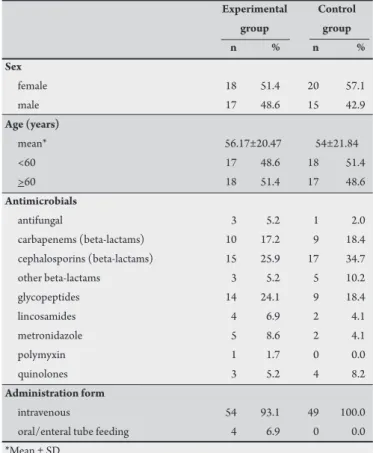
DISCUSSION TABLE 1 - Baseline characteristics of experimental and control groups.
Experimental Control
group group
n % n %
Sex
female 18 51.4 20 57.1
male 17 48.6 15 42.9
Age (years)
mean* 56.17±20.47 54±21.84
<60 17 48.6 18 51.4
>60 18 51.4 17 48.6
Antimicrobials
antifungal 3 5.2 1 2.0
carbapenems (beta-lactams) 10 17.2 9 18.4 cephalosporins (beta-lactams) 15 25.9 17 34.7
other beta-lactams 3 5.2 5 10.2
glycopeptides 14 24.1 9 18.4
lincosamides 4 6.9 2 4.1
metronidazole 5 8.6 2 4.1
polymyxin 1 1.7 0 0.0
quinolones 3 5.2 4 8.2
Administration form
intravenous 54 93.1 49 100.0
oral/enteral tube feeding 4 6.9 0 0.0
*Mean ± SD.
TABLE 2 - Frequency of healing and recurrence of antibiotic associated diarrhoea in patients taking probiotics and those on placebo.
Probiotic Placebo
Variable n % n %
Cure without relapse 19a,d 54.3 17a,d 48.6
Cure with relapse 12a,c 34.3 8a,c 22.8
No cure 4b 11.4 10b 28.6
Total 35 100.0 35 100.0
a,bp=0.13, when comparing the probiotic and placebo groups related to the total healing (with or without relapse) and cases that were not cured. c,dp=0.80, when comparing the probiotic and placebo groups for relapse.
Out of the 73 patients who met the inclusion criteria, three were subsequently excluded because they died due to causes not related to diarrhea. Out of the 70 remaining patients, 35 were in the experimental group and 35 belonged to the control group; 21 patients from the experimental group and 20 from the control group were under enteral feeding.
here was no signiicant diference in the average age of the patients (p=0.71), in the proportion of male patients (p=0.81), and in the proportion of people who were aged 60 years or more (p=1.00), among the patients from the experimental and control groups.he antimicrobials most frequently involved with AAD were beta-lactams, particularly cephalosporins and carbapenems, and glycopeptides. Also, it is noteworthy that during the intervention, no antimicrobials were removed or exchanged for others because of diarrhea. he administration of intravenous antibiotics occurred in most patients in the experimental and control groups (Table 1).
he AAD was initiated, on average, on the tenth day of use of antimicrobials in patients in the experimental group and on the seventh day in the control group (p=0.02). hree (8.6%) patients in the experimental group and four (11.4%) in the control group developed AAD only ater the discontinuation of the antimicrobial.
he average use of probiotics (treatment period) was 5.06±2.18 days for the experimental group and 5.49±3.17 days for the control group (p=0.95), and the duration of diarrhea, (curing time) among those who were healed, was also similar between the two groups
(Figure 1). The proportions among those who were cured less
0 1 2 3 4 5 6
Treatment (days) Healing (days) 5.06 + 2.18 5.49 + 3.17 4.87 + 2.13
4.52 + 2.55
Experimental
Control
FIGURE 1 - Average length of treatment and healing between experimental and control groups.
promptly, more markedly, or did not improve at all over the intervention were similar between the two groups (p>0.05). he frequencies of healing and recurrence were proportionally similar between the two groups (Table 2). Seven patients in the experimental group and seven in the control group had bloating and/or abdominal cramps and/or vomiting, in addition to diarrhea (p=1.00).
Although this study has shown the inefficacy of the use of probiotics in the treatment of AAD, some methodological problems limit the extent of generalization of this conclusion. he amount of viable cells ofered, the microbial species administered, and the number of patients involved could be the decisive factors in the results.
Some researchers23-24 have used prophylactically L. rhamnous GG and a multispecies of Lactobacillus spp. and Biidobacterium spp. in similar amounts or even superior to those used in this study; these showed no reduction in the incidence of AAD in children, adults, and elderly people in the use of antibiotics, whether hospitalized or not. However, other authors, offering 2×10⁸CFU/day of
L. acidophilus, L. bulgaricus, and S. thermophilus25; 4.4×10¹⁰ CFU/day of L. bulgaricus and L. immunitas20; or 2×10¹⁰CFU/day of
ACKNOWLEDGMENTS
he authors declare that there is no conlict of interest. he Yakult® pharmacy did not have any participation in the elaboration of the project or did not make any restrictions in the design of the paper. he reason for the partnership was only to obtain the product, which was provided without restriction on publication, whatever the results.
CONFLICT OF INTEREST
REFERENCES
In a meta-analysis involving a total of 707 patients from 0 to 18 years old in six studies, Johnston et al.27 found that four of these, offering doses between 5.5 and 40×109CFU/day of probiotics in different species or strains (L. casei GG, S. boulardii, and
L. sporogens), demonstrated the protective efect of probiotics in AAD (RR 0.36, 95% CI 0.25 to 0.53), and in cases in which they used lower doses than 2×10⁹CFU/day, the beneit was not achieved. In the present study, the daily dose was 1.8×10⁹CFU, which may explain its inefectiveness. However, it is diicult to atribute the failure of the treatment of AAD only to the quantity of probiotics ofered, as, assessing some studies using probiotics to prevent AAD, there is much overlapping of doses among those that showed efectiveness and those that did not. In the majority of those that achieved positive efects, the daily doses were 2×10⁸ to 4.4×10¹⁰CFU20,25,28-30, whereas for investigations that obtained negative results, the doses used were 1×10⁹ to 4×10¹⁰CFU4,11,23-24,31.
Lactobacillus spp. and Bifidobacterium spp. showed a loss of viability when exposed to the secretions of stomach acid and bile salts32. However, an increase of CFU was observed in these bacteria in the stools of individuals who ingested them, which could act beneicially in patients13-14,33.
Also, it is known that antimicrobial therapy reduces the anaerobic bacteria of the intestinal lora, especially biidobacteria34-35. Seki et al.36 investigated the behavior of the microbiota in the use of antimicrobials with or without the use of probiotics. hey classiied 110 children and teenagers between 1 month and 15 years of age, according to three groups: those who received only antimicrobial treatment, those who initiated the use of probiotics during antibiotic treatment, and those who combined probiotic and antimicrobial from the beginning of the treatment. In the irst group, there was a reduction of anaerobic bacteria and over 40% of the amount of intestinal biidobacteria. In the second group, a similar situation occurred on the third day of antimicrobials. Yet, when the use of probiotics was initiated, an elevation and normalization of the quantity of microorganisms present occurred. In the third group, the levels of colony forming units remained constant. herefore, the replacement with these intestinal microorganisms can restore normal levels, which would be the basis for a therapeutic efect on AAD. In the present study, treatment was initiated as soon as diarrhea developed, between the seventh and tenth day of the use of antimicrobials, in other words, when the intestinal microbiota was probably already seriously unbalanced. herefore, it is reasonable to suppose that the amount of probiotics necessary for the therapeutic efect would have to be greater than what was actually used.
Another possibility to explain the inefectiveness of probiotics in the treatment of AAD is the species used or the combination of both. his does not seem very likely, as, according to Timmerman et al.37, there is a greater possibility of efectiveness when using more than one species or more than one strain of probiotic bacteria. hey described studies in animals and humans where there was not only the colonization of the species Lactobacillus spp., Biidobacterium spp.,
Saccharomyces boulardii, and Enterococcus faecium at concentrations ranging from 0.8×10⁸CFU/g to 2.4×10⁹CFU/g, but also the increased production of IgA, especially by strains L. casei and L. casei Shirota. he authors tried to explain the greater efectiveness of using more than one species, due to the possibility that one can create an environment more suitable for colonization and adherence than the other in the intestinal epithelium.
As the number of patients involved in this study was modest, there might have been a type-II statistical error, which means that an existing effect might not have been demonstrated, especially if it was small.
In studies with probiotics in preventing AAD19,30 for children between 6 months and 10 years of age receiving antimicrobial associated with L. casei GG, B. lactis, and S. thermophilus, no diferences were found in the duration of diarrhea, with an average of 4.7 days compared with 5.8 days in the placebo group (p>0.05) in one study, and 3.92 days compared with 5.00 days for the placebo group (p>0.05) in another. hus, in general, the main symptom of the AAD appears to continue for a period of approximately ive days, which is consistent with the data from this study.
Although beta-lactam antibiotics were the most commonly used antimicrobials in patients with AAD (55% of all antimicrobials used in both groups) and were common to multiple antimicrobial therapy (more than 50% of patients, both in the experimental group and the placebo group), the study design was not adequate to assess the ability of each antimicrobial to cause AAD, and the prevalence might be due only to the layouts of most antimicrobials used in the Federal University Hospital of Uberlândia, and not due to a lower or higher capacity to cause AAD.
As the other possible gastrointestinal manifestations, which have been caused by the use of probiotics, occurred in a percentage similar to that found in the control group, we can infer that the use of the product is, in this aspect, safe. homas et al.24 and McFarland et al.29, while assessing events such as nausea, abdominal cramps, latulence, and fever, also found them in similar frequencies or even higher in the placebo group than in the experimental group. As such, another study found no signiicant diference in the incidence of latulence and bloating in the group receiving Lactobacillus GG, along with the antimicrobial agent for preventing recurrence of Clostridium diicile -associated diarrhea, compared with the group that received the placebo38. Hence, we conclude that the data from this study showed no eicacy with the use of probiotics L. casei and B. breve in the dosage and frequency administered, as for the treatment of AAD and its recovery. Similar studies, however, still need to be conducted, but with higher doses than the ones used herein or other probiotics.
We would like to thank the Yakult® pharmacy for the free
supply of probiotics and the Laboratory for Quality Control and Food Safety of the Faculty of Veterinary Medicine of the Federal University of Uberlândia for the analysis performed.
1. Beaugerie L, Petit J. Antibiotic-associated diarrhoea. Best Pract Res Clin Gastroenterol 2004; 18:337-352.
2. Doron SI, Hibberd PL, Gorbach SL. Probiotics for prevention of antibiotic-associated diarrhea. J Clin Gastroenterol 2008; 42:S58-S63.
3. Bergogne-Bérézin E. Treatment and prevention of antibiotic associated diarrhea. Int J Antimicrob Agents 2000; 16:521-526.
4. Arvola T, Laiho K, Torkkeli S, Mykkänen H, Salminen SS, Maunula L, et al. Prophylatic Lactobacillus GG reduces antibiotic-associated diarrhea in children with respiratory infections: a randomized study. Pediatrics 1999; 104:64-67. 5. Bourlioux P, Koletzko B, Guarner F, Braesco V. he intestine and its microlora
are partners for the protection of the host: report on the Danone Symposium “The intelligent intestine”, held in Paris, June 14, 2002. Am J Clin Nutr 2003; 78:675-683.
6. Damião AOMC. Prebióticos, probióticos e simbióticos. Aplicações clínicas. Rev Nestlé Bio. 2006; 1:18-24.
7. Gill HS, Guarner F. Probiotics and human health: a clinical perspective. Postgrad Med J 2004; 80:516-526.
8. William M, Mabel A, Alberto B. Probióticos, prebióticos y simbióticos en pacientes críticos. Rev Bras Nutr Clin 2006; 21:155-162.
9. Kelly CP, Pothoulakis C, Lamont JT. Clostridium diicile colitis. N Eng J Med 1994; 330: 257-262.
10. Lewis SJ, Freedman AR. Review article: the use of biotherapeutic agents in the prevention and treatment of gastrointestinal disease. Aliment Pharmacol her 1998; 12:807-822.
11. Plummer S, Weaver MA, Harris JC, Dee P, Hunter J. Clostridium diicile pilot study: effects of probiotic supplementation on the incidence of C. difficile
diarrhoea. Int Microbiol 2004; 7:59-62.
12. Fuller R. Probiotics in human medicine. GUT 1991; 32:439-442.
13. Bezkorovainy A. Probiotics determinants of survival and growth in the gut. Am J Clin Nutr 2001; 73:399S-405S.
14. Pochart P, Marteau P, Bouhnik Y, Goderel I, Bourlioux P, Rambaud J. Survival of biidobacteria ingested via fermented milk during their passage through the human small intestine: an in vivo study using intestinal perfusion. Am J Clin Nutr 1992; 55:78-80.
15. Cremonini F, Di Caro S, Nista EC, Bartolozzi F, Capella G, Gasbarrini G, et al. Meta-analysis: the efect of probiotic administration on antibiotic-associated diarrhoea. Aliment Pharmacol her 2002; 16:1461-1467.
16. D’Souza AL, Rajkumar C, Cooke J, Bulpit CJ. Probiotics in prevention of antibiotic associated diarrhoea: meta-analysis. BMJ 2002; 324:1361-1366. 17. Floch MH, Walker WA, Guandalini S, Hibbert P, Gorbach S, Surawics C, et al.
Recommendations for probiotic use – 2008. J Clin Gastroenterol 2008; 42: S104-S108.
18. Sazawal S, Hiremath G, Dhingra U, Malik P, Deb S, Black R. Eicacy of probiotics in prevention of acute diarrhoea: a meta-analysis of masked, randomized, placebo-controlled trials. Lancet Infect Dis 2006; 6:374-382.
19. Corrêa NBO, Filho LAP, Penna FJ, Lima FMLS, Nicoli JR. A randomized formula controlled trial of Biidobacterium lactis and Streptococcus thermophilus
for prevention of antibiotic-associated diarrhea in infants. Aliment Tract Clin Res 2005; 39:385-389.
20. Hickson M, D’Souza AL, Muthu N, Rogers TR, Want S, Rajkumar C, et al. Use of probiotic Lactobacillus preparation to prevent diarrhoea associated with antibiotics: randomized double blind placebo controlled trial. BMJ 2007; 335:80-84. 21. Pillai A, Nelson RL. Probiotics for teatment of Clostridium diicile-associated colitis in adults. Cochrane Database of Systematic Reviews 2008; 1:CD004611. 22. Morton RD. Aerobic plate count.in: Compendium of Methods for the Microbiological Examination of Foods. 4th ed. Washington DC: American Public
Health Association; 2001.
23. Conway S, Hart A, Clark A, Harvey I. Does eating yogurt prevent antibiotic-associated diarrhoea? BJ Gen Pract 2007; 57:953-959.
24. homas MR, Litin SC, Osmon DR, Corr AP, Weaver AL, Lohse CM. Lack of efect of Lactobacillus GG on antibiotic-associated: a randomized, placebo-controlled trial. Mayo Clin Proc 2001; 76:883-889.
25. Beniwal RS, Arena VC, homas L, Narla S, Imperiale TF, Chaudhry A, et al. A randomized trial of yogurt for prevention of antibiotic-associated diarrhea. Dig Dis Sci 2003; 48:2077-2082.
26. Salazar-Lindo E, Figueroa-Quintanilla D, Caciano MI, Reto-Valiente V, Chauviere G, Colin P. Efectiveness and safety of Lactobacillus LB in the treatment of mild acute diarrhea in children. JPGN 2007; 44:571-576.
27. Johnston BC, Supina AL, Vohra S. Probiotics for pediatric antibiotic-associated diarrea: a meta-analysis of randomized placebo-controlles trials. CMAJ 2006; 175:377-383.
28. Armuzzi A, Cremonini F, Bartolozzi F, Canducci F, Candelli M, Ojeti V, et al. he efect of oral administration of Lactobacillus GG on antibiotic-associated gastrointestinal side-effects during Helicobacter pylori eradication therapy. Aliment Pharmacol her 2001; 15:163-169.
29. McFarland LV, Surawicz CM, Greenberg RN, Elmer GW, Moyer KA, Melcher SA, et al. Prevention of beta-lactm-associated diarrhea by Saccharomyces bourlardii compared with placebo. Am J Gastroenterol 1995; 90:439-448. 30. Vanderhoof JA, Whitney DB, Antonson DL, Hanner TL, Lupo JV, Young RJ.
Lactobacillus GG in the prevention of antibiotic-associated diarrhea in children. J Pediatr 1999; 135:564-568.
31. Gotz V, Romanklewics JA, Moss J, Murray HW. Prophylaxis against ampicillin-associated diarrhea with a lactobacillus preparation. Am J Hosp Pharm 1979; 36:754-757.
32. Charteris WP, Kelly PM, Morelli L, Collins JK. Development and application of an in vivo methodology to determine the transit tolerance of potentially probiotic
Lactobacillus and Biidobacterium species in the upper human gastrointestinal tract. J Appl Microbiol 1998; 84:759-768.
33. Yuki N, Wanatabe K, Mike A, Tagami Y, Tanaka M, Ohwaki M, et al. Survival of a probiotic, Lactobacillus casei strain Shirota, in the gastrointestinal tract: selective isolation from faeces and identiication using monoclonal antibodies. Int J Food Microbiol 1999; 48:51-57.
34. Plummer SF, Garaiova I, Sarvotham T, Cotrell SL, Scouiller SS, Weaver MA, et al. Efects of probiotics o the composition of the intestinal microbiota following antibiotic therapy. Int J Antimicrob Agents 2005; 26:69-74.
35. Zoppi G, Cinqueti M, Benini A, Bonamini E, Minelli EB. Modulation of the intestinal ecosystem by probiotics and lactulose in children during treatment with cetriaxone. Curr her Res 2001; 62:418-435.
36. Seki H, Shiohara M, Matsumura T, Miyagawa N, Tanaka M, Komiyama A, et al. Prevention of antibiotic-associated diarrhea in children by Clostridium butyricum
MIYAIRI. Pediatr Int 2003; 45:86-90.
37. Timmermam HM, Koning CJM, Mulder L, Rombouts FM, Beynen AC. Monostrain, multistrain and multispecies probiotics – A comparison of functionality and eicacy. Int J Food Microbiol 2004; 96:219-233.
38. Lawrence SJ, Korzenik JR, Mundy LM. Probiotics in recurrent Clostridium diicile