RE
VIE
W
1 Departamento de Nutrição e Saúde, Universidade Federal de Viçosa (UFV). Av. Peter Henry Rolfs s/n, Campus Universitário. 36570-000 Viçosa MG Brasil. marianalouzadaprates@ hotmail.com 2 University of
Saskatchewan. Saskatoon Canada.
3 Departamento de Medicina e Enfermagem, UFV. Viçosa MG Brasil.
Performance of primary health care
according to PCATool instrument: a systematic review
Abstract This study aims to analyze studies that evaluated the performance of Primary Health Care (PHC) services by using the Primary Care Assessment Tool (PCATool) under a worldwide user perspective. This is a systematic review that implemented the Preferred Reporting Items for Systematic Reviews and Meta-Analyses (PRIS-MA) model, from the following databases: Lilacs, Medline, SciELO, PubMed and the Coordination for the Improvement of Higher Education Person-nel (CAPES) Journals Website, using descriptors Primary Care Assessment Tool and PCATool. Considering inclusion and exclusion criteria, we analyzed 22 research papers published from 2007 to 2015. The best-evaluated attributes were cul-tural competence, first contact use and longitu-dinality. On the other hand, the worst evaluated were first contact accessibility, family orientation, community orientation and comprehensiveness. Most of the health services evaluated were from Brazil, applied to “traditional” primary care clin-ic (UBS) and the Health Family Strategy (FHS). Services evaluated should strengthen structure and process components to achieve a better per-formance in PHC.
Key words Primary care assessment tool,
Pri-mary Health Care, PCATool, Systematic review, Health evaluation
Mariana Louzada Prates 1
Juliana Costa Machado 1
Luciana Saraiva da Silva 1
Patrícia Silva Avelar 1
Luciana Louzada Prates 2
Erica Toledo de Mendonça 3
Glauce Dias da Costa 1
P
rat
es ML
Introduction
In 1978, with the Alma-Ata International
Con-ference1, Primary Health Care (PHC) gains
mo-mentum as a strategy to be implemented in the operationalization of health services (HS) under ongoing health care that provides prevention, promotion, treatment and rehabilitation at
af-fordable costs1-4.
Based on the assumptions defined in
Al-ma-Ata1, Starfield5 codified PHC into four
es-sential attributes and three derivatives, which qualify services as PHC and increase their in-teraction power with users and communities. The essential attributes are first contact access, access and use of HS whenever necessary; lon-gitudinality, understood as a professional-sub-ject-of-care temporal relationship, leading to the establishment of a strong mutual trust; co-ordination, understood as the integration of all the care that the user receives and needs with the other HS; comprehensiveness, represented by actions of promotion, prevention, treatment and rehabilitation appropriate to the PHC con-text, recognizing the biopsychosocial character
of the health-disease-illness process6. Derivative
attributes include family orientation, which is the knowledge of family factors that interfere in the health-disease-illness process by the health team, considering the family as the subject of care; community orientation, understood as the recognition of community health needs, guid-ing services for their benefit and, finally, cultural competence, which means adapting the HS to the
cultural specificities of the community served5.
According to Fracolli et al.3 and Ibanez et al.7,
due to the lack of research to evaluate the per-formance of PHC, the Primary Care Assessment
Tool (PCATool)8,9 was based on Donabedian10
theory on the evaluation quality of HS structure, process and results.
The publicly-owned instrument implement-ed by the World Health Organization (WHO) consists of a structured questionnaire that em-pirically measures the essential PHC attributes
and derivatives through the evaluation of users8,9,
managers and health professionals11, which has
been adapted and validated in different
coun-tries, namely, Brazil11,12, South Korea13 and
Cat-alonia-Spain14.
According to Donabedian10, the quality
com-ponent of the structure corresponds to the char-acteristics of the service; the process refers to actions by health professionals and populations; and results reflect the health status achieved.
Regarding the PCATool8,9 instrument, the
attri-butes enable the evaluation of services’ structure and process. Longitudinality and coordination attributes involve both structure and process characteristics, while the structure aspect of ser-vices is strongly linked to the first contact access/ sub-item accessibility and comprehensiveness/ sub-item available services, whereas the process category is more involved in first contact access/ sub-item use and comprehensiveness/sub-item
services provided5.
To this end, this study aims to analyze the performance of PHC services worldwide, through studies available in the national and in-ternational literature in relation to the attributes
originally proposed by Starfield5 in the PCATool
instrument.
Methods
This is a systematic review built on the recom-mendations proposed in the Guide Preferred Reporting Items for Systematic Reviews and
Me-ta-Analyzes - PRISMA15, based on studies that
used the PCATool instrument to evaluate SH’s performance.
The PCATool appears as a questionnaire di-vided into sections by evaluated attribute, which are divided into essential attributes and their sub-items: first contact access, with sub-items ac-cessibility and use; longitudinality; coordination, with sub-items integrated care and information system; and comprehensiveness, with sub-items available services and services provided.
The identification and selection of studies oc-curred from June to October 2015, independently by two trained researchers, through the guiding question: “Which studies evaluated the perfor-mance of PHC services worldwide using the PCA-Tool instrument, from the user’s perspective?”
The main health databases consulted were the Latin American and Caribbean Health Sciences Literature (LILACS), Medical Literature Anal-ysis and Retrieval System Online (MEDLINE), CAPES Journals Website, Scientific Electronic Library Online (SciELO), PubMed (US Nation-al Library of Medicine NationNation-al Institutes of Health). The Pan American Health Organization (PAHO) and WHO databases were also includ-ed. Descriptors used in the search were “primary care assessment tool” and “PCATool” and in their Spanish and Portuguese versions.
aúd
e C
ole
tiv
a,
22(6):1881-1893,
2017
were tuberculosis patients, since in order to cover this condition, the PCATool instrument under-went considerable adaptations, theses, manuals, editorials and studies that exclusively evaluated professionals and managers. The inclusion cri-teria were original studies that applied the PCA-Tool to target users, which evidenced defined performance classification criteria, i.e. a cut-off point from which the evaluated service could be classified as adequate to PHC principles.
In total, 466 papers were identified, of which 311 were excluded due to duplication within and between the databases, leaving out 155 papers, which were analyzed. Then, applying the exclu-sion criteria, 83 studies were fully analyzed. In the end, applying the inclusion criteria, we analyzed 22 original papers that implemented the PCA-Tool to users which included, at least, an essential or derivative attribute in the instrument and that defined a minimum value for the performance of the evaluated PHC services.
Regarding the services’ performance assess-ment, studies evaluated used different methods, and 19 studies used the Likert-type scale with an adjusted score from zero to ten. Of these,
one paper16 considered satisfactory performance
values above 7.0; 11 papers17-29, values equal to
or above 6.6; one paper27, values above 4 and 6
papers19,30-34, values above 3.0. Another 3 papers
adjusted the Likert scale from 0 to 100, and 2
studies35,36 evaluated the performance of services
according to the percentile achieved by the
attri-bute and one study37 classified values of 50% or
greater as satisfactory. In this study, as a form of standardization, attributes related to the perfor-mance of services were classified as adequate and inadequate, according to the papers evaluated.
Results
Chart 1 lists 22 studies published between 2007 and 2015, of which 15 (68.20%) are
Brazil-ian16-18,20-30,37 , 3 (13.63%) are Canadian31,32,34, 2
(9,09%) Korean33,35, one (4,54%) is Spanish19 and
one (4,54%) Chinese36. Only one (4.54%) study
was implemented in two stages, before the health
reform in Quebec and then34, all the others were
applied in a single stage. Four (18.2%) studies were applied in different PHC services to
com-pare them to each other21,26,28,35.
Regarding the studied population, 8 (36.36%) studies addressed only the child user
population17-19,22,23,25,26,30, through the application
of PCATool to caregivers, 6 (27.27%) papers
cov-ered the adult population20,28,29,33,34,36, 5 (22,73%)
evaluated services in the adult and child
popula-tion27,31,32,35,37, 2 (9,1%) targeted the elderly
popu-lation16,21 and 1 (4.54%) focused on adult women
as the research subject24.
Regarding the type of services evaluated, eight studies exclusively evaluated Family Health
Strategy (FHS)16,17,20,24,25,27,29,30, one
exclusive-ly addressed “traditional” primary care clinic
(UBS)37, two jointly evaluated FHS and UBS18,22,
two evaluated comparatively FHS versus UBS21,26,
two evaluated FHS in comparison with other PHC services (Health Center and Community
Health Worker Program - PACS)23,28. In relation
to Canadian studies, one evaluated only the
ser-vices provided by the Family Medicine Group34
and two evaluated several PHC services: Group practice, Solo practice, Stand-alone walk-in
clin-ic and Community Health Centers (CHCs)31,32.
With regard to Korean studies, one evaluated services from CHCs and private clinics offering general practice, general surgery, family
medi-cine, gynecology and obstetrics services33 and the
other evaluated PHC services in private clinics, school hospitals, public health centers and
clin-ical cooperatives35. One Chinese study evaluated
only CHCs36 and the Spanish study assessed the
Catalan population ascribed to Arees Integrals de
Salut19. Two studies jointly evaluated urban and
rural population31,32, and one study exclusively
evaluated the rural population25 (Table 1).
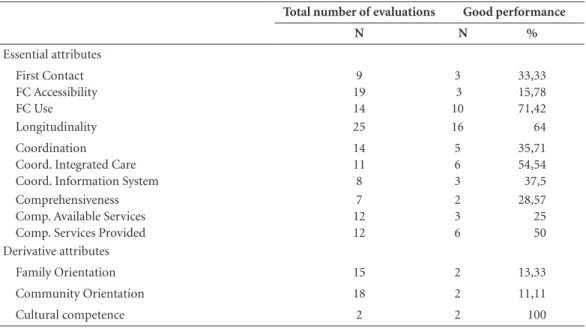
The most evaluated attributes were longitu-dinality (24), first contact access/sub-item acces-sibility (19), community orientation (18) and family orientation (15). The least evaluated were cultural competence (2) and comprehensiveness (7).
P
rat
es ML
Chart 1. Matrix analyzing studies included in the systematic review on the use of the PCATool instrument in the evaluation of the performance of Primary Health Care services worldwide.
Author Objective Study population Location
Araújo et al., 201416
Identifying the extent of attributes of family and community orientation in child health care in PHCa.
548 caregivers of children under 12 years of age of the 24 health facilities
(23 UBSb and 2 FHSc).
Brazil
Araújo et al., 201418
Assessing the quality of PHC from the perspective of the elderly.
Interview with 100 elderly enrolled in 10 FHS teams of the 20 municipal primary health care facilities.
Brazil
Berra et al., 201419
Evaluating the health perceptions of the child user.
2,196 caregivers of children under 15 years of age in all 36 health areas called “Arees Integrals
de Salut” according to the National Health
System in the region of Catalonia.
Espanha
Carneiro et al., 201420
Evaluating the quality of PHC by verifying the coordination attribute.
607 adult users of the 48 FHS facilities of the municipality. FHS professionals.
Brazil
Carvalho, et al., 201321
Evaluating the PHC orientation level with regard to the quality of life of the elderly attended.
509 elderly (> 60 years) coming from 21 municipal PHCs, 13 of the 33 FHSs and 8 of the 23 UBS
Brazil
Mesquito-Filho et al. 201422
Evaluating the attributes of primary health care for children from zero to two years of age
343 caregivers of children aged 0 to 2 years attended at the municipal PHC services
Brazil
Furtado et al., 201330
Analyzing the existence and extent of PHC attributes and the level of user enrollment vis-à-vis the FHS.
44 mothers of children under one year of age monitored at an FHS.
Brazil
Haggerty, et al., 200731
Evaluating Quebec primary care services from patients’ care experiences in PHC.
3,441 patients and caregivers of 100 primary care services (Group practice, Solo practice, Stand-alone, walk-in clinic, Community Health Center) in urban and rural areas.
Canada
aúd
e C
ole
tiv
a,
22(6):1881-1893,
2017
Chart 1. continuation
Autor Appropriate Performance Inappropriate
Araújo et al., 201416
__________ Family Orientation
Community Orientation
Araújo et al., 201418
First Contact sub-item Use
Coordination sub-item Information System
First Contact
First Contact sub-item Accessibility Coordination
Coordination sub-item Integrated Care Comprehensiveness
Comprehensiveness sub-item Services Provided Comprehensiveness sub-item Available Services Community Orientation
Family Orientation Berra et
al., 201419
First Contact Longitudinality Coordination
Comprehensiveness sub-item Available Services
Comprehensiveness sub-item Services Provided
Cultural Competence
_________
Carneiro et al., 201420
_____________ Coordination
Carvalho, et al., 201321
First Contact sub-item Use (FHS) First Contact sub-item Use (UBS)
First Contact sub-item Accessibility (UBS) (FHS) Longitudinality (UBS) (FHS)
Coordination (UBS) (FHS) Comprehensiveness (UBS) (FHS) Family Orientation (UBS) (FHS)
Mesquito-Filho et al. 201422
Longitudinality First Contact sub-item Accessibility
Coordination
Comprehensiveness sub-item Available Services Comprehensiveness sub-item Services Provided Family Orientation
Community Orientation Furtado et
al., 201330
First Contact sub-item Accessibility First Contact sub-item Use Longitudinality
Coordination sub-item Integrated Care
Coordination sub-item Information System
Comprehensiveness sub-item Available Services
Family Orientation Community Orientation
Comprehensiveness sub-item Services Provided
Haggerty, et al., 200731
First Contact sub-item Accessibility Longitudinality
Coordination
_________
P
rat
es ML
Author Objective Study population Location
Haggerty et al., 200832
Identifying the characteristics of clinical organization and professional practice in the prediction of accessibility, longitudinality and coordination of care.
2,725 patients from 100 PHC services (10 Community Health Centers, 57 private clinics, 16 private physician offices, 10 Walk in Clinics) in rural and urban areas.
Canadá
Jeon, 201133
Adapting and validating the short version of the US Consumer Primary Care Assessment Tool in primary care in the Republic of Korea.
606 users over the age of 17 were interviewed from 245 rural and urban Community Health Centers as well as from private clinics providing general practice, general surgery, family medicine, gynecology and obstetrics services.
South Korea
Leão e Caldeira, 201117
Verifying the association between PHC attributes and the professional qualification promoted by the Family and Community Medicine Residency and by the Family Health Multidisciplinary Residency.
Caregivers of children from 0 to less than 2 years of age of 350 families enrolled and monitored in 43 of the 44 FHSs located in urban area. The sample was divided into children from FHSs with professionals with family medicine and related areas residency (RF) and those without residency in the area (sRF).
Brazil
Leão et al., 201123
Comparing PHC in child health care in the family health teams with that of other childcare services at the municipal level from the viewpoint of caregivers.
Caregivers of children from 0 to less than 2 years of age of 350 families enrolled and accompanied in 43 of the 44 FHSs located in urban areas.
Brazil
Lima et al., 201524
Evaluating FHS quality from the perspective of female users and verifying the association between PHC attributes.
215 female users aged 20 to 49 years from the FHS services of the municipality of Serra, ES.
Brasil
Marques et al., 201425
Evaluating PHC attributes focusing on child health.
Caregivers of children from 0 to 5 years of age from the 76 families enrolled in the FHS of the quilombola rural community Buriti do Meio in the North of Minas Gerais.
Brazil
Oliveira e Veríssimo, 201526
Comparing the existence and extent of PHC attributes to child health between the traditional municipal FHS and UBS facilities.
482 caregivers of children over one year of age (247 children in UBS and 235 in FHS) from the 21 municipal health facilities.
Brazil
aúd
e C
ole
tiv
a,
22(6):1881-1893,
2017
Autor Appropriate Performance Inappropriate
Haggerty et al., 200832
Longitudinality Coordination sub-item Integrated Care
First Contact sub-item Accessibility
Jeon, 201133
First Contact sub-item Use Comprehensiveness Cultural Competence
First Contact sub-item Accessibility Longitudinality
Coordination
Community Orientation
Leão e Caldeira, 201117
Longitudinality (RF) (sRF) Coordination (sRF)
Comprehensiveness sub-item Services Provided (RF) (sRF)
First Contact (RF) (sRF) Coordination (RF)
Comprehensiveness sub-item Available Services (RF) (sRF)
Family Orientation (RF ) (sRF) Community Orientation (RF) (sRF)
Leão et al., 201123
Longitudinality (FHS) (OS) Coordination (OS)
Comprehensiveness sub-item Services Provided (FHS) (OS)
First Contact (FHS) (OS) Coordination (FHS)
Comprehensiveness sub-item Available Services (FHS) (OS)
Community Orientation (FHS) (OS)
Lima et al., 201524
First Contact sub-item Use First Contact sub-item Accessibility
Longitudinality
Coordination sub-item Integrated Care Coordination sub-item Information System Comprehensiveness sub-item Available Services Comprehensiveness sub-item Services Provided Family Orientation
Community Orientation Marques
et al., 201425
First Contact sub-item Use
Coordination sub-item Information System
First Contact sub-item Accessibility Longitudinality
Coordination sub-item Integrated Care Comprehensiveness sub-item Services Provided Comprehensiveness sub-item Available Services Family Orientation
Community Orientation Oliveira e
Veríssimo, 201526
First Contact sub-item Use (FHS) Coordination sub-item
Integrated Care (FHS)
First Contact sub-item Accessibility (FHS) (UBS) First Contact sub-item Use (UBS)
Longitudinality (FHS) (UBS)
Coordination sub-item Integrated Care (UBS) Coordination sub-item Information System (FHS) (UBS)
Comprehensiveness (FHS) (UBS) Family Orientation (FHS) (UBS) Community Orientation (FHS) (UBS)
P
rat
es ML
Author Objective Study population Location
Pereira et al., 201137
Evaluating organizational and performance characteristics from users.
55 users (adults and companions of children under 14 years) from a UBS of the 14 PHC services facilities of a municipality in rural São Paulo.
Brazil
Reis et al., 201327
Evaluate the access and use of the FHS as the gateway to the SUS, identifying the structural and procedural elements that strengthen or hamper the accomplishment of this role.
882 users (adults and children caregivers) enrolled and monitored in 44 of the 89 FHS teams.
Brazil
Silva et al., 201428
Evaluating the PHC
Comprehensiveness process from the users’ viewpoint.
373 adult users, 124 (33.6%) covered by the FHS and 249 (66.4%) by other services – Health Center and Community Health Worker Program as the main source of PHC.
Brazil
Silva e Fracolli, 201429
Evaluating attributes of first contact access, comprehensiveness, care coordination, longitudinality, family orientation and community orientation, FHS attributes from the perspective of users.
527 adults over 18 years of age enrolled in 33 municipal FHS facilities.
Brazil
Sung, et al., 201035
Comparing different PHC services from the perspective of patients.
602 patients enrolled in different PHC care services (private clinics, school hospitals, public health centers and clinical cooperatives).
South Korea
Tourigny et al., 201034
Assessing how primary care reform affects patients’ experience with regard to the essential realms of PHC.
1,046 adult users interviewed in 5 of the 13 Family Medicine Group at the onset of implementation and after 18 months of operation.
Canada
Wang et al., 201436
Evaluate PHC attributes in CHC through user evaluation.
3,360 adult PHC users serviced at the Community Health Center.
China
it continues Chart 1. continuation
Discussion
The PCATool instrument is recent in the evalu-ation of PHC services, which justifies the
pub-lication period of the studies found (2007 and 2015). Its first version was shown in 2000 to
eval-uate services provided to the child user9, followed
aúd
e C
ole
tiv
a,
22(6):1881-1893,
2017
Autor Appropriate Performance Inappropriate
Pereira et al., 201137
First Contact Longitudinality Comprehensiveness Coordination
Family orientation Community orientation
Reis et al., 201327
___________
First Contact
First Contact sub-item Use First Contact sub-item Accessibility
Silva et al., 201428
First Contact sub-item Use (FHS) Longitudinality (FHS)
First Contact sub-item Use (OS)
First Contact sub-item Accessibility (FHS/ OS) Longitudinality (OS)
Silva e Fracolli, 201429
First Contact sub-item Use Longitudinality
First Contact sub-item Accessibility Coordination sub-item Integrated Care Coordination sub-item Information System Comprehensiveness sub-item Available Services Comprehensiveness sub-item Services Provided Community Orientation
Sung, et al., 201035
First Contact Longitudinality
Coordination
Community/Family Orientation
Tourigny et al., 201034
Coordination sub-item Integrated Care (AR / DR)
Longitudinality (AR/ DR)
First Contact sub-item Accessibility (AR / DR)
Wang et al., 201436
First Contact sub-item Accessibility First Contact sub-item Use
Coordination Service Integration System Longitudinality
Coordination sub-item Information System
Comprehensiveness sub-item Available Services
Comprehensiveness sub-item Services Provided
Family Orientation Community Orientation
_______________
a- Primary Health Care. b- Primary Health Care Facility. c- Family Health Strategy. Chart 1. continuation
services by adult users8, by professionals and by
health service providers11. In Brazil, the original
version of the instrument was adapted and val-idated for existing PHC services in the country
by Almeida and Macinko12, conducted in the city
of Petrópolis, and by Harzheim et al., applied to PHC services in Porto Alegre, Rio Grande do Sul.
P
rat
es ML
Table 1. Performance of attributes according to studies that used the PCATool instrument.
Total number of evaluations Good performance
N N %
Essential attributes First Contact FC Accessibility FC Use
9 19 14
3 3 10
33,33 15,78 71,42
Longitudinality 25 16 64
Coordination Coord. Integrated Care Coord. Information System
14 11 8
5 6 3
35,71 54,54 37,5 Comprehensiveness
Comp. Available Services Comp. Services Provided
7 12 12
2 3 6
28,57 25 50 Derivative attributes
Family Orientation 15 2 13,33
Community Orientation 18 2 11,11
Cultural competence 2 2 100
of Health launched/introduced the PHC
Evalu-ation Instrument Manual (PCATool-BR)11, an
adaptation of the original instrument made by
Harzheim et al.39 for the evaluation of PHC
ser-vices from the perspective of adult and child us-ers, health professionals and managers; b) in the manual, the Ministry of Health recommends that the instrument be used for the evaluation and monitoring of PHC quality as a routine of the Family Health teams, at various levels of man-agement and for academic use; c) Brazil, as well as Canada, which presented the second largest representation in the sample, have PHC-oriented health systems. Thus, an instrument for evalu-ating the performance of health services is very useful in feeding and feeding back policies geared
to the sector3.
In relation to the evaluation of attributes, cultural competence had the best performance, however, it appeared only twice in the papers analyzed, which does not allow us to infer that this attribute is strongly incorporated in PHC services. One of the factors that may explain the low frequency found may be the non-inclusion
of this attribute in the PCATool-BR11 instrument,
although it is included in the original version for
the assessment of adults8 and its evaluation
en-couraged in later publications5.
The first contact access attribute and its sub-item accessibility had poor performance, both
making up part of the evaluation of HS structure
according to the Donabedian model5,10. The low
performance found may reflect geographical and organizational barriers to PHC services, such as reduced facility working hours, difficulties faced in scheduling appointments, and waiting time at the facility in order to be serviced. This low percentage impairs individual comprehensive health care, since, when faced with access barri-ers, health care tends to be postponed, hamper-ing the impact of possible prevention actions,
incurring future additional expenses5. However,
first contact access attribute’s sub-item use,
cor-responding to Donabedian10 process category,
had a high performance, suggesting that the user
seeks health services whenever necessary11,
be-fore visiting a service of greater specialization2,5.
Thus, its high performance may indicate that, while there are structural hurdles in accessing the evaluated services, users recognize PHC services as their primary source of health care.
The longitudinality attribute, belonging to
process category10, had the third best evaluation
in this review. Longitudinality is not an exclusive PHC attribute, but is essential to it. It develops insofar as users identify the location or provider of PHC services as their usual source of health
care5. In this respect, the definition of an ascribed
population, a PHC4 characteristic, and the
ex-aúd
e C
ole
tiv
a,
22(6):1881-1893,
2017
panded FHS24 can be variables that explain the
good performance found.
The essential attribute coordination and its sub-items integrated care and information sys-tem had low adequate performance. To achieve a satisfactory coordination, PHC and subspecialty care must be closely linked through appropriate communication and a strengthened referral and counter-referral system. The low performance of the attribute may show flaws in this interrelation-ship, which evidences the need for greater
inte-grated and articulated PHC in the HS4.
In the same perspective, the essential attri-bute comprehensiveness and its sub-item avail-able services had inadequate performance, below sub-item services provided. The low perfor-mance found can show the critical difficulty of assessed HS in PHC in offering a complete range of individual health-related needs and in making
available the resources needed to include them5.
Comprehensiveness requires different levels of complexity in health promotion, prevention,
re-covery and rehabilitation services6,22 from health
counseling to small surgeries8. The good
perfor-mance of comprehensiveness demands constant investments in physical, material and human re-sources, which requires assigning to PHC its real significance and not to be characterized as a ser-vice of low complexity and requiring low
invest-ment4. However, comprehensiveness sub-item
services provided had a better performance, ev-idencing a greater capacity of the facility to pro-vide services well rather than to supply a greater variety of these services.
With the exception of cultural competence, the attributes community orientation and fam-ily orientation evidenced the worst performance
rates of the entire study. According to Starfield5,
a high level of achievement of the exclusive and
fundamental qualities of PHC results in these three derivative attributes. The low performance achieved by family orientation and community orientation may be associated with a difficulty in PHC services evaluated to provide comprehen-sive care geared to family and community, being still far from the of Social Production of Health
model6.
However, some limitations should be pointed out: the difficulty of finding studies that present-ed a definpresent-ed and standardizpresent-ed classification of adequate performance of PHC services; studies that evaluated, in a limited way, only some at-tributes; the non-homogeneity of PHC services; the limitations of the PCATool itself, considering that all the attributes showed the same weight in the orientation of PHC services, as well as, the conception that the quality of PHC services are included in the attributes of the instrument.
Conclusion
P
rat
es ML
Collaborators
M Louzada-Prates: Conception, draft elabora-tion, search in databases, identification of man-uscripts, data analysis, writing and other stages of production of the manuscript. JC Machado: Research planning and critical review of the manuscript. LS da Silva: critical review of the manuscript. PS Avelar: Search in databases and identification of manuscripts. LL Prates: Iden-tification of manuscripts, critical review of the manuscript and translation of abstract. ET Men-donça: Research planning and critical review of the manuscript. GD Costa: Research planning. RMM Cotta: Research planning and critical re-view of the manuscript.
Acknowledgment
This work was performed with the support of the Coordination for the Improvement of Higher Education Personnel (CAPES), a Brazilian Gov-ernment body geared to the training of human resources.
References
1. Organização Pan-Americana da Saúde. Declaração de Alma-Ata. In: ConferênciaInternacional Sobre Cuidados
Primários de Saúde;1978, Alma Ata.
2. Organização Mundial da Saúde (OMS). Relatório mun-dial de saúde 2008: Atenção Primária em Saúde. Agora
mais do que nunca. Genebra: OMS; 2008.
3. Fracolli LA, Gomes MFP, Nabão FRZ, Santos MS, Cappellini VK, Almeida ACC. Instrumentos de avalia-ção da Atenavalia-ção Primária à saúde: revisão de literatura e metassíntese. Cien Saude Colet 2014; 19(12):4851-4860. 4. Mendes EV. Uma agenda para a saúde. São Paulo:
Hu-citec; 1996.
5. Starfield B. Atenção Primária: equilíbrio entre necessi-dades de saúde, serviços e tecnologia. Brasília: Unesco, Ministério da Saúde; 2002.
6. Cotta RMM, Campos AOC, Mendonça EO, Costa GD, Machado JC, Silva LS, Siqueira RL, Leão RT, Reis RS.
Políticas de saúde: desenhos, modelos e paradigmas.
Vi-çosa: UFV, Abrasco; 2013.
7. Ibañez N, Rocha JSY, Castro PC, Ribeiro MCSA, Fors-ter AC, Novaes MHD, Viana ALd’A. Avaliação do de-sempenho da atenção básica no Estado de São Paulo.
Cien Saude Colet 2006; 11(3):683-703.
8. Shi L, Starfield B, Xu J. Validating the adult primary care assessment tool. J Fam Pract 2001; 50(2):161-175. 9. Cassady CE, Starfield B, Hurtado MP, Berk R, Nanda JP,
Friedenberg LA. Measuring consumer experiences with primary care. Pediatrics 2000; 105(4 Pt 2):998-1003. 10. Donabedian A. The quality of care: How can it be
as-sessed? JAMA 1988; 260(12):1743-1748.
11. Brasil. Ministério da Saúde (MS). Manual do
Instru-mento de Avaliação da Atenção Primária à Saúde.
Bra-silia: MS; 2008. (Primary Care Assessment Tool. PCA-Tool-Brasil).
12. Almeida C, Macinko J. Validação de uma metodologia de avaliação rápida das características organizacionais e do desempenho dos serviços de atenção básica do Sistema Único de Saúde (SUS) em nível local. Brasília: Organiza-ção Pan-Americana da Saúde (OPAS); 2006. (Série téc-nica desenvolvimento de sistemas e serviços de saúde). 13. Lee JHO, Choi YJ, Sung NJ, Kim SY, Chung SH, Kim J,
Jeon TH, Park K. Development of the Korean primary care assessment tool - measuring user experience: tests of data quality and measurement performance. Int J
Qual Health Care 2009; 21(2):103-111.
14. Berra S, Rocha KB, Rodríguez-Sanz M, Pasarín I, Ra-jmil L, Borrell C, Starfield B. Properties of a short questionnaire for assessing primary care experiences for children in a population survey. BMC Public Health
2011; 11:285.
15. Moher D, Liberati A, Tetzlaff J, Altman DG, The PRIS-MA Group. Preferred reporting items for systematic re-views and meta-analyses: the PRISMA statement. BMJ
2009; 339:b2535.
aúd
e C
ole
tiv
a,
22(6):1881-1893,
2017
17. Leão CDA, Caldeira AP. Avaliação da associação en-tre qualificação de médicos e enfermeiros em atenção primária em saúde e qualidade da atenção. Cien Saude
Colet 2011; 16(11):4415-4423.
18. Araújo JP, Viera CS, Toso BRGO, Collet N, Nassar PO. Avaliação dos atributos de orientação familiar e co-munitária na saúde da criança. Acta Paul Enferm 2014; 27(5):440-446.
19. Berra S, Rodríguez-Sanz M, Rajmil L, Pasarín MI, Borrell C. Experiences with primary care associated to health, socio-demographics and use of services in children and adolescentes. Cad Saude Publica 2014; 30(12):2607-2618.
20. Carneiro MSM, Melo DMS, Gomes JM, Pinto FJM, Sil-va MGC. ASil-valiação do atributo coordenação da Aten-ção Primária à Saúde: aplicaAten-ção do PCATool a profis-sionais e usuários. Saúde Debate 2014; 38(n. esp.):279-295.
21. Carvalho VCHS, Rossato SL, Fuchs FD, Harzheim, Fuchs SC. Assessment of primary health care received by the elderly and health related quality of life: a cross-sectional study. BMC Public Health 2013, 13:605. 22. Mesquita-Filho M, Luz BSR, Araújo CS. A Atenção Pri-mária à Saúde e seus atributos: a situação das crianças menores de dois anos segundo suas cuidadoras. Cien
Saude Colet 2014; 19(7):2033-2046.
23. Leão CDA, Caldeira AP, Oliveira MMC. Atributos da atenção primária na assistência à saúde da criança: ava-liação dos cuidadores. Rev. Bras. Saúde Matern. Infant
2011; 11(3):323-334.
24. Lima EFA, Sousa AI, Primo CC. Avaliação dos atributos da atenção primária na perspectiva das usuárias que vi-venciam o cuidado. Rev. Latino-Am. Enfermagem 2015; 23(3):559-559.
25. Marques AS, Freitas DA, Leão CDA, Oliveira SKM, Pereira MM, Caldeira AP. Atenção Primária e saúde materno-infantil: a percepção de cuidadores em uma comunidade rural quilombola. Cien Saude Colet 2014; 19(2):365-371.
26. Oliveira VBCA, Veríssimo MLOR. Assistência à saúde da criança segundo suas famílias: comparação entre modelos de atenção primária. Rev Esc Enferm USP
2015; 49(1):30-36.
27. Reis RS, Coimbra LC, Silva AAM, Santos AM, Britto e Alves MTSS, Lamy ZC, Ribeiro SVO, Dias MAS, Silva RA. Acesso e utilização dos serviços na Estratégia Saúde da Família na perspectiva dos gestores, profissionais e usuários. Cien Saude Colet 2013; 18(11):3321-3331. 28. Silva OCS, Fonseca ADG, Souza e Souza LP, Siqueira
LG, Belasco AGS, Barbosa DA. Integralidade e Atenção Primária à Saúde: avaliação sob a ótica dos usuários.
Cien Saude Colet 2014; 19(11):4407-4415.
29. Silva AS, Fracolli LA. Avaliação da Estratégia Saúde da Família: perspectiva dos usuários em Minas Gerais, Brasil. Saúde Debate 2014; 38(103):692-705.
30. Furtado MCC, Braz JC, Pina JC, Mello DF, Lima RAG. A avaliação da atenção à saúde de crianças com menos de um ano de idade na Atenção Primária. Rev. Latino
-Am. Enfermagem 2013, 21(2):554-561.
31. Haggerty JL, Pineault R, Beaulieu MD, Brunelle Y, Gauthier J, Goulet F, Rodrigue J. Room for improve-ment: Patients’ experiences of primary care in Que-bec before major reforms. Can Fam Physician 2007; 53(6):1056-1057.
32. Haggerty JL, Pineault R, Beaulieu MD, Brunelle Y, Gauthier J, Goulet F, Rodrigue J. Practice features as-sociated with patient reported accessibility, continuity, and coordination of primary health care. Ann Fam Med
2008, 6(2):116-123.
33. Jeon KY. Cross-cultural adaptation of the US consum-er form of the short Primary Care Assessment Tool (PCAT):the Korean consumer form of the short PCAT (KC PCAT) and the Korean standard form of the short PCAT (KS PCAT). Qual Prim Care 2011;19(2):85-103. 34. Tourigny A, Aubin M, Haggerty J, Bonin L, Morin D,
Reinharz D, Leduc Y, St-Pierre M, Houle N, Giguère A, Benounissa Z, Carmichael PH. Patients’ perceptions of the quality of care after primary care reform: Family medicine groups in Quebec. Can Fam Physician 2010; 56(7):273-282.
35. Sung NJ, Suh SY, Lee DW, Ahn HP, Choi YJ, Lee JH. Patient’s assessment of primar y care of medical insti-tutions in South Korea by structural type. Int J Qual
Health Care 2010; 22(6):493-499.
36. Wang HHX, Wong SYS, Wong MCS, Wang JJ, Wei JL, Li DKT, Tang JL, Griffiths SM. Attributes of primary care in community health centres in China and implica-tions for equitable care: a cross-sectional measurement of patients’ experiences. QJM 2014; 108(7):549-560. 37. Pereira MJB, Abrahão-Curvo P, Fortuna CM, Coutinho
SS, Queluz MC, Campos LVO, Fermino TZ, Santos CB. Avaliação das características organizacionais e de de-sempenho de uma unidade de Atenção Básica à Saúde.
Rev Gaúcha Enferm 2011; 32(1):48-55.
Article submitted 28/12/2015 Approved 19/07/2016