FREE THEMES
1 Ciências da Motricidade. Universidade Estadual Paulista Júlio de Mesquita Filho. Avenida 24A 1515, Jardim Bela Vista. 13506-900 Rio Claro SP Brasil. [email protected]
Walking and health care expenditures among adult users
of the Brazilian public healthcare system:
retrospective cross-sectional study
Abstract Physical inactivity is a major public health challenge due to its association with chron-ic diseases and the resulting economchron-ic impact on the public healthcare system. However, walking can help alleviate these problems. Aim: To verify associations between walking during leisure-time, risk factors and health care expenditure among users of the Brazilian public health care system. Methods: The sample consisted of 963 adults. Walking was evaluated using the Baecke question-naire. The total expenditure per year was evaluat-ed through the demand for health care services, verified in the medical records of each participant. Results: Walking was reported as a physical activ-ity during leisure-time by 64.4% of the partici-pants. The group with the highest engagement in walking was younger and presented lower values for BMI, WC and expenditure on medication. Participants inserted in the category of higher in-volvement in walking were 41% less likely to be inserted into the group with higher total expendi-ture (OR = 0:59; 95% CI 0.39-0.89). Conclusion: It was found that walking was the most frequent leisure-time physical activity reported by users of the Brazilian health care system and was associat-ed with lower total and massociat-edication expenditure.
Key words Walking, Health care expenditure,
Primary health care
Bruna Camilo Turi 1
Jamile Sanches Codogno 1
Rômulo Araújo Fernandes 1
T
Introduction
Physical inactivity is recognized as one of the greatest public health challenges of the 21st cen-tury due to its association with several noncom-municable diseases (NCDs) and other harmful
effects to health1. It is estimated that 6% of heart
disease, 7% of type 2 diabetes, 10% of breast and colon cancer and 9% of premature mortality
worldwide are due to physical inactivity2.
Besides increasing the risk of NCDs, stud-ies have shown that physical inactivity can have a direct economic impact on the public health
care system3, significantly increasing medication
consumption4 and demand for medical services5,
varying from basic to high complexity.
Being characterized as an articulated network between primary, medium and high complexity health care, the Brazilian National Health Sys-tem currently faces many problems, including the disorderly flow of people and the high and unscheduled demand for services, causing poor regulation of access to health care services by the population, especially in primary care, the gate-way to health care services with high coverage in
the country6.
As an alternative, in order to reduce the bur-den of diseases, the development of policies and programs aimed at increasing physical activity at
the population level have been prioritized7, and
among the types of physical activity, walking has the highest adherence rate. Walking is recom-mended for people with NCDs and/or the elder-ly, conditions that make them more susceptible to physical inactivity and functional limitation, in addition to being a low cost and widely acces-sible physical activity. Walking on a regular basis can provide several health benefits, among them, fitness, body composition and physiological
im-provements8-10.
Due to its feasibility and the potential bene-fits that walking can provide as well as the grow-ing economic impact of physical inactivity, the aim of this study was to determine, among users of the Brazilian National Health System, wheth-er thwheth-ere are associations between walking during leisure-time, risk factors and expenditure related to health care services in primary care.
Methods
Study design, population and sample
This is a cross-sectional study with a ret-ro-analytical component, conducted in the city of Bauru, Sao Paulo State, and approved by the Ethics Committee Group from the Universidade Estadual Paulista, Bauru campus, and the Ethics Committee Group of the Department of Health, Bauru/Sao Paulo State.
The present study was based on a larger study, which randomly selected a representative group of users of the Brazilian National Health System in Bauru – SP, Brazil (963 participants were
ran-domly selected and interviewed)11. For this study,
the nonexistence of previous parameters for this population were considered (walking among us-ers of primary health care system), the sample size estimation equation was based on percentage values with an outcome of 50% (which generates the largest sample size in this type of equation). Added to the 50%, the following parameters were used; 3.5% error (arbitrary because there are no similar studies) and 5% statistical signif-icance [z = 1.96 using a 95% confidence interval (95%CI)]. Finally, the minimum representative sample size for this study was set at 784 people. The inclusion criteria were defined as follows: i) being registered for a minimum of one year at the
Basic Healthcare Unit (BHU); ii) aged ≥ 50 years;
iii) having an active registration in the health care service (having scheduled at least one medical visit in the previous six months); iv) signing the standard written consent form.
Initially, in each of the five selected BHUs, the medical agendas were screened to identify all patients with at least one scheduled appointment in the previous six months. Next, the medical re-cord numbers of the patients who met the inclu-sion criteria were inserted in a computer spread-sheet and 250 to 500 randomly selected from each BHU. This procedure was performed using the Statistical Package for Social Sciences (SPSS) software, version 13.0. All the selected patients
were invited to attend the BHU interview11. The
aúd
e C
ole
tiv
a,
20(11):3561-3568,
2015
Walking
Information regarding walking was extracted using the “physical activity during leisure-time”
section of the Baecke12 questionnaire, validated
by Florindo and Latorre13 for the Brazilian
pop-ulation. This section evaluates the frequency of walking during leisure-time with the following options: (i) never; (ii) seldom; (iii) sometimes; (iv) often; (v) always.
Healthcare expenditure
Healthcare expenditure per year was estimat-ed, including all items registered in the medical records of the patients for one year prior to the date of the interview. The following data were gathered: medication dispensed, laboratory tests performed and number of medical consulta-tions. To transform the procedures into curren-cy, a specific standard table was provided by the Department of Health for the year 2012. For sta-tistical procedures, expenditure was ranked and stratified into quartiles and the highest quartile (> P75) was adopted as the indicator of high
healthcare expenditure14.
Potential confounders
The face-to-face interviews and anthropo-metric measurements were performed in a quiet room at the BHU by a researcher. The following data were obtained through interviews and con-firmed in the medical records, which, for statis-tical procedures, were dichotomized, as follow: (i) socio-demographic variables (sex [female or male] and chronological age [structured as
cate-gorical variable: < 65 years-old (adult) and ≥ 65
years-old (elderly)]); (ii) smoking habits [cate-gorized as “yes” (current smokers independent of number of cigarettes per day) or “no” (for-mer smokers or non-smokers)]; (iii) economic status, assessed using a specific and previously
validated Brazilian questionnaire15, which
esti-mates the family income (dichotomized into ei-ther low or high income) and includes level of formal education; (iv) general obesity, identified through the body mass index (BMI), calculated
using measurements of weight and height16 and
obtained by dividing weight by height squared
(kg/m2). Overweight was defined as BMI ≥ 25 kg/
m2 and obesity as 30kg/m2; (v) abdominal
obesi-ty, identified by waist circumference (WC) with the cut-off point set at 1.02 meters for men and
0.88 meters for women17; (vi) blood pressure was
measured in a seated position at rest and values lower than 120/80 mmHg for systolic (SBP) and diastolic blood pressure (DBP) were considered normal, respectively. Diagnosis of arterial hy-pertension was identified through the medical records of the participant.
Statistical analysis
Categorical variables were expressed as rates and the 95%CI calculated. The chi-square test analyzed the existence of associations between walking, risk factors and healthcare expenditure. Next, binary logistic regression was performed to identify the same associations adjusted by poten-tial confounders. This procedure generated odds ratio (OR) and 95%CI values. Statistical
signifi-cance was set at p-value ≤ 0.05 and all statistical
analyses were performed using the software Bio-Estat (release 5.0). Adjustment of the multivari-able models was identified using the Hosmer-Le-meshow goodness-of-fit test [non-significant results (p-value > 5%) indicated an adequate adjustment].
Results
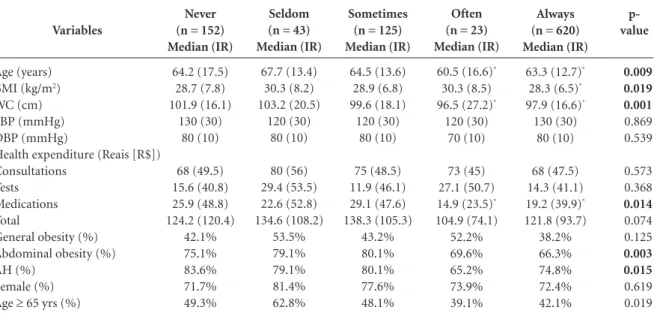
Considering the total sample, 963 adults of both sexes were selected and interviewed (women 73.4% [95%CI: 70.6 to 76.2]) with ages rang-ing between 50 and 96 years (Table 1). Walkrang-ing during leisure-time was reported as follows: 15.8% never (95%CI: 13.4% - 18.1%), 4.5% sel-dom, 13% sometimes, 2.4% often and 64.4% al-ways (95%CI: 61.3% - 67.4%). The groups with a higher frequency of walking during leisure-time presented lower ages (“always” group 1.5% younger compared to the “never” group; p-value = 0.009), lower BMI values (“always” group val-ues 1.4% lower compared to the “never” group; p-value = 0.019), WC (“always” group values 4% lower compared to the “never” group; p-value = 0.001) and medicine expenditure (“always” group 25.9% lower expenditure compared to the “nev-er “ group; p-value = 0.014). In the same groups it was also possible to identify lower occurrenc-es of abdominal oboccurrenc-esity (“never” group 75.1% [95%CI: 68.1% - 81.8%] and “always” group 66.3% [95%CI: 62.5% - 70.1%]; p-value = 0.003) and arterial hypertension (“never” group 83.6% [95%CI: 77.6% - 89.4%] and “always” group 74.8% [95%CI: 71.4% -78.2%]; p-value = 0.015).
T
tests or medication (all p-values > 5%). However, it was observed that higher engagement in walk-ing was associated with a lower percentage of pa-tients classified in the highest total expenditure group (p-value = 0.002) (Table 2).
Moreover, even after adjustment for poten-tial confounders, it was identified that patients with the highest engagement in walking during leisure-time (when compared to patients insert-ed in the “Never” category) were 41% less likely to be in the highest quartile of total expenditure (OR = 0.59 [0.39 - 0.89]). The multivariate
mod-el also showed that obesity (BMI ≥ 30 kg/m2; OR
= 1.32 [1.01 - 1.74]) and a diagnosis of arterial hypertension (OR = 2.07 [1.34 - 3.22]) remained associated with higher total expenditure, regard-less of walking.
It is noteworthy that the created multivariate model explained 75.4% of variation related to outcome, and the Hosmer-Lemeshow goodness-of-fit test showed that all models were well fitted to the data (p-value > 5%) (Table 3).
Regarding expenditure according to frequen-cy of walking, there was a significant difference
p- value 0.009 0.019 0.001 0.869 0.539 0.573 0.368 0.014 0.074 0.125 0.003 0.015 0.619 0.019 Variables Age (years) BMI (kg/m2)
WC (cm) SBP (mmHg) DBP (mmHg)
Health expenditure (Reais [R$]) Consultations
Tests Medications Total
General obesity (%) Abdominal obesity (%) AH (%)
Female (%) Age ≥ 65 yrs (%)
Never (n = 152) Median (IR) 64.2 (17.5) 28.7 (7.8) 101.9 (16.1) 130 (30) 80 (10) 68 (49.5) 15.6 (40.8) 25.9 (48.8) 124.2 (120.4) 42.1% 75.1% 83.6% 71.7% 49.3%
Table 1. General characteristics of the sample according to engagement in walking during leisure-time.
Sometimes (n = 125) Median (IR) 64.5 (13.6) 28.9 (6.8) 99.6 (18.1) 120 (30) 80 (10) 75 (48.5) 11.9 (46.1) 29.1 (47.6) 138.3 (105.3) 43.2% 80.1% 80.1% 77.6% 48.1% Seldom (n = 43) Median (IR) 67.7 (13.4) 30.3 (8.2) 103.2 (20.5) 120 (30) 80 (10) 80 (56) 29.4 (53.5) 22.6 (52.8) 134.6 (108.2) 53.5% 79.1% 79.1% 81.4% 62.8% Often (n = 23) Median (IR)
60.5 (16.6)*
30.3 (8.5) 96.5 (27.2)*
120 (30) 70 (10)
73 (45) 27.1 (50.7) 14.9 (23.5)*
104.9 (74.1) 52.2% 69.6% 65.2% 73.9% 39.1% Always (n = 620) Median (IR)
63.3 (12.7)*
28.3 (6.5)*
97.9 (16.6)*
130 (30) 80 (10)
68 (47.5) 14.3 (41.1) 19.2 (39.9)*
121.8 (93.7) 38.2% 66.3% 74.8% 72.4% 42.1%
* = Statistical difference (p-value < 5%) when compared to group “never”; IR = Interquartile Range (P75 – P25); BMI = Body Mass Index; WC = Waist circumference; SBP = Systolic blood pressure
Independent variable
Walking during leisure-time Never
Seldom Sometimes Often Always
χ2 (p-value)
Consultations (≥ P75)
N (% [95%CI])
40 (26.3 [19.3-33.3]) 15 (34.9 [20.6-49.1]) 34 (27.2 [19.4-35.1]) 04 (17.4 [1.9-32.8]) 149 (24.1 [20.6-27.4])
0.263
Tests (≥ P75)
N (% [95%CI])
33 (21.7 [15.1-28.2]) 14 (32.6 [18.5-46.5]) 33 (26.4 [18.6-34.1]) 08 (34.8 [15.3-54.2]) 153 (24.7 [21.2-28.1])
0.818
Medications (≥ P75)
N (% [95%CI])
44 (28.9 [21.7-36.1]) 13 (30.2 [16.5-43.9]) 36 (28.8 [20.8-36.7]) 02 (8.7 [1.1-20.2]) 146 (23.5 [20.2-26.8])
0.080
Total (≥ P75)
N (% [95%CI])
48 (31.6 [24.1-38.9]) 14 (32.6 [18.5-46.5]) 39 (31.2 [23.1-39.3]) 05 (21.7 [4.8-38.6]) 135 (21.8 [18.5-25.1])
0.002
Table 2. Association between walking during leisure-time and healthcare expenditure in primary care.
χ2 = chi-square test; 95%CI = 95% confidence interval.
aúd
e C
ole
tiv
a,
20(11):3561-3568,
2015
between the median of the “always” group “and the cluster of the other groups for medication (5.9 Reais per patient; p-value for Mann-Whit-ney test = 0.012) and total expenditure (9.5 Reais per patient; p-value for Mann-Whitney test = 0.010).
Discussion
The main findings of the present study were: (i) a high adherence to walking as a leisure-time physical activity; (ii) the association of walking with lower expenditure on medication and a lower percentage of people engaged in walking classified in the highest total expenditure group. In addition, obesity and the diagnosis of arterial hypertension were associated with higher total expenditure regardless of walking.
Regarding the high adherence to walking, it was found that 64.4% of participants reported walking as a leisure-time physical activity. This finding is consistent with other studies con-ducted in Brazil that assessed physical activity patterns through a telephone survey, and found that 67.9% of men and 79.8% of women aged less than 45 years old walk for at least 30 minutes
on five or more days per week18. In agreement
with data from Brazil, an American study found that the prevalence of walking increased signifi-cantly from 2005 to 2010, being a common type
of physical activity for 62% of the population19.
These findings indicate that in Brazil and other countries, walking presents itself as an import-ant manifestation of physical activity during lei-sure-time and thus should be considered as an
important promotional agent of physical activity in adults.
Although walking has become popular among the adult population, this does not mean that the number of minutes performed by par-ticipants reaches the recommendations of the American College of Sports Medicine, which de-fines that health benefits can be achieved with an accumulation of at least 150 minutes of physical activity at moderate intensity during the week. In this sample, among subjects reporting walking with the frequency “always”, only 19.5% (95%CI: 16.4% - 22.6%) met these recommendations. Likewise, the inclusion of this variable in the multivariate model did not affect the association between walking and health care expenditure (OR = 0.62 [0:41 - 0.94]) and did not increase the explanation power of the model (maintained at 75.4%). These findings demonstrate that, even when below current recommendations, walking can be associated with health benefits. Thus, for additional health benefits, public health strate-gies should provide the population with infor-mation on the current recommendations for walking, regarding optimal intensity, duration and frequency.
Moreover, it was found that participants en-gaged in walking presented a lower age, BMI and
WC, corroborating the findings of CDC19.
Con-trary to these results, Malta et al.18 observed an
increase in walking levels with an increase in age for both sexes, with the explanation that, when older, physical activity motivation becomes more related to health maintenance than leisure
prac-tice20. However, it should be considered that the
sample in the present study was composed of
Walking during leisure-time Never
Seldom Sometimes Often Always
χ2 (p-value) Hosmer-Lemeshow (p-value) Model’s explanation
N (%)
48 (31.6) 14 (32.6) 39 (31.2) 05 (21.7) 135 (21.8)
0.002
OR (95%CI)
1.00 1.04 (0.50-2.15) 0.98 (0.59-1.63) 0.60 (0.21-1.71)
0.60 (0.40-0.89)
---OR adjusted (95%CI)*
1.00 0.92 (0.43-1.95) 0.98 (0.58-1.66) 0.63 (0.21-1.89) 0.59 (0.39-0.89)
---0.286 75.4%
Table 3. Adjusted association between walking during leisure-time and healthcare expenditure in primary care.
95% CI = 95% confidence interval; χ2 = chi-square test; OR = odds ratio; * = Multivariate model simultaneously adjusted by: BHU, age, sex, economic status, smoking habit, SBP, DBP, WC, BMI and AH.
T
people treated at BHUs of 50+ years old, unlike
the sample in the Malta study18.
Regarding the association between health care expenditure and walking, it was found that the most active group presented lower expendi-ture on medicine and was 41% less likely to be classified in the highest total expenditure group. Consistent with these findings, a Brazilian study showed that a one-year intervention of a guid-ed walking program was able to rguid-educe mguid-edica- medica-tion use by 25% and the outpatient expenditure
among women with hypertension by 35%21.
In this respect, Bertoldi et al.4 found that
insufficiently active individuals used 39% more medication compared to active participants, and,
similarly, Codogno et al.5 found that
insufficient-ly active diabetic patients presented 63% more expenditure on consultations and 128% more on medication for the treatment of other diseases when compared to the active group.
Extrapolating data on economic impact and physical activity, an Australian study estimated that, if all inactive adults in the country walked for an hour a day at least five days a week, the
an-nual savings would be A$419.9 million22. A
sim-ilar study conducted in Pelotas/RS found that, if all citizens were active, savings to the Brazilian public healthcare system, including medication and hospitalizations from arterial hypertension and diabetes, would be approximately RS$2.2
million3.
In the present sample, the median difference between the “always” group and the cluster of other walking groups for medication (R$5.9 per patient; p-value for Mann-Whitney test = 0.012) and total health care expenditure (R$9.5 per pa-tient; p-value for Mann-Whitney test = 0.010) were significant. If we consider that the popu-lation of Bauru city includes 83,104 adults over
50 years old living in the urban area23, of which
60% would be exclusively attended by the Brazil-ian National Health System (49,862 inhabitants) and 35.6% of these (17,751 inhabitants) are not engaged in walking in the “always” frequency, if all these patients became more active, i.e., re-porting the frequency “always” in walking during leisure-time, the projected annual savings would be R$104,730.90 on medication expenditure and R$168,634.50 on total expenditure in primary care alone, without considering the demand for specialized care, the costs of which are potentially higher. It is important to mention that this sam-ple is representative only of users of primary care in the city of Bauru/SP and, thus, implications for the general population cannot be assumed.
On the other hand, even considering this limita-tion, this simple estimalimita-tion, provides interesting information about the association between walk-ing and lower health care expenditure in the gen-eral population.
It is also important to highlight the low per-centage of participants reporting “always” walk-ing that did not meet the recommendations for physical activity of moderate to vigorous
intensi-ty in the preceding four months24,25,
demonstrat-ing that if this type of physical activity were bet-ter supervised, the observed associations could be strengthened.
With regard to obesity and arterial hyperten-sion being associated with higher total expendi-ture, there is worldwide evidence confirming the findings of the present study. A Brazilian study on diabetes mellitus found that a higher BMI and waist-hip ratio were significantly related to high-er expenditure on medications for chronic
dis-eases other than diabetes14. In addition, Bahia et
al.26 found that estimated total costs in one year
on all diseases related to overweight and obesity were US$2.1 billion, 68.4% being due to hospi-talizations, and US$679,000 due to outpatient procedures. In our sample, medication use was significantly affected by walking and represented a total burden of 35% of total health expenditure. These findings indicate that interventions aimed at increasing physical activity levels during lei-sure-time could affect a significant portion of primary care costs.
Regarding the economic impact of hyper-tension, there is a consensus that the medical, monetary and human costs of untreated and/ or inadequately controlled blood pressure are
enourmous27. A population-based survey in
southern Brazil showed that treatment for this disease costs around 23% of income per capita
of hypertensive patients28. In addition,
anoth-er study indicated that, in 2001, blood pressure above recommended levels cost US$370 million, which represented about 10% of total health care
expenditure in the world29. In Brazil, the
Minis-try of Health has programs for the treatment of patients with hypertension and/or diabetes and increased access to medication, known as
Hiper-Dia30 and Farmácia Popular31. Such initiatives
in-crease knowledge on the epidemiological profile of these diseases in the country and give patients regular and systematic access to medicines, how-ever, none of the programs have recommenda-tions for physical activities, since inclusion of a physical education trainer is new in the context
aúd
e C
ole
tiv
a,
20(11):3561-3568,
2015
Thus, taking into account the
highlight-ed benefits of walking to rhighlight-educe mortality33, its
advantages for diabetic34 and cardiovascular
pa-tients35,36 as well as those with mental diseases37,
the gains in physiological components and
func-tional capacity8, in addition to the contribution
of walking in reducing expenditure related to
health care services3, the stimulation of programs
and actions to promote walking is recommend-ed, since control of risk factors has been iden-tified as a priority for the Brazilian government
action plan38.
The following can be considered limitations of the present study: i) the self-reporting of walk-ing as a leisure-time physical activity, which may have been overestimated due to the high
aware-ness of the importance of physical activity; ii) the lack of quantitative data on walking, since interpretation of the categories of perception “seldom, sometimes, often and always” can differ from person to person, and iii) the cross-section-al design, which does not establish causcross-section-al rela-tionships.
In conclusion, it was found that among the study population, there was an association be-tween walking during leisure-time and lower expenditure on medication, as well as a lower percentage of walking participants entered in the highest total expenditure group. In addition, obesity and a diagnosis of hypertension were as-sociated with higher total expenditure regardless of walking.
References
Blair S. Physical inactivity: the biggest public health problem of the 21st century. Br. J. Sports Med. 2009; 43(1):1-2.
Lee IM, Shiroma EJ, Lobelo F, Puska P, Blair SN, Katzmarzyk PT. Effect of physical inactivity on major non-communicable diseases worldwide: an analysis of burden of disease and life expectancy. Lancet 2012; 380(9838):219-229.
Bielemann RM, Knuth AG, Hallal PC. Atividade física e redução de custos por doenças crônicas ao Sistema Úni-co de Saúde. Rev Bras Ativ Fís Saúde 2010; 15(1):9-14. Bertoldi AD, Hallal PC, Barros AJ. Physical activity and medicine use: evidence from a population-based study.
BMC Public Health 2006; 6:224.
Codogno JS, Fernandes RA, Monteiro HL. Prática de atividades físicas e custo do tratamento ambulatorial de diabéticos tipo 2 atendidos em unidade básica de saúde. Arq Bras Endocrinol Metab 2012; 56(1):6-11. Pires MRGM, Gottems LBD, Martins CMF, Guilhem D, Alves ED. Oferta e demanda por média complexida-de/SUS: relação com atenção básica. Cien Saude Colet
2010; 15(Supl. 1):1009-1019.
Heath GW, Parra DC, Sarmiento OL, Andersen LB, Owen N, Goenka S, Montes F, Brownson RC; Lancet Physical Activity Series Working Group. Evidence-based intervention in physical activity: lessons from around the world. Lancet 2012; 380(9638):272-281.
1.
2.
3.
4.
5.
6.
7. Collaborations
T
Silva MP, Santos Filho JAA, Gobbi S. Aptidão funcional de mulheres idosas mediante programa supervisiona-do de atividades físicas generalizadas ou caminhadas regulares sem supervisão. Rev Bras Ativ Fís Saúde 2006; 11:3-12.
Kelly P, Kahlmeier S, Götschi T, Orsini N, Richards J, Roberts N, Scarborough P, Foster C. Systematic review and meta-analysis of reduction in all-cause mortality from walking and cycling and shape of dose response relationship. Int J Behav Nutr Phys Act 2014; 11(1):132. Hamer M, Chida Y. Walking and primary prevention: a meta-analysis of prospective cohort studies. Br J Sports Med 2008; 42(4):238-243.
Turi BC, Codogno JS, Fernandes RA, Monteiro HL. Prática de atividade física, adiposidade corporal e hi-pertensão em usuários do Sistema Único de Saúde. Rev
bras epidemiol 2014; 17(4):925-937.
Baecke JAH, Burema J, Frijters JER. A short question-naire for the measurement of habitual physical activ-ity in epidemiological studies. Am J Clin Nutr 1982; 36(5):936-942.
Florindo AA, Latorre MA. Validation and reliability of the Baecke questionnaire for the evaluation of habitual physical activity in adult men. Cad Saude Publica 2006; 22(3):535-541.
Codogno JS, Fernandes RA, Sarti FM, Freitas Júnior IF, Monteiro HL. The burden of physical activity on type 2 diabetes public healthcare expenditures among adults: a retrospective study. BMC Public Health 2011; 11:275. Associação Brasileira de Empresas de Pesquisa (ABEP).
Dados com base no Levantamento Sócio Econômico 2008. ABEP; 2010. [acessado 2010 mar 10]. Disponível em: www.abep.com.br
Organização Mundial de Saúde (OMS). Obesity, Pre-venting and Managing the Global Epidemic: Report of
the WHO Consultation on Obesity. Geneva: OMS; 1998.
Peixoto MRG, Benício MHD, Latorre MRDO, Jardim PCBV. Circunferência da cintura e índice de massa cor-poral como preditores da hipertensão arterial. Arq Bras Cardiol 2006; 87(4):462-470.
Malta DC, Moura, EC, Castro AM, Cruz DKA, Mo-rais Neto OL, Monteiro CA. Physical activities pattern among Brazilian adults: Results of phone survey, 2006.
Epidemiol. Serv. Saúde 2009; 18(1):7-16.
Centers for Disease Control and Prevention. Vital Signs: Walking Among Adults — United States, 2005 and 2010. MMWR 2012; 61(31):595-601.
Monteiro CA, Conde WL, Matsudo SM, Matsudo VR, Bonsenor IM, Lotufo PA. A descriptive epidemiology of leisure-time physical activity in Brazil, 1996-1997.
Rev Panam Salud Publica 2003; 14(4):246-254.
Rolim LM, Amaral SL, Monteiro HL. Hipertensão e exercício: custos do tratamento ambulatorial, antes e após a adoção da prática regular e orientada de condi-cionamento físico. Hipertensão 2007; 10(2):2-10. Zheng H, Ehrlich F, Amin J. Economic evaluation of the direct health care cost savings resulting from the use of walking interventions to prevent coronary heart disease in Australia. Int J Health Care Finance Econ
2010; 10(2):187-201.
Brasil. Instituto Brasileiro de Geografia e Estatística (IBGE). Censo demográfico 2010. [acessado 2014 maio 18]. Disponível em: http://www.cidades.ibge.gov.br/xtras/ temas.php?lang=&codmun=350600&idtema=90&sear- ch=sao-paulo|bauru|censo-demografico-2010:-resulta-dos-da-amostra-caracteristicas-da-populacao
8.
9.
10.
11.
12.
13.
14.
15.
16.
17.
18.
19.
20.
21.
22.
23.
Fernandes RA, Christofaro DG, Casonatto J, Codogno JS, Rodrigues EQ, Cardoso ML, Kawaguti SS, Zanesco A. Prevalence of dyslipidemia in individuals physically active during childhood, adolescence and adult age. Arq
Bras Cardiol 2011; 97(4):317-323.
Fernandes RA, Zanesco A. Early physical activity pro-motes lower prevalence of chronic diseases in adult-hood. Hypertens Res 2010; 33(9):926-931.
Bahia L, Coutinho ES, Barufaldi LA, Abreu Gde A, Ma-lhão TA, de Souza CP, Araújo DV. The costs of over-weight and obesity-related diseases in the Brazilan public health system: cross-sectional study. BMC Public Health 2012; 12:440.
Elliott WJ. The economic impact of hypertension. J Clin Hypertens 2003; 5(3 Supl. 2):3-13.
Dias da Costa JS, Fuchs SC, Olinto MT, Gigante DP, Menezes AM, Macedo S, Gehrke S. Cost-effectiveness of hypertension treatment: a population-based study.
Sao Paulo Med J 2002; 120(4):100-104.
Gaziano TA, Bitton A, Anand S, Weinstein MC. The global cost of nonoptimal blood pressure. J Hypertens.
2009; 27(7):1472-7.
Brasil. Ministério da Saúde (MS). Plano de Reorgani-zação da Atenção à Hipertensão Arterial e ao Diabetes mellitus: programa de educação permanente em Hiper-tensão Arterial e Diabetes mellitus para os municípios
com população acima de 100 mil habitantes. Brasília:
MS; 2002.
Brasil. Decreto no 5.090, de 20 de maio de 2004. Regula-menta a Lei no 10.858, de 13 de abril de 2004, e institui o programa “Farmácia Popular do Brasil”, e dá outras providências. Diário Oficial da União 2004; 21 maio. Malta DC, Castro AM, Gosch CS, Cruz DKA, Bressan A, Nogueira JD, Morais Neto OL, Temporão JG. A Polí-tica Nacional de Promoção da Saúde e a agenda da ati-vidade física no contexto do SUS. Epidemiol Serv Saúde
2009; 18(1):79-86.
Woodcock J, Franco OH, Orsini N, Roberts I. Non-vig-orous physical activity and all-cause mortality: system-atic review and meta-analysis of cohort studies. Int J
Epidemiol 2011; 40(1):121-138.
Yates T, Davies M, Gorely T, Bull F, Khunti K. Effec-tiveness of a pragmatic education program designed to promote walking activity in individuals with impaired glucose tolerance: a randomized controlled trial.
Dia-betes Care 2009; 32(8):1404-1410.
Lee LL, Watson MC, Mulvaney CA, Tsai CC, Lo SF. The effect of walking intervention on blood pressure con-trol: a systematic review. Int J Nurs Stud 2010; 47(12): 1545-1561.
Murphy MH, Nevill AM, Murtagh EM, Holder RL. The effect of walking on fitness, fatness and resting blood pressure: a meta-analysis of randomised, controlled trials. Prev Med 2007; 44(5):377-385.
Roe J, Aspinall P. The restorative benefits of walking in urban and rural settings in adults with good and poor mental health. Health Place 2011; 17(1):103-113. Brasil. Ministério da Saúde (MS). Secretaria de Vigilân-cia em Saúde. Departamento de Análise de Situação em Saúde. Avaliação de Efetividade de Programas de Ativi-dade Física no Brasil. Brasília: MS; 2011.
Article submitted 08/11/2014 Approved 09/03/2015
Final version submitted 11/03/2015 24.
25.
26.
27. 28.
29.
30.
31.
32.
33.
34.
35.
36.
37.