Psychometric properties of the Portuguese
version of the Conflict Tactics Scales:
Parent-child Version (CTSPC) used to identify
child abuse
Propriedades psicométricas da versão em
português do instrumento
Conflict Tactics Scales:
Parent-child Version
(CTSPC) utilizado
para identificar violência contra a criança
1 Instituto de Medicina Social, Universidade do Estado do Rio de Janeiro, Rio de Janeiro, Brasil.
Correspondência M. E. Reichenheim Departamento de Epidemiologia, Instituto de Medicina Social, Universidade do Estado do Rio de Janeiro. Rua São Francisco Xavier 524, 7oandar, Rio de Janeiro, RJ 20559-900, Brasil. [email protected]
Michael Eduardo Reichenheim 1 Claudia Leite Moraes 1
Abstract
This article follows another, which presented the first phase of the cross-cultural adaptation process examining the psychometric properties of the Conflict Tactics Scales, Parent-child Ver-sion (CTSPC), Portuguese verVer-sion. Fieldwork took place in three public maternity wards in Rio de Janeiro, Brazil, from March to September 2000. Interviews relate to siblings of randomly selected live births. Respondents were mothers. Information on partners was obtained by proxy. Almost all intra-observer reliability kappa esti-mates were above 0.75. Depending on the scale and type of perpetrator, internal consistency (a) estimates ranged from 0.49 to 0.68. Using the same sample, the iterated principal factor analysis identified four dimensions. Although most items performed well, some failed to ade-quately load in their expected factors. Construct validity involved exploring the relationship be-tween several other theoretical dimensions and a variable encompassing the cumulative pat-tern of violence severity. All the hypotheses test-ed were corroborattest-ed. The current evaluation indicates that the CTSPC can be recommended for use in Portuguese-speaking contexts. Still, it also identified some important points needing further investigation and discussion.
Domestic Violence; Questionnaires; Reliability and Validity
Introduction
In different parts of the world, family violence has had an important impact on the health and mortality of children, adolescents, and women 1,2,3,4,5,6. In Brazil, a clear picture has not yet been established, since information on the mag-nitude of family violence at the population lev-el is scarce. Even so, some studies have shown violence at the family level as an escalating problem 7,8,9,10,11,12,13,14.
The bio-psycho-social consequences of do-mestic violence have led to increasing interest in the scientific community with regard to pre-vention, follow-up of victims, and the develop-ment of pertinent research programs. Identifi-cation of violence in families is a major chal-lenge 15,16. Accepting that comparing profiles between cultures in different settings is of great interest, it is essential that instruments con-ceived and widely researched in one country are also thoroughly adapted for use in the new context. Local or regional nuances need to be contemplated in order to achieve cross-cultur-al equivcross-cultur-alence 17.
evalua-tions of the Conflict Tactics Scales (CTS) and their successful use in at least 20 countries 7,12, 23,24,25,26, the Conflict Tactics Scales: Parent-child Version (CTSPC) was selected to be adapt-ed to Portuguese for use in Brazil and possibly other Portuguese-speaking countries/commu-nities.
Straus et al. 26conceived the instrument in English as an offshoot of the first Conflict Tac-tics Scales (CTS1) released in 1979 24. The basic form of CTSPC consists of 22 items divided in-to three scales: non-violent discipline, psycho-logical aggression, and physical assault. The latter is further split into three subscales ac-cording to severity, which are respectively called corporal punishment, physical maltreatment, and severe physical maltreatment. The ques-tionnaire also contains supplementary scales on disciplinary methods, neglect, and sexual abuse in the preceding week (7 days).
The adaptation process underlying this pa-per is based on the guidelines proposed by Herdman et al. 27. The first three phases of the procedure – concept, item, and semantic equiv-alences evaluations – and a provisional Por-tuguese version proposed for use and further testing were presented elsewhere 22. The pre-sent paper carries the adaptation process a step further, formally assessing the psychometric properties of the Portuguese version of the in-strument. The Portuguese version of the CTSPC is evaluated here in terms of intra-observer re-liability, internal consistency, factor structure, and construct validity. Measurement equivalence between the original instrument developed in English and the version under test is granted if there is an overall similarity of estimates.
Methods
The Portuguese version of the CTSPC under test
As described in the previous section, the Por-tuguese version of CTSPC under test has al-ready undergone the first three steps of formal evaluation. The assessment of conceptual and item equivalence included discussion groups with experts, as well as a comprehensive litera-ture review to evaluate the pertinence of the concepts and items covered by the original in-strument in the Brazilian context. The ensuing appraisal of semantic equivalence consisted of two translations and respective back-transla-tions; an independent and blinded assessment of the equivalence between those and the orig-inal instrument with regard to referential
(liter-al) and general (connotative) meanings 27; a discussion phase with specialists in order to re-examine and select items for the proposed ver-sion; and a pre-test on 30 women admitted to hospital for childbirth. Conceptual, item, and semantic equivalence could be ascertained.
The original instrument in English and the proposed version may be found in Table 1, where the reader also finds the item letters used throughout the rest of this paper. Note that due to reasons that will become clearer later in the discussion, the psychometric evaluation con-cerns four scales, namely, non-violent disci-pline (NVD), psychological aggression (PSY), corporal punishment (CP), and physical mal-treatment (PM). As a result of underlying oper-ational demands, the proposed version has been adapted to the second person for use in face-to-face interviews, and the items’ score schemes restricted to two levels regarding the occurrence of the event (or lack thereof ) dur-ing the recall period. In this study, only the main part of the instrument has been addressed. The scales covering the previous 7 days’ neglect and sexual abuse alluded to in the introduction were left out.
Fieldwork and data analysis
The present study is part of a hospital-based case-control study exploring the relationship between violence in families of pregnant women and premature childbirth. The fieldwork took place from March to September 2000 in three large public maternity wards in Rio de Janeiro. Cases comprised all premature newborns ac-crued during the 6-month period. In order to comply with the pre-specified sample size, about 14% of the 3,800 eligible live births with gestational age above 36 weeks were randomly selected as controls. Subjects were drawn from a list of live births occurring in the previous 24 hours. Women with diabetes mellitus, systemic arterial hypertension, or who gave birth to neonates with severe congenital malforma-tions, infections associated with prematurity, or twins were excluded. The effective sample sizes are shown along with the details on each analysis.
parent-child relationships. Except for (a), the recall pe-riod was confined to the time pepe-riod covered by the main study, i.e., pregnancy. Information about the partner was obtained from the mother. The analysis of intra-observer reliability re-lates to 155 (91 mothers and 64 partners) CTSPC modules replicated by the same interviewer 24-48 hours after the first sitting. This time re-striction aimed at avoiding selectively losing subjects due to hospital discharge. Reliability was evaluated separately for each scale of the instrument, using both scores and as dichoto-mous variables. Regarding the latter, a positive event was defined as having at least one posi-tive item in the scale. Simple kappa statistics are used as estimators and respective confi-dence intervals calculated according to Fleiss
et al. 28. The overall scores result from the sum of items. Point-estimates are kappas with qua-dratic weights 29and confidence intervals ob-tained via bootstrap 30. Interpretation follows Shrout 31, who proposed classifying agreement as virtually none (κ< 0.1); slight (κ= 0.11-0.40); fair (κ= 0.41-0.60); moderate (κ= 0.61-0.80); and substantial (κ= 0.81-1.0).
The analysis of internal consistency con-cerns data from 439 and 335 questionnaires with complete sets of items pertaining to moth-ers or partnmoth-ers as perpetrators, respectively. The
αcoefficient is used as estimator 32,33, along with its one-sided 95% confidence bound 34,35. The item-rest point-biserial correlations (rpb) and the αcoefficients on excluding each item from the analysis are also provided (α(k-1)) 33. Table 1
Conflict Tactics Scales: Parent-child Version (CTSPC): original instrument in English and its Portuguese version.
Item Scale English Portuguese
A NVD Explained why something was wrong? Você explicou o/a XXX porque o que ele/a estava fazendo estava errado?
B NVD Put him/her in time out (or sent to his/her room)? Você colocou ele/a de castigo do tipo: mandou ele ficar em seu quarto ou em qualquer outro lugar?
C CP Shook him/her? Você sacudiu o/a XXX?
D CP Hit him/her on the bottom with something like a belt, Você bateu no bumbum dele/a com alguma coisa como um hairbrush, a stick, or some other hard object? cinto, chinelo, escova de cabelo, vara ou outro objeto duro? E NVD Gave him/her something else to do instead of what Você deu a ele/a outra coisa para fazer ao invés daquilo que
he/she was doing wrong? ele/a estava fazendo de errado?
F PSY Shouted, yelled, or screamed at him/her? Você falou alto, berrou ou gritou com XXX?
G PM Hit him/her with a fist or kicked him/her hard? Você bateu com a mão fechada ou deu um chute com força nele/a? H CP Spanked him/her on the bottom with your bare hand? Você deu uma palmada no bumbum de XXX?
I PM* Grabbed him/her around the neck and choked him/her? Você agarrou ele/a pelo pescoço e o sacudiu?
J PSY Swore or cursed at him/her? Você xingou ou praguejou, quer dizer, rogou praga, contra ele/a? K PM* Beat him/her up, that is you hit him/her over and over Você bateu muito em XXX, ou seja, bateu nele/a sem parar,
as hard as you could? o máximo que V/S conseguiu?
L PSY Said you would send him/her away or kick him/her out Você disse alguma vez que iria expulsar ele/a de casa ou of the house? enxotá-lo/a para fora de casa?
M PM* Burned or scalded him/her on purpose? Você queimou ou derramou líquido quente em XXX de propósito? N PSY Threatened to spank or hit him/her but did not actually do it? Você ameaçou dar um tapa nele/a mas não deu?
O PM Hit him/her on some other part of the body besides the Você bateu em alguma parte do corpo dele diferente do bottom with something like a belt, hairbrush, a stick, bumbum com alguma coisa como um cinto, chinelo, escova de or some other hard object? cabelo, vara ou outro objeto duro?
P CP Slapped him/her on the hand, arm, or leg? Você deu um tapa na mão, no braço ou na perna de XXX? Q NVD Took away privileges or grounded him/her? Você tirou as regalias dele/a ou deixou ele/a sem sair de casa? R CP Pinched him/her? Você deu um beliscão em XXX?
S PM* Threatened him/her with a knife or gun? Você ameaçou ele/a com uma faca ou arma? T PM Threw or knocked him/her down? Você jogou XXX no chão?
U PSY Called him/her stupid or lazy or some other name like that? Você chamou ele/a de estúpido/a, burro/a, preguiçoso/a ou de outra coisa parecida?
V PM Slapped him/her on the face or head or ears? Você deu um tapa/bofetada no rosto, na cabeça ou nas orelhas de XXX?
Factor analysis aims at reassessing the di-mensional structure first reported by the pro-ponents of the instrument 26. On this perspec-tive and to keep in line with the studies on the other CTS, the iterated principal factor method with varimax rotation was used. The analysis relates to the same sample as for internal con-sistency. In order to appropriately handle di-chotomous items, the factor analysis has been applied to tetrachoric correlations matrices 36, which were previously smoothed in order to re-duce or avoid the number of Heywood cases in the solutions. Results consider only factors with eigenvaluesabove one 37and, following Nunnally & Bernstein 33, according to their the-oretical interpretation. The analysis was car-ried out in Microfact 2.0.
In order to avoid the possibility of cluster-ing effects ariscluster-ing from families where more than one mother-child or partner-child rela-tionship had been investigated, only one child (CTSPC) per perpetrator was accepted in the three analyses outlined so far. To this effect, a further ad hoc random sampling was carried out on the entire original sample of the main case-control study.
In contrast, the evaluation of construct va-lidity was restricted to the control group, al-though all tapped parent-child relationships in a household were now included. In all, there were 574 relationships occurring in 303 fami-lies. The ensuing clustering effects were dealt with by using suitable analysis 38,39. The validi-ty assessment explores the link between sever-al related dimensions previously reported in the literature and a composite variable repre-senting a pattern of increasing violence severi-ty 40. This entails a four-level variable whereby parent-child relationships are classified ac-cording to the most severe type of violence that took place within the recall period, regardless of whether another of lesser importance oc-curred. Thus, a relationship was ascribed to the “worst-scenario” (level 4) if at least one item of the physical maltreatment (PM) scale occurred within the recall period, regardless of whether a NVD, PSY, or CP act had been reported. Simi-larly, the “second-worst scenario” (level 3) re-quired the occurrence of at least one corporal punishment (CP) item, regardless of whether a NVD or PSY item took place. By extension, the “best scenario” (level 1) encompassed only those relationships in which no violent act had been reported (i.e., only non-violent discipline – NVD – items are permissible) and the “sec-ond-best scenario” (level 2) involved relation-ships using psychological aggression (PSY), with or without NVD.
Eight dimensions were formally tested, namely, the woman’s schooling and age; her satisfaction with the latest pregnancy; suspi-cion of alcohol and illicit drug abuse by the re-spondent and/or partner; number of children under five years living in the household; level of social support received during pregnancy; and the family’s socioeconomic status approxi-mated by an indicator describing the housing conditions 3,4,41,42. Corresponding variables are described in the last table presented in the Re-sultssection. Although most are self-evident, a few points need clarification: (a) schooling is presented as a four-level variable in accordance with the current Brazilian educational system. The first category (incomplete primary) in-cluded six illiterate individuals. The last cate-gory (complete secondary or more) also in-cluded six women who went on to attend uni-versity. (b) Suspicion of alcohol abuse was de-fined as either the respondent or her partner answering positively to two or more items from the CAGE (cut-down; annoyed; guilty & eye-opened) questionnaire 43. (c) Use of illicit drugs was evaluated by way of the World Health Or-ganization supported Non-student Drug Use Questionnaire (NSDUQ) 44. Either the respon-dent or the partner having consumed at least one listed drug defined a positive case. (d) Lev-el of social support was evaluated by the in-strument developed by Sherbourne & Stewart 45and adapted for use in Brazil 46. Since there is no consensus as to how one should qualify social support, the overall score was converted into quintiles. For ease of presentation, the three middle strata were pooled, since the level of violence among them is virtually indistin-guishable. (e) The indicator for housing condi-tions includes four characteristics: household crowding expressed as the ratio between the number of available rooms and dwellers; the type of predominant floor material; sewage disposal system; and domestic garbage dispos-al facilities.
Data entry and quality control were con-ducted, respectively, in Epi Info 6.04 (Centers for Disease Control and Prevention, Atlanta, Estados Unidos) and Stata 8.2 (Stata Corpora-tion, College StaCorpora-tion, Estados Unidos). The lat-ter was also used for data processing and most of the analysis.
fami-lies suffering from violence and were encour-aged to seek help if they felt it was necessary.
Results
The study population (respondents) comprised mostly young women (mothers) with average age 24.9 years (sd = 6.6); poorly educated with a mean of 6.3 years (sd = 2.9) of schooling; hav-ing attended an average of 6.1 (sd = 2.7) pre-na-tal visits; and coming from low income fami-lies – median per capita income of US$80.4 (c5: 23.5/c95: 221.2). One-fourth of households were headed by single or unmarried women at the time of interview (26.4%; 95%CI: 21.6-31.3). In almost all families non-violent discipline was used to solve conflicts during pregnancy (96%; 95%CI: 94.4-97.6). Still, four out of five used at least one act of verbal aggression as a disciplinary method (79.6%; 95%CI: 76.3-82.9), almost a third resorted to corporal punishment (61.8%; 95%CI: 57.8-65.8), and 12.7% (95%CI: 10.0-15.4) perpetrated some act of physical abuse against a child. Only two respondents re-fused to finish the interview.
Reliability
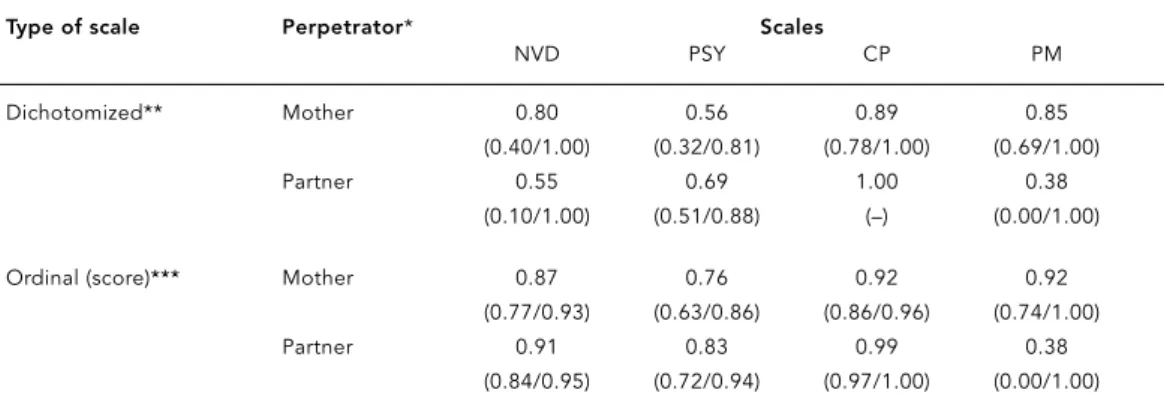
Intra-observer agreements are shown in Table 2. Weighted kappas were above 0.75 for all scales, except for PM when perpetrated by the partner. When analyzed dichotomously, estimates were also mostly above this limit. The exceptions were psychological aggression (PSY) perpetrated by the mother and NVD or PM by the partner.
Internal consistency
Table 3 shows αcoefficients ranging from 0.48 to 0.67. Although most estimates were quite close to each other, the αrelating to the NVD scale was slightly below average when moth-ers were perpetrators, whereas both CP esti-mates were above. As a whole, estiesti-mates for mothers were slightly lower than for partners. For comparison, the αcoefficients reported by Straus et al. 26for the non-violent disci-pline, psychological aggression, and physical assault scales when perpetrated by any “par-ent” are provided in the last column of the table. The respective figures in the present study were 0.52 (one-sided 95% lower confidence bound – LCB = 0.47), 0.60 (95%LCB = 0.56), and 0.73 (95%LCB = 0.70).
Systematically withdrawing items from their respective scales (item-rest analysis) did not show much change in estimates, apart from item E, which inflated the αbeyond 10.0% among mothers. Most item-rest correlations (rpb) were above 0.2. Only item V was below this threshold, irrespective of the perpetrator. Correlations below 0.2 were also found for items E and S when mothers were perpetrators and for items L and I when partners.
Factor analysis
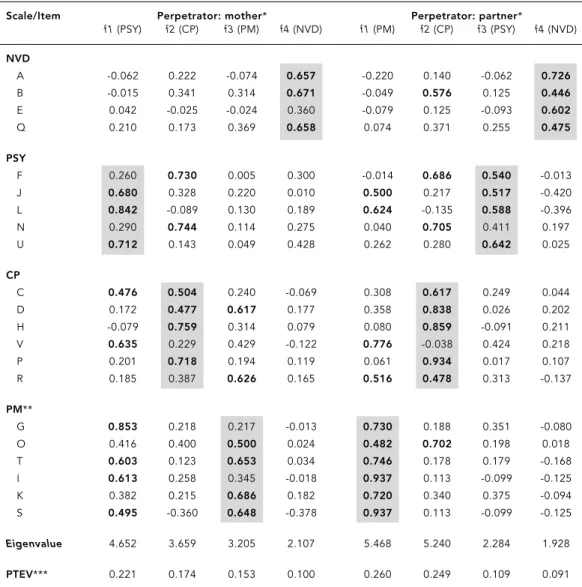
Table 4 shows that, regardless of perpetrator, four factors with eigenvaluesabove 1.0 could be extracted. Their order corresponds roughly to the PSY, CP, PM, and NVD scales when the acts were committed by the mother. Positions
Table 2
Intra-observer reliability of the Portuguese version of the Conflict Tactics Scales: Parent-child Version (CTSPC).
Type of scale Perpetrator* Scales
NVD PSY CP PM
Dichotomized** Mother 0.80 0.56 0.89 0.85
(0.40/1.00) (0.32/0.81) (0.78/1.00) (0.69/1.00)
Partner 0.55 0.69 1.00 0.38
(0.10/1.00) (0.51/0.88) (–) (0.00/1.00)
Ordinal (score)*** Mother 0.87 0.76 0.92 0.92 (0.77/0.93) (0.63/0.86) (0.86/0.96) (0.74/1.00)
Partner 0.91 0.83 0.99 0.38
(0.84/0.95) (0.72/0.94) (0.97/1.00) (0.00/1.00)
NDV= non violent discipline; PSY = psychological aggression; CP = corporal punishment; PM = physical maltreatment. * Sample size: mothers/respondents = 91; partners = 64;
** Simple kappa;
change when the partner was involved, but the general pattern was retained.
Despite overall agreement with the original proposition by Straus et al. 26regarding the un-derlying dimensionalities, a few items failed to conform to the anticipated factors/scales. Not-ing that loadNot-ings around or above 0.45 are highlighted for presentation in Table 4, the fol-lowing items stand out when the mother was the perpetrator: (a) items F and N load high in
f2 (CP), instead of the expected PSY factor (f1). (b) Regarding the projected CP items in f2, item D loads higher in f3(PM) despite a concomi-tant borderline loading in its own factor. There was also a split in item C, with some loading in
f1(PSY). (c) In turn, item V does not load at all in f2, appearing slightly in f3(PM) and also most strongly in f1(PSY ). (d) Item R appears heavily in f3(PM). (e) In relation to the PM items foreseen in f3, items G and I clearly di-verge from the rest, fitting in with f1(PSY) in-stead. (f ) Items T and S are split between their own factor and f1(PSY).
The overall picture improves when the per-petrator was the partner, but some differences are still noticeable: (a) The NVD item E now loads in f4as expected. However, the pattern for item B is less clear than before. The item now loads more in f2(CP), although still bor-derline in its own factor. (b) Item F shares two Table 3
Internal consistency of the Portuguese version of the Conflict Tactics Scales: Parent-child Version (CTSPC).
Scale/Item Perpetrator: mother Perpetrator: partner
α* α(k-1)** d*** r
pb# α α(k–1) d rpb αs##
NVD
A 0.48 (0.41) 0.44 (0.35) -9.3 0.28 (0.19/0.37) 0.54 (0.47) 0.48 (0.39) -11.0 0.32 (0.23/0.42) 0.70 B 0.27 (0.16) -43.9 0.41 (0.33/0.48) 0.38 (0.28) -28.8 0.41 (0.31/0.49) E 0.53 (0.47) 10.9 0.15 (0.06/0.24) 0.52 (0.45) -2.3 0.26 (0.16/0.35) Q 0.35 (0.26) -26.9 0.33 (0.24/0.41) 0.46 (0.37) -13.7 0.32 (0.23 /0.41)
PSY
F 0.57 (0.51) 0.49 (0.42) -14.6 0.38 (0.29/0.44) 0.58 (0.52) 0.41 (0.32) -29.4 0.50 (0.40/0.56) 0.60 J 0.53 (0.47) -6.9 0.30 (0.24/0.38) 0.57 (0.50) -1.56 0.26 (0.16/0.38) L 0.57 (0.51) -0.7 0.25 (0.17/0.32) 0.60 (0.53) 2.9 0.19 (0.08/0.30) N 0.47 (0.40) -17.1 0.40 (0.31/0.47) 0.44 (0.35) -23.8 0.46 (0.37/0.56) U 0.49 (0.42) -14.2 0.38 (0.31/0.45) 0.51 (0.44) -11.7 0.36 (0.24/0.43)
CP
C 0.66 (0.62) 0.63 (0.58) -4.9 0.36 (0.28/0.45) 0.67 (0.63) 0.64 (0.59) -4.8 0.38 (0.25/0.49) 0.55 D 0.59 (0.53) -10.9 0.46 (0.38/0.52) 0.58 (0.52) -13.7 0.55 (0.46/0.65) H 0.57 (0.52) -13.0 0.49 (0.43/0.56) 0.55 (0.49) -18.0 0.60 (0.51/0.66) P 0.59 (0.54) -10.3 0.46 (0.38/0.52) 0.53 (0.46) -21.4 0.64 (0.56/0.69) V 0.67 (0.63) 1.9 0.19 (0.10/0.30) 0.71 (0.66) 4.6 0.01 (-0.01/0.04) R 0.62 (0.57) -5.6 0.36 (0.28/0.45) 0.69 (0.64) 1.9 0.19 (0.02/0.33)
PM###
G 0.54 (0.48) 0.40 (0.32) -25.3 0.45 (0.29/0.61) 0.62 (0.57) 0.56 (0.49) -10.3 0.42 (-0.02/0.76) O 0.52 (0.46) -4.2 0.38 (0.24/0.49) 0.67 (0.62) 7.2 0.43 (0.17/0.59) T 0.46 (0.39) -15.2 0.43 (0.23/0.62) 0.53 (0.46) -14.7 0.59 (0.02/0.82) I 0.49 (0.43) -8.1 0.29 (0.09/0.47) 0.64 (0.59) 3.0 0.12 (0.01/0.28) K 0.51 (0.45) -5.3 0.25 (0.05/0.50) 0.53 (0.46) -15.3 0.51 (0.15/0.76) S 0.56 (0.50) 3.6 0.06 (0.02/0.11) 0.57 (0.51) -8.0 0.54 (0.01/0.82)
NDV = non-violent discipline; PSY = psychological aggression; CP = corporal punishment; PM = physical maltreatment. * Scale’s αcoefficient. In brackets: 95% lower confidence bound calculated according to Woodward & Bentler 35;
** Coefficient αon excluding the item. In brackets: same as in *;
*** Percent change in · on excluding the item given by [-(α- α(k-1))/α]. Value sign relates to the direction of change (positive = increase; negative = decrease);
factors, now also loading high in its envisaged PSY factor (f3) alongside the CP factor as before (mother). (c) A similar split-pattern also emerges regarding items J and L. (d) Whereas item D loads with its expected factor (f2), item V is still off, now clearly accompanying f1 (PM). (e) Conversely, the CP-expected item R that is at-tached preferentially to the PM factor when the mother was the perpetrator, is rather split for perpetration by the partner. (f ) Turning to the PM items, whereas item G appears to cluster mainly in its own factor (f1), the reverse holds for item O, which is now inclined towards f2(CP).
Construct validity
Table 5 shows the relationship between child abuse and selected construct-related variables identifying population subgroups. Accepting a more lenient decision level of 10%, all tested associations with the variable tapping the in-creasing severity of violence are statistically significant. The overall profile is quite consis-tent, with opposite trends found in the extreme groups (NVD and PM) and rather balanced fre-quencies in the middle (PSY and CP). This bi-faceted picture is present in relation to whether the mother was at ease with the latest pregnan-Table 4
Factor analysis of the Portuguese version of the Conflict Tactics Scales: Parent-child Version (CTSPC).
Scale/Item Perpetrator: mother* Perpetrator: partner*
f1(PSY) f2(CP) f3(PM) f4(NVD) f1(PM) f2(CP) f3(PSY) f4(NVD)
NVD
A -0.062 0.222 -0.074 0.657 -0.220 0.140 -0.062 0.726
B -0.015 0.341 0.314 0.671 -0.049 0.576 0.125 0.446
E 0.042 -0.025 -0.024 0.360 -0.079 0.125 -0.093 0.602
Q 0.210 0.173 0.369 0.658 0.074 0.371 0.255 0.475
PSY
F 0.260 0.730 0.005 0.300 -0.014 0.686 0.540 -0.013
J 0.680 0.328 0.220 0.010 0.500 0.217 0.517 -0.420
L 0.842 -0.089 0.130 0.189 0.624 -0.135 0.588 -0.396
N 0.290 0.744 0.114 0.275 0.040 0.705 0.411 0.197
U 0.712 0.143 0.049 0.428 0.262 0.280 0.642 0.025
CP
C 0.476 0.504 0.240 -0.069 0.308 0.617 0.249 0.044
D 0.172 0.477 0.617 0.177 0.358 0.838 0.026 0.202 H -0.079 0.759 0.314 0.079 0.080 0.859 -0.091 0.211
V 0.635 0.229 0.429 -0.122 0.776 -0.038 0.424 0.218
P 0.201 0.718 0.194 0.119 0.061 0.934 0.017 0.107 R 0.185 0.387 0.626 0.165 0.516 0.478 0.313 -0.137
PM**
G 0.853 0.218 0.217 -0.013 0.730 0.188 0.351 -0.080
O 0.416 0.400 0.500 0.024 0.482 0.702 0.198 0.018
T 0.603 0.123 0.653 0.034 0.746 0.178 0.179 -0.168
I 0.613 0.258 0.345 -0.018 0.937 0.113 -0.099 -0.125
K 0.382 0.215 0.686 0.182 0.720 0.340 0.375 -0.094
S 0.495 -0.360 0.648 -0.378 0.937 0.113 -0.099 -0.125
Eigenvalue 4.652 3.659 3.205 2.107 5.468 5.240 2.284 1.928
PTEV*** 0.221 0.174 0.153 0.100 0.260 0.249 0.109 0.091
NDV = n-violent discipline; PSY = psychological aggression; CP = corporal punishment; PM = physical maltreatment. * Sample size: mothers = 439; partners = 335;
cy; alcoholism or illicit drug consumption among any of the child’s caregiver; the number of under-fives in the family; and the degree of social support received during this period. For instance, the exclusive use of non-violent forms of discipline declines from 33.7% to 8.3% as the amount of social support drops, yet resorting to physical maltreatment increases from 3.3% to 21.1%. There are three exceptions to this pat-tern. First, both NVD and PM tend to increase with maternal age. Second, only PM appears to change (i.e., doubles) with the family’s socioe-conomic status as expressed by housing
condi-tions. Third, while NVD increases tenuously with maternal schooling, there is an apparent U-shaped trend in relation to PM.
Discussion
Taken as a whole, the picture conveyed by the analysis presented in Tables 1 to 3 is encourag-ing in terms of the adequacy of the cross-cul-tural adaptation process under scrutiny, and (indirectly) in relation to the instrument’s ap-propriateness for capturing the envisaged con-Table 5
Construct validity of the Portuguese version of the Conflict Tactics Scales: Parent-child Version (CTSPC): frequency (%) of increasing violence severity* in selected population sub-groups.
Construct variables Increasing violence severity (%)
NVD PSY CP PM p**
Educational status/schooling (mother) 0.079
Incomplete primary (up to 7 years) 18.1 19.9 47.9 14.1 Complete primary (8 years) 16.1 18.3 55.9 9.7 Incomplete secondary (9 or 10 years) 12.5 12.5 72.5 2.5 Complete secondary (11 or more) 24.6 24.6 35.4 15.4
Maternal age (years) 0.001
< 20 12.8 18.6 58.1 10.5
20-29 16.9 20.5 53.5 9.1
≥30 23.6 18.5 36.3 21.7
Maternal satisfaction with pregnancy 0.025
No 14.5 16.4 53.1 16.0
Yes 21.1 22.3 46.5 10.1
Suspicion of alcoholism among parents 0.017
No 20.3 20.3 49.0 10.3
Yes 12.2 17.9 50.6 19.2
Illicit drug consumption among parents 0.005
No 19.2 20.5 49.8 10.5
Yes 12.2 15.6 47.8 24.4
Presence of children under five years of age 0.017
None 23.9 21.1 41.6 13.4
1 or 2 15.3 18.8 54.5 11.4
3 or more 0.0 23.1 38.5 38.5
Social support 0.000
Low 8.3 18.8 52.8 20.1
Moderate 18.0 19.8 50.0 12.1
High 33.7 20.7 42.4 3.3
Housing conditions 0.067
Adequate 19.8 24.1 48.1 8.0
Inadequate 17.3 17.6 50.1 15.0
NDV = non-violent discipline; PSY = psychological aggression; CP = corporal punishment; PM = physical maltreatment. * See text for the definition;
struct. The present findings show that the CTSPC, if properly applied, is reproducible, internally consistent, and somehow able to discriminate several underlying dimensions.
Focusing on Table 2, the majority of intra-observer agreements are moderate or substan-tial. The eccentric values relating to the PM scale when the partner is the perpetrator may be overlooked, since they are more under the influence of the idiosyncrasies of the kappa es-timator vis-à-visthe data at hand, than a sub-stantive finding. In fact, only 1 out of 69 cases is in disagreement, which shows how sensitive the estimator is to extreme prevalence.
The αcoefficients are sufficiently large to convey reasonable internal consistency, yet are not so extreme as to indicate redundancies and thus affect content validity and efficiency 47. Another positive aspect is that the vast majori-ty of component items acceptably correlate with the scores formed by the remaining items of the respective scale, showing that there is not much heterogeneity within the studied constructs/dimensions. According to Streiner & Norman 47, these correlations ought to ex-ceed 0.2, which on the whole are easily at-tained in the present study. A third interesting feature is that the present coefficients for the scales covering physical violence are consider-ably higher than those presented by Straus et al. 26. Contrary to what the authors found – lit-tle improvement over the internal consistency reported for the CTS1 (0.58) – the current find-ings are more reassuring, possibly showing that developing a new instrument to specifically tap parent-child relationships actually paid off.
Despite some inconsistencies, the results from the factor analysis broadly overlay the picture suggested by Straus et al. 26. Still, the present study identifies just four dimensions, which is somewhat at odds with the dimen-sionality proposed by those authors. As con-veyed in the introduction, Straus et al. 26 sug-gested splitting physical violent acts into three blocks of increasing severity, comprising one scale for punishment and two for maltreat-ment, the latter further divided according to severity of abuse. The present findings suggest that these two form a single scale and should thus not be used separately in practice. An en-suing aspect is that the results also tend to un-dermine the proposition to use all “physical” items in a single scale as originally proposed under the label of physical assault. As suggest-ed by the factor analysis, the CP scale is fairly distinct from the PM scale. At any rate, these findings need to be replicated and further de-bated.
While a positive appraisal about the instru-ment and/or its adaptation to a Portuguese-speaking setting is certainly possible, it would be appropriate to specifically identify the items which, if not compromising the respective scales en bloc, do have problems and are open to reassessment, improvement, or revision. Item M could not be evaluated at all in the pre-sent study due to a complete lack of positive subjects. This finding may suggest that “burn-ing or scald“burn-ing a child on purpose” is not part of the Brazilian socio-cultural context and, added to the fact that an item that does not vary is uninformative, that the item should be withdrawn from the Portuguese version. Al-though a tempting procedure at first, the au-thors defend refraining at all cost from remov-ing an item, as an important psychometric principle. Thus, before taking any measure, further studies should be encouraged, not only to corroborate this finding, but should this happen, to enable exploring psychometrically equivalent questions as replacement 48.
Beyond item M, the remaining 21 items may be broken down into four groups for scrutiny. The first includes items that did not show any psychometric problem in the present study (A, Q, U, H, P, and K). The second group is formed by 9 items with minor problems confined to only one parent, most of those comprised of high loadings sharing the projected scale with another (B, J, L, C, D, O, T, and S) and one item narrowly failing to provide an adequate “sig-nal” when mothers are involved (E).
Of particular interest here is the fact that the present psychometric evaluation rejects some charges brought upon five of those items as lacking pertinence or semantic adequacy 22. As the results convey, suggested language idio-syncrasies from the standpoint of the new cul-ture in which the instrument was being adapt-ed were not detectadapt-ed in either item J (swearing at or cursing a child) or Q (taking away privi-leges or grounding a child). Similarly, alleged age incompatibility for portions of the target population could not be confirmed. Spanking an older child or adolescent on the bottom (H), threatening to send away or kick a toddler out of the house (L), or calling an infant stupid or lazy (U) do not appear to carry much weight as first envisaged.
culturally determined. One may conjecture that in the setting where the study was conducted, striking the child with a belt or hairbrush on the bottom (item D; mother) or some other part of the body (item O; partner) may be per-ceived as something at the limit between a sanc-tioned – sometimes “necessary” – punishment and an act of overt maltreatment. Whether this feature is also intrinsic to any CTSPC needs to be further explored.
A third group encompasses two items (G and I), which again showed a problem confined exclusively to one perpetrator, yet involved a total change of scale. One cannot rule out that the low item-rest correlation found for items I has more to do with sparseness of the data since, there were fewer than 1% positives, and those few took place in different subjects. Simi-larly to what has been argued by the instru-ment’s authors with regards to the original set-ting (USA) 26, a concomitance of severe types of physical maltreatment seems to be uncommon in Brazil as well. Parents who purposely choke or grab a child are unlikely to use a gun or knife within the response time frame covered by the instrument. Another more substantive expla-nation is that mothers tend to threaten rather than to enact the specific item, entailing a shift towards the psychological (verbal) aggression dimension. The same is conceivable in regards to item G (hitting with fist or kicking).
The fourth and most troublesome group consists of four items (F, N, V, and R) that show problems in both relationships and/or in both analyses sought to determine the structure of relations among measures. Considering the act of slapping a child in the face as “minor” was debated at length by experts, who came to the conclusion that, at least in the Brazilian milieu, it would be better to place the item among the others connoting physical mal-treatment. The current psychometric evalua-tion captures this, showing that if perpetrated by the father (partner), item V appears to real-ly belong to the latter scale rather than to CP. Although less sharply, an analogous picture arises if perpetrated by the mother. An ad hoc internal consistency evaluation analyzing the item in tandem with the other PM items could shed some light on the “borderline” loading found in f3(PM). On placing the item with the other six from this scale, the a coefficient in-creases from 0.54 to 0.61 (about 13%), whereas the item-rest correlation, formerly below the 0.2 threshold, increases sharply to 0.450. How-ever, it is still not understood why the item al-so tends to load in f1(PSY). More studies are clearly needed.
The same point can be made for item R. “Pinching” a child may well be interpreted as physical maltreatment rather than “simple” punishment, and more evidence is needed here as well. As for the PSY items F and N hanging together with the CP items, it may well be that shouting/yelling and threatening to spank/hit consistently precede an ensuing act of physical punishment and, if perpetrated jointly, are in-tended to intimidate and achieve a change in behavior by the child. An analogous concomi-tance was observed in another study focusing on violence within couples 19.
The analysis of construct validity reveals a satisfactory picture. The pattern of associations between child abuse and selected construct-re-lated variables corroborated almost all the test-ed hypothesis. The use of non-violent discipli-nary methods tended to increase with the fam-ily’s socioeconomic status (schooling); more experience (increasing age); maternal care-giv-ing capability (fewer children under five, less alcohol or drug consumption in the household, and satisfaction with the latest pregnancy); and increasing social support. The inverse was large-ly true for the opposite extreme. Worse scenar-ios tended to go hand in hand with increasing physical maltreatment, a profile consistent with previous studies 3,4,49,50.
interview-ing both parents independently, re-interview-ing a subgroup at home at wider intervals, and using a more refined scoring system.
The present evaluation of the psychometric properties of the CTSPC Portuguese version complements the work initiated with the as-sessment of concept, item, and semantic equiv-alence. Beyond the restrictions described above, on the whole, the results reinforce previous findings and suggest that this version may be used in the Brazilian context and, following further fine-tuning, in other Portuguese-speak-ing settPortuguese-speak-ings and countries. Still, our evaluation of measurement equivalence identified some important points that need discussion and ad-ditional investigation in order to improve the proposed version. A thorough assessment would also require comparisons with results obtained
in other contexts. For one, there are important socio-demographic differences between this study population and that underlying the orig-inal work by Straus et al. 26. Besides, studies on the adaptation of the CTSPC to different cul-tures are still few and far between. More evalu-ation instances, preferably carried out through integrated, multi-center, and international consortiums, are highly important to foster the research program on the instrument. In this spirit, the authors propose that a discussion concerning the main properties of a Portuguese version is useful beyond an assessment of the quality of the cross-cultural adaptation process
per seand should thus not be restricted to a “local” forum. Some if not all of the present findings can serve a wider audience working in other areas of the world.
Acknowledgments
Funding for this project was provided in part by a grant from CNPq (Brazilian National Research Coun-cil), grant 663073/9987 (PRONEX Project) and in part by FAPERJ (Rio de Janeiro State Research Founda-tion), grants E-26/171.223/98 and E-26/150.893/99. Michael Eduardo Reichenheim was partially funded by CNPq, grant 300234/94-5.
Contributors
M. E. Reichenheim and C. L. Moraes participated in all phases of the study: fundraising/administration; theoretical development; field work, data processing, and analysis; and drafting of the text.
Resumo
Este artigo segue outro que apresentava a primeira fase do processo de adaptação transcultural, exami-nando as propriedades psicométricas da versão em português do instrumento Conflict Tactics Scales: Par-ent-child Version(CTSPC). O trabalho de campo ocor-reu de março a setembro de 2000 em três materni-dades públicas de grande porte do Rio de Janeiro, Brasil. Irmãos de recém-nascidos foram amostrados aleatoriamente. Entrevistas foram realizadas com mães. Informações sobre parceiros foram obtidas por
proxi. A maioria das estimativas de confiabilidade in-tra-observador (kappa) se mostrou acima de 0,75. Consistência interna (a) variou de 0,49-0,68, depen-dendo da escala e tipo de perpetrador. Usando a mes-ma amostra, a análise de fatores principais iterativa identificou quatro dimensões. Ainda que a maioria dos itens se saísse bem, alguns não carregaram ade-quadamente nos fatores esperados. Validade de cons-truto envolveu uma exploração entre diversas dimen-sões teóricas e uma variável abarcando um padrão cu-mulativo de gravidade de violência. Todas as hipóteses foram corroboradas. A presente avaliação indica que CTSPC pode ser recomendada para uso em contextos lusófonos. Ainda assim, foram identificados alguns pontos importantes que necessitam mais investigações e discussão.
References
1. Kashani JH, Daniel AE, Dandoy AC, Holcomb WR. Family Violence: impact on children. J Am Acad Child Adolesc Psychiatry 1992; 31:181-9. 2. Heise L, Pitanguy J, Germain A. Violence against
women: the hidden health burden. Washington DC: World Bank; 1994. (Discussion Paper, 255). 3. Straus MA, Gelles RJ. Physical violence in
Ameri-can families: risk factors and adaptations to vio-lence in 8,145 families. New Brunswick: Transac-tion Publisher; 1995.
4. Gelles RJ. Intimate violence in families. London: SAGE Publications; 1997.
5. Bardi M, Borognini-Tarli SM. A survey on parent-child conflict resolution: intrafamily violence in Italy. Child Abuse Negl 2001; 6:839-53.
6. Watts C, Zimmerman C. Violence against women: global scope and magnitude. Lancet 2002; 359: 1232-7.
7. Assis SG. Trajetória sócio-epidemiológica da vio-lência contra crianças e adolescentes: metas de prevenção e promoção [Tese de Doutorado]. Rio de Janeiro: Escola Nacional de Saúde Pública, Fundação Oswaldo Cruz; 1995.
8. Guedes LG. Violência doméstica: prevalência e fatores associados em famílias atendidas num serviço de emergência pediátrica [Dissertação de Mestrado]. Rio de Janeiro: Instituto de Puericul-tura e Pediatria Martagão Gesteira, Universidade Federal do Rio de Janeiro; 1996.
9. Ferreira AL, Gonçalves HS, Marques MJV, Moraes SRS. A prevenção da violência contra a criança na experiência do Ambulatório de Atendimento à Família: entraves e possibilidades de atuação. Ciênc Saúde Coletiva 1999; 4:123-30.
10. Gonçalves HS, Ferreira AL, Marques MJV. Avalia-ção de serviço de atenAvalia-ção a crianças vítimas de violência doméstica. Rev Saúde Pública 1999; 33:547-53.
11. Ministério da Saúde. Política nacional de redução da morbimortalidade por acidentes e violências. Brasília: Ministério da Saúde; 2001.
12. Moraes CL, Reichenheim ME. Domestic violence during pregnancy in Rio de Janeiro, Brazil. Int J Gynaecol Obstet 2002; 79:269-77.
13. Moura ATMS, Reichenheim ME. Estamos real-mente detectando violência familiar contra a cri-ança em serviços de saúde? A experiência de um serviço público do Rio de Janeiro, Brasil. Cad Saú-de Pública 2005; 21:1124-33.
14. Schraiber LB, d’Oliveira AF. Violence against women and Brazilian health care policies: a pro-posal for integrated care in primary care services. Int J Gynaecol Obstet 2002; 78 Suppl 1:S21-5. 15. Djeddah C, Facchin P, Ranzato C, Romer C. Child
abuse: current problems and key public health challenges. Soc Sci Med 2000; 51:905-15. 16. Krug EG, Sharma GK, Lozano R. The global
bur-den of injuries. Am J Public Health 2000; 90:523-6. 17. Behling O, Law KS. Translating questionnaires and other research instruments: problems and solutions. Thousand Oaks: Sage Publications; 2000. 18. Reichenheim ME, Moraes CL, Hasselmann MH. Equivalência semântica da versão em português do instrumento Abuse Assessment Screeningpara
rastrear a violência contra a mulher grávida. Rev Saúde Pública 2000; 34:610-6.
19. Moraes CL, Hasselmann MH, Reichenheim ME. Adaptação transcultural para o português do ins-trumento “Revised Conflict Tactics Scales (CTS2)”
utilizado para identificar violência entre casais. Cad Saúde Pública 2002; 18:163-76.
20. Moraes CL, Reichenheim ME. Cross-cultural mea-surement equivalence of the Revised Conflict Tac-tics Scales (CTS2) Portuguese version used to iden-tify violence within couples. Cad Saúde Pública 2002; 18:783-96.
21. Hasselmann MH, Reichenheim ME. Adaptação transcultural da versão em português da Conflict Tactics Scales Form R(CTS-1), usada para aferir violência no casal: equivalências semântica e de mensuração. Cad Saúde Pública 2003; 19:1083-93. 22. Reichenheim ME, Moraes CL. Adaptação trans-cultural do instrumento Parent-Child Conflict Tactics Scales(CTSPC) utilizado para identificar a violência contra a criança. Cad Saúde Pública 2003; 19:1701-12.
23. Archer J. Assessment of the reliability of the con-flict tactics scales: A meta-analytic review. J Inter-pers Violence 1999; 14:1263-89.
24. Straus MA. Measuring intra-familiar conflict and violence: the conflict tactics (CT) scales. J Mar-riage Fam 1979; 41:75-88.
25. Straus MA, Hamby SL, Boney-McCoy S, Sugarman DB. The revised Conflict Tactics Scales (CTS2): de-velopment and preliminary psychometric data. J Fam Issues 1996; 17:283-316.
26. Straus MA, Hamby SH, Finkelhor D, Moore DW, Runyan D. Identification of child maltreatment with parent-child conflict tactics scales: develop-ment and psychometric data for a national sam-ple of American parents. Child Abuse Negl 1998; 22:249-70.
27. Herdman M, Fox-Rushby J, Badia X. A model of equivalence in the cultural adaptation of HRQoL instruments: the universalist approach. Qual Life Res 1998; 7:323-35.
28. Fleiss JL. Statistical methods for rates and pro-portions. New York: John Wiley & Sons; 1981. 29. Cohen J. Weighted kappa: nominal scale
agree-ment with provision for scaled disagreeagree-ment or partial credit. Psychol Bull 1968; 70:213-20. 30. Efron B, Tibshirani R. An introduction to the
bootstrap. London: Chapman & Hall; 1993. 31. Shrout PE. Measurement reliability and
agree-ment in psychiatry. Stat Methods Med Res 1998; 7:301-17.
32. Cronbach LJ. Coefficient alpha and the internal structure of tests. Psychometrika 1951; 16:297-334. 33. Nunnally JCJ, Bernstein I. Psychometric theory.
New York: McGraw-Hill; 1995.
34. Bleda M-J, Tobias A. Cronbach’s alpha one-sided confidence interval (insert sg143). Stata Techni-cal Bulletin 2000; 56:26-7.
35. Woodward JA, Bentler PM. A statistical lower bound to population reliability. Psychol Bull 1978; 85:1323-6.
37. Kaiser HF. Varimax criterion for analytic rotation in factor analysis. Psychometrika 1958; 23:187-200. 38. Skinner CJ, Holt D, Smith TMF. Analysis of com-plex surveys. New York: John Wiley & Sons, 1989. 39. Korn EL, Graubard BI. Analysis of health surveys.
New York: John Wiley & Sons; 1999.
40. Straus MA, Gelles RJ. Physical violence in Ameri-can families: risk factors and adaptations to vio-lence in 8,145 families. New Brunswick: Transac-tion Publishers; 1995.
41. Tajima EA. The relative importance of wife abuse as a risk factor for violence against children. Child Abuse Negl 2000; 24:1383-98.
42. Muller RT, Goebel-Fabbri AE, Diamond T, Din-klage D. Social support and the relationship be-tween family and community violence exposure and psychopathology among high risk adoles-cents. Child Abuse Negl 2000; 24:449-64. 43. Mayfield D, McLeod G, Hall P. The CAGE
ques-tionnaire: validation of a new alcoholism screen-ing instrument. Am J Psychiatry 1974; 131:1121-3.
44. Smart RG, Arif A, Hughes P, Medina-Mora ME, Navaratnam V, Varma VK, et al. Drugs use among non-student youth. Geneva: World Health Orga-nization; 1981. (WHO Offset Publication, 60). 45. Sherbourne CD, Stewart AL. The MOS social
sup-port survey. Soc Sci Med 1991; 32:705-14. 46. Chor D, Griep RH, Lopes CS, Faerstein E.
Medi-das de rede e apoio social no Estudo Pró-Saúde: pré-testes e estudo piloto. Cad Saúde Pública 2001; 17:887-96.
47. Streiner DL, Norman GR. Health measurement scales: a practical guide to their development and use. Oxford: Oxford University Press; 1995. 48. van der Linden WJ, Hambleton RK. Handbook of
modern item response theory. New York: Springer; 1996.
49. Belsky J. Etiology of maltreatment: a develop-mental-ecological analysis. Psychol Bull 1993; 114:413-34.
50. Gough D. Defining the problem. Child Abuse Negl 1996; 20:993-1002.
Submitted on 22/Oct/2004