Rev Bras Anestesiol SCIENTIFIC ARTICLE 2011; 61: 1: 202-210
202 Revista Brasileira de Anestesiologia
Vol. 61, No 2, March-April, 2011 Received from Instituto Básico de Biociências – Universidade de Taubaté (UNITAU),
Tau-baté, São Paulo, Brazil.
1. Responsible for the CET/SBA of Hospital Municipal de São José dos Campos, SP; PhD in Anesthesiology; Master’s Degree in Pharmacology and Professor of Anesthesiology and Pharmacology – UNITAU
2. Professor of the Departamento de Medicina do Centro de Ciências Biológicas e da Saúde of Universidade Federal de São Carlos; Collaborating Professor of the Departa-mento de Cirurgia of Faculdade de Medicina da Universidade de São Paulo (FM/USP) and Laboratório de Investigação Médica – LIM-08 of FM/USP
3. Anesthesiologist; Professor of Anesthesiology of UNITAU
4. Professor of Physiology and Pharmacology of UNITAU; PhD in Pharmacology; Master’s Degree in Pharmacology
5. Professor of Disciplina de Anestesiologia of FM/USP; Professor of Pharmacology of UNI-TAU
Submitted on July 4, 2010. Approved on December 13, 2010.
Correspondence to: Dr. Oscar César Pires
Avenida Itália, 1.551 – Rua 13, n° 821 12030-212 – Taubaté, SP, Brazil E-mail: [email protected] SCIENTIFIC ARTICLE
Subarachnoid Serotonergic and Noradrenergic Antagonists
increase the Pain Response in Rats
Oscar César Pires, TSA
1, Hazem Adel Ashmawi, TSA
2, Elton Constantino
3, Naira Correa Cusma Pelogia
4,
Irimar de Paula Posso, TSA
5Summary: Pires OC, Ashmawi HA, Constantino E, Pelogia NCC, Posso IP – Subarachnoid Serotonergic and Noradrenergic Antagonists Increase
the Pain Response in Rats.
Background and objectives: There is evidence that the passage of nociceptive information through the posterior horn of the spinal cord (PHSC)
on its way to rostral levels of the central nervous system undergoes profound excitatory and inhibitory inluences. The objective of the present study was to compare the effects of the subarachnoid administration of methysergide, phentolamine, and phentolamine associated with methy-sergide on phases I, intermediate, and II of the modiied phormaline test in rats.
Methods: Twenty-eight male Wistar rats distributed randomly in four groups (n = 7) to received subarachnoid saline solution (GC), phentolamine
(GF), methysergide (GM), or phentolamine associated with methysergide (GFM). Pain was induced by the administration of phormaline in the dorsal region of the right hind paw. The test was divided in three phases: phase I, intermediate, and phase II. Statistical analysis of the results was performed using the software SPSS (Statistical Package for Social Sciences), adopting a level of signiicance of 5%.
Results: In the intermediate phase the number of paw elevations was signiicantly higher in GF, GM, and GFM groups when compared to the
GC group.
Conclusions: The results suggest the existence of a noradrenergic and serotonergic effect in the inhibitory descending system of acute pain, with
the possibility of using serotonergic and α1-adrenergic antagonists to control acute pain.
Keywords: Pain measurement; Subarachnoid Space; Phentolamine; Methysergide; Rats.
[Rev Bras Anestesiol 2011;61(2): 202-210] ©Elsevier Editora Ltda.
INTRODUCTION
Nociception is a bidirectional process with ascending and descending pathways in the nervous system. Pain signals processed in the periphery go through the posterior horn of the spinal cord (PHSC) on their way to cerebral centers and, in response, projections leave the brain to the PHSC mak-ing several connections 1. The proposed descending pain inhibitory system consists of areas of the central nervous system (CNS) interconnected to ibers that leave the cortical and diencephalic systems to the periaqueductal (PAG) and
periventricular gray matter, which are rich in enkephalins and opioid receptors and, from there on, they go to areas of the rostroventral medulla, especially the nucleus raphe magnus (NRM) and adjacent nuclei that send serotonergic and noradrenergic ibers,via the dorsolateral funiculus to the dorsal horn of the spinal cord and medulla where they end, mainly in laminae I, II, and V inhibiting nociceptive neurons, interneurons, and ascending tracts that project rostrally in-cluding the spinothalamic, spinoreticular, and spinomesen-cephalic tracts 1-3. Therefore, it is expected that the increase in noradrenalin, serotonin, and opioid neurotransmission could be effective in pain control.
Phentolamine is an imidazole derivative that has competi-tive antagonist activity with affinity similar for both subtypes of α1 and α2 adrenergic receptors, affecting the pain phenom-enon 4.
Methysergide, a butanolamine of 1-methyl-d-lisergic acid, is a non-speciic serotonin receptor antagonist used in several animal studies on serotonergic pain modulation 5.
The objective of the present study was to evaluate the ef-fects of the subarachnoid administration of the adrenergic antagonist, phentolamine, serotonergic antagonist, methy-sergide, and the association of both antagonists on modula-tion of pain induced by the modiied phormaline test.
METHODS
Revista Brasileira de Anestesiologia 203 Vol. 61, No 2, March-April, 2011
SUBARACHNOID SEROTONERGIC AND NORADRENERGIC ANTAGONISTS INCREASE THE PAIN RESPONSE IN RATS
were used. Three animals were kept per compartment, where they remained for at least 15 days before the beginning of the experiment for adequate adaptation. They were treated with balanced commercial feed and water ad libitum, 12-hour day-night cycle, and temperature of 22° C ± 3° C (19° C to 25° C). To administer the drugs in the subarachnoid space, ani-mals were anesthetized with halothane at a 3.0% concen-tration in inspired oxygen fraction of 1.0, administered by a calibrated vaporizer, and maintained for enough time to the animal to lose postural relexes and become unable to walk in the chamber. At that moment, the animal was removed from the chamber and placed with its head in a cone-shaped mask through which it received the same concentration of halothane and oxygen.
After tricotomy, a transversal incision was performed in the midline of the intervertebral space above the next to last lumbar vertebra. Through the incision, the subarachnoid space was punctured with a 22G Tuohy needle, which was identiied by relex movements of the tail or hind legs. After the identiication of the subarachnoid space, a Telon PE-10 catheter was introduced through the needle for the adminis-tration of drugs. Before suturing the skin, the catheter was ixed on the musculature to conirm its location inside the subarachnoid space at the end of the procedure, after the animal was killed.
Animals were divided in four groups of seven rats each. Animals in the control group (GC) received 10 µL saline; in the phentolamine group (GF), animals received 82 nmoles of phentolamine diluted in 10 µL of saline; in the methysergide group (GM), animals received 64 nmoles of methysergide in 10 µL of saline; and in the phentolamine associated with methysergide group (GFM), they received 82 nmoles of phentolamine associated with 64 nmoles of methysergide in 10 µL of saline. The volumes and doses were deined based on prior studies 4,6. All drugs were obtained from the Sigma-Aldrich laboratory, Saint Louis, MO, USA.
Pain was induced by injecting 50 µL of 2% phormaline so-lution in the dorsal region of the right hind paw 25 minutes af-ter the administration of the drugs in the subarachnoid space. Paw elevations not related to ambulation during a period of 60 minutes were recorded, and the number of partial eleva-tions was recorded every 5 minutes.
The test was divided in three phases: phase I, intermedi-ate, and phase II. In phase I, the number of elevations in the irst ive minutes was recorded; in the intermediate phase, the number of paw elevations from the 6th to the 20th minute was recorded; and in phase II, the number of paw elevations from the 21st minute to the 60th minute was recorded.
The software SPSS (Statistical Package for Social Sci-ences), version 13.0, was used for the statistical analysis of the results adopting a level of signiicance of 5% (0.05). To identify differences in each group, the Wilcoxon Signed Rank Test was used. To identify differences among the four groups, the Kruskal-Wallis Test was used and whenever a difference among the groups was observed the Mann-Whitney Test was used to identify which groups differed.
RESULTS
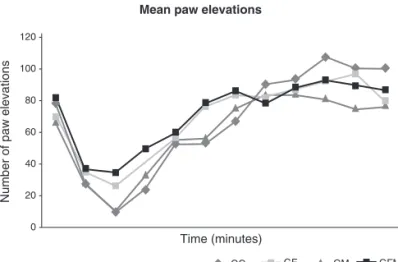
In all groups, a biphasic behavior with an intermediate phase sig-niicantly different than phases I and II (Figure 1) was observed. In phase I, signiicant differences were not observed in the num-ber of paw elevations among the four groups (Figure 2).
In the intermediate phase, the number of paw elevations was signiicantly greater in GF, GM, and GFM groups when com-pared to the GC group; however, a difference was not observed when the GF, GM, and GFM groups were compared to each oth-er (Figure 3), although the numboth-er of paw elevations was greatoth-er in the GFM group, in which the serotonergic and noradrenergic antagonists were associated, than in the GF and GM groups, in which they were used isolatedly. The GM group showed a smaller number of paw elevations than the GF and GFM groups; however, this difference was not statistically signiicant.
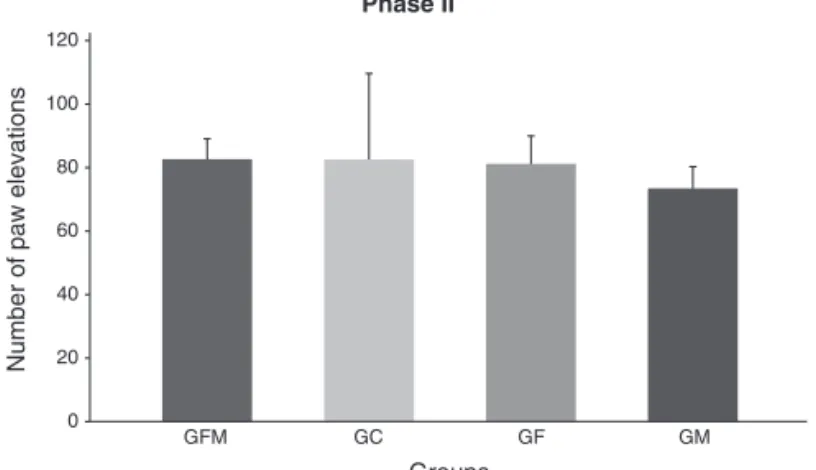
In phase II, signiicant differences were not observed when groups GF, GM, and GFM were compared to GC group; how-ever, when the GM group was compared to GF and GFM, it showed a statistically signiicant reduction in the number of paw elevations (Figure 4).
Figure 1. Mean Number of Paw Elevations During all the Phases of
the Modiied Phormaline Test in all Groups.
Figure 2. Means and Standard Deviation of the Number of Paw
Ele-vations in all Groups during Phase I of the Modiied Phormaline Test.
No signiicant differences among groups. Mean paw elevations
Number of paw elevations
Time (minutes)
120
100
80
60
40
20
0
GC GF GM GFM
GFM GC GF GM
Phase I
Number of paw elevations
Groups
120
100
80
60
40
20
-PIRES, ASHMAWI, CONSTANTINO ET AL.
204 Revista Brasileira de Anestesiologia
Vol. 61, No 2, March-April, 2011 DISCUSSION
The phormaline test is an old experimental model of pain in animals that consists in the injection of a diluted phormaline solution, in the concentration of 0.5 to 5.0%, in the dorsal re-gion of the hind paw of rats, producing a biphasic nociceptive response. In its irst phase, includes the irst 5 minutes after the injection, and, in a second phase starts on the 20th minute and extends for 40 to 60 minutes. The irst phase is interpre-ted as the result of direct activation of peripheral nociceptive receptors, while the second phase is interpreted as the re-sult of acute inlammatory response and central sensitization. The period between both phases is identiied as a phase of inactivity, being attributed to a central antinociceptive mecha-nism 7,9. A review on the phormaline test concluded that it has considerable advantages over other tests, being considered the standard model to study nociception in animals 10. Com-paring to other pain-inducing agents, phormaline produces more consistent spontaneous response, offering the beneit
of a biphasic response with a great potential for the study of acute pain 11.
The number of paw elevations was used to quantify the painful behavior induced by phormaline, since it has an impor-tant correlation with the classical phormaline test and with the cardiovascular changes in response to the pain caused by the injection of this substance in the paw. It has a reliable correla-tion with pain behavior in non-physically restricted conscious animals 11-17. The literature has few data on the role of sero-tonergic or noradrenergic receptors in the CNS in mediating response to phormaline-induced pain.
Several doses of subarachnoid phentolamine and methy-sergide are used in rats, and in the present study we used doses already described and that are commonly used by oth-er authors 4,18,19.
Pentobarbital, diazepam, and alcohol inhibit the reduction in nociception seen in the intermediate phase of the phorma-line test, which is assumed to be secondary to the involvement of GABAA receptors 9. On the other hand, an electrophysi-ological study in rats anesthetized with sodium thiopental fol-lowed by section of the spinal cord showed biphasic behavior, suggesting that control of phormaline-induced pain does not depend of a GABAergic mechanism 20.
In the present study, we observed an increase in the number of paw elevations during the intermediate phase in GF, GM, and GFM groups, which shows the involvement of serotoner-gic and noradrenerserotoner-gic pathways in the inhibitory descending pain system. According to the results observed in this study, involvement of serotonin (5-HT) in descending pain modula-tion was also demonstrated through inhibimodula-tion of its synthesis by p-chlorophenylalanine, electrolytic damage of the nucleus raphe magnus, and the use of 5,6-dihydroxytriptamine, a ser-otonergic neurotoxin 21. Another study indicated a reduction in nociceptive response to phormaline in all phases with the use of the serotonergic agonist, α-methyl-5-HT 22.
We expected to ind an addictive or potentiating effect in the number of paw elevations with the association of serotonergic and noradrenergic antagonists. A greater number of paw el-evation was observed in GMF group; however, it did not have statistical signiicance when compared to GF and GM groups, and the former had the lower number of paw elevations, which also did not show statistical signiicance. This data suggests that the dose of phentolamine was high enough to inhibit al-most completely the adrenergic descending system and that the dose of methysergide was not elevated enough to inhibit completely the serotonergic descending pathway; however, the association of both drugs seems to have been enough to inhibit the descending serotonergic and adrenergic inhibitory activities. The use of logarithmically lower doses could show this effect of the serotonergic and noradrenergic antagonists, phentolamine and methysergide, as well as its association, on the inhibition of serotonergic and noradrenergic descending inhibitory activities, since the data of the present study allows one to infer that, despite having use doses evaluated by other authors 4,18,19, they could have been higher enough to eluci-date controversial aspects of the serotonergic and noradren-ergic inhibitory descending activities.
Figure 3. Means and Standard Deviation of the Number of Paw
Ele-vations in all Groups during the Intermediate Phase of the Modiied Phormaline Test.
* Statisticallysigniicant difference between groups GC x GFM (p = 0.025); GC x GF (p = 0.025); and GC x GM (p = 0.047).
Figure 4. Means and Standard Deviation in all Groups during Phase
II of the Modiied Phormaline Test.
*Statistically signiicant difference between groups GM x GFM (p = 0.013) and GM x GF (p = 0.035).
GFM GC GF GM
GFM GC GF GM
Intermediate Phase
Phase II
Number of paw elevations
Number of paw elevations
Groups
Groups
50
45
40
35
30
25
20
15
10
5
0
120
100
80
60
40
20
-Revista Brasileira de Anestesiologia 205 Vol. 61, No 2, March-April, 2011
SUBARACHNOID SEROTONERGIC AND NORADRENERGIC ANTAGONISTS INCREASE THE PAIN RESPONSE IN RATS
On the other hand, a study with several pain models observed an antinociceptive effect of methysergide in the second phase of the phormaline test, suggesting that is due to the reduced re-lease of glutamate and substance P by primary afferent neurons in the spinal cord caused by the blockade of 5-HT2 receptors pri-or to peripheral inlammation 23. On the other hand, the inhibitory role of noradrenergic pathways was demonstrated in the model of tail withdrawal, in which phentolamine and yohimbine led to an increase in the electrical stimulation of the lateral reticular nu-cleus to activate the inhibitory descending system 24.
Another study observed a reduction in the nociceptive re-sponse of the phormaline test, with yohimbine, and a relatively selective adrenergic α2 antagonist and serotonergic 5-HT1A receptors, allowing the inference of the direct involvement of α1 receptors in the modulation of nociception in phase II of the phormaline test, since this was observed with phentolamine, an unspeciic antagonist of α1 and α2 reecptors 25.
In this study, during phase II of the modiied phormaline test, a signiicant difference was observed in nociceptive response when the phentolamine and phentolamine as-sociated with methysergide groups were compared to the methysergide group, which might be explained by the an-tagonistic effect of phentolamine in α2 receptors, promoting a α1 effect.