Arquivos Brasileiros de Cardiologia - Volume 8 3 , Nº 2 , Agosto 2 0 0 4
169
The autonomic nervous system (ANS) plays a fundamentalrole in the control of arterial blood pressure and heart rate, and,
therefore, may be considered an important pathophysiologic factor in the developm ent of arterial hypertension1. Currently, the status
of a utonom ic a ction of the hea rt m a y be known through the study of heart rate variability. Heart rate varies per beat as a consequence of the constant adaptations prom oted by the ANS to m a inta in ca rdiova scula r system ba la nce. These a ltera tions m ay be assessed through the variations in R-R intervals, the-refore, constituting the hea rt ra te va ria bility2. The integra tion
between th e s ym pa th etic a nd pa ra s ym pa th etic m odula tions determines heart rate variability3. As a research tool, assessm ent
of heart rate variability has provided a better understanding of the participation of the ANS in different physiological and pa -thological situations of the cardiovascular system. The assessment of heart rate variability has stim ulated a large num ber of obser-vations, indicating the potential value of that approach in the diffusion of knowledge about the alterations in the mechanisms of blood pressure control involved in hypertension4 -6.
The existence of sympathetic hyperactivity has been frequently associated with arterial hypertension7 ,8. Evidence exists indicating
tha t the sensitivity of ba roreceptor control, im pa ired in som e
hypertensive individuals9 -1 1, involves mainly parasympathetic
me-chanisms1 2 -1 4.
Although several studies indicate that sympathetic and para-sympathetic alterations are simultaneously involved in the patho-genesis and development of arterial hypertension, the results
ob-tained using heart rate variability are controversial. Population-based studies have reported reduced heart rate variability in patients
with long-term arterial hypertension, despite treatment with an-tihypertensive drugs1 5. However, one does not know whether
ab-normal autonomic cardiovascular regulation is a primary
charac-teristic preceding the onset of hypertension, or whether it may be reversed with antihypertensive therapy. In addition, it is not known
whether the improvement in autonomic regulation is related to a reduction in blood pressure or whether it is an immediate effect of the drug1 6.
The present study aimed at analyzing and comparing heart rate variability in normotensive and hypertensive individuals and at observing the behavior of the ANS after administration of ACE inhibitors to these hypertensive patients.
Original Article
Analysis of Heart Rat e Variabilit y in Hypert ensive
Pat ient s Bef ore and Af t er Treat m ent w it h
Angiot ensin II-Convert ing Enzym e Inhibit ors
Ant ônio da Silva M enezes Júnior, Humbert o Graner M oreira, M urilo Tavares Daher
Goiânia, GO - Brazil
Universidade Federal de Goiás and Hospital São Francisco de Assis Mailing address: Rua C-2 5 A - Qd 1 4 - Lote 1 6 - Jd. América Cep 7 4 2 6 5 -1 5 5 - Goiânia, GO, Brazil
E-m a il: h um bertogra ner@ uol.com .br Received: 4 /4 /0 3
Accepted: 1 1 /1 7 /0 3
English version by Stela Maris Costalonga
Objective
To compare heart rate variability in normotensive and hyper-tensive individuals and to observe the behavior of the autonomic nervous system after treatment with angiotensin II-converting enzyme inhibitors.
M ethod
The study comprised 286 patients diagnosed with arterial hypertension (AH) for the first time and divided into 4 groups according to diastolic blood pressure (DBP) levels: group A -DBP< 90 mmHg; group B - DBP 90-99 mmHg; group C - DBP 100-109 mmHg; group D - DBP> 110 mmHg. Group A (110 healthy individuals) and group C (7 9 patients with moderate AH) underwent 24-hour Holter-ECG with analysis of heart rate variability in time domain (TD) and frequency domain (FD). The group C patients were treated with ACE inhibitors for 3 months, and, after this period, they underwent a new 24-hour Holter-ECG study for assessing heart rate variability, the values being compared with those of normotensive individuals.
Results
The SDNN and PNN50 parameters (TD), and the LF spectrum (FD) were significantly different in the 2 groups, with clearly reduced values in hypertensive individuals (P< 0.05). Group C patients, after treatment with ACE inhibitors, showed a recovery in all variables of heart rate variability, achieving values close to those of normotensive individuals.
Conclusion
Heart rate variability was reduced in hypertensive patients when compared with that in normotensive individuals, indicating a decrease in the baroreceptor reflex. A functional autonomic adjustment after the antihypertensive treatment with ACEI was observed, indicating recovery of parasympathetic tonus.
Key w ords
Arquivos Brasileiros de Cardiologia - Volume 8 3 , Nº 2 , Agosto 2 0 0 4
170
Heart rate variability in hypertensive patients
M ethod
This study comprised 2 8 6 patients of both sexes, older than 1 8 years, with the primary diagnosis of essential hypertension, a nd, th erefore, not using a ntih ypertensive m edica tions. Th e patients selected were informed about the study and signed a written informed consent. A clinical history was obtained and clinical and complementary examinations were performed for as-sessing arterial hypertension and possible lesions in target organs. The following patients were excluded from the study: patients with a previous diagnosis of arterial hypertension, whether users or nonusers of antihypertensive medication; patients suspected of having secondary arterial hypertension, or renal, heart or hepatic failure; those who had experienced any recent cardiovascular event; those with neuropathies, diabetes mellitus, autoimmune disease, Parkinson’s disease, cardiac arrhythmias, and other conditions affecting neuroautonomic function; and those using antidepressants, neuroleptics, antiarrhythmic drugs, and lithium.
Patients had their blood pressure measured on an outpatient basis, at least 3 distinct times with aneroid sphygmomanometers properly calibrated according to the instructions of the IV Brazilian Guidelines on High Blood Pressure (IV Diretrizes Brasileiras de Hipertensão Arterial)1 7 and the Joint National Committee1 8. The
mean of the last 2 measurements was used for classification of blood pressure values.
Based on the m easurem ent of diastolic blood pressure, the patients were divided into the following 4 groups according to the classification recom m ended by the IV Brazilian Guidelines on High Blood Pressure1 7: group A – DBP< 9 0 mmHg; group B
-DBP 9 0 -9 9 m m Hg; group C - -DBP 1 0 0 -1 0 9 m m Hg; group D – DBP> 1 1 0 mmHg.
The patients in groups A and C, with normal blood pressure values and moderate arterial hypertension, respectively, were cho-sen for follow-up of the analysis of heart rate variability. They underwent 2 4 -hour Holter-ECG monitoring with Hill-Med™ devi-ces, model 3 .0 , and Hill-1 0 ™ tape recorders with magnetic tapes, according to international regulations2. Three electrocardiographic
leads (V1 , V5 , and aVF) were recorded during the examination. The recordings were divided into 5 -minute segments. All ectopic beats were classified, and only the segments with ectopia smaller than 2 % were used. Each abnormal R-R interval was replaced by the next R-R interval. The sequence of normal R-R intervals was analyzed in the time and frequency domains, using the indices described in chart I. The data obtained in the analysis of heart rate variability in groups A and C were then compared.
After analyzing heart rate variability, group C patients were trea ted with a ngiotensin II-converting enzym e inhibitors for 3 month, without adding a second drug. Enalapril and ramipril were preferably used due to their greater availability and greater number of studies reported in the medical literature related to their use. The dosage administered varied and depended on the characteristics of each patient. If 1 patient had an adverse effect due to the use of the angiotensin II-converting enzyme inhibitors, the medication was changed and the patient was excluded from the study. After 3 months, these patients underwent a new 2 4 -hour Holter-ECG study and analysis of heart rate variability and were compared again with the normotensive group, independent of their blood pressure levels, to assess possible autonomic alterations resulting from the treatment.
The data were analyzed using Epi Info 6 .2 statistical software. For comparison between the 2 groups and statistical validation, the Pearson correlation (r) and the 2 -tailed Student t test (p) were used with an alpha of 5 % and 9 5 % confidence interval.
Results
Group A comprised 1 1 0 (3 8 .4 %) patients; group B 6 9 (2 4 .1 %) patients; group C 7 9 (2 7 .6 %) patients; and group D 2 8 (9 .7 %) patients. Groups A and C were followed up for analyzing heart rate variability.
The base characteristics of the patients in both groups are shown in table I. Although the hypertensive patients in group C were slightly younger and more obese, and had a greater prevalence of smoking, no significant difference was observed as compared with the findings in the normotensive group. Only the blood pressure levels were significantly different between the 2 groups, but this was already expected.
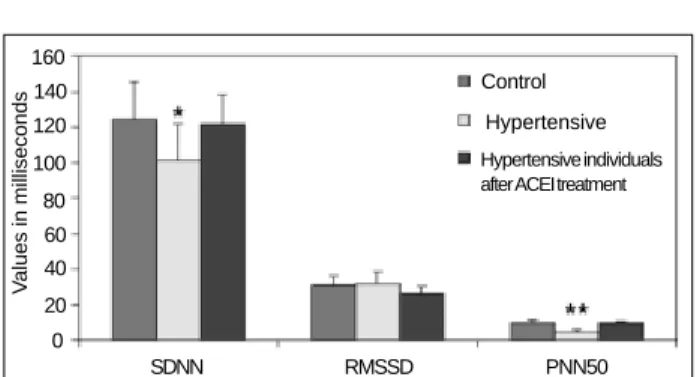
The 2 4 -hour Holter-ECG was regularly recorded in all patients, and no episode of recording error, which could jeopardize the results of the examination, occurred. All patients had at least 2 1 hours of recording available for the analysis of heart rate variability. The SDNN (standard deviation of all R-R intervals) (P= 0 .0 3 ), PNN5 0 (percentage of successive differences between the R-R intervals > 5 0 ms) (P< 0 .0 0 1 ), and LF (low frequency spectrum between 0 .0 4 and 0 .1 5 Hz) (P< 0 .0 0 1 ) were significantly smaller in the hypertensive group when compared with those in the nor-motensive group (fig. 1 and 2 ). A nonsignificant tendency towards an increase in the LF (low frequency spectrum)/HF (high frequency spectrum) ratio (P= 0 .0 6 ) could also be observed (fig. 2 ). No significant difference was observed in the other indices evaluated. All group C patients received angiotensin II-converting enzyme inhibitors for 3 months, during which time none of them had persistent dry cough or any other adverse effect that could be attributed to the medication. After 3 months, those patients were reassessed. Not all patients achieved satisfactory control of blood pressure with monotherapy with angiotensin II-converting enzyme inhibitors. The mean systolic blood pressure measured after that period was 1 3 5 ± 1 2 mmHg, and the mean diastolic blood pressure was 8 8 ± 4 m m Hg. Those patients underwent a new 2 4 -hour Holter-ECG, and the results were compared with those in the normotensive group.
Chart I - Description of the indices of heart rate variability (HRV) used for analysis
Index Definition Unit
Time domain
SDNN Standard deviation of all ms
R-R intervals
RMSSD Square root of the m ean of the successive ms
differences between adjacent R-R intervals
PNN50 Percentage of successive differences between %
R-R intervals greater than 5 0 m s Frequency domain
LF Low frequency spectrum ms²
(between 0 .0 4 and 0 .1 5 Hz)
HF High frequency spectrum ms²
(between 0 .1 5 and 0 .4 0 Hz)
-Arquivos Brasileiros de Cardiologia - Volume 8 3 , Nº 2 , Agosto 2 0 0 4
171
Heart rate variability in hypertensive patientsAfter administration of the angiotensin II-converting enzyme inhibitors, correction was observed in all parameters of heart rate variability in the hypertensive group, no significant difference being observed between both groups (fig. 1 and 2 ).
Discussion
Our study found significant distortions in heart rate variability in patients with moderate hypertension when compared with that in a control group of normotensive patients, showing substantial changes in the autonomic function of hypertensive patients, reflected mainly by an accentuated reduction in SDNN, PNN5 0 , and LF.
The differences in heart rate variability between hypertensive and normotensive individuals found in the present study are in ac-cordance with previous reports in regard to changes in SDNN1 9,
PNN5 02 0, and LF1 5 ,2 0 ,2 1. A nonsignificant increase in the LF/HF ratio
was also found in hypertensive individuals, similarly to the findings reported by Pikkujamsa et al9 and Sevre et al2 2.
Previous studies reported controversial results in heart rate varia-bility in hypertensive individuals. Usually, the LF spectrum is said to
be modulated by sympathetic and parasympathetic activities. Our findings regarding LF may be consequent to the reduction observed in the parasympathetic activity in hypertensive individuals. Some studies reported that when heart rate varied under strictly control-led circumstances, the LF spectrum was mainly influenced by sympa-thetic activity. However, other data suggest that when heart rate variability is calculated using 2 4 -hour Holter-ECG recordings under unrestricted conditions, the LF spectrum reflects mainly the para-sympathetic activity2 1, in accordance with our findings.
The decrease in the parasympathetic activity is also implicated in the low PNN5 0 values in patients with moderate hypertension, because the value of this index of time domain mainly reflects the vagal tonus.
After 3 months of antihypertensive treatment with angiotensin II-converting enzyme inhibitors, a notable recovery was observed in the variables of heart rate variability initially assessed.
The recovery of the parasympathetic tonus, previously reduced in group C patients due to the use of angiotensin II-converting enzyme inhibitors, was consistent with previous investigations sho-wing that angiotensin II is a potent inhibitor of arterial baroreflex activity1 6 ,2 3. In addition, Wollert and Drexler2 4 reported that the
lower sensitivity of the baroreceptor reflex caused by angiotensin II significantly contributes to the pathophysiology of arterial hy-pertension and also of heart failure.
Several other studies2 5 -3 1 reported that the infusion of
angio-tensin II resulted in an increase in central sympathetic activity. Therefore, it was expected from our results, that a reduction in the concentration of angiotensin II, due to an angiotensin II-con-verting enzyme inhibitor, would be accompanied by an increase in the parasympathetic tonus and an increase in the activity of the systemic arterial baroreceptor reflex.
The action of the arterial baroreceptors involves mainly a reflex reduction in sympathetic activity and an increase in vagal activity3 2.
Our study did not include specific research on the sensitivity of the baroreceptor reflex, but an impaired vagal activity in hypertensive patients, who recover by using angiotensin II-converting enzyme inhibi-tors, which allows for the inference about the influence of these medications on baroreceptors. Some questions still need clarification, such as whether the alteration in baroreceptor sensitivity precedes or is part of the development of hypertension, or whether the defi-ciency in the baroreflex control of heart rate depends on the alteration in vagal activity. Because the vagal component predominates in the reflex responses of heart rate3 2, and considering our results, it is
more evident that is certainly impaired in hypertensive individuals, and, in addition, that the angiotensin II-converting enzyme inhibitors substantially recover the activity of that reflex.
In addition, other physiological effects resulting from the use of angiotensin II-converting enzyme inhibitors should be considered, because the inhibition of this enzyme can alter the concentration of other substances, such as bradykinin, which alone also influences the a utonom ic ba la nce. Bradykinin has a complex autonomic function, because it can sensitize both vagal stimuli and sympathe-tic afferent fibers, mediating mechanoreceptors and chemosensiti-ve reflexarches3 3 -3 7. Such mechanisms may also contribute to the
course of the autonomic changes observed in this study through the administration of angiotensin II-converting enzyme inhibitors.
Therefore, our findings support those of other studies in the m edical literature by dem onstrating that heart rate variability,
Table I - Basic characteristics of group A and group C patients
Characteristics Group A Group C P
Age 5 2 .2 ± 1 0 4 7 .5 ± 1 2 0.23
Male sex (%) 42% 49% 0.31
BMI (kg/m² ) 2 5 ± 4 2 7 ± 5 0.21
Smoking (%) 19% 25% 0.09
SBP (mmHg) 1 1 8 ± 1 3 1 5 4 ± 2 1 < 0.001
DBP (mmHg) 7 7 ± 9 1 0 3 ± 2 < 0.001
HR (bpm) 6 0 ± 3 6 5 ± 4 0.08
BMI - body mass index; SBP - systolic blood pressure; DBP - diastolic blood pressure; HR - heart rate. The values are shown as mean ± standard deviation.
V
alues in milliseconds
160
140
120
100
80
60 40
20
0
Control
Hypertensive
Hypertensive individuals after ACEI treatment
SDNN RMSSD PNN50
Fig. 1 - Compared analysis of heart rate variability in time domain between group A, group C, and group C after treatment with angiotensin II-converting enzyme inhibitors. *P< 0 .0 5 ; **P< 0 .0 0 1 .
V
alues in ms
2
1000 900 800 700 600 500 400 300 200
Control
Hypertensive Hypertensive individuals after ACEI treatment
LF HF LF/HF
Fig. II - Compared analysis of heart rate variability in frequency domain between group A, group C, and group C after treatment with angiotensin II-converting enzyme inhibitors. **P< 0 .0 0 1 .
100 0
6
5
4
3
2
1
Arquivos Brasileiros de Cardiologia - Volume 8 3 , Nº 2 , Agosto 2 0 0 4
172
Heart rate variability in hypertensive patients
1. Julius S. Autonom ic nervous system dysregulation in hum an hypertension. Am J
Cardiol 1 9 9 1 ; 6 7 : 3 B-7 B.
2. Task Force of the European Society of Cardiology and the North American Society of
Pacing and Electrophysiology. Heart rate variability: standards of measurement, physiological interpretation, and clinical use. Eur Heart J 1 9 9 6 ; 1 7 : 3 5 4 -8 1 .
3. Malik M, Camm AJ. Components of heart rate variability - What they really mean
and what we really measure. Am J Cardiol 1 9 9 3 ; 7 2 : 8 2 1 -2 .
4. Furla n R, Guzetti S, Crivella ro W et a l. Continuous 2 4 -hour a ssessm ent of the
neural regulation of system ic arterial pressure and RR variabilities in am bulant subjects. Circulation 1 9 9 0 ; 8 1 : 5 3 7 -4 7 .
5. Guzzetti S, Dassi S, Pecis M et al. Altered pattern of circardian neural control of
heart period in mild hypertension. J Hypertens 1 9 9 1 ; 9 : 8 3 1 -8 .
6. Langewitz W, Ruddel H, Schachinger H. Reduced parasympathetic cardiac control
in patients with hypertension at rest and under m ental stress. Am Heart J 1 9 9 4 ; 1 2 7 : 1 2 2 -8 .
7. Guzzetti S, Piccaluga E, Casati R et al. Sympathetic predominance in essential
hy-pertension: a study em ploying spectral analysis of heart rate variability. J Hyper-tens 1 9 8 8 ; 6 : 7 1 1 -7 .
8. Piccirilo G, Munizzi MR, Fim ognari FL et al. Heart rate variability in hypertensive
subjects. Int J Cardiol 1 9 9 6 ; 5 3 : 2 9 1 -8 .
9. Pikkujamsa SM, Huikuri HV, Airaksinen KE et al. Heart rate variability and
barore-flex sensitivity in hypertensive subjects with and without metabolic features of in-sulin resistance syndrome. Am J Hypertens 1 9 9 8 ; 1 1 : 5 2 3 -3 1 .
10. Wa tkins LL, Grossm a n P, Sh erwood A. Noninva sive a ssessm ent of ba roreflex control in borderline hypertension: com parison with the phenylephrine m ethod. Hypertension 1 9 9 6 ; 2 8 : 2 3 8 -4 3 .
11. Grassi G, Cattaneo BM, Seravalle G, Lanfranchi A, Mancia G. Baroreflex control of sympathetic nerve activity in essential and secondary hypertension. Hyperten-sion 1 9 9 8 ; 3 1 : 6 8 -7 2 .
12. Mancia G, Ludbrook J, Ferrari A et al. Baroreceptor reflex in human hipertension. Circ Res 1 9 7 8 ; 4 3 : 1 7 0 -7 .
13. Mancia G, Ferraria A, Gregorini L et al. Control of blood pressure by carotid sinus baroreceptor in human beings. Am J Cardiol 1 9 7 9 ; 4 4 : 8 9 5 -9 0 2 .
14. Grassi G, Mancia G. Arterial baroreflexes and other cardiovascular reflexes in hy-pertension: In Guyton AC, Hall JE, Cardiovascular Physiology IV. Baltimore, Uni-versity Park Press, 1 1 9 , 1 9 9 2 .
15. Huikuri HV, Yitalo A, Pikkujämsä SM. Heart rate variability in systemic hyperten-sion. Am J Cardiol 1 9 9 6 ; 7 7 : 1 0 7 3 -7 7 .
16. Yitalo A, Airaksinem KEJ, Sellin L et al. Effects of com bination antihypertensive therapy on baroreflex sensitivity and heart rate variability in systemic hypertension. Am J Cardiol 1 9 9 9 , 8 3 : 8 8 5 -9 .
17. Sociedade Brasileira de Hipertensão Arterial, Sociedade Brasileira de Cardiologia, Sociedade Brasileira de Nefrologia. IV Diretrizes Brasileiras de Hipertensão Arte-rial. Cam pos do Jordão, fev 2 0 0 2 .
18. Joint National Com m ittee on Detection, Evaluation and Treatm ent of High Blood Pressure (JNC). The Seventh Report of the Joint National Com m ittee on Preven-tion, DetecPreven-tion, Eva lua Preven-tion, a nd Trea tm ent of High Blood Pressure: the JNC 7 report. JAMA 2 0 0 3 ; 2 8 9 : 2 5 6 0 -7 2 .
References
19. Barbosa Fº J, Barbosa PRB, Cordovil I. Modulação autonômica do coração na hi-pertensão arterial sistêmica. Arq Bras Cardiol 2 0 0 2 ; 7 8 : 1 8 1 -8 .
20. Chakko S, Mulingtapang RF, Huikuri HV, Kessler KM, Materson BJ, Myerburg RJ. Alterations in heart rate variability and its circadian rhythm in hypertensive patients with left ventricular hypertrophy free of coronary artery disease. Am Heart J 1 9 9 3 ; 126: 1364-72.
21. Singh JP, Larson MG, Tsuji H, Evans JC, O’Donnell CJ, Levy D. Reduced heart rate variability and new-onset hypertension: insights into pathogenesis of hyperten-sion: the Framingham heart study. Hypertension 1 9 9 8 ; 3 2 : 2 9 3 -7 .
22. Sevre K, Lefrandt JD, Nordby G et al. Autonomic Function in hypertensive and nor-motensive subjects. The importance of gender. Hypertension 2 0 0 1 ; 3 7 : 1 3 5 1 -6 . 23. Bigger JT Jr, Fleiss JL, Steinmann RC, Rolnitzky LM, Kleiger RE, Rottman JN.
Fre-quency domain measures of heart period variability and mortality after myocardial infarction. Circulation 1 9 9 2 ; 8 5 : 1 6 4 -7 1 .
24. Woolert KC, Drexler H. The rennin-angiotensin system and experimental heart fai-lure. Cardiovasc Res 1 9 9 5 , 4 3 : 8 3 8 -4 9 .
25. Lum bers ER, McCloskey DI, Potter EK. Inhibition by angiotensin II of barorecep-tor-evoked activity in cardiac vagal efferent nerves in the dog. J Physiol 1 9 7 9 ; 2 9 4 : 6 9 -8 0 .
26. Phillips MI. New evidence for brain angiotensin and for its role in hypertension. Fe-deration Proceedings 1 9 8 3 ; 4 2 : 2 6 6 7 -7 2 .
27. Bickerton RK, Buckley JP. Evidence for a central mechanism of angiotensin indu-ced hypertension. Proc Soc Exp Biol Med 1 9 6 1 ; 1 0 6 : 8 3 4 -6 .
28. Hoechst AG. Effects of angiotensin II and ACE inhibitors on electrically stimulated noradrenaline release from superfused rat brain slices. Clin Exp Theory Practice 1 9 8 4 ; A6 : 1 8 4 7 -5 1 .
29. Kohlm ann Jr O, Bresnahan M, Gavras H. Central and peripheral indices of sym -pathetic activity after blood pressure lowering with enalapril (MK-4 2 1 ) or hydra-lazine in normotensive rats. Hypertension 1 9 8 4 ; 6 (2 Pt 2 ): I1 -I6 .
30. Cody RJ, Franklin KW, Kluger J et al. Mechanisms governing the postural response and baroreceptor abnormalities in chronic congestive heart failure: effects of acute and long-term converting-enzyme inhibition. Circulation 1 9 8 2 ; 6 6 : 1 3 5 -4 2 . 31. Dibner-Dunlap ME, Sm ith ML, Kinugawa T et al. Enalapril at augm ents arterial
and cardiopulm onary baroreflex control of sym pathetic nerve activity in patients with heart failure. J Am Coll Cardiol 1 9 9 6 ; 2 7 : 3 5 8 -6 4 .
32. Guyton AC, Hall JE. Textbook of Medical Physiology. 9 th ed. WB Saunders, 1 9 9 6 . 33. Regoli D, Barabe J. Pharm acology of bradykinin and related kinins. Pharm acol
Rev 1 9 8 0 ; 3 2 : 1 -4 6 .
34. Schaefer S, Valente RA, Laslett LJ et al. Cardiac reflex effects of intracoronary bra-dykinin in humans. J Invest Med 1 9 9 6 ; 4 4 : 1 6 0 -7 .
35. Uchilda Y, Murao S. Bradykinin-induced excitation of afferent cardiac sympathetic nerve fibers. Jpn Heart J 1 9 7 4 ; 1 5 : 8 4 -9 1 .
36. Staszewska-Barczak J, Ferreira SH, Vane JR. An excitatory nociceptive cardiac reflex elicited by bradykinin and potentiated by prostaglandins and myocardial is-chaemia. Cardiovasc Res 1 9 7 6 ; 1 0 : 3 1 4 -2 7 .
37. Baker DG, Coleridge HM, Coleridge JCG et al. Search for a cardiac nociceptor: sti-m ulation by bradykinin of systi-m pathetic afferent nerve endings in the heart of the cat. J Physiol (Lond) 1 9 8 0 ; 3 0 6 : 5 1 9 -3 6 .
both in time and frequency domains, is diffusely decreased in patients with moderate arterial hypertension as compared with that in normotensive individuals. This reduction reflects the degree of cardiac autonomic activity determined by the baroreceptor refle-xes, which are impaired in arterial hypertension. Our data also allow for the statement that antihypertensive therapy with