Indicadores de adesão, fatores motivacionais e benefícios percebidos por idosos da academia da terceira idade
Adherence indicators, motivational factors, and benefits
perceived by elderly people in the gym for the elderly
Correspondence: Leandro de Oliveira Sant’Ana, Faculty of Physical Education and Sports, FAEFID-UFJF, Rua José Lourenço Kelmer, S/N, University Campus, Bairro São Pedro 36036-900 Juiz de Fora MG, E-mail: losantana.ufjf@ gmail.com
Received: December 4, 2019; Accepted May 29, 2020.
Natália Rodrigues dos Reis1, Leandro de Oliveira Sant’Ana1,2, Felipe Faria da Costa3, Aline Aparecida
de Souza Ribeiro1, Yuri de Almeida Costa Campos1, Fabiana Rodrigues Scartoni2, Amanda Fernandes
Brown4, Estêvão Rios Monteiro4, Henrique Novais Mansur5, Jefferson da Silva Novaes4, Jeferson Macedo
Vianna1. 1. Federal University of Juiz de Fora, Juiz de Fora, MG, Brazil. 2. Catholic University of Petrópolis, Petrópolis, RJ, Brazil. 3. Estácio de Sá University, Petrópolis, RJ, Brazil. 4. Federal University of Rio de Janeiro, Rio de Janeiro, RJ, Brazil. 5. Federal Institute of Southeast Minas Gerais, Juiz de Fora, MG, Brazil.
ABSTRACT
Introduction: Aging is defined as a progressive process with biological, psychological and social changes. Objective: To identify the indicators of adherence, motivations and benefits perceived by elderly people
in the gym for the elderly. Methods: 30 elderly (21 women) participated (67 ± 4 years; 76 ± 3 kg; 164 ± 7 cm; 28 ± 2 kg / m2). An individual interview was conducted, guided by questions related to the object of study. The data obtained were treated using the content analysis technique of the Bardin method.
Re-sults: For the adherence indicators, a better health condition (90%), quality of life (76%), quality of sleep
(73%) and reduction of stress and weight (63%) were identified. For motivation the answers were to make new friends and get out of solitude (100%) as well as living with people of the same age group (95%). And the perceived benefits were pain reduction (27%), increased muscle capacity (25%), autonomy (21%), functional capacity (20%), balance (18%), flexibility (14%) and what all the individuals realized there was a significant improvement in quality of life (100%). Conclusion: The main indicators of adherence were health and quality of life, the motivational factors were to reduce loneliness and to increase social life, and among the most reported benefits were quality of life and health.
Key-words: Elderly gym, Physical exercise, Health. RESUMO
Introdução: O envelhecimento é definido como um processo progressivo que consiste em modificações
biológicas, psicológicas e sociais. Objetivo: Identificar os indicadores de adesão, motivacionais e benefí-cios percebidos por idosos da academia da terceira idade. Métodos: Participaram 30 idosos (21 mulheres) (67±4 anos; 76±3 kg; 164±7 cm; 28±2 kg/m2). Foi realizada uma entrevista individual, norteada por pergun-tas relacionadas com o objeto de estudo. Os dados obtidos foram tratados por meio da técnica de análise de conteúdo, através do método de Bardin. Resultados: Para os indicadores de adesão foram identificados uma melhor condição de saúde (90%), qualidade de vida (76%), qualidade do sono (73%) e redução do stress e do peso (63%). Para a motivação as respostas foram fazer novas amizades e sair da solidão (100%) bem como conviver com pessoas da mesma faixa etária (95%). E os benefícios percebidos foram redução de dores (27%), aumento da capacidade muscular (25%), autonomia (21%), capacidade funcional (20%), equilíbrio (18%), flexibilidade (14%) e o que todos os indivíduos perceberam foram melhora significativa na qualidade de vida (100%). Conclusão: Os principais indicadores de adesão foram saúde e qualidade de vida, os motivacionais foram diminuir a solidão e aumentar o convívio social e dentre os benefícios mais relatados está a qualidade de vida e a saúde.
Palavras-chave: Academia da terceira idade, Exercício físico, Saúde.
Original Article
Brazilian Journal of
Exercise Physiology
ISSN Online: 2675-1372 ISSN Printed: 1677-8510RBFEx
Introduction
Aging is defined as a progressive process that consists of biological, psycho-logical, and social changes [1]. Aging is something natural and inevitable, so it will be in constant progress in the coming years and at this stage of life, the chances of damage to the individual’s physical and psychological state become greater, compro-mising the public health worldwide [2]. These biopsychosocial changes are responsi-ble for the functional decline, dependence, and reduced quality of life of the elderly population [3]. Also, significant changes in physical capabilities are evident and the-se can affect functional independence and autonomy [4]. This deleterious effect in the elderly affects the performance of simple daily activities and this episode can be clarified due to the decrease in the physiological functions of the cardiorespiratory system [5], neuromuscular and osteoarticular [6].
On the other hand, it is permitted that the practice of physical exercise pro-motes health benefits for the elderly population [7]. Thus, guidelines on the practice and prescription of physical exercises for the elderly are already established, to pro-mote the conditional improvement of this population. [8-9]. The benefits are related to improved autonomy, improved self-esteem, improved mood, better socialization, improved cognitive function, and prevention of chronic diseases [10]. The lifestyle adopted can influence these changes and can predict successful aging [11]. Thus, se-veral disorders related to the natural aging process can be mitigated with the practice of physical exercise, and with that, a better quality of life can be acquired [12].
For the provision of an environment for the practice of physical exercises with easier accessibility for the elderly, gyms for the elderly (EG) were created and were primarily installed in the city of Maringá (PR) in 2006 [4]. EG has established itself throughout the national territory and with structures located outdoors, it is part of one of the ways of applying for health promotion, specifically for the elderly. Cur-rently, EG’s are important allies in the quest for healthy aging, allowing the elderly to integrate and participate in the community [13]. Also, EG can be an important ally for the significant improvement of some physiological factors that are directly linked to the level of physical fitness of the elderly, bringing together important benefits to enable healthy aging [14].
Studies have shown that EG can be an important environment for the appli-cation of interventions aiming at neuromuscular [15] and morphofunctional [16] improvements. However, studies that demonstrate the efficiency of EG on emotional, perceptual, and physiological factors in the elderly are still discreet. Thus, based on the importance of physical exercise in maintaining the health of the elderly, the pre-sent study aimed to investigate the adherence indicators, motivational factors, and benefits perceived by elderly people included in the EG.
Methods
SampleAn exploratory and descriptive study. Participated in 30 elderly (21 women, 9 men), inserted in an EG unit (Table I). The research started with an invitation to the elderly observing the inclusion criteria established for this study, such as being 60 years of age or older and attending ATI for at least 3 months, with a frequency of 3 times a week. As an exclusion criterion, the impairment of cognitive ability to understand and answer the research questionnaire was considered. Average weekly
frequency below 3 times in one month was also an exclusion criterion. The selected elderly people who accepted to participate voluntarily in this study signed the Free and Informed Consent Term, in compliance with Resolution 466/2012 of the National Health Council. The study met the ethical and moral conduct of research with human beings (CAAE: 18071713.0.0000.5285).
Data collect
The strategy used for data collection was an individual interview, guided by the following questions: 1) What made you participate in the gym for the elderly? 2) What motivates you to continue attending the gym for the elderly? 3) What are the improvements perceived with the practice of physical activity at the gym for the elderly? The interviews were conducted at EG itself, by a responsible researcher. The information was recorded with the aid of a recorder and later transcribed in full, individually. For greater reliability of the acquired data, reproducibility was perfor-med through a second application of the interview with an interval of ten days. Data collections were performed by two interviewers, one for each interview. Both rese-archers were familiarized with all procedures and conduct for the application of the interviews so that, in this way, they avoided the risk of bias in the act of collecting.
Data analysis
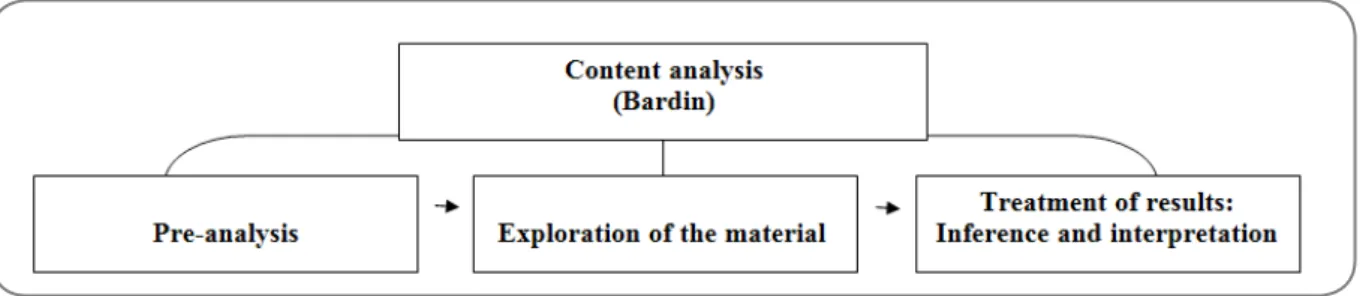
The data obtained were treated using the content analysis technique, using the Bardin method [17]. Bardin content analysis method consists of using a set of te-chniques for analyzing communications aiming at systematic and objective procedu-res to describe the content that may indicate conditions and inferences about a given situation. Therefore, it was necessary to follow three phases, these being registered by the type of analysis (Figure 1). What emerged in the voice of the elderly regarding reasons for adherence, motivations, and benefits because of their regular activities at EG were separated into categories.
Adapted from Bardin (2011)
Figure 1 - Three phases of content analysis using the Bardin method.
Results
After selecting individuals, an assessment was carried out to identify the an-thropometric characteristics of the participants (Table I).
After analyzing the content with the answers obtained, some possible fac-tors were detected that may favor the requirements of adherence, motivation, and benefits with the practice of physical activity in the EG, these were determined as categories. They are Adherence: Health condition, quality of life, stress reduction, weight reduction, and quality of sleep. Motivational: Make new friends, live with people of the same age group, and get out of solitude. Benefits: Reduced pain, muscle capacity, autonomy, functional capacity, flexibility, and balance. However, the results will be exposed by the categories followed by a percentage value (%), having this as the number of individuals who expressed in their answers the questions related to the reasons for adherence, motivation, and perceived benefits associated with the EG (Table II).
Table I - Characteristics of the selected sample, in mean and standard deviation.
Variables Values Mean SD Age (years) 67 4 (±) Weight (kg) 76 3 (±) Height (m) 1.64 7 (±) BMI (kg/m2) 28 2 (±)
BMI: Body Mass Index; SD: Standard Deviation.
Table II - Results of the adherence indicators, motivational factors, and perceived benefits identified among the parti-cipants, in percentage values (%).
Variables Values (%) Adherence indicatores Health condition 90% Quality of life 76% Sleep quality 73% Stress reduction 63% Weight reduction 63% Motivational factors
Make new friends 100%
Get out of loneliness 100%
Living with people of the same age 95%
Perceived benefits
Pain reduction 27%
Increased muscle capacity 25%
Autonomy 21%
Functional capacity 20%
Balance 18%
Flexibility 14%
Discussion
The present study aimed to identify adherence indicators, motivational fac-tors, and benefits perceived by elderly people included in the GE. Our findings can help with possible inquiries related to the practice of physical activity and aging, specifically in the public environment of GE. Through Bardin’s content analysis [17] factors were detected, here outlined as categories, which are important in the reality of the elderly public, both for adherence and for motivation and benefits.
Concerning the reasons for adherence cited, were the improvement of heal-th condition, quality of life, reduction of stress and weight, quality of sleep. These results are different from those found by Marquez et al. [18] who also investigated elderly people included in the GE and found 65% reasons for adherence to have better health, 15% for aesthetics, 15% sociability and 5% indicated different reasons. Still, on reasons for adherence, Martins et al. [19] investigated the participation of elderly pe-ople in the GE of the Federal University of São Paulo, campus Baixada Santista (Uni-fesp/BS) and found that the main reasons related to adherence were the expectation to participate in the proposed activities, socialization and filling free time.
Regarding the motivational factors responsible for staying at the GE, in the present study they were strongly related to social issues expressed in relationships, in the possibilities of cultivating friendships. It stood out as motivational factors to make new friends and leave loneliness (100%) as well as living with people of the same age group (95%). This indicates that this public need differentiated attention, which in environments with a diverse population may not be the same, it is important to practice activities with individuals in the same age group. In the study by Marquez
et al. [18], when the elderly were questioned by the motivational factors of
perma-nence in the practices of the gym in a generalized way, 50% indicate improvements for health and specifically 15% prevention of osteoporosis, 30% cardiovascular and cardiorespiratory improvement and only 5% aesthetics/beauty. Also corroborating our findings, Eiras et al. [20] also found in a physical activity program for the elderly that the main reasons for these individuals’ adherence are the search for better he-alth, socialization, and well-being. Another possible motivational aspect, however, not identified in the present study is to do physical exercises outdoors. Studies have shown positive results on motivation with interventions in outdoor environments [21].
As for the physical benefits, our findings identified that the reduction of pain, improvement in muscle capacity, autonomy, functional capacity, balance, and flexibility were perceived by the elderly investigated. However, among the benefi-cial effects promoted by adherence to GE, all individuals noticed a significant im-provement in the quality of life, which is an important factor in promoting healthy aging. Marquez et al. [18], who also carried out an investigation with elderly people included in the GE, observed that (10%) stated an improvement in balance (10%), in general, health (40%), (10%) reduction of stress (10%) ), improved posture (20%) and reduced muscle pain (20%). Martins et al. [19], in turn, identified that in terms of per-ceived benefits, quality of life was highlighted as a significant improvement factor along with the practice of physical activity in the GE and reported the perception of improvements in their quality of life. However, these findings, in part, corroborate ours consolidating that even in different places the results related to benefits are the same, with emphasis on the quality of life.
Our results add to the data presented so far by other studies and can help to better understand the reasons that lead the adherence and motivation of the elderly
to participate in GE, as well as to know what benefits are generated by this inser-tion. However, it will be necessary to develop new studies with an investigation in elderly practitioners of physical activity in GE, perhaps, with a larger sample. Thus, we will have information about the items evaluated in the present study in a more established way.
Conclusion
Given the above, the study showed that the main indicators of adherence were health and quality of life, the motivational factors were to reduce loneliness and increase social life and among the most reported benefits is quality of life and health.
Conflict of interest
No conflicts of interest with potential potential for this article were reported.
Financing source
Coordenação de Aperfeiçoamento de Pessoal de Nível Superior (CAPES), with a scholarship the resear-cher Natália Rodrigues dos Reis and the Universidade Federal de Juiz de Fora (UFJF),with the scholar-ship to the researcher Leandro de Oliveira Sant’Ana.
Academic link
There is no link between this study and graduate programs.
Authors’ contributions
Conceptualization of the project: Reis NR, Sant’Ana LO, Costa FF and Vianna JM. Data collections: Sant’Ana LO and Costa FF. Literature review: Ribeiro AAS, Campos YAC, Brown AF and Monteiro ER. Obtaining financing: None. Writing of the manuscript: Reis NR, Sant’Ana LO, Costa FF and Scartoni FR. Critical review of the manuscript for intellectually important content: Scartoni FR, Mansur HN, Novaes JS and Vianna JM.
References
1. World Health Organization. World report on ageing and health. World Health Organization, 2015. https://www.who.int/ageing/events/world-report-2015-launch/en/
2. Chang ES, Kannoth S, Levy S, Wang SY, Lee JE, Levy BR. The global reach of ageism on older per-sons’ health: A systematic review. PLoSOne 2020;15(1):e0220857. https://doi.org/10.1371/ journal. pone.0220857
3. Boulton ER, Horne M, Todd C. Multiple influences on participating in physical activity in older age: Developing a social ecological approach. Health Expectations 2018;21:239-48. https://doi.org/10.1111/ hex.12608
4. Gozzi SD, Bertolini SMMG, Lucena TFR. Impacto das academias da terceira idade: comparação da capacidade motora e cognitiva entre praticantes e não praticantes. Conscientia e Saúde 2016;15:15-23. https://doi.org/10.5585/ConsSaude.v15n1.5775
5. Oliveira NAD, Silveira HS, Carvalho A, Hellmuth CG, Santos TM, Martins JV, Deslandes AC. Ava-liação da aptidão cardiorrespiratória por meio de protocolo submáximo em idosos com transtorno de humor e doença de parkinson. Arch Clin Psychiatr 2012;40:88-92. https://doi.org/10.1590/S0101-60832013000300002.
6. Araujo APS, Bertolini SMMG, Martins Junior J. Alterações Morfofisiológicas decorrentes do proces-so do envelhecimento e suas conseqüências para o organismo humano. Perspectivas online: biológicas e saúde 2014;12:22-34. https://doi.org/10.25242/8868412201442
7. Azevedo Filho ER, Chariglione IPFS, Silva JTC, Vale, MAS, Araújo ERHS, Santos MFR. Percepção dos idosos quanto aos benefícios da prática da atividade física: um estudo nos Pontos de Encontro
Comunitário do Distrito Federal. Rev Bras Ciênc Esporte 2019;41:142-49. https://doi.org/10.1016/j. rbce.2018.04.010
8. American College of Sports Medicine. Quantity and quality of exercise for developing and main-taining cardiorespiratory, musculoskeletal, and neuromotor fitness in apparently healthy adults: gui-dance for prescribing exercise. Medicine & Science in Sports & Exercise 2011. https://doi.org/10.1249/ MSS.0b013e318213fefb
9. Fragala MS, Cadore EL, Dorgo S, Izquierdo M, Kraemer WJ, Peterson MD, Ryan ED. Resistance trai-ning for older adults: position statement from the national strength and conditiotrai-ning association. J Strength Cond Res 2019;33:2019-52. https://doi.org/10.1519/JSC.0000000000003230
10. Chodzko-Zajko W, Proctor DN, Fiatarone Singh MA, Minson CT, Nigg CR., Salem GJ, Skinner JS. Exer-cise and physical activity for older adults. Medicine and Science in Sports and ExerExer-cise 2009;41:1510-30. https://doi: 10.1249/MSS.0b013e3181a0c95c
11. Vila CP, Silva MEM, Simas JPN, Guimarães ACA, Parcias SR. Aptidão física funcional e nível de aten-ção em idosas praticantes de exercícios físicos. Rev Bras Geriatr Gerontol 2013;16:355-64.
12. Freitas V, Melo CC, Leopoldino A, Boletini T, Noce F. Influência do nível de atividade física e da mobilidade sobre o estresse emocional em idosos comunitários. Revista de Psicología del Deporte 2018;27:75-81.
13. Lima FLR. Percepção do esforço em idoso nas academias ao ar livre. Rev. Bras. de Prescrição e Fisio-logia do Exercício 2013;7:55-64.
14. Scartoni FR, Rabello MFP, Silva SNR, Sant’ Ana LO, Scudese E, Ramos AM, et al. Physical conditio-ning index on active elderly population. Biomed J Sci & Tech Res 2018;11:1-4. https://doi.org/10.26717/ BJSTR.2018.11.002177
15. Bertolini SMMG, Manueira P. Equilíbrio estático e dinâmico de idosos praticantes de atividades físicas em Academias da Terceira Idade. Conscientia e Saúde 2013;12:432-8. https://doi.org/10.5585/ conssaude.v12n3.4318
16. Esteves JVDC, Andreato LV, Pastório JJ, Versuti JKB, Almeida HC, Moraes SMF. O uso de academias da terceira idade por idosos modifica parâmetros morfofuncionais? Acta Scientiarum. Health Sciences 2012;34:31-8. https://doi.org/10.4025/actascihealthsci.v34i1.8354
17. Bardin. Análise de conteúdo. São Paulo: Edição 70; 2011.
18. Marquez TB, Zamai CA, Furtuoso Filho AA, Emerenciano PCF. A prática do exercício físico na pro-moção da saúde de sujeitos da terceira idade. Revista Saúde e Meio Ambiente 2019;9:163-73.
19. Martins RCCC, Casetto SJ, Guerra RLF. Mudanças na qualidade de vida: a experiência de ido-sas em uma universidade aberta à terceira idade. Rev Bras Geriatr Gerontol 2019;22. https://doi. org/10.1590/1981-22562019022.180167.
20. Eiras SB, Silva WHA, Souza DL, Vendruscolo R. Fatores de adesão e manutenção da prática de ativi-dade física por parte de idosos. Revista Brasileira de Ciências do Esporte 2010;31:75-89.
21. Kruchelski S, Grande D, Wendling NMS. Utilização do ambiente construído: academias ao ar livre em Curitiba. Revista Gestão Pública em Curitiba 2011;2:67-80. https:/doi.org/10.5020/18061230.2017.6688