Applying Data Warehousing Technology to
Support Planning and Control on Mass Transit
Companies
Jo˜ao Mendes Moreira∗ Jorge Freire de Sousa ∗
∗ INEGI – Instituto de Engenharia Mecˆanica e Gest˜ao Industrial
Rua Dr. Roberto Frias s/n; 4200-465 Porto – Portugal FEUP – Faculdade de Engenharia da Universidade do Porto
Tel.:+351-225081639, Fax: +351-225081797 {jmoreira, jfsousa}@fe.up.pt
Abstract
This paper describes the methodology used in the construction of a Data Warehousing project to support planning and control on mass transit compa-nies. The data sources used were the ones from the GIST98/EUROBUS system - a computer application for supporting operational planning in public transport companies. Firstly, the main Data Warehousing concepts and definitions are introduced. After the problem description and a brief analysis of different Data Warehousing methodologies, the analysis and development phases of the Data Warehousing project are presented. Finally, in the conclusions, the main advan-tages to implement such a system in the situation described are emphasized. Keywords: Data Warehousing, OLAP, Mass Transit, Transportation Management
1 Introduction
When computation began to be used massively in the sixties/seventies, the data moved from paper files to device drivers but, in the main, the role that data had in the companies did not change so much. The manager of a company made use of the same information no matter if it was on paper or in a device driver. Along time, information and time won an increasing importance, and the pressure to get more and faster information also increased. In the nineties, Data Warehousing technology was an answer to that tendency that is still going on, particularly with the possibility
c
24 J. Moreira, J. Sousa / Investigac¸˜ao Operacional, 26 (2006) 23-43
to use the data to extract hidden information. It is the era of the data mining and knowledge discovery.
In this paper the construction of a Planning Indicators Board (PIB) is described. The PIB is a top level oriented module of the GIST98/EUROBUS system, a Decision Support System (DSS) for mass transit companies. The proposal is to collect and to show the planning and control information to support the decision-making process using Data Warehousing technology.
Firstly, the main Data Warehousing concepts and definitions are introduced, followed by the description of the GIST98/EUROBUS system and the presentation of a Data Warehousing development methodology. The PIB’s construction is described by using the structure of that methodology.
2 Data Warehousing concepts and definitions
Traditionally, the operational databases are:
• Data oriented: the database design depends on data itself and not on the way the data is red by end-users applications. Roughly we can say that the paradigm is: ”The less is the space needed to store the data, the better is the database design”.
• Not integrated: the data is spread across several databases not necessarily consistent.
• Volatile: the data can be changed.
• Time invariant: often, it is not possible to know the same information at differ-ent momdiffer-ents in time.
Databases with these characteristics are not adequate to support management’s decisions because queries are time consuming, information is not integrated, and it is not guaranteed that the information is accurate and stored along time. The answer to these problems is the Data Warehouse: “a subject oriented, integrated, non-volatile and time variant collection of data in support of management’s deci-sions” [6]. This concept became quite popular on Information Technology in the nineties, because, on one hand, the information won an increasing strategic im-portance in the companies and, on the other hand, hardware became cheaper and technologically much better.
The definition of Data Warehouse is data-oriented and does not include all the processes connected with the Data Warehouse technology. In order to get a process-oriented definition, the term Data Warehousing became more popular: “Warehous-ing refers to a set of processes or an architecture that merges related data from many operational systems to provide an integrated view of data that can span mul-tiple business divisions” [16].
Connected with the Data Warehouse concept appears in 1993 the term OLAP (OnLine Analytical Processing) that is “a category of software technology that enables analysts, managers and executives to gain insight into data through fast, consistent, interactive access to a wide variety of possible views of information that has been transformed from raw data to reflect the real dimensionality of the enterprise as understood by the user (. . . )” [8].
2.1 Data Warehousing reference architecture
As it can be seen in Figure 1, the Data Warehousing architecture can be divided, typically, in three big components:
• The sources: operational databases and/or data files.
• The Data Warehouse and all the software needed to load, administer and man-age it: the Data Warehouse administration and manman-agement software is like a Data Base Management System but with more capacity to manage huge amount of data and to data reading operations. The data acquisition is the software responsible by the data migration from the sources to the Data Ware-house.
• The decision support tools: the frontend & report tools – they are easy to use tools that allow enduser to see and manipulate data in a useroriented way; the OLAP tools – they allow to organise and manipulate data in a multidimensional way; and vertical and Data Mining solutions – they are able to find, in a semi-automatic way, patterns, associations, changes and disturbances, using sta-tistical methods and a big variety of algorithms.
Data Marts can be seen as small Data Warehouses. If the Data Marts load data directly from operational systems they are said to be independent. If they load data from the Data Warehouse, they are defined as dependent. The main difference be-tween a Data Warehouse and an independent Data Mart is that the Data Mart is departmentally or functionally structured, while the Data Warehouse is organisa-tionally structured.
The Data Warehouses and the Data Marts can be stored using the relational model (ROLAP), the multi-dimensional model (MOLAP) or a hybrid model that uses both relational and multi-dimensional models (HOLAP). The relational model [3] is the most popular of all database models. The multi-dimensional model [15] can be seen as a set of multi-dimensional arrays. For each array, the number of results (the NULL is a possible result) is the Cartesian product of the several possible arguments. A multi-dimensional array has the name of Multi-Dimensional Structure or Cube.
26 J. Moreira, J. Sousa / Investigac¸˜ao Operacional, 26 (2006) 23-43
Figure 1: Data Warehousing reference architecture (translated from [12])
3 The GIST system
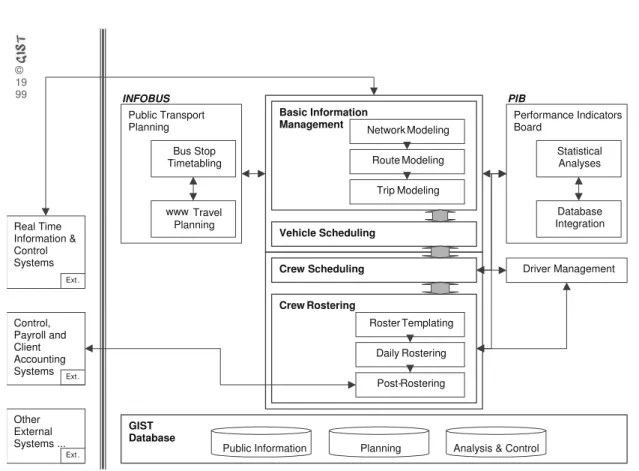
The GIST system [2], [13] is a computer application for supporting operational plan-ning in public transport companies. It was developed as a decision support system that aims to help mass transit companies to improve the operation of critical re-sources, such as vehicles, drivers and planning staff. The system is also an impor-tant software tool to support tactical and strategic management studies regarding companies operations. A consortium of 5 leading Portuguese transport companies (CARRIS, STCP, Hor ´arios do Funchal, Empresa Barraqueiro and Vimeca) and 2 R&D institutes (INEGI-FEUP and ICAT-FCUL) is responsible for the GIST system.
The GIST system was successfully installed in those companies in 1996. In 2001, this application was developed under the name of GIST98/EUROBUS. This evolution represents improvements both to the GIST functions and extensions of its functionality. Nowadays, it is being used by eight Portuguese companies that operate, daily, about 2800 vehicles, corresponding broadly to 21% of the road public transport market in Portugal, including Madeira and Azores.
3.1 The GIST98/EUROBUS system
• Network Module, allowing the definition of the transportation network; • Gist-Line Module, the route information module;
• Trip and Vehicle Scheduling Module, allowing the trip timetable definition and the vehicle scheduling information management and optimisation;
• Crew Scheduling Module, the crew scheduling information management and optimisation module;
• Crew Management and Rostering Module, which defines the daily tasks to ev-ery employee and where various optimisation algorithms are applied to the rostering rules.
• User Information Module, an user-oriented module producing information to the users of public transports;
• Performance Indicators Board Module, a top level oriented module providing planning and control indicators to support the decision making process. The first four modules are upgrades of the GIST modules. The Crew Scheduling Module, the Crew Management and Rostering Module, the User Information Module and the Performance Indicators Board Module belong to the EUROBUS project that has been financially supported by a public institution named ‘Agˆencia de Inovac¸˜ao’. All these modules form the GIST98/EUROBUS system.
3.2 The Performance Indicators Board Module (PIB)
The PIB Module filters the information derived from the other modules so that the toplevel managers can access, in an easy way, the relevant information for the deci-sion making process. The main problem in structuring the PIB Module is to identify those indicators that are significant to top-level managers. All other information is included in the corresponding module. As the GIST98/EUROBUS is a decision support system to the operational planning, the information that it can provide it is essentially the planning and control information.
4 The methodology
There are several Data Warehousing methodologies [1], [16]. In the following, in-stead of describing them, it will be highlighted what is common to those method-ologies (Figure 3), namely the Hadden-Kelly method [5], the methodology from NCR Corporation [4] and the methodology from DataWing Consulting Services, LLC [17]. In fact, it is possible to say that these methodologies have three main phases, even if in some of them, those phases are splitted in more than three. The phases are anal-ysis, development and implementation. The analysis phase includes all the tasks related to the process definition, the requirement analysis and the software and hardware architecture design. The development phase corresponds to the database
28 J. Moreira, J. Sousa / Investigac¸˜ao Operacional, 26 (2006) 23-43 Driver Management Crew Rostering GIST Database Planning
Public Information Analysis & Control
Basic Information Management Public Transport Planning www Travel Planning Bus Stop Timetabling Performance Indicators Board Database Integration Statistical Analyses Vehicle Scheduling Real Time Information & Control Systems Ext. Control, Payroll and Client Accounting Systems Ext. Other External Systems ... Ext. © 19 99 Network Modeling Route Modeling Trip Modeling Crew Scheduling Roster Templating Daily Rostering Post-Rostering INFOBUS PIB
Figure 2: The GIST98/EUROBUS system architecture model
design and development, as well as the transformation and integration programs de-velopment and the Cube’s definition. The last phase is the system implementation and configuration that is done in the company.
Another common aspect to the main Data Warehousing methodologies is their iterative nature. An iteration, that is every set of three phases, has between three to six months of duration, allowing a good expectation management. So, it can be a never stop process.
4.1 The methodology used to build the PIB module
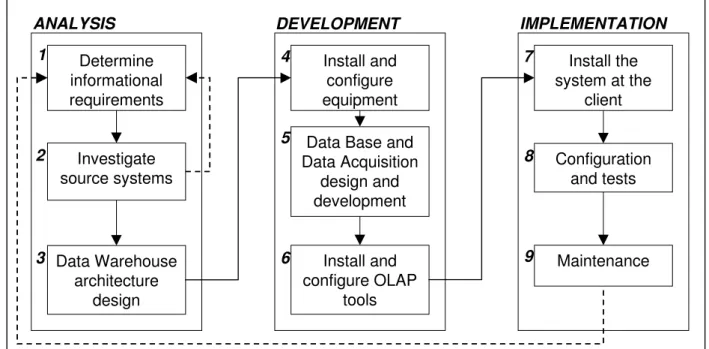
In the methodology used to build the PIB module (Figure 4) it is clear the sequential structure of the iterations. The only exception is in the analysis phase. In fact, the study of the indicators that the company needs and the study of the data sources are done almost in parallel.
Analysis
Development Implementation
Figure 3: Data Warehousing reference methodology
Investigate source systems Determine informational requirements Install and configure equipment ANALYSIS IMPLEMENTATION Data Warehouse architecture design DEVELOPMENT Install the system at the client Configuration and tests Maintenance Install and configure OLAP tools Data Base and Data Acquisition design and development 1 2 4 5 6 3 7 8 9
30 J. Moreira, J. Sousa / Investigac¸˜ao Operacional, 26 (2006) 23-43
5 The PIB module: Analysis, Development and
Implemen-tation
By definition, a Data Warehouse integrates all the data of the company that is rel-evant to support management’s decisions. Since the data used on PIB module is exclusively the one that comes from one or more GIST98/EUROBUS systems, we cannot say that the PIB’s database is a Data Warehouse. In fact, it is more correct to define the PIB’s database as an independent Data Mart. Independent because the data sources are operational systems (one or more GIST98/EUROBUS databases) and Data Mart because it is functionally structured (it uses the data relevant to the planning and control activities).
In this section it is described the analysis and development phases of the first iteration.
5.1 The analysis phase
The analysis phase has, typically, a duration of three months.
5.1.1 Informational requirements
The first questions we tried to answer were: “Which are the big groups of indicators that managers need?” and “Which indicators must be included in each group?”
The results presented in this text are derived from the study accomplished at the STCP Company (the Oporto Public Transport Authority).
”Which are the big groups of indicators that managers need?”
Taking attention to the information that GIST98 contains and to the big areas where top-level managers need planning and control information, we have defined two main groups of performance indicators: service indicators and crew indicators. The first group gives information about the level of service that the company is offer-ing, which is especially important to the operations management department, while the crew indicators give information relevant to the human resource department.
”Which indicators must be included in each group?”
The first thing to do was to collect information from the companies. It was a long, interactive process between the analysts and the companies’ staff. The service reports produced monthly by the companies were another major source of informa-tion.
Based on the information collected it was possible to notice that each potential indicator has no more than 4 parameters. This means that it is possible to identify a specific indicator by answering to 4 questions: ”Which is the indicator denomina-tion?”, ”Which entity does the indicator refers to?”, ”Which is the aggregation level
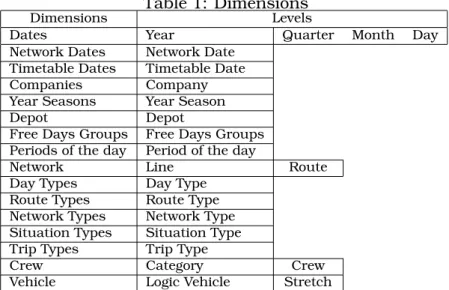
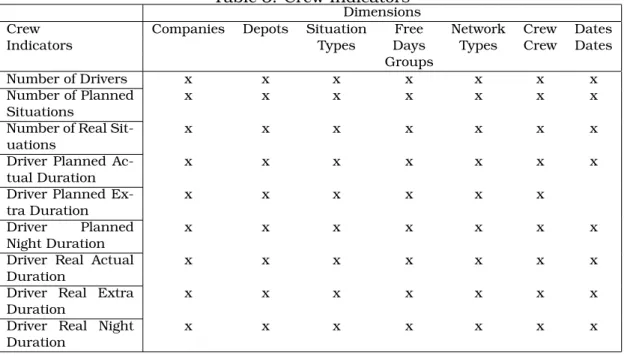
used?” and ”Which aggregation function does it represent (in other words, is it an average, a maximum or any other kind of function)?” As an example: if we want to know the average distance of trips per route, the indicator is the distance, the entity is the trip, the aggregation level is the route, and the aggregation function is the average. Using this methodology it was possible to identify the indicators group, the entities group and the aggregation function group. The aggregation level was more complex to define. In fact, using the example above, the trips can be aggre-gated by route, by line, by day type, by route and by day type at the same time, etc., i.e., they can be aggregated by one entity or by a combination of entities. The first thing we observed was that when an indicator can be aggregated by one entity it can also be aggregated by more generic entities. In the example, if routes can aggregate trips, lines can also aggregate trips (notice that a line is a set of routes). The step forward was to define the different dimensions to be used. Each dimension refers to a sequence of entities. The order by which they appear on table 1 is related with the degree of detail, i.e., the first entity of each dimension is the most generic one and the last one is the most specific. In other words, the entity referred at the first column of each dimension is a set of the entities referred at the next one, and so on. In tables 1, 2 and 3 the results obtained by this methodological approach are presented (the aggregation functions were ignored just for the sake of simplicity).
Table 1: Dimensions
Dimensions Levels
Dates Year Quarter Month Day
Network Dates Network Date Timetable Dates Timetable Date
Companies Company
Year Seasons Year Season
Depot Depot
Free Days Groups Free Days Groups Periods of the day Period of the day
Network Line Route
Day Types Day Type
Route Types Route Type Network Types Network Type Situation Types Situation Type Trip Types Trip Type
Crew Category Crew
Vehicle Logic Vehicle Stretch
With these tables we can easily identify four groups of indicators: the route ex-tension and the number of routes in the first group of indicators, the number of logic vehicles in the second group, all the others indicators from table 2, in the third group, and the indicators presented in table 3, in the fourth group. The identifica-tion of these groups of indicators derives from the indicator’s entity and from the set of dimensions used. Each group will be implemented using the Cube concept. Once the cubes are defined tables 4 and 5 are used in substitution of tables 2 and 3 because they present the same information in a more concise and practical way.
32 J. Mor eira, J. Sousa / Investigac ¸˜ao Operacional, 26 (2006) 23-43 T able 2: Service Indicators Dimensions
Service Companies Network Network Network Timetable Year Depots Periods of Dates Route Day Trip Vehicle
Indicators Types Dates Dates Seasons the Day Types Types Types
Route Exten-sion x x x x x Number of Routes x x x x x Number of Trips x x x x x x x x x x Trip Dis-tance x x x x x x x x x x Trip Driv-ing Time x x x x x x x x x x Trip Driv-ing Time with Sup-port Time x x x x x x x x x x Trip Com-mercial Speed x x x x x x x x x x Trip Ex-ploration Speed x x x x x x x x x x Number of Logic Vehicles x x x x x x x x x x x
Table 3: Crew Indicators
Dimensions
Crew Companies Depots Situation Free Network Crew Dates
Indicators Types Days Types Crew Dates
Groups
Number of Drivers x x x x x x x
Number of Planned
Situations x x x x x x x
Number of Real
Sit-uations x x x x x x x
Driver Planned
Ac-tual Duration x x x x x x x
Driver Planned Ex-tra Duration
x x x x x x
Driver Planned Night Duration
x x x x x x x
Driver Real Actual Duration
x x x x x x x
Driver Real Extra Duration
x x x x x x x
Driver Real Night
Duration x x x x x x x
Table 4: Dimensions by Cube `` `` `` `` `` ` Dimensions
Cubes Commercial Network Vehicle’s Services Vehicle’s Services Crew along the day
Dates x x x Network Dates x Timetable Dates x x Companies x x x x Year Seasons x x Depots x x x
Free Days Groups x
Periods of the Day x
Network x x x Day Types x x Route Types x Net Types x x x x Situation Types x Trip Types x x Crew x Vehicle x x
34 J. Moreira, J. Sousa / Investigac¸˜ao Operacional, 26 (2006) 23-43
Table 5: Indicators by Cube
Commercial Network Vehicle’s Services Vehicle’s Services
along the day Crew
Route Extension Number of Trips Number of Logic Vehi-cles
Number of Drivers
Number of Routes Trip Distance Number of Planned
Situations
Trip Driving Time Number of Real
Situa-tions Trip Driving Time with
Support Time Driver Planned ActualDuration
Trip Commercial Speed
Driver Planned Extra Duration
Trip Exploration Speed
Driver Planned Night Duration
Driver Real Actual Du-ration
Driver Real Extra Du-ration
Driver Real Night Du-ration
5.1.2 Source systems
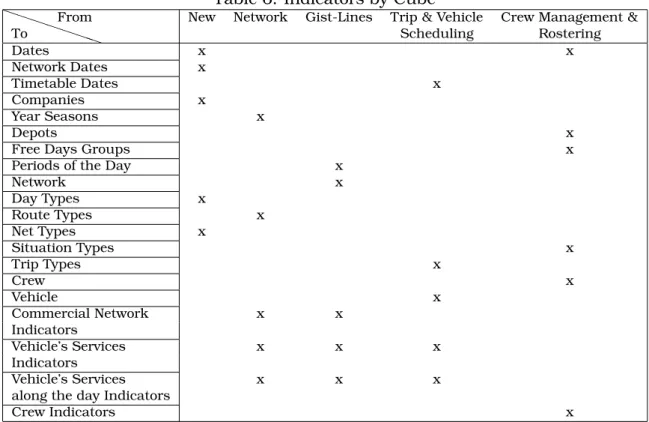
In order to know how to obtain the identified indicators from the available data, maps that relate the sources (modules) with the dimensions and indicators have been done (table 6).
The “New” column exists because there is some information that is created dur-ing the data acquisition process. An example is the company owner of each source. That information is implicit to each source but it must be explicit in the Data Ware-house.
In order to obtain that information with more detail, tables have been created that describe, for each level of every dimension and for each indicator of every Cube, which are the tables from the sources that are needed to obtain them. Table 7 shows this information for the different levels of each dimension.
5.1.3 Data Warehouse architecture design
To define the Data Warehouse architecture the first step is to preview the database dimension. Secondly, it is necessary to choose the software tools that will be evalu-ated. Once the evaluation is done, the architecture is established.
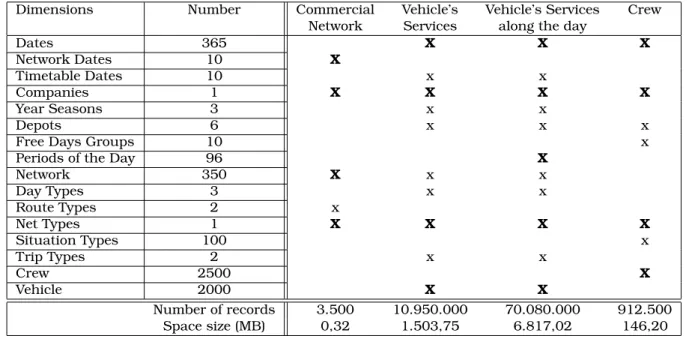
To preview the database dimension it was assumed the use of the star schema [11] since it is the most space consuming database design used for these propos-als. Since the PIB module is part of the GIST98/EUROBUS system, the scalability problem is a minor one. The formula used to preview the database space was:
Table 6: Indicators by Cube P P P P P PP
To From New Network Gist-Lines Trip & VehicleScheduling Crew Management &Rostering
Dates x x Network Dates x Timetable Dates x Companies x Year Seasons x Depots x
Free Days Groups x
Periods of the Day x
Network x Day Types x Route Types x Net Types x Situation Types x Trip Types x Crew x Vehicle x Commercial Network x x Indicators Vehicle’s Services x x x Indicators Vehicle’s Services x x x
along the day Indicators
Crew Indicators x
Table 7: Data sources for each level of each dimension
Dimension →Level Data source
Dates Data acquisition process and
Shifts schedules; Daily rosters
Network Dates →Network Date Data acquisition process Timetable Dates →Timetable Date Data acquisition process
Companies →Company Direct introduction
Year Sessions →Year Session Year seasons
Depots →Depot Depots
Free Days Groups →Free Days group Freeday groups
Periods of the Day →Period of the Day Periods
Network →Line Lines
Network →Route Paths e Lines paths
Day Types →Day Type Day types
Route Types →Route Type Direct introduction
Net Types →Net Type Direct introduction
Situation Types →Situation Type Situation types
Trip Types →Trip Type Direct introduction
Crew →Category Categories
Crew →Crew Crew members
Vehicle →Logic Vehicle Shifts schedules, Shifts e Trips
Vehicle →Stretch Shifts schedules, Shifts, Trips, Trips nodes, Glines nodes types e Nodes types
36 J. Moreira, J. Sousa / Investigac¸˜ao Operacional, 26 (2006) 23-43 fmidx – a factor to preview the space used by the indexes: 2.
fmdiv – a factor to preview the space used by metadata, or other no counted
space: 1,5.
ech – size of each primary key field: 6 Bytes.
ndim – number of independent dimensions: marked with X on table 8. eind – size of each indicator field: 4 Bytes.
nind – number of the Cube’s indicator: see table 5.
nregmax – number of records (it was used the data from CARRIS - the biggest
company): it is the Cartesian product of the number of members of the independent dimension’s lowest levels (marked with X on table 8).
fmgra – is a granularity factor. It is the average of records’ number needed for
each value of nregmax. It is assumed that the data detail level is already defined. It is a critical decision once it is a compromise between the data space and the information detail level. For example, to the vehicle’s services Cube, it is important to save the trips information because, even if indicators are not aggregated by trip, this information allows, in the future, the calculation of other indicators with a low cost. The average of trips by vehicle’s stretches is around 15. This is the fmgra to the vehicle’s services Cube. To the other Cubes the fmgra will be 1.
The values of fmidx and fmdiv will be studied using a more reliable sample. Looking to table 8 it can be seen that around 80% of the database dimension is needed to obtain the indicator ‘Number of logic vehicles’. It is possible to get this indicator by calculus once the beginning and the end of each stretch are stored. With this change, the database dimension for a year will be around 1,9 Giga Bytes. For three years – the time considered as necessary by the companies to keep the information – it will be around 5,7 Giga Bytes.
The software tools chosen to be evaluated were: MicroStrategy 7 (a reference between the ones that use the ROLAP architecture); Express Server from Oracle
Corporation (a reference between the ones that use the MOLAP architecture); iTM1
from Applix, Inc (a very versatile tool); and SQL Server7/OLAP Services from Oracle
Corporation (a tool with a very competitive ratio price/quality).
The weights used for each criteria were the ones that seem to be more adequate for this particular case (see table 9). The points were based in some tests and mainly in [10]. MicroStrategy7 was classified with 8 in the ‘Database management system robustness’ despite it has not an own Database management system. That classi-fication is the one attributed to Oracle8 Enterprise Edition once it is the Database management system used by all the other modules of the GIST98/EUROBUS system and it would be naturally the one to use with the MicroStrategy 7 option.
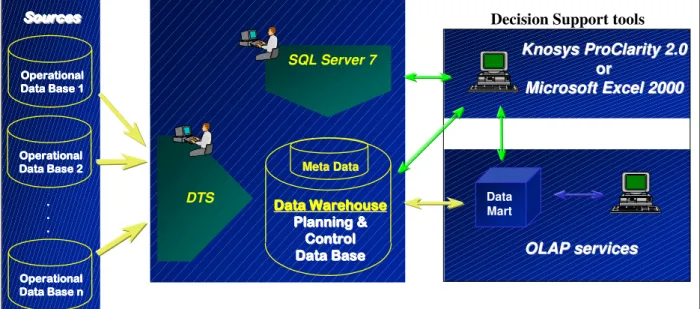
Figure 5 presents the chosen architecture. An important feature of SQL server
7’ OLAP services is the possibility to choose between ROLAP, MOLAP or HOLAP
Table 8: Prevision study of the database dimension for a year
Dimensions Number Commercial Vehicle’s Vehicle’s Services Crew Network Services along the day
Dates 365 X X X Network Dates 10 X Timetable Dates 10 x x Companies 1 X X X X Year Seasons 3 x x Depots 6 x x x
Free Days Groups 10 x
Periods of the Day 96 X
Network 350 X x x Day Types 3 x x Route Types 2 x Net Types 1 X X X X Situation Types 100 x Trip Types 2 x x Crew 2500 X Vehicle 2000 X X Number of records 3.500 10.950.000 70.080.000 912.500 Space size (MB) 0,32 1.503,75 6.817,02 146,20
Table 9: OLAP tools evaluation
Weight MicroStrategy 7 Express iTM1 SQL Server / OLAP Services
Capacity 10 10 8 6 9
Database structural
sim-plicity 50 4 5 9 8
Database structural flex-ibility and calculation functionality
50 7 9 7 9,5
Data access functionality 70 7 10 7 9
Technical support and
documentation 50 7 9 7 7
Database management system robustness
70 n.a. (8) 8 8 10
Decision support tools 70 6 8 6 9
Price 90 6 2 5 10
4600 3010 3230 3130 4175
Classification (%) 65,43% 70,22% 68,04% 90,76%
n.a. - not appliable because it has not a own
38 J. Moreira, J. Sousa / Investigac¸˜ao Operacional, 26 (2006) 23-43 OLAP services are all part of the SQL Server / OLAP Services option. The Knosys ProClarity 2.0 is an easy to use front-end tool as the quite known Microsoft Excel 2000. DTS SQL Server 7 Data Mart Meta Data Meta Data OLAP services OLAP services Knosys ProClarity 2.0 Knosys ProClarity 2.0 or or Microsoft Excel 2000 Microsoft Excel 2000 Decision Support tools
Figure 5: PIB architecture
5.2 The development phase
The development phase has, typically, a duration of three months. 5.2.1 Install and configure equipment
It is a technical work without any special difficulty.
5.2.2 Data Base and data acquisition design and development
In the development phase of a Data Warehousing system there are three main steps to consider [14]:
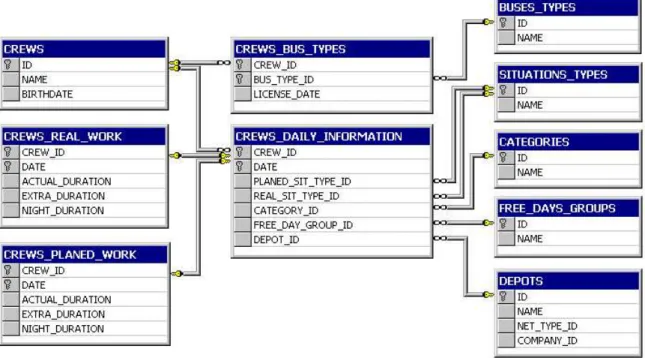
• The database design: As shown in table 3 and figure 6, the data is stored according to the indicators and dimensions required. The data is pre-processed before the user can access it; so, the concern with efficiency when designing the database has impact, especially on the processing time. It has no visible impact on the efficiency as seen by the user. The efficiency for the end-user is mainly determined by the architecture used. The ROLAP architecture is more scalable (manages more data) but is slower while MOLAP architecture is less scalable but faster. The PIB module uses the HOLAP architecture. Figure
6 shows the database design for the crew indicators. As it can be seen, it is directly obtained from tables 1 and 3. The database design was done according to the dimensional model [7].
Figure 6: database design for the crew indicators
• The transformation and integration programs [16]: The development of all these programs takes typically around 80% of all the development effort. It includes the extraction, transformation, transport and load processes. Previ-ously, it is important to analyse the source data and clean it. This is a very important issue because without reliable data it is not possible to guarantee the results. The source of information can be multiple: operational databases, other Data Warehouses/Marts or external data. In PIB’s case, the source data can be one or more GIST98/EUROBUS databases. The execution of these pro-grams is done every night assuring that the Data Warehouse is always up to date. This step was done using the DTS – Data Transformation Services.
• Cubes definition [15]: A cube is a structure that can be seen as a huge table (fact table) where the primary key is the set of all dimensions’ identifiers and the attributes are the indicators. Taking attention to tables 1, 4 and 5, it is possible to define the cubes easily. The first thing to do is to define the dimensions as in table 1. The second step is to implement the cubes defining the indicators and selecting the related dimensions. This step was done using the OLAP Services.
40 J. Moreira, J. Sousa / Investigac¸˜ao Operacional, 26 (2006) 23-43
5.2.3 Install and configure OLAP tools
Finally, how can the information be useful to the decision making process? There are several non-expensive analysis and reporting tools that allow the user to do all kind of analysis, just executing basic commands with the mouse. In figures 7 and 8 some examples using the Knosys – ProClarity 2.0 are presented. They show two specific types of analysis. Figure 7 shows the decomposition tree with the information about the distance planned to the day 28-05-1999 with different levels of detail: by net type; by logic vehicle; by stretch; by travel’s type and by route. Figure 8 shows the relationship between the planned distance and the number of trips by logic vehicle for the day 28-05-1999.
Using this tool it is possible to do much more types of analysis such as, to compare indicators for the same month of consecutive years, or for consecutive months, to see line, column, pie, bar or other chart types, to create other indicators using formulae, etc. All this may be done using the aggregation level chosen by the user. To aggregate or detail data, it is enough to drill up or down.
Figure 7: Decomposition Tree
5.3 Some considerations about the implementation phase
The implementation phase has a set of tasks that are done once and other tasks that must be done periodically. In the first group are:
• To install and configure hardware and software at the client: like the install and configure equipment task, it is a technical work without any special difficulty.
Figure 8: Perspective chart
• To create database, users and access policy: it is a typical task for a database manager.
• To verify and configure OLAP Services: when the OLAP Services will be tested with real data.
• To create a backup and data acquisition policy: it is a very important issue where the acquisition and backup periodicities are defined. The data acqui-sition policy depends on the aggregation level previously chosen. The backup policy is a basic task for every database system.
In the second group are:
• To verify log files: it is a regular task to do at least after every acquisition procedure since it is, usually, the main source of errors.
• To verify indicators evolution along time to detect eventual data errors: it is important to control the indicators evolution because there are several possible errors that are difficult to detect by software.
6 Conclusions
42 J. Moreira, J. Sousa / Investigac¸˜ao Operacional, 26 (2006) 23-43
• There is the perception that the information exists but it is not so useful as it could be;
– Each department has its own language and communication is difficult; – The reports production is expensive and inefficient.
To transform data in information is the main goal of a Data Warehousing system. Traditionally, when a manager wants information he asks it to the information de-partment in order to get a report. If the manager wants additional information he needs to wait longer. A Data Warehousing system lets the manager free to pick up the information he wants, with the type of display he prefers, just using the mouse. This flexibility leads to a higher concentration on information instead on data, giv-ing more time to analyse information. The report production is also reduced since time is not spent doing queries to the database. Another important feature is that all the information is centralised, with everybody using the same indicators with the same definitions, which makes communication easier. But the main advantage of the Data Warehousing systems is to turn data into a competitive advantage because it can be used to analyse relationships between variables, to analyse trends, in a word, to put the information at the service of the decision making process.
7 References
[1] Sid Adelman, Joe Oates, Data Warehouse Project Management, Data Management Re-view, May 1998
[2] Jo˜ao Falc˜ao e Cunha, Jorge Pinho de Sousa, Teresa Galv˜ao, Jos´e Luis Borges., A Decision Support System for the Operational Planning at Mass Transport Companies, presented at the 6th International Workshop on Computer-Aided Scheduling of Public
Transport, July 1993, Lisbon, Portugal.
[3] C. J. Date, An Introduction to Database Systems (6th Edition), Addison-Wesley, 1995 [4] Stephen R. Gardner, Building the Data Warehouse, Communications of the ACM,
Septem-ber 1998
[5] Hadden & Company, http://www.hadden-kelly.com, 1999 [6] Inmon W.H., Building the Data Warehouse, Wiley, 1996, pp.33
[7] Ralph Kimball, Laura Reeves, Margy Ross, Warren Thornthwaite, The Data Warehouse Lifecycle Toolkit, Wiley, 1998, pp. 137-314
[8] OLAP Council, http://www.olapcouncil.org/research/glossaryly.htm, 1997
[9] John Onder, Todd Nash, Building a business-driven Data Warehouse, Data Manage-ment Review, October 1998
[10] Nigel Pendse, Richard Creeth, The OLAP Report, http://www.olapreport.com, red in October 2000
[11] Neil Raden, Data Modeling – Star Schema 101, http://www.archerdecision.com, 1995/96 [12] Jo˜ao Ranito, seminar presentation at Faculdade de Engenharia da Universidade do
[13] Jorge Pinho de Sousa, Jorge Freire de Sousa and Rui Campos Guimar˜aes, Un syst`eme informatique d’aide `a la g´en´eration d’horaires de bus et de chauffeurs, in: Gestion de l’´economie et de l’entreprise - l’approche quantitative, Editions CORE, S´erie Balises, De Boeck, Brussels, 1988, pp. 477-492 (in French).
[14] The Data Warehousing Institute, 1998 Data Warehousing Buyer’s Guide, http://www.dwinstitute.com/buyersguide/, 1998
[15] Erik Thomsen, OLAP Solutions, Wiley, 1997, pp. 229-264
[16] Karen Watterson, Attention, Data-Mart shoppers, BYTE Magazine - July 1997 [17] J. D. Welch, http://www.datawing.com/BOOKS F.HTM, 1998
![Figure 1: Data Warehousing reference architecture (translated from [12])](https://thumb-eu.123doks.com/thumbv2/123dok_br/19214713.959912/4.892.109.790.151.564/figure-data-warehousing-reference-architecture-translated.webp)