1(Trabalho 060-09). Recebido em:09-03-2009. Aceito para publicação em: 27-11-2009. Trabalho desenvolvido com apoio do Edital
MCT/CNPq 15/2007 - Universal; Processo 474193/2007-1.
2Eng. Agr., Dr., Pesquisador Científi co, Instituto Agronômico (IAC). Centro de Citricultura Sylvio Moreira, Cordeirópolis-SP. E-mail:
[email protected]; [email protected].
3Eng. Agr., UFSCar. Centro de Ciências Agrárias, Araras-SP. E-mail: [email protected]. Bolsista CNPq/PIBIC/IAC 4Eng. Agr., Dr., Pesquisador Científi co, Instituto Agronômico (IAC). Centro de Solos e Recursos Ambientais, Campinas-SP. E-mail:
SCIENTIFIC COMUNICATION
SOIL NUTRIENT AVAILABILITY AND ITS IMPACT
ON FRUIT QUALITY OF TAHITI ACID LIME
1DIRCEU MATTOS JUNIOR2, THIAGO FERNANDO MILANEZE3,
FERNANDO ALVES AZEVEDO2 , JOSÉ ANTÔNIO QUAGGIO4
ABSTRACT - The Tahiti acid lime in Brazil is mostly grown in the São Paulo State. The value of this crop production ranks among the ten most important fruits in the country. The Brazilian exports of Tahiti limes have increased in the last years with a corresponding increased demand for superior quality of fresh fruits, which is affected by mineral nutrients. Therefore, this study evaluated nutrient soil availability and its infl u-ence on nutritional status of trees based on the determination of leaf and fruit nutrient concentrations, fruit characteristics, and post harvest quality. Eleven commercial groves with trees older than 4-yr and differently managed were studied. Plots with six trees in each grove were sampled for soil (0-20 cm depth layer), leaf and fruit analyses with three replicates. Correlation coeffi cients were pair wised established for all variables. The results showed that N leaf concentration was well correlated with green color of fruit peel as measured by a color index (r = -0.71**), and which was optimum with Leaf-N around 22 g kg-1. Leaf-Ca was inversely
correlated with fruit water loss after 14-day interval from harvest (r = -0.54*) demonstrating that Ca plays an important role in Tahiti fruit shelf-life. Data also suggested that increased fruit K concentration correlated with increased fruit water losses during storage (r >0.58*).
Index terms:Citrus latifolia, mineral nutrients, soil fertility, leaf analysis, fruit analysis.
DISPONIBILIDADE DE NUTRIENTES NO SOLO E IMPACTOS
NA QUALIDADE DE FRUTOS DA LIMA-ÁCIDA TAHITI
RESUMO - No Brasil, a lima-ácida Tahiti é produzida principalmente em São Paulo. O valor dessa produção situa-se entre as dez variedades de frutas mais importantes no País. As exportações brasileiras de Tahiti in natura aumentaram signifi cativamente nos últimos anos e têm demandado frutas de qualidade superior. Essas
características são afetadas pelos nutrientes minerais. Assim, o trabalho avaliou os efeitos da disponibilidade de nutrientes no solo, sua infl uência no estado nutricional das plantas e no teor desses nos frutos, e correlações sobre a qualidade de Tahiti, como maneira de criar subsídios para o manejo nutricional adequado de pomares. Foram estudados onze pomares comerciais com plantas em produção, >4 anos de idade, conduzidos com diferentes tipos de manejo. Foram marcadas parcelas com seis plantas em cada local, que representaram unidades de amostragem com três repetições. Dessas unidades, foram coletadas amostras de solo (0-20 cm), de folhas e de frutos maduros para análises físicas e químicas. Realizou-se a análise de correlação múltipla para estimativas dos coefi cientes de correlação entre as variáveis de medida, duas a duas. Verifi cou-se que o teor de N na folha correlacionou-se à intensidade de cor verde do fruto, expresso pelo índice de cor (r = -0,71**), o qual foi ótimo com N nas folhas ao redor de 22 g kg-1. O teor de Ca na folha foi inversamente
correlacionado à perda de água do fruto 14 dias após a colheita (r = -0,54*), demonstrando que o Ca desem-penha papel importante na vida útil de prateleira da lima-ácida Tahiti. Os dados ainda indicaram que teores elevados de K no fruto contribuem para maiores perdas de água após a colheita (r >0,58*).
Termos para indexação:Citrus latifolia, nutrientes minerais, fertilidade do solo, análise foliar, análise de
The Tahiti acid lime is largely grown in Mexi-co, Brazil and United States of America. In Brazil, its crop value ranks tenth after the most important fruits produced in the country as oranges, bananas, grapes, papayas, apples, mangoes, coconuts, mandarins and passion fruits (IBGE, 2009), because the exports of acid limes have signifi cantly increased during the last years, from 37.2 thousand tons in 2004 (equiva-lent to US$ 18.3 million) to 58.2 thousand tons in 2007 (equivalent to US$ 41.7 million) (Datafruta/ SECEX, 2009). The majority of Tahiti groves and production is located in the State of São Paulo with approximately 8.6 million trees distributed in 37 thousand hectares within 8.2 thousand small farms, usually below 20 ha, according to Silva et al. (2009). Added to its economical value, the Tahiti acid lime production also improves social aspects of the local citriculture.
The effi cient use of nutrients for crop produc-tion must account for crop demand and soil nutrient availability. However, because of the diffi culty of preserving soil samples for nitrogen (N) analysis and the lack of effective methods for measuring the N availability in the soil (Cantarella et al., 2008), espe-cially for perennial crops, the determination of leaf N concentration becomes an important diagnostic tool for optimum nutrient management in the fi eld. On the other hand, soil potassium (K) and phosphorus (P) analyses have been used as a base for citrus fertiliza-tion (Quaggio et al., 1998). The effectiveness of using these criteria depends on proper studies conducted in the fi eld, in which the most probable responses of trees to nutrient availability have been studied.
The N and K supplies signifi cantly affect fruit yield and quality of citrus (Alva & Paramasi-vam, 1998; Alva et al., 2006; Quaggio et al., 1998, 2006). Therefore, this information becomes valuable considering market requirements for superior charac-teristics of Tahiti fresh fruits (i.e. optimum size with coarse and intense green colored peel). For example, a “good green” color is a characteristic used to grade those limes in the external market. The United States Department of Agriculture defi nes the US No. 1 grade fruits those having not less than an aggregate area of three-fourths of the surface of the fruit which shows good green color characteristic of the variety (USDA, 1997); in Brazil, color defi nes fruits into subclasses I to V in which peel varies from dark green to yellow-ish colors (Gutierrez & Almeida, 2005).
Another important fact, which information is also required for best nutrient management of citrus, relies on the adequate calcium (Ca) supply for the Tahiti acid lime. Field observations have suggested that fruit set and quality have improved in
commer-cial groves after application of soluble Ca to the soil beginning the spring time. About 60% of cellular Ca is located in the cell wall (medium lamella), where it is responsible for important structural function due to the ability of Ca2+ to bind free carboxyl groups.
Therefore, it is expected that adequate Ca supply will improve peel texture and fi rmness (reducing cell wall breakdown), fruit maturation, and reduce vitamin C degradation, fruit respiration and ethylene production on post-harvest as well as diseases occurrence in sev-eral species (Tobias et al., 1993; Martinez-Romero et al., 1999; Prado et al., 2005).
Little information has been available in the literature with respect on nutrient management for the Tahiti lime. Young & Koo (1967, 1973) and Camp-bel & Orth (1968) addressed the effects of N and K supply on fruit yield and quality, and demonstrated significant correspondence between fertilization levels and tree nutritional status. However, those experiments were conducted in Florida (USA) under sandy and/or calcareous soils where effi ciency of nutrient use by trees greatly differs from acid oxisols predominant in our tropical region.
Face to the above mentioned, it was verifi ed the need to better balance production and quality characteristics of the Tahiti lime fruits. Therefore, the objectives of this study were to establish a priori
information on nutrient soil availability, plant nutri-tional status and fruit quality from different groves, which will serve as a basis for further studies.
Eleven commercial Tahiti lime groves with bearing fruit trees grown under different management practices (i.e.: conventional/organic, irrigated/non-irrigated, and low/high nutrient supply) in the North (Aw climate - Köppen-Geiger, mean annual tempera-ture of 25 ºC, and hydric defi cit >200 mm) and in the Southeast (Aw climate - Köppen-Geiger, mean annual temperature of 20 ºC, and hydric defi cit of <50 mm) producing regions of the State of São Paulo, Brazil, were selected for this study (Table 1).
Three experimental plots of six trees in a same planting line were marked for each grove. Soil samples were collected within a 1.0-1.5 m width band, where fertilizers were usually applied to the soil surface, and at a 0-20 cm depth using an auger. Determinations of organic matter, pH (CaCl2 0.01 mol L-1), resin extracted P, K, Ca and Mg, H+Al and
base saturation (V%) were conducted in soil samples according to Raij et al. (2001). Groves were expected to present a wide range of characteristics that would impact yield and quality of fruits.
concentra-tion of macro and micronutrients in the leaf dry matter (Bataglia et al., 1978).
Fruits were harvest in the same period and separated into batches of 12 fruits each, which were used for determination of fruit quality characteristics, nutrient content and water loss during storage as described: (i) fresh fruit mass was determined using a scale, peel color (from the area externally exposed in the plant canopy) by estimating color indexes using a chroma-meter colorimeter (Mod. CR 300, Minolta Co., Japan) (Jimenez-Cuesta et al., 1983) - the colorimeter measures refl ected color and color difference of a surface exposed to a pulsed xenon arc (PXA) lamp, which correlate well with color as seen under diffuse lighting conditions (negative color indexes indicate green hue, whereas positive color indexes indicate orange hue of peel), and peel thick-ness using a digital caliper (0.01 cm); (ii) nutrient concentrations in segments of fruits (1/
4 of whole fruit
correspondent to the area where color was evaluated; dried at 602.5 C per 72 h) were also determined according to Bataglia et al. (1983); and (iii) water loss of whole fruits stored in the laboratory in perforated plastic baskets at room temperature (25 C3 C) and relative air humidity <75% during 7, 14 and 21 days after fruit harvest – percent water loss was calculated based on the decrease of fruit mass for each storage period.
Descriptive statistic analysis was applied to selected soil and plant characteristics to demonstrate variability among studied groves. Other data were evaluated using the Pearson correlation analysis to estimate the strength of the relationship between two
continuous variables using theCORR procedure of
the SAS® system (SAS Institute, 1996).
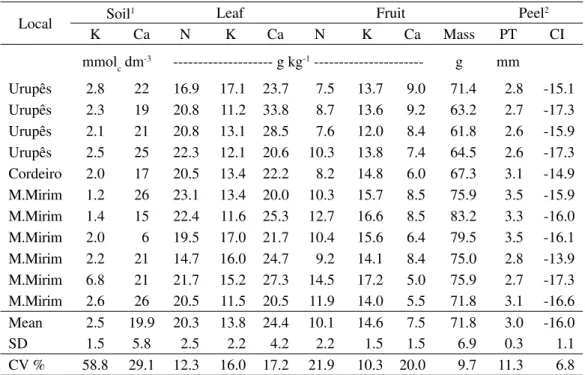
Soil and plant characteristics varied significantly for all sites as a response of local management practices used by growers, which validated the experimental conditions required for the present study (Table 2). Coefficients of variation (CV) were greater for soil Ca and K as mean values ranged from very low (i.e. Ca as measured by soil base saturation – V <26%) to high levels (i.e. exch.-K >3.0 mmolcdm-3)
based on the interpretation of the results of soil chemical analysis for citrus (Raij et al., 1997). Similarly, but to a lesser extent, leaf N, Ca and K concentrations varied from low (i.e. N <17 g kg-1; Ca <35 g kg-1; K ~ 11 g kg-1)
to high levels (i.e. N >22 g kg-1) based on the
preliminarily guidelines for interpretation of leaf analysis for the Tahiti acid lime proposed by Mattos Jr. et al. (2003).
Despite the large variation found for soil
chemical characteristics, there were no clear correlations established among studied variables (Prob. >0.05) (Table 3). Comprehensive on-site records of management practices were not obtained after selecting the studied groves. Therefore, it is expected that high levels of exchangeable-K in soil, for example, could result of recent amendments ap-plication what would turn out as a non-controlled factor intrinsic in this kind of study. From this later, it is possible to attribute that some larger fruits oc-curred during off-season harvests. Thereafter, fruits size varied from medium to large (60-80 g; data for fruit diameter is not shown), which corresponded to classes 48 and 62 according to fruit classifi cation parameters (Gutierrez & Almeida, 2005).
The results also presented a narrow correla-tion between leaf-N and peel color (r = -0.71) dem-onstrating the importance of N nutrition on Tahiti fruit quality (Table 3). This negative correlation is shown because of green color is expressed as a negative index according to the method described. Greener fruits were obtained with leaf-N around 22 g kg -1, level considered adequate to excessive for
the Tahiti (Mattos Jr. et al., 2003). It is important to know that even tough N supply affects yield and quality of fruits and increases total leaf area per tree, fruit surface showing whitish to yellowish green area or areas might occur because of either leaf shading or contact with other fruit on the tree.
Leaf Ca appeared to play an important role on fruit quality during storage because of the negative correlation observed with water loss after 14-day storage at room temperature (r= -0.54), even tough Ca concentration in the fruit did not show the same (Prob. >0.05). Since whole fruits were analyzed, it is possible that nutrient concentrations in the peel (fl a-vedo and albedo), excluding the pulp, could be more meaningful for this discussion. Likewise, Bataglia et al. (1977) found that mean Ca concentration of fruit parts in nine different citrus cultivars was 2.3 times greater in the peel than in the pulp. This later study also reported that Ca concentrations for the Tahiti acid lime were 6.4 g kg-1 in the peel.
correlations between fruit size, as measured by fresh mass (Table 3).
Nitrogen fertilization affects fruit size when fruit set is marked increased in the citrus tree; this relation implies that size of fruit is inversely propor-tional to their number (Spiegel-Roy & Goldschmidt, 1996). On the other hand, K supply has a marked effect on size of fruits, which is accompanied with increased peel : juice content ratio of individual fruits (Mattos Jr. et al., 2004; Quaggio et al., 2002, 2006); this later could explain the positive cor-relation found for size and peel thickness. As fruit size increased, fruit water loss also increased in all studied time intervals (0.75 < r < 0.66) (Table 3); larger fruit surface area of bigger fruits favours rate of water loss during storage.
Correspondently, concentrations of K in the fruit positively correlated with water losses of fruits after 14- and 21-d storage at room temperature (r=0.66 and r= 0.64, respectively). A possible expla-nation for this later relies on the fact that K uptake by citrus is antagonistic to Ca uptake (Mattos Jr. et al., 2004). Because of Ca is important for maintenance of cell wall integrity as discussed before, decreased concentrations of this nutrient in the fruit peel could contribute to increased water losses during storage. Present data did not fully support these
relation-ships; therefore, further studies must be conducted to demonstrate the same.
Citrus fruits can be stored for long periods in modifi ed environment (high relative air humidity and cold temperatures), even tough development of rind disorders still affects their postharvest quality. In our study, mean water loss for fruit stored in the
laboratory for 7 days was 6.3%2.8%, for 14 days
was 11.8%2.8%, and for 21 days was 14.4%3.0%, which were less signifi cant than those reported for fruits in Mexico (Saucedo-Veloz & Medina-Urrutia, 2008). Strong correlations were observed for fruit water loss during the three time intervals studied (0.68<r<0.90) what point out that fruit quality of fruits might be assessed at shorter times.
In summary, soil Ca and K availability in studied sites did not explain variations on quality characteristics of Tahiti acid lime fruits. Concentration of N in the leaves correlated with peel color index, which demonstrated that greater leaf N improved superior green color of fruits, and those of Ca plays an important role in the shelf-life of Tahiti fruits because a negative correlation with fruit water loss during storage at room temperature. On the contrary, concentrations of N and K in the fruits positively correlated with water losses.
TABLE 1 - Characteristics of eleven commercial Tahiti acid lime groves under study located in the São Paulo State, Brazil.
Local Farm Soil order Planting date Scion Rootstock Technology
Urupês Barreirão Oxisol 2000 IAC 5 Rangpur lime conventional/ irrigated
Urupês Barreirão Oxisol 2000 IAC 5 Rangpur lime conventional/ irrigated
Urupês Barreirão Oxisol 2000 IAC 5 Rangpur lime conventional/ irrigated
Urupês Barreirão Oxisol 2000 IAC 5 Rangpur lime conventional/ irrigated
Cordeirópolis CitriculturaCentro de Ultisol 1996 IAC 5 Rangpur lime conventional
Mogi Mirim S. Marcos Oxisol 2001 Quebra-galho Rangpur lime conventional
Mogi Mirim Sta. Cruz Oxisol 2002 Quebra-galho Rangpur lime mixed2
Mogi Mirim Sta. Maria Oxisol nd1 nd nd conventional
Mogi Mirim Lagoa Bonita Oxisol nd nd nd conventional3
Mogi Mirim N.S. Aparecida Ultisol 1999 nd nd organic3
Mogi Mirim N.S. Aparecida Ultisol 2000 nd nd organic
nd = not determined
1 bearing trees >5-yr-old
TABLE 2 - Selected soil nutrient availability indexes and nutrient concentrations in leaves and fruits ob-served in eleven Tahiti acid lime groves in the State of Sao Paulo, Brazil.
Local Leaf Fruit Peel2
K Ca N K Ca N K Ca Mass PT CI
mmolc dm-3 --- g kg-1 --- g mm
Urupês 2.8 22 16.9 17.1 23.7 7.5 13.7 9.0 71.4 2.8 -15.1
Urupês 2.3 19 20.8 11.2 33.8 8.7 13.6 9.2 63.2 2.7 -17.3
Urupês 2.1 21 20.8 13.1 28.5 7.6 12.0 8.4 61.8 2.6 -15.9
Urupês 2.5 25 22.3 12.1 20.6 10.3 13.8 7.4 64.5 2.6 -17.3
Cordeiro 2.0 17 20.5 13.4 22.2 8.2 14.8 6.0 67.3 3.1 -14.9
M.Mirim 1.2 26 23.1 13.4 20.0 10.3 15.7 8.5 75.9 3.5 -15.9
M.Mirim 1.4 15 22.4 11.6 25.3 12.7 16.6 8.5 83.2 3.3 -16.0
M.Mirim 2.0 6 19.5 17.0 21.7 10.4 15.6 6.4 79.5 3.5 -16.1
M.Mirim 2.2 21 14.7 16.0 24.7 9.2 14.1 8.4 75.0 2.8 -13.9
M.Mirim 6.8 21 21.7 15.2 27.3 14.5 17.2 5.0 75.9 2.7 -17.3
M.Mirim 2.6 26 20.5 11.5 20.5 11.9 14.0 5.5 71.8 3.1 -16.6
Mean 2.5 19.9 20.3 13.8 24.4 10.1 14.6 7.5 71.8 3.0 -16.0
SD 1.5 5.8 2.5 2.2 4.2 2.2 1.5 1.5 6.9 0.3 1.1
CV % 58.8 29.1 12.3 16.0 17.2 21.9 10.3 20.0 9.7 11.3 6.8
1 soil nutrient availability (resin extracted)
2 PT = peel thickness; CI = color index (a negative color index indicate green hue, whereas a positive color index indicate orange hue
of peel)
, v
. 32, n. 1, p. 335-342, Março 2010
groves in the State of São Paulo. Brazil. Variable1 K
soil Casoil Nleaf Kleaf Caleaf Nfruit Kfruit Cafruit PT CI Mass WL7 WL14 WL21
Ksoil
-Casoil 0.13ns
-Nleaf 0.02ns 0.12ns
-Kleaf 0.26ns -0.35ns -0.64 *
-Caleaf 0.25ns -0.13ns -0.05ns -0.19ns
-Nfruit 0.53ns -0.01ns 0.44ns -0.16ns -0.13ns
-Kfruit 0.35ns -0.31ns 0.33ns 0.15ns -0.20ns 0.79**
-Cafruit -0.56ns 0.10ns -0.20ns -0.07ns 0.36ns -0.56ns -0.41ns
-PT -0.44ns -0.37ns 0.27ns 0.06ns -0.52ns 0.24ns 0.53ns -0.16ns
-CI -0.39ns -0.11ns -0.71** 0.50ns -0.24ns -0.49ns -0.16ns 0.27ns 0.12ns
-Mass 0.03ns -0.39ns -0.04ns 0.34ns -0.34ns 0.61 * 0.80** -0.16ns 0.65 * 0.20ns
-WL7 0.16ns -0.46ns -0.02ns 0.56ns -0.13ns 0.33ns 0.50ns -0.09ns 0.32ns 0.22ns 0.67 *
-WL14 0.09ns -0.12ns 0.19ns 0.20ns -0.54 * 0.66 * 0.66 * -0.29ns 0.46ns 0.06ns 0.75** 0.69**
-WL21 0.11ns -0.30ns 0.26ns 0.29ns -0.45ns 0.58 * 0.64 * -0.21ns 0.39ns -0.13ns 0.66 * 0.68 * 0.90**
-1soil = nutrient availability (resin extracted); leaf or fruit = total nutrient concentration in the dry matter; PT = peel thickness; CI = peel color index (a negative color index indicate green hue. whereas a
positive color index indicate orange hue of peel); and WL = percent water loss during storage – subscript indicates number of days after fruit harvest
ns = non signifi cant; *. ** = signifi cant at Prob. = 0.05 and 0.01, respectively
SOIL
NUTRIENT
A
V
AILABILITY
AND ITS IMP
ACT
ON FRUIT
REFERENCES
ALVA, A.K.; MATTOS Jr., D.; PARAMASIVAM, S.; PATIL, B.; DOU, H.; SAJWAN, K.S. Potassium management for optimizing citrus production and quality. International Journal of Fruit Science, Binghamton, v.6, n.1, p.3-43, 2006.
BATAGLIA, O.C.; FURLANI, A.M.C.; TEIXEIRA,
J.P.F.; FURLANI; P.R.; GALLO, J.R. Métodos de
análise química de plantas. Campinas: Instituto Agronômico. 1983. 48p. (Boletim Técnico, 78)
BATAGLIA, O.C.; RODRIGUEZ, O.; HIROCE, R.; GALLO, J.R.; FURLANI, P.R.; FURLANI, A.M.C. Composição mineral de frutos cítricos na colheita.
Bragantia, Campinas, v.36, n.21, p.215-221. 1977.
CAMPBELL, C.W.; ORTH, P.G. Effects of tree years of differential nitrogen and potassium application on ‘Tahiti’ lime yield and leaf analysis on Rockdale soil in Florida. Proceedings of the Florida State Horticultural Society, Tallahassee, v.81, p.336-340, 1968.
CANTARELLA, H.; ANDRADE, C.A.; MATTOS Jr., D. Matéria orgânica do solo e disponibilidade de N para as culturas. In: SANTOS, G.A; SILVA, L.S.; CANELLAS, L.P.; CAMARGO, F.A.O. (Ed.).
Fundamentos da matéria orgânica do solo. 2. ed. Porto Alegre: Metrópole, 2008. p.581-895.
DATAFRUTA/SECEX. Instituto Brasileiro de
Frutas. Disponível em: <http://www.ibraf.org.br/ estatisticas/Exportação/Comparativo_das_Exporta-ções_Brasileiras_de_Frutas_frescas_Jan_Out_2008. pdf>. Acesso em: 28 jan. 2009.
GUTIERREZ, A.S.D.; ALMEIDA, G.V.B. Bene-fi ciamento e comercialização de frutos in natura.
In: MATTOS Jr., D.; De NEGRI, J.D.; PIO, R.M.;
POMPEU Jr., J. Citros. Campinas: IAC e Fundag,
2005. p.823-837.
IBGE. Instituto Brasileiro de Geografi a e
Estatís-tica. Banco de dados agregados. Disponível em:
<http://www.sidra.ibge.gov.br/bda/tabela/listabl.asp? c=1613&z=p&o=18>. Acesso em: 28 jan. 2009.
JIMENEZ-CUESTA, M.; CUQUERELLA
CAYUE-LA, J.; MARTINEZ-JAVEGA, J.M. Teoria y
prac-tica de la desverdizacion de los citricos. Madrid: INIA, 1983. 22p. (Hoja Técnica, 46)
MARTÍNEZ-ROMERO, D.; VALERO, D.; SERRA-NO, M.; MARTÍNEZ-SÁNCHEZ, F.; RIQUELME, F. Effects of post-harvest putrescine and calcium treatments on reducing mechanical damage and polyamines and abscisic acid levels during lemon
storage. Journal of the Science of Food and
Agri-culture, London, v.79, n.12, p.1589-1595, 1999.
MATTOS Jr., D.; QUAGGIO, J.A.; CANTARELLA, H. Manejo da fertilidade do solo. In: MATTOS Jr., D.; De NEGRI; J.D.; FIGUEIREDO, J.O. (Ed.).
Lima-ácida Tahiti. Campinas: Instituto Agronômi-co, 2003. p.67-80.
MATTOS Jr., D.; QUAGGIO, J.A.; CANTARELLA, H.; ALVA, A.K. Nutrient content of biomass compo-nents of Hamlin sweet orange trees. Scientia Agri-cola, Piracicaba, v.60, n.1, p.155-160, 2003.
MATTOS Jr., D.; QUAGGIO, J.A.; CANTARELLA, H.; CARVALHO, S.A. Superfícies de resposta do tangor Murcott à fertilização com N, P e K. Revista Brasileira de Fruticultura, Jaboticabal, v.26, n.1, p.164-167, 2004.
PARAMASIVAM, S.; ALVA, A.K.; HOSTLER, K.H.; EASTERWOOD, G.W.; SOUTHWELL, J.S. Fruit nutrient accumulation of four orange varieties
during fruit development. Journal of Plant
Nutri-tion, New York, v.32, n.3, p.313-327, 2000.
PRADO, R.M.; NATALE, W.; SILVA, J.A.A. Lim-ing and quality of guava fruit cultivated in Brazil.
Scientia Horticulturae, Amsterdam, v.106, n.1, p.91-102, 2005.
QUAGGIO, J.A.; CANTARELLA, H.; RAIJ, B. van. Phosphorus and potassium soil test and nitrogen leaf analysis as a basis for citrus fertilization. Nutrient Cycling in Agroecosystems, Dordrecht, v.52, n.1, p.67-74, 1998.
QUAGGIO, J.A.; MATTOS Jr., D.; CANTARELLA, H. Fruit yield and quality of sweet oranges affected by nitrogen, phosphorus, and potassium fertilization in tropical soils. Fruits, Montpellier, v. 61, n. 5, p. 1-10, 2006.
QUAGGIO, J.A.; MATTOS Jr., D.; CANTARELLA, H.; ALMEIDA, E.L.E.; CARDOSO, S.A.B. Lemon yield and fruit quality affected by NPK fertilization.
RAIJ, B. van; ANDRADE, J.C.; CANTARELLA, H.;
QUAGGIO, J.A. Análise química para avaliação
da fertilidade de solos tropicais. Campinas: Insti-tuto Agronômico, 2001. 285p.
RAIJ, B. van; CANTARELLA, H.; QUAGGIO,
J.A.; FURLANI, A.M.C. (Ed.). Recomendações de
adubação e calagem para o Estado de São Paulo. 2.ed. Campinas: Instituto Agronômico e Fundação IAC, 1997. 285p. (Boletim Técnico 100)
SAS Institute. The SAS System - Release 6.12.
Cary: NC, 1996.
SAUCEDO-VELOZ, C.; MEDINA-URRUTIA, V.M. Problemas del manejo postcosecha y comer-cialización de limas ácidas en México. In: NASCI-MENTO, L.M.; De NEGRI, J.D.; MATTOS Jr., D.
Tópicos em qualidade e pós-colheita de frutas. Campinas: IAC e Fundag, 2008. p.203-211.
SILVA, P.R.; FRANCISCO, V.L.F.S.; BAPTIS-TELLA, C.S.L. Caracterização da cultura do limão
no Estado de São Paulo, 2001-2007. Informações
Econômicas, São Paulo, v.38, n.7, p.24-31, 2008.
SPIEGEL-ROY, P.; E.E. GOLDSCHMIDT. Biology
of citrus. Cambridge: Cambridge University Press, 1996. 230p.
TOBIAS, R.B.; CONWAY, W.S.; SAMS, C.E. Cell was composition of calcium-treated apples inocu-lated with Botrytis cinera. Phytochemistry, New
York, v.32, n.1, p.35-39, 1993.
USDA. United States Department of Agriculture.
United States standards for grades of Persian (Tahiti) limes, 1997. 6p.
YOUNG, T.W.; KOO, R.C.J. Effects of nitrogen and potassium fertilization on Persian limes on Lakeland fi ne sand. Proceedings of the Florida State Horticultural Society, Tallahassee, v.80, p.337-342, 1967.