snake communities in Central Brazil?
França, FGR.
a* and Araújo, AFB.
baPrograma de pós-graduação em Ecologia, Departamento de Ecologia, Universidade de Brasília, CEP 70910-900, Brasília, DF, Brazil
bDepartamento de Biologia Animal, Universidade Federal Rural do Rio de Janeiro, CEP 23890-000, Seropédica, RJ, Brazil
*e-mail: [email protected]
Received December 6, 2004 – Accepted March 4, 2005 – Distributed February 28, 2007 (With 4 figures)
Abstract
The main factors that structure Neotropical animal communities have been the subject of discussion in ecology com-munities. We used a set of null models to investigate the existence of structure in snake communities from the Cerrado in Central Brazil in relation to the co-occurrence of species and guilds concerning specific resources. We used frag-ments (conservation units) inside the Distrito Federal and neighbor municipalities. In spite of recent human coloniza-tion in the region from the end of the 1950’s, intense habitat modificacoloniza-tion and fragmentacoloniza-tion has taken place. Sixty three snake species are present in the Distrito Federal. Co-occurrence analysis of species and guilds associated to snake diets and habitats suggested a lack of organization. The homogeneity of habitats in Central Brazil and the minor importance of ecological effects can lead to random arrangement.
Keywords: snakes, Central Brazil, community, null models, Cerrado.
Existem padrões de coocorrência que estruturam
comunidades de serpentes no Brasil Central?
Resumo
Os processos que levam à estruturação de comunidades animais neotropicais têm sido sujeito de ampla discussão em ecologia de comunidades. Usou-se um conjunto de modelos nulos para investigar a existência de estrutura em comu-nidades de serpentes presentes no Cerrado do Brasil Central, em relação à coocorrência de espécies e de guildas rela-cionadas a recursos específicos. As localidades utilizadas para as análises representam fragmentos de habitats dentro do Distrito Federal e em municípios vizinhos. Apesar da recente colonização humana da região, datada para o final da década de 50, a intensidade da modificação e fragmentação dos habitats no Brasil Central têm sido enorme. Sessenta e três espécies de serpentes estão presentes no Distrito Federal. As análises dos padrões de coocorrência tanto para as es-pécies quanto para guildas relativas à dieta e ao uso do ambiente sugeriram ausência de organização. A homogeneidade dos ambientes no Brasil Central e a baixa importância de efeitos ecológicos podem levar ao arranjo randômico.
Palavras-chave: serpentes, Brasil Central, comunidade, modelos nulos, Cerrado.
1. Introduction
Understanding processes responsible for the commu-nity structure is a central problem in commucommu-nity ecology. The topic has been widely debated by many ecologists studying different taxa and biomes (Cody, 1974; Pianka, 1973; Ricklefs and Schluter, 1993). The comparative observation of ecological interactions between species provides a wide range of evidence concerning the im-portance of ecology in community structure (Cody and Diamond, 1975; Losos, 1983; Pianka, 1986; Schoener, 1974). However, few studies have investigated the effect
of isolation on the reptiles’ community structure (Case, 1983; Gainsbury and Colli, 2003; Murphy, 1983).
Human population growth and the consequent imple-mentation and maintenance of a productive infrastruc-ture with the construction of a strucinfrastruc-tured urban area and, mainly, a large rural area of planted pastures and crops, have been the basic factors of fragmentation of natural environments (Sutherland, 2001). Isolation promotes lo-cal colonization and extinctions that influence species interactions. The longer they have been in isolation, the
more susceptible the species are to extinctions (Case and Cody, 1987; Foufopoulos and Ives, 1999). Studies on the effect of the habitat fragmentation on communities of lizards and snakes have registered a positive association between species diversity and patch size (Cosson et al., 1999; Kjoss and Litvaitis, 2001).
The development of null models that yield null com-munities generated by randomization of the original data is a powerful tool for investigating community structure and this analysis has been applied to the study of vari-ous animal groups (Caswell, 1976; Colwell and Winkler, 1984; Connor and Simberloff, 1979; Gainsbury and Colli, 2003; Gotelli, 2000, 2001; Jackson et al., 1992; Pianka, 1980).
Herein we use null models to investigate the exist-ence of structure in snake assemblages of fragments in the Distrito Federal region of Central Brazil. This region has been intensively fragmented since the end of the 50’s due to building Brasília, the new capital, and cities that have grown around it (UNESCO, 2000).
2. Material and Methods
2.1. Study areaThe studied area is an arbitrary circle of 100 km ra-dius around the center of Brasília (15° 47’ S and 47° 52’ W), including all the territory of Distrito Federal and part of neighboring municipalities in adjacent states of Goiás (Luziânia and Alexânia municipalities) and Minas Gerais
(Unaí municipality) covering 31,400 km2 (Figure 1).
The region is located in the core of the Cerrado
mor-phoclimatic domain, which covers about 2 million km2
of the Brazilian territory, mostly on the Central Brazilian plateau (Ab’Saber, 1977). The Distrito Federal region harbors headwaters of important tributaries of the three major Brazilian river basins: the Amazon basin to the north (Tocantins River), the São Francisco basin to the east-northeast, and the Paraná-Plata system to the south-southwest. The climate in the region is type Cwbl
follow-ing Köppen’s classification (RADAM, 1982). Average annual rainfall is 1,600 mm, concentrated from October to April with a dry season from April to October.
Inside the Distrito Federal there are conservation areas of varying status. Two Conservation Units of in-tegral protection (Brasília’s National Park and Águas Emendadas Ecological Station) and the Environmentally Protected Area of Gama and Cabeça de Veado river ba-sins comprise the Cerrados’ Biosphere Reserve, created by UNESCO in 1993.
2.2. Sampling
We used snake inventories from the following ar-eas: inside the Distrito Federal Brasília’s National Park (30,000 ha), Águas Emendadas Ecological Station (10,500 ha), Environmentally Protected Area of Gama e Cabeça de Veado (10,000 ha), Fercal region (approx. 10,000 ha), Núcleo Rural (approx. 10,000 ha). Regions outside the Distrito Federal included the Unaí municipal-ity (25,000 ha), the Luziânia municipalmunicipal-ity (10,000 ha) and the Alexânia municipality (5,000 ha) (Figure 1). The ecological data of the species diet and use of habitat was obtained from previous field work in the region and by ex-amining 1,020 specimens present in the following scien-tific collections: Coleção Herpetológica da Universidade de Brasília (CHUNB), Coleção Herpetológica do Instituto Butantan (IB), Museu Nacional do Rio de Janeiro (MNRJ) and Museu de Zoologia da Universidade de São Paulo (MZUSP).
We used species richness for each area in the Distrito Federal region to test for non-random patterns of species co-occurrence, using EcoSim’s Co-occurrence Module (Gotelli and Entsminger, 2001). The data was organized in a matrix of presence (1) and absence (0), in which each species represents a row and each site a column. We used the following options in EcoSim: C-score in-dex (Stone and Roberts, 1990) as a quantitative co-oc-currence index, fixed sum row and column constraints, “Sequential Swap” algorithm for randomizing matrices, and 10,000 simulations. Gotelli (2000) shows how these parameters act. The C-score is the number of checkboard units for all unique pairs of species and in a structured community should be significantly larger than expected by chance. Using fixed sum row and column constraints produces null matrices with the same number of site oc-currences per species (row totals) and the same number of species per site (column total) as observed in the origi-nal data set. The sequential swap algorithm reshuffles the original matrix by repeatedly swapping sub-matrices that preserve row and column totals and is not prone to Type I or Type II errors (Gainsbury and Colli, 2003; Gotelli and Entsminger, 2001).
We used diet and habitat information to investigate the presence of non-random patterns of guild co-occurrence. We consider habitat as an organism’s general position in the environment. For this, we used the Guild Structure Module in EcoSim (Gotelli and Entsminger, 2001). This module tests a priori hypotheses concerning guilds ac-cording to biologically realistic criteria such as
taxonom-50 45 15 a b c d e f g h 0 100 200 300
Figure 1. Study area: a-h are localities of central Brazil.
a) Brasília’s National Park, b) Águas Emendadas Ecologi-cal Station, c) Environmentally Protected Area of Gama and Cabeça de Veado, d) Fercal region, e) Núcleo Rural, f) Unaí, g) Luziânia and h) Alexânia.
ic groupings (all species within a genus), resource-based groupings (all species that use a particular food resource), and functional groupings (all species with similar mor-phology that exploit a shared resource) (Simberloff and Dayan, 1991). All species in an assemblage are assigned to a guild and each species can only be assigned to one guild. We used Cadle and Greene’s (1993) system to clas-sify snakes in two guilds (diet and habitat). Nine guilds were identified based on prey category: arthropods, earth-worms (‘goo-eaters’), amphibians, lizards, fish and am-phibians (water vertebrates), snakes and amphisbaenas (elongate body vertebrates), mammals and lizards, mam-mals and birds (endothermic vertebrates), and generalists (three or more prey items). Six guilds were identified based on habitat: fossorial, cryptozoic, aquatic, terres-trial, arboreal, and terrestrial plus semi-arboreal.
We used the same options of the co-occurrence anal-ysis on EcoSim: C-score index, fixed sum row and col-umn constraints, and “Sequential Swap” algorithm for randomizing matrices. In these analyses, EcoSim meas-ures the significance patterns of the co-occurrence indi-ces among the different guilds. It tests whether the mean co-occurrence index among guilds is larger or smaller than expected by chance. It also tests the co-occurrence index’s variance among guilds. Unusually large varianc-es imply that guilds are significantly different in levels of co-occurrence: some guilds have species with high levels of co-occurrence, while others have species with low levels of co-occurrence. An unusually small variance means that guilds are similar in levels of co-occurrence. A random result for the variance means that the level of co-occurrence among guilds is as expected if species were randomly assigned to different guilds (Gotelli and Entsminger, 2001).
3. Results
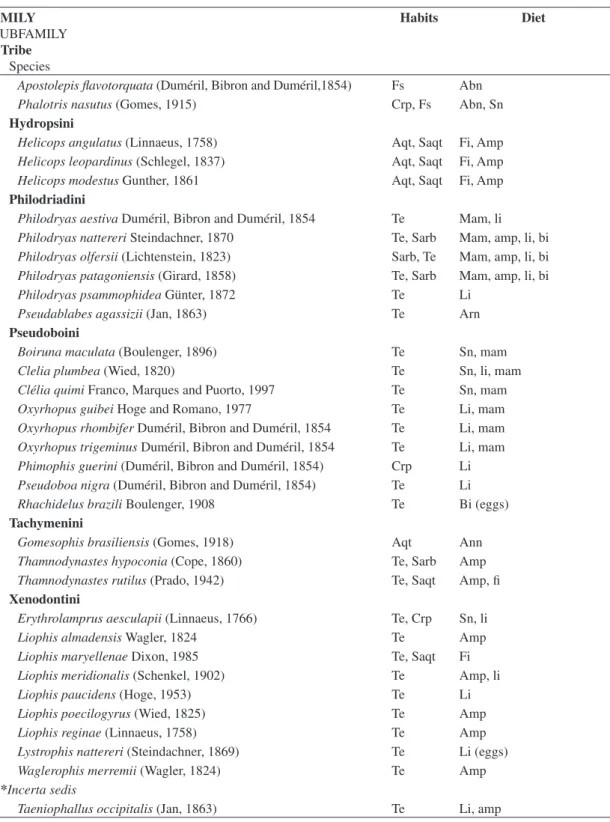
A total of 63 snake species were found in our study site in Central Brazil (Table 1). Among these, Corallus
hortulanus and Imantodes cenchoa were only collect-ed in neighboring cities outside the Distrito Fcollect-ederal. Colubridae was the most diverse family with 51 species distributed into three subfamilies: Colubrinae (10 spp.), Dipsadinae (05) and Xenodontinae (36). Anomalepididae and Leptotyphlopidae presented one species each, and the family of coral-snakes Elapidae has two species in Central Brazil. Both, Boidae and Viperidae presented four species. However, this number is likely to increase for Viperidae, because Bothrops neuwiedi was recently recognized as a complex of different species (Silva, 2004) and this classification scheme was not applied here. Hence, we used the Bothrops neuwiedi Complex for our analysis.
There was a high diversity of natural history charac-teristics in this snake community. Fourteen prey catego-ries were identified, varying from invertebrates, arthro-pods, and mollusks to medium size vertebrates (Table 1). Thirty species have specialized diets, eating only one prey category, while six species are full generalists,
eat-ing five or more categories. Twenty seven species are strictly terrestrial, six are strictly fossorial, and five are strictly cryptozoic. Sixteen species are found in arboreal and semi-arboreal habitats, while six species use aquatic habitats frequently (Table 1).
Out of 63 species present in the entire region, the protected areas of Distrito Federal presented more rich-ness with 45 species in Brasília’s National Park and Environmentally Protected Area of Gama/Cabeça-de-Veado, and 40 species in Águas Emendadas Ecological Station. Other localities varied between 35 species in the Unaí municipality to 23 in the Núcleo Rural, the most disturbed area (Table 2).
The co-occurrence analysis of species richness re-vealed that Liotyphlops ternetzii, Boa constrictor and
Bothrops moojeni formed no checkboard units in the presence-absence matrix. The largest numbers of check-board units was (15) between Micrurus lemniscatus and Oxyrhopus rhombifer, and (12) observed between
Drymarchon corais and Atractus pantostictus, and be-tween Atractus pantostictus and Boiruna maculata. The observed C-score index was 1.15, and was not significant (1.17; P = 0.89, Figure 2). These results are consistent with the hypothesis that local coexistence of snake spe-cies in Central Brazil is not structured by deterministic processes.
The analysis of nonrandom patterns of guilds co-occurrence showed similar results. For guilds based on prey categories, the C-score index for each guild varied from 0 for mammal and bird prey guilds to 2.4 for lizard-only prey guild. The index measured between all guilds (1.18) did not differ from the null assemblages mean index (1.15; P = 0.40, Figure 3), and the observed vari-ance of the co-occurrence index among guilds (0.59) did not differ from the simulated variance by chance (0.96;
P = 0.69, Figure 3). For guilds based on snake habitat,
C-score index for each guild varied from 0 for terrestrial
and semi-arboreal snake guild to 1.9 for the aquatic snake guild. The index measured between all guilds (1.19) did not differ from the null assemblage mean index (1.15; P = 0.41, Figure 4), and the observed variance of the co-occurrence index among guilds (0.42) did not differ from the simulated variance by chance (0.57; P = 0.65, Figure 4).
4. Discussion
Snake species richness in Central Brazil is high compared to other Cerrado localities and even other bi-omes, such as the Atlantic Forest and Amazon localities. The presence of a high number of species in protected areas of Distrito Federal representing almost all spe-cies present in Central Brazil (lacking only Apostolepis
flavotorquata, Chironius exoletus, Corallus hortulanus,
Drymoluber brazili, and Imantodes cenchoa) has impor-tant implications for local snake conservation. All five snakes absent in the protected areas are rare throughout the entire region, with a small number of specimens col-lected, but are likely to be better represented in these
Table 1. Summary of information of the natural history of snakes in the Distrito Federal, Brazil. Abbreviations of diet are:
abn = amphisbaenian, amp = amphibian, ann = annelids, arn = aranae, bi = birds, ch = chilopoda, cro = crocodylians, fi = fish, gas = gastropode, ins = insecta, li = lizards, mam = mammals, mi = millipede, sn = snakes. Abbreviations of habits are: Arbo-real = Arb, Aquatic = Aqt, Criptozoic = Crp, Fossorial = Fs, Terrestrial = Te, Semi-arboArbo-real = Sarb, Semi-aquatic = Saqt.
FAMILY SUBFAMILY Tribe Species Habits Diet ANOMALEPIDIDAE
Liotyphlops ternetzii (Boulenger, 1896) Fs Ins LEPTOTYPHLOPIDAE
Leptotyphlops fuliginosus Amaral, 1955 Fs Ins BOIDAE
Boa constrictor Linnaeus 1758 Te, Sarb Mam., bi
Coralus hortullanus Linnaeus 1758 Arb, Sarb Mam., bi, li
Epicrates cenchria Linnaeus 1758 Te, Sarb Mam., bi, li
Eunectes murinus (Linnaeus, 1758) Saqt Mam, bi, fi, li, sn, cro VIPERIDAE
Bothrops itapetiningae (Boulenger, 1907) Te Mam, li, amp, bi, mi, ch
Bothrops moojeni Hoge, 1966 Te Mam, li, amp, bi, sn, mi, ch
Bothrops neuwiedi Wagler, 1824 Te Mam, li, amp, bi, sn, mi, ch
Crotalus durissus Linnaeus, 1758 Te Mam, bi
ELAPIDAE
Micrurus frontalis (Duméril, Bibron and Duméril, 1854) Crp Sn, abn
Micrurus lemniscatus (Linnaeus, 1758) Crp Sn COLUBRIDAE
COLUBRINAE
Chironius exoletus (Linnaeus, 1758) Arb, Te Amp, li, bi, mam
Chironius flavolineatus (Boettger, 1885) Arb, Te Amp, li, bi, mam
Chironius quadricarinatus (Boie, 1827) Arb, Te Amp, li, bi, mam
Drymarchon corais (Boie, 1827) Te, Sarb Mam, amp, li, bi, sn, abn
Drymoluber brazili (Gomes, 1918) Te Li
Mastigodryas bifossatus (Raddi, 1820) Te Mam, amp, li, bi, sn, abn
Oxybelis aeneus (Wagler, 1824) Arb, Sarb Amp, li, bi, mam
Simophis rhinostoma (Schlegel, 1837) Te Amp
Spilotes pullatus (Linnaeus, 1758) Arb, Sarb Bi, mam
Tantilla melanocephala (Linnaeus, 1758) Fs, Crp Ch DIPSADINAE
Dipsadini
Atractus pantostictus Fernandes and Puorto, 1993 Crp Ann
Sibynomorphus mikanii (Schlegel, 1837) Te, Sarb Gas Leptoderini
Leptodeira annulata (Linnaeus, 1758) Arb, Sarb Amp
Imantodes cenchoa (Linnaeus, 1758) *Incerta sedis
Xenopholis undulatus (Jensen, 1900) Crp Amp
XENODONTINAE Elapomorphini
Apostolepis assimilis (Reinhardt, 1861) Fs Abn
Apostolepis gr. tenuis Fs Abn
FAMILY SUBFAMILY
Tribe Species
Habits Diet
Apostolepis flavotorquata (Duméril, Bibron and Duméril,1854) Fs Abn
Phalotris nasutus (Gomes, 1915) Crp, Fs Abn, Sn Hydropsini
Helicops angulatus (Linnaeus, 1758) Aqt, Saqt Fi, Amp
Helicops leopardinus (Schlegel, 1837) Aqt, Saqt Fi, Amp
Helicops modestus Gunther, 1861 Aqt, Saqt Fi, Amp Philodriadini
Philodryas aestiva Duméril, Bibron and Duméril, 1854 Te Mam, li
Philodryas nattereri Steindachner, 1870 Te, Sarb Mam, amp, li, bi
Philodryas olfersii (Lichtenstein, 1823) Sarb, Te Mam, amp, li, bi
Philodryas patagoniensis (Girard, 1858) Te, Sarb Mam, amp, li, bi
Philodryas psammophidea Günter, 1872 Te Li
Pseudablabes agassizii (Jan, 1863) Te Arn
Pseudoboini
Boiruna maculata (Boulenger, 1896) Te Sn, mam
Clelia plumbea (Wied, 1820) Te Sn, li, mam
Clélia quimi Franco, Marques and Puorto, 1997 Te Sn, mam
Oxyrhopus guibei Hoge and Romano, 1977 Te Li, mam
Oxyrhopus rhombifer Duméril, Bibron and Duméril, 1854 Te Li, mam
Oxyrhopus trigeminus Duméril, Bibron and Duméril, 1854 Te Li, mam
Phimophis guerini (Duméril, Bibron and Duméril, 1854) Crp Li
Pseudoboa nigra (Duméril, Bibron and Duméril, 1854) Te Li
Rhachidelus brazili Boulenger, 1908 Te Bi (eggs) Tachymenini
Gomesophis brasiliensis (Gomes, 1918) Aqt Ann
Thamnodynastes hypoconia (Cope, 1860) Te, Sarb Amp
Thamnodynastes rutilus (Prado, 1942) Te, Saqt Amp, fi Xenodontini
Erythrolamprus aesculapii (Linnaeus, 1766) Te, Crp Sn, li
Liophis almadensis Wagler, 1824 Te Amp
Liophis maryellenae Dixon, 1985 Te, Saqt Fi
Liophis meridionalis (Schenkel, 1902) Te Amp, li
Liophis paucidens (Hoge, 1953) Te Li
Liophis poecilogyrus (Wied, 1825) Te Amp
Liophis reginae (Linnaeus, 1758) Te Amp
Lystrophis nattereri (Steindachner, 1869) Te Li (eggs)
Waglerophis merremii (Wagler, 1824) Te Amp
*Incerta sedis
Taeniophallus occipitalis (Jan, 1863) Te Li, amp areas as more inventories and studies are made in the
region. The small numbers of species from the Núcleo Rural, however, can be a result of rapid loss of a high number of species in disturbed areas.
Co-occurrence analysis indicated no specific pat-terns of coexistence for species or guilds, showing no
structure in the snake community in Central Brazil. The coexistence of species can be limited by negative ecological interactions such as interspecific competition, competition for habitats in the past, species that evolved distinct habitat preferences, and predator-prey relation-ships (Connor and Simberloff, 1979; Gotelli et al., 1997;
Table 2. Species occurrence in eight localities of central Brazil.
Species PNB ESECAE APAGCV Unaí Luziânia Fercal NRural Alexânia
Apostolepis albicolaris 0 0 1 0 1 0 0 1 Apostolepis assimilis 1 1 1 1 1 1 1 1 Apostolepis flavotorquata 0 0 0 0 0 0 0 1 Apostolepis gr. tenuis. 1 0 1 0 1 1 0 0 Atractus pantostictus 1 0 1 0 0 0 1 0 Boa constrictor 1 1 1 1 1 1 1 1 Boiruna maculata 1 1 1 0 1 0 0 0 Bothrops itapetiningae 1 0 1 0 0 0 1 0 Bothrops moojeni 1 1 1 1 1 1 1 1
Bothrops neuwiedi complex 1 1 1 1 1 1 1 1
Chironius exoletus 0 0 0 0 1 1 0 0 Chironius flavolineatus 1 1 1 0 0 1 1 0 Chironius quadricarinatus 1 1 1 1 1 1 0 1 Clelia plumbea 1 0 0 0 0 0 0 0 Clelia quimi 1 1 1 0 0 0 0 0 Corallus hortulanus 0 0 0 1 0 0 0 0 Crotalus durissus 1 1 1 1 1 1 1 1 Drymarchon corais 1 0 0 1 1 0 0 1 Drymoluber brazili 0 0 0 0 0 1 0 0 Epicrates cenchria 1 1 1 1 1 1 1 1 Erythrolamprus aesculapii 1 1 1 1 0 1 0 1 Eunectes murinus 0 1 0 1 0 0 0 0 Gomesophis brasiliensis 0 1 0 0 0 0 0 0 Helicops angulatus 1 0 0 0 0 1 0 0 Helicops leopardinus 0 0 1 0 0 0 0 0 Helicops modestus 1 1 1 0 1 0 1 0 Imantodes cenchoa 0 0 0 1 0 0 0 0 Leptodeira annulata 1 0 0 1 0 1 0 1 Leptotyphlops fuliginosus 1 0 0 1 0 0 0 0 Liophis almadensis 1 0 1 0 1 0 0 1 Liophis maryelenae 1 1 0 0 0 0 0 1 Liophis meridionalis 1 1 0 0 0 0 0 0 Liophis paucidens 0 0 1 0 0 0 0 0 Liophis poecilogyrus 1 1 1 1 1 1 1 1 Liophis reginae 1 1 1 1 1 1 1 1 Liotyphlops ternetizii 1 1 1 1 1 1 1 1 Lystrophis nattereri 1 0 1 1 0 1 0 0 Mastigodryas bifossatus 1 1 1 1 1 0 0 1 Micrurus frontalis 1 1 1 1 1 1 1 1 Micrurus lemniscatus 1 1 1 1 0 0 1 0 Oxybelis aeneus 0 1 0 0 0 0 0 0 Oxyrhopus guibei 1 1 1 1 1 1 1 1 Oxyrhopus rhombifer 1 1 1 1 1 1 1 1 Oxyrhopus trigeminus 0 0 1 1 0 0 0 1 Phalotris nasutus 1 1 1 1 0 0 0 0 Philodryas aestiva 0 1 1 1 0 0 0 0 Philodryas nattereri 1 1 1 1 1 1 1 1 Philodryas olfersii 1 1 1 1 1 1 1 1 Philodryas patagoniensis 1 1 1 1 1 1 1 1 Philodryas psamophidea 0 0 1 0 0 0 0 0 Phimophis guerini 0 0 1 0 1 0 0 0 Pseudablabes agassizii 1 1 1 1 1 1 0 0 Pseudoboa nigra 0 1 0 1 0 1 0 0 Rachidelus brazili 0 0 1 0 0 1 0 1 Sibynomorphus mikanii 1 1 1 1 1 1 1 1 Simophis rhynostoma 1 0 0 0 1 0 1 0 Spilotes pullatus 1 1 1 1 1 1 0 1 Taeniophallus occipitalis 1 1 1 0 0 0 0 0 Tantilla melanocephala 1 1 1 0 0 0 0 0 Thamnodynastes hypoconia 1 1 1 0 0 1 0 0 Thamnodynastes rutilus 0 1 0 0 0 0 0 0 Waglerophis merremii 1 1 1 1 1 1 1 1 Xenopholis undulatus 1 1 1 1 1 1 0 0 45 40 45 35 31 32 23 29
2000 1500 1000 500 0 0.6 0.8 1.0 1.2 1.4 1.6 1.8 Simulation frequencies
Simulation means snake habitat 2500 2000 1500 1000 500 0 Simulation frequencies 1.14 1.16 1.18 1.20 1.22 C-score 1 0 0 2 3 4 3500 3000 2500 1500 1000 500 2000
Simulation means of snake habitat
Simulation frequencies 2000 1500 1000 500 0 0.6 0.8 1.0 1.2 1.4 1.6 1.8 2.0 2.2 Simulation frequencies
Simulation means snake diet
4000 3000 2000 1000 0 2 4 6 8
Simulation means of snakes diet
Simulation frequencies
Figure 2. Frequency distribution of checkboard C-scores,
obtained from 10,000 simulations producing random snake communities from Central Brazil. Arrow indicates observed mean; P is the probability that the observed mean is larger than the expected mean.
Figure 3. Frequency distribution of checkboard C-scores
and variance, obtained from 10,000 simulations producing random snakes guild of diet from Central Brazil. Arrow in-dicates observed mean; P is the probability that the observed mean is larger than the expected mean.
Figure 4. Frequency distribution of checkboard C-scores
and variance, obtained from 10,000 simulations producing random snakes guild of habits from Central Brazil. Arrow indicates observed mean; P is the probability that the ob-served mean is larger than the expected mean.
Jackson et al., 1992). The importance of these ecologi-cal factors is recognized in communities with sympatric species that had great abundance. In Central Brazil, even more abundant snake species such as Bothrops moojeni,
Crotalus durissus, Liophis poecilogyrus, Philodryas
nat-tereri and Philodryas patagoniensis are not present in high densities. This low abundance, plus low metabolism rates, that are characteristics for snakes (Greene, 1997), can minimize these ecological factors. Considering the
low importance of the negative ecological interactions, the possibility that all 63 snake species occupy the sites of Central Brazil cerrados is equivalent, resulting in a random arrangement of the species.
Nonrandom resource distribution can also influence species coexistence by causing species composition to vary nonrandomly (Case, 1983; Stone and Roberts, 1990). Hence, species presence can be related to habitat specificity and limited resources would increase species competition (Connor and Simberloff, 1979). All locali-ties in Central Brazil present the same Cerrado habitats and only small local differences can be detected, such as the mesophytic dry forests patches in Fercal and buriti palm marshes in Águas Emendadas Ecological Station. However, the intense habitat loss can lead to modifica-tion in the landscape and can influence the relamodifica-tions be-tween the species.
Acknowledgments — We would like to thank Adrian Garda, Renato Gomes Faria and Vívian Braz for their valuable comments on a previous version of the manuscript and for help in English. This work was supported by a master’s fellowship from CNPq to FGRF.
References
AB’SABER, AN., 1977. Os domínios morfoclimáticos da América do Sul. Primeira aproximação. Geomorfologia, vol. 52, p. 1-21.
CADLE, JE. and GREENE, HW.. 1993. Phylogenetic patterns, biogeography, and the ecological structure of Neotropical snake assemblages, In: RICKLEFS, RE. and SCHLUTER, D. (eds.), Species diversity in ecological communities: historical and geographical perspectives. University of Chicago Press, Chicago, p. 281-293.
CASE, TJ., 1983. The reptiles: Ecology. In: CASE, TJ. and CODY, ML. (eds.), Island biogeography in the Sea of Cortéz. University of California Press, Berkeley, California., p. 159-209 CASE, TJ. and CODY, ML., 1987. Testing theories of island biogeography. Am. Sci., vol. 75, no. 4, p. 402-411.
CASWELL, H., 1976. Community structure: a neutral model analysis. Ecol. Monogr., vol. 46, no. 3, p. 327-354.
CODY, ML., 1974. Competition and the structure of bird communities, Princeton University Press, Princeton, New Jersey, 318p.
CODY, ML. and DIAMOND, JM., 1975. Ecology and Evolution of Communities, Harvard University Press, Cambridge, 545p. COLWELL, RK. and WINKLER, DW. 1984. A null model for null models in biogeography. In SIMBERLOFF, D., ABELE LG. and THISTLE, AB. (eds.) Ecological Communities: Conceptual Issues and the Evidence, Princeton University Press, Princeton, New Jersey, p. 344-359,
CONNOR, EF. and SIMBERLOFF, D., 1979. The assembly of species communities: Chance or competition. Ecology, vol. 60, p. 1132-1140.
COSSON, JF., RINGUET, S., CLAESSENS, O., DE MASSARY, JC., DALECKY, A., VILLIERS, JF., GRANJON, L. and PONS, JM., 1999. Ecological changes in recent land-bridge islands in French Guiana, with emphasis on vertebrate communities. Biol. Conserv., vol. 98, no. 2, p. 285-292.
FOUFOPOULOS, J. and IVES, AR., 1999. Reptile extinctions on land-bridge islands: Life-history attributes and vulnerability to extinction. Am. Nat., vol. 153, no. 1, p. 1-25.
GAINSBURY, AM. and COLLI, GR., 2003. Lizard Assemblages from Natural Cerrado Enclaves in Southwestern Amazonia: The Role of Stochastic Extinctions and Isolation. Biotropica, vol. 35, no. 4, p. 503-519.
GOTELLI, NJ., 2000. Null model analysis of species co-occurrence patterns. Ecology, vol. 81, no. 9, p. 2606-2621. -, 2001. Research frontiers in null model analysis. Global Ecol. & Biogeogr., vol. 10, p. 337-343.
GOTELLI, NJ., BUCKLEY, NJ. and WIENS, JA., 1997. Co-occurrence of Australian land birds: Diamond’s assembly rules revisited. Oikos, vol. 80, no. 2, p. 311-324.
GOTELLI, NJ. and ENTSMINGER, GL. 2001. EcoSim: Null Models Software for Ecology. Acquired Intelligence Inc. and
Kesey-Bear. Jericho, VT 05465. http://garyentsminger.com/ ecosim
GREENE, HW. 1997. Snakes: the evolution of mystery in nature. University of California Press, California, 351 p. JACKSON, DA., SOMERS, KM. and HARVEY, HH., 1992. Null models and fish communities: Evidence of nonrandom patterns. Am. Nat., vol. 139, no. 5, p. 930-951.
KJOSS, VA. and LITVAITIS, JA., 2001. Community structure of snakes in a human-dominated landscape. Biol. Conserv., vol. 98, no. 3, p. 285-292.
LOSOS, JB. 1983. Historical contingency and lizard community ecology. In HUEY, RB., PIANKA, ER. and SCHOENER, TW. (eds.), Lizard Ecology: Studies of a model organism, Harvard University Press, Cambridge, p. 319-333
MURPHY, RW. 1983. The reptiles: Origins and evolution. In CASE, TJ. and CODY, ML. (eds.), Island biogeography in the Sea of Cortéz. University of California Press, Berkeley, California, p. 130-158.
PIANKA, ER., 1973. The structure of lizard communities. Annu. Rev. Ecol. Syst., vol. 4, p. 53-74.
-, 1980. Guild structure in desert lizards. Oikos, vol. 35, p. 194-201.
-, 1986. Ecology and Natural History of Desert Lizards. Princeton University Press, Princeton, New Jersey.
RADAM. 1982. Projeto RadamBrasil - levantamento de recursos naturais. Folha SD. 23, Brasília, vol. 29,
RICKLEFS, RE. and SCHLUTER, D., 1993. Species diversity in ecological communities: historical and geographical perspectives. University of Chicago Press, Chicago, 416p. SCHOENER, TW., 1974. Resource partitioning in ecological communities. Science, vol. 185, p. 27-39.
SILVA, VX., 2004. The Bothrops neuwiedi Complex, In CAMPBELL, JA. and LAMAR, WW. (eds.), The Venomous Reptiles of the Western Hemisphere. Comstock Publishing Associates, California, p. 410-422.
SIMBERLOFF, D. and DAYAN, T., 1991. The Guild concept and the structure of ecological communities. Annu. Rev. Ecol. Syst, vol. 22, p. 115-143.
STONE, L. and ROBERTS, A., 1990. The checkboard score and species distributions. Oecologia, vol. 85, no. 1, p. 74-79. SUTHERLAND, WJ.. 2001. The Conservation Handbook: research, management and policy. Iowa State University Press, Iowa, 278p.
UNESCO., 2000. Vegetação no Distrito Federal - tempo e espaço. Brasília, Brasil, 74p.