Vol.57, n.1: pp. 62-69, January-February 2014
ISSN 1516-8913 Printed in Brazil BRAZILIAN ARCHIVES OF
BIOLOGY AND TECHNOLOGY
A N I N T E R N A T I O N A L J O U R N A L
Isolation of New Steroids of Kala Dhaman Grass (
Cenchrus
setigerus
) and Evaluation of Their Bioactivity
Premlata Singariya
1*, Padma Kumar
1and Krishan Kumar Mourya
21Laboratory of Tissue Culture and Secondary Metabolites; Department of Botany; University of Rajasthan; Jaipur. 2
Veterinary Hospital; Pahari (Bharatpur); Rajasthan - India
ABSTRACT
The present study was carried out to determine the possible bioactive components (steroids) of Cenchrus setigerus
using GC-MS analysis and in vivo estimation of metabolites (total soluble sugar, soluble protein, proline and total phenolics), photosynthetic pigments (chlorophyll-a, chlorophyll-b and carotenoids) of seedlings and antimicrobial activity of extracts in various polar solvents from the leaves of C. setigerus. Antimicrobial activity was evaluated against three Gram-negative bacteria, including Proteusmirabilis, Klebsiella pneumonia and Agrobacterium tumefaciens andone fungus Aspergillus niger using ‘disc diffusion’ method, followed by the determination of minimum inhibitory concentrations (MIC) by broth dilution method. Results revealed the presence of some steroids in the isopropyl alcohol extract of C. setigerus:which are (22E)-stigmasta-4,22-dien-3-one(4.93%), δ 4-sitosterol-3-one (stigmast-4-en-3-4-sitosterol-3-one) (4.31%), fagarsterol (lupeol) (1.25%) and ethyl iso-allocholate (0.32%). Total soluble sugars and chlorophyll-a were also recorded to be highest. The highest activity was exhibited by the isopropyl alcohol and ethyl acetate extract against P. mirabilis.
Key words: Cenchrus grass, photosynthetic pigments, total soluble sugar, proline; Antibacterial activity, MIC,
MBC/MFC
*Author for correspondence: [email protected]
INTRODUCTION
The chemical analysis of isopropyl alcohol extract
of Cenchrus setigerus showed a mixture of
long-chain hydrocarbons, carboxyl esters, alcohols, acids, alkaloids, steroids, amino and nitro compound etc. Phytochemical screening using the pharmacognostic methods revealed the presence of flavonoids, steroids and alkaloids. Taking into consideration of the medicinal importance of this plant, the isopropyl alcohol extract of C. setigerus was analyzed for the first time using GC–MS following the method of Hema et al. 2010. This work will help to identify the compounds (steroids) of therapeutic value. GC–MS is the best
technique to identify the bioactive constituents of long chain hydrocarbons, alcohols, acids, ester, alkaloids, steroids, amino and nitro compounds, etc. (Amakrishnan 2011).
C4 grasses have gained attention in various field of
research, as they are best suited to the present
environmental conditions. They are more
1996). However, C. setigerus is most suitable and highly nutritive grass for desert environmental conditions; still no antimicrobial studies have so far been done for this grass.
Carotenoids act as accessory light-harvesting pigments as well as for the protection of
chloroplasts from light mediated stress
(Siefermann-Harms 1987). Proline has been reported to protect protein structure and membrane from damage and to reduce the enzyme denaturation (Rajendra kumar et al.1994). Alternatively, proline accumulation has also been proposed for nitrogen storage (Larcher 1995). Antimicrobial resistance developing in pathogens towards antibodies has leads to treatment failure and necessitates the search for new antimicrobials (Otimentin et al. 2008). Plants derived compounds contribute a lot in fight against pathogens (Vyvyan 2002). Various plant extracts can serve both as potential antimicrobial crude drugs as well as a source of new anti-infective agents (Rios, 2005). The aim of the present study was to investigate the possible bioactive components of C. setigerus using GC-MS analysis and in vivo estimation of metabolites (total soluble sugar, soluble protein, proline and total phenolics), photosynthetic pigments (chlorophyll-a, chlorophyll-b and carotenoids) of seedlings and antimicrobial activity of the extracts in various polar solvents from the leaves of C. setigerus against important pathogenic microbes.
MATERIALS AND METHODS
Experimental design:
Identification of Components
Analysis of extracts was performed using a GC-MS (Model; QP 2010 series, Shimadzu, Tokyo, Japan) equipped with a VF-5 ms fused silica capillary column of 60 m length, 0.25 mm dia. and 0.25 mm film thickness; injection mode: split; flow control mode: linear velocity; pressure: 173.3 kPa; linear velocity: 28.9 cm/sec; purge flow: 3.0 mL/min; split ratio: 10.0. For GC-MS detection [GC-2010], an electron ionization system with ionization energy of 70 eV was used. Helium gas (99.99%) was used as a carrier gas at a constant flow rate- total flow: 16.3 mL/min. and column flow: 1.21 mL/min. injector and mass transfer line temperature were set at 200 and 240°C,
respectively. The oven temperature was
programmed (column oven temp.: 100°C and
injection temp.: 270°C) from 70 to 220°C at 10°C/min, held isothermal for 1min and finally raised to 300°C at the rate of 10°C/min. A 2.0 m L of respective diluted samples were manually injected in the split less mode, with split ratio of 1:40 and with mass scan of 50-600 amu. Total running time of GC-MS was 48 min.
The relative amount of each component was calculated by comparing its average peak area to the total areas, software adopted to handle mass spectra and chromatograms was a Turbo mass. The relative percentage of the each extract constituents was expressed as percentage with peak area normalization. Interpretation on mass spectrum of GC-MS was done using the database of National Institute of Standard Technology (NIST) having more than 62,000 patterns. The mass spectrum of the unknown component was compared with the spectrum of the known components stored in the NIST library. The name, molecular weight and structure of the components
of the test materials were ascertained
(Muthulakshmi et al. 2012).
Photosynthetic pigments and metabolite: In-vivo studies
For in vivo studies, seeds of C. setigerus
(CAZRI-76) were grown in 12” earthen-ware pots. Pots were filled with 8 kg of a mixture of garden soil and goat manure in the ratio of 3:1 and were watered every day. After two weeks of sowing, thinning was done and 3-4 plants of uniform size were selected in each pot. Leaf samples were collected for the biochemical analysis (Singariya et al. 2009).
Preparationofextract
All the operations for preparing the extracts were performed at 4°C. Plant material (in vivo-leaves) were homogenized using appropriate buffer in pre-chilled pestle mortar and centrifuged at 10,000 rpm for 20 min. The supernatant collected was used for all the metabolites estimation.
Estimation of soluble protein
Soluble proteins were estimated by the method of Bradford (1976). This involved the binding of Coomassie Brilliant Blue G-250 (CBB-G-250) to the proteins.
Estimation of proline
made to react with ninhydrin in acidic conditions to form the chromophore (red colour), which was read at 520 nm.
Estimation of total soluble sugars
Total soluble sugars were estimated in accordance with Mc-Ready et al. (1950) method.
Total Phenolics
The phenols in the extracts were determined according to Folin -Ciocalteu procedure (Singleton and Rossi 1995).
Photosynthetic pigments
The leaves (500 mg) were homogenized in 5.0 mL of 80% acetone, centrifuged for 20 min at 10,000 rpm and the supernatant was used for the estimation of photosynthetic pigments. The absorbance was recorded at 663, 645 and 470 nm against 80% acetone as blank. Arnon’s (1949) method was used for the calculation of chlorophyll content.
Antimicrobial Activity Plant material
The seeds of C. setigerus (variety: CAZRI-358) were collected in the month of August 2009 from the CAZRI, Jodhpur, Rajasthan. The collected plant materials were transferred immediately to the laboratory, cleaned with water. The selected plant parts were separately shade dried until constant weight. Shade dried parts were powdered with the help of grinder (Hussain et al. 2010).
Preparation of extracts
Crude extracts of the seeds of C. setigerus were prepared with a series of non- polar to polar solvents by hot extraction method (Harborne 1984) in Soxhlet assembly. Different extracts were then screened for their antimicrobial activity by ‘Disc Diffusion Assay’ (Singariya et al. 2012a) against a few medically important bacteria and fungi. The fraction showing best activity was then used for determining the MIC by broth dilution method (Singariya et al. 2011b) and minimum bactericidal/fungicidal concentration (MBC/MFC).
Micro-organisms
The organisms used in the study were three Gram-negative bacteria viz., Proteus mirabilis (MTCC-3310), Klebsiella pneumoniae (MTCC-4030),
Agrobacterium tumefaciens (MTCC-431) and one
fungus, Aspergillus niger (MTCC-282). Selected
microorganisms were procured from IMTECH, Chandigarh, India.
Maintenance of test pathogens culture and Disc diffusion assay
The bacterial strains were grown and maintained on Nutrient Agar (NA) medium, while fungus was maintained on Sabouraud Dextrose Agar (SDA) medium. Disc diffusion assay (DDA) was performed for screening by the standard method (Singariya et al. 2011c). NA and SDA plates were seeded with the bacterial and fungal inoculum, respectively using the inoculum size of 1×10⁸ CFU/mL for the bacteria and 1×10⁷ cell/mL for the fungus. Sterile filters paper discs (Whatman no. 1, 5 mm in diameter) were impregnated with 100 µL of each of the extract (10 mg/mL) to give a final concentration of 1 mg/disc and dried in vacuum so as to remove the residual solvent. Extract discs were then placed on the seeded agar plates. Each extract was tested in triplicate along with gentamycin (10 mcg/disc) and ketoconazole (10 mcg/disc) as the standard for bacteria and fungi, respectively. The plates were kept at 4°C for 1 h for the diffusion of extract, thereafter were incubated at 37°C for bacteria (24 h) and 27°C for fungi (48 h). The inhibition zones were measured and compared with the standard reference antibiotics. Activity index for each extract was calculated by the formula.
Serial dilution method
The MIC was determined as the least extract concentration, which inhibited the growth of the test organisms (Jain and Sharma 2009; Singariya et al. 2012d). The bacterial and fungal suspensions were used as negative control, while broth containing standard drug was used as positive control.
Determination of Minimum bactericidal/
fungicidal concentration (MBC/MFC)
incubated for 24 h. The highest dilution that yielded no single bacterial colony was taken as the MBC (Singariya et al. 2012b).
Total activity (TA) determination
Total activity is the volume at which the test extract can be diluted with the ability to kill the microorganisms. It is calculated by dividing the amount of extract from 1.0 g plant material by the MIC of the same extract, or the compound isolated and expressed in mL/g (Singariya et al. 2012c).
RESULTS AND DISCUSSION
GC-MS analysis
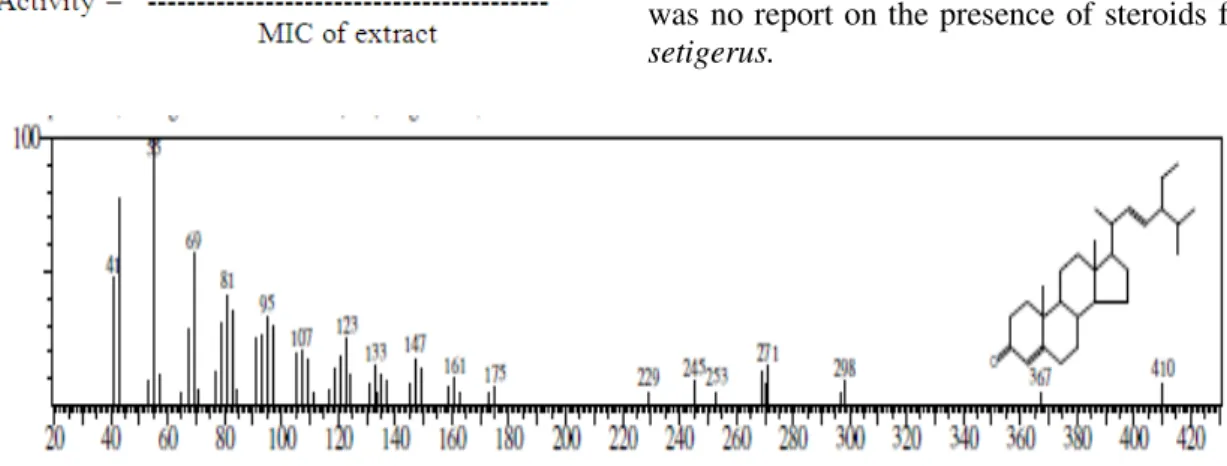
GC-MS results revealed following steroids (22E)-stigmasta-4,22-dien-3-one(4.93% retention time-37.32 min and area-197485) (Fig. 1), δ 4-sitosterol-3-one (stigmast-4-en-4-sitosterol-3-one) (4.31% retention time-38.795 min and area-1725255) (Fig. 2), fagarsterol (lupeol) (1.25% retention time-36.943 min. and area-500335) (Fig. 3), which has been used as anti-cancer drug and ethyl iso-allocholate (0.17% retention time-39.707 min and area-66937) (Fig. 4), which has antimicrobial, diuretic and anti-inflammatory activity. However, till-date there was no report on the presence of steroids from C. setigerus.
Figure 1 - Mass Spectrum of 4,22-Stigmastadiene-3-one (RT- 37.325 min.).
Figure 2 - Mass Spectrum of Delta.4-Sitosterol-3-one (RT - 38.795 min.)
Figure 4 - Mass Spectrum of Ethyl iso-allocholate (RT- 39.707 min.).
Photosynthetic pigments and metabolite Metabolites
In vivo study of C. setigerus showed highest total
soluble sugars (20.43 ± 0.143 mg/g F. wt.), followed by total phenolics (12.125 ± 0.145 mg/g F. wt.) among all the metabolites and proline was recorded as 0.089 ± 0.013 m mol/g F. wt. (Table 1).
Table 1 - Different metabolites of Cenchrus setigerus.
S. No. Metabolites Cenchrus setigerus (
In-vivo)
1 Soluble Protein 11.42±0.143 mg/g F. wt.
2 Total Soluble Sugar 20.43±0.143 mg/g F. wt.
3 Proline 0.089±0.013* m mol/g F. wt.
4 Total Phenolics 12.125±0.145 mg/g F. wt.
*SD value X10-3
Photosynthetic Pigments
Table 2 shows the results of photosynthetic pigments chlorophyll a, chlorophyll b and carotenoids (mg/g F. wt.). Chlorophyll a was
highest (0.829 ± 0.012), followed by chlorophyll b (0.393 ± 0.009).
Table 2 - Photosynthetic Pigments of Cenchrus
setigerus.
S.No. Pigments Cenchrus setigerus (In-vivo)
1 Chlorophyll a 0.829±0.012 mg/g F. wt.
2 Chlorophyll b 0.393±0.009 mg/g F. wt.
3 Carotenoids 0.159±0.008 mg/g F. wt.
*SD value X10-3
Antimicrobial Activity
Zone of inhibition (ZOI) and Activity Index (AI) Table 3 shows the results of the antimicrobial activity (assessed in terms of ZOI and AI) of the seed extracts in different polar solvents, tested against selected microorganisms. Most susceptible organism in the investigation was A. tumefaciens (Singariya et al. 2012e) against which most of the plant extracts showed inhibition zone but, according the zone of inhibition P. mirabilis was
the most susceptible organism. Maximum
antimicrobial activities were observed by glacial acetic acid (GAA) and ethyl acetate extracts in C. setigerus.
Table 3 - Zone of Inhibition (mm)* and Activity index of seed extracts of Cenchrus setigerus.
Polar Solvents
Bio-activity of seed extracts of Cenchrus setigerus against pathogens
Proteus mirabilis Klebsiella pneumoniae Agrobacterium tumefaciens Aspergillus niger
ZOI AI ZOI AI ZOI AI ZOI AI
Water - - - -
Acetic acid 38.50±0.64 3.208 34.83±0.24 1.742 25.5±0.64 1.159 - -
Ethanol 7.83±0.23 0.559 10.17±0.27 0.509 9.33±0.24 0.467 - -
Acetone 7.33±0.26 0.814 8.17±0.25 0.409 10.33±0.24 0.470 - -
Ethyl acetate 15.83±0.27 1.131 11.33±0.23 0.567 10.17±0.24 0.636 - -
Chloroform - - 8.17±0.24 0.409 9.67±0.27 0.484 - -
Iso propyl alcohol 16.50±0.64 1.833 11.67±0.24 0.584 10.5±0.64 0.700 - -
Benzene - - 8.5±0.64 0.425 9.5±0.64 0.792 - -
Toluene - - - -
Petrolium ether - - - -
Hexane - - - -
Isopropyl alcohol extract showed highest activity after GAA extract (ZOI-16.50 ± 0.64 mm, AI- 1.833), (ZOI- 11.67 ± 0.24 mm, AI- 0.584) and (ZOI- 10.50 ± 0.64 mm, AI- 0.700) against P.
mirabilis, K. pneumoniae and A. tumefaciens
respectively.
MIC and MBC/MFC
As shown in the Table 4, the range of MIC and
MBC/MFC of the extracts was 0.117 - 15 mg/mL. The lowest MIC value 0.117 mg/mL was recorded for GAA extracts against P. mirabilis and K.
pneumonia, followed by 0.234 mg/mL against A.
tumefaciens by the same, indicating significant
antimicrobial potential of test extracts. The MIC and MBC/MFC values were equal for the GAA
extracts showing the bactericidal properties of test extracts.
Total activity
Total activity indicated the volume at which extract could be diluted without losing the ability to kill the microorganisms. Most of the extracts showed high values of TA against P. mirabilis, K.
pneumoniae and A. tumefaciens, which proved the
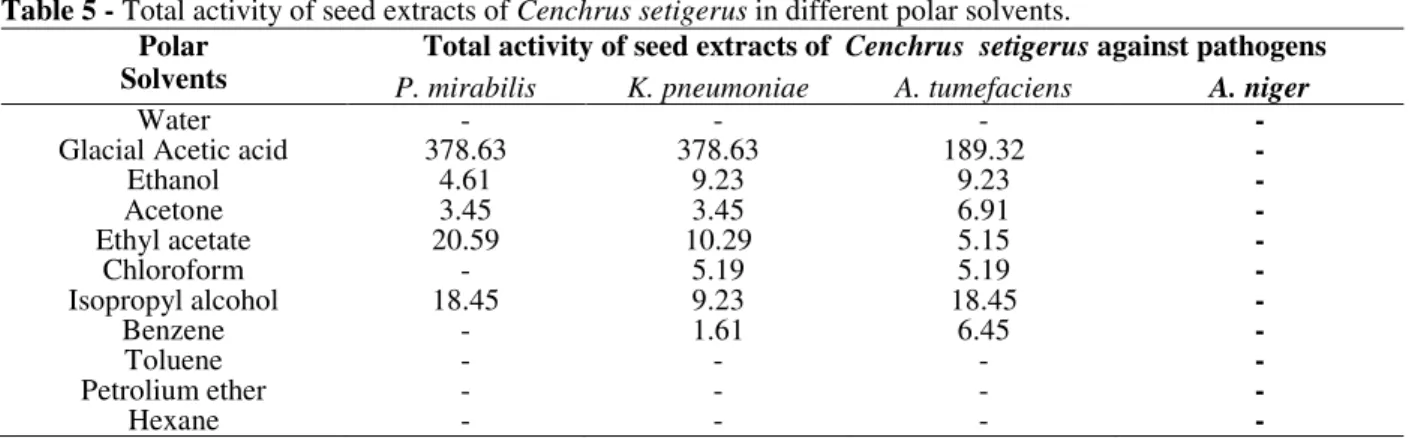
potential to inhibit the growth of the test microorganisms, even at low concentration. Maximum TA values calculated were 378.63 mL against P. mirabilis and K. pneumonia, followed by 189.32 mL against A. tumefaciens. The test pathogens were more sensitive to iso - propyl alcohol, ethyl acetate and acetone extracts after GAA extracts than to the rest of the extracts (Table 5).
Table 4 - MIC and MBC/MFC of seed extracts of C. setigerus in different polar solvents.
Polar Solvents
Bio-activity of seed extracts of Cenchrus setigerus against pathogens
P. mirabilis K. pneumoniae A. tumefaciens A. niger
MIC MBC MIC MBC MIC MBC MIC MFC
Water - - - -
Acetic acid 0.117 0.117 0.117 0.117 0.234 0.468 - -
Ethanol 7.5 15 3.75 7.5 3.75 3.75 - -
Acetone 7.5 15 7.5 15 3.75 7.5 - -
Ethyl acetate 1.875 1.875 3.75 7.5 7.5 15 - -
Chloroform - - 7.5 7.5 7.5 7.5 - -
Iso propyl alcohol 1.875 1.875 3.75 7.5 1.875 3.75 - -
Benzene - - 7.5 7.5 1.875 1.875 - -
Toluene - - - -
Petrolium ether - - - -
Hexane - - - -
MIC-Minimum inhibitory concentration (mg/ml), MBC-Minimum bactericidalconcentration (mg/ml), MFC-Minimum fungicidal concentration (mg/mL).
Table 5 - Total activity of seed extracts of Cenchrus setigerus in different polar solvents.
Quantitative phyto-chemical estimation
The phyto–chemical estimation for the seeds of C.
setigerus were carried out according to Farnsworth
(1966) wherein the consistency was sticky in the high polar solvent extracts whereas the low polar solvent extracts were non-sticky, which was same
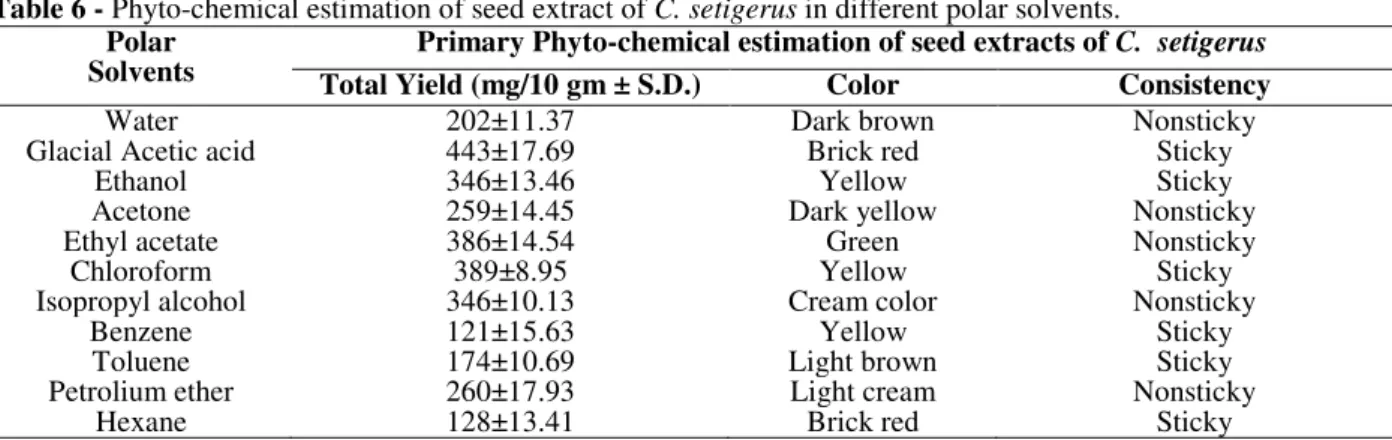
as described by Singariya et al. (2011a) but hexane, benzene and toluene extracts were sticky and water extract was non-sticky. The yield (mg/10 gm ± S.D.) of the extracts was also analyzed and highest yield for C. setigerus was observed in GAA extracts (Table 6).
Polar Solvents
Total activity of seed extracts of Cenchrus setigerus against pathogens
P. mirabilis K. pneumoniae A. tumefaciens A. niger
Water - - - -
Glacial Acetic acid 378.63 378.63 189.32 -
Ethanol 4.61 9.23 9.23 -
Acetone 3.45 3.45 6.91 -
Ethyl acetate 20.59 10.29 5.15 -
Chloroform - 5.19 5.19 -
Isopropyl alcohol 18.45 9.23 18.45 -
Benzene - 1.61 6.45 -
Toluene - - - -
Petrolium ether - - - -
Table 6 - Phyto-chemical estimation of seed extract of C. setigerus in different polar solvents.
The presence of various bioactive compounds justifies the use of this plant for various ailments by traditional practitioners. However, the isolation of individual phytochemical constituent and subjecting it to the biological activity would definitely give fruitful results. Isopropyl alcohol extract of the C. setigerus showed some bioactive
compounds, namely stigmast-4-en-3-one,
fagarsterol (lupeol) and ethyl iso-allocholate. These compounds have antimicrobial, diuretic, anti-cancers and anti-inflammatory activity. In the light of the fact that microorganism are becoming resistant against the existing drugs, present study if explored further can be of great use by the pharmaceutical industries for preparing the plant based antimicrobials drugs are concerned. Most susceptible organism in the investigation was A.
tumefaciens and P. mirabilis. Cenchrus grass
easily grows in harsh climatic conditions or xeric conditions and requires less care; hence its use as raw material for preparing the drugs could be economical.
ACKNOWLEDGEMENT
Authors are thankful to the UGC for providing the funds under Dr. D. S. Kothari Post-doctoral fellowship scheme.
REFERENCES
Agrawal P. Ecophysiological and Biochemical studies related to drought adaptation in grasses of Indian Desert. Ph.D. Thesis. J. N. Vyas University, 2007. Amakrishnan N. GC-MS Analysis of Rumexvesicarius
L. Int J Drug Development & Res. 2011; 3(2): 272-279.
Arnon DI. Copper enzymes in isolated chloroplast: polyphenol oxidase in Beta vulgaris. Plant Physiol.
1949; 24: 1-5.
Bates LR, Waldern RP, Teare ID. A rapid determination of free proline for water stress studies.
Plant Soil. 1973; 39: 205-207.
Bessman SP. Ammonia Metabolism in Animals: Symposium on Inorganic Nitrogen Metabolism. 1956; McElry and Glass (eds.) The Johns Hopkins Press. Bhattacharya S, Zaman MK, Haldar PK. Antibacterial
Activity of stem Bark and Root of Indian
Zanthoxylumnitidum. Asian J Pharm Clin Res. 2009; 2(1): 30-34.
Bradford MM.A rapid and sensitive method for the quantitation of microgram quantities of protein utilizing the principal of protein dye binding. Anal Biochem.1976; 72: 248-254.
Farnsworth NR. Biology and Phytochemical screening of plants. Pharm Sci. 1966; 55: 225-276.
Harborne JB. Phytochemical Methods, Chapman and Hall, London. New York, 1984; 5-6.
Hema R, Kumaravel S, Gomathi S, Sivasubramaniam C. Gas Chromatography-Mass Spectroscopic analysis of Lawsoniainermis leaves. New York Sci J. 2010; 3: 141-143.
Hussain A, Zaman MK, Ramteke AM. Antibacterial Activity of Trunk Bark of Alstoniascholaris. Asian J Pharm Clin Res. 2010; 3(4): 46-47.
Jain T, Sharma K. Assay of antibacterial activity of
Polyalthialongifolia Benth and Hook. Leaf extracts. J Cell and Tissue Res. 2009; 9(2): 1817-1820.
Larcher W. Physiol Plant Ecol. Springer-Verlag. Berlin. 1995; 506.
Mc-Cready RM, Gujjolz, Silviers V, Owers HS. Determination of starch and amylase in vegetables.
Application to Peas. Anal Chem. 1950; 22: 1156. Muthulakshmi A, Jothibai-Margret R, Mohan
VR.GC-MS Analysis of Bioactive Components of
Feroniaelephantum Correa (Rutaceae). J Applied Pharm Sci. 2012; 2(2): 69-74.
Polar Solvents
Primary Phyto-chemical estimation of seed extracts of C. setigerus
Total Yield (mg/10 gm ± S.D.) Color Consistency
Water 202±11.37 Dark brown Nonsticky
Glacial Acetic acid 443±17.69 Brick red Sticky
Ethanol 346±13.46 Yellow Sticky
Acetone 259±14.45 Dark yellow Nonsticky
Ethyl acetate 386±14.54 Green Nonsticky
Chloroform 389±8.95 Yellow Sticky
Isopropyl alcohol 346±10.13 Cream color Nonsticky
Benzene 121±15.63 Yellow Sticky
Toluene 174±10.69 Light brown Sticky
Petrolium ether 260±17.93 Light cream Nonsticky
Otimenyin O, Sunday, Uguru MO, Ogbonna A. Antimicrobial and hypoglycemic effects of
Momordicabalsamina.Linn. J Nat Products. 2008; 1: 03-09.
Rajendra Kumar CSV, Reddy BVD, Reddy AR. Proline protein interactions: Protection of structural and functional integrity of M4 lactate dehydrogenase.
Biochem Biophy Res Comm. 1994; 201:957-963. Rios JL, Reico MC. Medicinal plants and antimicrobial
activity. J Ethnopharmacol. 2005; 100: 80-84. Siefermann-Harms D. The light-harvesting and
protective functions of carotenoid in photosynthetic membranes. Physiol Plant.1987; 69: 561-568. Singariya P, Kumar P, Mourya KK. Antimicrobial
Activity of Fruit coat (Calyx) of Withania somnifera
against some Multi Drug Resistant Microbes. Int J Biological Pharm Res. 2012c; 3(2): 252-258. Singariya P, Kumar P, Mourya KK. Evaluation of
Antibacterial Activity and Preliminary Phytochemical Studies on the Stem of Cenchrus ciliaris and
Cenchrus setigerus. Asian J Pharm Clin Res. 2012b; 5(1): 163-167.
Singariya P, Kumar P, Mourya KK. Phyto-chemical Screening and Antimicrobial Activities of Dhaman grass and Indian Ginseng. J Pharmacy Res. 2012a; 5(1): 135-139.
Singariya P, Kumar P, Mourya KK. Ripen Fruits of Indian Ginseng: Phyto-chemical and Pharmacological examination against Human and Plant Pathogens. Int J Appl Biol Pharm Tech. 2012e; 3(2): 1-8.
Singariya P, Mourya KK, Kumar P. Antimicrobial Activity of the Crude Extracts of Withania somnifera
and Cenchrus setigerusIn-vitro. Pharmacogn J.
2012d; 4(27): 60-65.
Singariya P, Mourya KK, Kumar P. Bio Activity of crude extracts of Leaves of Cenchrus Grass in different polar solvents against some pathogenic microbes. Int J Pharm Sci Review and Res. 2011b; 11(1): 124-129.
Singariya P, Mourya KK, Kumar P. Comparative Microcidal Activity of Withania somnifera and
Cenchrus setigerus against the Pathogenic Micro-organisms. Int J Pharmacy Pharm Sci. 2011c; 3(5): 511-555.
Singariya P, Mourya KK, Kumar P. Preliminary Phyto-profile and Pharmacological Evaluation of some Extracts of Cenchrus grass against Selected Pathogens. J Pharm Sci Res. 2011a; 3(8): 1387-1393. Singariya P, Rathi P, Gadi BR, Bohra SP. Effect of
Ethephon on the Activities of Ammonia Assimilation Enzymes and Metabolites of Cenchrus Setigerus-76 grown in vivo. Adv Microbiol Biotechnol. 2009; 347-351.
Singariya P. Effect of Sub-Optimal Environment and PGR’s on Metabolic Pattern of Certain Species of Cenchrus. Ph.D Thesis.J. N. Vyas University. 2009. Singleton S, Rossi T. Methodology of plant metabolites
and enzymes.Vol. II, (eds.), Bhansali R R, Jindal S K. 1995; 245-265.
Sinha RK, Bhatia S, Vishnoi R. Desertification control and rangeland management in the Thar desert of India. 1996; In: Rala Report no. 200, 115-123. Vyvyan JR. Allelo-chemicals as leads for new
herbicides and agrochemicals. Tetrahedron.2002; 58:1631-1646.