Vol.60: e17160410, January-December 2017 http://dx.doi.org/10.1590/1678-4324-2017160410
ISSN 1678-4324 Online Edition
BRAZILIAN ARCHIVES OF BIOLOGY AND TECHNOLOGY
A N I N T E R N A T I O N A L J O U R N A L
Assessment of Rice Associated Bacterial Ability to Enhance
Rice Seed Germination and Rice Growth Promotion
R. Gholamalizadeh
1, G. Khodakaramian
1*, A. A. Ebadi
2.
1Department of Plant Protection, College of Agriculture, Bu-Ali Sina University, Hamedan, Iran; 2 Rice Research
Institute of Iran (RRII), Agricultural Research Education and Extension Organization (AREEO), Rasht, Iran.
ABSTRACT
The application of beneficial bacteria has recently been used for sustainable agriculture. In current research, 71 bacterial isolates were obtained from rice plant and the rhizosphere soil of different paddy fields in Guilan province, Iran. After primitive investigation, 40 bacteria with typical predominant characteristics were selected. By PCR-RFLP of their 16S r-DNA gene, 8 Operational Taxonomic Units (OTUs) totally consisted of 33 isolates were obtained. From all of them, 8 isolates were selected for rice seed germination experiment, then, effective isolates were used for pot experiment to evaluate their ability for promoting rice growth. All of them were able to increase rice growth and yield, but in different potential. These tested isolates were identified as Alcaligenes faecalis (DEp8, O1R4), Pantoea ananatis (AEn1), Bacillus vietnamensis (MR5), Bacillus idriensis (MR2) and Stenotrophomonas
maltophilia by partial sequencing of their 16S r-DNA gene. Among them, AEn1 and MR5 produced indole-3- acetic acid (IAA) in larger amounts than the other isolates and the isolates AEn1 and O1R4 were able to solubilize phosphate in higher amounts. According to the results obtained, it can be concluded that AEn1, O1R4 and MR5 can be considered as bacterial inoculants to use as alternatives for chemical fertilizers.
Key words: Rice associated bacteria, Plant growth promoting bacteria, PCR-RFLP of 16S r-DNA, IAA production, Phosphate solubilizing bacteria.
*
INTRODUCTION
Rice, which is the most important cereal crop and the main food in many countries,
provides more than 20% of the consumers’ daily calories. About 90% of rice is
cultivated in 200 million paddy fields in Asia 19. In Iran, most rice farms are in the
Northern provinces including Guilan and Mazandaran.
Due to the growing demand for rice, one of the increasing concern about rice production in the world especially in Iran is the extra use of chemical fertilizers,
which have negative effects on human health and environment 9. So, there is an
urgent need to use the substitutes without or with less harmful side effects. Thus, recently, microorganisms as an inoculants to reduce the use of chemicals are being a
matter of interest 13. For stimulating rice seed germination and rice growth
promotion biologically, there are many attempts to find successful bacteria 3, 5, 21, 42.
Rice seed priming with plant growth promoting bacteria (PGPB), as an alternative for chemicals, can be considered to enhance seed germination, vigor index and
germination speed 11. Because germination stage is the most susceptible period in
rice life cycle 39. Rice growth promotion can be achieved by beneficial bacteria but
the exact mechanism by which PGPB induce their effects is not clearly understood, however, several hypotheses such as producing phytohormones, activation of phosphate solubilization and promotion of the mineral nutrient uptake are usually
considered to be involved 8, 14, 26, 29. Production of phytohormones is one of the
important mechanism and indole-3 acetic acid (IAA), which is a member of native
auxin, is a common metabolism produced by several beneficial bacteria 31. Indole-3
acetic acid stimulates cell elongation through enhancement of cell osmotic contents and cell wall synthesis, permeability of water into cell, decrease in wall pressure and
inducing protein synthesis, flowering and fruiting 2. Solubilization of phosphate is
one of the other important mechanism the PGPB uses to enhance growth of host plant. A great part of soil phosphorus is in the form of insoluble phosphate and
cannot be used by plants 22 and phosphorus deficiency results in small leaves, weak
stem and slow development 40. By considering these facts, the aim of current study is
to isolate rice associated bacteria from Guilan’s paddy fields, the evaluation of their
ability to enhance rice seed germination and plant growth, and investigation of the mechanisms such as IAA production and phosphate solubilization in order to introduce any possible native beneficial bacteria for rice growth promotion as a
biological inoculant to use in paddy fields instead of hazardous chemical fertilizers.
MATERIAL AND METHODS
Sample Collection and Isolation of Bacteria
Rice plants variety ashemi includin stem, leaf, root and rhi osphere soil ere
collected from different paddy fields of sites in Guilan province, .2 , 9. 9 E, 2 m a.s.l), Iran, including Astara, Talesh, Rezvanshahr, Masal, Fooman, Shaft, Anzali, Rasht, Astaneh Ashrafieh, Lahijan, Langerood, Roodsar, Amlash, Rostam Abaad, Some Sara and Siahkal from June to July 2015. The condition of rice cultivation in paddy fields were continuous irrigation or continuous flow of water
(ponding) and the soil type was clayey ith the avera e p of . . amples ere
ept in plastic ba s and immediately brou ht to the laboratory of ice esearch nstitute of ran, Guilan. amples ere ept at C in refrigerator.
The epiphytic, endophytic and rhizospheric culturable bacteria were isolated
according to Lindow et al. (1978), Sturz et al. (1997) and Mohite (2013),
phosphate buffer (pH:7.0) and 1 g/l peptone. Flasks were shaken for about 2h at 150 rpm. For endophytic isolation, stems, leaves and roots of rice were washed thoroughly under tap water and rinsed with deionized water. Surface sterilization of samples was done with 5% sodium hypochlorite solution for 5 minutes followed by 3 times washing with sterile distilled water. Then samples were cut into small pieces with sterile scalpel and were ground well with a sterile pestle and mortar. Rhizospheric bacteria were isolated by keeping the clay firmly adhering the roots and removing the rest. Ten grams of this clay from each sample were suspended in 90 ml of sterile distilled water in a 250 ml flasks and shaken for about 20 min at 120
rpm. Serial dilutions of all suspensions were made up to 1/105 and an ali uot of 00
l from each dilutions ere spread on utrient A ar A medium. in le colonies ere pic ed up after days of incubation at 2 C and streaked on fresh plates to get
pure colonies.
Colony Characteristics
Colony characteristics such as shape, color, margins and gram staining were carefully studied. The final isolated bacteria were selected from the bacteria with typical predominant characteristics on NA medium. Thus, the redundant isolates
with different characteristics but in few population were discarded.
DNA Extraction and Amplification of 16S rDNA
Total genomic DNA of bacteria in each group was extracted from freshly grown cultures on NA medium according to the method described by Murry & Thompson (1980). Quantification of extracted DNA was done on 1% agarose gel
electrophoresis. Universal primers 2 f: ′-AGAGTTTGATCCTGGCTCAG- ′ and
92r: ′- GGTTACCTTGTTACGACTT- ′ ere used for amplification of rDNA region. The final reaction mixture was 10 µl, contained of 0.5 µl of
magnesium chloride [MgCl2], 1 µl of PCR buffer, 1.2 µl of dNTPs, 0.6 µl of each
forward and reverse primers, 2.96 µl sterile deionized water and 0.14 µl of Taq DNA
Polymerase (Cinnagen, Iran). Polymerase Chain Reaction amplification ere
carried out on l of A in an automated thermal cycler Gradient- iometra,
Germany ith follo in pro ram: an initial denaturation in 9 for min, cycles of denaturation 9 for s , annealin 0 C for 1 min), e tension 2 for
2 min and final e tension in 2 C for 7 min. PCR product size was confirmed on
1.5% agarose gel electrophoresis and photographed under UV light.
PCR-Restriction Fragment Length Polymorphism (PCR-RFLP) of 16S rDNA
This method was used to cluster bacterial isolates in groups with most similarity according to their restricted bands. Digestion of the amplified 16S rDNA was carried out by two recognizing enzymes: Mse I and Hinf I. The final reaction mixture was 15 µl, contained of 8 µl of sterile deionized water, 1.5 µl of 10X buffer with 5 µl of
the PCR products sub ected to di est ith units l of each en yme at C for
30 to 60 min. The restricted DNA fragments were separated on 10% polyacrylamide gel (140 V for 2 h) stained in ethidium bromide and photographed under UV light. The results were converted into a binary matrix indicating the presence and absence of restricted bands. The analysis of this matrix was done using SM (Simple Matching) correlation index and clustering analysis was performed using Complete method. The correlation index and clustering analysis method was performed according to the highest cophenetic correlation coefficient (0.8486). The software
Sequencing of 16S r-DNA
The 16S r-DNA gene of tested bacterial isolates, were partially sequenced using forward or reverse universal primers 27f and 1492r (used in PCR above) to identify the isolates. The sequencing reaction were done at Macrogen Sequencing Service, Republic of Korea and sequences were submitted to the National Center for Biotechnology Information database.
Rice Seed Germination Test
Rice seed (Variety Hashemi), obtained from Rice Research Institute of Iran, Guilan, were surface sterilized by 5% sodium hypochlorite for 5 min and rinsed three times with sterile distilled water. Then, they were soaked in different bacterial suspensions
including 4 bacteria isolated from rhizosphere (O1R4, MR5, MR2 and KR1), 3 from
rice endophyte (AEn1, AEn4 and FEn1) and 1 from rice epiphyte (DEp8), with
sufficient population density of 106 to 107 cfu/ml and shaken overnight in 150 rpm.
Seeds were soaked in sterilized distill water considered as control. For each isolate, 45 seeds in 3 replications were allocated and in each replication, 15 seeds were put
on sterile filter paper in 100 mm petri dishes. hey ere irri ated by sterili ed distill
ater durin days of incubation at 2 2 C.
In the stage of imperfect leaf emergence (code 09) 6, shoot and root length of all
seedlings in each replication were measured in mm scale. For weight measurements,
shoot and root ere separated and ei hted as fresh ei ht and dry ei ht after eepin at C for 72 h in an electric oven. Weight measurements was done by
digital weight scales and noted in gram.
Germination rate or seedling emergence was calculated using the following formula
proposed by International Rice Research Institute (2011) on last day of experiment:
100
Vigor index of seedling were measured on last day of experiment (day 6) according to the formula proposed by Abul-Baki & Anderson (1973):
The speed of germination was calculated by counting the number of emerged seedlings every day of experiment according to Gupta (1993):
The experiment was performed in a completely randomized design. Data were statistically analyzed with SAS version 9.0 and the comparison of means was done by LSD.
Growth Promotion in Pot Experiment
More effective isolates on enhancement of rice seed germination were selected for evaluation of their effects on growth and yield of rice. Seedling trays were sterilized with 5% sodium hypochlorite and washed thoroughly by sterile distilled water. They were filled with autoclaved soil and surface sterilized rice seed (Variety Hashemi) were sown for nursery raising. Seedling trays were irrigated by sterile distilled water
until the stage of unfolded 3 leaves (code 13) 6. Rice pots sterilized with 5% sodium
hypochlorite were filled with autoclaved paddy field soil and irrigated by sterilized water. For each isolate 6 pots (replications) and for each pot, 3 seedlings were allocated. Before planting, rice seedling roots were dipped and shaken in selected rhizobacterial suspension (the bacteria isolated from rice rhizosphere) with a
population density of 106 to 107 cfu/ml for one hour in 150 rpm to let bacteria
colonize roots (Sharma et al. 2014) and the phyllosphere spraying of bacterial
was done after planting for epiphyte and endophyte bacterial colonization. Sprayed inoculated seedlings were wrapped up with plastic bags for 24 hours to make a humid condition for better colonization of bacteria. Seedlings without bacterial inoculation considered as control. Data collection of rice plant growth including
stem and root length and weight were done by tillering stage (code 29) 6, for 3 pots
(replications) and the other 3 pots were remained to evaluate the bacterial effects on rice yield. Yield data collection including plant height and weight, flag leaf area, number of tillers, number of panicle, panicle length, weight of 1000 grain and
number of full grain were done according to standard evaluation system for rice 20 at
ripening stage (code 89) 6.
The pot experiment was done in a randomized complete block design and the data obtained were subjected to analysis with SAS version 9.0. The significance of
differences between mean values were evaluated by LSD.
Phosphate Solubilizing Ability
The phosphate solubilizing ability was studied by plate assay using the National
otanical esearch nstitute’s hosphate ro th medium 38
. The medium
was consisted of 10g glucose, 5g calcium phosphate [Ca3(PO4)2], 5g magnesium
chloride [MgCl2], 0.25g magnesium sulfate [MgSO4], 0.2g potassium chloride
[KCl], 0.1g ammonium sulfate [(NH4)2SO4 and l a ar in liter. he p as
ad usted to .0 before autoclave. lates ere ept at 2 C and formation of visible halo zones in NBRIP media around bacterial colonies after 7 days showed the ability
of solubilizing phosphate .
Production of IAA
The presence of IAA in bacterial metabolites and the amount of IAA production was
colorimetrically determined by Salkowski reagent 15. Bacterial isolates were
inoculated in broth containing 20g/l bacteriological peptone, 1.15g/l dipotassium
phosphate [K2HPO4], 1.5g/l magnesium sulfate [MgSO4. 2 and the same broth
supplemented by tryptophan 0. l . acterial ro n cultures ere centrifu ed after hours incubation at 2 C and 1ml of supernatant was mixed with 1ml of
Salkowski reagent (12 g/l ferric chloride [FeCl3] in sulfuric acid [H2SO4, 7.9 M]).
After 30 min of dark incubation at room temperature, the optical densities were measured at 530 nm by spectrophotometer (CECIL, England). The concentration of IAA production was estimated by a standard IAA curve.
RESULT
Isolation and Colony Characteristics
A total of 71 pure bacterial isolates were obtained and their morphological study showed typical bacterial characters. Their color varied from yellow to pink, milky and orange. Their shape was mostly rounded with some smooth or undulate margins and gram test separated them in to two major groups. Due to these typical predominant characteristics the total number of bacteria reduced to 40 and the rest
with many diverse characteristics but in fewer population were removed.
Amplification of 16S r-DNA and PCR-RFLP
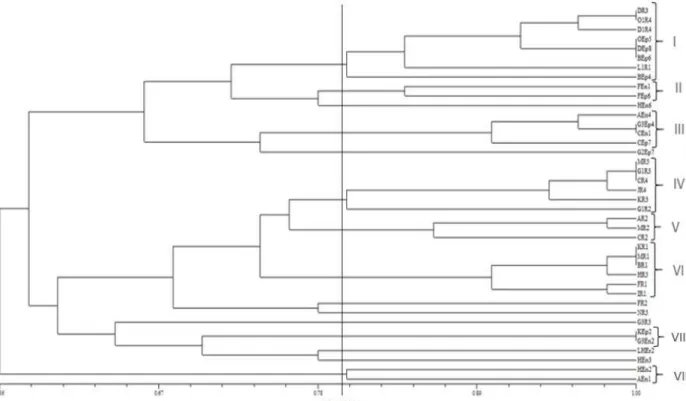
from OTU (I), with higher number of isolates, two representatives (DEp8 and OR4)
and from each one of II, III, IV, V, VI and VIII OTUs, one representative isolate
including (FEn1, AEn4, MR5, MR2, KR1 and AEn1) were selected respectively for
evaluation of their ability to enhance rice seed germination.
Figure 1. Dendrogram based on UPGMA cluster analysis of PCR-RFLP pattern of 16S r-DNA profiles showing the relationships among the isolated bacteria.
Rice Seed Germination
Seed inoculation with 8 bacterial isolates from 8 groups resulted in increased
seedlin s’ len th and vi or inde compared to un-inoculated control. In all treatments, the increase in shoot length were higher than control but in root
elongation, just the isolate KR1 showed similar effect with control. The highest effect
on shoot and root length obtained from the seedlings inoculated with isolates DEp8
and AEn1 respectively followed by O1R4 in shoot length and FEn1 in root length.
Isolates KR1, MR2 and AEn4 could not increase the shoot fresh and dry weight more
than control and O1R4 was the isolate which had the most effect on enhancement of
shoot fresh and dry weight. The root fresh and dry weight of seedlings inoculated by
MR2 were the highest but AEn4 could not increase fresh weight of roots. Comparing
the treated seeds and non-treated seeds, there was not a considerable difference in
germination rate and the result of data analysis showed that MR5, MR2, O1R4, DEp8
and FEn1 treated seeds had the same germination rate but some of the seeds in KR1,
AEn1 and AEn4 treatments did not germinate. Speed of germination which computed
by counting the number of germinated seeds at an interval of 24 h to the day number of counting from the beginning day of experiment, were faster in seeds inoculated by
isolates MR2, OR4 and FEn1 respectively than un-inoculated seeds and vigor index of
Table 1. Mean comparison for the effect of different bacterial isolates on enhancement of rice seeds Bacterial isolates root length(mm) shoot length(mm) root fresh weight(g) shoot fresh weight(g)
root dry weight(g)
shoot dry weight(g)
germination rate
speed of germination
seed vigor index
OR4 96.8b 53.6a 0.330bc 0.427a 0.039cd 0.051a 100a 7.40ab 15040ab
MR5 89.8d 47.5bc 0.349ab 0.353bc 0.040bc 0.046bc 100a 6.64c 13730cd
MR2 95.6bc 47.7bc 0.366a 0.327cd 0.044a 0.039e 100a 7.55a 14330bc
KR1 84.4e 46bc 0.326bcd 0.314d 0.038d 0.042de 97.76ab 6.80c 12758e
AEn1 103a 48.7b 0.348ab 0.362b 0.042ab 0.044cd 95.53b 6.69c 14503bc
AEn4 89.2de 45.5bc 0.252e 0.312d 0.033e 0.039e 95.53b 6.61c 12866ed
DEp8 92cd 554a 0.300cd 0.376b 0.037d 0.048ab 100a 7.12b 14740ab
FEn1 101.8a 53.3a 0.350ab 0.409a 0.042abc 0.049ab 100a 7.26ab 15510a
control 84.4e 44.1c 0.291d 0.350bc 0.028f 0.043cd 100a 7.13b 12860ed
L.S.D٭ 4.745 4.148 0.035 0.031 0.002 0.003 3.831 0.288 914.42
StandardError ±1.597 ±1.396 ±0.011 ±0.010 ±0.0008 ±0.001 ±1.28 ±0.096 ±307.7 The abbreviations given to isolates represents respectfuly from left to right: the name of sampling site (O for Langerood, M for Fooman, K for Shaft, A for Astara, D for Amlash and F for Rostam Abaad),, the part of rice plant the bacteria isolated (R for rhizosphere, Ep for epiphyte and En for Endophyte) and the number at the end shows the number of isolate
٭Least Significant Differences
Growth Promotion in Pot Experiment
From 8 isolates studied in seed germination test, the isolates KR1 and AEn4 which
had less effects on evaluated traits, were discarded and the rest were used for pot
experiment. At tillering stage (code 29) 6, 3 pots were collected and the other 3 pots
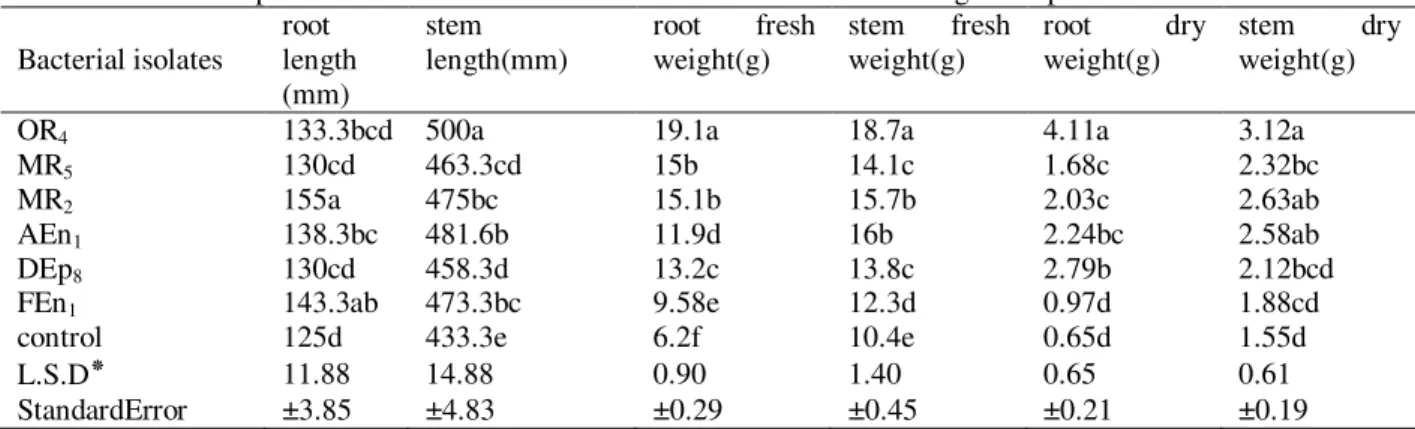
were left for yield increasing evaluation. The results of seedling inoculation with selected bacteria showed significant increase in all investigated characters including root and stem length and weight compared to un-inoculated seedlings. The isolate
O1R4 showed the highest consistency in ability to enhance growth in almost all traits
except the root length which the highest was for isolate MR2 followed by FEn1. The
isolates MR2, DEp8 and AEn1 were in second place after O1R4 in increasing each
evaluation of root and stem fresh and dry weight (table 2).
Table 2. Mean comparison for the effect of different bacterial isolates on rice growth promotion
Bacterial isolates root length (mm) stem length(mm)
root fresh weight(g)
stem fresh weight(g)
root dry weight(g)
stem dry weight(g)
OR4 133.3bcd 500a 19.1a 18.7a 4.11a 3.12a
MR5 130cd 463.3cd 15b 14.1c 1.68c 2.32bc
MR2 155a 475bc 15.1b 15.7b 2.03c 2.63ab
AEn1 138.3bc 481.6b 11.9d 16b 2.24bc 2.58ab
DEp8 130cd 458.3d 13.2c 13.8c 2.79b 2.12bcd
FEn1 143.3ab 473.3bc 9.58e 12.3d 0.97d 1.88cd
control 125d 433.3e 6.2f 10.4e 0.65d 1.55d
L.S.D٭ 11.88 14.88 0.90 1.40 0.65 0.61
StandardError ±3.85 ±4.83 ±0.29 ±0.45 ±0.21 ±0.19
The evaluation of rice yield in 3 left pots were studied at the end of ripening stage. Many traits were measured and the inoculated bacteria were different in their potential to enhance rice yield. Plant height, which were measured from the soil surface up to the end of the longest panicle, were the highest in plants inoculated by
the isolates AEn1 and DEp8 followed by MR5. The isolate AEn1 also produced the
most number of full grains in inoculated rice plants compared to other isolates and
un-inoculated control. Plants inoculated by MR5 produced the highest weight of
1000 grain and also the highest plant and panicle fresh and dry weight but in the
evaluation of increasing flag leaf area, MR5 could not increase the area of flag leaf
more than control. The number of panicles and tillers were significantly the highest
for isolate DEp8. The isolate O1R4 showed the highest consistency in ability to
increase panicle length and flag leaf area, but O1R4 with 3 other isolates, AEn1, FEn1
and DEp8 could not increase plant and panicles fresh and dry weight more than
control (table 3).
Table 3. Mean comparison for the effect of different bacterial isolates on rice growth yield
Bacterial isolates
Plant height(mm)
Flag leaf area(mm2)
Number of tillers
Panicle number
pa.l(mm) p.f.w p.d.w pa.f.w pa.d.w w.1000.g(g) n.f.g
OR4 1128bc 243.6a 17.6cd 16.3c 276.6a 81.3b 28.7ab 26.3d 24.5d 23.5ab 51.6cd
MR5 1145a 152.6e 20b 18.6b 271.6ab 88.9a 29.3a 32.7a 29.4a 24a 53.6bc
MR2 1143ab 181.6b 19.6bc 18.6b 250d 79.9b 29.1ab 30.3b 27.9abc 23.5ab 54.6b
AEn1 1146a 186.1b 20b 18.6b 251d 70.3c 26.2cd 28.9bc 26.3cd 23.9ab 58.3a
DEp8 1146a 178.5bc 22.6a 22a 266.6abc 71.7c 27.3bc 27.3cd 21.7e 22.4b 54.3bc
FEn1 1116c 167.3cd 20b 18.3bc 255cd 79.4b 25.3d 30.4ab 28.8ab 23.9ab 50.6d
control 1113c 155.6de 16d 16.3c 260bcd 78.9b 26.6cd 30.2b 26.6bcd 19.8c 30.6e
L.S.D٭ 16.06 13.57 2.17 2.29 12.50 2.68 1.84 2.28 2.39 1.58 2.68
Standard
Deviation ±5.21 ±4.4 ±0.7 ±0.74 ±4.05 ±0.87 ±0.59 ±0.74 ±0.77 ±0.51 ±0.86 ٭Least Significant Differences
Identification of Bacterial Isolates
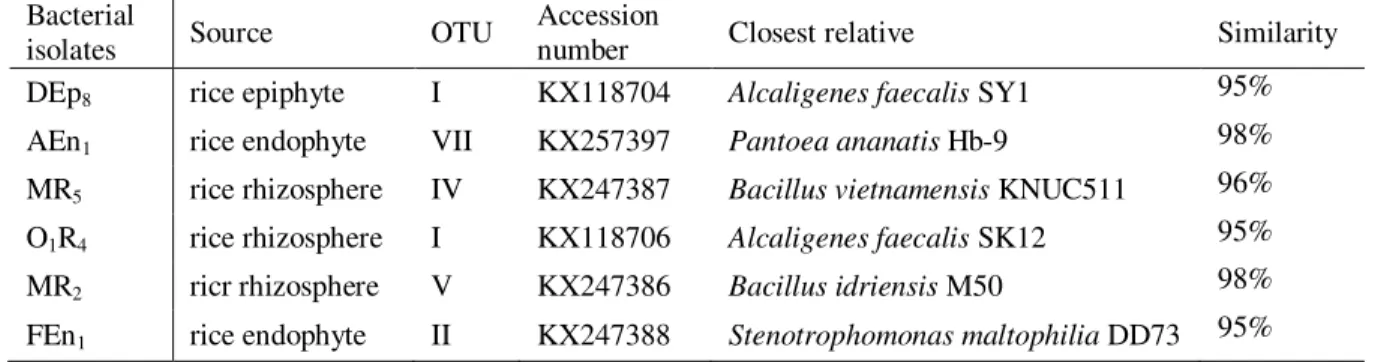
Identification of tested bacteria in pot experiment were done through partial
sequencing of their 16S r-DNA genes. They were identified as Alcaligenes facealis
(O1R4 and DEp8 from the same OTU), Stenotrophomonas maltophilia (FEn1),
Pantoeaananatis (AEn1), Bacillusvietnamensis (MR5) and Bacillusidriensis (MR2).
The information of these isolates with related accession numbers are presented in table 4.
Table 4. Identification of the tested isolates based on partial sequencing of 16S r-DNA gene Bacterial
isolates Source OTU
Accession
number Closest relative Similarity
DEp8 rice epiphyte I KX118704 Alcaligenes faecalis SY1 95%
AEn1 rice endophyte VII KX257397 Pantoea ananatis Hb-9 98%
MR5 rice rhizosphere IV KX247387 Bacillus vietnamensis KNUC511 96%
O1R4 rice rhizosphere I KX118706 Alcaligenes faecalis SK12 95%
MR2 ricr rhizosphere V KX247386 Bacillus idriensis M50 98%
FEn1 rice endophyte II KX247388 Stenotrophomonas maltophilia DD73 95%
Phosphate Solubilizing Ability
the isolates AEn1 (P. ananatis), O1R4 and DEp8 (A. facealis) were high solubilizer,
but FEn1 (S. maltophilia), MR2 (B. idriensis) and MR5 (B. vietnamensis) solubilize
phosphate in lower amount (table 5).
Production of IAA
The bacterial ability to produce IAA was determined by changing the color of bacterial broth after addition of Salkowski reagent and this color change was measured by spectrophotometer. All tested bacteria produced IAA in both media, but, tryptophan supplemented media had higher readings than the media without
tryptophan. The amount of IAA was the highest in B. vietnamensis (MR5) which
followed by P.ananatis (AEN1). The results are shown in table 5.
Table5. Phosphate solubilizing and IAA production ability of bacterial isolates Bacterial
isolates Phosphate solubilizing
IAA production without tryptophan
IAA production with tryptophan٭
DEp8 +++ 0.25 3.75
AEn1 +++ 1.43 7.5
MR5 + 1.51 8.75
O1R4 +++ 0.06 1.25
MR2 + 0.08 1.87
FEn1 + 0.20 2.5
low solubilizer (+),high solubilizer (+++) ٭IAA concentration (µg/ml)
DISCUSSION
Different bacteria can be found in association with rice plant. They have the ability to enhance rice growth and because of this potential they can be used as biofertilizers
33
. In current research, many bacterial isolates were obtained from rice plants including endophytes, epiphyte and rhizosphere bacteria. At first, primitive investigations of bacteria, which is a common way of partial bacterial
characterization 4, 37, 42 was done. In this way, the bacterial population density with
very different characteristics can be discarded and the total population density is consisted of some nearly homogeneous bacterial groups that share same color, shape
or gram reaction.
The studied bacteria were from different geographical locations and from different parts of rice plants and this was reflected in 16S r-DNA digestion with restriction enzymes. The final phylogenetic tree showed that the isolates were rather divers and from 40 isolates, 7 OTUs representing 31 isolates at the similarity of about 80% were obtained. Fingerprinting of 16S r-DNA has been used by many researchers to
discriminate bacterial isolates genetically 7, 12, 45. In such a similar practice, Loaces et
al. (2011), found 13 OTUs consisting of 55 isolates from 109 total isolates, whereas
the rest showed unique restricted patterns indicating that the population density was
quite variable .
To find bacteria with growth promoting effects on rice plants, one or two isolates from each OTU were selected for rice seed germination test. Seed priming or seed inoculation by beneficial bacteria has become a newly acceptable substitute for
sustainable agriculture 11. The result of seed germination in current study showed
that seedling length and weight can be increased by the inoculation with most of
tested bacteria. Two isolates including KR1 and AEn4 could not affect rice seed
many literatures, the increase in seedling length and weight is attributed to bacterial
phytohormones 5, 11, 41. Among different phytohormones, indole-3-acetic acid (IAA)
is usually considered as the most important native auxin. Production of IAA can vary in different species and strains and it is influenced by culture condition, growth stage
and substrate availability 34. Tryptophan is considered as a precursor for IAA
biosynthesis, because IAA producing bacterial culture supplemented by tryptophan
produced more concentration of IAA 10. Tryptophan dependent IAA biosynthesis
had been also reported in many other bacteria. Tien et al. (1979) reported that
Azospirillum was able to produce IAA when exposed to tryptophan or Karnwal
(2009) tested fluorescent pseudomonas production of IAA in the absence and
presence of tryptophan and showed that indole production enhanced by increasing tryptophan concentration. The assessment of IAA production in current research showed different concentration of IAA produced from all tested bacteria but the addition of tryptophan to the bacterial broth, increased IAA production considerably. It showed all of tested bacteria preferred tryptophan dependent way to produce IAA. There was not a significant differences between rhizospheric and epiphytic or bacterial endophyte tested, which is in agreement with issued publication of Lindow & Brandl (2003) who said that bacterial epiphytes are also known to produce
phytohormnes like endophytes and rhizospheric bacteria .
Seed vigor is mainly determined based on the seedling length 18. Vigor index reflects
the seedlings health, establishment and the state of final productivity of the plant 32.
According to results obtained here, since the seedling length were significantly increased by bacterial inoculations, the seed vigor enhancement was anticipated, as it was. The speed of seed germination was not affected considerably by seed priming compared to control. In some bacterial treatments, the rate of seed germination was
slowly during the experiment time. The isolates MR2 (B. idriensis) and O1R4 (A.
faecalis) were able to colonize rice seeds in a shorter time and therefore can be more successful biofertilizers. This has been approved by other authors who said that to be an effective plant growth promoting bacteria, they must be able to establish themselves and colonize plant to reach at an appropriate density sufficient for
producing beneficial effects 4.
Vegetative growth is an important growth phase in many crops as it determines the amount of biomass production and in rice it is important for development of tillers. A strong vegetative growth of rice plants reflects a higher plant height and greater
plant biomass, larger number of tillers and panicles 42. In current investigations, after
seed germination experiment, more successful bacteria were selected for pot experiment to evaluate bacterial growth promoting effects on vegetative growth
phase. At tillering stage (code 29) 6, rice growth in all measured traits including root
and stem length and weight was higher than control and it showed the beneficial effects of bacteria treated. One reason of this enhancement can result from phytohormones which led to higher root and stem length. Production of IAA from all of treated bacteria in different concentrations can explain the different effectiveness of beneficial bacteria on rice growth. Other than phytohormones, solubilizing of phosphate can be other reason for growth enhancement of rice. Phosphorus is one of the major nutrient requirements for plant growth. Phosphate-solubilizing microorganisms, in addition to provide phosphorus for plants, provide growth promoting substances like hormones, vitamins and amino acids. It is reported that mechanism of solubilizing phosphate is associated with release of low molecular weight organic acids which chelate the cation bound to phosphate and convert it into
soluble form 16, 24, 25. According to our result from phosphate solubilizing ability of
isolates FEn1 (S. maltophilia), MR2 (B. idriensis) and MR5 (B. vietnamensis) which
was showed by a single (+) as low solubilizers, but the isolates AEn1 (P.ananatis),
O1R4 and DEp8 (A.facealis), were considered as high phosphate solubilizers (+++).
According to our results, there was not a significant differences between tested rhizospheric and epiphytic or bacterial endophyte for solubilizing phosphate which is
not completely in agreement by Vazquez et al. (2000) who stated that high
proportion of phosphate solubilizing bacteria are concentrated in the rhizosphere and they are metabolically more active than other sources. In current research, the isolate AEn1 (P. ananatis) which isolated from rice as a bacterial endophyte or DEp8 (A.
faecalis) as a bacterial epiphyte were considered as high solubilizers since the diameter of the halo zone made by these isolates were more than the others, but this privilege was not reflected in the result of rice growth enhancement, because the
rhizospheric isolates, MR5 (B. vietnamensis) and MR2 (B. idriensis) with low ability
of phosphate solubilizing showed considerable enhancement of rice growth and
yield. The same results obtained from the experiment conducted by Mwajita et al.
(2013) in which over half of the bacterial phyllosphere isolates were able to solubilize phosphate, but generally the bacterial isolates from the rhizosphere and
rhizoplane were more efficient in plant growth enhancement.
The increase in shoot and root dry matter directly effects on the plant higher
productivity 42, which is clear in our results and the investigation of bacterial effects
on rice yield at the end of growth season showed higher productivity than un-inoculated control including tiller number, panicle number, the weight of 1000 grain and the number of full grain. It is evident that many different species colonize the tissues of the plants, but their persistence, activity and their interaction in this microbial community is not completely cleared. The understanding of the interaction between bacteria-bacteria and bacteria-plant would help us to modify the beneficial effects that bacteria may have on host plants. In other words, introducing a PGPB and its inoculation to plant cannot guarantee the enhancement of plant yield. The success of a PGPB inoculation depends on different factors including soil and agricultural conditions, plant properties and the characteristics of the bacteria
involved .
CONCLUSION
The current study showed that rice plants collected from different paddy fields in Guilan province, harbour diverse bacterial epiphytic, endophytic and rhizospheric population which some of them had the ability of plant growth promoting, but in different potential. All of tested bacteria were able to produce IAA and solubilize
phosphate. Among them, the isolates Alcaligenes faecalis, Pantoea ananatis and
Bacillus vietnamensis showed high potential of IAA production and phosphate solubilizing. From this study, it can be concluded that the above bacterial isolates can be promising as PGPB, but the final conclusion will be obtained when their potential of being a successful PGPB is investigated in paddy field conditions and when they are identified as safe microorganisms for human life in field trials.
REFERENCES
1. Abul-Baki AA. Anderson JD. Vigor determination in soybean by multiple criteria. Crop sci .1973; 3: 630-637.
2. Ahao Y. Auxin biosynthesis and its role in plant development. Annua Rev Plant Biol. 2010; 6: 49-64.
Fakre Malakand. Afr J Microbiol Res. 2013; 7: 1651-1656.
4. Ashrafuzzaman M, Hossen FA, Razi Ismail M, Anamul Hoque MD, Zahurul Islam M, Shahidullah SM Efficiency of plant growth-promoting rhizobacteria (PGPR) for the enhancement of rice growth. Afr J Biotechnol. 2009; 8: 1247-1252.
5. Baset Mia MA, Shamsuddin ZH, Mahmood M. Effects of rhizobia and plant growth promoting bacteria inoculation on germination and seedling vigor of lowland rice. Afr J Biotechnol. 2012; 11: 3758-3765.
6. Biologische Bundesanstallt für Land-und Forstwirtschaft, Meier, U. Growth Stages of Mono-and Dicotyledonous Plants: BBCH Monograph. Berlin: Blackwell Wissenschafts-Verlag; 1997.
7. Biswas JC, Ladha JK, Dazzo FB. Rhizobia inoculation improves nutrient uptake and growth of lowland rice. Soil Sci Soc Am J. 2000; 164: 1644-1650.
8. Bowen GD, Rovira AD. The rhizosphere and its management to improve plant growth.
Adv Agron. 1999; 66: 1-102.
9. Compant S, Duffy B, Nowak J, Clement CH, Barka EA. Use of plant growth-promoting bacteria for biocontrol of plant diseases: principles, mechanisms of action, and future prospects. Appl Environ Microbiol. 2005; 71: 4951-4959.
10. Costacurta A, Vanderleyden J. Synthesis of phytohormones by plant associated bacteria.
Crit Rev Microbiol. 1995; 21: 1-18.
11. Doni F, Anizan I, Che Radziah CMZ, Salman AH, Rodzihan MH, Wan yusoff WM. Enhancement of rice seed germination and vigor by trichoderma spp. Res J App Sci Eng Technol. 2014; 7:4547-4552.
12. Fischer SE, Sandra I, Fischer SM, Gladys BM. Isolation and characterization of bacteria from the rhizosphere of wheat. World J Microbiol Biot. 2007; 23: 895-903.
13. Gerhardson B. Biological substitutes for pesticides. Trnds Biotechnol. 2002; 20: 338-343. 14. Glick BR. The enhancement of plant growth by free-living bacteria. Can J Microbiol Res.
1995; 159: 371-394.
15. Glickmann E, Dessaux Y. A critical examination of the specificity of the salkowski reagent for indolic compounds produced by phytopatogenic bacteria. Appl Environ Microbiol. 1994; 61: 793-796.
16. Goldstein AH. Recent progress in understanding the molecular genetics and biochemistry of calcium phosphate solubilization by gram negative bacteria. Bio Agrc Hort. 1995; 12: 185-93.
17. Gupta PC. Seed vigor testing. In: Agarwal kP, editor. Handbook of seed testing. New Delhi; National Seed Corporation; 1993. P. 245-246.
18. International Rice Research Institute. Rice Knowledge Bank. Measuring seed germination [Internet]. 2011 [cited 2016 March 1]; Available from: http://www.knowledgebank.irri.org/index.php?option=com_zoo&view=item&layout=ite m&Itemid=468
19. IRRI, AfricaRice, CIAT. Global Rice Science Partnership (GRISP); 2010. 267 p.
20. International Network for Genetic Evaluation of Rice, International Rice Research Institute. Standard evaluation system for rice, 4th ed. Manila Philippines, The International Rice Research Institute; 1996. 52 p.
21. Jha Y, Subramanian RB. Isolation of root associated bacteria from the local variety of rice GJ-17. World Res J Geoinformatics. 2012; 1: 21-26.
22. Kannaiyan S, Kumar K, Govindarajan K. Biofertilizer technology for rice based cropping system. India: scientific publishers Jodhpur; 2004. 450 p.
23. Karnwal A. Production of indol acetic acid by fluorescent pseudomonas in the presence of l-tryptophan and rice root exudates. J plant pathol. 2009; 91: 61-63.
24. Kim k Y, Jordan D, Mcdonald GA. Enterobacter agglomerans, phosphate solubilizing bacteria, and microbial activity in soil: effect of carbon sources. Soil Bio Biochem. 1998; 30: 995-1003.
25. Kpomblekou K, Tabatabai MA. Effect of organic acids production and phosphorus from phosphate rocks. Soil Sci. 1994; 158: 442-53.
26. Lalande R, Bisssonnette N, Coutlee D, Antoun H. Identification of rhizobacteria from maize and determination of their plant-growth promoting potential. Plant Soil. 1989; 115: 7-11.
in nature. Appl Environ Microbial. 1978; 36: 831-838.
28. Lindow SE, Brandl MT. Microbiology of the phyllosphere. Appl Environ Microbial. 2003; 69: 1875-1883.
29.Liu ST, Lee LY, Tai CY, Hung CH, Chang YS, Wolfram H J, Rogers R, Goldstein AH. Cloning of an Erwinia herbicola gene necessary for gluconic acid production and enhanced mineral phosphate solubilization in Escherichia coli HB101. J Bacteriol. 1992; 174: 5814-5819.
30. Loaces I, Ferrando L, Scavino AF. Dynamics, diversity and function of endophytic siderophore-producing bacteria in rice. Microbial Ecol. 2011; 61: 606-618.
31. Lynch JM. Origin, nature and biological activity of alphabetic substances and growth hormones found in soil. In: Vaughan D, Malcom RE, editors. 9th ed. Soil organic matter and biological activity. Netherlands: Springer; 1985. P. 151-174.
32. Mcdonald MB, Copeland LO. Seed production: principles and practices. Chapman & hall, London; 1997. 719 p.
33. Meunchang S, Janzen HH, Rovira AD. Phylogenetic and physiological characterization of indigenous Azospirillum isolates in Thailand. Soil Sci Plant Nutr. 2004; 50: 413-421. 34. Mirza MS, Ahmad W, Latif F, Haurat J, Bally R, Normand P. Isolation, partial
characterization and the effect of plant-growth promoting bacteria (PGPB) on micro-propagated sugarcane in vitru. Plant Soil. 2001; 237: 47-54.
35. Mohite B. Isolation and characterization of indole acetic acid (IAA) producing bacteria from rhizosphere soil and its effect on plant growth. J Soil Sci Plant Nutr. 2013; 13: 638-649.
36. Murry MG, Thompson WF. Rapid isolation of high molecular weight plant DNA. Nucleic acids Res. 1980; 8: 4321-4325.
37. Mwajita MR, Muage H, Tani A, Kahangi EM. Evaluation of rhizosphere, rhizoplane and phyllosphere bacteria and fungi isolated from rice in Kenya for plant growth promoters.
Springer plus. 2013; doi: 10.1186/2193-1801-2-606
38. Nautiyal SC. An efficient microbiological growth medium for screening phosphate solubilizing microorganisms. FEMS Microbiol Lett. 1999; 170: 265-270.
39. Rajjou L, Duval M, Gallardo K, Catusse J, Bally J, Job C. Seed germination and vigor.
Annu Rev Plant Biol. 2012; 63: 507-533.
40. Ranjan A, Rajan Mahalakshmi M, Sridevi M. Isolation and characterization of phosphate-solubilizing bacterial species from different crop fields of Salem, Tamil Nuda, India. I J N P N D. 2013; 3: 29-33.
41. Rosenblueth M, Martinez Romero E. Bacterial endophytes and their interactions with hosts. Mol Plant Microb Interct. 2006; 19: 827-837.
42. Sharma A, Shankhdhar D, Sharma A, Shankhdhar SC. Growth promotion of the rice genotypes by PGPRs isolated from rice rhizosphere. J Soil Sci Plant Nutr. 2014; 14: 505-517.
43.Sturz AV, Christie BR, Matheson BG, Nowak J. Biodiversity of endophytic bacteria which colonize red clover nodules, roots, stems and foliage and their influence on host growth. Biol Fert Soils. 1997; 25: 13-19.
44. Tien TM, Gaskinsa MH, Hubbell NDDH. Plant growth substances produced by
Azospirillum brasilense and their effect on the growth of pearl millet (pennisetum americanum l.). Appl Environ Microbiol. 1979; 37: 1016-1024.
45. Tripathi AK, Verma SC, Ron EZ. Molecular characterization of a salt tolerant bacterial community in the rice rhizosphere. Res Microbiol. 2000; 153: 579-584.
46. Vazquez P, Holguin G, Puente M, Cortes AE, Basham Y. Phosphate solubilizing microorganisms associated with the rhizosphere of mangroves in a semi-arid coastal lagoon. Biol Fert Soils. 2000; 30: 460-8.