Resequencing Reveals Different
Domestication Rate for
BADH1
and
BADH2
in Rice (Oryza sativa)
Qiang He1, Jie Yu1, Tae-Sung Kim1, Yoo-Hyun Cho1,2, Young-Sang Lee3, Yong-Jin Park1,4*
1Department of Plant Resources, College of Industrial Science, Kongju National University, Yesan, Republic of Korea,2Seedpia, 85 Maesil-ro, Kwonsun-ku, Suwon, Republic of Korea,3Department of Medical Biotechnology, Soonchunhyang University, Asan, Republic of Korea,4Legume Bio-Resource Center of Green Manure (LBRCGM), Kongju National University, Yesan, Republic of Korea
Abstract
BADH1andBADH2are two homologous genes, encoding betaine aldehyde dehydroge-nase in rice. In the present study, we scannedBADHssequences of 295 rice cultivars, and 10 wild rice accessions to determine the polymorphisms, gene functions and domestication of these two genes. A total of 16 alleles forBADH1and 10 alleles forBADH2were detected in transcribed region of cultivars and wild species. Association study showed thatBADH1
has significant correlation with salt tolerance in rice during germination stage, the SNP (T/A) in exon 4 is highly correlated with salt tolerance index (STI) (P<10−4). While,BADH2was only responsible for rice fragrance, of which twoBADH2alleles (8 bp deletion in exon 7 and C/T SNP in exon 13) explain 97% of aroma variation in our germplasm. Theses indicate that there are no overlapping functions between the two homologous genes. In addition, a large LD block was detected inBADH2region, however, there was no large LD blocks in a 4-Mb region ofBADH1. We found thatBADH2region only showed significant bias in Tajima’s D value from the balance. Extended haplotype homozygosity study revealed fragrant acces-sions had a large LD block that extended around the mutation site (8 bp deletion in exon 7) ofBADH2, while both of theBADH1alleles (T/A in exon 4) did not show large extended LD block. All these results suggested thatBADH2was domesticated during rice evolution, whileBADH1was not selected by human beings.
Introduction
Betaine aldehyde dehydrogenase (BADH) is an enzyme found in a large number of plant spe-cies, and its catalyst glycine betaine (GB) is a powerful osmoprotectant associated with salt and drought stress tolerance [1]. In many plant species, such as mangrove, spinach (Spinacia olera-ceaL.), amaranth (Aramanthusspp.), barley (Hordeum vulgareL.) and sorghum (Sorghum bicolorL.), BADH plays a role in abiotic stress tolerance through the accumulation of GB from betaine aldehyde (BA). Conversely, plant species such as tobacco (Nicotiana tabacumL.), OPEN ACCESS
Citation:He Q, Yu J, Kim T-S, Cho Y-H, Lee Y-S, Park Y-J (2015) Resequencing Reveals Different Domestication Rate forBADH1andBADH2in Rice (Oryza sativa). PLoS ONE 10(8): e0134801. doi:10.1371/journal.pone.0134801
Editor:Prasanta K. Subudhi, Louisiana State University Agricultural Center, UNITED STATES
Received:April 1, 2015
Accepted:July 14, 2015
Published:August 10, 2015
Copyright:© 2015 He et al. This is an open access article distributed under the terms of theCreative Commons Attribution License, which permits unrestricted use, distribution, and reproduction in any medium, provided the original author and source are credited.
Data Availability Statement:All relevant data are within the paper and its Supporting Information file.
tomato (Solanum lycopersicumL.) and rice (Oryza sativaL.) reportedly do not accumulate GB due to insufficient BA [1–3].
Rice is regarded as a typical non-glycine betaine-accumulating species with two functional genes coding BADH (EC 1.2.1.8).BADH1(Os04g0464200) is located on chromosome 4 and
BADH2(Os08g0424500) is found on chromosome 8 [1,4]. Both genes have 15 exons and show 75% sequence homology at the amino acid level [5].In vitrostudies showed that rice BADH1 has very low activity on BA but the function and mechanism ofBADH1are uncertain [6]. The riceBADH1has been reported close correlation with salt tolerance [7], while as Singh et al. (2010) arguedBADH1is associated with rice fragrance [1]. In contrast,BADH2has been iden-tified as a recessive gene conferring fragrance in rice, rather than abiotic stress tolerance[8]. The loss of function ofBADH2is the reason for aromatic rice, accumulating the main flavoring components 2-AP (2-acetyl-1-pyrroline).
Fitzgerald et al. (2008) reported that as the salt concentration increased, the transcript level ofBADH1increased significantly in leaf tissues of both non-fragrant and fragrant rice, while no consistent relationship was observed betweenBADH2transcript levels and salt concentra-tion during the seedling stage [5]. However, Fitzgerald et al. (2010) found a highly significant difference in the ability to produce mature seed between the fragrant and non-fragrant rice in the presence of salt [2]. Thus,BADH1andBADH2may be responsible for salt stress tolerance, but at different growth stages.
BADH2has been extensively studied at the genetic and molecular levels for rice fragrance. Many studies on theBADH2have been reported since Bradbury et al. (2005) found a strong allele with eight base-pairs deletion in exon 7, causing 2AP-dependent strong fragrance in rice [8]. NumerousBADH2alleles, at least 15 alleles in transcribed region, have been detected in diverse rice germplasms [8–16]. However,BADH1has not been studied as extensively as
BADH2. Only three single-nucleotide polymorphisms (SNPs) have been reported so far [1]. Investigating the domestication of the agriculturally important gene is one of the methods to enlighten the rice evolutionary history, which are receiving increasing research attention in recent years [11,17–19]. In rice, a number of genes have been proved as the domesticated genes, such assh4[20],rc[21],prog1[22],GS3[23] includingbadh2[11].Thebadh2.1allele has been significantly selected during the aromatic rice evolution [11]. The evolutionary path ofBADH1, however, has not been fully explored. It is of great interest to explore whether rice
BADH1gene was also involved in the domestication.
The goal of this study were to: (1) identify sequence polymorphism in theBADH1and
BADH2gene from 295 cultivated rice and 10 wild rice by re-sequencing and (2) investigate the function ofBADHson the salt tolerance at germination stage and rice fragrance, and their overlapping functions. Lastly, we (3) investigated evolutionary path ofBADHsin Asian rice.
Materials and Methods
Plant materials
Two hundred and ninety-five rice varieties used for the present study were collected from RDA gene bank of Korea. Among the 295 accessions, 137 accessions were selected from worldwide 4,046 accessions, based on 15 SSRs by a heuristic approach using PowerCore software [24,25], the rest 158 accessions were selected from Korean breeding varieties. All rice accessions were planted in a paddy field at Kongju National University, Korea, in 2012 and 2013.
Salt stress evaluation
Seeds of each accession were sterilized in sodium hypochlorite (1%) solution for 10 min and then washed twice with deionized distilled water. Then, the seeds were placed in petri dishes
roles of these authors are articulated in the‘author contributions’section.
with two-layer filter paper and soaked in 200 mM NaCl solution, which was previously deter-mined as an the optimal concentration (data not shown) to distinguish salt stress tolerance and sensitivity. The salt tolerance index (STI) was used to evaluate salt stress tolerance, where STI (%) = (total dry weight of the samples/total dry weight of the control) × 100.
Assay of rice fragrance
The aroma of rice grains and leaves were measured by a sensory evaluation according to the method of Amarawathi et al. (2008) with minor modifications. Ten milled rice grains were placed in a 15 ml tube containing 8 ml of 1.7% KOH and incubated at 30°C water bath for 10 min with lids on. The lids were then opened and samples were smelled. The aroma of young leaves was checked by the same method to confirm the results for rice grain.
Resequencing of 295 rice accessions and allele detection for
BADH1
and
BADH2
HiSeq 2000 and HiSeq 2500 were employed for whole-genome resequencing of the 295 rice accessions. Raw sequences were first processed to obtain an average of quality score (QS) per read20 by trimming 3'-end of reads using SICKLE (https://github.com/najoshi/sickle). High-quality reads were aligned to the rice reference genome IRGSP-1.0 (http://rapdb.dna. affrc.go.jp/download/irgsp1.html) using the Burrows-Wheeler Aligner (BWA) (version 0.7.5a) with default parameters [26]. The reads that does not meet BWA quality criteria or not match the reference genome were removed. PCR duplicate reads were removed by using PICARD (version 1.88) (http://broadinstitute.github.io/picard/). By using Genome Analysis Toolkit (GATK) (version 2.3.9 Lite) [27], regional realignment and quality score recalibration were car-ried out. SNPs and InDels were, then, identified with3X of read depth coverage. Overall, the mapping depth about 9X in average. Sequence data for 10 WT rice accessions (5Oryza rufipo-gonand 5Oryza nivara) were downloaded from the National Centre for Biotechnology Infor-mation Sequence Read Archive 023116 [19]. The polymorphisms ofBADH1andBADH2were purified from whole-genome resequencing data.
Association study
Genotypic and phenotypic data files were prepared and imported to TASSEL4.0 [28] for associ-ation test. The general linear model (GLM), containing the SNP tested as a fixed effect, was applied to test the association between phenotypic variation (aroma and STI) and 19 alleles, which located in transcribed region ofBADHswithout any missing data. To get reliable results, P-value0.001 was considered to have a significant effect on each trait.
Linkage disequibrium (LD) block detection, nucleotide diversity, Tajima
’
s
D analysis and extended haplotype homozygosity (EHH) analysis
To identify LD blocks in both wild and cultivated rice populations, we used Haploview software
with“-dprime–minMAF 0.05–hwcutoff 0.001–blockoutput GAB–pairwiseTagging”
Results
Salt stress tolerance and rice fragrance
A total of 205 rice accessions, without any missing sequence information ofBADH1and
BADH2, were evaluated for salt stress index and rice fragrance. The average STI is 1.14. Among these, RWG-140 had the highest stress tolerance (STI, 1.50). However, RWG-222 had the low-est STI (0.26), which is salt stress sensitive. In the rice aroma tlow-est, total 12 accessions were eval-uated to be fragrant rice (S3 Table).
Polymorphisms of
BADH1
and
BADH2
In this study, we used the whole genome resequencing data to studyBADH1andBADH2. From our resequencing data set (cultivated rice), seven SNPs were found in the exon region, three SNPs and one insertion were in the untranslated region (UTR) inBADH1(S1 Table). For
BADH2, three SNPs, two deletions and one insertion were located in exon part, while four SNPs and three insertions were detected in untranslated region (S2 Table). When we checked those regions in the wild rice, we found, to our surprise, very high sequence diversity in
BADH1gene region, including four SNPs in UTR and twelve SNPs in exon region. However, only four heterozygous SNPs were found inBADH2exon part and five heterozygous SNPs and one insertion in UTR (S1andS2Tables).
Among the 16 exonic SNPs ofBADH1, only seven were non-synonymous mutations, others were synonymous mutations. In our rice germplasm, five non-synonymous mutations were detected. Here we are using“P1”and“P2”to represent the gene positions inBADH1and
BADH2, respectively. The five mutations are described as follows: 1) one G/A SNP (P1141) in
exon 1 leading to substitution from arginine to histidine; 2) one T/A SNP (P11483) in exon 4
leading to asparagine to lysine substitution; 3) one C/A SNP (P13605) in exon 11 leading to
sub-stitution from glutamine to lysine; 4) one T/C SNP (P13612) in exon 12 leading to substitution
from isoleucine to threonine; 5) one G/T SNP (P13883) in exon 12 leading to substitution from
glutamic acid to aspartic acid. Two non-synonymous mutations were represented in wild type as heterozygous SNPs. One is T/A SNP (P11232) in exon 3 leading to a substitution from
aspar-tic acid to glutamic acid, the other was a G/T SNP (P13672) leading to a substitution from
argi-nine to leucine in exon 11 (S1 Table).
Eighteen alleles were detected inBADH2transcribed region. Ten of 18 were located in cod-ing region, and eight were located in untranslated region. In our materials, 1) 8-bp deletion in exon 7 (P23036) leading to premature transcription termination; 2) one C/A SNP (P24488) in
exon 10 leading to amino acid substitution from alanine to glutamic acid; 3) three base-pair deletion (P25240) in exon 12 leading to loss of one amino acid; 4) one C/T SNP (P25390) in exon
13 leading to substitution from alanine to valine; and 5) one base pair insertion in exon 14 resulting in frameshift and premature transcription termination have been detected. One syn-onymous SNP (P24528) in exon 10 has been found in two varieties. Two non-synonymous
SNP were detected in wild rice, 1) C/G SNP (P2205) in exon 1 resulting to alanine to glycine
substitution; and 2) C/T SNP (P22685) in exon 5 resulting to alanine to valine substitution.
Those two alleles were heterozygous and initially detected inBADH2. In the UTR, three InDels, P214(1 bp insertion), P236(1 bp deletion) and P241(insertion in the 5’UTR) and two SNPs
(P224C/T in the 3’UTR and P26038in the 3’UTR) were detected.
Association analysis of salt tolerance, aroma and
BADHs
alleles
BADH1andBADH2region, but some accessions had low coverage or missing sequence in these gene regions. After removing accessions with missing sequence data, a total of 205 acces-sions remained. Among these 205 accesacces-sions, totally 19 SNPs and InDels were detected in
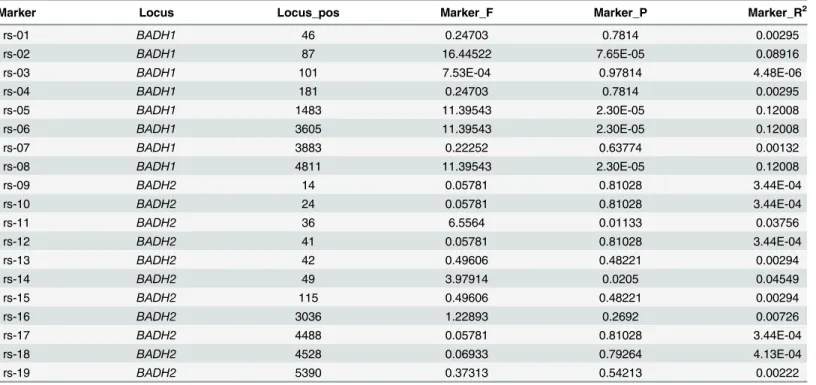
BADH1andBADH2transcribed regions (S3 Table), and subsequently used for the association studies (Table 1).
The association study demonstrated a relatively high correlation (R2) of 0.12 between P11483/P13605/P14811and STI (P<10−4) inBADH1(Table 1andFig 1), while no correlation
was observed inBADH2in this regard. On the other hand, it was found that twoBADH2alleles (P23036, P25390) explain 97% of aroma variation in our germplasm. However, no association
existed between aroma andBADH1(S4 Table). It is suggested thatBADH1andBADH2have different functions in rice.
Extended haplotype homozygosity study
According to the association study, P23036(8-bp deletion in exon 7) is the major allele which is
associated with rice fragrance (S4 Table). P23036also calledbadh2.1by Kovach et al. (2009). Here
we follow the method which was used by Kovach et al. (2009) for domestication study. Firstly, we divided the whole 205 accessions into two subgroups: the one that have 8-bp deletion in exon 7 (badh2.1), and without 8-bp deletion (Wild). Then we investigated the extended haplotype homozygosity ofBADH1andBADH2regions to find the evidence for artificial selections. We calculated the EHH forBAHD2gene by comparing the haplotypes of fragrant (badh2.1) and wild type (with functionalBADH2gene) group. Thebadh2.1had a large LD block that extended around the mutation site, while LD decreased rapidly around the wild type alleles (Fig 2B).
Since the P11483(T/A) allele was significantly correlated with salt tolerance, we separated
the 205 individuals into two subgroups, one included“T”allele (Allele_Tgroup), another one Table 1. The association study of salt tolerance index and candidate regions.
Marker Locus Locus_pos Marker_F Marker_P Marker_R2
rs-01 BADH1 46 0.24703 0.7814 0.00295
rs-02 BADH1 87 16.44522 7.65E-05 0.08916
rs-03 BADH1 101 7.53E-04 0.97814 4.48E-06
rs-04 BADH1 181 0.24703 0.7814 0.00295
rs-05 BADH1 1483 11.39543 2.30E-05 0.12008
rs-06 BADH1 3605 11.39543 2.30E-05 0.12008
rs-07 BADH1 3883 0.22252 0.63774 0.00132
rs-08 BADH1 4811 11.39543 2.30E-05 0.12008
rs-09 BADH2 14 0.05781 0.81028 3.44E-04
rs-10 BADH2 24 0.05781 0.81028 3.44E-04
rs-11 BADH2 36 6.5564 0.01133 0.03756
rs-12 BADH2 41 0.05781 0.81028 3.44E-04
rs-13 BADH2 42 0.49606 0.48221 0.00294
rs-14 BADH2 49 3.97914 0.0205 0.04549
rs-15 BADH2 115 0.49606 0.48221 0.00294
rs-16 BADH2 3036 1.22893 0.2692 0.00726
rs-17 BADH2 4488 0.05781 0.81028 3.44E-04
rs-18 BADH2 4528 0.06933 0.79264 4.13E-04
rs-19 BADH2 5390 0.37313 0.54213 0.00222
Locus_pos: Physical distance from the transcription initiation site of the gene.
included“A”allele (Allele_Agroup). STI values of the“T”allele subgroup were significantly higher than the“A”allele subgroup (P<0.05;Fig 3). The EHH study for theBADH1gene was
compared the extended haplotypes of (P11483A) and wide type (P11483T). However, these two
groups carrying A or T alleles did not exhibit large difference, both of them did not show large extended LD block, reducing rapidly around P11483(Fig 2A).
LD block, nucleotide diversity and Tajima
’
s D analysis in different
subpopulations
In order to find more evidence whether the domestication rate forBADH1andBADH2are dif-ferent, we analyzed the LD block, nucleotide diversity and Tajima’s D for each subgroup. For
BADH2, it clearly showed that wild group has no block inbadh2gene region, whilebadh2.1
group had the block which over 7 kb in the gene region (Fig 4B). The nucleotide diversity study showed that wild group had higher diversity thanbadh2.1in both the flanking 2 Mb ofBADH2
andBADH2gene region. Interestingly, the nucleotide diversity inBADH2gene region was reduced in two subgroups. The wild type was still higher thanbadh2.1and the diversity of
badh2.1was almost as low as 0 (Fig 4D). Using 205 individual’s sequence, we calculated the Tajima’s D value inBADHsregions. It is clearly showed that inBADH2region the Tajima’s D value (less than -1) was significantly biased from the balance (Fig 4F). These three results strongly suggested thatbadh2.1had been artificially selected during the rice domestication.
On the other hand, we failed to find the large LD block inBADH1region in bothAllele_T
group andAllele_Agroup (Fig 4A). The nucleotide diversity study showed that theAllele_T
Fig 1. Associations across transcribed regions ofBADH1andBADH2.
Fig 2. EHH plot across theBADH1andBADH2genomic region.(a) EHH ofBADH1genomic region. Wild type (T) and P11483 (A) did not show large LD block. (b) EHH ofBADH2genomic region. The fragrant accessions carrying the P23036(badh2.1which has 8 bp deletion in exon 7) allele exhibited a large
block of extended LD around the FNP, while wild type allele declined rapidly.
doi:10.1371/journal.pone.0134801.g002
Fig 3. Boxplot of STI (salt tolerance index) for different allele type at P11483(T/A).
group had higher diversity thanAllele_Ain both flanking region and gene region ofBADH1
(Fig 4C), butAllele_Agroup had low diversity level in this region. The Tajima’s D value also kept a stationary value in theBADH1gene region (Fig 4E). From these three analyses, we are failed to get any clear evidence thatBADH1was also selected by human beings, suggesting that
BADH1is not a domesticated gene in rice.
Discussion
Polymorphism and association study
BADH2was widely known as the gene associated with fragrance in rice [11]. As the homolo-gous gene ofBADH2,BADH1is considered to be the candidate gene controlling fragrance or salt tolerance in rice. Recently, Fitzgerald et al. (2010) suggested thatBADH2is also responsible for salt stress tolerance. The relationship between these twoBADHgenes and salt stress toler-ance or fragrtoler-ance in rice is unclear. Various studies have reported conflicting results [1,2,5]. These inconsistencies could be attributable to the differences either in rice germplasm materials or growth stages that they investigated for their studies.
Fig 4. LD block, nucleotide diversity and Tajima’s D inBADHsregions (Green part are the gene regions).(a) LD block ofBADH1at different groups. (b) LD block ofBADH2at different groups (badh2.1 has 8bp deletion in exon 7). (c) Nucleotide diversity ofBADH1region with 3kb slide window. (d) Nucleotide diversity ofBADH2region with 3kb slide window. (e) Tajima’s D ofBADH1region with 3kb slide window. (f) Tajima’s D ofBADH2region with 3kb slide window.
Here, we used whole genome resequencing data to studyBADH1andBADH2genes. For
BADH1, we found a total of 10 genetic variants, seven SNPs were in the exon region and two SNPs and one insertion were in the untranslated region (S1 Table). Among the seven SNPs in exon region, four of them were novel (S1 Fig). It was observed that four SNPs and three inser-tions were detected in the UTR ofBADH2. Three SNPs, two deletions and one insertion were located in the exon region ofBADH2, extending the number ofBADH2exonic alleles from 15 to 18 (S2 TableandS2 Fig) [8–11,13].
After removing the accessions with missing sequence information, we finally discovered eight alleles inBADH1, and eleven alleles inBADH2from the 205 accessions (S3 Table). Eight alleles inBADH1generated 7 haplotypes and eleven alleles result in 9 haplotypes inBADH2
region (S3 Table). We performed the GLM based association study for STI using19 alleles. As a result, we discovered that P11483(T/A), P13605(C/A) in translated region and P14811in the
3’UTR were highly correlated with STI with,P<10−4andR2around 0.12 (Table 1andFig 1). However, similar correlations were not found forBADH2(Table 1), indicatingBADH2may not be associated with salt tolerance.
Fitzgerald et al. (2008) reported that the expression level ofBADH1in leaf tissue is highly asso-ciated in response to salt treatment at the seedling stage. In contrast, such relationship between
BADH2transcript levels and salt treatment has not been found yet. More recently, however, Fitz-gerald et al. (2010) did show a difference between fragrant (badh2) and non-fragrant (BADH2) rice for the ability to produce mature seed in the presence of salt. Tang et al. (2014) proved that
BADH1was associated with rice salt (NaCl) tolerance at seedling stage by using RNAi-directed knock down ofBADH1[32]. Thus,BADH1andBADH2are both suggested to be responsible for salt stress tolerance in rice, but, possibly, at different growth stages. Since our STI was tested at germination stage, we extended the conclusion thatBADH1is response for rice salt stress at ger-mination and seedling stage, whileBADH2may be accountable at the reproductive stage.
P23036(8 bp deletions) and P25390(C/T) were the main alleles that explained the aroma
vari-ation with 74% and 23% respectively (S4 Table), which are consistent with previous studies in that the lack of function ofBADH2has a significant effect on rice aroma [8,11]. However, we found no association betweenBADH1and aroma (S4 Table).
Singh et al. (2010) reported that there’s no association between salt tolerance and common
BADH1but few exceptions. None the less, our results are rather consistent with the result from Fitzgerald et al. (2008), demonstrating thatBADH1(and notBADH2) contributes to salt stress tolerance. However, we cannot exclude the possibility that these contradictions may be resulted from the different conditions undertaken.
Domestication of
BADH1
and
BADH2
Domestication of crops has historically been critical for human reproduction and development. The domestication of rice were explained by several models [11]. The recent increase in molec-ular marker density through next generation sequencing (NGS) technology has facilitated to build more solid hypotheses on the domestication process of rice [11,33]. Investigating the domestication history of a specific gene is one way to decipher the history of rice and its impact on humans [11]. An EHH study ofBADH2led by Kovach et al. (2009) suggested thatBADH2
is one of the domesticated genes responsible for rice fragrance. In this study, we attempted to determine ifBADH1is also a domesticated gene.
The association mapping study identified three alleles (P11483, P13605and P14811) inBADH1
highly correlated with STI. These three alleles were consistently present together in the rice genome. We selected P11483(T/A) as the key allele for an evolution study ofBADH1. To
as Kovach et al. (2009). Our EHH test result was similar to the results of Kovach et al. (2009). The fragrant accessions which carrying 8 bp deletions in exon 7 showed a large LD block extended around the mutation site, while the wild type alleles relatively reduced rapidly (Fig 2B). To obtain more clear evidence, we further investigated LD block, nucleotide diversity, and Tajima’s D for the 4-Mb flanking regions ofBADHs, which had always been tested for mutual verification for a domestication process [11,18,19,34]. ForBADH2, LD block study showed that there were a lot of LD blocks in the fragrant rice group (badh2.1) over 7 kb, while fewer LD blocks were found in wild type group (Fig 4B). The diversity study suggested that all groups show reduced diversity inBADH2gene region, but thebadh2.1approaches zero for this region (Fig 4D). Furthermore, the Tajima’s D test showed a significantly deviated signal inBADH2
region (Fig 4F). All of those results support the conclusions thatbadh2.1was domesticated, which is totally consistent with previous study [11].
Employing the same tests, finding clear domesticated signals forBADH1was difficult. We failed in finding LD blocks inBADH1for the“Allele_A”and“Allele_T”groups (Fig 4A). The diversity ofAllele_Agroup was consistently low without any violent swings inBADH1gene region (Fig 4C). Moreover, Tajima’s D value was not significant forBADH1(Fig 4E). Lastly, EHH was significantly diminished in the twoBADH1groups (Fig 2A). Thus, we concluded thatBADH1had not been domesticated in Asian rice.
Interestingly, Wang et al. (2014) found that the genetic diversity is strongly reduced in the
BADH1region ofO.glaberrima, indicatingBADH1was possibly domesticated inO.glaberrima
[35].O.glaberrimais widely known to be better at tolerating biotic or abiotic stress thanO.
sativa[36]. As a gene associated with abiotic stress tolerance,BADH1was likely domesticated inO.glaberrima, which is not the case forO.sativa[36]. Our results supports that theBADH1
is responsible for salt stress in rice germination stage, explaining 12% variation of phenotype for salt stress inO.sativa(Table 1). However, this effect might not be strong enough to be selected during the evolution of Asian cultivated rice.
Supporting Information
S1 Fig.BADH1allelic diversity in exon region.badh1.3,badh1.5andbadh1.6were detected by previous study [1].badh1.1,badh1.2,badh1.4andbadh1.7were detected in this study. (DOCX)
S2 Fig.BADH2allelic diversity.badh2.1~badh2.2[11];badh2.11~badh2.12,badh2.14[10];
badh2.13[16];badh2.15[12].badh2.16~badh2.18were detected in this study. (DOCX)
S1 Table. Transcribed polymorphism inBADH1.
(DOCX)
S2 Table. Transcribed polymorphism inBADH2.
(DOCX)
S3 Table. Haplotype ofBADH1andBADH2, and phenotype.(Excel) (XLSX)
S4 Table. The association study of aroma and candidate regions.
(DOCX)
Acknowledgments
Author Contributions
Conceived and designed the experiments: QH YP. Performed the experiments: QH JY TK YC YL YP. Analyzed the data: QH. Contributed reagents/materials/analysis tools: YC YP. Wrote the paper: QH TK.
References
1. Singh A, Singh PK, Singh R, Pandit A, Mahato AK, Gupta DK, et al. (2010) SNP haplotypes of the BADH1 gene and their association with aroma in rice (Oryza sativaL.). Mol Breed 26: 325–338. 2. Fitzgerald TL, Waters DLE, Brooks LO, Henry RJ (2010) Fragrance in rice (Oryza sativa) is associated
with reduced yield under salt treatment. Environ Exp Bot 68: 292–300.
3. Sakamoto A, Murata AN (1998) Metabolic engineering of rice leading to biosynthesis of glycinebetaine and tolerance to salt and cold. Plant Mol Biol 38: 1011–1019. PMID:9869407
4. Nakamura T, Yokota S, Muramoto Y, Tsutsui K, Oguri Y, Fukui K, et al. (1997) Expression of a betaine aldehyde dehydrogenase gene in rice, a glycinebetaine nonaccumulator, and possible localization of its protein in peroxisomes. The Plant Journal 11: 1115–1120. PMID:9193078
5. Fitzgerald TL, Waters DLE, Henry RJ (2008) The effect of salt on betaine aldehyde dehydrogenase transcript levels and 2-acetyl-1-pyrroline concentration in fragrant and non-fragrant rice (Oryza sativa). Plant Sci 175: 539–546.
6. Bradbury LM, Gillies SA, Brushett DJ, Waters DL, Henry RJ (2008) Inactivation of an aminoaldehyde dehydrogenase is responsible for fragrance in rice. Plant Mol Biol 68: 439–449. doi: 10.1007/s11103-008-9381-xPMID:18704694
7. Hasthanasombut S, Ntui V, Supaibulwatana K, Mii M, Nakamura I (2010) Expression of Indica rice OsBADH1 gene under salinity stress in transgenic tobacco. Plant Biotechnology Reports 4: 75–83. 8. Bradbury LM, Fitzgerald TL, Henry RJ, Jin Q, Waters DL (2005) The gene for fragrance in rice. Plant
Biotechnol J 3: 363–370. PMID:17129318
9. Shi W, Yang Y, Chen S, Xu M (2008) Discovery of a new fragrance allele and the development of func-tional markers for the breeding of fragrant rice varieties. Mol Breed 22: 185–192.
10. Shao G, Tang S, Chen M, Wei X, He J, Luo J, et al. (2013) Haplotype variation atBadh2, the gene determining fragrance in rice. Genomics 101: 157–162. doi:10.1016/j.ygeno.2012.11.010PMID: 23220350
11. Kovach MJ, Calingacion MN, Fitzgerald MA, McCouch SR (2009) The origin and evolution of fragrance in rice (Oryza sativaL.). Proceedings of the National Academy of Sciences 106: 14444–14449. 12. Shi Y, Zhao G, Xu X, Li J (2014) Discovery of a new fragrance allele and development of functional
markers for identifying diverse fragrant genotypes in rice. Mol Breed 33: 701–708.
13. Bourgis F, Guyot R, Gherbi H, Tailliez E, Amabile I, Salse J, et al. (2008) Characterization of the major fragance gene from an aromatic japonica rice and analysis of its diversity in Asian cultivated rice. Theor Appl Genet 117: 353–368. doi:10.1007/s00122-008-0780-9PMID:18491070
14. Myint KM, Arikit S, Wanchana S, Yoshihashi T, Choowongkomon K, Vanavichit A (2012) A PCR-based marker for a locus conferring the aroma in Myanmar rice (Oryza sativaL.). Theor Appl Genet 125: 887– 896. doi:10.1007/s00122-012-1880-0PMID:22576235
15. Ootsuka K, Takahashi I, Tanaka K, Itani T, Tabuchi H, Yoshihashi T, et al. (2014) Genetic polymor-phisms in Japanese fragrant landraces and novel fragrant allele domesticated in northern Japan. Breeding science 64: 115–124. doi:10.1270/jsbbs.64.115PMID:24987297
16. Amarawathi Y, Singh R, Singh AK, Singh VP, Mohapatra T, Sharma TR, et al. (2008) Mapping of quan-titative trait loci for basmati quality traits in rice (Oryza sativaL.). Mol Breed 21: 49–65.
17. Huang X, Kurata N, Wei X, Wang Z-X, Wang A, Zhao Q, et al. (2012) A map of rice genome variation reveals the origin of cultivated rice. Nature 490: 497–501. doi:10.1038/nature11532PMID:23034647 18. Lam H-M, Xu X, Liu X, Chen W, Yang G, Wong F-L, et al. (2010) Resequencing of 31 wild and
culti-vated soybean genomes identifies patterns of genetic diversity and selection. Nat Genet 42: 1053– 1059. doi:10.1038/ng.715PMID:21076406
19. Xu X, Liu X, Ge S, Jensen JD, Hu F, Li X, et al. (2012) Resequencing 50 accessions of cultivated and wild rice yields markers for identifying agronomically important genes. Nat Biotechnol 30: 105–111. 20. Li C, Zhou A, Sang T (2006) Rice domestication by reducing shattering. science 311: 1936–1939.
21. Sweeney MT, Thomson MJ, Cho YG, Park YJ, Williamson SH, Bustamante CD, et al. (2007) Global dissemination of a single mutation conferring white pericarp in rice. PLoS Genet 3: e133. PMID: 17696613
22. Jin J, Huang W, Gao J-P, Yang J, Shi M, Zhu M-Z, et al. (2008) Genetic control of rice plant architecture under domestication. Nat Genet 40: 1365–1369. doi:10.1038/ng.247PMID:18820696
23. Takano-Kai N, Jiang H, Kubo T, Sweeney M, Matsumoto T, Kanamori H, et al. (2009) Evolutionary his-tory of GS3, a gene conferring grain length in rice. Genetics 182: 1323–1334. doi:10.1534/genetics. 109.103002PMID:19506305
24. Kim K-W, Chung H-K, Cho G-T, Ma K-H, Chandrabalan D, Gwag J-G, et al. (2007) PowerCore: a pro-gram applying the advanced M strategy with a heuristic search for establishing core sets. Bioinformat-ics 23: 2155–2162. PMID:17586551
25. Zhao W, Cho G-T, Ma K-H, Chung J-W, Gwag J-G, Park Y-J (2010) Development of an allele-mining set in rice using a heuristic algorithm and SSR genotype data with least redundancy for the post-geno-mic era. Mol Breed 26: 639–651.
26. Li H, Durbin R (2009) Fast and accurate short read alignment with Burrows–Wheeler transform. Bioin-formatics 25: 1754–1760. doi:10.1093/bioinformatics/btp324PMID:19451168
27. McKenna A, Hanna M, Banks E, Sivachenko A, Cibulskis K, Kernytsky A, et al. (2010) The Genome Analysis Toolkit: a MapReduce framework for analyzing next-generation DNA sequencing data. Genome Res 20: 1297–1303. doi:10.1101/gr.107524.110PMID:20644199
28. Bradbury PJ, Zhang Z, Kroon DE, Casstevens TM, Ramdoss Y, Buckler ES (2007) TASSEL: software for association mapping of complex traits in diverse samples. Bioinformatics 23: 2633–2635. PMID: 17586829
29. Barrett JC, Fry B, Maller J, Daly MJ (2005) Haploview: analysis and visualization of LD and haplotype maps. Bioinformatics 21: 263–265. PMID:15297300
30. Danecek P, Auton A, Abecasis G, Albers CA, Banks E, DePristo MA, et al. (2011) The variant call for-mat and VCFtools. Bioinforfor-matics 27: 2156–2158. doi:10.1093/bioinformatics/btr330PMID:21653522 31. Gautier M, Vitalis R (2012) rehh: an R package to detect footprints of selection in genome-wide SNP
data from haplotype structure. Bioinformatics 28: 1176–1177. doi:10.1093/bioinformatics/bts115 PMID:22402612
32. Tang W, Sun J, Liu J, Liu F, Yan J, Gou X, et al. (2014) RNAi-directed downregulation of betaine alde-hyde dehydrogenase 1 (OsBADH1) results in decreased stress tolerance and increased oxidative markers without affecting glycine betaine biosynthesis in rice (Oryza sativa). Plant Mol Biol 86: 443– 454. doi:10.1007/s11103-014-0239-0PMID:25150410
33. Huang X, Wei X, Sang T, Zhao Q, Feng Q, Zhao Y, et al. (2010) Genome-wide association studies of 14 agronomic traits in rice landraces. Nat Genet 42: 961–967. doi:10.1038/ng.695PMID:20972439 34. Jin L, Lu Y, Xiao P, Sun M, Corke H, Bao J (2010) Genetic diversity and population structure of a
diverse set of rice germplasm for association mapping. Theor Appl Genet 121: 475–487. doi:10.1007/ s00122-010-1324-7PMID:20364375
35. Wang M, Yu Y, Haberer G, Marri PR, Fan C, Goicoechea JL, et al. (2014) The genome sequence of African rice (Oryza glaberrima) and evidence for independent domestication. Nat Genet.