AbstrAct: The increasing demand for food creates environmental problems, mainly due to the removal of native vegetation cover for agriculture expansion in Brazil. These changes in land use lead to changes in the soil organic matter dynamics. Microorganisms represent the most biological and physiological diversity in soil, as well as are responsible for more than 95% of the decomposition and nutrient cycling processes. The objective in this research was to check if there is difference of patterns in activity of soil microbial biomass under varied natural vegetation, pastures in use and agricultural systems recently established. The area covered by this study corresponds to the states of Rondônia and Mato Grosso. Canonical variate analysis was used in physical, chemical and
soil And PlAnt nutrition - Article
Activity of soil microbial biomass altered by
land use in the southwestern Amazon
André Mancebo Mazzetto1*, Carlos Eduardo Pellegrino Cerri1, Brigitte Josefine Feigl2, Carlos Clemente Cerri2
1. University of São Paulo - Higher School of Agriculture “Luiz de Queiroz” - Department of Soil Sciences - Piracicaba (SP), Brazil.
2. University of São Paulo - Center of Nuclear Energy in Agriculture - Laboratory of Environmental Biogeochemistry - Piracicaba (SP), Brazil.
*Corresponding author: [email protected]
Received: Feb. 20, 2015 – Accepted: Jul. 24, 2015
microbiological factors in each ecoregion and land use, looking for patterns and variables that can differentiate them. The native areas showed distinct patterns in the dynamics of microbiological attributes mainly related to the amount of litter in each biome studied. For the disturbed areas, there were similar results between pastures and native areas, significantly different from the results obtained in agricultural areas, which, due to differences in management and kind of cultures analyzed, showed a great variability in the final result. The results support the recommendation for use of microbiological attributes as indicators of land use change, combined with chemical and physical factors of the soil.
introduction
The growing demand for food, fiber and biofuel creates various environmental problems, mainly caused by the disorderly occupation of the largest agricultural border in the world, that between the Amazon Forest and the Cerrado of Central Brazil (Borlaug 2002). The flat relief facilitates the use of machines, making the occupation of this area relatively easy. In the southwestern Amazonia, the states of Rondônia (RO) and Mato Grosso (MT) are the major ones that promote deforestation for agricultural land use (INPE 2006).
The intensive land use causes negative effects on both the environment and the agricultural productivity when conservation practices are not adopted (Cerri et al. 2004; Foley et al. 2005). There are concerns regarding soil quality alterations for a long period or even in an irreversible way. Soil microbiota is an important part of biogeochemical cycles and has a key role in developing and maintaining soil structure and quality (Allen and Schlesinger 2004). The microbial biomass is the living and active part of the soil and can indicate changes in the amount of nutrients due to changes in land use (Brookes 2001). After the alteration, microbial biomass fluctuates to reach a new equilibrium (Powlson et al. 1987). In this way, the demand for rapid and reliable indicators to detect changes in soil quality has been continuously growing, mainly those based on microorganisms (Anderson 2003; Ananyeva et al. 2008).
In most soils subjected to agricultural practices, niches available are affected by the interference with soil properties. Each major change is a renewal of selection pressure favoring some microbial components and eliminating others, reorganizing the equilibrium among populations. If there is a reduction in microbial diversity, some species capable of metabolizing certain functional groups are lost, resulting in a reduction in system resilience (van Heerden et al. 2002).
This study aimed to add new information on the alterations resulting from changes in land use and their impact on soil microbial biomass. The goal was to evaluate the change in soil microbial biomass activity after human interference with the natural vegetation for land use as pasture and farming areas in the southwestern Amazon.
MAtEriAl And MEtHods
Study area
The study area corresponds to the states of Rondônia and Mato Grosso. The southwestern Amazon is an area of transition between the Amazon Basin and the Brazilian Central Plateau, located between 7° and 18° South latitude and between 50° and 67°West longitude, forming a watershed between the Amazon Basin to the north and the Paraná Basin to the south. This region is one of the largest agricultural frontiers in the world,
covering an area of approximately 1,128,000 km2 in
these states. The climate varies according to latitude and can be characterized by a humid tropical regime with a short dry season. Maia et al. (2009, 2010) described the soils of the region studied as mainly represented by Oxisols, Ultisols and Entisols, with about 40, 20 and 15%, respectively.
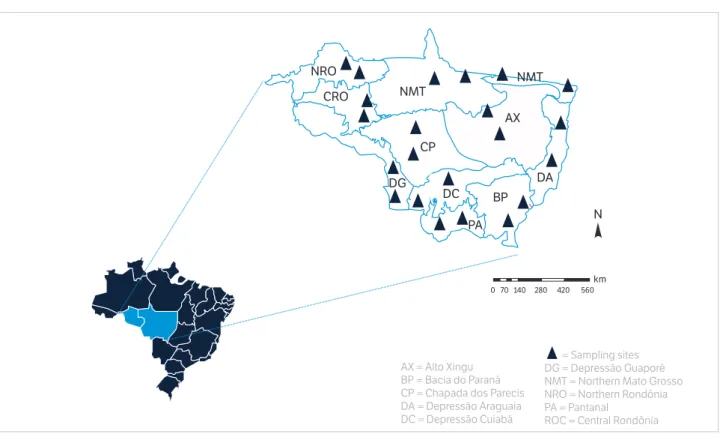
To better select the sampling sites, the total area of the states of Rondônia and Mato Grosso was divided into 11 biogeoclimatic macroareas (Figure 1). The division was made using the Geographic Information System ArcGIS 9.0 by the overlapping of information layers related to soil, native vegetation, geology, climate and topography in order to find relatively homogeneous areas, making it possible to determine the soil properties to be carefully extrapolated to the whole ecoregion. Full description of the type of soil, climate, vegetation, topography and geology of each ecoregion can be found in Maia et al. (2009, 2010).
In each ecoregion, two municipalities were drawn to evaluate the physical, chemical and microbiological attributes of the soil due to the change in land use, totaling 22 municipalities (Figure 1). At these sites, soil samplings were conducted in representative pairs regarding the use and change of land use for determining the carbon stock. Sampling pairs are characterized by native system (reference), pasture and agricultural area.
Sampling
samples were homogenized and sieved with the aid of a 2-mm sieve to remove non-decomposed material.
Soil basal respiration
Soil basal respiration (BR) was determined by carbon dioxide (CO2) emission. Soil samples (5 g of dry weight)
were pre-incubated in 250-mL flasks at 25 °C for three days. The tubes were then sealed, and CO2 concentration
was measured after 8 h of incubation by collecting
2 mL of gas using BD syringes. CO2 production was
determined by an infrared gas analyzer (infra-red gas analyzer — IRGA).
Microbial biomass carbon and nitrogen
The microbial biomass carbon (MB-C) was determined by fumigation-extraction method (Vance et al. 1987). Extracts were analyzed for organic carbon content (Shimadzu - TOC 5000A), and microbial biomass was determined by the difference between the values obtained in fumigated and non-fumigated samples. To determine the microbial biomass nitrogen (MB-N), the extracts
were analyzed by the Ninhydrin method (Joergensen and Brookes 1990).
Chemical and physical characterization of the soil
The total carbon content (C%) of the samples was determined by dry combustion in an elemental analyzer LECO CN-2000. To calculate the apparent bulk density, undisturbed soil samples were collected with the aid of a stainless steel cylinder (5 × 5 cm). The apparent bulk density was determined according to Blake and Hartge (1986). The carbon stock was calculated by multiplying its content by soil density at the 0 – 10 cm layer. The pH
was determined in H2O and KCl (1.0 mol∙L
–1) using a
soil : solution ratio of 1 : 2.5.
Statistical analysis
The results were grouped into different categories as to land use (pasture — PAST; agricultural areas — AGR; native areas — NAT). The analysis of variance (ANOVA; α = 0.001) was applied to test the differences between Figure 1. Distribution of the ecoregions in the study area.
ROC NRO
NMT
AX
AX
BP CP
DA
N DC
DG NMT
NMT CRO
PA
km
560 420 280 140 70 0 NRO
AX = Alto Xingu BP = Bacia do Paraná CP = Chapada dos Parecis DA = Depressão Araguaia DC = Depressão Cuiabá
= Sampling sites DG = Depressão Guaporé NMT = Northern Mato Grosso NRO = Northern Rondônia PA = Pantanal
land uses. Canonical variate analysis was run considering the microbiological data obtained in this study and then adding the chemical and physical data of the soil. All statistical analyses were performed using the statistical package GenStat 11 and GenStat Discovery Edition 3 (VSN International Ltd., Herts., UK).
rEsults
MB-C ranged from 0.04 to 1.75 g C per kg soil. MB-N ranged from 0.12 to 108.4 mg N per kg soil. Microbial activity, measured as soil respiration, ranged from 0.07 to 1.82 μg CO2 per g soil·h. In general, there was a
great similarity between the values of native areas and pastures, with significant differences from agricultural areas (Table 1).
The relationship between carbon immobilized in the microbial biomass and total soil organic carbon also followed the same trend, i.e. 25% higher in pasture areas. The metabolic quotient (qCO2 — ratio between
basal respiration and quantity of microbial biomass) was higher in native areas (1.7 times higher than in agricultural areas and 2.2 times higher than in pastures; Table 1). Soil properties also presented significant
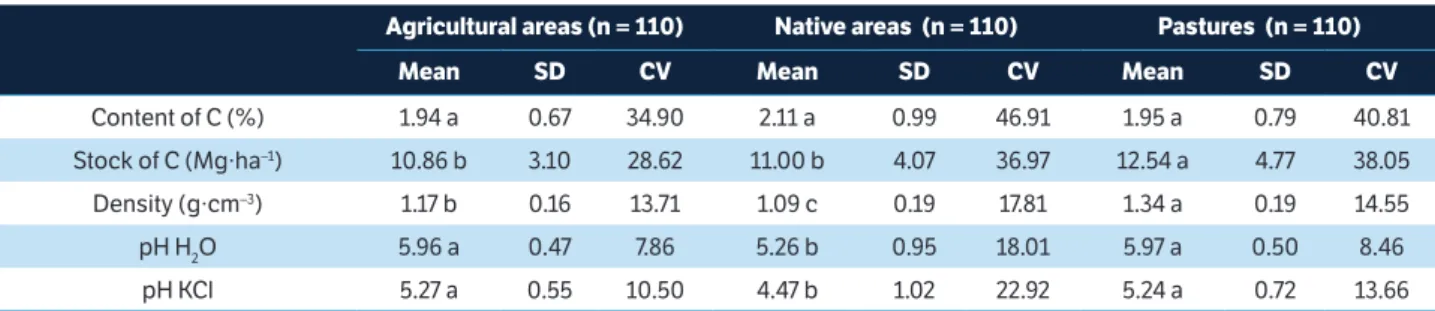
differences between the areas analyzed, except for the total soil carbon (Table 2), with the highest values found in pasture areas.
In pasture areas, the carbon content had a highly significant correlation (p < 0.01) with the three studied microbiological attributes (basal respiration — r2 = 0.29,
MB-C and MB-N — r2 = 0.43), while pH KCl had a
high correlation with basal respiration (r2 = 0.38). In
agricultural areas, it was only found a highly positive correlation between basal respiration and carbon stock (r2 = 0.21). In turn, in native areas, MB-N showed a
correlation with pH H2O (r
2 = 0.60), pH KCl (r2 = 0.63)
and carbon stock (r2 = 0.55).
The canonical analysis restricted to microbiological data demonstrated no clear distinction between pastures and native areas. An overlap of the confidence regions was observed between pasture and native areas (Figure 2). This overlap reflects the great variability in the database. On the other hand, the canonical analysis distinguished pastures and native areas from agricultural areas (Figure 2). The key attributes accounting for this separation were basal respiration and MB-C with high values of canonical vectors for the canonical axis 1 (CV1), which explains 72.84% of the observed variation (Table 3). The canonical axis 2 (CV2) explained 27.16% of the observed variation, once
Agricultural areas native areas Pastures
Mean sd cV Mean sd cV Mean sd cV
Basal respiration (ug CO2 per g soil·h)
0.37 b 0.04 21.44 0.46 a 0.04 24.89 0.50 a 0.04 38.06
MB-C (g C per kg soil) 0.53 b 0.07 41.29 0.55 b 0.07 55.50 0.69 a 0.07 25.29
MB-N (mg N per kg soil) 17.85 b 7.09 90.19 37.89 a 7.09 83.20 37.16 a 7.09 71.00
MB-C : Corg 2.98 b 0.45 49.51 3.05 b 0.45 64.65 4.08 a 0.45 33.14
qCO2 1.01 b 0.49 97.14 1.71 a 0.49 169.00 0.76 b 0.49 45.09 table 1. Microbiological attributes in the study area.
Means followed by different letters in the same row are significantly different by Tukey’s test (p < 0.05). SD = Standard deviation; CV = Coefficient of variation; MB-C = Microbial biomass carbon; MB-N = Microbial biomass nitrogen; Corg = Organic carbon; q = metabolic quocient.
Agricultural areas (n = 110) native areas (n = 110) Pastures (n = 110)
Mean sd cV Mean sd cV Mean sd cV
Content of C (%) 1.94 a 0.67 34.90 2.11 a 0.99 46.91 1.95 a 0.79 40.81
Stock of C (Mg∙ha–1) 10.86 b 3.10 28.62 11.00 b 4.07 36.97 12.54 a 4.77 38.05
Density (g∙cm–3) 1.17 b 0.16 13.71 1.09 c 0.19 17.81 1.34 a 0.19 14.55
pH H2O 5.96 a 0.47 7.86 5.26 b 0.95 18.01 5.97 a 0.50 8.46
pH KCl 5.27 a 0.55 10.50 4.47 b 1.02 22.92 5.24 a 0.72 13.66
table 2. Physical and chemical properties in the study area.
again especially for MB-C and basal respiration, while MB-N did not contribute significantly to the separation of land uses on any of the axes (Table 3).
When combining the results of physical and chemical data with the microbiological data, the separation of land uses becomes more evident. Most of the variability found was explained by CV1, which separated native and agricultural areas (Figure 3). The separation is confirmed by canonical scores of the first axis, being positive for native areas and negative for agriculture areas and pastures (Table 3). Soil density had a highly negative value related to CV1, representing the main factor for the separation verified in this axis. Other important factors
in CV1 include MB-C and pH H2O (Table 3). The CV2
explained 40.25% and distinguished pastures and native areas from agricultural areas, as demonstrated by the negative scores of pasture and native areas compared to the positive score of agricultural areas. As well as in CV1, the main factor for CV2 has been soil density, but the basal respiration and total soil carbon also contributed to this separation (Table 3).
Figure 2. Canonical analysis considering only microbiological attributes.
Figure 3. Canonical analysis considering microbiological, physical and chemical soil properties.
PAST
NAT
AGR
CV2 (27.16%) –1
0 1 2 3 4
4 5
2 1 0
–1 3
CV1 (
72.8
4%)
AGR ( ) = Agricultural areas NAT ( ) = Native areas PAST ( ) = Pastures
PAST
NAT
AGR
CV2 ( 5%)
–3 –2 –1 0 1 2 3
3
2 4
0 –1 –2
–3 3
CV1 (5
9
.7
5%)
AGR ( ) = Agricultural areas NAT ( ) = Native areas PAST ( ) = Pastures Microbiological data Microbiological, physical
and chemical data
Variation (%)
CV1 72.84 CV1 59.75
CV2 27.16 CV2 40.25
Total 100.00 Total 100.00
Vectors
CV1 CV2 CV1 CV2
MB-C 1.39 −4.99 BR 0.4 4.43
MB-N 0.02 0.04 C% 0.3 1.72
BR 5.71 −1.57 2.00 −0.90
Stock of C −0.05 −0.01
Density 6.42 6.90
MB-N −0.04 0.01
pH H2O 1.12 0.01
pH KCl 0.04 −1.05
canonical mean
CV1 CV2 CV1 CV2
AGR −0.74 −0.14 AGR −0.71 1.2
NAT 0.18 0.46 NAT 1.62 −0.10
PAST 0.56 −0.32 PAST −0.09 −1.10 table 3. Canonical variate analysis of the study area..
CV1 = Canonical axis 1; CV2 = Canonical axis 2; MB-C = Microbial biomass carbon; MB-N = Microbial biomass nitrogen; BR = Basal respiration; C% = Carbon content; AGR = Agricultural areas; NAT = Native areas; PAST = Pastures.
discussion
The similarities between pasture and native areas may be related to equivalent carbon stock, while the different behavior presented by agricultural areas may be related to soil management and the different types of crops found in the region (soybean, corn, rice, cocoa, coffee etc.). The highest values of MB-C : Corg were registered in pastures followed by native and agricultural areas (Table 1). Jakelaitis et al. (2008) also reported the same sequence. According to Balota et al. (1998), soils with high and low values of MB-C : Corg may represent, respectively, accumulation or loss of soil C. These values confirm the percentage proposed by Jenkinson and Ladd (1981), who considered that usually 1 to 4% of the total soil carbon correspond to the microbial component. This relationship indicates the soil organic matter (SOM) quality, as it allows to track disturbances promoted by ecological imbalance and changes in total SOM caused by management, reacting faster than the physical-chemical indicators (Alvarez et al. 1995). Santos et al. (2004) and Fialho et al. (2006) also presented higher values of qCO2 in
native areas. Mader et al. (2002) evaluated agroecosystems for 21 years and verified a high negative correlation between qCO2 and microbial diversity. The low values found in pastures
and agricultural areas suggest that the microbial biomass in these areas is more efficient in the energy use, characterizing more stable environments (Chaer 2001), and that these areas have also higher microbial diversity (Mader et al. 2002). Dinesh et al. (2003) assign higher values of qCO2, such as
those found in the present study (1.71), to native areas due to the large amount of C content available for degradation by soil microorganisms.
The high values of microbiological attributes observed in pasture soils in relation to native areas are mainly because most pastures analyzed herein are old, between 10 and 25 years of planting. Besides the pasture age, it is also considered the overall increase of C from the photosynthesis performed by grasses (Feigl et al. 1995). Cerri et al. (2003, 2004) made simulations modeling the dynamics of SOM in pasture soils and demonstrated an increase in carbon stock in the long term (100 years) compared to native areas. Other studies show that, after several years of cultivation, the total concentration of carbon in pasture soils is comparable to those of forests (Cerri et al. 2003). The fine root biomass is a factor that can affect the response of microbiological attributes in the pasture system, with a positive correlation with the microbial biomass and with the water content of the soil (Luizão et al. 1999; Rangel and Silva 2007). The high basal respiration
verified in degraded pastures may be related to the diversity of weeds, which have diversified root systems, promoting greater aeration and oxygenation of the soil and increasing the input of nutrients through the litter and exudates produced by different plant species. The highest nitrogen content of the microbial biomass in degraded pastures may indirectly indicate a change in taxonomic groups comprising the microbial biomass. Management such as pasture, where there is not soil disturbance, allows lower flow of CO2 into
the atmosphere due to less mineralization of SOM (Bayer et al. 2000), besides the large input of nutrients that enables, in a long term, an increase in its content (Carneiro et al. 2008). Due to similarities of microbiological attributes between native forests and pastures, the separation was only possible after the inclusion of physical and chemical factors, especially density (Table 3), which was significantly higher in pastures (Table 2). Other factors that may favor the development of microbial biomass in pastures are the grazing pressure, which results in an increase in the carbon and nitrogen of microbial biomass (Wang et al. 2006), and livestock excreta, which acts as a natural fertilizer (Saviozzi et al. 2001; Iyyemperumal et al. 2007).
Agricultural areas have significantly lower values of microbiological attributes due to anthropogenic influence in this land use. Soils under natural vegetation present a stable carbon stock due to the dynamic equilibrium of soil CO2 emission and the amount of organic matter
conclusion
Microbiological attributes are efficient for separation of land uses assessed in southwestern Amazon when combined with chemical and physical soil properties. When used alone, the microbiological attributes do not distinguish native areas from pastures, thus indicating
a high similarity in the behavior of microbial biomass in these two areas. Soil density contributes significantly to strengthen the differences between native areas and pastures. The canonical variable analysis highlights the key attributes for the separation of land uses and ecoregions analyzed, representing a simple multivariate technique of easy application, with practical results.
rEFErEncEs
Allen, A. S. and Schlesinger, W. H. (2004). Nutrient limitations to
soil microbial biomass and activity in loblolly pine forests. Soil
Biology and Biochemistry, 36, 581-589. http://dx.doi.org/10.1016/j. soilbio.2003.12.002.
Alvarez, R., Díaz, R. A., Barbero, N., Santanatoglia, O. J. and Blotta,
L. (1995). Soil organic carbon, microbial biomass and CO2-C
production from tree tillage systems. Soil and Tillage Research,
33, 17-28. http://dx.doi.org/10.1016/0167-1987(94)00432-E.
Ananyeva, N. D., Susyan, E. A., Chernova, O. V. and Wirth, S. (2008).
Microbial respiration activities of soil from different climatic regions
of European Russia. European Journal of Soil Biology, 44, 147-157.
http://dx.doi.org/10.1016/j.ejsobi.2007.05.002.
Anderson, T. H. (2003). Microbial eco-physiological indicators
to asses soil quality. Agriculture, Ecosystems and Environment,
98, 285-293. http://dx.doi.org/10.1016/S0167-8809(03)00088-4.
Balota, E. L., Colozzi-Filho, A., Andrade, D. S. and Hungria, M. (1998).
Biomassa microbiana e sua atividade em solos sob diferentes
sistemas de preparo e sucessão de culturas. Revista Brasileira
de Ciência do Solo, 22, 641-649.
Bayer, C., Mielniczuk, J. and Martin-Neto, L. (2000). Efeito de
sistemas de preparo e de cultura na dinâmica da matéria orgânica
e na mitigação das emissões de CO2. Revista Brasileira de Ciência
do Solo, 24, 599- 607.
Blake, G. R. and Hartge, K. H. (1986). Bulk density. In A. Klute
(Ed.), Methods of soil analysis. Part 1: physical and mineralogical
methods (p. 364-367). Madison: American Society of Agronomy.
Borlaug, N. E. (2002). Feeding a word of 10 billion people: the
miracle ahead. In R. Bailey (Ed.), Global warming and other
eco-myths (p. 29-60). Roseville: Competitive Enterprise Institute.
Brookes, P. C. (2001). The soil microbial biomass: concept,
measurement and applications in soil ecosystem research. Microbes
Environment, 16, 131-140. http://dx.doi.org/10.1264/jsme2.2001.131.
Carmo, J. B., Piccolo, M. C., Andrade, C. A., Cerri, C. E. P., Feigl,
B. J., Souza Neto, E. and Cerri, C. C. (2007). Short-term chances
in nitrogen availability, gas fluxes (CO2, NO, NO2) and microbial
biomass after tillage during pasture re-establishment in Rondônia,
Brazil. Soil and Tillage Research,96, 250-259.
Carneiro, M. C., Assis, P. C. R, Melo, L. B. C., Pereira, H. S., Paulino,
H. B. and Silveira Neto, A. N. (2008). Atributos bioquímicos em
dois solos de Cerrado sob diferentes sistemas de manejo e uso.
Pesquisa Agropecuária Tropical,38, 276-283.
Cerri, C. E. P., Coleman, K., Jenkinson, D. S., Bernoux, M., Victoria, R.
and Cerri, C. C. (2003). Modeling soil carbon from forest and pasture
ecosystems of Amazon, Brazil. Soil Science Society of America
Journal, 67, 1879-1887. http://dx.doi.org/10.2136/sssaj2003.1879.
Cerri, C. E. P., Paustian, K., Bernoux, M., Victoria, R. L., Mellilo, J.
and Cerri, C. C. (2004). Modeling changes in soil organic matter in
Amazon forest to pasture conversion with Century model. Global
Change Biology, 10, 815-832.
Chaer, G. M. (2001). Modelos para determinação de índice de
qualidade do solo baseado em indicadores físicos, químicos
e biológicos (Dissertação de mestrado). Viçosa: Universidade
Federal de Viçosa.
Dinesh, R., Chaudhuri, S. G., Ganeshamurthy, A. N. and Dey, C. (2003).
Changes in soil microbial indices and their relationships following
deforestation and cultivation in wet tropical forests. Applied Soil
Ecology, 24, 17-23. http://dx.doi.org/10.1016/S0929-1393(03)00070-2.
Feigl, B. J., Sparling, G. P., Ross, D. J. and Cerri, C. C. (1995). Soil
estimates of pool sizes. Soil Biology Biochemistry, 27, 1467-1472.
http://dx.doi.org/10.1016/0038-0717(95)00063-K.
Fialho, J. S., Gomes, V. F. F., Oliveira, T. S. and Silva Júnior, J. M. T.
(2006). Indicadores da qualidade do solo em áreas de vegetação
natural e cultivo de bananeiras na Chapada do Apodi - CE. Revista
Ciência Agronômica,37, 250-257.
Foley, J. A., Defries, R., Asner, G. P., Barford, C., Bonan, G., Carpenter,
S. R., Chapin, F. S., Coe, M. T., Daily, G., Gibbs, H. K., Helkowski, J.
H., Holloway, T., Howard, E. A., Kucharik, C. J., Monfreda, C., Patz,
J. A., Prentice, I. C., Ramankutty, N. and Snyder, P. K. (2005). Global
consequences of land use. Science, 309, 570-574. http://dx.doi.org/ 10.1126/science.1111772.
Instituto Nacional de Pesquisas Espaciais (2006). Projeto PRODES:
Monitoramento da floresta amazônica brasileira por satélite;
[accessed 2015 Nov 23]. http://www.obt.inpe.br/prodes/index.html
Iyyemperumal, K., Israel, D. W. and Shi, W. (2007). Soil microbial
biomass, activity and potential nitrogen mineralization in a pasture:
impact of stock camping activity. Soil Biology and Biochemistry,
39, 149-157. http://dx.doi.org/10.1016/j.soilbio.2006.07.002.
Jakelaitis, A., Silva, A. A., Santos, J. B. and Vivian, R. (2008).
Qualidade da camada superficial de solo sob mata, pastagens
e áreas cultivadas. Pesquisa Agropecuária Tropical, 38, 118-1127.
Jenkinson, E. S. and Ladd, J. N. (1981). Microbial biomass in soil
measurement and turnover. In E. A. Paul e J. N. Ladd (Eds.), Soil
biochemistry (p. 415-471). New York: Marcel Dekker.
Joergensen, R. G. and Brookes, P. C. (1990). Ninhydrin-reactive nitrogen
measurements of microbial biomass in 0.5 M K2SO4 soil extracts.
Soil Biology and Biochemistry,22, 1023-1027. http://dx.doi.org/ 10.1016/0038-0717(90)90027-W.
Luizão, R. C. C., Costa, E. S. and Luizão, F. J. (1999). Mudanças na
biomassa microbiana e nas transformações de nitrogênio em uma
sequência de idades de pastagens após derruba e queima da
floresta na Amazônia Central. Acta Amazonica,29, 43-56.
Mader, P., Fliebach, A., Dubois, A., Gunst, L., Fried, P. and Niggli, U.
(2002). Soil fertility and biodiversity in organic farming. Science,
296, 1694-1697. http://dx.doi.org/10.1126/science.1071148.
Maia, S. M. F., Ogle, S. M., Cerri, C. C. and Cerri, C. E. P. (2010).
Changes in soil organic carbon storage under different agricultural
management systems in the Southwest Amazon Region of Brazil.
Soil and Tillage Research, 106, 177-184. http://dx.doi.org/10.1016/ j.still.2009.12.005.
Maia, S. M. F., Ogle, S. M., Cerri, C. E. P. and Cerri, C. C. (2009). Effect of
grassland management on soil carbon sequestration in Rondônia and
Mato Grosso states, Brazil. Geoderma, 149, 84-91. http://dx.doi.org/ 10.1016/j.geoderma.2008.11.023.
Muñoz-Leoz, B., Ruiz-Romera, E., Antigüedad, I. and Garbisu, C. (2011).
Tebuconazole application decreases soil microbial biomass and
activity. Soil Biology and Biochemistry, 43, 2176-2183. http://dx.doi.org/ 10.1016/j.soilbio.2011.07.001.
Powlson, D. S., Prookes, P. C. and Christensen, B. T. (1987).
Measurement of soil microbial biomass provides an early
indication of changes in total soil organic matter due to straw
incorporation. Soil Biology and Biochemistry, 19, 159-164.
http://dx.doi.org/10.1016/0038-0717(87)90076-9.
Rangel, O. J. P. and Silva, C. A. (2007). Estoques de carbono e
nitrogênio e frações orgânicas de latossolo submetido a diferentes
sistemas de uso e manejo. Revista Brasileira de Ciência do Solo, 31,
1609-1623. http://dx.doi.org/10.1590/S0100-06832007000600037.
Reyes-Reyes, B. G., Alcántara-Hernández, R., Rodríguez, V.,
Olalde-Portugal, V. and Dendooven, L. (2007). Microbial biomass in a semi
arid soil of the central highlands of Mexico cultivated with maize
or under natural vegetation. European Journal of Soil Biology, 43,
180-188. http://dx.doi.org/10.1016/j.ejsobi.2007.02.001.
Santos, V. B., Castilhos, D. D., Castilhos, R. M. V., Pauletto, E. A.,
Gomes, A. S. and Silva, D. G. (2004). Biomassa, atividade microbiana
e teores de carbono e nitrogênio totais de um planossolo sob
diferentes sistemas de manejo. Revista Brasileira de Agrociência,
10, 333-338.
Saviozzi, A., Levi-Minzi, R., Cardelli, R. and Riffaldi, R. (2001). A
comparison of soil quality in adjacent cultivated forest and native
grassland soils. Plant and Soil, 233, 251-259. http://dx.doi.org/ 10.1023/A:1010526209076.
Van Heerden, J., Korf, C., Ehlers, M. M. and Cloete, T. E. (2002).
Biolog for the determination of diversity in microbial communities.
Water AS, 28, 29-35.
Vance, E. D., Brookes, P. C. and Jenkinson, D. S. (1987). An
extration method for measuring soil microbial biomass C.
Soil Biology and Biochemistry, 19, 703-707. http://dx.doi.org/ 10.1016/0038-0717(87)90052-6.
Wang, K. H., Mcsorley, R., Bohlen, P. and Gathumbi, S. M. (2006).
Cattle grazing increases microbial biomass and alters soil nematode
communities in subtropical pastures. Soil Biology and Biochemistry,