Palavras chave: Polietileno Polipropileno Fibras naturais Agente de acoplamento Propriedades mecânicas Histórico: Recebido 23/06/2016
Aceito 17/11/2016 Keywords: Polyethylene Polypropylene
Natural fibers Coupling agent Mechanical properties
1 Gorgan University of Agricultural Sciences and Natural Resources, Gorgan, Golestan, Iran 2 Federal University of Lavras, Lavras, Minas Gerais, Brazil
+Correspondência: [email protected]
DOI: 10.1590/01047760201622042192
Hossein Mohammadi1, Seyedmohammad Mirmehdi2+, Lisiane Nunes Hugen2
RICE STRAW/THERMOPLASTIC COMPOSITE: EFFECT OF FILLER LOADING, POLYMER TYPE AND MOISTURE ABSORPTION ON THE PERFORMANCE
ABSTRAT: Thermoplastic composites made with 45, 60 and 75% of rice straw as filler and two types of thermoplastics, virgin polyethylene (PE) and polypropylene (PP) were
evaluated. The final boards were made with and without maleic anhydride modified polypropylene (MAPP) at 2% of the total weight of each specimen. The flexural and
tensile strengths were measured for dry composites and also measured after 24 h of water
immersion of the composites (wet condition). By increasing the filler content, the flexural and tensile strengths and also the density of the specimens decreased. The type of matrix (PE or PP) did not affect significantly the flexural strength, but PP led to higher values of tensile strength for low fiber loadings (45% and 60%). Coupling agents increased the flexural and tensile strength. After water immersion, modulus of elasticity and modulus of rupture were decreased, while tensile strength was less influenced.
COMPÓSITO TERMOPLÁSTICO/PALHA DE ARROZ: EFEITO DA CARGA DE ENCHIMENTO, TIPO DE POLÍMERO E ABSORÇÃO DE UMIDADE NO DESEMPENHO
RESUMO: Foram avaliados compósitos termoplásticos feitos com 45, 60 e 75% de palha de arroz como material de enchimento e dois tipos de termoplásticos, polietileno virgem
(PE) e polipropileno (PP). As placas finais foram feitas com e sem polipropileno modificado
com anidrido maleico (MAPP) a 2% do peso total de cada amostra. As resistências à
TYPE AND MOISTURE ABSORPTION ON THE PERFORMANCE
INTRODUCTION
As open-field burning of rice straw is being
phased out in the north of Iran and government agencies are looking for new rice straw uses as a lignocellulosic
residue. Any substance that contains carbohydrate
polymers, cellulose and hemicellulose and an aromatic polymer, lignin, is a lignocellulosic. Lignocellulosic includes types of wood, agricultural crops, like kenaf;
agricultural residues, such as bagasse, corn stalks and
rice stalk, agricultural pruning residue such as date palm
fronds and other plant substances (MIRMEHDI et al.,
2014). In general, what is true for wood is also true for other lignocellulosics even though they may differ in
chemical composition and matrix morphology, in fact these kind of natural lignocellulosic fibers are available in
many different forms and produce different properties
when added to thermoplastics (GILBERT, 1994; SANADI et al., 1995; ZAINI et al., 1995). These natural fibers are sustainable and available in large quantities and may be renewed annually. They are non-abrasive and possess high specific properties (ELGHARBAWY et al., 2016; DAYLAN; CILIZ, 2016).
The total area under rice in Iran is more than 600,000 ha and rice is grown in 15 provinces. However, more than 80 percent of rice area is distributed in the southern shores of the Caspian Sea (RANI, 2016) thus, there is a large amount of agricultural waste from rice harvests in these areas that can be considered and used as raw material in the manufacture of the lignocellulosic composites.
The properties of natural fiber/thermoplastic composites are influenced by the type of polymer,
processing method and the type and content of
natural fiber. The mechanical properties of wood fiber composites may not be significantly affected by wood fiber type (PARPARITA, 2014), but it has also been reported that the type of lignocellulose fiber and
the lignin, cellulose and hemicellulose content have
a strong influence on mechanical properties (HABIBI et al., 2008). Polymers that have been used in natural fiber-reinforced thermoplastic composites include
low and high-density polyethylene, polypropylene, polystyrene. The source of polymer as virgin or recycled
material may (ZABIHZADEH et al., 2011) or may not (ADHIKARY et al., 2008) affect the properties of natural fiber-thermoplastic composites. Furthermore, the fiber content has a noticeable influence on the mechanical properties of these composites (YAO et al., 2008).
This is due to the hydrophobic and hydrophilic characteristics presented by the fibers and polymers,
respectively (SILVA et al., 2012), which interfere in fiber-matrix adhesion. In this way, the chemical affinity between the components can be improved by the modification of the polymer by means of maleic anhydride (LÓPEZ
MANCHADO et al., 2003; SOMBATSOMPOP et al., 2005; KIM et al., 2008; SOLEIMANI et al., 2008; SILVA et al., 2012). Coupling agents also have a positive effect
on the properties of agro-based fiber/thermoplastic composites (BAJWA et al., 2015; ESSABIR et al., 2016; POLETTO et al., 2012; POLETTO; ZATTERA, 2015;
SOCCALINGAME et al., 2015).
The wood fiber itself may absorb moisture before compounding with polymer to form the composite.
Moisture uptake also can be a processing problem if
pre-compounded pellets are used as feedstock in a forming
operation. In these fields, the composites themselves can absorb moisture, which may adversely affect mechanical
properties. It is sometimes claimed that moisture is not
a problem for wood-plastic composites because the
wood is totally encapsulated in polymer. In the case of total encapsulation, polymers would protect the wood
from moisture because they are hydrophobic. At high percentages of wood flour, however, a composite still absorbs moisture (ZABIHZADEH et al., 2011). Moisture is likely to affect the flexural and tensile strengths which
are used in real conditions.
The flexural and tensile strengths in moist
conditions are considered in the draft for development of the European standard BS EN 15534-1 (2014).
This paper aims to investigate the flexural and tensile strengths and density in thermoplastics filled with rice
stalk evaluated under dry and wet conditions. The effect
of the fiber content, coupling agent and type of polymer on flexural and tensile strengths was investigated.
MATERIAL AND METHODS
Polymer matrix
The thermoplastic polymers, polyethylene (PE)
with a melt flow index of 18 g/10 min at 190 ºC and a density of 960 kg.m-3 and polypropylene (PP) with a melt flow index of 5 g/10 min at 190 ºC and a density of 918 kg.m-3 was used as the virgin powder polymer matrix and obtained from Arak Petrochemical Corporation.
Filler
The raw rice straw was obtained from local
75% by weight used as the discontinuous phase (filler
or reinforcement) in the composites and their size was
40-mesh. Rice straw is an agricultural by-product and the dry stalk after the grain and chaff have been removed.
Before grinding, the rice straw was oven-dried at
100 ± 5 ºC for 24 h to expel moisture prior to blending
with the polymers in order to encourage faster and uniform heating of the material. The moisture content
of dried fiber was reduced to about 3%. The oven-dried rice stalk was ground with a small laboratory grinder followed by passing through a 40-mesh screen, and then was stored in sealed plastic bags prior to compounding. Table 1 presents the average of chemical constituent of rice stalk (RAHNAMA et al., 2013).
Compatibilizing agent
The maleic anhydride grafted polypropylene
(MAPP), was used as coupling agent for both types of composites with a fixed amount of 2% (by mass) in the sample preparation. MAPP was used to obtain better bonding between the hydrophilic fiber and the hydrophobic matrix polymer.
Composites preparation
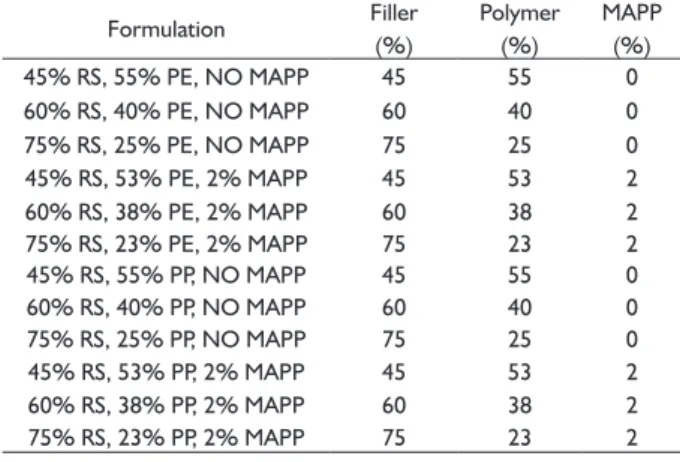
Polymer, filler, and compatibilizer were initially weighed and bagged according to the various filler contents indicated in Table 2. After weighing the required quantity of materials for each treatment, a dry-blending
method was used for compounding the materials.
To prepare the composites, each mixture was separately stored in a two-layer plastic bag to ensure TABLE 1 Chemical constituents of rice stalks.
Cellulose (%) Hemicellulose (%) Lignin (%) Ash (%)
36-43 26-27 6.3-12.3 12-13
containment, and then spread as randomly as possible inside a metal frame and a wooden box with nominal dimensions of 25 cm x 15 cm x 1 cm in order to form a mat. This mat was cold pressed by using of a wooden
sheet and wrapped in aluminum foil.
The final composites were made by pressing the wrapped mat between the hot plates of a compression press at 190 ºC for 7 min at 30-35 bar pressure, followed by removal of the pressure for 1 minute to allow steam to be ejected (Table 3). Then, for a second time the 30-35 bar pressure was applied for 7 min. The composite was cooled at 40 bar pressure by placing the composite between the two cold plates of another press for 5
min. The prepared composites were kept at room temperature for 15 days in order to allow the condition
of the composite to reach equilibrium.
TABLE 2 Rice stalk (RS) / plastic composite formulations (% by mass). Formulation Filler (%) Polymer (%) MAPP (%) 45% RS, 55% PE, NO MAPP 45 55 0 60% RS, 40% PE, NO MAPP 60 40 0 75% RS, 25% PE, NO MAPP 75 25 0 45% RS, 53% PE, 2% MAPP 45 53 2 60% RS, 38% PE, 2% MAPP 60 38 2 75% RS, 23% PE, 2% MAPP 75 23 2 45% RS, 55% PP, NO MAPP 45 55 0 60% RS, 40% PP, NO MAPP 60 40 0 75% RS, 25% PP, NO MAPP 75 25 0 45% RS, 53% PP, 2% MAPP 45 53 2 60% RS, 38% PP, 2% MAPP 60 38 2 75% RS, 23% PP, 2% MAPP 75 23 2
TABLE 3 Hot-pressing process and conditions.
Conditions Pre-pressing Pressing Cold-Pressing
Press pressure (bar) 30-35 - 30-35 40 Press temperature (˚C) 190 190 190 Room temp.
Press duration (min) 7 1 7 5
Mechanical tests and conditioning
All measurements were performed for three
replicates of specimens and averaged to obtain the final
result. An universal testing machine (Schenk) was used to
obtain the flexural and tensile based on BS EN 15534-1
(2014) in dry and wet conditions. For the dry condition,
the samples were oven dried at 100 ± 2 ºC for 24 h.
For the wet condition, the specimens were immersed in distilled water for 24 h, and then, oven-dried for 24 h.
Finally, the flexural and tensile strengths were measured in both conditions. This testing was carried out at room temperature. The obtained results presented here are the average of three measurements obtained for each kind of samples. Analysis of variance (ANOVA) was applied using Minitab 17.3 (Minitab Inc., State College, PA, USA) to determine significance of differences between means, at the significance level of 5%.
RESULTS AND DISCUSSION
Density
It was found that the density of the composites
TYPE AND MOISTURE ABSORPTION ON THE PERFORMANCE
made with MAPP have a slightly higher density, which
is consistent with previous fi nding (ADHIKARY et al.,
2008), where the density of composites increased as
the loading of wood fi ber increased, the addition of rice
straw reduced the density of the composites.
Flexural modulus
The fl exural samples were cut into rectangular specimens and the fl exural modulus (MOE) was
determined accordance with related standard. It is
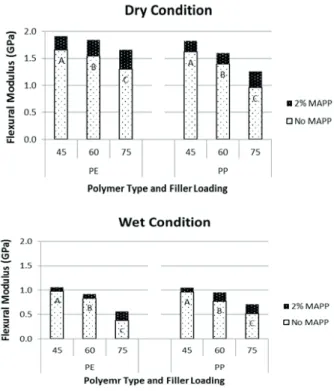
appeared that the effect of the fi ller loading was highly signifi cant at both dry and wet conditions. In general, the fl exural modulus decreased as the rice stalk level
increased (Figure 3).
Furthermore, composites with coupling agent
have slightly higher fl exural modulus than those without coupling agent. This fi nding is also consistent with previous fi ndings (SOCCALINGAME et al., 2015; BAJWA et al., 2015; ADHIKARY et al., 2008). There were no signifi cance differences between specimens made from PE and PP on fl exural modulus at both dry
and wet conditions.
Tensile strength
Filler plays an important role in determining the
mechanical properties of cellulose fi lled/thermoplastic
composites. The most crucial factor that affects the
mechanical properties of the fi ber reinforced materials is the fi ber–matrix interfacial adhesion. The quality of FIGURE 1 Density of rice straw/thermoplastic composite at
the different fi ller loading (45%, 60% or 75%), polymer type (PE or PP) and with/without MAPP. Different letters within a columns indicated signifi cant difference at p < 0.05.
This trend can be seen to be logical if we
consider the higher density of wood materials and
also the lower density of rice straw fi ber compared
with the density of polymer. Hence, increasing the
amount of lignocellulose fi ber leads to a lower density
composite, which is very important from an industrial point of view.
Flexural strength
The modulus of rupture (MOR) obtained from the specimens under fl exural loading at the different
rice stalk level and different polymer matrices type were compared with each other and in dry and wet conditions
as shown in Figure 2. The fi ndings show that for higher fi ber loading the fl exural strength are decreased. Hence the general conclusion is that fi ber content variation at the lower fi ber to polymer ratios does not affect the fl exural strength, while at higher fi ber to polymer ratios (>50%) the fl exural strength declines.
Furthermore, composites with coupling agent
have slightly higher fl exural strength than those without coupling agent. This fi nding is also consistent with previous fi ndings (SOCCALINGAME et al., 2015; BAJWA et al., 2015; ADHIKARY et al., 2008). The type of polymer matrix does not affect signifi cantly on fl exural strength at both dry and wet conditions. It is also clear that all fl exural strengths in various formulations were reduced signifi cantly in wet conditions.
interfacial bonding is determined by several factors, such
as the nature of fi ber and polymer components, the fi ber
aspect ratio, the processing method and the treatment
of the fi ber (MIRMEHDI et al., 2014). Result of tensile strength of rice stalk/thermoplastic composites is shown
in Figure 4.
The result showed that rice stalk/thermoplastic
composites presented lower tensile strength values with
increasing fi ller loading. The highest tensile strength was observed for specimens with 45% rice stalk with both PE and PP. There was statistical signifi cance in tensile strength among the different fi ller loadings. Composites with PP matrix using 45% and 60% of fi ber loading
seems to present improved performance at tensile test
than PE matrix in the same conditions.
Tensile strength is extremely dependable on interfacial adhesion between the phases. With adding MAPP, all of the samples had better tensile strength and its effect on tensile strength was more evident than fl exural strength. This result is consistent with previous fi ndings,
which Mirmehdi et al. (2014) showed that increasing
fi ller content in PE compound resulted in reduction of
tensile strength.
Wet conditions
The fl exural and tensile strengths are reduced by
increasing moisture content. Comparing the wet and dry
conditions reveals that in wet conditions the existence of a coupling agent may slightly reduce water absorption especially at higher levels of fi ber loading and improve the fl exural and tensile strengths in wet conditions.
However, more content of coupling agent is
probably required to reduce water absorption and increase fl exural and tensile strengths. The result is reasonably consistent with Adhikary et al. (2008)
on the measurement of other polymer properties.
Furthermore, this fi nding might be important from the
point of view of economical savings during industrial production, particularly for Iranian manufacturers.
Coupling agent, fi ber loading and wetting conditions signifi cantly infl uence the fl exural and tensile strengths. High fi ber loading should be avoided in wet conditions (MADHOUSHI et al., 2009).
Composites with coupling agent have better dispersion and better interfacial strength compared to the composites without coupling agent (WALKER,
2006). After water immersion, the MOE was reduced FIGURE 3 Flexural Modulus of rice straw/thermoplastic
composite at the different fi ller loading (45%, 60% or 75%), polymer type (PE or PP) and with/ without MAPP (dry and wet conditions). Different letters within a columns indicated signifi cant difference at p < 0.05.
TYPE AND MOISTURE ABSORPTION ON THE PERFORMANCE
more than MOR values. Tensile strength showed the
lowest reduction due to wetting.
CONCLUSIONS
The density of rice straw fiber-polymer composites decreased as the amount of fiber increased. The flexural and tensile strengths increased with using coupling agent and decreased when fiber loading is
higher than 50%. After immersion, the values of MOE,
MOR and tensile strength decreased for all formulations. The type of polymer matrix does not affect significantly the flexural strength, but PP matrix seems to present improved tensile strength than PE matrix when using 45% and 60% of fiber loading.
REFERENCES
ADHIKARY, K. B.; PANG, S.; STAIGER, M. P. Dimensional stability and mechanical behaviour of wood–plastic composites based on recycled and virgin high-density polyethylene (HDPE). Composites part B, v. 39, n. 5, p. 807-815, 2008.
BAJWA, D. S; BAJWA, S. G; HOLT, G. A. Impact of biofibers and coupling agents on the weathering characteristics of composites. Polymer Degradation Stability, v. 120, p. 212-219, 2015.
BS EN 15534-1:2014. Wood-plastics composites (WPC). Test methods for characterization of WPC materials and products.
DAYLAN, B.; CILIZ, N. Life cycle assessment and environmental life cycle costing analysis of lignocellulosic bioethanol as an alternative transportation fuel. Renewable Energy, v. 89, p. 578–587, 2016.
ELGHARBAWY, A. A.; ALAM, M. D. Z.; MONIRUZZAMAN, M.; GOTO, M. Ionic liquid pretreatment as emerging approaches for enhanced enzymatic hydrolysis of lignocellulosic biomass. Biochemical Engineerning Journal, v.109, p. 252–267, 2016.
ESSABIR, H.; BENSALAH, M. O.; RODRIGUE, D.; BOUHFID, R.; QAISS, A. Biocomposites based on Argan nut shell and a polymer matrix: effect of filler content and coupling agent. Carbohydrate Polymers, v.143, n. 5, p. 70-83, 2016.
GILBERT, R. D. Cellulosic polymers, blends and composites. New York: Hanser Publishers; 1994.
HABIBI, Y.; ELZAWAWY, W. K.; IBRAHIM, M. M.; DUFRESNE, A. Processing and characterization of reinforced polyethylene composites made with lignocellulosic fibers from egyptian agro-industrial residues. Composites Science and Technology, v.68, n. 7-8, p. 1877-1885, 2008.
KIM, S.; MOON, J.; KIM, G.; HÁ, S. Mechanical properties of polypropylene/natural fiber composites: Comparison of wood fiber and cotton fiber. Polymer Testing, v. 27, n.7, p. 801- 806, 2008.
LÓPEZ MANCHADO, M. A.; ARROYO, M.; BIAGIOTTI, J.; KENNY, J. M. Enhancement of mechanical properties and interfacial adhesion of PP/EPDM/Flax fiber composites using maleic anhydride as a compatibilizer. Journal of Applied Polymer Science, v. 90, n.8, p. 2170-2178, 2003.
MADHOUSHI, M.; NADALIZADEH, H.; ANSELL, M. P. Withdrawal strength of fasteners in rice straw fibre-thermoplastic composites under dry and wet conditions. Polymer Testing, v. 28, n. 3, p. 301-306, 2009.
MIRMEHDI, S. M.; ZEINALY, F.; DABBAGH, F. Date palm wood flour as filler of linear low-density polyethylene. Composites Part B: Engineering, v. 56, p. 137-141, 2014.
PĂRPĂRIŢĂ, E.; DARIE, R. N.; POPESCU, C. M.; UDDIN,
M. D. A.; Vasile, C. Structure–morphology–mechanical properties relationship of some polypropylene/ lignocellulosic composites. Materials and Design, v. 56, p. 763–772, 2014.
POLETTO, M.; ZENI, M.; ZATTERA, A. J. Effects of wood flour addition and coupling agent content on mechanical properties of recycled polystyrene/wood flour composites. Journal of Thermoplastic Composite Materials, v. 25, p. 821-833, 2012.
POLETTO, M.; ZATTERA, A. J. Mechanical and dynamic mechanical properties of polystyrene composites reinforced with cellulose fibers: coupling agent effect. Journal of Thermoplastic Composites, v. 9, p. 1-13, 2015.
RAHNAMA, N.; MAMAT, S.; SHAH, U. K.; LING, F. H.; ABDUL RAHMAN, N. A.; ARIFF, A. B. Effect of alkali pretreatment of rice straw on cellulose and xylanase production by local trichoderma harzianum SNRS3 under solid state fermentation. Bioresources, v. 8, n. 2, p. 2881-2896, 2013.
RANI, N. S. International rice commission newsletter: the rice situation in iran. Available at: http://www.fao.org/ docrep/003/w8595t/w8595t05.htm#P0_0. Accessed in: 11 April 2016.
SANADI, A. R.; WALZ, K.; WEILOCH, L.; JACOBSON, R. E.; CAULIFIELD, D. F.; ROWELL, R. M. Effect of matrix modification on lignocellulosic composite. In: Proceedings of 3rd international conference on wood fiber–plastic composites, Madison, WI; May p. 1–3, 1995.
SOCCALINGAME, L.; BOURMAUD, A.; PERRIN, D.; BENEZET, J. C.; BERGERET, A. Reprocessing of wood flour reinforced polypropylene composites: Impact of particle size and coupling agent on composite and particle properties. Polymer Degradation Stability, v. 113, p. 72–85, 2015.
SOLEIMANI, M.; TABIL, L.; PANIGRAHI, S.; OPOKU, A. The effect of fiber pretreatment and compatibilizer on mechanical and physical properties of flax fiber-polypropylene composites. Journal of Polymers and the Environment, v. 16, n.1, p. 74-82, 2008.
SOMBATSOMPOP, N.; YOTINWATTANAKUMTORN, C.; THONGPIN, C. Influence of type and concentration of maleic anhydride grafted polypropylene and impact modifiers on mechanical properties of PP/Wood sawdust composites. Journal of Applied Polymer Science, v. 97, n. 2, p. 475-484, 2005.
WALKER, J. C. F. Primary wood processing: principles and practice. 2nd ed. Dordrecht: Springer Science & Business Media, 2006, 396p.
YAO, F.; WU, Q.; LEI, Y.; YANJUN, X. Rice straw fiber-reinforced high-density polyethylene composite: effect of fiber type and loading. Industrial Crops and Products, v. 28, n. 1, p. 63-72, 2008.
ZABIHZADEH, S. M.; OMIDVAR, A.; MARANDI, M. A. B.; MIRMEHDI, S. M.; DASTOORIAN, F. Physical and mechanical properties of rapeseed waste-filled LLDPE composites. Journal of Thermoplastic Composite Materials, v. 24, n. 4, p. 447-458, 2011.