R E S E A R C H A R T I C L E
Open Access
Mechanisms of haplotype divergence at the
RGA08
nucleotide-binding leucine-rich repeat
gene locus in wild banana
(Musa balbisiana)
Franc-Christophe Baurens
1†, Stéphanie Bocs
1†, Mathieu Rouard
2, Takashi Matsumoto
3, Robert NG Miller
4,5,
Marguerite Rodier-Goud
1, Didier MBéguié-A-MBéguié
6, Nabila Yahiaoui
1*Abstract
Background:Comparative sequence analysis of complex loci such as resistance gene analog clusters allows estimating the degree of sequence conservation and mechanisms of divergence at the intraspecies level. In banana (Musa sp.), two diploid wild speciesMusa acuminata(A genome) andMusa balbisiana (B genome) contribute to the polyploid genome of many cultivars. TheM. balbisianaspecies is associated with vigour and tolerance to pests and disease and little is known on the genome structure and haplotype diversity within this species. Here, we compare two genomic sequences of 253 and 223 kb corresponding to two haplotypes of the RGA08resistance gene analog locus in M. balbisiana“Pisang Klutuk Wulung”(PKW).
Results:Sequence comparison revealed two regions of contrasting features. The first is a highly colinear gene-rich region where the two haplotypes diverge only by single nucleotide polymorphisms and two repetitive element insertions. The second corresponds to a large cluster ofRGA08 genes, with 13 and 18 predicted RGA genes and pseudogenes spread over 131 and 152 kb respectively on each haplotype. TheRGA08 cluster is enriched in repetitive element insertions, in duplicated non-coding intergenic sequences including low complexity regions and shows structural variations between haplotypes. Although some allelic relationships are retained, a large diversity of RGA08genes occurs in this single M. balbisianagenotype, with severalRGA08paralogs specific to each haplotype. TheRGA08gene family has evolved by mechanisms of unequal recombination, intragenic sequence exchange and diversifying selection. An unequal recombination event taking place between duplicated non-coding intergenic sequences resulted in a differentRGA08 gene content between haplotypes pointing out the role of such duplicated regions in the evolution of RGA clusters. Based on the synonymous substitution rate in coding sequences, we estimated a 1 million year divergence time for theseM. balbisianahaplotypes.
Conclusions:A largeRGA08gene cluster identified in wild banana corresponds to a highly variable genomic region between haplotypes surrounded by conserved flanking regions. High level of sequence identity (70 to 99%) of the genic and intergenic regions suggests a recent and rapid evolution of this cluster inM. balbisiana.
Background
Comparative genomics studies at the interspecies and intraspecies levels have revealed the dynamics of genome evolution and the plasticity of plant genomes. Within monocotyledons, the grass species of the order Poales have been extensively studied for their genome structure
and evolution [1], but little is known about monocotyle-don plants outside this group. Musa species are giant herbs from the order Zingiberales of the monocotyledon group and comprise two important tropical crops, banana and plantain. Two wild diploid AsianMusa spe-cies,M. acuminataColla (A genome, 2n = 2x = 22) and M. balbisianaColla (B genome, 2n = 2x = 22) are at the origin of most cultivated bananas. Intraspecific hybridiza-tions withinM. acuminataand interspecific hybridiza-tions with M. balbisiana have resulted in various combinations of the A and B genomes in different * Correspondence: [email protected]
†Contributed equally
1
CIRAD, UMR DAP, TA A-96/03, Avenue Agropolis, F-34398 Montpellier Cedex 5, France
Full list of author information is available at the end of the article
cultivars. A majority of these cultivars are triploids with a genome constitution of AAA (mostly dessert banana), AAB (including plantains) and ABB [2]. Limited genetic variation in the most economically important banana cul-tivars, which are clonally propagated sterile polyploids, has resulted in a crop lacking resistance to some major fungal, bacterial and viral pathogens and to several pests.
WildM. balbisianais native to South Asia with a geo-graphical distribution ranging from India to south China [3,4]. It grows in forest clearings and produces non-pulpy, non-edible bananas. Plants of this species are immune to several diseases and pests such as Fusarium wilt and Black leaf streak disease and represent excellent sources of natural resistance [5,6]. The B genome is used in breeding programs for its traits of vigour, of cold resistance [7] and could also be interesting for tol-erance to pests and pathogens. Recent studies involving
M. balbisianaplants prospected in China have shown
that significant genetic diversity exists in this species [8]. A better knowledge of the genome structure and diver-sity of M. balbisiana should help exploiting this resource to increase the genetic basis of cultivated bananas.
Genomic resources have been recently developed to study the genome structure ofMusaspecies. The size of the haploid Musa genome is estimated as varying between 560 to 600 Mb [9,10]. BAC (bacterial artificial chromosome) libraries for M. acuminata [11,12] and
M. balbisiana [13] are available and analysis of BAC
end sequences from M. acuminata“Calcutta 4” deter-mined a gene density of one per 6.4 kb, similar to that of rice [14]. Further insight on theMusagenome struc-ture was recently provided by the sequencing and analy-sis of 1.8 Mb from 17 BAC clones [15]. The 443 predicted genes revealed that Zingiberales genes share GC content and distribution characteristics with Eudicot and Poaceae genomes. Comparison with rice identified traces of microsynteny that were retained in several regions since the divergence of the Poales and Zingiber-ales at least 117 MYA. Comparisons of two genomic regions representing 140 kb from M. acuminata and
M. balbisiana revealed a highly conserved genome
structure, and indicated that these genomes diverged circa 4.6 Mya [15]. However, no data is yet available on Musaintraspecies sequence diversity and divergence.
Resistance (R) genes encode proteins that indirectly or directly detect specific pathogen avirulence genes pro-ducts thus triggering a resistance response [16]. The lar-gest class ofRgenes encodes proteins with a nucleotide binding domain and leucine-rich repeats (NB-LRR pro-teins) associated at the N-terminal to a Toll/Interleukin-1 Receptor (TIR) homologous region or to a coiled-coil (CC) motif. NB-LRR encoding genes have been widely studied in plant genomes [17-20]. Most of them are
organized in arrays of closely related genes resulting from tandem duplication events. NB-LRR gene clusters have been identified in several plant species, e.g. in let-tuce [21], potato [22], rice [23,24], wheat [25] and com-mon bean [26,27]. They can span from less than a hundred Kb up to several megabases, as in the RGC2 locus in lettuce [21]. Within clusters, sequence exchange through unequal crossing over or gene conversion leads to the formation of new chimeric genes. In addition, point mutations and diversifying selection result in the creation and maintenance of novelRgene variants. Stu-dies on the Rpp5cluster in Arabidopsis, the R1locus in potato and the Rpg1-b locus in soybean have shown reduced colinearity and differences in NB-LRR gene numbers between haplotypes, likely due to unequal crossing over between paralogs [22,28,29].
In banana species, around two hundred and fifty resis-tance gene analog (RGA) partial sequences have been amplified using primers from conserved motifs of NB-LRR genes [30-33]. Recent work identified the partial MaRGA08 sequence from the wild diploid M. acumi-nata Calcutta 4 [33]. Used as a hybridization probe, this sequence revealed the presence of a multigenic family across three Musagenomes, including the wild diploid
M. balbisiana. Here, we have sequenced, annotated and
compared M. balbisiana “Pisang Klutuk Wulung”
(PKW) BAC clones showing high densities of this NB-LRR RGA. These sequences corresponded to two haplotypes ofM. balbisiana which allowed us to study intraspecific variation of this wild Musa species at the molecular level. New Musa repetitive elements have been identified, and the structure and evolution mechanism of a large cluster of NB-LRR genes identified in these sequences is revealed.
Results
Identification of two large clusters of theRGA08locus in
M. balbisiana
The MaRGA08 sequence, previously amplified from
M. acuminataspp.burmannicoidesCalcutta 4 (A
was chosen for sequencing and yielded a 223 694 bp sequence (B2 [EMBL: FN396603]).
The specific features of each sequence are presented in Table 1. Automatic and manually curated sequence annotation predicted 39 and 37 genes and pseudogenes, covering 50.4% and 47.9% (exons and introns, Table 1) of the sequence on B1 and B2, respectively. This corre-sponds to an overall gene density of one gene per 6.3 kb, similar to the first estimates of gene density inMusa [14] although slightly less dense than the average of one gene per 4.2 kb found by [15]. Most of the predicted genes correspond to one large cluster of NB-LRR genes spread over 59% of each sequence in length. This indi-cates that we have identified two large RGA clusters corresponding to the MaRGA08 probe.
Genetic mapping reveals two haplotypes of theRGA08
locus inM. balbisianaPKW
The B1 and B2 sequences could either correspond to paralogous loci or to orthologous (allelic) regions. The dot plot alignment of the two sequences showed two different patterns: a highly colinear profile at both ends of the sequences and a repetitive and more disrupted pattern in the central part (Figure 1). The repetitive pat-tern corresponds to the RGA cluster in both sequences. Within this region, colinear relationships are disrupted, although sequence blocks do show colinearity. To test the hypothesis of allelism of the twoRGA08loci, a per-fect (CT)nmicrosatellite sequence, mMaCIR341, located
in the central region (Figure 1), was used as a marker for genetic mapping on an F1 population of 67 triploid hybrids derived from the interspecific cross between the
M. acuminata autotetraploid cv. IDN110 (4x, AAAA
genome) and M. balbisiana PKW (BB genome) [34]. The two amplification products from the PKW parent
had sizes corresponding to the mMaCIR341 sequences on B1 and B2, while the progeny had either one or the other band but not both and showed a 1:1 Mendelian segregation ratio (c2= 0.37) for this marker (Additional File 2: Microsatellite mMaCIR341 segregation profile). This strict segregation of the mMaCIR341 alleles in PKW demonstrates that the B1 and B2 sequences are allelic and represent two haplotypes of the same genetic locus in M. balbisiana. FISH analysis of metaphase chromosomes ofM. balbisianaPKW, using either BAC clone MbP036B13 or the RGA08gene alone as a hybri-dization probe showed two signals potentially corre-sponding to one chromosome pair, thus supporting this result (Additional File 3: Fluorescentin situ hybridiza-tion at theRGA08locus ofM. balbisiana).
Conserved and divergent regions between the twoRGA08
haplotypes
To investigate the extent of sequence conservation and divergence, we analysed and compared the sequence structure of the two haplotypes. The B1 and B2 sequence overlap corresponds to 245 kb on B1 and 218 kb on B2 with two highly colinear regions flanking the RGA cluster (Figure 1 and Figure 2). The first colinear sequence stretch is 72.5 kb long and contains 10 genes and four pseudogenes. It starts in the middle of a puta-tive aspartate carbamoyltransferase gene which is com-plete on B1 and only partially covered in B2. Four of the predicted genes have a putative assigned function based on similarity with known proteins in the databases (Additional File 4: Gene list of MbP032N20c and MbP036B13 BACs), six genes encode hypothetical pro-teins highly conserved with rice predicted propro-teins and only one gene encodes a hypothetical protein with no corresponding hit in the databases. The remaining three
Table 1 Features ofM. balbisianaBAC sequences containingRGA08clusters
RGA cluster Flanking sequences
B1 B2 B1 B2
Size (bp) 151959 131218 101407 92476
Exons &ψexons (%) 36.1 33.7 18.1 19.1
Introns &ψintrons (%) 13.4 13.3 33.7 30.1
Intergenic (%) 33.6 36.7 42.9 49.9
TE (%) 15.7 15.3 4.4 0
SSR (%) 1.2 0.9 0.9 0.9
Gene &ψgene density (kb/gene) 6.9 6.6 6 5.4
Total predicted gene &ψgene number (RGA &ψRGA) 22 (18) 20 (13) 17 17
ψgene number (ψRGA) 12 (8) 14 (7) 4 4
Number of exon/gene 1 1 5.2 5.7
Number of gene &ψgene on the direct strand 4 3 10 11
Number of gene &ψgene on the complementary strand 18 17 7 6
Percentages of exons andψexons, introns andψintrons, TE and SSR were computed according to the size of the nucleotide sequence. Percentage of intergenic
sequences represents the rest of the sequence. In these statistics, the five and four Gag-Polymerase -encoding genes of B1 and B2 respectively, were not taken
predicted coding sequences (CDS) correspond to frag-ments of genes. The only interruption in colinearity in this region consists of two indels in predicted introns of the chlorophyl synthase VTE2 gene (Figure 2). In B1, the VTE2 gene has a 4.4 kb LTR retrotransposon inser-tion in intron eight and a 0.9 kb Musa repetitive sequence in intron 10, both of which are absent from B2. The second highly colinear region located at the end of both sequences is 17.4 kb long and contains two pre-dicted genes coding for a mitochondrial transcription termination factor (MTERF) domain-containing protein and a putative serine/threonine-protein kinase (B1 MbP032N20cg440; B2 MbP036B13g380, Figure 2 and Additional File 4). In both colinear regions, the level of sequence identity between the two haplotypes is very high (99%). Syntenic relationships of B1 and B2 with the rice and sorghum complete genomes were investigated based on best hit (Additional File 4: Gene list of MbP032N20c and MbP036B13 BACs) and phylogenetic relationships (data not shown). A syntenic relationship was predicted within the rice chromosome 6 and its ortholog, the sorghum chromosome 10. This relation-ship is based on five of the predicted genes and should be confirmed on a larger sequence scale when available. None of the syntenic regions of rice and sorghum con-tains RGAs.
In between the B1 and B2 colinear regions, the RGA cluster shows a size difference of approximately 21 kb between the two haplotypes. This is not due to a
MbP032N20c B1
253366
223694 10 Kb
MbP036B13 B2
VTE22
RGA08 genes (A to X)
BC D E F G H I J K L M N O P QR
1 RPA1 2 3 3 4
VTE2
T U G H I E V K P QW X
1 2 2 3 3 4
5 * * * * *
A
non RGA genes (Including VTE2 and RPA1) MTERF genes
F
RPA1
Repetitive elements (1: RE1, 2: Clio, 3: Mooz, 4: RE4 and 5: RE5 ) 1kb intergenic sequence
10 202530 40 70 80 90 100105 110 120140 150
102030 40 60 70 80 90 100 110 120140 150
440
380 390
* Gene tested for expression in M. balbisiana Probable unequal recombination event
4
4 4
4
4 4
4 4 4
4 4 4
*
Figure 2Genomic organization of theRGA08haplotypes inM. balbisiana.M. balbisianaB1 and B2 haplotypes corresponding to BAC MbP032N20c and MbP036B13 respectively are represented. Predicted genes, pseudogenes and transposable elements are represented as plain arrowheads with the head indicating the direction of transcription.RGA08genes coding for CC-NB-LRR proteins are indicated as green boxes with a corresponding letter. Genes tested for expression are labelled with a star. White arrows representMTERFgenes. Other predicted genes in pink arrows are numbered according to sequence annotation. Repetitive elements are represented as black arrows and numbered according to the list in Table 2. RE4 is a low complexity region with no clear structure. The 1 kb duplicated intergenic sequence is in orange boxes. Simple colinear pattern between haplotypes based on sequence similarity (blast2seq, E-value < = 1e-20) is highlighted for genes and intergenic sequences using light pink trapezoids in the flanking regions of the RGA clusters. Syntenic regions within the RGA clusters are highlighted using light green trapezoids. Identified unequal recombination events are highlighted with yellow trapezoids. The RE3 (Mooz) sequence inverted between haplotypes is indicated with twisted connections.
B2
(MbP036B13)
B1(MbP032N20c)
RGA08 cluster
(CT)15
(CT)18
difference in retroelement insertions as their density is similar between haplotypes (Table 1) but rather to a dif-ferential expansion of the RGA family (see below). This region also includes a C-terminal fragment of a DNA-directed RNA polymerase I largest subunitRPA1 gene and severalMTERF remnants and pseudogenes inter-spersed betweenRGA08 genes. Thus, sequence analysis of the two M. balbisiana haplotypes showed that they differ from each other by few relatively small indels cor-responding to repetitive sequences and in the RGA gene cluster by differential gene expansion.
Repetitive elements in theRGA08region ofM. balbisiana
Repetitive sequences are major contributors to genome structure and evolution and are often responsible for intra- and interspecies sequence variation [35,36]. Repe-titive sequences identified here include transposable ele-ments and simple sequence repeats (SSR) and represent an overall 10% of each sequence. Transposable elements are mostly present within the RGA clusters rather than in the flanking regions (Table 1). Four types of transpo-sable elements (RE1, Clio (RE2), Mooz (RE3) and RE5, Table 2) have been detected usingab initio prediction and similarity based methods. RE1, Mooz and RE5 have a size ranging from 2.8 to 4.2 kb. They show sequence similarity to plant Copia/Ty type of retroelements and have high DNA sequence identity to Musasequences available in databases (Additional File 5:MusaRE simi-larity). Mooz and RE5 have long terminal repeats (LTRs) of a relatively small size (Table 2) and partial or disrupted predicted CDS. RE1 is a remnant copia-like retroelement with a disrupted CDS and no detectable LTRs. An additional repetitive element, Clio, has a 4441 bp size with LTRs of 382 bp and an internal domain with no apparent coding capacity similar to large
retrotransposon derivatives (LARD). This element shows several hits to M. acuminata and M. balbisiana sequences (Additional File 5:Musa RE similarity) but not to sequences from other organisms, indicating a new banana specific repetitive element. Target site duplications flanking retroelements insertions have only been found for four elements of the Clio, Mooz and RE5 type and several LTR sequences were partially deleted (Table 2). Truncated Clio and Mooz elements (Table 2) were identified and in addition to the elements described here, fragments of LTR retrotransposon cod-ing sequences are also present on both haplotypes (unla-belled black boxes on Figure 2). This indicates that most of the retroelements have been subject to deletions and sequence rearrangements since their insertion.
The position of most retroelements is conserved, with the exception of three of them which contribute to sequence variation between the B1 and B2 haplotypes. A copy of the Clio LARD element in theVTE2 gene of B1 is responsible for the first indel polymorphism in the B1 and B2 colinear region and within the RGA08cluster, one Mooz copy is only present on B1 and the RE5 element is only inserted into the B1 RGA08F-1 gene (Figure 2).
No class II element (transposon) was identified, but other repeat types were present in this region. In intron 10 of the VTE2-1gene, an indel of 0.9 kb consists of a sequence showing several hits only toMusa BAC clones. This sequence is then clearly a banana repeat, although no specific structure was identified. A particularly com-plex region, RE4 (near RGA08Q, Figure 2) was found highly conserved on B1 and B2. This 4 kb region is AT-rich with 30% of GC compared to the average 40% GC content. It includes three tandem repetitions of 127 bp and a fragment of a copia-type polyprotein. Fragments
Table 2 Type, localization and characteristics of repeated elements in theRGA08locus ofM. balbisiana
Name Type ID Location Length 5’LTR 3’LTR TSD Divergence time
(bp) (bp) length TG CA length TG CA (MY)
RE1 Copia-like element MbP032N20c_te030 129477 2855 - - -
-RE1 MbP036B13_te010 100745 2882 - - -
-Clio LARD MbP032N20c_te010 28466 4441 382 TG CA 382 TG CA ATAC/ATAC 0.294
Clio MbP032N20c_te040 148954 4441 382 TG CA 382 TG CA GGAG/GGAG 1.189
Clio MbP036B13_te020 120343 4441 382 TG CA 382 TG CA
GGAG/-Clio* MbP036B13_te030 124784 1606 - - -
-Mooz Copia-like element MbP032N20c_te050 166534 3849 115 - - 112 - - -
-Mooz MbP032N20c_te060 225945 3346 231 - - 447 TG CA -
-Mooz MbP036B13_te050 185390 3688 447 TG CA 447 TG CA CTTTG/CTTTC 2.183
Mooz* MbP036B13_te040 181339 2464 447 TG CA - - -
CTTTG/-RE5 Copia-like element MbP032N20c_te020 124026 4301 94 TG - 171 TG CA ACCAC/ACCAC
-LTR features (length, presence of TG and CA at their ends) and Target Site Duplication (TSD) were determined using -LTR_FINDER followed by manual annotation. For complete elements with clearly identified TSD and with LTR length exceeding the empirical limit of 300 bp, divergence time was calculated based on the
of the RE4 region ranging from 470 bp up to 1 kb are found at several locations within the RGA08 cluster (seven on B1 and five on B2, Figure 2) close toRGA08 genes. On B1, adjacent to RE4, three tandem repeats of 162 bp are also present.
In addition, SSRs (i.e. dinucleotide up to hexanucleo-tide repeats) are very abundant, with 112 and 87 SSRs in B1 and B2 respectively. Except for SSR loci that were assigned to RGA coding sequences, and for which it is difficult to find the real ortholog, most of the SSRs are unambiguously found in both haplotypes with their flanking sequences. Of these 75 common non-coding SSRs, 31 are heterozygous, with differences in repeat number varying from one to 46 repetitions.
A largeRGA08gene family
The most divergent region between the B1 and B2 haplotypes corresponds to theRGA08 cluster. A total of 31 RGA sequences were identified, differing in num-ber between haplotypes, with 18 present on B1 and 13 on B2 (Table 1). Sixteen are potentially complete genes and the remaining 15 are fragments, pseudogenes or remnants with frameshifts, in frame stop codons and in one case a RE5 insertion (RGA08F-1). All the 31 genes belong to the same family as they share 81% of nucleic identity in average (ranging between 65% and 99%). They also share an average of 89% sequence identity with the MaRGA08 probe from M. acuminata Calcutta 4. On both haplotypes, only one complete RGA is predicted on the direct strand (RGA08G-1 and
RGA08G-2, Figure 2): it faces an RGA pseudogene on
the reverse strand in a tail-to-tail structure (RGA08H-1
and RGA08H-2) with less than 300 bp between stop
codons. Other predicted NB-LRR genes on the direct strand are gene remnants (two on B1 and 1 on B2) all showing the same tail-to-tail structure with another inverted RGA remnant. This indicates a duplication of a region containing this structure followed by loss of sequence. All remaining RGA08genes are predicted on the reverse strand, indicating an expansion of the gene family on this DNA strand. Sequences immediately upstream and downstream the CDS of most RGA08 genes are highly conserved, suggesting recent duplica-tion events.
The structural pattern ofMTERFgenes present in the
RGA08cluster is also complex. On both haplotypes, one
complete copy of this gene with an identical structure of seven exons, is present in the region flanking the RGA cluster (Figure 2). Within the RGA cluster, sixMTERF pseudogenes and gene remnants are also present, inter-spersed with RGA08sequences. This indicates common duplication events affecting these sequences and result-ing in the complex sequence organisation observed here.
Conserved allelic relationships between someRGA08
homologs
We compared the sequences of the RGA08 genes and found that except for one case, the highest levels of sequence identity observed were between RGA pairs from the two haplotypes, thereby defining allelic rela-tionships. The two pairs of RGAs in tail-to tail orienta-tion (RGA08G-1/RGA08H-1andRGA08G-2/RGA08H-2) show 98 to 99% DNA sequence identity and are embedded in a highly conserved syntenic region between the two haplotypes. This region of 26 kb also comprises a highly conserved RPA1C-terminal remnant and is flanked by two repetitive elements RE1 and Clio which are present on both haplotypes (Figure 2). Two other gene pairs (RGA08K-1andRGA08K-2, RGA08P-1
andRGA08P-2) together with gene remnants
RGA08Q-1/RGA08Q-2 showed 99% sequence identity and
there-fore also correspond to allelic pairs. The highest level of sequence identity between pairs was always between genes from different haplotypes, with one exception:
RGA08I-1 andRGA08I-2 showed 98% sequence identity
to each other as well as to RGA08D-1, suggesting a recent duplication of this gene in the B1 haplotype. The
pairRGA08D-1andRGA08I-2is present within a highly
conserved region between haplotypes which comprises
the MTERF1pseudogene and theRGA08E-1/RGA08E-2
pair (95% sequence identity). This sequence block is in a different position in B1 compared to B2 (Figure 2) due to sequence rearrangements within theRGA08cluster. Finally,RGA08F-1andRGA08S-2 share 95% identity in their CDS but they are not in syntenic position and they also differ by the RE5 LTR retroelement insertion
in RGA08F-1 which interrupts its coding sequence
(Figure 2). No clear allelic relationships could be found for the remaining RGAs which are therefore considered as paralogs.
Two clades ofRGA08genes are present at theRGA08
locus
The RGA08genes encode predicted proteins with two
complete genes of 3147 bp (RGA08G-1andRGA08G-2) and three remnants of 711 to 720 bp covering the NB region (RGA08B-1, RGA08Q-1and RGA08Q-2). These remnants are more similar to each other than to the complete RGA08G-1 and RGA08G-2, which indicates that at least two duplicated genes of this clade were ori-ginally present in this region. The second clade com-prises all RGAs predicted on the reverse DNA strand. These genes have an average size of 3.2 kb (from 2793
to 3310 bp). Three remnants of these genes covering the NB region have a size of 1026 to 1555 bp. A 70% level of DNA sequence identity was observed between clade one and clade two genes and their overall struc-ture is highly conserved (Figure 3). One major difference between the two clades is the presence of coding micro-satellite sequences only in the LRR region of clade 2
RGA08 genes. The first microsatellite (TTC
trinucleo-tide repeat) between LRR10 and LRR11 results in a
* * * ***** ***** ** ** **** * * ** *** * * * **
1 5 10 15
100 200 300 400 500 600 700 800 900 1000
RGA08I-1
RGA08I-2
RGA08D-1
RGA08K-1
RGA08K-2
RGA08F-1p
RGA08S-2p
RGA08L-1
RGA08U-2
RGA08P-1
RGA08P-2p
RGA08T-2
RGA08H-1p
RGA08H-2p
RGA08E-1p
RGA08E-2p
RGA08V-2p
RGA08J-1
RGA08R-1r
RGA08W-2r
RGA08C-1r
RGA08O-1
RGA08X-2
RGA08M-1
RGA08A-1
RGA08N-1p
RGA08Q-1r
RGA08Q-2r
RGA08B-1r
RGA08G-1
RGA08G-2
95
80 75
100
100
76 99 96
14
99
94
70
90 68
100
99
97
100
22 100
75
100
100 99
90
85
100
0.05
CC CC NB-ARC LRR microsat1 microsat2
polyserine tract which varies from three up to 16 amino acids. The second microsatellite is a compound (GAT)n (GCT)n(GAA)n motive at the 3′end of group 2 RGA genes. The GAA triplet show the largest size expansion (from four up to 21 repeats) resulting in a predicted acidic coiled-coil domain (polyE, aspartic acid) for genes showing a high number of repeats.
Evolution of theRGA08cluster: intragenic and intergenic
recombination
Sequence exchange was previously shown to be a main mechanism ofRgene evolution [38,39]. Using the pro-gram RDP3.34 which integrates several modules for detection of recombination and gene conversion events, we investigated the degree of sequence exchange between theRGA08homologs. A total of 21 events (at p < 0.05) were detected betweenRGA08 genes. These sequence exchanges affected allRGA08genes except for the genes in tail-to-tail structure (RGA08G-1/RGA08H-1
andRGA08G-2/RGA08H-2).
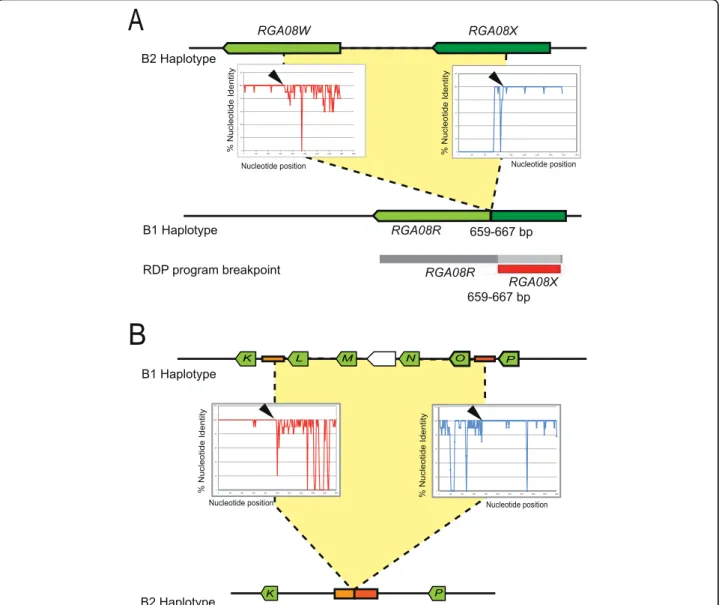
Unequal recombination resulting in increase or decrease in RGA numbers in one or the other haplotype also takes place in theRGA08cluster. One intragenic recombination event was detected by the RDP program based on con-served sequence blocks betweenRGA08RandRGA08X (Figure 4A). Manual inspection of the alignment of
RGA08R,RGA08XandRGA08Wsuggests that the actual
structure of theRGA08Rremnant results from an unequal recombination event betweenRGA08W andRGA08X sequences likely resulting in the elimination ofRGA08X from B1. Other recombination events detected by RDP could not lead to clear reconstruction of structural changes affecting theRGA08cluster. We therefore manu-ally examined colinearity breakpoints between haplotypes within theRGA08cluster. In addition to theMTERF cod-ing sequences present in theRGA08cluster, a 1 kb inter-genic sequence present at 2 kb upstream the start codon of the completeMTERFgene is duplicated and conserved (70 to 98% identity) within the RGA cluster at three and two additional locations on B1 and B2 respectively (orange boxes on Figure 2). Two of these 1 kb long sequences are flanking the region carrying theRGA08Lup toRGA08O genes on B1 (Figure 2). Another copy is present between
theRGA08KandRGA08Pgenes on B2. Sequence
align-ment of these regions identified a shift of sequence iden-tity levels between B1 and B2 within this intergenic sequence (Figure 4B). This suggests that the absence of
the RGA08LtoRGA08Oregion from the B2 halotype
could be due to an intergenic unequal recombination event between duplicated non-coding sequences.
Diversifying selection
Sequence exchange is a major mechanism of RGA evolu-tion but its possible homogenizing effect is counteracted
by diversifying selection acting on specific residues of CC-NB-LRR proteins [38]. We investigated the sites under positive selection in the CC-NB region and the LRR region of complete genes using the PAML pack-age [40]. Two likelihood-ratio tests (M1a against M2a and M7 against M8) indicated that sites were under diversifying selection for the CC-NB (M7/M8,c2= 145, P < 0.001) and LRR data sets (M7/M8, c2 = 246, P < 0.001). The majority of positively selected sites (21 out of 40) were located in LRRs (Figure 3) and 14 of them were solvent-exposed residues (x residues in the LxxLxLxx motif) which are predicted to be involved in effectors’recognition in R proteins.
Expression ofRGA08genes
Six specific primer pairs were defined in divergent parts of 3′-untranslated regions to test whether the corresponding
RGA08genes (i.e. RGA08E-1,RGA08G-1, RGA08K-1,
RGA08L-1,RGA08M-1, RGA08O-1, Figure 2) are
ex-pressedin planta. All tested genes were found expressed in different tissues ofM. balbisiana(Additional file 7: Real-time qPCR analysis of RGA08 expression) indicating that several members of theRGA08cluster are expressed and are thus potentially functional.
Divergence time ofM. balbisianahaplotypes
To estimate the timing of evolution of the two M. bal-bisiana haplotypes, we calculated the extent of sequence divergence between the conserved colinear sequences on both sides of the RGA cluster. In addition to indels, these sequences differ by single nucleotide polymorph-isms with an overall nucleotide diversity of 0.95%. Twelve complete predicted allelic pairs have been used to calculate the ratio of synonymous mutation per synonymous site according to [41]. On the 12.9 kb of coding sequences (Additional File 8: Estimation of diver-gence time between PKW haplotypes), 27 synonymous mutations were detected giving a p-distance of 0.0088. This is lower than the value found between genes of
M. acuminata and M. balbisiana (ks = 0.04) which
diverged 4.6 MYA. Using the substitution rate that was recently determined for banana coding sequences (0.45 × 10⁻⁸mutations per site per year; [15]), a diver-gence time of almost 1 MYA was obtained forM.
bal-bisianaPKW haplotypes.
is coherent with an insertion of Clio into haplotype B1 rather than elimination from B2. A second Clio element in syntenic position in the two haplotypes has inserted in B1 around 1.2 MYA and thus possibly predates hap-lotype divergence. Its insertion time could not be con-firmed in B2 due to rearrangements. Mooz elements located on the left side of theRGA08cluster are also in syntenic position but their structure is complex with an inversion and indels. However, the complete Mooz
element in B2 has inserted 2.2 MYA confirming pre-sence of Mooz in the ancestral haplotype.
Discussion
Sequence divergence ofM. balbisianahaplotypes
Despite the increasing number of genomic resources developed forMusaspecies, no study has addressed the question of haplotype divergence at the sequence level. Molecular marker analyses have uncovered a large
Figure 4Unequal recombination breakpoints within theRGA08gene cluster. (A) An intragenic unequal recombination event between
RGA08XandRGA08Wresults in the actual structure of theRGA08Rsequence. The RDP software detected the region of sequence identity
betweenRGA08XandRGA08Rand indicated a recombination breakpoint onRGA08X. Manual inspection ofRGA08sequence alignments indicated
RGA08WandRGA08Xas likely parental sequences. The percent nucleotide identity ofRGA08X(red curve) andRGA08W(blue curve) is plotted
along the sequence ofRGA08R. A shift in sequence identity levels (black arrows) is observed indicating a putative recombination event. (B) Unequal recombination mediated by duplicated 1 kb intergenic sequences (orange boxes). Intergenic sequences betweenRGA08K-RGA08Land
RGA08O-RGA08Pin B1 (top) have recombined to produce the actual intergenic sequence structure betweenRGA08K - RGA08Pin B2 (bottom).
diversity among M. acuminatasubspecies and also to some extent inM. balbisiana[43,44].Musawild species such as M. balbisianaare generally outcrossing even if inbreeding is not totally excluded, due to potential crosses between vegetative offspring. We have identified two sequence haplotypes in wildM. balbisianaPKW in the region of the RGA08 cluster which allowed us to assess their degree of sequence divergence. The struc-ture and divergence of sequence haplotypes have been studied in different plant species including grasses such as barley, wheat and maize and recently in poplar and sugarbeet. They revealed a mosaic structure of con-served and non-concon-served sequences at orthologous or allelic regions [35,45-48]. The differences mostly affected the intergenic space and were based on repetitive ele-ment insertions and indels of various sizes likely due to unequal homologous recombination and illegitimate recombination events. In maize, intraspecific compari-sons have additionally showed a difference in gene con-tent between inbred lines [49]. Here, two regions of contrasting features were identified: the divergent
RGA08gene cluster and the highly conserved non-RGA
region. In the latter, the gene content was fully served and the intergenic regions were also highly con-served. The two relatively small indels correspond to 5.8% of the colinear sequence indicating few rearrange-ments in the region flanking theRGA08cluster. In rice, indels account for 13% of genome divergence between the indica and japonica subspecies [36], whereas in poplar, indel rate was found to vary from 0.5 to 14.8% of non aligning segments between four regions of poplar haplotypes [47]. In terms of nucleotide diversity, our values (0.95% based on the complete colinear region and 0.34% for coding sequences) are very similar to those in rice subspecies in overall substitution rate (0.96%) and for genic regions (0.25% for coding sequences) [36] and are lower than those observed in maize (0.8% in coding sequences [50]) or sugarbeet (5.14% overall, 0.96% for coding sequences [48]). Haplo-type divergence rates might vary from one region of the genome to the other as shown in poplar [47] where sequence diversity varied from 0.32 to 1% in 320 kb spread over four compared regions. We calculated the nucleotide divergence at a second M. balbisiana PKW locus (EPRV locus, [51]) and found there a value of 0.25% overall nucleotide divergence (0.03% for coding sequences). Thus, the degree of polymorphism observed between these two haplotypes of M. balbisiana is in the range of what was observed for intraspecies diver-sity in rice and in poplar but is lower than that found in maize and sugarbeet. This degree of polymorphism is compatible with the recent divergence time of 1MY we calculated for theseM. balbisianahaplotypes.
The role of repetitive elements
The repetitive fraction of plant genomes is highly vari-able and can constitute more than 50% of the genome landscape as in some grass species [52]. In Musa, a pro-portion of 35% of repetitive sequences was estimated based on BAC end sequences ofM. acuminata Calcutta 4 [14]. The sequences analysed here showed a relatively low repeat content of 10% in size. The proportion of identified retroelements in the overall RGA08 region corresponds to the average of 2.6 retrotransposons per 100 kb found in gene-rich Musa BAC clones [15] although this value is possibly underestimated as many Musatransposable elements are still unknown.
Transposable elements identified here all belong to class I LTR retrotransposons. They showed an uneven distribution, with the majority present within the RGA gene cluster. It is difficult to know, however, if this dif-ference in repeat distribution is a cause or a conse-quence of the RGA08 gene amplification process. Estimation of insertion times of RE2/Clio and RE3/ Mooz retroelements (0.3 to 2.2 MY) indicates recent insertions after the divergence of the Musa A and B genomes, 4.5 MY ago. The presence of older remnants of LTR retrotransposons and the fact that most ele-ments identified here are disrupted in their sequences is consistent with mechanisms of deletion affecting repeti-tive elements as previously described in other genomes such as rice and Arabidopsis [53,54]. The recent RE2/ Clio insertion (0.3 MYA) contributed to haplotype divergence in the non-RGA colinear region and reflects very recent activity of this retrotransposon family in Musa. Indel sequence variation between haplotypes was due to repetitive sequences and suggests a major role of repeats in the divergence of gene-rich regions of the Musa genome.
Sequences presented here are particularly rich in SSRs, when compared to available banana BAC end sequences in which only one SSR was observed every 13 kb [14]. Density of SSRs in this locus is much higher, with an average of one every 1.5 kb. A strong bias exists within the RGA cluster, with one SSR every 1.1 Kb compared to the flanking sequences with one SSR every 2.6 kb. The high density of SSRs within the RGA cluster is due, at least partly to the presence of coding microsatellites withinRGA08genes.
RGA08cluster evolution inM. balbisiana: the impact of
duplicated intergenic sequences
The RGA08 cluster is a member of the large R gene
tomatoI2 locus (7 genes in 90 kb, [55]) and in lettuce where the RGC2 gene family comprises 32 members within 3 Mb [39]. Within the RGA08cluster, drastic changes have disrupted colinearity between haplotypes. These include a difference inRGA08 gene number, in repetitive elements and a reshuffling of whole sequence blocks carrying RGA08genes and fragments of MTERF genes. Such features are similar to what was previously described in other plants atR gene loci (e.g. [22]). One specific feature here is the high level of sequence con-servation of both genic (92% identity in average) and intergenic (average 78% identity) sequences between clade 2 paralogs which suggests recent duplication events.
Two clades of genes coexist on the RGA08 cluster with one clade showing a particularly large expansion on one DNA strand. The two types of RGA08 genes likely originated from the same ancestral sequence and followed two different evolutionary paths. The actual structure of the cluster and the presence of remnants in tail-to-tail orientation suggest a possible model of evolu-tion where a duplicaevolu-tion of the ancestral RGA08 sequence was followed by an inversion and a differential expansion on one DNA strand. The structure in tail-to-tail orientation was also likely duplicated then partially deleted. It was frequently reported that repetitive ele-ments are associated to Rgene clusters [27,56] and the presence of duplicated sequences such as the LTRs of LTR retrotransposons could provide templates for unequal recombination thus generating diversity at R gene clusters. Despite the identification of several LTR retrotransposons, we could not find evidence for their involvement in unequal recombination events. This is likely due to the fact that the complete retroelements we identified are not highly duplicated within the clus-ter. One particular duplicated sequence, the RE4 region contains remnants of a copia-like polyprotein. Frag-ments of RE4 have been found close to duplicated
RGA08 genes and although we could not demonstrate
such events, it is not excluded that this particular low complexity region corresponds to an old repetitive sequence involved in the duplication process of the RGA08clade 2 genes. In addition to RE4, three types of sequences are found highly duplicated within the
RGA08 cluster: the RGA08 genes, fragments of the
MTERF gene and intergenic non-coding sequences of
varying sizes which were found conserved at different positions. We could show that sequence exchange occurred between RGA08 sequences. In addition, we found strong indication that a duplicated non-coding sequence with no specific features was likely involved in an intergenic unequal recombination event resulting in a large difference in RGA08gene content between hap-lotypes. The RGA08gene family thus likely evolved by
mechanisms involving intragenic and intergenic unequal recombination, resulting in a difference in size and
RGA08 gene content between haplotypes. In spite of
this, allelic relationships have been retained for some of
theRGA08genes.
A particular feature of the RGA08family is the differ-ential expansion of coding microsatellites in the LRR region encoding a polyserine and a poly-glutamic acid motif. Such a feature has been described for the RGC2 gene family in lettuce [57] and theHeronematode resis-tance gene in tomato [58]. AmongstHero paralogs, the functional gene showed the largest expansion of the microsatellite. Currently the function of these motifs is unknown, although their presence inRgenes and RGAs across different species suggests a potential functional impact of such regions.
The RGA08genes show all typical modes of evolution
of R gene clusters. Several of them are expressed, encode potentially complete proteins, and positive selec-tion has been identified on specific residues mostly in LRR repeats. Such a large gene cluster with a likely recent expansion could encode functional resistance genes. Unfortunately, no resistance phenotype has yet been mapped in Musa species. Markers derived from the different RGA08genes here identified could help in targeting a specific disease resistance trait in Musa species.
Conclusions
The comparative analysis of the sequence structure of two recently divergedM. balbisianahaplotypes revealed an overall high level of sequence conservation of gene-rich regions but also identified recent activity of repeti-tive elements contributing to sequence divergence. In addition, our analysis of the sequence organisation of
theRGA08locus in wild banana has shown that within
one diploid genotype, considerable variation exists in the number, sequence organisation, sequence poly-morphism and mode of evolution of RGA genes. Larger scale studies on different M. balbisiana genotypes are required to better apprehend the haplotype divergence and evolution in this species and help breeders in mana-ging the integration of M. balbisianain breeding pro-grams. In addition, the whole genome sequence of M.
acuminata(A genome,
http://www.cns.fr/spip/Septem-ber-8th-2009-Banana-genome.html) will soon become available which will allow further comparative studies of the different Musa genomes.
Methods
BAC library screening, contig construction and BAC sequencing
manually based on MaRGA08 hybridization profiles. Con-tigs were subsequently confirmed by FPC reconstruction based onHindIII fingerprints using the following para-meters: tolerance, 7; cutoff, 10e-12. BACs were sequenced at 15 fold coverage and assembled using Phred-Phrap. Automatically generated draft sequences were manually curated using CONSED viewer. To ensure correct sequence assembly,in silicofingerprints were compared to BAC DNA fingerprints on pulse field gel electrophoresis using several restriction endonucleases (HindIII,EcoRI, SwaI,SfoI andBssHII).
Segregation analysis
Genetic mapping was performed on a population of 67 allotriploid hybrids (AAB) previously described in [34]. This population is derived from interspecific hybridization of autotetraploidM. acuminata(IDN110 4x, AAAA) and diploidM. balbisianaPisang Klutuk Wulung (PKW). The microsatellite mMaCIR341 was amplified by PCR with pri-mer pair mMaCIR341-F (5’ -TGAAGGAATCATCAAG-CACAA-3)’and mMaCIR341-R (5’- GGGAAAAATT CAGCACTTGA-3)’using 25 ng of plant DNA or 2 ng of BAC DNA as template. PCR conditions were those described for banana SSRs [59]. The33P-labelled amplifi-cation products were resolved on polyacrylamide gels. Dried gels were exposed overnight and autoradiographed using a STORM 820 scanner (Amersham). Segregation data were scored manually.
Fluorescentin situhybridization (FISH)
FISH experiments were performed on root tips of green-house grown M. balbisianaPKW as described in [60]. MbP036B13 BAC DNA or PCR amplified RGA08gene were labelled with biotin using BioPrime DNA labelling system (Invitrogen) and detected with Texas Red. The hybridization was performed with 100ng of probe as described in [60]. The chromosomes were counter-stained with DAPI (4’.6-diamino-2-phenylindole). Images were taken from a Leica DMRXA2 epifluores-cence microscope equipped with a cooled Hamamatsu Orca AG camera and Volocity acquisition software (Per-kin Elmer).
Gene model prediction, sequence alignment and comparison
Gene structures were predicted using the EuGène com-biner release 3.2 [61] with rice-specific parameters that integrate several evidences. Gene models were predicted
withab initio gene finders, EuGèneIMM and Fgenesh
[62]. Translation starts and splice sites were predicted by SpliceMachine [63]. Available monocotyledon ESTs from EMBL were aligned on the genome using Sim4 [64]. Similarities to protein sequences were identified using BLASTx (NCBI-BLASTALL) [65] on UniProt [66].
Polypeptide functions were also predicted by integrating several evidences. Protein similarities were searched using tBLASTn on translated monocotyledon ESTs and BLASTp on UniProt. Protein domains were predicted with InterproScan [67]. Clusters of orthologous genes between the predicted polypeptides and the proteomes
of O. sativa (TIGR release 5.0) and S. bicolor (JGI
release 1.0) were also identified using the pipeline GreenPhyl [68]. The predicted genes were manually annotated using Artemis [69]. A gene is considered complete if its coding sequence (CDS) is canonical and matches significantly a known sequence in the public databanks with coverage parameters Qcov and Scov greater or equal to 0.8. Under these parameters, the CDS is also predicted to be functional. If a gene con-tains mutations that could prevent correct expression (i.e. missing start codon or stop codon, non canonical splicing site, frameshift or in frame stop codon), it was considered as a pseudogene. A polypeptide was anno-tated as a fragment if its coverage (Qcov) is inferior to 0.8 when comparing its length to the length of the match with the best significant hit. We annotated a gene as remnant if it is composed of a small fragment (Qcov <0.3), more than three fragments (Qcov <0.5) and/or if it has more than two mutations preventing correct CDS expression. BAC sequence annotation is available on a genome browser http://gnpannot.musage-nomics.org/cgi-bin/gbrowse/musa/. Sequence compari-son between haplotypes was performed using dotplot analysis [70]. Local alignments were performed using BLASTn [65] and visualised with the Artemis Compari-son Tool (ACT) [69].
Identification and characterization ofMusarepeats
were calculated using MEGA release 4 [74] with the Kimura 2-parameter substitution model. A rate of 9.10-9
mutations per site per year was used. This rate was 2-fold higher than that determined for coding sequences in banana based on the assumption that non-coding sequences evolve more rapidly [36].
Divergence time ofM. balbisianaallelic regions
Divergence time between two homologous protein-cod-ing sequences was calculated accordprotein-cod-ing to the formula T = pS/(2r) where T is the time of divergence, pS the
number of synonymous mutations per synonymous sites between the two sequences and r the synonymous sub-stitution rate. pS was determined using the Nei and
Gojobori method in MEGA4 [74]. The synonymous sub-stitution rate of 4.5 per 10 9 years determined for banana coding sequences [15] was used.
Analysis of the CC-NB-LRR genes
The 31 CC-NB-LRR coding nucleotide sequences were aligned with MAFFT [75] and checked manually to ver-ify that codon alignment corresponds to amino acid alignment (Additional File 9: Sequence alignment of the coding sequences ofRGA08genes). The maximum-like-lihood tree was computed using aLRT-PhyML [76][77] under the HKY85 substitution model. Instead of the classical Felsenstein’s bootstrap, the approximate likeli-hood-ratio test (aLRT) non-parametric branch support based on a Shimodaira-Hasegawa-like procedure (SH-like branch support) was used.
The conserved motifs of NB-LRR proteins (P-loop, RNBS-A, kinase-2, RNBS-B, RNBS-C, GLPL, RNBS-D, MHD) were identified based on [17]. LRR repeats were defined manually based on the consensus LxxLxxLxx LxLxx(N/C/T)x(x)LxxIPxx where L is an aliphatic amino acid and x is any amino acid [78]. Coiled-coil structure was predicted by COILS http://www.ch.embnet.org/soft-ware/COILS_form.html. Sequence exchange was evaluated using the programs RDP, Geneconv [79] and Bootscan [80], implemented in RDP version 3.34 [44] with defaults parameters except for the Bootscan method where 200 bootstraps and a 90% cut-off value were used.
For the detection of positive selection, sites under diversifying selection were investigated with the maxi-mum likelihood program CODEML of the PAML pack-age [81]. Sixteen complete genes were analyzed: ten genes for the B1 haplotype (RGA08A, RGA08D, RGA08G-1, RGA08I-1, RGA08J, RGA08K-1, RGA08L,
RGA08M, RGA08O and RGA08P) and six genes for the
B2 haplotype (RGA08T, RGA08U, RGA08G-2,
RGA08I-2, RGA08K-2 and RGA08X). As suggested by [17], the
alignment of the coding sequences was cut into two parts: the CC-NB and the LRR, 30 amino acids beyond the MHDL motif. The two trees were computed using
PhyML. Two LRTs, M2a against M2a and M7 against M8, were run for testing positive selection.
Expression analysis
Two micrograms of total RNA were extracted from dif-ferent PKW tissues (fruit, flower, root, stem, and leaves) using the hot borate method as described in [82]. RNA was treated with RQ1 DNase (Promega, Charbonnières, France) to remove possible contaminating genomic DNA. First-strand cDNA was synthesized using AMV reverse transcriptase enzymes (Promega, Charbonnières, France) and random hexamers according to the manu-facturer’s instructions. Quantitative Real-Time PCR was performed to analyse mRNA accumulation using the ABI PRISM 7000 sequence detection system (Applied Biosystems, Courtaboeuf, France). All qPCR experiments were performed as described by [83]. Six RGAs (i.e. RGA08E-1, RGA08G-1, RGA08K-1, RGA08L, RGA08M, RGA08O) were selected for expression analysis. Specific primer pairs were designed in the predicted 3′UTR of each selected gene. The specificity of PCR amplification was examined by monitoring the dissociation curves during qPCR reactions. The relative fold differences in expression of each gene between samples were deter-mined using the 2-∆∆Ct formula [84]. For each gene
and sample, analysis was performed in triplicate on two independent RNA extracts. The MaACT (actin, EF672732) gene was used as internal control to standar-dise the difference between template amounts and expression level in the peel of green fruit was used as calibrator.
Accession numbers
Sequences presented in this paper are available under the following accession numbers in the International Nucleotide Sequence Databases (INSD): FN396603; M.
balbisiana clone BAC MBP-36B13, complete sequence;
FN396606; M. balbisiana BAC contig MBP-32N20c, complete sequence.
Additional material
Additional file 1: MaRGA08 BAC fingerprints and contig assembly. A -EcoRI fingerprint of positiveMusa babisianaBAC clones hybridized with the MaRGA08 probe. Lanes 1 to 22 correspond to BAC clones
Additional file 2: Microsatellite mMaCIR341 segregation profile. The autoradiography of mMaCIR341 SSR amplification on the whole F1 mapping population from the cross PKW (BB) X IDN4x (AAAA) is presented. Controls are loaded on both sides of the gel: Parent PKW, lanes 1 and 76; BAC MbP036B13 (B2) lanes 2 and 77, BAC MbP026I06 (B1), lane 3 and 78; Parent IDN4x AAAA, lanes 4 and 79. Of the 71 individuals of the AAB F1 progeny, four have missing data (lanes 13, 24, 39, and 68), the remaining 67 exhibit one mMaCIR341 allele or the other demonstrating strict segregation of mMaCIR341 alleles at this locus. mMaCIR341 allele sizes are indicated on the left side.
Additional file 3: Fluorescentin situhybridization at theRGA08
locus ofM. balbisiana.In situFISH of metaphase spread chromosomes
ofM. balbisianaPKW using Biotin/Texas Red labelled BAC MbP036B13 (A)
and 1.4 kb of MaRGA08 gene (B). Arrows indicate the two labelled chromosomes.
Additional file 4: Gene list of MbP032N20c and MbP036B13 BAC sequences. The MbP032N20c and MbP036B13 polypeptides were aligned with BLASTALL to the rice proteome (MSU Annotation Release 6.0) to determine best hit relationships (BH). Rice genes used to infer syntenic relationships are in red. C, complete;Ψpseudogene; f, fragment; f, terminal fragment;C-f, C-terminal fragment; r, remnant; r, N-terminal remnant; C-r, C-N-terminal remnant.
Additional file 5:Musarepetitive element (RE) similarity. Blastn hits
were reported if the query coverage >50%.
Additional file 6: Prediction of coiled-coil motifs in RGA08 predicted proteins. The probability of forming stable coiled-coils predicted by the COILS program http://www.ch.embnet.org/software/COILS_form.html is plotted against the amino acid residues of RGA08K-1. Predicted coiled-coil structures correspond to residues 34-54 and 123-143.
Additional file 7: Real-time qPCR analysis of RGA08 expression. Quantitative Real-Time PCR was used to analyse the mRNA accumulation of: RGA08E, RGA08G, RGA08K, RGA08L, RGA08M (A) and RGA08O (B) in different tissues of PKW including peel of mature green fruit (Gpe), pulp of mature green fruit (Gpu), peel of ripe fruit (Rpe), pulp of ripe fruit (Rpu), flower (Fw), bract (Bc), root (Rt), seed (Se), stem (St), young leaf (Yl) old leaf (Ol). The y axis represents the relative fold difference of mRNA level and was calculated using the 2-∆∆Ct formula with actin as reference. The mRNA fold difference was relative to peel tissue of green fruit used as calibrator. Each data point is the mean of values obtained from qPCR reaction performed in triplicate on one sample. Each sample was prepared from tissues originated from two replicate plants or bunches. Vertical bars indicate standard deviation (S.D.). When no bar is shown, S.D. was smaller than the symbol. Primer pairs used in this study are indicated (C).
Additional file 8: Estimation of divergence time between PKW haplotypes. Gene names are those listed in Additional File 4, sequence length is given in base pairs, Sd is the number of synonymous mutations, p-distance is estimated as the ratio of synonymous mutations per synonymous sites [41] and divergence time is calculated using a synonymous substitution rate of 0.45 per 109year [15].
Additional file 9: Sequence alignment of the coding sequences of
RGA08genes. Phylip format Aligned coding sequences for all members
of the RGA08 family are provided in phylip format.
Acknowledgements
Marie-Line Iskra-Caruana is gratefully acknowledged for providing theMusa
interspecific mapping population. Joelle Amselem and Gaetan Droc are also acknowledged for their help with the genomic prediction pipeline and for developments of the community system GNPAnnot which allows structural, functional and comparative annotation of genomic sequences. BAC sequencing was funded by the Generation Challenge Program GCP-SP2-project #15.
Author details
1CIRAD, UMR DAP, TA A-96/03, Avenue Agropolis, F-34398 Montpellier Cedex
5, France.2Bioversity International, Parc Scientifique Agropolis II, F-34397
Montpellier Cedex 5, France.3Rice Genome Research Program (RGP),
National Institute of Agrobiological Sciences (NIAS)/Institute of the Society for Techno-innovation of Agriculture, Forestry and Fisheries, Tsukuba, Ibaraki 305-8602, Japan.4Postgraduate program in Genomic Science and
Biotechnology, Universidade Católica de Brasília, SGAN 916, Módulo B, CEP 70.790-160, Brasília, DF, Brazil.5Universidade de Brasília, Campus Universitário
Darcy Ribeiro, Instituto de Ciências Biológicas, Departamento de Biologia Celular, Asa Norte, Brasília, Brazil.6CIRAD, UMR QUALITROP, F-97130
Capesterre-Belle-Eau, Guadeloupe, France.
Authors’contributions
All authors read and approved the final manuscript. FCB: participated in the study design, performed BAC physical mapping and genetic analysis, participated in BAC annotation and sequence analysis and jointly wrote the manuscript. SB: participated in the study design, coordinated BAC annotation and sequence analysis, performed selection tests and jointly wrote the manuscript. MR: performedMusa- Sorghum synteny analysis. TM: performed BAC sequencing and sequence assembly. RNGM: participated in the study design and performed BAC selection. MRG: designed and performed FISH experiments. DMAM: designed and performed gene expression experiments. NY: participated in the study design, coordinated the study, analysed BAC sequences and jointly wrote the manuscript.
Received: 16 September 2009 Accepted: 16 July 2010 Published: 16 July 2010
References
1. Devos KM:Grass genome organization and evolution.Curr Opin Plant Biol
2010,13(2):139-45.
2. Stover RH, Simmonds NW:Bananas.Harlow, UK: Longman Scientific & Technical 1987.
3. Uma S, Siva S, Saraswathi M, Manickavasagam M, Durai P, Selvarajan R, Sathiamoorthy S:Variation and intraspecific relationships in indian wild Musa balbisiana(BB) population as evidenced by Random Amplified Polymorphic DNA.Genetic Resources and Crop Evolution2006,
53(2):349-355.
4. Wang XL, Chiang TY, Roux N, Hao G, Ge XJ:Genetic diversity of wild banana (Musa balbisianaColla) in China as revealed by AFLP markers.
Genetic Resources and Crop Evolution2007,54(5):1125-1132. 5. Subbaraya U:Potential and constraints of using wild Musa.Farmers’
knowledge of wild Musa in IndiaFood and Agriculture Organization of the United Nations 2006, 33-36.
6. Tripathi L, Odipio J, Nath Tripathi J, Tusiime G:A rapid technique for screening banana cultivars for resistance to Xanthomonas wilt.Eur J Plant Pathol2008,121:9-19.
7. Bakry F, Carreel F, Jenny C, Horry JP:Genetic improvement of banana.
Breeding plantation tree crops: tropical speciesPriyadarshan PM: SpringerJain SM 2009, 3-50.
8. Ge XJ, Liu MH, Wang WK, Schaal BA, Chiang TY:Population structure of wild bananas,Musa balbisiana, in China determined by SSR fingerprinting and cpDNA PCR-RFLP.Mol Ecol2005,14(4):933-944. 9. Lysak MA, Dolezelova M, Horry JP, Swennen R, Dolezel J:Flow cytometric
analysis of nuclear DNA content in Musa.Theor Appl Genet1999,
98(8):1344-1350.
10. Kamate K, Brown S, Durand P, Bureau JM, De Nay D, Trinh TH:Nuclear DNA content and base composition in 28 taxa of Musa.Genome2001,
44(4):622-627.
11. Vilarinhos AD, Piffanelli P, Lagoda P, Thibivilliers S, Sabau X, Carreel F, D’Hont A:Construction and characterization of a bacterial artificial chromosome library of banana (Musa acuminataColla).Theor Appl Genet
2003,106(6):1102-1106.
12. Ortiz-Vazquez E, Kaemmer D, Zhang HB, Muth J, Rodriguez-Mendiola M, Arias-Castro C, James A:Construction and characterization of a plant transformation-competent BIBAC library of the black Sigatoka-resistant bananaMusa acuminatacv. Tuu Gia (AA).Theor Appl Genet2005,
110(4):706-713.
14. Cheung F, Town CD:A BAC end view of theMusa acuminatagenome.
BMC Plant Biol2007,7:29.
15. Lescot M, Piffanelli P, Ciampi AY, Ruiz M, Blanc G, Leebens-Mack J, da Silva FR, Santos CM, D’Hont A, Garsmeur O,et al:Insights into the Musa genome: syntenic relationships to rice and between Musa species.BMC Genomics2008,9:58.
16. Jones JDG, Dangl JL:The plant immune system.Nature2006,
444(7117):323-329.
17. Meyers BC, Kozik A, Griego A, Kuang H, Michelmore RW:Genome-wide analysis of NBS-LRR-encoding genes in Arabidopsis.Plant Cell2003,
15(4):809-834.
18. Zhou T, Wang Y, Chen JQ, Araki H, Jing Z, Jiang K, Shen J, Tian D: Genome-wide identification of NBS genes in japonica rice reveals significant expansion of divergent non-TIR NBS-LRR genes.Mol Genet Genomics
2004,271(4):402-415.
19. Ameline-Torregrosa C, Wang BB, O’Bleness MS, Deshpande S, Zhu HY,
Roe B, Young ND, Cannon SB:Identification and characterization of nucleotide-binding site-Leucine-rich repeat genes in the model plant Medicago truncatula.Plant Physiol2008,146(1):5-21.
20. Mun JH, Yu HJ, Park S, Park BS:Genome-wide identification of NBS-encoding resistance genes inBrassica rapa.Mol Genet Genomics2009,
282(6):617-631.
21. Meyers BC, Chin DB, Shen KA, Sivaramakrishnan S, Lavelle DO, Zhang Z, Michelmore RW:The major resistance gene cluster in lettuce is highly duplicated and spans several megabases.Plant Cell1998,
10(11):1817-1832.
22. Kuang H, Wei F, Marano MR, Wirtz U, Wang X, Liu J, Shum WP, Zaborsky J, Tallon LJ, Rensink W,et al:TheR1resistance gene cluster contains three groups of independently evolving, type IR1homologues and shows substantial structural variation among haplotypes ofSolanum demissum.
Plant J2005,44(1):37-51.
23. Qu S, Liu G, Zhou B, Bellizzi M, Zeng L, Dai L, Han B, Wang GL:The broad-spectrum blast resistance genePi9encodes a nucleotide-binding site-leucine-rich repeat protein and is a member of a multigene family in rice.Genetics2006,172(3):1901-1914.
24. Lin F, Chen S, Que Z, Wang L, Liu X, Pan Q:The blast resistance genePi37 encodes a nucleotide binding site leucine-rich repeat protein and is a member of a resistance gene cluster on rice chromosome 1.Genetics
2007,177(3):1871-1880.
25. Wicker T, Yahiaoui N, Keller B:Contrasting rates of evolution inPm3loci from three wheat species and rice.Genetics2007,177(2):1207-1216. 26. Geffroy V, Macadre C, David P, Pedrosa-Harand A, Sevignac M, Dauga C,
Langin T:Molecular analysis of a large subtelomeric nucleotide-binding-site-leucine-rich-repeat family in two representative genotypes of the major gene pools ofPhaseolus vulgaris.Genetics2009,181(2):405-419. 27. David P, Chen NW, Pedrosa-Harand A, Thareau V, Sevignac M, Cannon SB,
Debouck D, Langin T, Geffroy V:A nomadic subtelomeric disease resistance gene cluster in common bean.Plant Physiol2009,
151(3):1048-1065.
28. Noel L, Moores TL, van Der Biezen EA, Parniske M, Daniels MJ, Parker JE, Jones JD:Pronounced intraspecific haplotype divergence at theRPP5 complex disease resistance locus of Arabidopsis.Plant Cell1999,
11(11):2099-2112.
29. Innes RW, Ameline-Torregrosa C, Ashfield T, Cannon E, Cannon SB, Chacko B, Chen NW, Couloux A, Dalwani A, Denny R,et al:Differential accumulation of retroelements and diversification of NB-LRR disease resistance genes in duplicated regions following polyploidy in the ancestor of soybean.Plant Physiol2008,148(4):1740-1759. 30. Pei XW, Li SJ, Jiang Y, Zhang YQ, Wang ZX, Jia SR:Isolation,
characterization and phylogenetic analysis of the resistance gene analogues (RGAs) in banana (Musaspp.).Plant Sci2007,172(6):1166-1174. 31. Azhar M, Heslop-Harrison JS:Genomes, diversity and resistance gene
analogues inMusaspecies.Cytogenet Genome Res2008,121(1):59-66. 32. Peraza-Echeverria S, Dale JL, Harding RM, Smith MK, Collet C:
Characterization of disease resistance gene candidates of the nucleotide binding site (NBS) type from banana and correlation of a transcriptional polymorphism with resistance toFusarium oxysporumf.spcubenserace 4.Mol Breed2008,22(4):565-579.
33. Miller RNG, Bertioli DJ, Baurens FC, Santos CMR, Alves PC, Martins NF, Togawa RC, Junior MTS, Junior GJP:Analysis of non-TIR NBS-LRR
resistance gene analogs inMusa acuminataColla: Isolation, RFLP marker development, and physical mapping.BMC Plant Biol2008,8.
34. Lheureux F, Carreel F, Jenny C, Lockhart BEL, Iskra-Caruana ML:
Identification of genetic markers linked to banana streak disease expression in inter-specificMusahybrids.Theor Appl Genet2003,
106(4):594-598.
35. Wicker T, Yahiaoui N, Guyot R, Schlagenhauf E, Liu ZD, Dubcovsky J, Keller B:Rapid genome divergence at orthologous low molecular weight glutenin loci of the A and Am genomes of wheat.Plant Cell2003,
15(5):1186-1197.
36. Ma JX, Bennetzen JL:Rapid recent growth and divergence of rice nuclear genomes.Proc Natl Acad Sci USA2004,101(34):12404-12410.
37. Yang SH, Zhang XH, Yue JX, Tian DC, Chen JQ:Recent duplications dominate NBS-encoding gene expansion in two woody species.Mol Genet Genomics2008,280(3):187-198.
38. Michelmore RW, Meyers BC:Clusters of resistance genes in plants evolve by divergent selection and a birth-and-death process.Genome Res1998,
8(11):1113-1130.
39. Kuang H, Woo SS, Meyers BC, Nevo E, Michelmore RW:Multiple genetic processes result in heterogeneous rates of evolution within the major cluster disease resistance genes in lettuce.Plant Cell2004,
16(11):2870-2894.
40. Yang ZH:PAML: a program package for phylogenetic analysis by maximum likelihood.Comput Appl Biosci1997,13(5):555-556. 41. Nei M, Gojobori T:Simple methods for estimating the numbers of
synonymous and nonsynonymous nucleotide substitutions.Mol Biol Evol
1986,3(5):418-426.
42. SanMiguel P, Gaut BS, Tikhonov A, Nakajima Y, Bennetzen JL:The paleontology of intergene retrotransposons of maize.Nature Genetics
1998,20(1):43-45.
43. Grapin A, Noyer JL, Carreel F, Dambier D, Baurens FC, Lanaud C, Lagoda PJ:
Diploid Musa acuminatagenetic diversity assayed with sequence-tagged microsatellite sites.Electrophoresis1998,19(8-9):1374-1380.
44. Martin DP, Williamson C, Posada D:RDP2: recombination detection and analysis from sequence alignments.Bioinformatics2005,21(2):260-262. 45. Isidore E, Scherrer B, Chalhoub B, Feuillet C, Keller B:Ancient haplotypes
resulting from extensive molecular rearrangements in the wheat A genome have been maintained in species of three different ploidy levels.Genome Res2005,15(4):526-536.
46. Scherrer B, Isidore E, Klein P, Kim JS, Bellec A, Chalhoub B, Keller B, Feuillet C:Large intraspecific haplotype variability at theRph7locus results from rapid and recent divergence in the barley genome.Plant Cell2005,17(2):361-374.
47. Kelleher CT, Chiu R, Shin H, Bosdet IE, Krzywinski MI, Fjell CD, Wilkin J, Yin TM, DiFazio SP, Ali J,et al:A physical map of the highly heterozygous Populus genome: integration with the genome sequence and genetic map and analysis of haplotype variation.Plant J2007,50(6):1063-1078. 48. Dohm JC, Lange C, Reinhardt R, Himmelbauer H:Haplotype divergence in
Beta vulgarisand microsynteny with sequenced plant genomes.Plant J
2009,57(1):14-26.
49. Fu HH, Dooner HK:Intraspecific violation of genetic colinearity and its implications in maize.Proc Natl Acad Sci USA2002,99(14):9573-9578. 50. Ching A, Caldwell KS, Jung M, Dolan M, Smith OS, Tingey S, Morgante M,
Rafalski AJ:SNP frequency, haplotype structure and linkage disequilibrium in elite maize inbred lines.BMC Genet2002,3:19. 51. Gayral P, Noa-Carrazana JC, Lescot M, Lheureux F, Lockhart BEL,
Matsumoto T, Piffanelli P, Iskra-Caruana ML:A single Banana streak virus integration event in the banana genome as the origin of infectious endogenous pararetrovirus.Journal of Virology2008,82(13):6697-6710. 52. Schnable PS, Ware D, Fulton RS, Stein JC, Wei F, Pasternak S, Liang C,
Zhang J, Fulton L, Graves TA,et al:The B73 maize genome: complexity, diversity, and dynamics.Science2009,326(5956):1112-1115.
53. Devos KM, Brown JKM, Bennetzen JL:Genome size reduction through illegitimate recombination counteracts genome expansion in Arabidopsis.Genome Res2002,12(7):1075-1079.
54. Ma JX, Devos KM, Bennetzen JL:Analyses of LTR-retrotransposon structures reveal recent and rapid genomic DNA loss in rice.Genome Res
2004,14(5):860-869.