Printed version ISSN 0001-3765 / Online version ISSN 1678-2690 http://dx.doi.org/10.1590/0001-3765201820170972
www.scielo.br/aabc | www.fb.com/aabcjournal
Physicochemical quality profiles of commercial oral tablets and capsules
containing lutein – impact of insufficient specific sanitary regulations
CARINA DE S. ANSELMO, THAMARA C. MENDES, LUCIO M. CABRAL and VALÉRIA P. DE SOUSA
Departamento de Fármacos e Medicamentos, Faculdade de Farmácia, Centro de Ciências da Saúde, Universidade Federal of Rio de Janeiro, Av. Carlos Chagas Filho, 373, Sala 15, 21941-902 Rio de Janeiro, RJ, Brazil
Manuscript received on December 5, 2017; accepted for publication on March 7, 2018
ABSTRACT
Dietary supplements in many countries such as the USA do not require registration prior to commercialization. The Agência Nacional de Vigilância Sanitária (ANVISA) registers substances with functional properties as foods. Lutein is a carotenoid with antioxidant activity available on the market. However, no regulatory mandates exist to govern the design of quality control tests, which are necessary to ensure formulation effectiveness. Therefore, in the present study, tablet and dosage formulations from different manufacturers were tested following general methods outlined in the Brazilian and American Pharmacopeias. The average-weight, disintegration, content and dose uniformity assays were performed for all tablets and capsules, whereas hardness assays were only performed on tablets. None of the 10 formulations studied were found to be of satisfactory quality. Of all tablets tested, two had no-significant available lutein content, which may indicate adulteration. The capsules displayed adequate amounts of lutein, however had alarmingly negative disintegration and dissolution test results, which may contribute to non-bioavailability of lutein. All formulations analyzed are currently being marketed in the Brazilian and American markets. The low physicochemical performance in these formulations can be explained by the lack of specific regulations, which are necessary to ensure the quality of lutein-containing products on the market.
Key words: Dietary supplements, lutein, quality control, age-related macular degeneration.
Correspondence to: Valéria Pereira de Sousa E-mail: [email protected]
INTRODUCTION
Lutein is a yellow pigment found in the macula
lutea of human eyes and classified as xanthophyll
carotenoid (Azqueta and Collins 2012, Anselmo et al. 2016). Over the years, several studies have shown an association between lutein consumption and reduced age-related macular degeneration (ARMD) (Tian et al. 2015, Eisenhauer et al. 2017). In addition, there are reports that ARMD patients
exhibit deficiencies in their daily lutein intake (Olea et al. 2012). This is important since humans are unable to biosynthesize lutein and must consume vegetables and fruit, animal products (Kijlstra et al. 2012), or dietary supplements to receive adequate levels of these xanthophylls (Gellenbeck et al.
2012). Lutein is most commonly extracted from
marigold flowers, however egg yolk, microalgae,
tomatoes and others serve as alternative sources (Montesano et al. 2012, Gong et al. 2017).
underscored by the worldwide growth in the consumption of dietary supplements. In the USA more than 40% of the population uses some type of supplemental product (Timbo et al. 2006, Rock 2007, Neves and Caldas 2015). Despite the widespread and increasing consumption of dietary supplements within the USA, no requirements have been in place regarding registration of these products prior to marketing. In 2016, the Brazilian market had already registered 50 lutein-containing products as food, citing antioxidant use as their functional property claim (Anvisa 2017). These formulations contain lutein primarily as either ester or crystalline forms and are commercially available in either capsular or tablet forms. In addition to lutein, most of these formulations also contain vitamins and minerals. Vitamin E is almost always present in lutein formulations associated with vitamin supplementation. Unlike the USA, the term “supplement” in Brazil applies only to products containing vitamins and/or minerals or a combination. Other products containing substances
with functional and/or health claims not classified
as drugs, are registered as food and unnamed dietary supplements (Neves and Caldas 2015, Anselmo et al. 2016).
Quality control encompasses a group of measurements intended to ensure, at any time, the production of numerous medicines and other products that meet the standards of identity,
activity, content, purity, effectiveness and safety
(Brazil 2010). Meeting quality control standards is integral to good pharmaceutical manufacturing practices (USP 2016). The specifications and quality tests for pharmaceutical raw materials and formulations are described in detail in pharmacopeia monographs; including average weight, weight uniformity, hardness, disintegration time, dissolution and dose uniformity (Brazil 2010, USP 2016). Related to dietary supplements, the U.S. Pharmacopeia contains a chapter that establishes quality parameters, and mandates on which tests
must be performed on these products. The only quality control parameters listed in this publication are microbiological analysis, dissolution and disintegration tests for solid oral dosage forms, weight uniformity and good manufacturing practice recommendations (USP 2016). However, in Brazil, there are no official guidelines or instructions requiring quality control analyses to be performed on marketed products with functional property claims. So while the Brazilian legislation is more stringent than the USA in respect to the registration of food supplements, Brazilian companies are not required to perform quality control tests. Therefore, this absence of established quality control practices can negatively impact the quality of these products. Thus, the aim of this study is to perform physicochemical quality control analysis of solid oral formulations containing lutein to verify the efficacy and safety of products commercially available to consumers. The quality control tests applied in this study were those recommended by international guidelines, average weight, hardness, disintegration and dose uniformity for content (Brazil 2010, USP 2016).
MATERIALS AND METHODS
SAMPLES
All lutein-containing products were obtained in drugstores and therefore, available on both the local Brazilian and United States markets. All analyses were conducted within the period of validity of each
product. The coated tablets obtained from different
manufacturers were designated as A through D and the gelatin capsules E to J. The numbers 1 and 2
represent different batches obtained from the same
Hessen, Germany). The durometer measures the force (Newtons) applied diametrically that was necessary to crush the tablets (Brazil 2010).
Disintegration
The tablet and capsule disintegration tests were carried out in a USP disintegration apparatus (Erweka ZT 53, Heusenstamm, Germany) in 700 mL water at 37°C. The dosage forms were placed in tubes in the basket, in the presence or absence of discs. The time for disintegration of each unit was recorded, and the total test time was 30 minutes (Brazil 2010). In addition, the USP dissolution apparatus II (paddle) was also used to assess
disintegration of capsules in 500 mL of different
media: water, water with pepsin and simulated
gastric fluid (SGF) pH 1.2 with pepsin. All testing
was performed at 37ºC with a rotation speed of 50 rpm. The capsules were placed in each vessel and the total assay time was 30 minutes (USP 2016).
Dose uniformity for content
Ten tablets were individually crushed and quantitatively transferred to volumetric flasks
along with ethanol to a final concentration of 40% (v/v). Then, the volumetric flasks were quiesced
with water at 37ºC along with 2% (w/v) of P80.
The volumetric flasks were stirred in an ultrasonic
bath (Unique, Indaiatuba, São Paulo, Brazil) for 20 minutes. The capsules were opened and the entire content of each capsule was individually
transferred to 100 mL volumetric flasks containing 95% ethanol (v/v). These flasks were shaken for
20 minutes in an ultrasonic bath and diluted as
necessary. Individually, all samples were filtered
through a 0.45 µm PVDF membrane and the amount of lutein and vitamin E determined by
HPLC-DAD. For the verification of content and
uniformity of dose, the acceptance value (AV) was
calculated from the individual quantification results
CHEMICAL PRODUCTS
The lutein (Achemo, Hong Kong, China) and vitamin E (Galena, São Paulo, Brazil) standards had purities of 98.80% and 90.03%, respectively. Water
was obtained using the Milli-Q water purification
system (Millipore, Bedford, Massachusetts, USA). The reagents acetonitrile and ethyl acetate (chromatographic grade) were purchased from Tedia (Rio de Janeiro, RJ, Brazil). Ethanol 95% (v/v) and polysorbate 80 (P80) were purchased from Vetec (Rio de Janeiro, RJ, Brazil). The samples were filtered using 10 µm polyethylene filters obtained from Hanson Research (Chatsworth, California, USA) and 0.45 µm polyvinylidene
fluoride (PVDF) filters were purchased from Millex
Millipore® (São Paulo, SP, Brazil).
QUALITY CONTROL ANALYSES
The average weight, disintegration, content and dose uniformity assays were performed for all tablets and capsules. Hardness assays were performed only on tablets.
Average weight
Ten tablets were individually weighed using an analytical balance (Mettler Toledo, Columbus, USA) and their average weights determined (Brazil 2010). The ten capsules were individually weighed and their entire content removed using 95% ethanol (v/v). After complete drying, the empty capsules were weighed again, and the average weight was
calculated by comparing the difference between full
and empty capsules. The uniformity of weight was evaluated based on variation limits for the average weights present in the Brazilian Pharmacopeia (Brazil 2010).
Hardness
from 10 tablets and capsules, according to equation 1 (Brazil 2010, USP 2016):
AV = |M – | + ks (1)
Where, M = Reference value to be used based on T (average of the minimum and maximum limits
specified in the monograph); = Average of the individual content expressed as a percentage of the declared amount; k = Acceptability constant. The value of k is 2.4 to 10 units tested; s = Standard deviation of the samples.
QUANTIFICATION BY HPLC-DAD
The chromatographic method was the same as previously used by Anselmo et al. (2016). The system Elite LaChrom liquid chromatograph Merck-Hitachi (Darmstadt, Hesse, Germany) was coupled to a diode array detector (DAD L-2130), quaternary pump (L-2455), column oven (L-2350), autosampler (L-2200), and EzChrom software. The column used was C18 (4.6 x 250 mm, 5 µm) SunFire from Waters (Milford, Massachusetts, USA) coupled to a guard column from Kromasil (Bohus, Kungälv, Sweden). The mobile phase was composed of distilled water (A), acetonitrile (B) and ethyl acetate (C) and eluted using the following gradients: 0 – 9 minutes: A 9 to 5%, B 81 to 45% and C 10 to 50%; 9.1 – 15 minutes: A 5 to 1%, B 45 to 9% and C 50 to 90%; 15.1 – 18 minutes: A 1 to 9%, B 9 to 81% and C 90 to 10%. The detection and quantification of lutein and vitamin E was performed using the respective wavelengths 450 nm and 285 nm. The lutein and vitamin E standard solutions were prepared in ethyl acetate and diluted in the mobile phase. All solutions were filtered through a 0.45 µm PVDF membrane. Equations of the straight lines obtained from standard curves of lutein and vitamin E were used to quantify the content of these substances in the tablets and capsules.
DISSOLUTION TEST
The dissolution test was carried out using the validated dissolution test for lutein tablets (Anselmo et al. 2016). The test was carried out in the USP-apparatus II (Hanson Research SR6; Chatsworth, CA, USA) at 100 rpm and dissolution medium consisting of water and 2% P80 at 37°C for the tablets. For the capsules the dissolution medium was prepared including the addition of 25% ethanol. From each condition, 5 mL was collected at 0, 5, 15, 30, 45, 60, 90, 120, 150 and 180 min time points without replacing the volume. All aliquots
were filtered using a 10 μm porous polyethylene filter (Hanson Research, Chatsworth, CA, USA) and subsequently filtered through a 0.45 μm PVDF
membranes. The samples were quantified using HPLC-DAD and the straight-line equation obtained from a lutein standard to determine the amount of lutein obtained while dissolving the tablets and capsules. The percentage of lutein dissolved was calculated in relation to the labeled amount.
RESULTS AND DISCUSSION
The physicochemical quality control analyses were performed for lutein-containing tablets and capsules. The tablets from different manufactures were designated as A, B, C and D, and all were acquired on the Brazilian market. Capsules obtained from Brazil (E, F, G and H) and from the USA market (I
and J) were also selected for analysis. Two different
batches of B and D tablets and G and H capsules were also selected. In all, the combined total of
formulations analyzed included six different tablets and eight different capsules (Table I). The capsules
was present in all formulations studied. Thus, as part of quality control, the products were evaluated for vitamin E content and dose uniformity, using comparable parameters used to assess lutein. The physicochemical quality control tests performed on these formulations were average weight, weight uniformity, hardness, disintegration, content, and dose uniformity for content and dissolution according to U.S. and Brazilian Pharmacopeias (Brazil 2010, USP 2016).
The amount of particulate material used
during compression determines the final weight
of the tablet. The particulate volume is adjusted
upon compression of the first tablet to obtain the
content of the active substance and the required weight per unit. Thus, to ensure uniformity weight of the active substance among dosage forms, the average weight of tablets produced within the same batch should not have a large degree of variation. The coated tablets with average weights over 250 mg had variation limits of ± 5.0%. Whereas, soft capsules, with average weights less than 300 mg, the variation limit is approximately ± 10.0% (Brazil 2010).
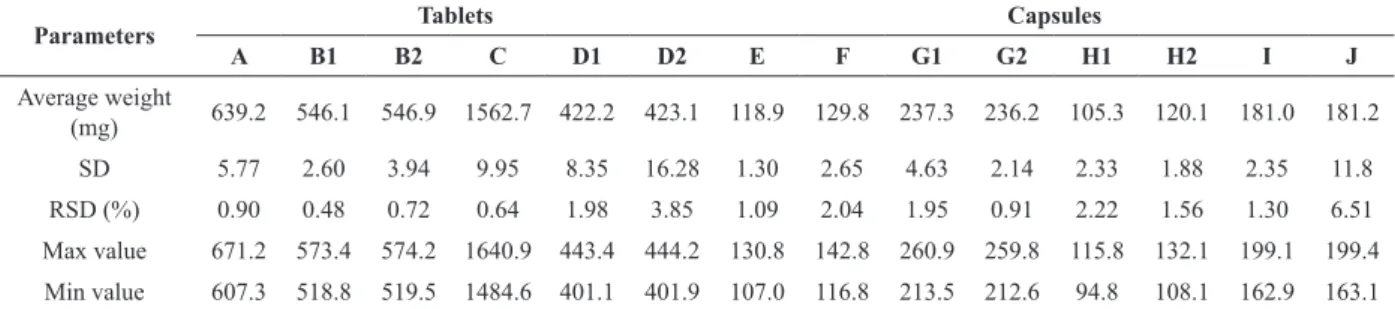
The tablets obtained from the different manufacturers displayed quite different average
weight values ranging between 422.2 to 1562.7 mg (Table II). This variation in average weights amongst the analyzed tablets can be attributed to
the difference in excipient composition used by different manufacturers. Different batches obtained
from the same manufacturer, however, did not exhibit large variations in average weight, therefore they were of suitable quality. All tablets analyzed showed RSD less than 5% (Table II), which is in
accordance with published specifications (Brazil
2010, USP 2016). Considering the maximum and minimum variation limits for the average weight of
coated tablets, all tablets were within the specified
limits. Thus, all the tablets studied showed suitable uniformity of weight.
Compared to the tablets, the analyzed capsules did not show large variations in average weights, which ranged from 105.3 to 237.3 mg (Table II). As with the tablets, average weights did not vary
substantially between different batches. All batches
of capsules analyzed showed RSD values below
10%, in accordance with established specifications
(Brazil 2010, USP 2016). Thus, all capsule batches
were within the specified weight uniformity.
The hardness test is a procedure directed at evaluating the mechanical strength of tablets and
TABLE I
Dosage forms and amounts (mg) declared on the label of lutein, vitamin E, vitamins and minerals.
Formulations Lutein (mg) Vitamin E (mg) Vitamins Minerals
Tablets
A 5.0 10.0 B2 and C Zn, Cu and Se
B 3.0 4.4 C Zn and Na
C 2.0 10.0 A, B1, B2, B3, B6, B7, B9, B12, C, D and K Ca, Mg, Fe, Zn, Mn, Cu, Na, Cr and K
D 5.0 9.0 A, C, B1, B2, B3, B6 and B12 Si, Mn, Cu, Se and Zn
Capsules
E 10.0 NC NC NC
F 3.0 4.4 C Zn and Se
G 10.0 10.0 C Zn and Se
H 10.0 NC NC NC
I 20.0 NC NC NC
J 20.0 NC NC NC
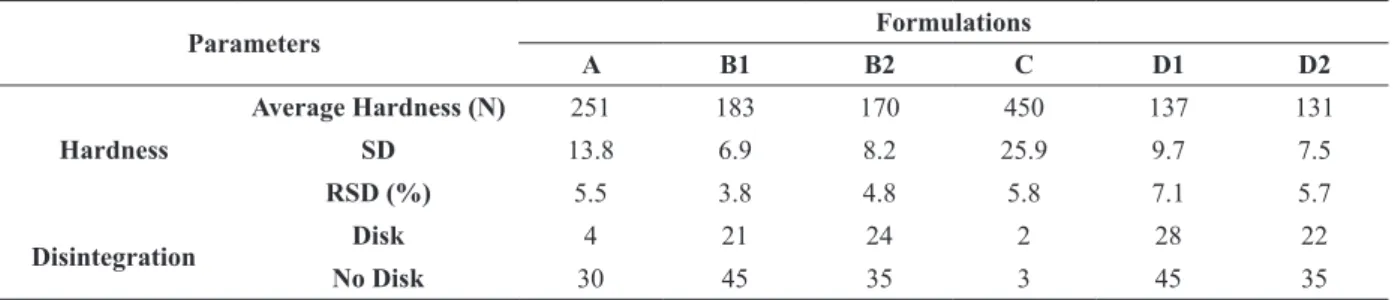
their susceptibility to breakage as a result of falls or friction (Brazil 2010, USP 2016). The hardness of a tablet is proportional to the compression force and inversely proportional to its porosity. In general, tablet disintegration must satisfy two major parameters: 1) sufficient hardness to resist breakage during handling and 2) adequate weakness to warrant disintegration upon ingestion. Overall, the hardness of the tablets studied (Table III) was proportional to the values of their average weights (Table II), and tablets with higher average weights displayed increased hardness values. For these reasons, the hardness values were also very different between different manufacturers.
However, different batches obtained from the same
manufacturer had similar hardness values were obtained.
In the chapter, “Dietary Supplements” of the U.S. Pharmacopeia it is recommended that a disintegration test is performed for tablets in 37°C water in a USP disintegration apparatus, and the disintegration time should not exceed 30 minutes (USP 2016). The Brazilian Pharmacopeia does not
recommend a disintegration test specifically for food
supplements, but suggests the use of disks during the disintegration test for coated tablets. Furthermore, if tablets adhere to the disks, then they must be removed (Brazil 2010). Complete disintegration is achieved if the remaining dosage form residue (except fragments of insoluble coating material or
capsule shell) on the disintegration apparatus grid
is a soft mass without a palpable firm core (USP
2016). Table III shows the results obtained from the tablet disintegration tests. Since no adherence was observed, the test was carried out in the presence of and absence of disks. The use of disks accelerated the disintegration process of analyzed tablets, therefore all tablets disintegrated within 30 minutes in 37°C water (Table III). However, in the absence of disks, formulations B and D did not disintegrate within the 30 minutes time frame. Formulations A
and C, however, disintegrated within the specified
disintegration times. One result however stands out, formulation C disintegrated quickly (3 min) even in the absence of disks. This may be due to the presence of polyvinylpyrrolidone (absent in other formulations) as excipients in formulations A and C, which act as a binder and a disintegrant thereby promoting disintegration of the tablets (Muñoz et al. 2014).
For capsules, the “Dietary Supplements” Chapter of the U.S. Pharmacopeia recommends the use of the USP dissolution apparatus II and rotation of 50 rpm for the disintegration test. The time limit
specified for the disintegration of capsules is up
to 30 minutes. However, for medicines, the most widely used apparatus for disintegrating solid oral dosage forms is the USP disintegration apparatus (Brazil 2010, USP 2016), used in this study for evaluating tablet disintegration. Thus, two tests
TABLE II
Average weight (mg) of tablets (A, B1, B2, C, D1 and D2), capsules (E, F, G1, G2, H1, H2, I and J), SD, RSD and maximum and minimum limits of variation.
Parameters Tablets Capsules
A B1 B2 C D1 D2 E F G1 G2 H1 H2 I J
Average weight
(mg) 639.2 546.1 546.9 1562.7 422.2 423.1 118.9 129.8 237.3 236.2 105.3 120.1 181.0 181.2 SD 5.77 2.60 3.94 9.95 8.35 16.28 1.30 2.65 4.63 2.14 2.33 1.88 2.35 11.8
RSD (%) 0.90 0.48 0.72 0.64 1.98 3.85 1.09 2.04 1.95 0.91 2.22 1.56 1.30 6.51 Max value 671.2 573.4 574.2 1640.9 443.4 444.2 130.8 142.8 260.9 259.8 115.8 132.1 199.1 199.4
Min value 607.3 518.8 519.5 1484.6 401.1 401.9 107.0 116.8 213.5 212.6 94.8 108.1 162.9 163.1
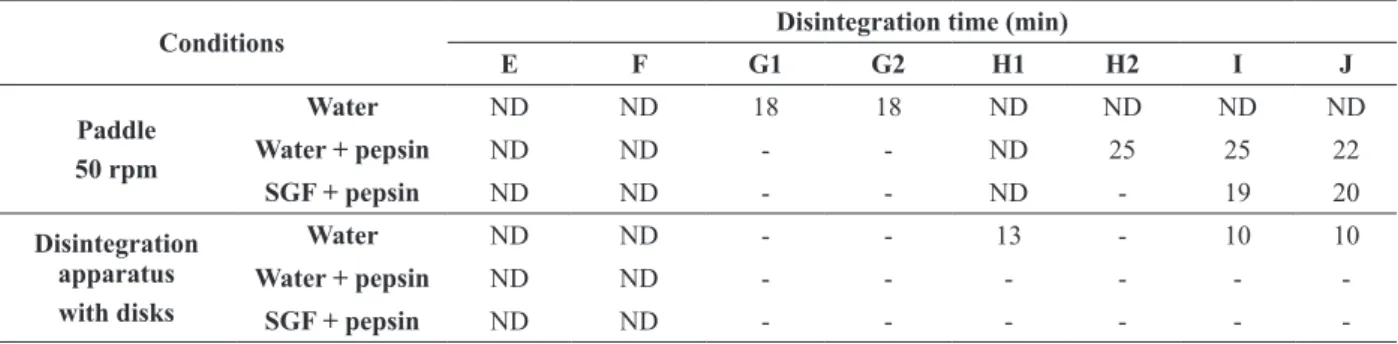
were carried out to verify the disintegration of capsules using methods outlined in the U.S. and Brazilian Pharmacopeia. The tests were initiated in a dissolutor with water heated to 37ºC (USP 2016). When capsules fail to disintegrate in water within the time limit the U.S. and Brazilian Pharmacopeia recommend testing disintegration of capsules in water containing pepsin (Brazil 2010, USP 2016). If water and pepsin are unable to promote capsule disintegration, the next recommended step is using SGF (simulated gastric fluid) pH 1.2. Table IV shows only capsules obtained from manufacturer G passed the disintegration test in water and the 30 minutes time limit. Capsules H2, I and J displayed adequate disintegration in water with pepsin. The other capsules (E, F and H1) did not disintegrate in any of the three solvents tested within the 30 minutes time limit. In Table IV, it can be observed that distintegration could be achieved for capsules I and J in pepsin/water at 37°C. For these capsules, SGF with pepsin is the medium provided the shortest disintegration times.
The fact that some capsules displayed non-disintegration, may be due to crosslinking within the gelatin coating, which hinders disintegration, and hence capsule dissolution (Brown et al. 1998, Ofner et al. 2001). This process may occur in some product batches, like capsule H, which only disintegrated when enzyme was added to water for H2. H1, however, did not disintegrate in any of the conditions tested (Table IV). Thus, crosslinking
may occur as a result of the storage conditions of
the soft capsules causing a film to form in aqueous fluids, which hampers drug release. Thus, the dyes
present in the capsules tested may complicate and prevent disintegration, especially in the Brazilian manufactured capsules (E, F, and H). Capsules obtained on the American market (I and J) however, do not include dyes in their formulations.
The disintegration test was repeated using the disintegration apparatus with disks, for all capsules that did not disintegrate in the dissolutor (E, F, and H). Capsules I and J however, were analyzed and
the disintegration profiles were compared of these
soft capsules containing lutein. The results of the disintegration tests are presented in Table IV and it appears that disintegration was facilitated by use of the disintegration apparatus. Previously H1
capsules did not disintegrate in all the fluids tested,
but could be disintegrated in water while using the disintegration apparatus (Table IV). Capsules I and J also exhibited an accelerated disintegration process, whereas disintegraton of E and F capsules was still not achieved. Comparing the results obtained using the two apparatus, the dissolutor, recommended by the U.S. Pharmacopeia, best discriminates these formulations and thereby reveals pharmacotechnical deviations.
Determining the average content of active ingredients in pharmaceutical forms is essential for quality control, and expressed as a percent on the label claim. In this study the assay was performed
TABLE III
Hardness and disintegration times (minutes) of tablets in the presence or absence of disks in water at 37ºC in the USP disintegration apparatus.
Parameters Formulations
A B1 B2 C D1 D2
Hardness
Average Hardness (N) 251 183 170 450 137 131
SD 13.8 6.9 8.2 25.9 9.7 7.5
RSD (%) 5.5 3.8 4.8 5.8 7.1 5.7
Disintegration Disk 4 21 24 2 28 22
by HPLC-DAD, using a chromatographic condition
that allowed simultaneous quantification of lutein
and vitamin E. Lutein and vitamin E standard curves were used to quantify their content in tested tablets and capsules. The USP recommends a variation limit of 90-130% of the declared content of lutein and 95 to 120% of vitamin E (USP 2016). Table V shows the lutein and vitamin E content in the analyzed tablets and capsules. In summary, only tablets A and C had adequate lutein content. Both batches analyzed from tablets B and D yielded
insignificant amounts of lutein. All tablets had an
excess of vitamin E content exceeding 100%, even those tablets not in accordance regarding lutein content. Nevertheless, only the B1 formulation was
within limits specified for vitamin E content since
the B2 batch and the other formulations exceeded the designated maximal level standards for this vitamin (120%). None of the tablet batches were in accordance with the simultaneous limits set for lutein and vitamin E content. The very low levels of lutein in the formulations may be attributed to degradation reactions that occur during storage, since lutein is an unstable substance (Li et al. 2014). However, an alternate hypothesis is that adulteration may be responsible for the low levels of lutein found in the formulations tested. Tablet C, for example, contains ponceau 4R dye, which has a strong orange color very similar to lutein. During analysis of these tablets, it could be observed that this dye was
deposited at the bottom of volumetric flasks due to
its insolubility in organic solvents. Furthermore,
distribution of this dye is different from lutein, which
is highly hydrophobic (Li et al. 2014).
However, the capsules contained amounts of
lutein close to the specified limits (Table V). It was
also observed that only capsules F and H2 had lutein content that was slightly higher than the maximum limits allowed. Any of the capsules containing vitamin E displayed adequate simultaneous content of this vitamin and lutein.
In order to ensure the delivery of correct doses of active compounds, each unit of a pharmaceutical form batch must contain the active content amount next to the declared quantity and dose uniformity (Brazil 2010). This parameter is measured by the AV calculation, which can have a maximum of 15 to ensure dose uniformity and correct specified content values. Table V shows that the AV values obtained for the tablets, for both lutein as vitamin
E exceeded dose specifications. Through the dose
uniformity for tablet content analysis it could be observed that, even in formulations with lutein contents consistent with stated values other deviations in quality could be detected. Other quality control concerns included non-uniform distribution of the active pharmaceutical in the analyzed forms.
Therefore, these different factors can all impact the final quality of the product offered to the consumer.
As for capsules, only formulations E, G1, I and
TABLE IV
Disintegration times of the capsules in different fluids using the USP dissolution and disintegration apparatus.
Conditions Disintegration time (min)
E F G1 G2 H1 H2 I J
Paddle
50 rpm
Water ND ND 18 18 ND ND ND ND
Water + pepsin ND ND - - ND 25 25 22
SGF + pepsin ND ND - - ND - 19 20
Disintegration
apparatus
with disks
Water ND ND - - 13 - 10 10
Water + pepsin ND ND - - -
-SGF + pepsin ND ND - - -
J were found to have acceptable specified values
and lutein dose uniformity. In regard to vitamin E content, only capsule F met the pharmacopeial requirements displaying values less than 15. The capsules displayed greater dose uniformity of content compared to that of tablet formulations, which largely met disapproval. This may be explained by more homogeneous distribution of lutein in soft capsules dispersed in oily liquid vehicle, compared to the same homogenized and compressed active forms present along with excipients in solid form.
In vitro dissolution tests are an important means of characterizing the biopharmaceutical quality of solid oral dosage forms, thus enabling quality control of formulations. This test was carried out for tablets A and C as well as for capsules J and I. These formulations were selected for this test since their lutein content and disintegration times made them ideal for measurements of lutein release time. The test conditions will be carefully selected in order to achieve the greatest discriminatory power, thus allowing the ability to detect possible
TABLE V
Content uniformity and acceptance values for tablets and capsules.
Formulations Lutein Vitamin E
Content (%)** SD AV Content (%)** SD AV
Tablets
A 120.2 8.38 27.80 125.2 6.1 32.48
B1 0.12 0.01 NA 108.6 -
-B2 0.61 0.10 NA 140.4 -
-C 125.0 2.84 19.33 140.6 6.7 49.35
D1 0.35 0.03 NA 156.7 -
-D2 3.96 0.92 NA 146.9 -
-Capsules
E 116.2 3.9 13.04 NC NC NC
F 131.9 6.5 35.00 113.7 3.4 14.38
G1 120.1 2.7 13.95 132.7 3.6 33.87
G2 125.7 6.6 28.94 139.7 4.4 42.83
H1 126.1 4.5 24.50 NC NC NC
H2 135.2 4.1 32.50 NC NC NC
I 112.5 4.2 10.01 NC NC NC
J 111.9 5.6 13.50 NC NC NC
**Content mean of active ingredient in each individual tablets (n=10) expressed as a percent to label claim (%); SD: standard deviation; AV: acceptance value. NC: does not contain vitamin E.
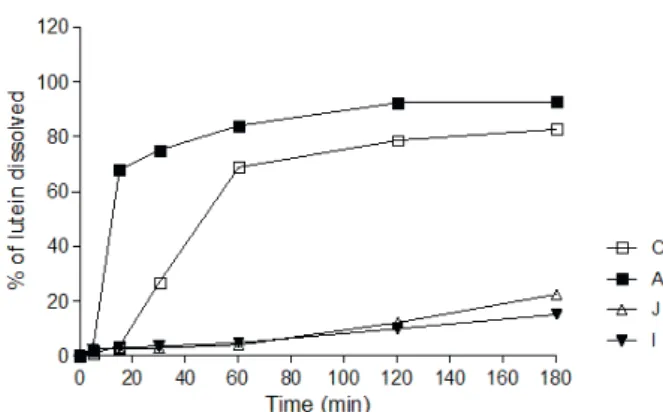
breaches in existing quality control standards. Thus, a validated dissolution test for lutein tablets was applied. After 180 minutes of testing (Anselmo et al. 2016), the capsules were less than 20% dissolved. The tablets performed better during this test, however, they displayed large disparities in their dissolution values. Although the A and C tablets performed well in testing, more than 80% of lutein released within 180 min. After 30 mins, 40% more lutein was dissolved in tablets A than tablets
C (Figure 1). This difference in lutein release from
tablets impacts the bioavailability of this carotenoid in humans. Therefore, it was established that
differences existed in the bioavailabilty of different
tablet formulations as well as factors that reduced the overall lutein availability from capsules.
CONCLUSIONS
In summary, none of the ten formulations studied presented satisfactory results during all of the quality control tests conducted. Of all tablets tested,
two showed no significant available lutein content,
the two tablet formulations with significant lutein content did not show dose uniformity of content. The capsules, despite having adequate amounts of lutein, presented alarming negative results as a result of poor disintegration and dissolution properties. These results may impact the non-bioavailability of lutein from these formulations. All formulations analyzed in the present study are currently being marketed on the Brazilian and American markets. The low performance found in physicalchemical quality
control tests can be explained by the lack of specifi c
regulations, which are necessary to ensure the quality of lutein-containing products on the market.
ACKNOWLEGMENTS
This material is based upon works supported by
Conselho Nacional de Desenvolvimento Científi co
e Tecnológico (CNPq) (Brasília, Brazil) and Fundação Carlos Chagas Filho de Amparo à Pesquisa do Estado do Rio de Janeiro (FAPERJ) (Rio de Janeiro, Brazil). We are grateful to Michelle Parvatiyar for the English review.
REFERENCES
ANSELMO CS, MENDES TC, HONORIO TS, CARMO FA, CABRAL LM AND DE SOUSA VP. 2016. Development
and validation of a dissolution test for lutein tablets and evaluation of intestinal permeability. Food Chem210: 63-69. ANVISA - AGÊNCIA NACIONAL DE VIGILÂNCIA
SANITÁRIA. Consulta de produtos e alimentos. Disponível em: http://www7.anvisa.gov.br/datavisa/ consulta_produto/Alimentos/frmConsultaAlimentos.asp. Acesso em 16/05/18.
AZQUETA A AND COLLINS AR. 2012. Carotenoids and DNA damage. Mutat Res 733: 4-13.
BRAZIL. 2010. Farmacopeia Brasileira. Agência Nacional de Vigilância Sanitária. 5ª ed., Brasília: ANVISA, vol 1. BROWN J, MADIT N, COLE ET, WILDING IR AND
CADÉ D. 1998. The effect of cross-linking on the in vivo
disintegration of hard gelatin capsules. Pharm Res 15: 1026-1030.
EISENHAUER B, NATOLI S, LIEW G AND FLOOD VM. 2017. Lutein and Zeaxanthin-Food Sources, Bioavailability and Dietary Variety in Age-Related Macular Degeneration Protection. Nutrients 9: 1-14.
GELLENBECK K, VENZON DS, LALA R AND CHAVAN J. 2012. A multicarotenoid beadlet for human nutrition - proof of concept of in vitro timed release. Acta Biochim Pol 59: 35-38.
GONG M, WANG Y AND BASSI A. 2017. Process analysis and modeling of a single-step lutein extraction methods for wet microalgae. Applied Micro Biotech 101: 8089-8099. KIJLSTRA A, TIAN Y, KELLY ER AND BERENDSCHOT
TT. 2012. Lutein: More than just a filter for blue light. Prog Ret Eye Res 30: 1-13.
LI D, XIAO Y, ZHANG Z AND LIU C. 2014. Analysis of (all-E)-lutein and its (Z)-isomers during illumination in a model system. J Pharm Biom Anal 100: 33-39.
MONTESANO D, GENNARO O, SECCIA S AND ALBRIZIO S. 2012. A simple and selective analytical procedure for the extraction and quantification of lutein from tomato by-products by HPLC-DAD. Food Anal Method5: 710-715. MUÑOZ H, CASTAN H, CLARES B AND RUIZ MA.
2014. Obtaining fast dissolving disintegrating tablets with different doses of melatonin. Int J Pharmac 467: 84-89. NEVES DBJ AND CALDAS ED. 2015. Dietary supplements:
International legal framework and adulteration profiles, and characteristics of products on the Brazilian clandestine market. Regul Toxicol Pharmacol 73: 93-104.
OFNER CM, ZHANG YE, JOBECK VC AND BOWMAN BJ. 2001. Crosslinking studies in gelatin capsules treated with formaldehyde and in capsules exposed to elevated temperature and humidity. J Pharm Sci 90: 79-88. OLEA JL, ARAGÓN JA, ZAPATA ME AND TUR JA. 2012.
Characteristics of patients with wet age-related macular degeneration and low intake of lutein and zeaxanthin. Arch Soc Esp Oftalmol 87: 112-118.
ROCK CL. 2007. Multivitamin-multimineral supplements: who uses them? Am J Clin Nutr 85: 277S-279S.
Figure 1 - Dissolution profi les of lutein obtained from tablets
USP - THE UNITED STATES PHARMACOPEIA. 2016. The United States Pharmacopeia - National Formulary 29, 34th
ed., The dissolution procedure: development and validation. Rockville: USP Convention Inc, Chapter 1092. T I A N Y, K I J L S T R A A , W E B E R S C A B A N D
BERENDSCHOT TTJM. 2015. Lutein and Factor D:
Two intriguing players in the field of age-related macular degeneration. Arch Biochem Biophys 572: 49-53. TIMBO BB, ROSS MP, MCCARTHY PV AND LIN CTJ.