i
Universidade do Minho
Escola de Ciências
Daniela Clara Carqueija Cardoso
Isolation and characterization of the
genomic variability in activated-sludge: a
comparative analysis between bacterial
isolates and operation parameters
Dissertação de Mestrado em Genética Molecular
Trabalho efectuado sob orientação da
Doutora Ana Nicolau
Trabalho efectuado sob co-orientação de
Marta Martins Neto
ii
Declaração
Nome
Daniela Clara Carqueija Cardoso
Endereço electrónico: [email protected] Telefone: 91 6557746 Número de Identificação Civil: 13256329
Título da tese de mestrado:
Isolation and characterization of the genomic variability in activated-sludge: a comparative analysis between bacterial isolates and operation parameters
Orientador:
Doutora Ana Paula Mesquita Rodrigues da Cunha Nicolau Co-Orientador: Marta Martins Neto
Ano de conclusão: 2013
Designação do Mestrado ou do Ramo de Conhecimento do Doutoramento:
Ciências - Mestrado em Genética Molecular
1. É AUTORIZADA A REPRODUÇÃO INTEGRAL DESTA TESE/TRABALHO APENAS PARA EFEITOS DE INVESTIGAÇÃO, MEDIANTE DECLARAÇÃO
ESCRITA DO INTERESSADO, QUE A TAL SE COMPROMETE; Universidade do Minho, 30 de Abril de 2012
iii
The present work acknowledges the Project “PROTOFILWW – Establishment of relationships between protozoa, metazoa and filamentous bacteria of activated sludge and physical-chemical and operational parameters of plants” (PTDC/AMB/68393/2006) supported by the Foundation for Science and Technology (FCT).
iv
Abstract
Isolation and characterization of the genomic variability in activated-sludge: a comparative analysis between bacterial isolates and operation parameters
Activated-sludge is one of the most important biotechnological processes of our times supported by a mixture and variable set of micro and macro organisms that, in complex association, are able to remove and/or transform not only particulate pollutants but also particles dissolved in the mix. Bacteria play an essential role in these transformations that are carried mainly in aerobic conditions.
As in any other ecosystem, the microbiological community of activated-sludge is determined by the operational and physical-chemical variables prevalent in the aerated tank of these systems. Over the years, wastewater treatment was engineered with none or little knowledge about microorganisms, being the main information on the process provided by chemical and physical analyses. The difficulty of identifying the prevailing microorganisms, especially the bacteria, has been one of the reasons for its withdrawal. Molecular methods brought some advantages to this scenario enabling the identification of the prokaryotic microorganisms.
The aim of the present project was the study of the prokaryotic community of 8 wastewater treatment plants (WWTP) in the south region of Portugal, using molecular and bioinformatic approaches. A polymerase chain reation (PCR) was carried on and the primer M13 was chosen to discriminate the bacterial isolates previously obtained from the samples. The software Bionumerics was used to analyse the data building a dendrogram of the isolates based on the genetic profile and enabling the subsequent analyses of the relations between the microorganisms and the physical-chemical and operational parameters of the WWTP. This work is a exploratory work and, to the knowledge of the team, it was never done before.
The results showed a tendency for an aggregation of the microrgamisms of only one of the studied WWTP. In fact, the isolates that showed the highest similarity belong to that plant. The other isolates do not seem to show any pattern of similarity, probably indicating low variability among the remaining systems. This can be due to the fact that all the studied WWTP came from one limited geographic region and are explored by one enterprise. The present results show some interesting clues about the potentialities of these techniques to be use in the project PROTOFILWW that aimed at studying thirty-seven WWTP, all over the country over two years.
In conclusion, molecular techniques together with bioinformatics can have a significant contribution to the study and comprehension of the complex communities of activated-sludge systems, namely the prokaryotic component.
v
Resumo
Isolamento e caracterização da variabilidade genómica nos processos de lamas activadas: uma análise comparativa entre os isolados bacterianos e os parâmetros de operação
O processo de lamas activadas é um dos mais importantes processos biotecnológicos dos nossos tempos e não é nada mais do que uma mistura e um conjunto variável de organismos que, numa complexa associação, são capazes de remover e/ou transformar os poluentes. As bactérias desempenham um papel essencial nestas transformações que ocorrem principalmente em condições aeróbias. Como em qualquer outro ecossistema, a comunidade microbiológica de lamas activadas é determinada pelas variáveis operacionais e físico-químicas prevalecentes no tanque de arejamento dos sistemas de tratamento. Ao longo dos anos, o tratamento das águas residuais foi levado a cabo sem ter em atenção os microrganismos que o levavam a cabo, tendo sido as principais informações para a sua monitorização fornecidas por análises químicas e físicas. A dificuldade em identificar os microrganismos que prevalecem nas lamas activadas, especialmente as bactérias, tem sido uma das razões para este facto. Os métodos moleculares vieram melhorar em grande parte este cenário ao permitir a identificação dos microorganismos procarióticos não distinguíveis por métodos microscópicos.
O objetivo do presente trabalho foi o estudo da comunidade procariótica de 8 estações de tratamento de águas residuais (ETAR) na região sul de Portugal, através de abordagens moleculares e bioinformática. Uma reacção de polimerização em cadeia (PCR) foi realizada, usando o primer M13, com o objetivo de discriminar as bactérias isoladas a partir das amostras dessas ETAR. O software Bionumerics foi utilizado para analisar os dados e para a construção de um dendrograma com base no perfil genético, permitindo análises posteriores das relações entre os microorganismos e os parâmetros físico-químicos e operacionais das ETAR. O presente trabalho é um trabalho exploratório, na medida em que não se conhece nenhum feito nos mesmos moldes em ETAR.
Os resultados mostraram uma tendência para agregação dos microrganismos de apenas uma das ETAR estudadas. De facto, os isolados que mostraram mais semelhança entre si pertencem a esta ETAR. Os demais isolados não parecem mostrar qualquer padrão de similaridade, provavelmente indicando baixa variabilidade entre as ETAR. Este facto pode ocorrer porque as ETAR estudadas se encontram numa região geográfica limitada e são exploradas pela mesma empresa. Os resultados demonstram algumas pistas interessantes sobre as potencialidades desta técnica que pode ser explorada no projeto PROTOFILWW que teve como objetivo estudar 37 ETAR em todo o país durante dois anos.
Em conclusão, as técnicas moleculares, juntamente com a bioinformática, podem ter uma contribuição significativa no estudo e na compreensão das complexas comunidades de lamas ativadas, nomeadamente a componente procariótica.
vi
Acknowledgement/Agradecimentos
Porque nada na vida se faz sem ajuda, agradeço:À Professora Doutora Ana Nicolau por ter aceitado a orientação da minha tese, especialmente por o ter feito nas condições em que fez. Por mais anos que viva e por mais voltes que a vida dê, jamais esquecerei o que ela fez por mim. Mais do que uma tese de mestrado ela permitiu que eu terminasse os meus estudos depois de tanto esforço e dedicação. Deixo aqui um agradecimento também à Doutora Rosário por ter encontrado a Doutora Ana e lhe ter explicado a situação.
Agradeço também à Marta Neto por tudo. Por me acompanhar em todas as etapas. Ensinou-me sempre com paciência e atenção vezes e vezes sem conta. Não podia ter tido melhor pessoa a meu lado. Obrigada por tudo, Marta.
Agradeço à Liliana, à Vânia e aos restantes colegas de laboratório por me ajudarem sempre e por criarem um excelente ambiente a cada dia. Dava gosto trabalhar lá.
Ao Pedro Lopes deixo aqui um agradecimento especial por ter sido o meu grande apoio neste momento. Sem ti não teria conseguido. Obrigada por me ajudares com tudo. Por leres, por ajudares com o vocabulário, formatação etc, obrigada por te preocupares comigo, por acreditares em mim. Obrigada pela força, obrigada por me acalmares, obrigada por simplesmente me abraçares quando eu mais precisei, obrigada pelo carinho. Desculpa as noites mal dormidas, o mau humor que aturaste, o stresse, o tempo trancado em casa e a falta deste para tudo… Prometo que te compenso. Agradeço também à tua família o carinho com que me acolheu.
À Sónia Duarte que juntamente com o Pedro foi, também ela, o meu grande apoio. Obrigada Soninha por sempre te preocupares comigo, por sempre me animares, por me tirares de casa, por me telefonares quase todos os dias só para saber se estou bem. Muito obrigada por seres minha amiga.
Obrigada à Paula e à madrinha Cândida por estarem sempre presentes e acreditarem em mim.
vii
Obrigada à Filipa por me mostrar que não importa o tempo, a distância, ou as zangas que temos na vida. Quando somos amigos, corremos atrás e estamos lá quando e preciso. Jamais esquecerei.
Agradeço à Edite por ter estado presente e ao Pedro Rodrigues pelas horas que passou a dizer que eu havia de conseguir. Agradeço também à Marlene pelo apoio especialmente nesta fase final, agradeço também ao Flávio a amizade sempre demonstrada e ao Nuno Sousa as conversas e as idas ao Porto.
Agradeço à Isabel a amizade para além do tempo e por sempre torcer por mim. Falta pouco para entregar a tua tese Belita, ficarei muito feliz nesse dia.
Por último mas não menos importante, agradeço a Casa Do Menino Jesus por me terem educado e por me terem ensinado a importância de estudar. Obrigada pelo apoio e por terem permito que estudasse. Hoje estou pronta para assumir as rédeas da minha vida. Obrigada a todos que não mencionei mas que de um modo ou de outro estiveram presentes na minha vida e no meu trabalho. Sozinha jamais teria conseguido. Muito obrigada.
viii
Table of Contents
Symbols and Abbreviations ... x
Background and Objectives ... 1
1) Background and Objectives ... 2
Introduction ... 3
2.1 ) General Introduction ... 4
2.2) Residual Water ... 4
2.3) Importance of the Water Quality to the Receptor Ecosystems ... 5
2.4) WWTP (Waste Water Treatment Plant) ... 6
2.4.1) Treatment of Water in WWTP ... 7
2.5) Activated Sludge ... 8
2.5.1) Problems Associated With the Process ... 10
2.5.2) Possible Solutions... 11
2.6) Environmental Conditions in the WWTP ... 11
2.7) Organisms Living in WWTP ... 14
2.7.1) Metabolism of Bacteria ... 15
2.8.) Advantages of Molecular Methods Vs Classic Methods in the Identification of Microorganisms ... 17
2.9) Contribution of Bioinformatics to the Identification ... 22
Methodology ... 24
3.1) Samples ... 25
3.1.1) Culture of Samples and Isolation of Morphotypes ... 25
3.2) Isolates Preservation ... 26 3.3) Gram Staining ... 26 3.4) Molecular Approaches ... 27 3.5) DNA Extraction ... 27 3.6) PCR ... 27 3.7) Electrophoresis Gel ... 29
ix
3.8) Bioinformatics ... 29
Results and Discussion ... 31
4.1) Characterization of the Bacterial Isolates ... 32
4.2) Genomic characterization by M13-PCR fingerprinting ... 34
Conclusions and Future Work ... 47
Bibliography ... 50 Appendix ... 58 Appendix I ... 59 Appendix II: ... 60 Appendix III ... 62 Appendix IV ... 63 Appendix V ... 68
x
Symbols and Abbreviations
% - percentage µl – microliter
ARDRA - Amplified ribosomal DNA restriction analysis BOD - Biochemical oxygen demand
CO2 - Carbon dioxide
CSLM - confocal scaning laser microscopy DGGE - Denaturing gradient gel electrophoresis DNA - DesoxiribonucleicAcid
EDTA - Ethylenediamine tetraacetic acid FISH - Fluorescent in situ hybridization
H2O - water L - Liter Mg - Magnesium mg - Milligram ml - Milliliter NH4 - ammonium NO2 - Nitrogen Oxide O2 - Oxygen ºC - Celsius degree
PCR - Polymerase chain reaction pH - Potential of Hydrogen
RISA - Ribosomal RNA intergenic spacer analysis RNA - RibonucleicAcid
Rpm - rotations for minute SDS - Sodium Dodecil Phospate
TAE - Tris base, acetic acid and EDTA. TE - Tris-EDTA
TSA - Tryptone Soy Agar TSB - Tryptic Soy Broth UV- Ultra Violet
xi
List of Figures
Figure 1: Goals of this work ... 2
Figure 3: Mix of activated sludge and posterior separation by gravity ... 9
Figure 4: bacteria division ... 15
Figure 5: Molecular approaches for detection and identification of xenobiotic-degrading bacteria and their catabolic genes from environmental samples (Adapted from Muyzer and Smalla, 1998) ... 23
Figure 6: Gram staining procedure ... 26
Figure 7: Agarose gel with M13-PCR fingerprinting profiles obtained for some of the strains in study ... 34
Figure 8: Dendogram obtained after clustering analysis...………..36
Figure 9: Ladder NZYDNA ladder III with corresponding band size ... 62
Figure 10: 2.2CUC ... 68 Figure 11: 3.3CUC ... 68 Figure 12: 2.2LAG ... 69 Figure 13: 3.3LAG ... 69 Figure 14: 2.2MON ... 70 Figure 15: 3.2MON ... 70 Figure 16: 2.2SEI ... 71 Figure 17: 3.3SEI ... 71 Figure 18: 2.2VZI ... 72 Figure 19: 3.2VZI ... 73 Figure 20: 2.2ZIA ... 74 Figure 21: 3.3ZIA ... 74
xii
List of Tables
Table 1: Characteristics of residual water (Adapted from Tandoi et al, 2006) ... 5
Table 2: SBI Classes (Madoni, 1994) ... 13
Table 3: Metabolic groups in activated sludge (Nicolau, 2009)... 16
Table 4: Different methods of microorganism identification (Adapted from Gilbride et al., 2006) ... 19
Table 5: Composition of DNA mix ... 28
Table 6: PCR program ... 28
Table 7: Quantities of ladder and sample for the electrophoresis gel ... 29
Table 8: bacteria isolates generated from each sample ... 32
Table 9: Numbers given to the groups of isolates present in dendrogram ... 37
Table 10: Physico-chemical characteristics ... 63
Table 11: Microbiologic Characteristics (ind/mL). Protozoa (part 1) ... 64
Table 12: Microbiologic Characteristics (ind/mL). Protozoa (part 2) ... 65
Table 13: Microbiologic Characteristics (ind/mL). Protozoa (part 3) ... 66
1
CHAPTER I
2
1) Background and Objectives
This work part of the project PROTOFILWW (PTDC/AMB/68393/2006) funded by the Foundation for Science and Technology (FCT) entitled PROTOFILWW - Establishment of relationships between protozoa, metazoa and filamentous bacteria of activated sludge and physicochemical and operational parameters of plants. All samples in this work came from this project.
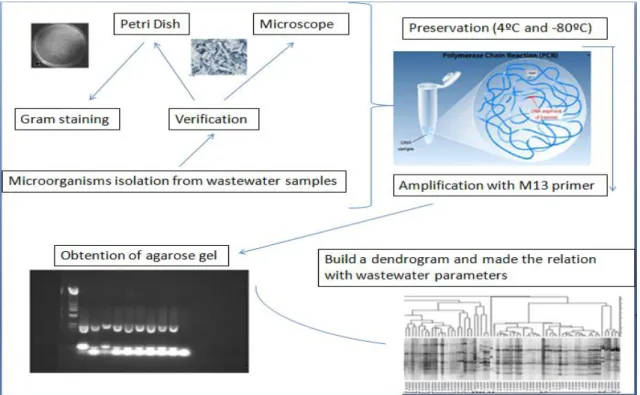
This part of the project was elaborated with the intention of isolating microorganisms from activated sludge samples from various wastewater treatment plants (WWTP). Then, the relation between the microorganisms and the WWTP characteristics would be made in achieve a better understanding of what determines the prokaryotic community of activated-sludge systems. To accomplish this, polymerase chain reaction PCR with the M13 primer was applied to the isolates previously made. Then, there was a verification of the strand patterns in an agarose gel followed by an analysis ran by a computer program in order to group and correlate the isolates, whether this is with each other or with the physical and chemical parameters of the wastewater treatment plants.
3
CHAPTER II
4
2.1 ) General Introduction
Water is one of the most valuable resources in the planet and, when people started to realize that it was becoming polluted, they began trying to clean it up. In the past, people have tried to create their own sewage systems (Lens et al., 2004) but it was only in the nineteenth century (1820 to 1850) that people started to understand that some diseases can infect humans through contaminated water (Chartered Institute Environmental Health, 1998). The treatment of water originated from the need to reduce human disease, followed by the environmental issues and finally because pure water is needed for human activities (Vesilind, 1998). It also finally came to light that the water cannot just be deposited into the sea or any other course of water. The technology to treat water exists and, in most cases, enables the direct re-introduction into its natural cycle or even the re-use of water to replace potable water in domestic use, such as toilet water supply. Microorganisms play the fundamental role in the majority of urban wastewater treatment systems. Although, over the years, wastewater treatment was engineered with none or little knowledge about microorganisms, it is important to understand which microorganisms exist and in what quantities in order to see what works better in these treatment systems. The main information was provided from chemical and physical parameters. Not surprisingly, proliferation of some microorganisms with undesirable effects, causing settling problems like bulking and foaming, often grow in the aeration tank of wastetwater treatment plants. Besides, the existence of pathogenic microorganisms in the final effluent can be a threat to public and environmental health (Gilbride et al., 2006).
2.2) Residual Water
Residual water is one of the many residuals that human beings produce every day, individually or as a group for industrial, agricultural or individual purposes. The residual water is easily identified because of its characteristic smell due to its provenience which is a mix of domestic waters, sanitary waters, urban waters infiltration water and water seepage. Its aspect resembles a much diluted suspension of different materials (Prescott et al., 2005). In this residual water, carcinogenic and/or mutagenic substances, such as toxic compounds, can exist, being able to cause serious disturbances to the ecosystems and to human health (Metcalf and Eddy, 2003). In table 1, physical and chemical characteristics of residual water are shown
5
It is not possible to estimate the volume of residual water produced per capita since this number depends on the referred country and also depends on the water availability and of the level and quality of life of the population (Water UK, 2006).
Table 1:Characteristics of residual water (Adapted from Tandoi et al, 2006)
Physical Chemical Microbiologic
Odor Organic Inorganic Gases Microbiological characteristics will
be described above in section 1.7
Temperature Proteins Ph Oxygen
Suspended solids Carbohydrates Chloride Hydrogen Lipids Alkalinity Sulphide Surfactants Nitrogen Methane Phenols Phosphorus
Pesticides Heavy metals Toxic materials
The characteristic look of residual water is due to physical characteristics. The smell is due to two main groups of chemical substances: nitrogen and sulfur compounds, such as mines, ammonia, diamines, and skatole and, in a minor extension, to chlorine and phenol compounds like hydrogen sulfide, mercaptans, organic sulfide and sulfur dioxide. The size of suspended particles that float in water varies between 1µl and distinguishable organic matter.
2.3) Importance of the Water Quality to the Receptor Ecosystems
Organic material, such as food waste or fecal matter and other biological material, is naturally degradable in the rivers and in the sea. Bacteria and other microorganisms are responsible by this clean up; in order to do that, microorganisms need to use dissolved oxygen to break it down in the respiration process. If the pollution is too much, the consequences can be irreversible. For instance, organic compounds will serve as food for the bacteria which, in turn, will use most of the available oxygen
6
killing the aquatic animal and plant life. The components released as a result of bacterial activity and organism death, such as phosphorus and nitrogen, can lead to a huge growth of green algae and cyanobacteria which produce toxic products (Codd, 1995). This will cause a domino effect and directly it will be difficult for other animals to survive with little oxygen. Besides organic waste, another big issue is the chemicals used in modern life including heavy metals which are not biodegradable and may accumulate in river sediments or worst in fish and plants. These toxic compounds came from industrial and domestic sources, and can be toxic to animals and humans (Water UK, 2006).
If the water goes through the appropriate treatment, the same water can reenter in its normal cycle without harmful consequences. In fact, the objective of water treatment is the removal of unwanted components in wastewaters providing a safe discharge into the environment. This is not simple but can be made by physical, chemical and biological means, either alone or in combination (Cooper, 2004).
2.4) WWTP (Waste Water Treatment Plant)
The biological wastewater treatment is one of the most important biotechnological processes of our times and differs from the conventional biotechnological process because it does not require pure cultures or controlled aerobic fermentations of economically important metabolites. Its importance can be seen when it is taken into account that this process has been used for over a century (Gray, 1990; Matsui et al., 1991).
In WWTP, an artificial ecosystem is built, consisting in one abiotic component (the plant structure and the sewage) and the biotic component comprising the living organisms such as the bacteria, the fungi, the protozoa and the little metazoan, the latter feeding on the bacteria inhabiting the same mixture. The bacteria extract the energy necessary for their metabolism from organic matter and from the oxygen that enters within wastewater (Madoni et al., 1993): as a result, at the same time as new biomass is produced, soluble organic material is removed from the waste treatment (Bonde, 1977). The engineering of this system is almost perfect because it gives the microbes all the nutrients and necessary oxygen and maintains them in intimate contact. In this way, most of the time, water with high degree of purity is obtained (Hawkes, 1983; Megank and Faup, 1988; Seviour and Blackall, 1999). In the end only biomass, carbon dioxide
7
and water would be obtained. Of course, its main product is the excess of sludge consisting of microbial biomass (Rocher et al., 1999).
2.4.1) Treatment of Water in WWTP
First, coarse solids and oils are removed with the goal of preventing the equipment from clogging. This is called preliminary treatment.
In the primary treatment, screens and sedimentation tanks are used with the aim of removing a significant proportion of the suspended solids.
The secondary treatment comprises the removal of soluble organic matter by bacteria in the aerated tank of activated-sludge systems. Oxygen is provided and flocculation of the biomass is favored to enable subsequent separation from the liquid fraction in the secondary sedimentation tank.
If the tertiary treatment is used, recalcitrant organic compounds can be removed as well as excessive nutrients like nitrogen and phosphorus and finally eventual pathogens, generally using physical and/or chemical treatments. The result is the reduction of BOD, nutrients, pathogens and toxic substances (Cooper, 2004). Figure 1 is a scheme of the operation of a WWTP system.
Available in <http://weather.nmsu.edu/Teaching_Material/SOIL350/waste_water_treatment_plant.htm>, acessed in April, 1.
8
2.5) Activated Sludge
Activated Sludge is nothing more than a mixed and variable set of micro and macro organisms in one complex association that are able to remove and/or transform not only particulate pollutants but also particles that remain dissolute in the mix. This is mainly operated by bacteria present in flocs under aerobic conditions (Lens and Stuetz, 2004).
Activated sludge needs to deal with a diversity of organic and inorganic compounds with irregularities of the system and the microorganisms need enough time to metabolize the biodegradable compounds (Painter, 1983).
In summary, this is an operation developing through two steps: first, the biomass removes the soluble organic matter with the help of the oxygen provided through several ways in the aeration tank and after that, the separation of the liquid portion in the secondary sedimentation is achieved (Painter, 1978).
The objectives of the activated sludge treatment are:
the reduction of the sludge volume reducing this way its fermentation capacity which leads to a better smell and to a diminution of pathogenic microorganisms in the sludge;
the removal of soluble organic matter of the wastewater so it cannot cause any important damage to receptor ecosystems;
the removal of the substances that have a demand for oxygen from the system like nitrogen and phosphorus in order to make sure that photosynthetic organisms in receiving waters stay with their growth limited.
A short way to resume how an activated sludge system works is mentioning the essential factors of its operation: it needs suspended biomass, oxygen (1 - 2 mg/l, ideally) and posterior separation by gravity (figure 2). The retention time varies with the effluent characteristics and with the desired depuration degree (Santana et. al., 2009).
On the other hand, sludge production depends on several factors like the degradability of organic compounds, mass loading of the treatment plant (Eckenfelder, 1978), cellular lyses (Hamer, 1984) or deregulation of the ecosystem for instance, with excessive growth of the bacteria grazers (Lee and Welander, 1996).
The biomass is organized into a discrete spatial entity. In the aerated tank, constant aeration and suspension provided by the agitation or by the bubbles rising from
9
diffusers in the basin floor is needed (Hawkes, 1983). The mixing also enables that the microbes stay in intimate contact and grow in a three-dimensional way in order to form flocs. These flocs shall have settling properties that allow an easy separation from the liquid mixing (Frey, 1992). This way of operation has not actually changed much in one century: from the beginning, most of the aerobic reactors consisted of a rectangular basin with submersed mechanical diffusers or mechanical surface agitators (Gray et al., 1999).
Figure 3:Mix of activated sludge and posterior separation by gravity
Availabel in <http://www.akvo.org/wiki/index.php/Activated_Sludge>, acessed in April, 1.
Aeration allows the continuous entrance of oxygen which is indispensable so nutrients can be oxidized, enabling the growth of biomass in size and cell number and the non-soluble particles being incorporated in the flocs (Wanner, 1994). The resultant water after aeration contains low content of dissolved organic compounds but has a lot of suspended solids that will be removed in a secondary decanter (Santana et. al., 2009). Then, a part of the solids separated from the liquid by gravity and the biomass, now enriched with microbes, can be recycled and used to re-inoculate the incoming raw sewage. Some of this mass is wasted in determined time intervals because of the age of the sludge since, over time the sludge becomes less and less efficient (Hansen et al., 1993). If it is possible and the oxygen is enough, the activated sludge systems should have microbes capable of removing some compounds like nitrogen and phosphorus because of its toxicology (Megank and Faup, 1988). In the end of the second stage, there was a reduction of the biochemical oxygen demand (BOD), suspended solids and, of course, if everything goes according to plan, a huge reduction in toxicity and a low concentration of nutrients (Sahlstrom et al., 2004).
10
In the end, as a result of the flocculation process, a mixture of organic and inorganic particles and live cells in a colloidal solution are obtained (Santana et. al., 2009). It is impressive that all this process is carried out by resident microorganisms but, in the end, a reduction in the number of pathogenic organisms present is observed (Betancourt and Rose, 2004).
2.5.1) Problems Associated With the Process
Some problems affect the separation process of the solids in activated sludge. There is a double goal in the activated sludge system, one is to metabolize organic substances and the other is to form flocks that allow posterior filtration and elimination of the system (Nicolau, 2009). Some microorganisms promote some undesirable effects such as disperse growth, pin floc, bulking and foaming. The problem is that the floc does not compact correctly which causes problems in the following steps (Metcalf and Eddy, 2003; Wanner, 1994). There are two phases in floc formation: flocculation of bacterial cells due to extracellular polymers of a viscous nature and the formation of a filamentous skeleton. This latter is important because the flocks can increase the size and exhibit better resist mechanic aggression resulting from turbulence. This phase corresponds to the formation of the macrostructure (Nicolau, 2009). It is extremely important that the sludge that comes out of the aeration tank should be easily separated from the liquid phase. If the separation goes well and the compression goes correctly performed too, a good quality of the effluent is assured (Flores-Alsina et al., 2009).
There are a lot of reasons that lead to problems in solids separation such as low dissolved oxygen content, oxygen demand (chemical and biological), nitrogen (nitrite and ammonia), phosphate and metals (heavy and trace), lack of nutrients, presence of septic waters, low food/microorganisms ratio, old sludge, configuration of the biologic reactor, temperature and pH. As a consequence, different phenomena can be observed:
Dispersed growth: if there is a lack in exopolymer bridges, the microorganisms are free in the medium individually (Wanner, 1994; Larsdotter, 2006); other causes can be a high relation between monovalent cations/divalent cations (Higgins and Novak, 1997) and the presence of substances which decrease the tension between two biodegradable liquids (Bott and Love, 2002).
Pin-point flock: sometimes, when the sludge is old, flocks are not exposed to exogenous metabolism. This occurs when bacteria form small flocs that, although small and round, have difficulty in sedimenting (Wanner, 1994). If
11
flock formation is not well succeeded, in the aeration tank total destruction of these kinds of flocks can occur (Wanner, 1994).
Filament bulking: if filamentous organisms grow excessively in the system, they produce a diffused structure of the flock, interfering with sedimentation and with the compression of the sludge, leading to bad quality of the final products: the final effluent and the sludge (Jenkins et al., 2004).
Bulking zoogleal: if there is excessive zoogleal growth, because of the excessive growth of exocellular material, a viscous sludge is formed also leading to a bad quality of both final effluent (Wanner, 1994).
Foaming: organisms like Nocardia and Microthrix parvicella have hydrophobic cells that are less dense than the water, accumulating in the surface of the aerated tank as a scum (Jenkins et al., 2004).
2.5.2) Possible Solutions
In order to solve one or more of these problems, some adjustments can be made (Nicolau, 2009; MetCalf and Eddy, 2003).:
Increase or decrease the dissolved oxygen; Variation in flux of the sewage;
Adjustment in recirculation flow;
Addition of chemical compounds in order to improve the flocculation and/or to decrease the amount of filamentous microorganisms;
Addition of nutrients;
pH alteration especially if it favors alkalinity.
2.6) Environmental Conditions in the WWTP
The environmental conditions that prevail in the aeration tank of the WWTP determine the microbial community in these systems. Some of the main characteristics are reflected by physical-chemical parameters, often determined in a routine way in the WWTP laboratories. There are six frequent parameters used to measure the quality of the WWTP. It is possible to start with the Biochemical Oxygen Demand (BOD) which is the quantity of oxygen consumed when organic matter is heated at 20ºC due to biological oxidation (Apha, 1995). Chemical Oxygen Demand (COD) is more or less the same as the previous parameter but it is faster to measure. It represents the quantity of oxygen needed to decompose organic matter using a chemical agent that is used with
12
the intent of replacing O2 in the reaction in organic matter oxidation. This parameter is
complete because it measures the total organic matter, not biodegradable and degradable, and the toxic substances, including bacteria and other microorganisms, that oxidize organic matter (Apha, 1995).
Suspended material can also be measured by two ways. Suspended Solid Total (SST) which is the solids that get retained after a filtration by glass fiber filters with a porosity of 0.45 mm, the percentage of this value is high which means a good operation in the system. As the quantity of SST lowers, the quality of the resulting effluent increases which suggests that the diversity lowers (Apha, 1995) and for Volatile Suspended solids (SSV) which is the approximation of the organic matter in the suspended solid fraction in the residual water expressed by the amount of the same that is incinerated at 550 ºC (Apha, 1995).
Maybe the most basic measure is pH which expresses the basicity or acidity of any solution which means that the concentration of hydrogen (H+) in any solution varies in a scale between zero and fourteen at 25ºC. pH alterations have several causes such as the decomposition of organic matter. This decomposition creates carbon hydrates that will be used by microorganisms as food, liberating CO2 and increasing the amount of
H+ in water which leads to a decrease in pH. A pH close to being neutral is better. Also, pH is a very important parameter in several stages of water treatment such as coagulation, disinfection, control of corrosion and removal of hardness (Wanner, 1994). Finally, it is possible to measure the Oxygen. The quantity of oxygen in water indicates a normal operation of the system. If the rate of oxygen is low it means that microorganisms used all the oxygen present in the system and they started to do anaerobic respiration which generally shows an increase of pathogenic microorganisms. The tank needs to be aerated in order to solve this problem since in these systems, there are no plants that undergo photosynthesis so, it is normal that the demand of oxygen is higher than the maximum solubility of oxygen in water (approximately 0 to 19 mg/L in surface waters but a value of 5 to 6 mg/L is enough to support marine life). The increase on the tax of respiration of the microorganisms leads to a huge quantity of CO2 and
methane gas which results in a stampede of oxygen that presents a low solubility in water (Madoni, 1994).
Besides these parameters, nowadays the WWTP managers pay attention to the microbiological communities and try to use parameters that assess the overall state of
13
the community. The Sludge Biotic Index (SBI) is the most used microbiological parameter used in the WWTP.
SBI is a measure of the “health of the sludge” since it is an objective value based on an objective calculation. This value can illustrate the operational conditions of the WWTP and can be used to compare different WWTP or the performance of one WWTP along time, since the result is a numerical value. Anyway, the SBI only give us information about the aeration tank and not about the sedimentation tank performance. SBI is calculated using a two entry table; the right side has four classes relative to the number of microfauna taxa (excluding the flagellates and the Fuchs-Rosenthal chamber counting on flagellates, and in the left side there are the different dominant groups found founded in the samples and the total density of the samples.
The four classes proposed by Madoni are shown in table 3.
Table 2:SBI Classes (Madoni, 1994) SBI Value Class Evaluation
8-10 I Stable and well colonized Sludge; optimal biologic activity; high purifying efficiency
6-7 II Stable and well colonized Sludge; sub-optimal biologic activity; sufficient purifying efficiency
4-5 III Insufficient biologic activity; mediocre purifying efficiency
0-3 IV Very low biologic activity; low purifying efficiency
This value, proposed by Madoni in 1994, is based on the specific diversity of the community as well as its abundance, and in different sensibilities revealed by that specific population to different physical chemical parameters (Santos, 2008).
There are a lot of advantages of using this method like the use of several simultaneous criteria such as the numeric and specific richness and the indicator concept (Santos, 2008).
14
2.7) Organisms Living in WWTP
There is a set of microorganisms living in it like bacteria, yeasts, fungi, algae, protozoa, metazoa, rotifers, larvae and insects (Oliveira, 1982) and, since this came from sewage, some of them are pathogenic organisms.
Since protozoa feed by active grazing on bacterial cells, the appear in large numbers in the system (Madoni, 1994). Some of protozoa are indicators of the good quality of water treatment (Madoni, 1994). Most protozoa inhabiting the aerating tank of WWTP are ciliate protozoa. The main function of ciliate protozoa is to be the predator of the system and they exist in large number (Curds, 1982). Also, flagellate can be in high numbers. These classes of protozoa possess small number of flagella which leads to the belief that movement is harder for them then for the previously mentioned organisms (Seviour and Blackall, 1999).
Fungi are not important members of the common activated sludge process. They cannot compete with bacteria unless in very low pH (Jenkins et al., 1993).
Referring to metazoan, a large amount of these are nematodes, rotifers and oligochaete worms, and it is believed that they are bacteria grazers, although, their real role is not yet truly understood (Ratsak et al., 1993).
In wastewater treatment, bacteria are the dominant group corresponding to 95% of total microbial population (Martins et al., 2004), in both biomass and number, being also responsible for the most part of the mineralization and elimination of organic and inorganic compounds (Amann, 1998, Bitton, 1978).
Bacteria are unicellular prokaryotic organisms and can present different types of morphology: sphere (cocci) or cylinders (rods or bacilli), rigid blades (vibrios, spirillum) and flexible helices (spirochetes) (Lopes and Fonseca, 1996). Like all prokaryotic organisms, there is no nucleolus in the cells and the DNA is located in the cytoplasm like all the other cell components such as carbohydrates and other organic complexes that have Ribonucleic acid (RNA) and can synthesize their own proteins, its dimensions are located between 1 and 3µm in size and 1,5 µm of diameter (Metcalf and Eddy, 2003). The most common reproductive process is the binary division (Figure 3). In some cases, the daughter cells stays together which leads to the formation of a “chain” resulting in the formation of the filamentous forms of bacteria (Nicolau, 2009).
15
Figure 4:bacteria division
Available in <http://science.nayland.school.nz/graemeb/yr11%20work/microbes/bacteria.htm>, acessed in April, 1. This group includes many fecal commensally bacteria but also pathogenic bacteria (Grant et al., 1996).
2.7.1) Metabolism of Bacteria
Bacteria are without a doubt very important in chemical changes that occur like the metabolizing process of the wide diversity of organic compounds present and, in some advanced plants, bacteria are responsible for the removal of nitrogen and phosphorus (Seviour and Blackall, 1999); in fact, 91% of all organisms that exist in activated sludge are bacteria (Nicolau, 2009). In the end, bacteria convert organic and inorganic nutrients into bacterial cells and inorganic products such as carbon dioxide, water, ammonia and phosphate (Copper, 2004).
Considering the metabolism of bacteria, they are classified according to the energy source or the carbon source that they use in the conversion of the substrate (Nicolau, 2009).
Chemoheterotrophs make up most of the bacteria present in activated sludge systems. They are aerobic and are responsible for the degradation and utilization of organic compounds which later turn in cell biomass and CO2 (Painter, 1983).
Chemoautotrophic nitrifying bacteria are the de-nitrificants by excellence (Robertson and Kuenen, 1992). Nitroso bacteria oxidize NH4+ into NO2- and Nitro
bacteria oxidize NO2- into NO3- (Bock et al., 1992). Their growth rates are low and the
energy they release is also low which means that they can be quickly washed out of the activated sludge system (Painter 1986).
Photoautotrophic and photoheteretrophic bacteria are purple and metabolically versatile and can denitrify (Hiraoshi et al., 1995).
16
Table 3:Metabolic groups in activated sludge (Nicolau, 2009)
Metabolic Group Carbon Source Energy Source Electron Acceptor Growth Structure
Organotrophs Organic Aerobic Oxidation FF,FIL
Fermentative Anaerobes
Organic Fermentation Organic Compound FF
Denitrifiers Organic Anoxic Oxidation FF,FIL
Nitrifiers Inorganic Aerobic Oxidation Adhered
Poli-P Organic Aerobic Oxidation Clusters,FIL
S-oxidizers Inorganic Aerobic Oxidation FF,FIL
-Reducers Organic Anaerobic Oxidation FF
In the treatment systems, carbon is the main energy source, so, the dominant microorganisms are the ones responsible for the metabolism of carbonate compounds. There are various carbon sources available for organisms, so, its characterization is measured by the biochemical oxygen demand (BOD) and can be subdivided in Biodegradable BOD, biochemically modified by the enzymatic system of the organisms and can be used as a substrate and carbon source, and non biodegradable BOD, either because it is toxic or the enzymatic system of the organisms cannot degrade them. These bacteria can be divided in subgroups. They can be organotrophs aerobic and are bacteria that can remove the most part of the organic compounds in depurating systems because of its enzymatic system that allows the quick utilization of soluble biodegradable compounds.
Can be fermentative bacteria and this fermentative process occurs in the absence of oxygen and nitrates but it is difficult for this process to occur in conventional systems. These bacteria are responsible for the removal of phosphorus and the conversion of organic compounds into volatile fatty acids such as acetic acid.
17
Another subgroup is the anoxic bacteria. An example of these is denitrifying bacteria. These kinds of bacteria have as final electron acceptors nitrates or analogue substances.
Talking about nitrifying bacteria, these bacteria are responsible for the oxidation of nitrito to nitrate.
Finally, bacteria can accumulate polyphosphates bacteria: these are of extreme importance in advanced depuration of residual water, however, their metabolism or identification is not well understood. It is believed that these bacteria are responsible for the removal of phosphates (Nicolau; 2009).
2.8.) Advantages of Molecular Methods Vs Classic Methods in the
Identification of Microorganisms
When the research, in the field of wastewater microbiology, first wanted to identify microorganisms from WWTP, they used very basic methods based on coloration and microscopic observation. Nowadays, with the advances in molecular methods, there are a lot of other options available (Gilbride et al., 2006). In order to use molecular approaches, the very first step is to extract and purify DNA/RNA (deoxyribonucleic acid/ribonucleic acid) with the nucleic acid it is possible, later, to obtain pieces of this DNA/RNA belonging to all members of the community regardless of special growth needs (Talbot et al., 2008). Over the time, molecular approaches have been very useful and have allowed the identification of new species and has confirmed older species (Gilbride et al., 2006) and information about the composition, structure, activity of the microbial community and other kinds of information is always welcome (Gilbride et al., 2006). Table 4 shows classic and molecular methods of microorganisms identification. Cultures of microorganism are sometimes done, in order to subsequently identify them, an appropriate medium is difficult to find. If the aim is to obtain cultures of all existing microorganisms, the task is increasingly difficult. For example, the average cell culture count, with the help of a microscope, is 1010 cells/ml (Victoria et
al., 1996) while the number of cells resulting from lab cultures is only 102 or 108 cells/ml (Fulthorpe et al. 1993). In fact, when the number of microorganisms grown in lab provided from activated sludge is compared with the estimates provided from direct observation of wastewater prior to cultivation using methods like direct cell counting or immunochemical techniques, the numbers do not match (Howgrave-Graham and Steyn, 1988).
18
Most of the times, growing cells is time consuming (Kampfer and Dott, 1989) and can be limited to growing a certain number of bacteria (Amann et al., 2001). Some molecular methodologies allow cells to be collected right away, cultures grown in labs show differences in structure and metabolic activity also, one of the most important advantages is due to molecular approaches the samples can be frozen in order to keep the metabolic status and microbial composition intact (Widada et al., 2002). Also, with direct extraction of DNA, information about microorganisms that are not able to grow in labs but may be responsible for some of the biodegrading activity can be obtained, which is an important issue (Brockman, 1995). With the use of these techniques it is possible to understand the diversity and interaction of microorganisms present in the wastewater.
19 Ta b le 4 : Diffe re n t m et h o d s o f m ic ro o rg a n is m i d e n tifi ca tio n ( Ad a p te d fr o m G il b rid e et a l. , 2 0 0 6 ) T ec hn iqu e B enef it s L im it a tio ns E x a m p les o f us a g e M icr o sco py Fas t Dir ec t o b ser v atio n o f m icr o b ial ce lls Ma jo rity o f b ac ter ial p o p u lati o n ca n n o t b e id en ti fied Ass o ciatio n o f fila m e n to u s b ac ter ia w it h sl u d g e b u lk in g (E ik elb o o m , 1 9 7 5 ; Seiv o u r et a l. , 1 9 9 7 ) M edia -B a sed M et ho ds E as y to p er fo rm Id en tif icat io n o f in d iv id u al m icr o o rg an is m s Ma jo rity o f b ac ter ia ca n n o t b e ea sil y cu lti v ated o n g en er al p u rp o se m ed ia Do m in atio n o f ae ro b ic a n d fac u ltati v e an ae ro b ic h eter o tr o p h s in k ra ft p u lp tr ea tm e n t sy ste m s (L is s an d A lle n , 1 9 9 2 ) C o m m o n b ac ter ial is o lates fr o m k raf t b leac h ed p u lp m ill ( F u lt h o rp e et a l. , 1 9 9 3 ) Ind ica to r m icr o o rg a nis m ba sed pa tho g en esti m a tio n E as y to p er fo rm C u rr en t sta n d ar d f o r co lif o rm s L ab o r in ten si v e an d ti m e co n su m in g In d ir ec t esti m at io n o f p ath o g en s rath er th a n d ir ec t d etec tio n Feca l co lif o rm /f ec al str ep to co cc u s ratio n to d if fer e n tiate h u m an v s. n o n -h u m a n p o llu tio n ( Sco tt et a l. ,2 0 0 2 ) F+ R N A a n d DN A co lip h ag e d en sities a s an in d icato r o f w a ter q u alit y ( C o le et a l. , 2 0 0 3) A m pli fie d ribo so m a l DNA re st rict io n a na ly sis ( ARDR A) C u ltu re -i n d ep en d en t Su itab le fo r an al y si s o f a w id e ran g e o f m icr o o rg an is m s DN A e x tr ac tio n a n d P C R b iase s No t q u an titat iv e Mic ro b ial d iv er sit y o f ac tiv at ed s lu d g e ( B lack all e t a l. ,1 9 9 8 ; P elleg rin et a l. , 1 9 9 9 ) Ribo so m a l RNA inte rg enic spa ce r a na ly sis ( RIS A) C u ltu re -i n d ep en d en t Su itab le fo r an al y si s o f a w id e ran g e o f m icr o o rg an is m s Sig n if ica n t h eter o g e n eit y in len g th DN A e x tr ac tio n a n d P C R b iase s No t q u an tita tiv e Sig n if ica n t h eter o g e n eit y in len g th a n d seq u e n ce B ac ter ial d iv er sit y an d co m m u n it y an a ly sis fr o m d if fer e n t p u lp an d p ap er w a ste w ater tr ea tm e n t sy ste m s (B ak er et a l. , 2 0 0 3 )
20 an d s eq u e n ce a m o n g b ac ter ia a m o n g b ac ter ia Dena turing g ra dient g el elec tro ph o re sis (DG G E ) C u ltu re -i n d ep en d en t Su itab le fo r an al y si s o f a w id e ran g e o f m icr o o rg an is m s Use o f rR N A g e n e seq u en ce h eter o g e n eit y DN A e x tr ac tio n a n d P C R b iase s No t q u an tita tiv e Sp ec if icit y ca n b e an i ss u e b ec au se o f sh o rt tar g et seq u en ce s P o p u latio n sh if t (Fer ris et a l. , 1 9 9 7 ) Su cc es sio n o f b ac te rial p o p u latio n ( Si m p so n et a l. , 2 0 0 0 ) T er m ina l-re st rict io n fra g m ent leng th po ly m o rp his m (t -RF L P ) C u ltu re -i n d ep en d en t su itab le fo r an al y sis o f a w id e ran g e o f m icr o o rg an is m s Fas t a n d s e m i-q u a n ti tati v e DN A ex tr ac tio n an d P C R b ias es C o m p o sitio n o f p u lp m ill m icr o b ial co m m u n it y (Gilb rid e an d Fu lth o rp e, 2 0 0 4 ) B ac ter ial co m m u n it y co m p o sitio n fr o m se w a g e tr ea tm e n t p lan ts ( Hir ais h i et a l. , 2 0 0 0 ) F luo re sce nt in sit u hy bridi za tio n ( F ISH ) Qu a n titati v e Dir ec t v is u al reso lu tio n o f m icr o b ial ce lls in c lu d in g n o n -c u lt u rab le In ac tiv e ce ll s m a y n o t b e d etec ted In s itu an al y sis o f m icr o b ial c o m m u n it y s tr u ct u re in ac tiv ated sl u d g e (W ag n e r et a l. , 1 9 9 3 ) Ob ser v atio n o f sl u d g e flo c fo rm in g m icr o o rg a n is m s (R o ss elló -Mo ra et a l. ,1 9 9 5 ) F luo re sce nt in sit u hy bridi za tio n (F ISH ) a nd co nfo ca l sca nin g la ser m icro sco py Qu a n titati v e Dir ec t v is u al reso lu tio n o f m icr o b ial ce lls in cl u d in g slo w g ro w in g a n d n o n -cu ltu rab le E x p en si v e in str u m en ta tio n Vis u a lizatio n o f n itri fy in g b a cter ia (W ag n er et a l. , 1 9 9 8 ; Ju retsch k o et a l, . 1 9 9 8 )
21 (CSL M ) M ulti plex P CR R ap id an d s im u ltan eo u s d ete ctio n o f sev er al tar g e t m icr o o rg a n is m s C o m b in atio n s o f p ri m er p air s m u st fu n ctio n in a sin g le P C R r ea ctio n Dete ctio n o f b ac ter ial p ath o g en s in w aste w a ter (I b ek w e et a l, . 2 0 0 2 ) an d v ir u ses ( B eu ret, 2 0 0 4 ) Nucleic a cid m ic ro a rr a y s Hig h th ro u g h p u t d esig n Var io u s ap p licatio n s L o w sen siti v it y fo r en v ir o n m en tal sa m p le s Sa m p le p ro ce ss in g co m p le x it ies P ath o g en d etec tio n in w a ter ( Stra u b an d C h an d ler , 2 0 0 3 ), Fo o d s (C all et a l. , 2 0 0 1 ) an d w a ste w ater (L ee et a l. , in p ress ) On -chip t ec hn o lo g y C o m b in atio n o f P C R w it h n u cle ic ac id h y b rid izatio n o n a si n g le ch ip L es s in ter fer en ce b et w ee n p ar allel rea ctio n s In teg ratio n an d p ac k a g in g Dete ctio n o f b ac ter ial p at h o g en s (L a g all y et a l. , 2 0 0 4 ; B lask o v ic an d B ar ak , 2 0 0 5 )
22
If classic microbiology is combined with molecular methods, the information will lead to a more comprehensive perspective and a better interpretation of the in situ microbial community and its response to engineered bioremediation is possible (Brockman, 1995).
2.9) Contribution of Bioinformatics to the Identification
When the goal is to identify microorganisms, after all the lab work and after compiling the results, these same results need to be analyzed in order to establish conclusions. Bioinformatics gives us a huge help in this step.
Bioinformatics made the bridge between lab work and the computers. With bioinformatics, the management and analysis of biological data is done and stored via computers. The next step is to analyze and merge biological data. Computers are, nowadays, in charge of sequence generation, storage, interpretation and analyses. (http://www.bioinformatics.nl/webportal/background/techniques.html).
In the end, with bioinformatics organized information and the right program that can help analyze the data, a clearer insight into the biology of microorganisms is obtained (http://www.bioinformatics.nl/webportal/background/techniques.html).
Finally, molecular techniques together with bioinformatics can be a huge contribution in microorganism identification and in their comprehension. With all the information together and available, it is possible to study microorganism characteristics and learn which environmental factors determine their prevalence, frequency and possible dominance (Figure 5).
23
Figure 5: Molecular approaches for detection and identification of xenobiotic-degrading bacteria and their catabolic genes from environmental samples (Adapted from Muyzer and Smalla, 1998)
24
CHAPTER III
25
In order to achieve the goal of the present work, a methodology was thought and applied step by step starting by the sampling of the biological material passing through the extraction of the DNA and finally the assemblage of the dendrogram.
3.1) Samples
In order to study the microbial biodiversity of the activated sludge process of six WWTP (Wastewater Treatment Plant), samples were taken from the aeration tank in the period between and subsequent, then the plating was made in order to obtain a series of isolates of each sample. A first set of samples, from 2 WWTP, was used to get acquainted with the methodology: these were samples 2.2MON, 3.2MON, 2.2VZI, 3.2VZI. Next, 4 more WWTP were chosen to complete the study and these latter were chosen with one year of interval between the two samples of each of the WWTP. Samples are named as:
2.2.MON 3.2.MON 2.2.VZI 3.2.VZI 2.2.CUC 3.3.CUC 2.2.LAG 3.3.LAG 2.2.SEI 3.3.SEI 2.2.ZIA 3.3.ZIA
3.1.1) Culture of Samples and Isolation of Morphotypes
The samples were cultivated in Tryptone Soy Agar (TSA) (Liofil Chen, Bacteriology products, Roseto DA, Italy) (Constitution on the appendix II). This medium was used according to the specifications of the manufacturer and it was chosen because it possesses a large spectrum of grown organisms. The microorganisms were plated directly from the samples to a TSA petri dish and grown at 37ºC over 24 hours. The cultures were observed and the different colonies were tagged and later subculture to a new Petri dish for another 24 hours in the same conditions. The colonies to subsequent isolation were chosen among isolated colonies and based on the apparent differences of colony morphotype. The procedure was repeated as many times as necessary until the culture appeared to be isolated.
26
3.2) Isolates Preservation
The next step was storing the isolates. In order to do that, the cells were places from the petri dish directly into a TSB (Tryptic Soy Broth) (Liofil Chen, Bacteriology products, Roseto DA, Italy) medium (constitution in the appendix II).
The growth was performed during 24 hours to 37ºC with constant agitation and then 1 ml was taken and centrifuged (Centurion Scientific Ltd) 5 min at 10000 rpm. The supernatant was rejected. This procedure was performed continuously until a reasonable quantity of cells was reached.
In order to preserve bacteria, these pellets were suspended in 1ml of TSB (Liofil Chen, Bacteriology products, Roseto DA, Italy) with 15% of glycerol. In the end, these preparations were frozen at -80ºC and -20ºC in duplicate.
3.3) Gram Staining
The Gram staining technique is a differential staining technique that allows bacteria split into two main groups: the Gram-positive and Gram-negative. The differences in staining are due to the difference in chemical composition the cell wall. In this study gram staining was performed according to steps in appendix I. Figure 5 Shows a overview of all technique.
Figure 6: Gram staining procedure
The bacteria that remain blue are called Gram-positive. On the other hand, the bacteria that are decolorized and took the safranin remaining red are Gram-negative. It is believed that the absence of lipids in cell wall of Gram-negative cells and its major abundance in gram positive cells can be an explanation for these results. Crystal violet
27
is positively charged. When enters in cells, binds to negatively charged compounds. With mordant the process is exactly the opposite (James and Mittwer, no year). Sometimes it is not so easy to say if a bacteria is Gram-negative or Gram-positive because some organisms have no consistence in results. These organisms are called gram variable. The results were observed under a microscope (Olympus, CX 41), both Gram staining results and new fresh preparation, and the results were compared (see results) using a 100X amplification.
When an isolate had one more morphology than it was assumed that it was not properly isolated and all the procedure to get an isolate was carried on again.
3.4) Molecular Approaches
The frozen cells were unfrozen and later cultivated again such as in step 2.1.1 conditions in order to move on to a molecular approach. This step was repeated for every isolate.
3.5) DNA Extraction
In order to obtain DNA to perform PCR the cell lyses were performed. The cells were directly removed with a loop from the petri dish to 400 µl of a aqueous solution. The aqueous solution used was made with one solution consisting of 200 µl of 0,5% SDS, sterilized with a filter (with 0,2µl), plus 200µl of TE buffer (composition in the appendix II) and were heated at 65ºC for 20 minutes (protocol adapted from Laboratory for Environmental Pathogens Research, Department of Environmental Sciences University of Toledo DNA, no year).
3.6) PCR
PCR-fingerprinting is a generic term applied to PCR-based methodologies that originate a fingerprint of each microorganism. There is a variety of PCR fingerprinting methodologies; nonetheless, some are based on amplification of different regions of the genome by PCR, using only one primer. In this work, M13 primer (Invitrogen) was used. Without question, the major advantage of the PCR-based typing is the fact that the technique requires very few starting materials, so this makes the technique cheap, has a universal application and it is rapid to perform (Diaz-Guerra et al., 1997). PCR
DNA-28
fingerprinting consists in applying, ideally, just one specific primer to create a fingerprint that will be unique to each organism. In order to achieve that goal, it is important to have low restringing conditions and direct the primer to repetitive sequences of the genome.
M13 primer has the required conditions. It belongs to the core of M13 phage mini-satellite that is able, due to low restringing conditions and due to its high affinity to genome, to amplify several regions of the genome. In fact, this methodology is employed to amplify hyper-variable genomic DNA sequences (Vassart G. et al., 1987). M13 primer has the sequence 5’‐GAGGGTGGCGGTTCT‐3’ (Neto, 2008).
The PCR reaction occurred with the help of the high-fidelity enzyme Taq DNA
Polimerase (Invitrogen). The PCR mixtures were done according to the description
below.
Table 5:Composition of DNA mix Compounds Initial concentration Final concentration Quantity Taq 5U 1,25U 0,25 µl Buffer 10X 1X 2,5 µl Mg 3mM 1,5mM 1,5 µl dNTP´s 10mM 4mM 0,5 µl Primer 50pmol 0,5µM 1,25 µl DNA template X 1:10 dilution 1 µl Water X X 18 µl
All the reagents used belong to Invitrogen. The following PCR program was used:
Table 6:PCR program
Steps Conditions Nº of Cycles
Step 1:
Initial Denaturation 3min, 95ºC 1
Step 2: Denaturation Annealing Extention 1min, 95ºC 2min, 50ºC 2min, 72ºC 40 Step 3:
Final Extension 5min, 72ºC 1
4ºC ∞
29
DNA was diluted in a proportion of 1:10 (9µl of water plus 1µl of DNA from damaged cells. This step was performed with intuit of have the perfect amount of DNA in DNA electrophoresis.
3.7) Electrophoresis Gel
Electrophoresis gel was performed with 1,5% agarose (BioRon) gel prepared with 1X TAE (Tris-acetate-EDTA) buffer (constitution in appendix II) and PCR samples were run over 90 minutes at 180 Volts.
Several run times and others buffers were experimented but these were the conditions that showed the best resolution and the best migration of the pattern band. The conditions were maintained for all the isolates in order to obtain a platform where it is possible to compare the results.
Before the polymerization of the agarose (BioRon) 10 mg/ml of ethidium bromide was added in order to observe the results under UV light.
Table 7:Quantities of ladder and sample for the electrophoresis gel
Ladder 5 µl NZYDNA
Ladder III
Sample 10 µl sample 2 µl loading
TAE buffer is useful in the separation of nucleic acids such as DNA and RNA and was used in the container before the agarose was there and then was added again until it covered the gel. The ladder used belongs to NZYTech, Lda and is ready to use. This molecular weight marker produces a pattern of 14 bands ranging from 200 to 10000 base pair (see appendix III).
3.8) Bioinformatics
To perform the analysis of the isolates obtained, Bionumerics (Applied Maths)
software was the chosen tool. This type of analysis allows the establishment of
correlations between the microbiology, the physical-chemical prevailing parameters and the performance of the WWTP.
Bionumerics (Applied Maths) software is the only program that can integrate several techniques like 1D electrophoresis gels, all kinds of spectrometric profiles, 2D protein gels, phenotype characters, microarrays and sequences in the same platform and better, this program is able to combine information from various genomic and
30
phenotypic sources in one global database and lead to a conclusive analysis (http://www.biosystematica.com/bionumerics.pdf). Cluster analysis, is, with no question, an indispensible tool in bioinformatics, the connections and the flexibility of relational database with the contribution of multiple techniques (http://www.applied-maths.com/bionumerics/modules/bn_tn.htm). It is possible to detect and analyze mutations, make epidemiological typing of bacteria, fungal and virus, bacterial source tracking, plant and animal breeding and generate the phylogenetic inference and evolution (Bryan et al., 2004).
The typification of the isolates was done with a M13 primer. This technique was applied in the analysis of the 113 isolates. After the DNA extraction and amplification by PCR the M13-PCR fingerprinting profiles were revealed by electrophoresis. Each profile consists of a complex pattern of bands that categorize each microorganism and that can be used to differentiate the isolates. The primer used determines the loci amplified and consequently defines a particular genome sample.
In silico analysis of the densitometry profiles that corresponds to the fingerprints
obtained allowed the construction of the dendrograms applying a coefficient of correlation “Dice” and a clustering method based on Unweight Pair Group method with Arithmetic Mean (UPGMA), an optimization of 0,5%, a band Matching Tolerance of 0,5% and a branch quality with cophenetic correlation. The purpose in the analysis of the dendrograms obtained after the in silico treatment of the M13-PCR fingerprinting profiles were to group the isolates by cluster similarity.