w w w . r b h h . o r g
Hematology, Transfusion and Cell Therapy
Original article
In vitro
kinetics of reticulocyte subtypes:
maturation after red blood cell storage
in additive solution-1 (AS-1)
Adriana Urbina
a,b,∗, Fernando Palomino
b,caEscuela de Medicina y Ciencias de la Salud, Universidad del Rosario, Bogotá DC, Colombia bAlternatives to Blood Transfusion Foundation (FUATS), Bogotá DC, Colombia
cFacultad de Medicina, Universidad Nacional de Colombia, Bogotá DC, Colombia
a r t i c l e
i n f o
Article history:
Received 30 June 2017 Accepted 6 December 2017 Available online 17 February 2018
Keywords:
Reticulocyte maturation Blood bank
Red-blood-cell unit
a b s t r a c t
Background:Reticulocytes are immature red blood cells containing RNA remnants. Their population kinetics has been documented under variousin vivoandin vitroconditions, including after storage of red blood cells in blood banks. The purpose of this study was to describe the influence of blood bank storage on the kinetics of reticulocyte disappearance byin vitroculturing.
Method:Samples of reticulocyte-enriched fractions (Percoll density-gradient) were obtained over different storage times from six red blood cell units stored in additive solution-1 (AS-1). Reticulocyte fractions were then cultured in enriched media at 37◦C and analyzed by flow
cytometry with thiazole orange taking into account hemolysis.
Results:Density-gradient enriched reticulocyte fractions were obtain from standard red blood cell units with <1% of reticulocytes. An exponential drop of reticulocytes was observed in cultures. The time taken for reticulocyte disappearance in cultures was shorter with increased blood bank storage time (144±46 h at 0.5 weeks of storage and 15±14 h in the sixth week). High fluorescence reticulocytes disappeared completely in 42.5±8.5 h, medium fluorescence reticulocytes in 73.4±20.8 h and low fluorescence reticulocytes in 269.9±98.8 h in red blood cell units stored for half a week. These times significantly decreased in red blood cell units stored for more time.
Conclusion: In vitroreticulocyte disappearance was significantly faster after prolonged stor-age of red blood cell units at 4◦C. Thein vitrohalf-life at 0.5 weeks of storage was not
significantly different from the values reported for fresh venous blood, but after the sixth week of storage, the half-lives were shorter. The possible explanation is that blood bank stor-age does not cause irreversible damstor-age to the human reticulocyte maturational machinery. © 2018 Associac¸ ˜ao Brasileira de Hematologia, Hemoterapia e Terapia Celular. Published by Elsevier Editora Ltda. This is an open access article under the CC BY-NC-ND license
(http://creativecommons.org/licenses/by-nc-nd/4.0/).
∗ Corresponding author at: Universidad del Rosario, Carrera 26 #63B-48 segundo piso, Bogotá DC 111221, Colombia.
E-mail address:[email protected](A. Urbina).
https://doi.org/10.1016/j.htct.2017.12.002
Introduction
In mammals, reticulocytes are immature red blood cells (RBCs) containing RNA remnants. Maturation to discocytes depends on energy and occurs during progressive stages in which RNA content decreases, protein synthesis becomes com-plete and the plasma membrane and cytoskeleton become remodeled.1 The entirein vivoprocess takes place in about
three days in bone marrow followed by one to two days in the peripheral blood2 and is dependent on erythropoietic
stress.3,4In vitro, under culture conditions, reticulocyte
matu-ration is characterized mainly by: (1) decreasing number of RNA-containing RBCs (total reticulocyte count); (2) progres-sive decrease of corpuscular RNA content; and (3) reductions in cell size.1,4,5 Reticulocytes can be classified according to
RNA content into subtypes reflecting successive stages dur-ing maturation: high fluorescence reticulocytes (LFR) mature to medium fluorescence reticulocytes (MFR) and these to low fluorescence reticulocytes (LFR).6,7The rate ofin vitro
reticu-locyte maturation depends on the temperature5and medium
composition. The normal time for reticulocyte disappearance in culture conditions increases as incubation temperature drops5; reticulocyte disappearance changes according to the
medium composition with a half-life of 4.8±1.9 h during agi-tated incubation at 37◦C in phosphate buffer solution with
added glucose4 in contrast to 20–29 h in enriched culture
medium.8
The reticulocyte counts in whole blood and RBC units drop progressively but do not disappear completely dur-ing standard blood bank storage5,9 and reticulocytes can be
detected in the recipients’ circulation up to 24–48 h post-transfusion.10 A previous study characterized the pattern of
total reticulocytes and reticulocyte subtypes in RBC units stored in additive solution-1 (AS-1: Adsol®) under blood bank conditions for up to six weeks, suggesting that they continue to mature slowly during refrigerated storage.9Blood bank
stor-age implies not only a low temperature (4◦C) but also other
conditions called the ‘storage lesion’, including but not limited to extracellular fluid acidification. Re-establishing physiologi-cal conditions (temperature and pH), as occurs during culture conditions, may reflect in the restoration of the kinetics of cell metabolism or not. This study aimed to describe the influence of previous blood bank storage on the kinetics of reticulocyte disappearance duringin vitroculturing.
Method
Red blood cell units and sampling
This study was approved by the institutional ethics com-mittee and followed current protocols for research involving humans and the handling of biological samples (Declaration of Helsinki). Non-leukoreduced whole blood units were obtained from six healthy volunteer blood donors using triple CPD-Adsol® bags (Optipac, Fenwall, Baxter S.A., Lake Zurich, IL, USA). Whole blood units were spun at high speed (4000 RPM, equivalent to 4100×g for 10 min at 22◦C) in a Beckman J6B
centrifuge with rotor JS-5.2 (Beckman Coulter Inc., Palo Alto,
CA, USA). Top and bottom technology was used for automatic fractionation (Optipress II, Fenwall, Baxter S.A., Deerfield, IL, USA). The resulting buffy coat-depleted RBC units in AS-1 were stored in standard blood bank conditions for six weeks. RBC units entered the study 72–96 h (0.5 weeks) after collection due to the implementation of routine screening for infectious dis-eases, according to local regulations for blood processing. For the experiments, 10 mL aliquots of each unit were obtained after 0.5, 2, 4 and 6 weeks of storage using an aseptic technique.
Reticulocyte culture
Considering that the reticulocyte count in blood bank RBC units is lower than in peripheral blood and the number decreases further during refrigerated storage as we have pre-viously reported,9 a reticulocyte-enrichment procedure was
designed to obtain culture inoculums with a reticulocyte count not below that usually expected in peripheral venous blood. Thus, before inoculation in culture bottles, reticulocyte-enriched fractions were obtained from RBC unit aliquots using Percoll density gradient separation (Sigma–Aldrich, St. Louis, MO, USA). Samples obtained from the RBC units were diluted 1:1 in a buffered solution containing 9 mM Na2HPO4, 1.3 mM
NaH2PO4, 140 mM NaCl, 5.5 mM glucose and 0.8 g/L bovine
albumin at pH 7.40. Diluted samples were incubated at room temperature (25±2◦C) for 30 min. Continuous density
gra-dients were prepared using 36.4% and 62.53% (v/v) Percoll solutions in 154 mM NaCl. Subsequently, 6 mL of each Per-coll solution were dispensed in a gradient former (Bio-Rad Gradient Former Model 385, Catalog # 165-2000, Bio-Rad Lab-oratories, Hercules, CA, USA). Gradients were prepared in 15 mL polypropylene centrifuge tubes (Falcon, Becton Dick-inson Company, San Jose, CA, USA) and were stabilized by centrifuging at 900×g (2500 RPM) for 5 min in a 45◦
fixed-angled rotor centrifuge (Sorvall Biofugue Prime R, with a Highconic® rotor #75007588, Sorvall, Newtown, CT, USA). Six hundred microliters of diluted sample was added to each gradient and spun at 900×g(2500 RPM) for 20 min at room temperature. Percoll density marker beads (Sigma–Aldrich, St. Louis, MO, USA) were used to determine the density of continuous gradients. Flow cytometry with thiazole orange (Retic-Count, Becton Dickinson Company, San Jose, CA, USA) was used to measure the total reticulocyte count and retic-ulocyte subtype concentrations before and after separation as described below. The yield of the reticulocyte-enrichment procedure is presented in the Results Section.
Culture bottles were inoculated with a reticulocyte-enriched concentrated aliquot from each RBC unit obtained at the different sampling times. The enriched culture medium was based on RPMI-1640 with the addition of 23 mM HEPES, 9 mM inosine 5-monophosphate, 5 mM adenosine, 4 mM glutamine, 22 mM NaHCO3, 100 IU/mL penicillin, 100g/mL
streptomycin and 0.25g/mL amphotericin B (all chemicals
were obtained from Sigma–Aldrich, St. Louis, MO, USA). Osmo-larity was adjusted to 295 mOsm/kg and pH to 7.3 before sterile filtration. NaHCO3 was added as an extra buffer to keep pH
stable at 5% pCO2 in the incubator. The pH was 7.45 after
were pre-incubated at 37◦C for 30 min with autologous plasma
to achieve 20% (v/v) final concentration. Each concentrated aliquot was used for inoculation of a set of culture bottles that were incubated at 37◦C in 5% CO
2atmosphere. Total RBC
concentration in the bottles was 3.0±0.2×10⁹cells/L. After
incubation at 1- to 4-h intervals, one bottle was taken from each set for reticulocyte analysis.
Cell survival was monitored by measuring free hemoglobin released to the culture medium by spectrophotometry (HemoCue low Hb, HemoCue, Ängelholm, Sweden). RBC counts were determined by impedance cytometry and total hemoglobin by the sodium lauryl sulphate method in an auto-mated hematology analyzer (Sysmex-R480, Sysmex America Inc., Mundelein, IL, USA). Percentage hemolysis was calculated as free hemoglobin percentage regarding total hemoglobin.
Reticulocyte analysis
Reticulocyte percentage was determined by flow cytometry using thiazole orange staining. Two microliters of samples were added to 1 mL of thiazole orange solution (Retic-COUNT, Becton Dickinson Company, San Jose, CA, USA). The mixture was stirred and incubated at 37◦C in the dark for 30 min.
An unstained control was simultaneously prepared for each sample and analyzed by adding 2L of the sample to 1 mL
of phosphate buffer solution and 0.1% sodium azide (w/v). Fluorescence intensity was measured at 530 nm in a flow cytometer (FACSCalibur, Becton Dickinson Company, San Jose, CA, USA). Acquisition parameters were set using reticulocyte controls in whole blood (BD ReticCount Control, Becton Dick-inson Company, San Jose, CA, USA); the results agreed with those expected by the manufacturer. Precision profile changes according to reticulocyte concentration had 28.2%, 1.8% and 13.3% variation coefficients (VC%) for 0.2%, 1.2% and 2.5% retic-ulocyte percentages, respectively. Determination coefficient (R2) test–retest was 0.99. The performance of the technique
was thus close to that of fully-automated, clinical hemato-logy analyzers (7.6–54.6% VC).11One hundred thousand events
were acquired for each sample at 1000 events/s. The gate for RBCs was set from light scatter cytograms and fluores-cence distribution scatterplots were analyzed using CellQuest Pro software (Becton Dickinson Company, San Jose, CA, USA) excluding auto-fluorescent cells. Reticulocytes were classi-fied according to the intensity of their fluorescence as high (HFR), medium (MFR) and low fluorescence (LFR) subtypes
(Figure 1).12 Light scatter and fluorescence intensity were
plotted to analyze reticulocyte subtype size and fluorescence changes during culturing.13For estimates of kinetics,
reticu-locyte counts expressed as percentage of total red cells were used, as were the absolute reticulocyte counts calculated from percentages and RBC counts.
Statistical analysis
The results are expressed as means±1 standard deviation (SD). The calculated sample size was six RBC units for observ-ing a difference in 0.1±0.05% in reticulocyte percentage or
10.0±4.6×10⁹/L in reticulocyte counts, considering a power
of 0.8, a 0.05˛level and comparing four time points during storage (0.5, 2, 4 and 6 weeks). The Friedman test was used to
LFR 104
104
103
103
102
101
102
MFR HFR
FSC
FL1
y=0.146x + 131.82 R2 = 0.57
Figure 1 – Reticulocyte analysis by flow cytometry using thiazole orange of a red blood cell unit stored for 0.5 weeks in AS-1. Fluorescence scatterplot from the red blood cell gate after excluding autofluorescent cells. Total
reticulocytes were classified into subtypes having low (LFR), medium (MFR) and high fluorescence (HFR).12FL1:
fluorescence intensity; FSC: forward light scattering.
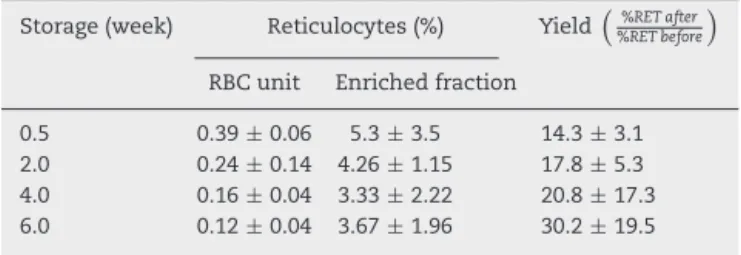
Table 1 – Reticulocyte-enrichment by continuous Percoll density gradient using red blood cell units stored in additive solution 1 (AS-1).
Storage (week) Reticulocytes (%) Yield
%%RET beforeRET after RBC unit Enriched fraction0.5 0.39±0.06 5.3±3.5 14.3±3.1 2.0 0.24±0.14 4.26±1.15 17.8±5.3 4.0 0.16±0.04 3.33±2.22 20.8±17.3 6.0 0.12±0.04 3.67±1.96 30.2±19.5
RBC: red blood cell; %RET: total reticulocytes percentage.
Reticulocytes are expressed as the percentage of total RBCs; the results are presented as the mean±1 standard deviation of six independent assays.
determine significance; the Statistical Package for the Social Sciences software (IBM SPSS) v23.0 was used for statistical analysis.
Results
Reticulocyte-enrichment procedure yield
The Percoll densities were 1.070–1.088 g/mL and densities of reticulocyte-enriched fractions were 1.0826–1.0844 g/mL when fresh blood samples were used. With the enrichment pro-cedure, fractions of from 3.7% to 5.3% reticulocytes were obtained for culture inoculum (Table 1) depending on the reticulocyte content in the RBC units at different blood bank storage periods.
Inoculum and reticulocyte count
300 40 100 80 60 40 20 30 20 10 0 40 100 80 60 40 20 0 100 80 60 40 20 0 100 80 60 40 20 0 30 20 10 0 40 30 20 10 0 0 200 100 0 300 200 100 0 300 200 100 0 300 200 100 0 300 200 100 0 300 200 100 0 300 200 100 0 300 200 100 0
0 2 18 25 27 46
0 1 2 23 27 40
0 2 18 25 27 46
0 2 18 23 40 46 0 1 2 23 27 40 46 0 1 2 23 27 40 46
0 1 4 11 40 46 0
0 1 4 1 4 11
11 40 23 40 46
0 1 4 11 23 40 46 46
0 1 5
11 23 40 46
0 1 3 5 6 11 40 46 0 1 4
11 40 46
0 2 18 25 27 46 0 2 18 25 27 46
Culture time (h)
Culture time (h)
Culture time (h) Culture time (h) Culture time (h)
Culture time (h) Culture time (h)
Culture time (h) Culture time (h)
Culture time (h)
Culture time (h)
Culture time (h)
Culture time (h) Culture time (h) Culture time (h)
#RET (x10 9/L) #RET (x10 9/L) #RET (x10 9/L) #RET (x10 9/L) #RET (x10 9/L) #RET (x10 9/L) #RET (x10 9/L) #RET (x10 9/L) #RET (x10 9/L) #RET (x10 9/L) #RET (x10 9/L) #RET (x10 9/L) #RET (x10 9/L) #RET (x10 9/L) #RET (x10 9/L)
Total HFR MFR LFR
Undetectable W e ek 0.5 W e
ek 2
W
e
ek 4
W
e
ek 6
Blood bank stor
age time
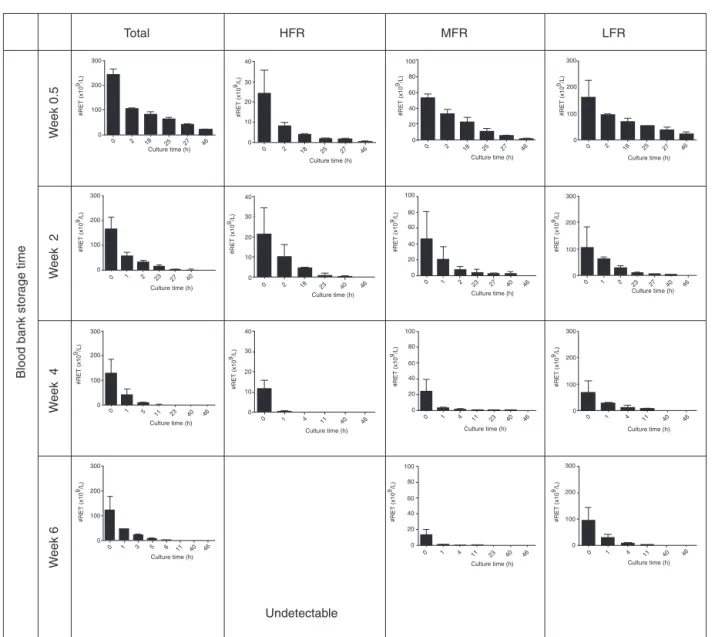
Figure 2 – Reticulocytes enriched from red blood cell units stored in AS-1 had a reducing pattern in culture. HFR: high fluorescence reticulocytes; MFR: medium fluorescence reticulocytes; LFR: low fluorescence reticulocytes. The results are presented as the mean±1 standard deviation of six independent assays.
than the drop in the reticulocyte percentage.Figure 2shows the patterns of total reticulocyte counts and reticulocyte sub-types during culturing for samples obtained from RBC units with different storage times in AS-1 after subtracting hemol-ysis. These graphical representations of data showed that the disappearance of reticulocytes culturedin vitrowas a negative exponential function. The corresponding equation is:
RET=RET0e−kt (1)
This equation expresses the number of reticulocytes sur-viving as a function of time withRET0being the initial number
of reticulocytes,ethe basis for the Naperian logarithms and
RETthe number of reticulocytes present at any timetduring the culture period;kis the reticulocyte maturation constant
for each aliquot. Expressed in logarithmic form, Eq.(1)is as follows (Figure 3A):
Ln RET=Ln RET0−kt (2)
Disappearance time as calculated from Eq.(2)is:
t= Ln RET0
k (3)
Kinetics regarding reticulocyte disappearance in culture
A
B
6.0
5.5
5.0
4.5
4.0
10
7
4
1 0
0 40 50.5
49.5
80
0 10 20 30 40 50
Culture time (h)
Ln (#RET)
SSC (RET/RBC) FSC (RET/RBC)
LnRET
Time for disappearance
Culture time (h)
Ln (#RET)= Ln (#RET0)-kt
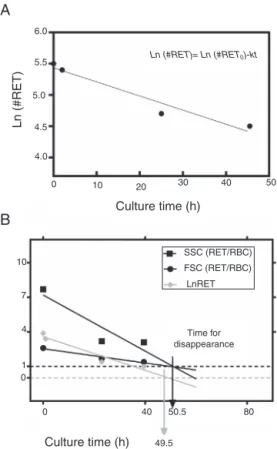
Figure 3 – (A) Fit of Naperian logarithm of reticulocyte concentration measured as cells×106/L (Ln #RET)vs.time. The figure gives an example of a reticulocyte sample obtained from a red blood cell unit after 0.5 weeks of blood bank storage. The linear regression model of the Naperian logarithm of reticulocyte count (Ln #RET) compared to time fitted the data for all the samples analyzed (R2= 0.77–0.96:
p-value = 0.0001). (B) The time for disappearance in culture conditions also may be calculated by analyzing size and shape changes. Forward (FSC) and side (SSC) light scattering signals of reticulocytes (RET) decrease progressively until they become equivalent to those of mature red blood cells (RBC) with the time for disappearance corresponding to the moment at which the SSC RET/RBC and FSC RET/RBC ratios are equivalent to 1.0. Results obtained by this method correlated with those calculated by the method based on fluorescence (reticulocyte count) (R2= 1.0;p-value <0.001).
observed that the reticulocyte disappearance rate became faster as the blood bank storage time increased. The retic-ulocyte disappearance time was 144.0±46.3 h for RBC units stored for 0.5 weeks and declined significantly for units stored for 2, 4 and 6 weeks (73.3±59.1; 27.1±29.0; and 15.1±14.3 h;
respectively;p-value <0.001 –Table 2).
In addition to the changes in fluorescence observed during cultivation, reticulocytes also showed changes in shape, man-ifested as a progressive decrease in side (SSC) and forward light scatter (FSC). The time for reticulocyte disappearance, defined by the moment at which the ratio of SSC of reticu-locytes to mature RBCs (SSCRET/RBC) and the ratio of FSC of
reticulocytes to mature RBCs (FSCRET/RBC) equaled 1.0, was
calculated. Results obtained using this method were strongly
Table 2 – The kinetics of reticulocyte disappearance in culture according to length of blood bank storage.
Length of blood bank storage (weeks)
0.5 2 4 6 p-value
Time until disappearance (h)
RET 144.0±46.3 73.3±59.1 27.1±29.0 15.1±14.3 0.0000 HFR 42.5±8.5 24.0±2.6 14.3±3.4 – 0.0001 MFR 73.4±20.8 32.5±19.5 19.2±11.0 3.0±2.9 0.0000 LFR 269.9±98.8 104.0±45.9 29.3±12.8 15.2±5.9 0.0000
Half-life (h)
RET 27.9±13.9 25.3±30.3 5.6±6.4 2.5±2.4 0.0000 HFR 12.9±7.4 7.1±1.5 3.6±4.2 – 0.0100 MFR 15.6±4.5 8.3±5.6 4.9±4.0 1.8±1.8 0.0040 LFR 43.1±42.3 22.7±16.7 6.3±6.7 2.5±2.4 0.0001
Disappearance rate (h−1)
RET−0.03±0.02−0.05±0.02−0.30±0.31−0.74±0.66 0.0003 HFR−0.07±0.03−0.10±0.02−1.22±2.17 – 0.0300 MFR−0.05±0.02−0.17±0.20−0.30±0.25−0.95±0.79 0.0040 LFR −0.03±0.02−0.03±0.03−0.29±0.26−0.71±0.63 0.0010
RET: total reticulocytes; HFR: high fluorescence reticulocytes; MFR: medium fluorescence reticulocytes; LFR: low fluorescence reticulo-cytes.
The results are presented as the mean±1 standard deviation for six independent assays.
correlated with the time for disappearance calculated by the fluorescence-based kinetic analysis (R2= 1.0; p-value <0.001)
(Figure 3B).
Moreover, reticulocyte subtypes showed distinctive disap-pearance kinetics; the time was faster for HFR and slower for MFR and LFR. Indeed, HFR completely disappeared after 42.5±8.5 h, MFR at 73.4±20.8 h and LFR at 269.9±98.8 h for
RBC units stored for 0.5 weeks. These times became signif-icantly reduced for each reticulocyte subtype in RBC units having longer blood bank storage times. The kinetics of dis-appearance for HFR in units stored for six weeks could not be determined because they were undetectable.
Furthermore, the half-life and constant disappearance rate could be calculated from Eq.(2):
T1 2
= Ln
1 2
k (4)
These additional kinetic parameters also showed differ-ences related to blood bank storage time. The half-life of total reticulocytes obtained from RBC units stored for 0.5 weeks was 27.9±13.9 h; this decreased significantly by the end of storage to 2.5±2.4 h (p< 0.001). HFR from RBC units after storage for 0.5 weeks had a half-life of 12.9±7.4 h in culture, while this
was 15.6±4.5 h for MFR and 43.1±42.3 h for LFR. These values
decreased significantly as the RBC unit storage time increased
(Table 2). The constant reticulocyte disappearance rate of RBC
units at the beginning of storage−0.03±0.02 h−1 increased
to −0.74±0.66 h−1 by the sixth week (p-value = 0.001). HFR
had a disappearance constant of−0.07±0.03 h−1at Week 0.5
which increased to−1.22±2.17 h−1by the 4th week of
stor-age (p-value = 0.01). For MFR, it was−0.05±0.02 h−1 at Week
In the case of LFR, it was−0.03±0.02 h−1 at Week 0.5 and
−0.71±0.63 h−1by Week 6 (p-value <0.001 –Table 2).
To summarize, an exponential decay for reticulocytes in culture was observed in all six RBC units studied at differ-ent blood bank storage times in AS-1. However, the kinetic parameters revealed significant differences according to the length of storage: reticulocyte disappearance time in culture became shorter with increasing blood bank storage time for all aliquots analyzed. Bivariate regression was used to analyze the relationship between reticulocyte disappearance time dur-ing culturdur-ing and previous blood bank storage duration givdur-ing the following model:
y= −0.1364x+138.1 (5)
whereyis the disappearance time in culture andxthe blood bank storage time. Theyintercept showed that the average disappearance time for reticulocytes isolated from fresh RBC units is 138.1±16.9 h. The slope suggested that the
disappear-ance rate during refrigerated blood bank storage was 7.3-fold lower than during cultivation at 37◦C (1/slope = 7.3).
Rearrang-ing the terms of the equation, total reticulocyte disappearance time was equivalent to decay time in culture conditions plus blood bank storage time adjusted by a constant accounting for the delay produced by refrigerated blood bank storage (Eqs.(6)
and (7)):
138.1=y+0.1364x (6)
Total disappearance time (h)=y+0.1364x (7)
Discussion
Several methods have been used to enrich reticulocytes from venous blood samples (expected reticulocytes concentration: 1–2%). Differential centrifugation, density gradient centrifu-gation, and elutriation attain reticulocyte concentrations of 2.6%,14 7–13%14 and 4–5%,15,16 respectively, while
immuno-magnetic separation using anti-CD71 antibodies attains concentrations greater than 90%.8,15 However, none of these
methods have been used in samples from RBC units that have been obtained by the centrifugation of whole blood units and have lower reticulocyte concentrations than those observed in venous blood.9In this study, we used a Percoll density gradient
centrifugation technique with reticulocyte-poor samples due to the standard blood bank processing to obtain RBC units; this technique obtained inoculums for culturing with reticulocyte counts close to those of fresh peripheral venous blood.
With this Percoll density centrifugation technique, a 14-fold increase in reticulocyte concentration was achieved in samples obtained from RBC units after 0.5 weeks of storage and the yield was even higher for units with longer storage times, obtaining a 30-fold increase in reticulocyte percent-ages from samples obtained from units at the end of the sixth storage week. This higher yield can be explained by the fact that reticulocyte fractions in the density gradients change throughout storage, with smaller volumes and higher reticu-locyte concentrations. On the one hand, as storage progresses, the concentration of free hemoglobin increases, which floats
at the top of the density gradients, so that it is necessary to avoid this layer and harvest the reticulocyte fraction below, thus collecting smaller volumes. On the other hand, it has been documented that the densities of all RBC populations increase during storage so that the reticulocytes are expected to be in bands of higher density within the gradient,17thereby
increasing reticulocyte concentrations in the fraction below the floating free hemoglobin, but above the fractions of mature RBCs. Although the densities of collected fractions was mea-sured using Percoll density markers, these measurements were achieved with fresh blood samples and not with stored blood samples.
The results of this study show that, total reticulocytes obtained from RBC units after 0.5 weeks of refrigerated storage had a half-life of 27.9±13.9 h during incubation at
37◦C, with 0.2±0.2% hemolysis. This result is similar to
previously reported data on fresh blood samples.8 When
the aliquots taken at different blood bank storage times were compared, it was observed that the reticulocyte dis-appearance rate increased (shorter disdis-appearance times) for RBC units having longer storage times in a glucose-rich medium such as AS-1. Since there was no difference between these aliquots regarding hemolysis, one plausible explana-tion is that the maturaexplana-tion of reticulocytes to discocytes occurred somewhat during storage in blood bank conditions.9
Nevertheless, the maturation rate during storage at 4◦C
appears to be much lower than that at 37◦C as
reticulo-cytes were present even in aliquots taken from refrigerated RBC units after the sixth week of storage. Similarly, another paper has also reported the presence of reticulocytes in RBC units in citrate-phosphate-dextrose-adenine-1 (CPDA-1) after 35 days of blood bank storage.5 Refrigerated storage
does not seem to cause permanent damage to the matura-tional machinery since the rate of disappearance in culture at 37◦C reported in the present study was equal to or faster
than that reported in fresh blood under equivalent culture conditions.8
Because reticulocyte maturation occurs gradually, as reflected in decreased fluorescence determining passage from high fluorescence (HFR) to medium fluorescence reticulocytes (MFR) and then to low fluorescence reticulocytes (LFR), if mat-uration is assumed to be the main explanation for cultured reticulocyte disappearance, it would be expected that the cells having shorter disappearance time would be the HFR. The results presented here for reticulocyte subpopulations support this hypothesis.
process in reticulocytes would be reflected as a decreased reticulocyte count but not as a change in light scattering indices.
If the progressive maturation of the reticulocytes into dis-cocytes is admitted as the main mechanism responsible for the time-dependent decrease in the reticulocyte count during culturing of fresh peripheral blood (20–29 h),8during storage
of RBC units at 4◦C, and duringin vitroculturing after
refrig-erated storage (28–2.5 h), it can be proposed that standard blood bank storage conditions fundamentally cause a slow-ing down of the maturation process, possibly due to the low temperature, and that the rate of this process is recovered by bringing the cells back to 37◦C. Thus, cells that have been
exposed to blood bank refrigerated storage complete their maturation in cultures at 37◦C in proportionally less time
depending on the time of storage in refrigeration. This might mean that the storage conditions of RBC units (no plasma, with anticoagulant/additive solution and low temperature) are not able to completely arrest reticulocyte maturation into discocytes.
Reticulocytes are considered a metabolic transition stage in erythroid maturation; they are cells that are ceasing to be aerobic and becoming anaerobic (discocytes). Thus, it is not surprising that reticulocyte maturation can be sustained with just glucose and adenine as metabolic sources. It is well known that reticulocyte maturation into discocytes is an active adenosine triphosphate (ATP)-dependent process18,19
characterized by mRNA translation,20protein synthesis,8,20–22
and membrane remodeling,23hence the relatively rapid fall
in intracellular ATP levels observed with solutions such as CPDA-122may be reflected in energy deficiency at 4◦C, thereby
resulting in the arresting of reticulocyte maturation. By con-trast, such energy demand could be supplied with the higher ATP concentrations observed throughout storage in AS-1.24
In addition to the energy metabolism, another factor that might influence reticulocyte maturation is the presence of plasma. Although plasma contains several stimulating fac-tors for reticulocyte maturation (erythropoietin,25 hemin26
and iron26), its presence in whole blood units has not been
associated with reticulocyte maturation.5Furthermore, their
absence, as in the RBC units in the current study, did not seem to be a limiting condition for reticulocyte maturation. The presence of plasma would thus not seem to be a neces-sary or sufficient condition for reticulocyte maturation under blood bank conditions.1,3,4,8
Conclusion
Data presented here seem to be consistent with the fact that refrigerated storage under blood bank conditions does not cause definitive damage to the human reticulocyte matura-tional machinery, but only a reversible kinetic slowdown.
Conflicts of interest
The authors declare no conflicts of interest.
Acknowledgments
Thanks to the National Blood Bank of the Colombian Red Cross for providing the red blood cell units for this study.
Appendix A. Supplementary data
Supplementary data associated with this article can be found, in the online version, atdoi:10.1016/j.htct.2017.12.002.
r e f e r e n c e s
1. Koury MJ, Koury ST, Kopsombut P, Bondurant MC. In vitro maturation of nascent reticulocytes to erythrocytes. Blood. 2005;105(5):2168–74.
2. Stryckmans PA, Cronkite EP, Giacomelli G, Schiffer LM, Schnappauf H. The maturation and fate of reticulocytes after in vitro labeling with tritiated amino acids. Blood.
1968;31(1):33–43.
3. Young LE, Lawrence JS. Maturation and destruction of transfused human reticulocytes, evaluation of reticulocyte experiments for the measurement of hemoglobin metabolism. J Clin Investig. 1945;24(4):554–63.
4. Baldini M, Pannacciulli I. The maturation rate of reticulocytes. Blood. 1960;15(5):614–29.
5. Perry ES, Moore RH, Berger TA, Billups LC, Maybee DA, Salata KF, et al. In vitro and in vivo persistence of reticulocytes from donor red cells. Transfusion. 1996;36(4):318–21.
6. Heilmeyer L, Westhauser R. Reifungsstudien an
ueberlebenden Reticulocyten in vitro und ihreó Bedeutung fur die Schatzung der taglichen Haemoglobinproduktion in vivo. Ztschr Klin Med. 1932;121:361–7.
7. Davis BH, Ornvold K, Bigelow NC. Flow cytometric
reticulocyte maturity index: a useful laboratory parameter of erythropoietic activity in anemia. Cytometry. 1995;22(1):35–9. 8. Skadberg O, Brun A, Sandberg S. Human reticulocytes isolated
from peripheral blood: maturation time and hemoglobin synthesis. Lab Hematol. 2003;9(4):198–206.
9. Urbina A, Palomino F. Reticulocyte count in red-blood-cell units stored in AS-1. Vox Sang. 2013;104(4):331–6.
10. Griffin GD, Lippert LE, Dow NS, Berger TA, Hickman MR, Salata KF. A flow cytometric method for phenotyping recipient red cells following transfusion. Transfusion. 1994;34(3):233–7. 11. Buttarello M, Bulian P, Farina G, Petris MG, Temporin V, Toffolo
L. Five fully automated for performing immature reticulocyte fraction: comparison in diagnosis of bone marrow aplasia. Am J Clin Pathol. 2002;117(6):871–9.
12. Davis BH, DiCorato M, Bigelow NC, Langweiler MH. Proposal for standardization of flow cytometric reticulocyte maturity index (RMI) measurements. Cytometry. 1993;14(3):318–26. 13. Bratosin D, Tcacenco L, Sidoroff M, Cotoraci C, Slomianny C,
Estaquier J, et al. Active caspases-8 and -3 in circulating human erythrocytes purified on immobilized annexin-V: a cytometric demonstration. Cytometry. 2009;75(3):236–44. 14. Rushing D, Vengelen-Tyler V. Evaluation and comparison of
four reticulocyte enrichment procedures. Transfusion. 1987;27(1):86–9.
15. Brun A, Gaudernack G, Sandberg S. A new method for isolation of reticulocytes: positive selection of human reticulocytes by immunomagnetic separation. Blood. 1990;76(11):2397–403.
support of thalassemia major patients. Blood. 1981;57(3):599–606.
17. Tuo WW, Wang D, Liang WJ, Huang YX. How cell number and cellular properties of blood-banked red blood cells of different cell ages decline during storage. PLOS ONE. 2014;9(8):e105692. 18. Speiser S, Etlinger JD. Loss of ATP-dependent proteolysis with
maturation of reticulocytes and erythrocytes. J Biol Chem. 1982;257(23):14122–7.
19. Tanaka K, Waxman L, Goldberg AL. ATP serves two distinct roles in protein degradation in reticulocytes, one requiring and one independent of ubiquitin. J Cell Biol.
1983;96(6):1580–5.
20. Lee E, Choi HS, Hwang JH, Hoh JK, Cho YH, Baek EJ. The RNA in reticulocytes is not just debris: it is necessary for the final stages of erythrocyte formation. Blood Cells Mol Dis. 2014;53(1):1–10.
21. Garcia-Santos D, Schranzhofer M, Bergeron R, Sheftel AD, Ponka P. Extracellular glycine is necessary for optimal
hemoglobinization of erythroid cells. Haematologica. 2017;102(8):1314–23.
22. Wilson MC, Trakarnsanga K, Heesom KJ, Cogan N, Green C, Toye AM, et al. Comparison of the proteome of adult and cord erythroid cells, and changes in the proteome following reticulocyte maturation. Mol Cell Proteomics.
2016;15(6):1938–46.
23. Liu J, Guo X, Mohandas N, Chasis JA, An X. Membrane remodeling during reticulocyte maturation. Blood. 2010;115(10):2021–7.
24. McCullough J. Transfusion medicine. 4th ed. Wiley Blackwell; 2016.
25. Wiczling P, Ait-Oudhia S, Krzyzanski W. Flow cytometric analysis of reticulocyte maturation after erythropoietin administration in rats. Cytometry A. 2009;75(7):584–92. 26. Waxman HS. Stimulation of globin synthesis: relative