rev bras hematol hemoter. 2015;37(5):320–323
w w w . r b h h . o r g
Revista
Brasileira
de
Hematologia
e
Hemoterapia
Brazilian
Journal
of
Hematology
and
Hemotherapy
Original
article
Transfusion
of
older
red
blood
cell
units,
cytokine
burst
and
alloimmunization:
a
case–control
study
Carla
Luana
Dinardo
a,b,∗,
Frederico
Leon
Arrabal
Fernandes
b,
Luciana
Ribeiro
Sampaio
a,
Ester
Cerdeira
Sabino
b,
Alfredo
Mendrone
Jr
a aFundac¸ãoPró-Sangue,HemocentrodeSãoPaulo,SãoPaulo,SP,BrazilbUniversidadedeSãoPaulo(USP),SãoPaulo,SP,Brazil
a
r
t
i
c
l
e
i
n
f
o
Articlehistory:
Received13March2015 Accepted2July2015 Availableonline29July2015
Keywords:
Alloimmunization Oldblood Antibodies Cytokines Transfusion
a
b
s
t
r
a
c
t
Background:Experimentaldatahaveshownthatthetransfusionofolderredbloodcellunits causesalloimmunization,buttheclinicalapplicabilityofthisstatementhasneverbeen properlyassessedinnon-sicklecellpatients.Ithasbeenhypothesizedthatolderunitshave highernumbersofcytokines,increasingtheriskofalloimmunizationrelatedto antigen-presentingevents.The goalofthisstudy wastoevaluate theassociation betweenthe transfusionofolderredbloodcellunitssubjectedtobedsideleukodepletionand alloim-munization.
Methods:Allpatientssubmittedtotransfusionsofbedsideleukodepletionredbloodcell unitsproventohavebecomealloimmunizedinoneoncologicservicebetween2009and 2013wereenrolledinthisstudy.Acontrolgroupwasformedbymatchingpatientswithout alloimmunizationintermsofnumberoftransfusionsandmedicalspecialty.Themedian ageoftransfusedunits,thepercentageoftransfusedredbloodcellunits>14daysofstorage inrelationtofresherredcellunits(≤14daysofstorage)andthemeanageoftransfused unitsolderthan14dayswerecomparedbetweenthegroups.
Results:Alloimmunizedandcontrolgroupswerehomogeneousregardingthemostrelevant clinicalvariables(age,gender,typeofoncologicaldisease)andinflammatorybackground (C-reactiveproteinandKarnofskyscale).Themedianageoftransfusedredbloodcellunits, theratioofolderunitstransfusedcomparedtofresherunitsandthemeanageoftransfused unitsolderthan14daysdidnotdifferbetweenalloimmunizedandcontrolpatients(17vs. 17;68/32vs.63.2/36.8and21.8±7.0vs.21.04±7.9;respectively).
Conclusion:Thetransfusionofolderredbloodcellunitssubjectedtobedsideleukodepletion isnotakeyriskfactorforalloimmunization.Strategiesofprovidingfreshredcellunits aimingtoavoidalloimmunizationarethusnotjustified.
©2015Associac¸ãoBrasileiradeHematologia,HemoterapiaeTerapiaCelular.Published byElsevierEditoraLtda.Allrightsreserved.
∗ Correspondingauthorat:ImmunohematologySection,AvenidaDr.EnéasdeCarvalhoAguiar,155,1◦andar,Pinheiros,05403-000São Paulo,SP,Brazil.
E-mailaddress:[email protected](C.L.Dinardo). http://dx.doi.org/10.1016/j.bjhh.2015.07.003
revbrashematolhemoter.2015;37(5):320–323
321
Introduction
Alloimmunization against red blood cell (RBC) antigens is a late transfusion complication, the clinical predic-tors of which in non-sickle cell patients are unclear.1,2 Alloimmunizationstemsfromtheantigen-presentation pro-cess, which is positively influenced by pro-inflammatory cytokinesandnegativelybyTregulatorycells.3Thegenetics of the patient, especially their human leukocyte anti-gen (HLA) type, plays a role in the alloimmunization process,4 but other environmental factors also seem to contribute and have been explored little in the medical literature.5
Themostimportantenvironmentalriskfactorfor alloim-munization is the recipient’s inflammatory background,6 which even causes antibody development in sickle cell patients.7 Recently it was observed that the presence of acutechestsyndromeand vaso-occlusivecrisesare associ-atedwithahigherriskofalloimmunization.8 Experimental datahave demonstrated that the transfusion ofolder RBC unitsisalsoariskfactor,5butthemechanismsforthishave notbeenelucidatedyet.Ithasbeenhypothesizedthatolder RBC units may contain higher levels of pro-inflammatory cytokines and products of RBC degeneration, which may causeaburstintheantigen-presentation processand lead toalloimmunization.5
The beneficial effect of the transfusion of pre-storage leukodepletedRBCunitstoreducealloimmunizationis well-known.9However,whetherthetransfusionofolderRBCunits subjectedtobedsideleukodepletionisariskfactorfor alloim-munizationhasneverbeenevaluated.Astheaccumulation ofpro-inflammatory interleukinsincreasesduringthe stor-age,theinfusionofolderRBCunits maypossiblyleadtoa moreintensecytokineburstand,accordingtoexperimental results,toahigherriskofalloimmunization.Theexactrole playedbyallleukocyte-derivedcytokinesinthedevelopment ofalloantibodies,however,hasnotbeendefinedeveninthe experimentalscenario.9
Thegoal ofthis case–control study was toevaluatethe associationbetweenthetransfusionofolderRBCunits sub-jectedtobedsideleukodepletionandalloimmunization,hence justifyingtheprescriptionoffresherunitsasprophylaxis.
Methods
ThisstudywasapprovedbytheLocalEthicsCommitteeand exemptedfromtheapplicationofinformedconsentform.All solidcancerpatientsproventohavebecomealloimmunized inthisservice(2009–2013)wereenrolled.Thechoicetoselect onlypatientswithnon-hematologicalcancerwasanattempt tomaximizethehomogeneityofthestudypopulation.A con-trolgroupwasformedinparalleltothealloimmunizedgroup matchedbothinterms ofthe number oftransfusions and medicalspecialty.Inthisregard,everytimeanalloimmunized patientwasincludedinthestudy,thenumberoftransfused RBC units until the development of the first alloantibody was calculated and, then, one or two non-alloimmunized controlpatients were added tothe control group withthe
samenumberoftransfusionsandasimilardiagnosis. Anti-bodyidentificationwasperformedusingthegelmethodology (Bio-Rad laboratories)followingthe manufacturer’s instruc-tions.
AllRBCunitswerecollectedincitrate-phosphate-dextrose withadenine (CPDA-1)bags (Fresenius-Kabi)and were sub-mittedtobedside-leukodepletion(BioRfilters,Fresenius-Kabi) beforetransfusion.Noneofthepatientsreceivedphenotyped unitsasaprimaryalloimmunizationprophylaxisorreceived RBC unitsoutside this service. Thepatients’ inflammatory background was assessed using cancer prognostic scales capable of evaluating systemic inflammation (Karnofsky)1 and C-reactive proteinlevels (measuredatinclusion inthe study).
Alloimmunized and control groups were compared in termsofthemedianageoftransfusedunits,thepercentage ofolderRBCunits(>14daysofstorage)/fresherRBCunits(≤14 daysofstorage)transfusedandthemeanageoftheolder(>14 daysofstorage)transfusedunits.Thedataconsideredforthis comparisoninvolvedalltransfusedRBCunitsuntilthe appear-anceofthe first alloantibody. Consideringtheknown risks associatedwiththetransfusionofolderRBCunits,thisstudy designwasapprovedbythelocalEthicsCommittee.
Thedesignofthestudyallowedathree-daystorage dif-ferencebetweenthegroupswiththeinclusionof50patients ineacharm(80%ofpower).Allstatisticalanalyseswere per-formedusingtheStatisticalPackagefortheSocialSciences (SPSS)software(version18).TheMann–Whitneytestwasused tocomparevariableswithunequaldistributionandthe Stu-dentt-test,tocomparevariableswithnormaldistribution.A
p-valuelessthan0.05wasconsideredsignificant.
Results
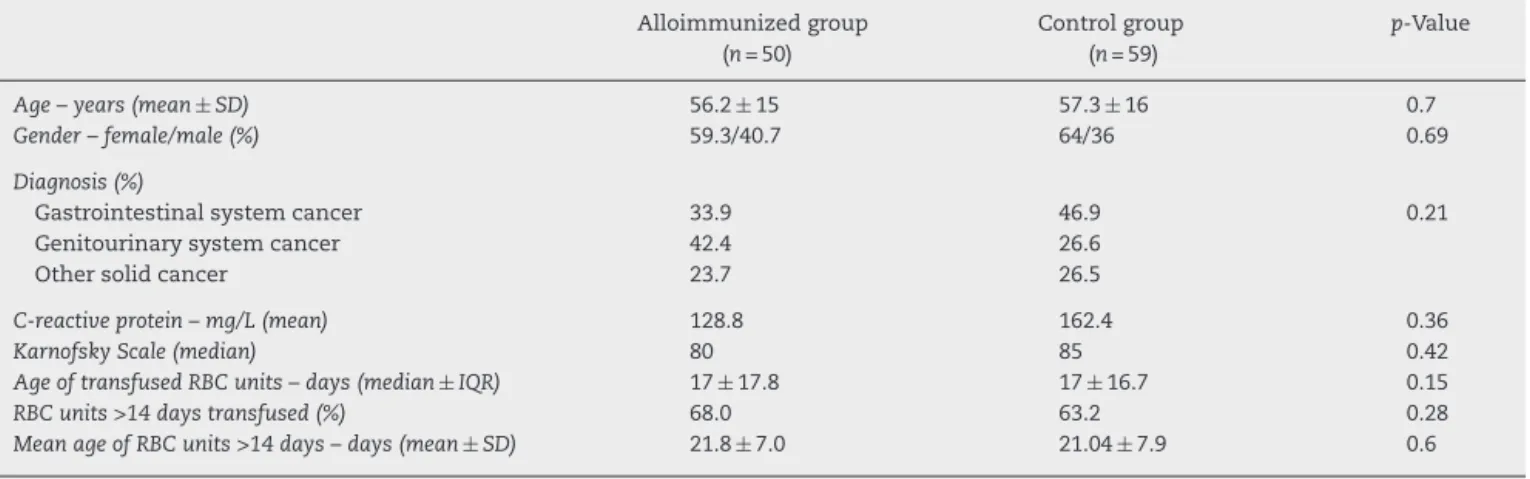
Fifty alloimmunized and 59 non-alloimmunized (control) patientswereenrolledinthestudy.Themeanageofpatients was 56.74±15.42and the mean numberoftransfusedRBC unitsperpatientwas4.76±3.85.Groupswereinitially com-paredinterms ofthe mostrelevantclinical variables (age, gender,bodymassindex,diagnosis)andprovedtobe homo-geneous (Table1). Thepatients’ inflammation background, evaluatedusingtheKarnofskycancerprognosticscaleand C-reactiveproteinlevels,wasalsosimilarbetweenthegroups (Table1).
Median ageoftransfused RBC unitswas equalforboth groups(17days;p-value=0.15).Thepercentageoftransfused unitsolderthan14dayswas68.0%inthealloimmunizedgroup and63.3%incontrolgroup(p-value=0.28).Themeanageof thetransfusedunitsolderthan14dayswas21.8±7.0inthe alloimmunizedgroupand21.04±7.9inthecontrolgroup(p -value=0.6).Table1comparesthegroupsintermsofthemost importantdemographicalandtransfusionvariables.
Discussion
322
revbrashematolhemoter.2015;37(5):320–323Table1–Comparisonbetweenalloimmunizedandnon-alloimmunizedpatientsregardingclinicalvariables, inflammatorybackgroundandageofredbloodcellunitstransfused.
Alloimmunizedgroup (n=50)
Controlgroup (n=59)
p-Value
Age–years(mean±SD) 56.2±15 57.3±16 0.7
Gender–female/male(%) 59.3/40.7 64/36 0.69
Diagnosis(%)
Gastrointestinalsystemcancer 33.9 46.9 0.21
Genitourinarysystemcancer 42.4 26.6
Othersolidcancer 23.7 26.5
C-reactiveprotein–mg/L(mean) 128.8 162.4 0.36
KarnofskyScale(median) 80 85 0.42
AgeoftransfusedRBCunits–days(median±IQR) 17±17.8 17±16.7 0.15
RBCunits>14daystransfused(%) 68.0 63.2 0.28
MeanageofRBCunits>14days–days(mean±SD) 21.8±7.0 21.04±7.9 0.6
RBC:redbloodcell;SD:standarddeviation;IQR:interquartilerange.
RBC alloimmunization was notsuggested bytheseresults, sincealloimmunizedandnon-alloimmunizedpatientswere homogenousintermsoflengthofstorageoftransfusedunits andthenumberofRBCunitssubjectedtobedside leukodeple-tion,whichhaveahigherlevelofpro-inflammatorycytokines. Tothebestofourknowledge,thisisthefirstcase–controlstudy toevaluatetheriskofalloimmunizationassociatedwiththe transfusionofolderRBCunits.
One previous clinical study also found no association betweenolder RBC unitsand alloimmunization,but it had two major limitations: the use ofunits submitted only to pre-storageleukodepletion,whichprecludedtheevaluationof leukocyte-derivedcytokines,anditdidnotevaluatethe recip-ientinflammationstatus,anextremelyimportantfactorfor alloantibodyformation.10Thepresentstudydidnotfindany associationbetweenageofthetransfusedunitand alloimmu-nization,andruledoutanypossiblebiasregardingdifferences intheinflammatorybackgroundofparticipants.Incontrast totheseresults,thereisconsistentexperimentaldata asso-ciatingtheaccumulationofleukocyte-derivedtransforming growthfactor-(TGF-)intransfusedunits andlowerrates ofalloimmunization.9However,theageofstorageoftheRBC unitsinthisspecificstudywassignificantlyshorter(threedays vs.fourteen days)andonlyoneleukocyte-derivedcytokine wasevaluated,whiletheeffectofmanyothersknowntocause pro-inflammatorystimulationwerenotevaluated.
Itisimportanttohighlightthatthisstudydidnotexclude thehypothesisofantibodyrecrudescenceaftertransfusions ofRBC units. However, asnone ofthe patientswas trans-fusedoutside thecurrentservice, thisevent wouldonlybe duetopregnancy-relatedalloimmunization.Asnoantibody withanti-Dspecificitywasidentifiedwithinthestudied pop-ulation,thisbiasprobablyhadnosignificantimpactonthe results.
Conclusions
Thetransfusion ofolderRBC units isnot akey riskfactor forthedevelopmentofRBCalloantibodiesinnon-sicklecell patients.Strategiesofprovidingfresherunitsasprophylaxis foralloimmunizationarethereforenotjustified.
Conflicts
of
interest
Theauthorsdeclarenoconflictsofinterest.
Acknowledgments
Fundac¸ãoPró-Sangue-HemocentrodeSãoPaulo.
r
e
f
e
r
e
n
c
e
s
1.DinardoCL,ItoGM,SampaioLR,MendroneJuniorA.Studyof possibleclinicalandlaboratorypredictorsof
alloimmunizationagainstredbloodcellantigensincancer patients.RevBrasHematolHemoter.2013;35(6):414–6. 2.MatteocciA,PierelliL.Redbloodcellalloimmunizationin
sicklecelldiseaseandinthalassaemia:currentstatus,future perspectivesandpotentialroleofmoleculartyping.VoxSang. 2014;106(3):197–208.
3.HendricksonJE,ChadwickTE,RobackJD,HillyerCD,Zimring JC.Inflammationenhancesconsumptionandpresentationof transfusedRBCantigensbydendriticcells.Blood.
2007;110(7):2736–43.
4.HanchardNA,MouldsJM,BelmontJW,ChenA.A genome-widescreenforlarge-effectalloimmunization susceptibilitylociamongredbloodcelltransfusionrecipients withsicklecelldisease.TransfusMedHemother.
2014;41(6):453–61.
5.HendricksonJE,HodEA,SpitalnikSL,HillyerCD,ZimringJC. Storageofmurineredbloodcellsenhancesalloantibody responsestoanerythroid-specificmodelantigen. Transfusion.2010;50(3):642–8.
6.HendricksonJE,DesmaretsM,DeshpandeSS,ChadwickTE, HillyerCD,RobackJD,etal.Recipientinflammationaffects thefrequencyandmagnitudeofimmunizationtotransfused redbloodcells.Transfusion.2006;46(9):1526–36.
7.HendricksonJE,HodEA,PerryJR,GhoshS,ChappaP,AdisaO, etal.AlloimmunizationtotransfusedHODredbloodcellsis notincreasedinmicewithsicklecelldisease.Transfusion. 2012;52(2):231–40.
revbrashematolhemoter.2015;37(5):320–323
323
9. VallionR,BonnefoyF,DaouiA,VieilleL,TiberghienP,SaasP, etal.Transforminggrowthfactor-betareleasedbyapoptotic whitebloodcellsduringredbloodcellstoragepromotes transfusion-inducedalloimmunomodulation.Transfusion. 2015;55(7):1721–35.