David Fernandes Semedo
Licenciado em Engenharia InformáticaA Public Transport Bus Assignment Problem:
Parallel Metaheuristics Assessment
Dissertação para obtenção do Grau de Mestre em Engenharia Informática
Orientador:
Prof. Doutor Pedro Barahona, Prof. Catedrático,
Universidade Nova de Lisboa
Co-orientador:
Prof. Doutor Pedro Medeiros, Prof. Associado,
Universidade Nova de Lisboa
Júri:
A Public Transport Bus Assignment Problem: Parallel Metaheuristics Assess-ment
Copyright cDavid Fernandes Semedo, Faculdade de Ciências e Tecnologia, Universidade Nova de Lisboa
A
CKNOWLEDGEMENTS
This research was partly supported by project “RtP - Restrict to Plan”, funded by FEDER (Fundo Europeu de Desenvolvimento Regional), through programme COMPETE - POFC
(Operacional Factores de Competitividade) with reference 34091.
First and foremost, I would like to express my genuine gratitude to my advisor profes-sor Pedro Barahona for the continuous support of my thesis, for his guidance, patience and expertise. His general optimism, enthusiasm and availability to discuss and support new ideas helped and encouraged me to push my work always a little further. Additionally, he was able to provide me financial support allowing me to keep focused on my work, which I believe otherwise would not have been possible.
Additionally, I would like to give a very special thanks to my co-advisor professor Pedro Medeiros for his utmost predisposition for any doubt on parallel architectures and implementations aspects, whose ideas and knowledge made possible the results achieved.
Second, I would like to thank Faculdade de Ciências e Tecnologia da Universidade Nova de Lisboa not only for providing me all the resources needed along the course but also for his excellent environment, in which I was able to forge valuable friendships. More-over, I thank my department, Departamento de Informática, and its associated research center NOVA-LINCS, for the excellent professors which whom I had the opportunity to learn from, specially for its close relation with the students, and for supporting my attendance at the INFORUM 2015 conference.
My sincere thanks to Marco Correia, for all his contributions to my work, in the development of the CaSPER LS solver and modelling of the vehicle scheduling problem, and for is insightful suggestions regarding implementation and modelling aspects.
To professor Jorge Cruz for his precious suggestions on the modelling of the problem. To all my colleagues, for sharing both stressful and relaxed moments, for providing me good moments and for giving me motivation even without knowing it. A special thanks to my colleague Alexandre Garcia, for sharing with me some of the most stressful moments during the course, for our wonderful projects, and for our discussions related with our works, which always helped clarifying and confirming ideas.
ones ) which always helped me relax and regain strengths. Carlos and Mirão, thank you for our CS:GO nights, which I am sure also contributed to this work.
To Olga, Pedro, Ana, Zé, Lurdes, Beatriz and Nuno for all their presence and support, and for helping me more than they can imagine.
To all my family, specially to my grandparents, who were always there to help me, despite not having the chance of seeing me very often. A huge thanks to my parents which despite all the difficulties, they always believed in me and gave me infinite support. Concretely, to my father which was always interested in my work and for being my inspiration, and to my mother for simply being my mother, for all is guidance through my life and for being ever-present even when it was difficult for her. To my warrior little sister which whom I shared marvellous moments, doing our things, and for inspiring me everyday. Words are not enough to express my gratitude.
A
BSTRACT
Combinatorial Optimization Problems occur in a wide variety of contexts and generally are NP-hardproblems. At a corporate level solving this problems is of great importance
since they contribute to the optimization of operational costs. In this thesis we propose to solve the Public Transport Bus Assignment problem considering an heterogeneous fleet and line exchanges, a variant of the Multi-Depot Vehicle Scheduling Problem in which additional constraints are enforced to model a real life scenario.
The number of constraints involved and the large number of variables makes imprac-ticable solving to optimality using complete search techniques. Therefore, we explore metaheuristics, that sacrifice optimality to produce solutions in feasible time. More con-cretely, we focus on the development of algorithms based on a sophisticated metaheuristic, Ant-Colony Optimization (ACO), which is based on a stochastic learning mechanism.
For complex problems with a considerable number of constraints, sophisticated meta-heuristics may fail to produce quality solutions in a reasonable amount of time. Thus, we developed parallel shared-memory (SM) synchronous ACO algorithms, however, synchronism originates the straggler problem. Therefore, we proposed three SM
asyn-chronous algorithms that break the original algorithm semantics and differ on the degree of concurrency allowed while manipulating the learned information.
Our results show that our sequential ACO algorithms produced better solutions than a Restarts metaheuristic, the ACO algorithms were able to learn and better solutions were achieved by increasing the amount of cooperation (number of search agents). Regarding parallel algorithms, our asynchronous ACO algorithms outperformed synchronous ones in terms of speedup and solution quality, achieving speedups of≈17.6x. The cooperation scheme imposed by asynchronism also achieved a better learning rate than the original one.
R
ESUMO
Problemas de Optimização Combinatória estão presentes em diversos contextos e são regra geral NP-hard. É importante resolver estes problemas a nível empresarial de
forma a optimizar os custos operacionais. Nesta dissertação iremos resolver o problema de Alocação de Autocarros num Serviço de Transportes Públicos considerando uma frota heterogénea e mudanças de linha, uma variante do problema de escalonamento de veículos com múltiplos depósitos, com restrições adicionais para modelar um cenário real. O grande número de restrições e de variáveis tornam impraticável a utilização de técnicas que garantam a otimalidade das soluções. Como tal, exploram-se metaheurísti-cas, métodos que sacrificam otimalidade, de forma a produzir soluções em tempo útil. Focamo-nos no desenvolvimento de algoritmos baseados numa metaheurística sofisticada, Ant-Colony Optimization (ACO), que tem por base um mecanismo de aprendizagem estocástico.
Para problemas complexos com um elevado número de restrições, metaheurísticas sofisticadas poderão não conseguir produzir boas soluções em tempo útil. Como tal, desenvolveram-se algoritmos de ACO paralelos síncronos em memória partilhada (MP), no entanto, o síncronismo causastraggler problem. Assim, propomos três algoritmos
as-síncronos em MP, que alteram a semântica do algoritmo original e diferem no grau de concorrência permitido na manipulação da informação recolhida.
Os nossos resultados demonstram que os nossos algoritmos sequenciais de ACO pro-duzem melhores soluções que a metaheurística de Restarts, que são capazes de aprender obtendo-se melhores soluções aumentando o nível de cooperação (número de agentes). Em relação aos algoritmos paralelos, os algoritmos assíncronos de ACO apresentaram melhores resultados em termos de speedup e qualidade da solução do que os síncronos, com speedups na ordem de≈17.6x. Com o esquema de cooperação imposto pelo assín-cronismo também se obteve uma melhor taxa de aprendizagem em relação ao original.
C
ONTENTS
Contents xiii
List of Figures xvii
List of Tables xix
1 Introduction 1
1.1 Context and Motivation . . . 1
1.2 Objectives . . . 2
1.3 Problem Description . . . 3
1.3.1 Public Transport Bus Assignment Problem . . . 4
1.3.2 Parallel Metaheuristics Hypothesis . . . 8
1.4 Main Contributions . . . 9
1.5 Document Organization . . . 9
2 Background and Related Work 11 2.1 Local Search Techniques and Metaheuristics . . . 12
2.1.1 Combinatorial Optimization Problems and Local Search . . . 12
2.1.2 Metaheuristics . . . 15
2.2 Constraint-Based Local Search . . . 17
2.3 Ant-Colony Optimization Metaheuristic . . . 18
2.3.1 Ant System . . . 21
2.3.2 MAX−MIN Ant System . . . 22
2.3.3 Ant Colony System . . . 24
2.4 Parallel Computing and Concurrency . . . 24
2.4.1 Multi-Core Architectures . . . 27
2.4.2 NUMA Architectures . . . 28
2.4.3 Communication within processes . . . 29
2.4.4 Concurrency Control Mechanisms . . . 29
2.5 Parallel Metaheuristics Algorithms . . . 30
2.5.1 Cooperative Parallel Search . . . 32
2.6 Parallel Ant-Colony Optimization . . . 35
3 PTBA Problem Algorithms 39
3.1 Problem Model and Base Algorithm . . . 39
3.1.1 Sequential Algorithm . . . 40
3.1.2 Vehicle Selection Heuristics . . . 46
3.2 Sequential and Parallel Probabilistic Restarts Metaheuristic . . . 51
3.3 Ant-Colony algorithms . . . 51
3.3.1 PTBA Ant-Colony Model and Ant-System algorithm . . . 52
3.3.2 MAX−MIN Algorithm . . . 53
3.4 Parallel Synchronous and Asynchronous ACO Algorithms . . . 53
3.4.1 Synchronous ACO Algorithms . . . 54
3.4.2 Asynchronous ACO Algorithms . . . 56
3.4.3 Base Algorithm . . . 56
3.4.4 Concurrency Models. . . 59
4 Implementation - Parallel PTBA Problem Optimization Library 61 4.1 Tools and Technologies . . . 61
4.1.1 Shared-Memory Multi-Threading Tools . . . 62
4.1.2 CaSPER LS . . . 63
4.2 Software Model . . . 64
4.2.1 Data Layer . . . 65
4.2.2 Core Layer . . . 67
4.3 Base Library Problem Components Implementation Details . . . 68
4.3.1 Objective Functions . . . 69
4.3.2 Heuristic Functions . . . 70
4.3.3 Constraint Manager . . . 71
4.4 Parallel Algorithms Implementation . . . 73
4.4.1 Parallel Restarts . . . 74
4.4.2 Parallel Synchronous ACO Algorithms . . . 76
4.4.3 Parallel Asynchronous ACO algorithm . . . 77
4.4.4 Parallel Implementations NUMA Details . . . 79
5 Evaluation 81 5.1 Experimental Setup . . . 81
5.1.1 Problem Instance . . . 82
5.2 Problem Model and Algorithms Analysis . . . 84
5.2.1 Analysis of Solutions . . . 85
5.2.2 Restarts Algorithm . . . 87
5.2.3 Model Parameters Influence Analysis . . . 89
5.2.4 Ant System andMMAS ACO algorithms . . . 93
5.3 Parallel Synchronous and Asynchronous ACO . . . 98
CONTENTS
5.3.2 Performance Analysis . . . 101 5.3.3 Parallel Issues . . . 103 5.4 Summary . . . 104
6 Conclusions and Future Work 107 6.1 Conclusions and Contributions . . . 107 6.2 Future Work . . . 108
L
IST OF
F
IGURES
1.1 Partial Assignment Example of the PTBA problem. . . 7
2.1 Search Space Structure. Adapted from [65, p. 121] . . . 15
2.2 ACO ants convergence. [24] . . . 19
2.3 SISD [79] . . . 25
2.4 SIMD [79] . . . 25
2.5 MISD [79] . . . 25
2.6 MIMD [79] . . . 25
2.7 Multi-Core computer architecture. [41] . . . 27
2.8 NUMA Architecture. . . 28
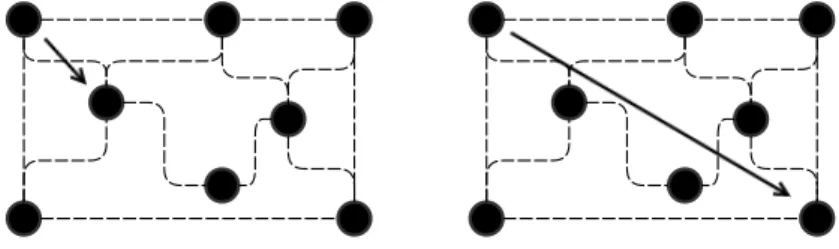
2.9 Single-step parallelism (left) and multi-step parallelism (right). Dotted edges denote connected neighbours, vertices denote solutions and the solid arc de-notes a LS step. In single-step parallelism only one move is performed whereas in multi-step parallelism multiple moves are performed (distant neighbours are reached). . . 31
2.10 Parallel metaheuristic models. Adapted from [51] . . . 32
3.1 Trips dependency example. . . 40
3.2 Example of a possible problem graph. . . 41
3.3 Plot of the functiony = e−x in which the behaviour of the function can be observed . . . 49
3.4 Illustration of the probabilities issue by considering a different number of vehicles while selecting a vehicle to assign to the current departure. In a) a vehiclev1 with utility 1 has 0.25 probability of being selected. The remaining vehicles fromv2 tov101 have a total probability of 0.75, each with probability 0.04. In b) only 11 vehicles are considered. A vehiclev1 with utility 1 has an associated probability of≈0.71 and the remaining vehicles have a probability of≈0.29. . . 50
3.5 Illustration of the parallel synchronous algorithm behaviour on each iteration. 55 3.6 ACO behaviour after introducing asynchronism. . . 57
4.1 Application Architecture. . . 65 4.2 Partial Class Diagram of Metaheuristics and Algorithms . . . 67 4.3 Partial Class Diagram of Pheromone models classes. . . 69 4.4 Constraint Systems definition. A global constraint system is defined based on
sub constraint systems. . . 72 4.5 Parallel Asynchronous ACO algorithm architecture. . . 77
5.1 Vehicles service tasks over time. Each vertical line denotes a given vehicle. In the plot two clusters of vehicles, where each cluster corresponds to vehicles from one of the two depots, can be identified. . . 86 5.2 Analysis of the solution quality (on the left) and execution times (on the right)
by varying the number of iterations and the number of agents on each execution. 94 5.3 Influence of the evaporation rateρparameter on the solution quality of the AS
algorithm. . . 96 5.4 Analysis of the learning capabilities of the AS andMMAS algorithms. A linear
regression line was computed based on the average values of the objective function of the solutions produced at each iteration, where the slopes indicate that the average quality of the solutions improved as the iterations increased. The number of iterations was set to 250 and the number of agents to 8. . . 97 5.5 Learning Capability Analysis of our parallel synchronous AS and asynchronous
L
IST OF
T
ABLES
2.1 Parallel ACO taxonomy categories. . . 35
5.1 Capacitiesrkof each depotDkfor each type of vehicle. . . 82
5.2 Characteristics of each vehicle type. Max time between maintenance tasks is denote by MaxTimeBMaintand maintenance durarion is denoted byMaintDur. 83
5.3 List of all the global parameters and its associated values. . . 83 5.4 List of all the 12 routes taken into account and its associated characteristics.
The descendant direction is denoted by DESC and the ascendant direction by ASC. . . 84 5.5 Default weight values for the probabilistic heuristic based on vehicle utility. . 84 5.6 Results in terms of solution quality and execution time of the sequential Restarts
algorithm for the three heuristics proposed, while varying the search depth in the number of restarts (#RS). The values of the meanµ, standard deviationσ,
minimumminand maximummaxvalues are shown. We duplicate the results
of the greedy algorithm to facilitate comparisons. . . 88 5.7 Analysis of the influence of line exchanges in the solutions produced. The
results of the average objective function value of the solutions produced, the average number of vehicles used in each of those solutions and the average total distance in void are shown. . . 90 5.8 Influence of the parametersk2andk3on the solutions produced. We fixed the
number of restarts to 1000. The values of the meanµ, the standard deviationσ
and minimumminof the average values of the objective function of the
solu-tions produced are shown. The average number of vehicles (column #Vehicles) and the number of line exchanges (column #LineExchanges) of the solutions produced are also shown. . . 91 5.9 Default values for each ACO parameter. . . 93 5.10 Solution quality of the solutions achieved in function of the parametersαand
β. We fixed the number of iterations to 250 and the number of agents to 8. The
L
IST OF
A
LGORITHMS
1 Ant-Colony Optimization.[32] . . . 20
2 PTBA Algorithm . . . 42
3 Restarts Metaheuristic . . . 51
G
LOSSARY
ACO Ant-Colony Optimization.
ACS Ant Colony System.
API Application Programming Interface.
AS Ant System.
ASSync Synchronous Ant System.
AsyncBC Asynchronous Blocking Column Ant System.
AsyncBM Asynchronous Blocking Matrix Ant System.
AsyncLF Asynchronous Lock-Free Ant System.
CBLS Constraint-Based Local Search.
COMA Cache-Only Memory Architecture.
COP Combinatorial Optimization Problem.
CP Constraint-Programming.
CPU Central Processing Unit.
CSOP Constraint Satisfaction and Optimization Problem.
CSP Constraint Satisfaction Problem.
GPU Graphical Processing Unit.
L1 Level 1.
L2 Level 2.
LS Local Search.
MIMD Multiple Instruction Stream Multiple Data Stream.
MP MultiProcessor.
MS Multi-start.
MW Multiple-Walk.
NUMA Non-Unified Memory Architecture.
ParallelPTBAP-OptLib Parallel PTBA Problem Optimization Library.
PC Personal Computer.
PTBA Public Transport Bus Assignment.
QAP Quadratic Assignment Problem.
RAM Random-Access Memory.
SIMD Single Instruction Stream Multiple Data Stream.
SISD Single Instruction Stream Single Data Stream.
S-metaheuristics Single-solution based Metaheuristics.
SM Shared-Memory.
SQL Structured Query Language.
SW Single-Walk.
TSP Travelling Salesman Problem.
UMA Unified Memory Architecture.
C
H
A
P
T
E
R
1
I
NTRODUCTION
This chapter introduces the context and the motivation surrounding this work in section 1.1. Then the objectives of our work will be presented in section 1.2 regarding the development of an algorithm to solve the Public Transport Bus Assignment problem and the exploration of parallelism.
After presenting the objectives, we present in section 1.3 the problem which this work tackles. More concretely, we formulate and describe the vehicle scheduling problem and enumerate the parallel metaheuristic hypothesis.
Lastly, the main contributions are specified and the document organization will be described, in sections 1.4 and 1.5, respectively.
1.1
Context and Motivation
Combinatorial Optimization Problems (COPs) occur in a wide variety of contexts, in-cluding science, business, industry, among others. These problems are very demanding in terms of computational complexity (in generalNP-Hard[31]), which makes human solving highly impractical. Nevertheless, at a corporate level, solving these problems is of great importance, since it allows corporations to optimize their operational resources/-costs. Many efficient decision support tools which automate the solving process, emerged, allowing companies to maximize their profits by applying an efficient resources/costs management.
instances. However, as the problem instances become very large, metaheuristic methods performance tends to degrade.
Solving large instances of COPs in reasonable time is very important, not only at a corporate level, but also in several fields of science like physics, biology and chemistry (e.g. sequencing and assembling of DNA chains [11]), contributing for progress.
The performance of the methods for solving COPs depend not only on how suited the method is to a specific problem (i.e. the method characteristics vs. the problem characteris-tics), but also on the hardware being used and how it is exploited.
Nowadays, due to technological limits, the processing power of Central Processing Units (CPUs) does not increase by increasing the clock speed, but instead, by increasing the number of transistors and the number of cores on the CPU (multi-core CPUs). Multiproces-sors systems follow the same trend by using two or more procesMultiproces-sors (single or multi-core processors) in order to achieve superior processing power. Moore’s law [58], which states that the number of transistors in a CPU would double approximately every two years, is still valid and it is worth exploring parallelism to increase applications performance.
Methods for solving COPs can exploit this degree of parallelism (from multi-core and multiprocessors systems) in order to increase their effectiveness in terms of computation time, solution quality or both. By reducing computation time, larger instances can be addressed. Since real life COPs tend to be very complex, involving a large number of variables, it is important to use all the potential parallelism in order to design solving methods capable of tackling these type of problems.
This thesis addresses a real life problem that Public Transport Services companies face, the Public Transport Bus Assignment (PTBA) problem , a Vehicle Scheduling Problem (VSP) variant with additional constraints, which comprises a large number of variables, resulting in a very complex and CPU time-consuming problem. The problem is described in detail in section 1.3.1.
Due to the promising features of Constraint-Based Local Search [76], which will be highlighted in section 2.2, we developed a sequential Constraint-Based Local Search (CBLS) solver: CaSPER LS [68]. CBLS solvers allow one to model complex COPs in a declarative manner, therefore simplifying the process of developing effective metaheuristic algorithms which not only attempt to maximize/minimize a given objective function but also attempt to minimize the number of constraints violations.
1.2
Objectives
1.3. PROBLEM DESCRIPTION
Initially our purpose is to develop a Local Search (LS) algorithm which a search agent can use to build complete solutions, satisfying all the constraints. This algorithm is an essential component to develop more intelligent metaheuristic-based algorithms.
Based on this algorithm we intend to develop an intelligent algorithm capable of escap-ing local optima and effectively explore the search space. The Ant-Colony Optimization (ACO) metaheuristic [22] will be used to achieve this goal.
Current multi-core/multiprocessor systems offer a high degree of parallelism. In this thesis, different parallel strategies targetingshared-memory(SM) architectures for different
local search metaheuristics will be analysed in order to develop improved, efficient and intelligent search techniques that not only take full advantage of the available hardware, but also of the problem characteristics. More concretely, it is our objective to perform the following tasks:
Parallel strategies - Analyse and develop improved parallel strategies for the metaheuris-tics used for the sequential implementations, namely the Ant-Colony Optimization metaheuristic. We will analyse the possibility the asynchronous approach since it mitigates the straggler problem, which will be presented on section 2.6. Concretely we intend to design ant test asynchronous strategies for the ACO metaheuristic;
Cooperation between processes - Study how can different search processes cooperate in order to reach higher quality solutions and assess if cooperation improves solutions quality.
The effectiveness of resulting techniques will be experimentally evaluated and tested against a real life instance with a considerable number of departures.
The best algorithm will be incorporated on a decision support tool that is being de-veloped in the context of the research project "RtP - Restrict to Plan" under development by the research centre NOVA LINCS at Faculdade de Ciências e Tecnologias da Univer-sidade Nova de Lisboa. This project aims to develop a state-of-the-art decision support tool for solving the three main problems of a public transport bus service: producing a time-table of departures for all the bus lines, assigning vehicles to each departure and finally assigning drivers to eachhdeparture,vehicleiassignment.
1.3
Problem Description
Complete search techniques like Constraint Programming (CP) [64], Integer Program-ming [59], tree search methods [65] (e.g. A*) and others, guarantee optimality. However, they all require exponential computational time complexity, making it impossible to obtain a solution in a reasonable amount of time.
in section 2.1.1, the effectiveness of metaheuristics is in part directly related to its capability of escaping local optima in order to effectively explore the search space. The most simple metaheuristics (e.g. Restarts and Multi-Starts, discussed in section 2.1.2.1) may fail to achieve this objective, therefore, more sophisticated metaheuristics should be considered. Even with sophisticated metaheuristics bad results may be observed since they may not be suited for a given problem. Therefore, it is important to analyse each metaheuristic characteristics and compare with the problem characteristics in order choose adequately. Nevertheless, sophisticated metaheuristics demand higher computation times. For complex problems with large search spaces and with a considerable number of constraints, as the one we address in this work, they may also fail to find quality solutions in a reasonable amount of time.
Metaheuristics performance can be improved by exploring parallelism offered by parallel architectures. Taking advantage of all the hardware resources is crucial in order to design algorithms that are able to address complex problems and to scale (in terms of instances size). Additionally, parallel computing may improve not only the performance but also the solution quality. In some parallel strategies, search agents execute a given algorithm in order to build a solution to the problem. Unlike the sequential scenario case, parallel algorithms introduce an interesting natural behaviour: cooperation between search agents. Search agents may exchange knowledge collected during the search in order to achieve a better exploration of the search space by indirectly guiding subsequent searches towards promising regions.
1.3.1 Public Transport Bus Assignment Problem
The Public Transport Bus Assignment (PTBA) problem is a combinatorial optimization problem arising in transit services companies, which consists of producing a schedule for each vehicle such that each trip is covered by one and only one vehicle and the operational costs are minimized, whilst satisfying a set of constraints. The PTBA problem is a variant of the more general Vehicle scheduling problem [30] in which several depots are considered and line exchanges are allowed. Additionally, an heterogeneous fleet of vehicles is considered (i.e. there are several types of vehicles each with different characteristics and constraints).
The problem can be formulated as follows:
LetLbe a set of lines to be covered,Pbe a set of terminals and Tbe a set ofn
time-tabled departures T1, . . . ,Tn, such that for each j ∈ [1,n],sj andej denote
the starting and ending time, respectively,itj, f tj ∈ Pdenote the initial and final
terminal, respectively, andlj ∈ Lthe corresponding line of departurej. LetDbe a
set ofmdepotsD1, . . . ,Dm where each depotDk has a total capacity ofrk (with
rk ≤n) vehicles.
Letτi,jbe the travel time for a vehicle to go from the arrival terminal of departure
1.3. PROBLEM DESCRIPTION
(Ti,Tj) is said to becompatibleiff the same vehicle can cover tripsTiandTj in the
sequence, i.e, the following inequality is verified:
ei+ǫmin+γi,j ≤sj (1.1)
whereǫminis the minimum time between an arrival and a departure, in order to
allow preparation of the vehicle and/or perform a driver exchange.
Let termi be a terminal such that termi ∈ P. At every moment in time, only
maxNumVehiclesAtTerminali vehicles can be parked attermiand the duration in
which a vehicle can be parked at atermi cannot exceedmaxDurAtTerminali. A
vehicle service is interrupted when a vehicle is idle at a terminal or at a depot (and already performed some work) for more thanmaxIdleTimeInServiceminutes.
A vehiclescheduling Si, performed by a vehiclevistationed at depotDk, consists
of a sequence of tasks. Each task consists in a tuplehv_id,il,f l,smin,emin,typei
where:
• v_iddenotes the vehicle identifier;
• iland f lare the initial and final locations, respectively, whereil, f l∈ P∪D;
• smin and emin are the starting and the ending minute, respectively. For
departure tasks ,smin=sj andemin=ejfor a given departureTj;
• type∈ {InService,Wait,VoidIn,VoidOut,LineExchange,Maintenance, ServiceInterrupt}and corresponds to the type of the task.
InServicetasks correspond to trips with passengers,Waittasks correspond
to a waiting state in which the vehicle is idle,VoidIn/VoidOuttasks
corre-spond to trips performed without passengers from/to a depot,LineExchange
corresponds to the situation where a vehicle performs a line exchange,
Maintenancecorresponds to a maintenance task where a vehicle performs maintenance andServiceInterruptcorrespond to a service interruption.
Vehicle schedules cannot have more thanmaxNumInterruptsservice interrupts.
Each type of vehicle has the following constraints associated:
• Maximum daily working time;
• Maximum time between two maintenance tasks;
• Minimum time of a maintenance task;
• Set of lines in which the vehicle is allowed to perform departures.
Additionally, for each type of vehicle, the following parameters are considered
• Working cost (e/day) of the vehicle (i.e. fuel and maintenance costs).
Given the specification above, the problem consists in finding an assignment of vehicles to departures such that:
i) each departure is covered by exactly one vehicle;
ii) each vehicle is assigned to a sequence of pairwisecompatibledepartures, starting
from and returning to its depot at the end of theschedule;
iii) the number of vehicles in a depotDkand used in the solution does not exceedrk,
fork ∈[1, . . . ,m];
iv) each vehicle waitsǫminminutes when arrives at a terminal before performing the
next departure;
v) the operational costs of the assignment are minimized.
We consider that each PTBA problem instance corresponds to a period of one day, where the services are the routes specified in a fixed timetable for that day. Furthermore, line exchanges are taken into account (vehicles are not bound to a single service line) although each vehicle is still bound to only one depot.
In our formulation, a vehicle travels along service lines starting and ending in the assigned depot. No interruptions occur during a trip between two terminals. Sporadically, a vehicle can return to his corresponding depot either for maintenance or in case no more services are allocated to that vehicle.
Vehicles can stay at a terminustermi waiting for a departure (idle time), to avoid
travelling to the depot, if a spot on termi is available and if the waiting time does not
exceed maxDurAtTerminali. When the waiting time exceedsmaxIdleTimeInServicethe
service is interrupted which means that the vehicle is not wasting working time.
Objective Function. The objective functionFto be minimized takes into account the
investment cost of each vehicle measured by its daily depreciation (e/day) (including the
cost of maintenance episodes) and the running cost of the total distance travelled by each vehicle. Each of the costs referred change according to the vehicle type.
LetNbbe the total number of vehicles used (i.e. the total number of schedulesSi in
the solution). The functionFof a solutionsolis defined as follows:
F(sol) =
Nb
∑
i=1(distTravelled(vi)∗distTypeCost(vi) +dailyTypeCost(vi)) (1.2)
wheredistTravelled(vi)is the total distance travelled by the vehicleviin the solutionsol,
distTypeCost(vi)and dailyTypeCost(vi)is the running cost and the daily depreciation,
respectively, of vehicles from the type of vehicle vi. The unused vehicles slots in each
1.3. PROBLEM DESCRIPTION
For m ≥ 2 this optimization problem is classified as an NP-Hard problem [5, 47], therefore, unlessP= NP, cannot be solved in polynomial time. The proof is omitted in
this document and can be seen in [5]. Whenm=1 the original problem can be solved in polynomial time [47].
Figure 1.1: Partial Assignment Example of the PTBA problem.
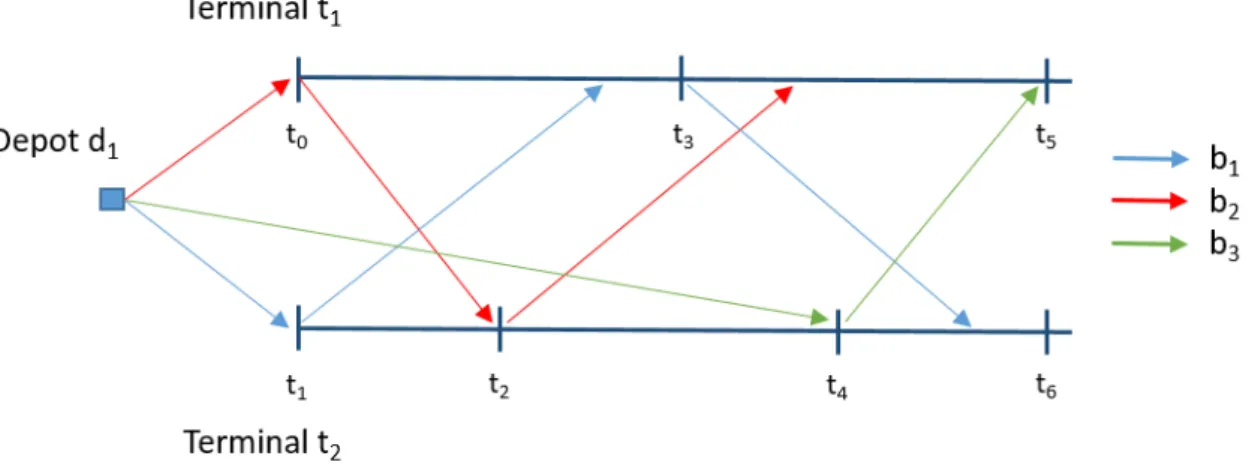
Partial Assignment example. Figure 1.1 illustrates a partial assignment example for one service linel1 withndepartures. The depots are omitted and all vehicles belong to
the depotd1. In this example we have:
• D={d1}withr1 =∞;
• T = {T0,T1,T2,T3,T4, . . . ,Tn}, with starting timest0,t0,t1,t2,t3, . . . ,tnand ending
timese0,e1,e2,e3,e4,e5, . . . ,en;
• LetB= {b1,b2,b3, . . .}the set of vehicles used;
• Solution={s1,s2,s3, . . .}, where:
– s1={hb1,d1,t0,−,s0,VoidIni,hb1,t0,t1,s0,e0,InServicei,hb1,t1,t1,s0,s2,Waiti,
hb1,t1,t0,s2,e2,InServicei,hb1,t0,d1,e2,−,VoidOuti, . . .}
– s2={hb2,d1,t1,−,s1,VoidIni,hb1,t1,t0,s2,e2,InServicei,
hb2,t0,t1,e2/s3,e3,InServicei,hb2,t1,d1,e3,−,VoidOuti, . . .}
– s3={hb3,d1,t1,−,s4,VoidIni,hb3,t1,t0,s4,e4,InServicei,
hb3,t0,d1,e4,−,VoidOuti, . . .}
are theschedulesfor vehiclesb1,b2andb3, respectively;
• F =∑|i=B|1(distTravelled(bi)∗distTypeCost(bi) +dailyTypeCost(bi))1.
1.3.2 Parallel Metaheuristics Hypothesis
Parallel computing is often used to decrease computation time. In search, parallel schemes may be developed from sequential algorithms in order to improve performance. The success of a parallelization schemes is closely related to the natural intrinsic parallelism of each algorithm and not all algorithms are suited for being parallelized.
In humans, knowledge gathering and learning from observations occurs sequentially. We observe the world with our senses (Sight, Hearing, Touch, etc.) and then we combine the obtained information in some manner in order to learn. This learning process is iterative. When learning a given concept, several iterations may be required. Just like humans, intelligent metaheuristics, i.e., in general metaheuristic that are not greedy and attempt to guide the search towards promising regions of the search space by gathering data from previous searches or by exploring problems characteristics, are also iterative.
The degree of metaheuristics parallelization is restrained by this fact since a certain degree of iterative processing, not parallelizable, must exist. Nevertheless, parallelism can still be explored and many parallel schemes hypothesis exist. In particular and as described in section 1.2, the following two major hypothesis exist:
Parallel strategies - Improved parallel strategies may be developed using parallel com-puting. Several parallelization strategies for metaheuristics have already been pro-posed and should be analysed to evaluate if they can possibly lead to performance gains within our algorithms.
ACO is a sophisticated metaheuristic which uses knowledge from previous search experiences in order to guide subsequent search processes. Furthermore, ACO can be naturally paralellized. Proposed ACO parallel strategies should be analysed and if possible new strategies may be derived for the purpose of developing a robust and scalable search algorithm for the PTBA problem. A common characteristic of the ma-jor parallel strategies for ACO is the fact that they are synchronous. As it will be dis-cussed in section 3.4 synchronism causes the straggler problem [13]. Asynchronous strategies mitigate this problem but usually increase algorithms complexity and/or change the original algorithm semantics. Therefore, the asynchronism hypothesis should be analysed taken into account this tradeoff. The developed strategies must be tested in order to assess their effectiveness.
1.4. MAIN CONTRIBUTIONS
1.4
Main Contributions
The PTBA problem variant was not yet addressed in the literature. This thesis will con-tribute with a set of approximative algorithms for solving the PTBA problem using Constraint-Based Local Search and Metaheuristics. Different metaheuristics, with different characteristics and degrees of sophistication will be analysed and implemented.
A detailed study of parallel mechanisms and strategies applied to metaheuristics suitable for solving the PTBA problem, as well as under what assumptions they prove to be, or not effective will be performed. More concretely, we will contribute with an analysis of:
i) How can sequential metaheuristics be extended by exploring the available resources in SM architectures (multi-coreandmultiprocessors) in order to achieve better performance
in terms of computation time and solution quality. Regarding ACO, we will develop asynchronous parallel strategies for ACO and analyse their respective performance;
ii) How can cooperation between processes be achieved and contribute towards an effective and intelligent exploration of problem’s search space;
To support this analysis, we will implement a parallel optimization library for the PTBA problem with implementations of the resulting algorithms from our analysis. This library aims at being efficient, compositional and extensive, such that new algorithms can be easily added by reusing existing ones. Additionally, even though we evaluate our algorithms in a SM architecture, our library will be designed such that developed algorithms can also target distributed architectures.
We will experimentally evaluate the resulting algorithms and strategies and assess the results obtained, namely the solution quality and speedups achieved with parallel strategies.
Our contribution on the analysis and design of parallel strategies for ACO, concretely synchronous and asynchronous strategies, was published at INFORUM 2015 [67]: Asyn-chronous Parallel Ant-Colony Optimization Strategies: Application to the Multi-Depot Vehicle Scheduling Problem with Line Exchanges.
1.5
Document Organization
The remainder of this document is organized as follows:
Chapter 2 - This chapter details the background on the topics covered by this thesis in particular Local Search Techniques and Metaheuristics, emphasizing the ACO metaheuristic, and Parallel Computing and Concurrency. The chapter finishes with a discussion of state of the art work in Parallel Metaheuristic Algorithms, also emphasising ACO, and in solutions to the PTBA problem;
also describing how the model incorporates the associated constraints. Based on the developed model sequential and parallel versions of a first randomized algo-rithm will be presented. The chapter finishes presenting ACO sequential model and algorithm for the PTBA problem and discussing the derived model characteris-tics. Additionally, parallel synchronous and asynchronous strategies for ACO are proposed and analysed;
Chapter 4 - Aspects related with the implementation are covered in this chapter. The chapter starts by presenting and discussing the tools and the software model of the library as well as the associated algorithms, highlighting the properties obtained with our model. Problem’s input data abstractions which allow one to obtain data from different sources (e.g. text files, remote database, etc. . . ) are shown. An overview of the CaSPER LS solver is given as well as which features of the solver are used on our implementation. The remaining part of the chapter discusses implementation details and decisions of both sequential and parallel algorithms.
Chapter 5 - In order to assess the effectiveness of the proposed algorithms, each algorithm is experimentally evaluated. In the first part of the chapter our experimental setup is presented as well as the instance of the problem which our experiments will use. The solutions produced by our algorithms are analysed in terms of relevant charac-teristics andquality of serviceaspects. The influence of different parametrizations and aspects on the solutions obtained will also be evaluated. The last part of this chapter focus on presenting and discussing results of the performance and solution quality for both sequential and parallel algorithms.
C
H
A
P
T
E
R
2
B
ACKGROUND AND
R
ELATED
W
ORK
In this chapter we describe the background material necessary to the understanding of this work and we also present a brief overview of the related work of our problem, described in section 1.3.
We start by discussing in section 2.1, Combinatorial Optimization Problems, Local Search and Metaheuristics techniques used to solve this type of problems and we de-fine the underlying base concepts. Metaheuristics and Constraint-Based Local Search approaches will be described in sections 2.1.2 and 2.2, respectively (emphasizing relevant metaheuristics for this thesis). The Ant-Colony Optimization Metaheuristic and relevant ACO versions will be described and discussed in section 2.3.
In section 2.4 we introduce Parallel Computing and Concurrency aspects. Multi-core and NUMA architectures are described in sections 2.4.1 and 2.4.2, respectively. Concur-rency control mechanisms are introduced in section 2.4.4. In section 2.5, an analysis of the related work in Parallel Metaheuristics applied to combinatorial optimization problems, will be presented and discussed. An overview of different approaches and architectures for Parallel Local Search discussing each one advantages/disadvantages and complexity issues will also be presented. Section 2.6 presents the state of the art in Parallel Ant-Colony Optimization (considering techniques using CPUs ).
Lastly, the state of the art in algorithms and techniques to solve the VSP problem will be discussed in section 2.7.
2.1
Local Search Techniques and Metaheuristics
Complete search methods guaranteeoptimality, in the sense that if several solutions exist
for the problem, the method finds the best one. However, to provide such guarantee it is necessary to explore the whole search space or, by using an heuristic to guide the search, to explore a subset of the search space, as long as the heuristic guarantees optimality[65]. In general COPs are NP-hardand cannot be solved to optimality within polynomial
bounded computation time [31].
Consequently, it turns out that for complex (in terms of instances size or problem formulation) COPs, the search space is huge and complete methods cannot solve these problems in reasonable computation time.
Approximative algorithms (e.g. Metaheuristics), despite not providing optimality, can be used to find near-optimal solutions in reasonable computation time. This algorithms can be classified as eitherconstructiveorreparativealgorithms.
Constructive algorithms build solutions incrementally, by adding components to a
partial solution until a complete solution is obtained. Due to their incremental nature, these type of algorithms tend to be very greedy, as in general at each iteration, the best component is selected. Consequently, this methods potentially tend to provide inferior quality solutions when compared to reparative algorithms.
Reparative or Perturbative algorithms start from an initial solution and attempt to
progressively improve the solution quality, by applying amovefrom the old solution to
the new one.
2.1.1 Combinatorial Optimization Problems and Local Search
In this section we will start by introducing a variety of concepts regarding COPs and Local Search (LS), mentioned throughout this thesis.
In general, a Combinatorial Optimization Problem is specified by a set of problem instances [1]. Each instance is a pairhS,FiwhereS is the set of feasible solutions and f
the cost function with the mappingF:S 7→R. The COP can be either a minimization or a maximization problem1. For a minimization problem, the objective is to find a globally optimal solution, i.e., ani∗ ∈S such thatF(i∗)≤ f(i)for alli∈S.
Local Search algorithms consist in performing "local changes" to a given solutionsin
order to improve the solution quality, therefore moving from solution to solution in the space of candidate solutions. This process terminates according to a given criteria (e.g. time elapsed, lower/upper bound on solution quality, among others).
As will be detailed in section 2.2, with the constraint-based local search approach, problems can be modelled as Constraint Satisfaction Problems (CSPs). CSPs[65, p. 202] are
1Every maximization/minimization problem can be turned into a minimization/maximization problem,
2.1. LOCAL SEARCH TECHNIQUES AND METAHEURISTICS
defined as a triplehX,D,Ciwhere:
i) X ={X1, . . . ,Xn}is a set of variables;
ii) D ={D1, . . . ,Dn}is a set of domains of the corresponding variables;
iii) C ={C1, . . . ,Cm}is a set of constraints.
A CSP is solved by finding values xi ∈ Di for each variable Xi that satisfy all the
constraints in C.
COPs can be modelled as Constraint Satisfaction and Optimization Problems (CSOPs). These last problems are defined as a CSP problem with an additional objective function
Fdefined over the variables, to be optimized. The solution space is defined by a set of
constraints. CSOPs have the following canonical form:
Minimize: F(~x)
Subject to: C1(~x),
C2(~x), . . .
Cm(~x).
where:
• ~xis a vector ofndiscrete decision variables;
• Fis an objective functionF:Dn 7→R;
• Ci(~x)are themconstraints that define the solution space of the problem.
Asolutionto aCSOPproblemPis an assignment of values to the variables in~xand a
feasible solutionis a solution that satisfies all the constraintsCi. Apartial solutionis a
solutionin which some variables in~xdo not have any value assigned.
LetLˆpbe the set of all thefeasible solutions. AnOptimal Solution(or aglobal optimum)
is afeasible solutionthat minimizes the objective functionF:
F∗ =arg minnF(s)|s∈ Lˆpo
And the set of optimal solutions toP, denoted byL∗p, is defined as:
L∗p =ns ∈ Lˆp|F(s) =F∗o
TheSearch Spaceof aCSOPproblemP, is the set of solutions that satisfy some subset
of the constraintsCi(~x)of the problem and is denoted byL
′
p.
Therefore, theSearch Spaceis the set of acceptable solutions (assignments that satisfy a subset ofCi(~x)) andLˆp ⊆ L
′
p⊆ Dn.
ANeighbourhoodof aCSOPproblemPis a pairhL′p,N iwhereL′pis a search space and N is a mappingN : L′p 7→ 2L′p that defines for each solutions, the set of adjacent
solutionsN(s) ⊆ L′p. Furthermore, when the relations ∈ N(j)⇔ j∈ N(s)holds, the
Neighbourhoodis symmetric.
ATransition GraphG(L′p,N)of a problemP, is the graph associated to the
Neigh-bourhoodhL′p,N i, where the nodes are solutions inL′pand an arca→bexists ifb∈ N(a). A solutions+isLocally Optimal(or alocal optimum) if none of its neighbours have a
smaller cost (measured byF). Formally:
F(s+) ≤mini∈N(s+)f(i).
LS algorithms must attempt to escape local optima. Therefore, they must select a solution fromN(s)by taking this into account.
ASelection RuleS(M,s)is a function S : 2Lˆp× Lˆ
p 7→ Lˆp that picks an elements
′ fromM, whereM = N(s), according to some strategy and decides to accept it or to select the current solutionsinstead.
LSreparativeorperturbativealgorithms [39] start from an initial solution and iteratively
attempt to improve the solution by examining the current solution neighbourhood and by applying a given move operator (e.g. changing the value of a variable or swapping the values of two variables), evolves the current solution to a new one.
Formally, areparative local searchalgorithm is a path:
s0→s1→s2→. . .→sk
in the transition graphG(L′p,N)forPsuch that:
si+1=S(N(si),si)
The sequences0 →s1 → s2 → . . .→ sk will eventually lead to a local optimum (or
even a global optimum). Heuristics are used to guide the search towards local optima. Metaheuristics are used to escape from local optima.
The neighbourhood definitionN(s)⊆ L′pis crucial in order to achieve high-quality solutions and depending on how each COP is modelled, should be defined in a problem specific way in order to take into account the problem search space structure.
The search space elements [65] of a COP are illustrated in figure 2.1, which represents a one-dimensional state-space for a generic maximization COP2. The following additional elements are defined:
plateau - a region of the search space where the evaluation function f is flat;
shoulder - Aplateaufrom which progress is possible.
2A solution to a COP can be any state itself (or in particular, the goal state) or the path taken by the
2.1. LOCAL SEARCH TECHNIQUES AND METAHEURISTICS
Figure 2.1: Search Space Structure. Adapted from [65, p. 121]
When in a given iteration, the move operator cannot evolve the old solution to a better one, the LS algorithm is said to be stuck in alocal optimum. This situation is also illustrated in figure 2.1. The LS algorithm is progressing towards a local optimum and, when it reaches the local optimum, the algorithm will be stuck since none of the neighbours improve the solution quality.
In order to escapelocal optima, specially in problems with complex search spaces (e.g.
large number of local optima), additional mechanisms must be used. This mechanisms, referred as Metaheuristics, will be discussed in section 2.1.2.
Constructivealgorithms [39] build solutions incrementally by completing partial
solu-tions. This type of algorithms implement two criteria: the order of the assignments, i.e. to which variable should a value be assigned next, and an heuristic to choose the value to assign. Additionally, constructive algorithms can in general be interpreted asconstructive local search methods, however, it should be noted that solutions generated by this type of
algorithm are not guaranteed to be locally optimal with respect to a simple neighbourhood
hL′p,N i.
2.1.2 Metaheuristics
Metaheuristics [32] are defined as methods that orchestrate an interaction between local improvement procedures (e.g. LS algorithms) and higher level strategies in order to develop search strategies capable of escaping local optima and guiding the search towards promising regions of the search space. This type of heuristics (heuristics that manipulate a single solution) are categorized assingle-solution based metaheuristics[72] (S-metaheuristics).
This type of metaheuristics manipulate and transform a single solution during the search. On the other hand, inpopulation based metaheuristics(P-metaheuristics) a population of
solutions are manipulated.
it is necessary to use mechanisms like metaheuristics in order to avoid the underlying search process being stuck.
A large number of different metaheuristics have been developed [37]. For this thesis, for reasons that will be explained shortly, the relevant metaheuristics are Multi-Starts and Restarts, and Ant-Colony Optimization, which will be described in sections 2.1.2.1 and 2.3, respectively.
2.1.2.1 Multi-Starts and Restarts Metaheuristics
The Multi-start (MS) and Restarts methods are closely related. Multi-start methods in general aim at helping search procedures exploring different regions of the search space, by applying a search procedure (or multiple search procedures) to multiple random initial solutions [54], for reparative LS algorithms, or by executing a randomizedconstructive
procedure, building multiple solutions. Randomization is needed such that constructive search agents can construct different solutions.
Restarts are a simple and generic technique that consists in restarting a search process using some stopping criteria (e.g. stop after a given number of iterations, stop after a given number of iterations without solution improvements, among others ).
A MS metaheuristic is in some sense a restart metaheuristic in which the initial solu-tions are not totally random.
Diversification in generating initial solutions or constructing distinct solutions, achieved with randomization, is an essential aspect in order provide Multi-Start methods the ability to overcome local optimality [54].
In [53] the authors show that Multi-start methods with memory, i.e., that use ele-ments of previous solutions to generate each new solution, contribute to overcome local optimality since they guide the diversification process.
A Multi-start method with memory approach is used in [25] to solve the Maximum Diversity Problem. The algorithm has two phases: solution construction and solution improvement. In the first phase an initial solution is constructed using the Tabu Search Metaheuristic, proposed by Fred Glover [34, 35], and in the second phase a local search algorithm is used to post-process that solution, attempting to improve the solution quality. At each iteration the first phase algorithm penalizes elements that appeared in previous solutions and rewards elements which previously appeared in high quality solutions. Additionally, the authors compared a MS algorithm without memory with a MS algorithm with memory and concluded that the version with memory is more effective (in terms of solution quality).
2.2. CONSTRAINT-BASED LOCAL SEARCH
diversity, in order to the local search algorithm perform the search close to the optimum. They compare the MS method with a complete search method that uses mixed integer programming and, the MS method proved to be robust providing optimal or near-optimal solutions for real-life instances within a reasonable response time.
In both works the post-processing phase that aims to improve initial generated/con-structed solutions consists in a simple and fast scheme. This is due to the fact that the objective here is to maximize the portion of the search space explored, in order to increase the possibility of reaching a global optimum. This maximization is accomplished by gen-erating/constructing as much as possible (high-quality) solutions. Subsequently, a local search over those solutions may be applied if possible.
The MS method can be naturally parallelized due to the fact that the method consists in starting a search algorithm several times.
2.2
Constraint-Based Local Search
General purpose languages lack expressivity and do not provide good abstractions to the development of local search algorithms, leading to very complex implementations, lacking modularity and compositionality.
CBLS [76] consists in a paradigm that incorporates Constraint Programming in local search methods.
With this paradigm it is possible to model complex COPs using constraints, inher-iting all the expressivity offered by the different types of constraints (e.g. Numerical, Combinatorial, Logical, amongst others), originating a CSOP (introduced in section 2.1.1). In CBLS constraints are used to describe and control local search algorithms and the number of constraints violations is included in the objective function to be posteriorly minimized. Additionally, CBLS provides a clean separation of concerns between the model and the search procedure. With this separation of concerns, implementation of generic and reusable search algorithms is straightforward. This also allows the programmer to design local search algorithms by specifying the model, in a declarative way, and the search, that will use the specified model structure to effectively explore the neighbourhoods.
Michel and Hentenryck [57] proposed a CBLS architecture that follows the principles described above and which was materialized in the COMET [76] programming language. The COMET3language is an object-oriented programming language that offers a wide variety of modelling and search abstractions and high-level control structures.
We developed CaSPER LS [68] a CBLS library, implemented in the C++ language,
which captures the principles of compositionality, reuse and extensibility at the core of CBLS and offers high-level abstractions, providing a suitable environment to address COPs with local search, modelled as CSPs. CaSPER LS will be described in section 4.1.2.
a local search component based on the model specification, which is abstracted by the constraints, since the search component only focus on minimizing the number of constraint violations.
Listing 2.1: N-Queens model and search using CaSPER LS.
1 #include <casper/ls/ls.h>
2 #include <iostream>
3
4 using namespace Casper::LS;
5 using namespace std;
6
7 int main(int argc, char* argv[]){ 8 Solver s;
9 ConstraintSystem<int> cs(s); 10 int N = 10;
11 Range<int> Size(0,N-1);
12 IntVarArray queens(s,RandomPermutation(Size)); 13
14 //Model definition
15 IntVar i(s,Size); 16 cs.post(alldifferent(
17 aggregate<int>({inRange(i,Size)}, queens[i] + (i+1) ))); 18 cs.post(alldifferent(
19 aggregate<int>({inRange(i,Size)}, queens[i] - (i+1) ))); 20
21 //Search
22 int it = 0;
23 IntVar p(s, Size); 24 IntVar v(s, Size);
25 while( cs.getViolations() > 0 && it < maxIt){
26 selectMaxExpr<int>({inRange(p, Size)}, cs.violations(queens[p]));
27 selectMinExpr<int>({inRange(v, Size)}, cs.swapDelta(queens[p],queens[v])); 28 swap(queens[p],queens[v]);
29 it++;
30 }
31
32 cout << "Solution: " << queens << endl;
33 return 0;
34 }
As will be discussed in sections 3 and 4, our proposed PTBA model will be designed using CBLS ideas and will be implemented using CaSPER LS features.
2.3
Ant-Colony Optimization Metaheuristic
The Ant-Colony Optimization (ACO) metaheuristic [22, 23] is a P-metaheuristic which was originally proposed by Dorigo [22] and is inspired on the behaviour of real ants
2.3. ANT-COLONY OPTIMIZATION METAHEURISTIC
which use pheromones as a communication medium. In particular, ants initially leave their nest (or colony) and travel along a random path in order to find food. When a given ant finds food, it returns to his colony leaving a pheromone trail over the path taken. As time goes by, subsequent ants will start following the pheromone trails instead of wandering randomly. Additionally, over time the deposited pheromone trails evaporate and become less appealing. As ants travel along a certain path, the pheromone trails on that path will be reinforced, therefore, longer paths will have more time to evaporate the pheromone trails. Since shorter paths will be used more frequently, the pheromone density will increase over time, making the path more appealing.
F
N
a
b
1
F
N
2
F
N
3
Figure 2.2: ACO ants convergence. [24]
This process is illustrated in figure 2.2. In step 1 an ant finds a food source (F) using a path a and returns by a pathb depositing pheromone trail. At step 2 ants leave the
nest and follow one of the 4 possible paths, however, due to pheromone evaporation and reinforcement, the shortest path becomes more appealing over time. Finally at step 3, approximately all ants converge to the same path, the shortest one.
Artificial ants are modelled as agents that communicate indirectly within the colony. Each agent performs a stochastic solution construction that probabilistically builds a solution by complementing a partial solution at each iteration. Concretely, to complement partial solutions, at each iteration heuristic information and pheromone trails are taken into account. Pheromone trails are updated at run-time reflecting the agents acquired search experience [32].
the ACO similar to a reinforcement learning procedure, i.e., a learning by interaction procedures [70].
Algorithm 1Ant-Colony Optimization.[32]
1: procedureANT-COLONYOPTIMIZATION(problem)returnbest solution found 2: Initialization
3: whiletermination condition not metdo 4: ConstructAntSolutions
5: ApplyLocalSearch % Optional
6: UpdatePheromoneTrails
returnbest solution
Algorithm 1 describes the main steps of ACO metaheuristic. In Initialization step
pheromone variables are initialized. In theConstructAntSolutionsa set ofNagents perform a constructive search procedure guided by heuristic information and by the pheromone trails, constructing the solutions. At the end of this step, a local search procedure may be applied (e.g. Steepest Ascent Hill-Climbing [65]) in order to improve the obtained solutions. Lastly, in theUpdatePheromoneTrailsstep the pheromone trails are updated such
that good solutions will be more desirable. In order to avoid a fast convergence of all the agents towards sub-optimal solutions, pheromone evaporation is applied.
In this thesis we explore the ACO metaheuristic since it not only is robust, but is also a constructive procedure, which as will be discussed in section 3.1, is more suitable to solve the PTBA problem. Additionally, we intend to explore parallel synchronous and asynchronous versions of ACO, in particular, how parallel cooperative schemes can build pheromone trails in an effective manner.
In the next sections we describe three ACO algorithms: Ant System [21] (AS), the first ACO algorithm proposed, theMAX−MIN Ant System [69] (MMAS) and Ant Colony System [20] (ACS), two more sophisticated and robust ACO algorithms [69] which both consist in extensions to the AS algorithm.
Several other algorithms have been proposed like Rank-Based Ant System [10], Hyper-Cube Framework for ACO [6], among others. In this thesis we focus only on AS,MMAS and ACS due to the following reasons:
AS - as it will be discussed in section 3.4, despite of being inferior in terms of robustness, the AS algorithm allows for a better exploitation of parallel resources;
2.3. ANT-COLONY OPTIMIZATION METAHEURISTIC
2.3.1 Ant System
The Ant System algorithm [21] was the first ACO algorithm proposed and was applied to the Travelling Salesman Problem (TSP).
The pheromone trails model holds information of the desirability of each solution componentcij. The definition of a component depends on the problem being solved and
on how one models the problem. As an example, in the TSP problem, a componentcij
refers to visiting a cityjafter visiting a cityi. The AS algorithm assigns a desirabilityτij
(the pheromone value) to each possible componentcij of the model of the problem.
We will now describe how each step of the algorithm 1 is implemented in the AS algorithm.
2.3.1.1 Initialization
In the initialization phase pheromone trails are initialized. The valueτ0to which each pheromone trail variable should be initialized depends on the problem being solved. However the following aspects must be taken into account.
The pheromone trails should be initialized with a value slightly higher than the expected amount of pheromone deposited by the ants in one iterations [23]. This is due to the fact that if the valueτ0is too low, the search will be quickly biased by the first solutions constructed, which will lead to a poor exploration of the search space. On the other hand, if the value τ0 is too high, many iterations will be lost until pheromone evaporation decreases pheromone trails values such that added pheromone from constructed ants starts to bias the search.
2.3.1.2 Ant Solutions Construction
As in the generic algorithm, at each iteration N ants construct a solution using a
con-structive search procedure. At each construction stept each agentkuses a probability distribution to select the solution componentcijto be added to a partial solutionsp.
The probability distribution used in the AS is defined as follows:
pk(cij|skp) = τij α ·
η(cij) β
∑l∈N(sk p)
τlj α
·
η(clj)
β , j∈ N(s k p)
0 , otherwise
(2.1)
whereN(skp) ⊆ L
′
pdenotes the feasible neighbourhood of the partial solutionspof
antk,η(·)is a function that assigns to eachcij in whichj∈ N(skp)an heuristic value that
evaluates the quality of this assignment in the context of the problem. Theαand β
pa-rameters are used to control the influence of pheromone values and heuristic information, respectively, on the algorithm behaviour.
The neighbourhoodN(skp)of a partial solution also depends on the problem being
2.3.1.3 Pheromone Trails Evaporation and Update
In the end of an iteration pheromone trails are evaporated and updated. Pheromone evaporation is implemented as follows:
τij ←(1−ρ)∗τij (2.2)
where 0 < ρ ≤ 1 is a parameter that denotes the rate of evaporation. If a solution
component is not used by an agent, its corresponding pheromone valueτij decreases
exponentially in the number of iterations, allowing the algorithm to avoid bad solution components, since its desirability is reduced.
After performing the pheromone evaporation step, the pheromone values are updated with learned information from each agent. The update is defined as follows:
τij ←τij+
∑
∆τijk (2.3)where∆τijk denotes the amount of pheromone deposited by agentkon the solution
com-ponents that belong the solutionsk obtained:
∆τijk =
λ
F(sk) , cij ∈s k
0 , otherwise
(2.4)
whereλis a parameter used to control the amount of pheromone deposited. With this
expression, and assuming a minimization problem, the amount of pheromone deposited by each agent depends on the quality of the solutions obtained. Therefore, agents that obtain better solutions will deposit a larger amount of pheromone, favouring good solution components.
2.3.2
MAX−MIN
Ant SystemTheMAX−MIN Ant System [69] extends the AS algorithm by introducing additional mechanisms which by assuming that concentrating the search around the best solutions found during the search is beneficial and leads to better results, attempt to perform a stronger exploration of the search history.
Based on this assumption, the following main modifications are performed:
• stronger exploitation of the best solutions found by allowing only the iteration-best (the agent which produced the best solution of the current iteration) or the best-so-far agent are allowed to deposit pheromone;
• allowing only the iteration-best or the best-so-far agent to deposit pheromone may lead to a stagnation situation due to an excessive growth of pheromone values from components on those solutions. Besides, is likely that this solutions are suboptimal. In order to overcome this problem, lower and upper bounds,τminandτmax, respectively,
2.3. ANT-COLONY OPTIMIZATION METAHEURISTIC
• pheromone trail values are initialized to the current upper boundτmax. This increases
diversification in the initial search iterations;
• each time the algorithm approaches stagnation or when improvements do not occur,
pheromone trails are reinitialized (e.g. after a given number of iterations without improvements).
The ant solution construction phase remains exactly the same. The modifications described just above will now be presented in more detail.
2.3.2.1 New Pheromone Trails Update Mechanism
In the AS algorithm all the agents deposit pheromone. The update is performed according to equation 2.3. InMMAS, only the iteration-best or the best-so-far agent perform the update. The update then is performed as follows:
τij ←τij+∆τijbest (2.5)
where∆τijbestis defined as in equation 2.4 but without depending on the agentkand
being based on the best solution of an iterationsibor on the global best solutionsgb, i.e.,
the denominator isF(sbest)instead ofF(sk).
2.3.2.2 Pheromone Trail Limits
The domain of pheromone trails values is restricted to the interval[τmin,τmax], i.e., the
following restriction is imposed:
0≤τmin ≤τij ≤τmax ≤1 (2.6)
It is shown by the authors that the maximum possible pheromone trail value is asymptotically bounded by 1/(ρf(sopt))where f(sopt)is the objective function value
of the optimal solution. Therefore,τmaxmust be defined using an estimative of this value:
1/(ρf(sbest)). Therefore, each time the best solution is improved,τmaxshould be updated.
The lower bound of pheromone values is defined as τmin = τmax∗a where a is a
parameter.
2.3.2.3 Pheromone Trails Initialization and Reinitialization
Initially pheromone trails are initialized to an estimate ofτmax. Additionally, the rate of
evaporationρ is set to a small value in order to achieve a slow increase across all the
pheromone trail values, such that diversification is achieved.
![Figure 2.1: Search Space Structure. Adapted from [65, p. 121]](https://thumb-eu.123doks.com/thumbv2/123dok_br/16531463.736308/39.892.225.722.131.414/figure-search-space-structure-adapted-p.webp)
![Figure 2.2: ACO ants convergence. [24]](https://thumb-eu.123doks.com/thumbv2/123dok_br/16531463.736308/43.892.212.720.368.740/figure-aco-ants-convergence.webp)
![Figure 2.7: Multi-Core computer architecture. [41]](https://thumb-eu.123doks.com/thumbv2/123dok_br/16531463.736308/51.892.276.660.700.932/figure-multi-core-computer-architecture.webp)

![Figure 2.10: Parallel metaheuristic models. Adapted from [51]](https://thumb-eu.123doks.com/thumbv2/123dok_br/16531463.736308/56.892.300.571.139.435/figure-parallel-metaheuristic-models-adapted-from.webp)