Cement and Concrete Composites 45 (2014), 264-271. http://dx.doi.org/10.1016/j.cemconcomp.2013.06.010
Physical and chemical assessment of lime-metakaolin mortars: Influence
of binder:aggregate ratio
A. Gameiroa, A. Santos Silvab, P. Fariac, J. Grilod, T. Brancoe, R. Veigaf, A. Velosag
a. National Laboratory for Civil Engineering, Av. do Brasil, 101, Lisbon, Portugal,
b. National Laboratory for Civil Engineering, Av. do Brasil, 101, Lisbon, Portugal, [email protected]
c. Department of Civil Engineering, NOVA University of Lisbon, 2829-516 Caparica, Portugal,
d. National Laboratory for Civil Engineering, Av. do Brasil, 101, Lisbon, Portugal,
e. Department of Civil Engineering, NOVA University of Lisbon, 2829-516 Caparica, Portugal,
f. National Laboratory for Civil Engineering, Av. do Brasil, 101, Lisbon, Portugal, [email protected]
g. Department of Civil Engineering, Geobiotec, University of Aveiro, Aveiro, [email protected]
Abstract
This work evaluates the influence of the binder:aggregate ratio in respect to
mineralogical and mechanical properties of air lime-metakaolin mortars.
Mineralogical analysis showed that binder:aggregate ratios modifies the extent of
carbonation and pozzolanic reactions with curing. The pozzolanic reaction occurs
mostly at lower curing times (28 days), while, at higher curing ages, carbonation
reaction is mostly dominant. The exceptions are mortars with 1:1 (air:lime) volumetric
ratio with 30% and 50% MK in which the pozzolanic reaction is still dominant.
For conservation purposes, the mechanical tests demonstrated that 1:2 and 1:3 mortar
volumetric ratios were considered adequate proportions since 1:1 was considered a
“strong” ratio, as it can induce tensions and mortar shrinkage that can damage historic
masonries.
Keywords
Nomenclature
MK– metakaolin
C2ASH8– stratlingite
C2AH6.5– calcium aluminate hydrate
CSH – calcium silicate hydrate
CH– portlandite
CaCO3– calcite
CO2–carbon dioxide
C4A ̅H11– monocarboaluminate
CSH– calcium silicate hydrate
XRF - X-Ray Fluorescence analysis
XRD– X-Ray Diffraction analysis
TG-DTA–Thermogravimetric and Differential Thermal Analysis
RH– relative humidity
Stdev– Standard deviation
1. Introduction
Since ancient times mortars were created and developed with traditional techniques
using easily-available materials, by several civilizations [1]. Nowadays, awareness of
the need for compatible materials regarding the preservation of the architectural
heritage has resulted in the revival of lime-based mortar technology and applications
[2,3,4]. However, several difficulties occur when using mortars solely of air lime, due to
their inability to harden without contact with CO2, to harden under water and their slow
setting. Several studies demonstrated that lime-pozzolan blended mortars showed
faster setting properties, as well as an increase of their durability [5-12].
Due to its high pozzolanic activity, metakaolin (MK) was used in this study for the
studies have been accomplished regarding the effects of MK additions to cement
mortars in order to achieve strength and durability [6, 13-17]; however, only few and
very recent studies about the reactions occurring in air lime-MK mortars and their
influence towards historic masonry requirements have been made [18-20]. Also, very
little attention has been given in terms of understanding the role of hydration and
carbonation reactions in lime-MK mortars as well as their mechanical and chemical
properties [21].
The principal objective of the present research was to seek the optimization of air
lime-MK mortar composition for historical heritage purposes, by learning and understanding
their chemical and physical properties. This study deals with the mineralogical and
physical-mechanical variations produced in mortars when the binder is constituted by
air lime and a metakaolin. Also, it is shown a comparison between mortars with and
without added metakaolin. This research can be divided in two parts: first, air lime
mortars with MK in different combinations with fixed binder:aggregate ratio; and
secondly, mortars with fixed combination of mortar and MK with variation of the
binder:aggregate ratio.
To accomplish this, three different volumetric binder:aggregate ratios of lime-MK
blended mortars compositions with three different MK contents were prepared and
submitted to curing conditions of 90±5% RH and a temperature of 20±3ºC. Several
physical and chemical tests, namely flexural and compressive strength, X-ray
diffraction analysis (XRD) and simultaneous thermogravimetric and differential thermal
analysis (TG-DTA), were conducted focusing mainly on characterizing the evolution of
the lime-MK mortars hardening in respect to time.
2. Materials and methods
Mortars with volumetric binder:aggregate ratios of 1:1, 1:2 and 1:3 were prepared by
mixing a Portuguese powdered commercial air lime EN 459-1 [22] CL90-S (Lusical
and some feldspar minerals. The lime binder content was maintained or replaced by
30% or 50% wt. of a commercial metakaolin (ARGICAL M1200S – MK), with specific surface area, by Blaine, of 3,38 m2/g and particle size distribution: d(10%)=1.53µm,
d(50%)=4.35 µm and d(90%)=11.97 µm. The chemical composition (major elements)
was carried out by X-ray fluorescence analysis (XRF) using a Panalytical Axios X-ray
fluorescence spectrometer with CrKα radiation. Loss-on-ignition (LOI) was determined
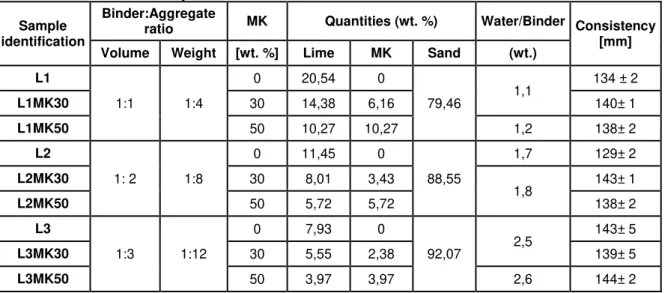
by sample calcination at 1000ºC for 3 hours. Table 1 presents the chemical
composition of the metakaolin and air lime used as binder in mortar production. The
mortar mixes identification, volumetric and weight ratios, percentage of lime weight
substitution by MK and water/binder ratio, are shown in Table 2.
Table 1 – Chemical composition (in wt. %) of materials used as binder in mortar preparation.
Material SiO2 Al2O3 Fe2O3 MnO MgO CaO Na2O K2O TiO2 P2O5 L.O.I.*
Metakaolin 54.39 39.36 1.75 0.01 0.14 0.10 – 1.03 1.55 0.06 1.90
Air Lime – 0.01 0.15 0.01 3.09 76.74 – 0.02 0.04 0.01 20.45
*Loss on ignition
Table 2 – Mortar mixes identification, volumetric and weight binder:aggregate ratio, MK replacement content, materials quantities, water/binder ratio and flow table consistency.
Sample identification
Binder:Aggregate
ratio MK Quantities (wt. %) Water/Binder Consistency [mm] Volume Weight [wt. %] Lime MK Sand (wt.)
L1
1:1 1:4
0 20,54 0
79,46 1,1
134 ± 2
L1MK30 30 14,38 6,16 140± 1
L1MK50 50 10,27 10,27 1,2 138± 2
L2
1: 2 1:8
0 11,45 0
88,55
1,7 129± 2
L2MK30 30 8,01 3,43
1,8 143± 1
L2MK50 50 5,72 5,72 138± 2
L3
1:3 1:12
0 7,93 0
92,07 2,5
143± 5
L3MK30 30 5,55 2,38 139± 5
L3MK50 50 3,97 3,97 2,6 144± 2
2.1 Mortar preparation: mixing and curing procedure
The mixing procedure was the same for all mortars: the amount of water to achieve a
mortars, was added in the first seconds of mixing; mechanical mixing went on for 150
seconds; the borders were scrapped and the mixing continue for another 30 seconds.
The flow table consistency was determined based on EN 1015-3 [23]. Mortars were
casted in metallic prismatic moulds of 40 x 40 x 160 mm and conditioned inside
polyethylene bags during 6 days for initial curing with high RH. After removing the
mortar samples from the moulds, they were maintained at a RH of 90±5% and 20±3⁰C
temperature and cured up to ages of 28 and 90 days. Mortars without MK could not be
demoulded at the 6th day of curing due to the fact that they were too soft to demould
and needed to be left for one more day outside the bag to be demoulded.
The day before initializing testing, samples were stored for 24h at 20±3⁰C and 65±5%
RH in a climatic chamber.
2.2 Flexural and compressive strength tests
Mortar flexural strength was determined by the average of three points bedding
strength of three mortar samples of each mortar, using an universal tensile machine
Zwick Z050 with a 2 kN load cell and velocity of 0,2 mm/min, based on EN 1015-11
[24]. At 28 days the core of the samples, when fractured, still presented high moisture,
particularly those of mortars with MK, showing a diverse behaviour at that lime-based
mortars young age.
The same equipment but with a compressive device, a load cell of 50 kN and a velocity
of 0,7 mm/min, was used for the compressive strength determination of each mortar,
using half samples from the previous test, and also based on EN 1015-11 [24].
Remaining pieces of mortars from the compressive strength’s test were dried at 60⁰C
2.3 X-ray diffraction analysis
The samples for XRD analysis were dried and sieved in order to enrich the mortar
binder fraction. These samples were afterwards ground to granulometry < 106μm.
X-ray diffractograms were obtained on a Philips PW3710 X-X-ray diffractometer, with 35 kV
and 45 mA, using Fe-filtered CoKα radiation of wavelength λ=1.7903 Å. Diffractograms were recorded from 3-74 º2θ, in 0.05 º2θ increments with 1 second per increment, in
effect 0.05 º2θs-1 .
2.4 Thermogravimetric and differential thermal analysis (TG-DTA)
The mortar samples to be analysed by TG-DTA were dried and ground to granulometry
up to 106μm. The TG-DTA analysis was performed in a TG-DTA analyser, under argon
atmosphere, with heating rate of 10ºC/min, from room temperature to 1000ºC. Free
portlandite content in the samples was determined from the mass loss in the range of
380–500ºC, corresponding to portlandite dehydration region. The CO2 content present in the samples was attained in the mass loss range of 500–850ºC, which corresponds to the decarbonation region of carbonates [25-28].
3. Results and analysis
3.1 Water/binder ratio and flexural and compressive strength
All the mortars presented an adequate workability for air lime based mortars. The
average value of consistency for each mortar is presented in Table 2, with an average
flow table consistency of 138 ± 5 mm for all the mortars.
Also, from Table 2 it is viewed that the water/binder ratio that was needed to achieve
comparable consistency increases with the decrease of the binder:aggregate ratio and
the extent of MK. Figure 1 and 2 presents flexural and compressive strength results of
Fig.1 – Flexural strength at 28 and 90 days (error bars +/- standard deviation).
Fig.2 – Compressive strength at 28 and 90 days (error bars +/- standard deviation). As expected, flexural strength decreases with the decrease of the binder:aggregate
ratio of mortars. The decrease of flexural strength with the binder:aggregate ratio is
even clearer at the age of 90 days compared with 28 days. For each binder:aggregate
mortar ratio, the flexural strength increases with the wt. % of lime substitution by MK,
increases from 28 to 90 days of age, except for L1MK30 and for mortars L3 with MK.
This reduction may be due to mortars shrinkage with microcracking, and also due to
the increase of the water/binder ratio.
Also, as expected, the mortars’ compressive strength follows the behaviour of the
flexural strength, decreasing with the binder:aggregate ratio. As previously, this
decrease is also clearer at the age of 90 days. The compressive strength increases
with the wt. % of lime substitution by MK for all mortars, which seem to be induced by
the occurrence of a pozzolanic reaction. It increases from 28 to 90 days except for
L1MK30 and for the L3MK mortars, following the behaviour shown by the flexural
strength results and by the same probable reasons.
3.2 XRD results and analysis
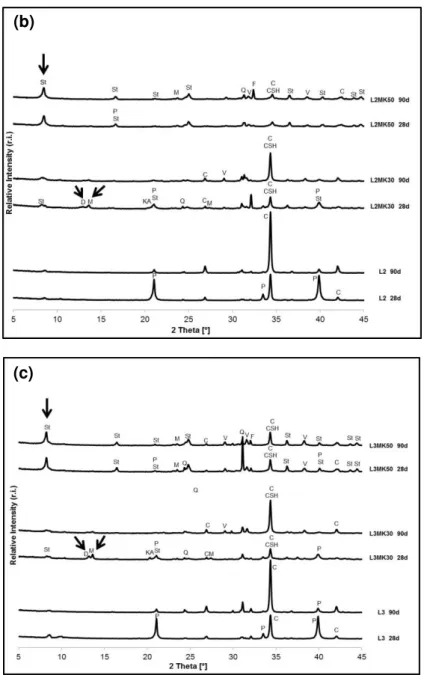
The XRD results of 1:1, 1:2 and 1:3 mortars are displayed in Fig. 3. The patterns
correspond to the binder rich fractions of the mortars. Also, a comparison of the
evolution between 28 and 90 days of curing is shown.
In these figures the bold arrows were drawn signalling the most intense peaks of the
hydrated compounds originated in lime-MK reaction.
Fig. 3 – XRD patterns of binder rich fraction of mortars with (a) 1:1, (b) 1:2 and (c) 1:3 volumetric ratios, 28 days versus 90 days of curing.
Notation:St – Stratlingite (2CaO.SiO2.Al2O3.8H2O); M – Monocarboaluminate (3CaO.Al2O3CaCO3
.
11H2O); CSH – Calcium silicate hydrate; D – calcium aluminate hydrate (Ca2Al(OH)7
.
6.5H2O); P – Portlandite (Ca(OH)2); C – Calcite (CaCO3); Q – Quartz (SiO2); F – Feldspar (KAlSi3O8);V – Vaterite (CaCO3);
KA – Katoite (Ca3Al2(SiO4)(OH)8).
As viewed in Figure 3, the main phases formed in the pure air lime mortars (0% MK) at
28 and 90 days of curing are portlandite (CH) and calcite (C). As expected, the calcite
content increases with curing age due to the evolution of carbonation reaction.
Comparing Figure 3 (a), (b) and (c), calcite peaks are more intense for mortars with
lower binder content, i.e., L2 and L3, also increasing with curing time (90 days). Also as
(b)
previewed, the presence of quartz and feldspar are also detected since they are
constituents of the siliceous sand used in the mortars formulation.
Figure 3 (a), (b) and (c) also show that mortars prepared with MK (e.g. L1MK30 and
L1MK50) present a steep decrease in the portlandite content with ageing, due to its
consumption towards the pozzolanic hydration, as well as for the carbonation reaction.
The hydrated phases obtained in the lime-MK reaction are stratlingite
(Ca2Al2SiO7.8H2O - C2ASH8), calcium aluminate hydrate (Ca2Al(OH)7.6.5H2O –
C2AH6.5) and monocarboaluminate (Ca4Al2O6CO3.11H2O – C4A ̅H11). The monocarboaluminate, as described by Arrizi and Cultrone [18], derives from the
reaction between the reactive alumina of MK and the free portlandite found in the
mortars in the presence of CO32-. The monocarboaluminate occurs in higher intensity
for L1MK30 at 28 days, decreasing with time and also with higher MK content. This
decrease with MK content was also observed for the remaining lime-MK mortars.
Calcium aluminum hydrate occurs in MK30 and, in a minor content, in MK50 mortars
both at 28 days, decreasing with ageing. The two aluminate hydrated phases identified
in MK mortars present an unstable behaviour with increasing curing age. This
behaviour could be attributed, as described by Silva and Glasser [29], to the reduction
of Ca2+ and OH- ions in the pore solution.
In contrast, stratlingite, a hydrated compound normally responsible for the improvement
of mechanical strength of lime-MK mortars [30, 31], increases with ageing and MK
content. As can be seen at 28 days for MK30 mortars (Fig. 3), the stratlingite peaks
presents similar intensity, with exception of L1MK30. However, at 90 days of curing the
stratlingite peaks are present with similar intensity in all MK30 mortars. This behavior of
stratlingite could indicate the ending of pozzolanic reaction at 90 days of ageing.
For MK50 mortars, it is observed an increase in the intensity of stratlingite peaks when
compared with MK30 mortars. This seems to be caused by the increase in the
pozzolanic reaction due to higher MK content. When comparing all MK50 mortars, the
The relative higher importance of the unstable aluminate hydrated phases by
comparison with the more stable stratlingite in all L3MK mortars and in L1MK30 mortar
may also contribute to explain the decrease in flexural and compressive strength from
28 to 90 days in the referred mortars.
Calcite is also present in all mortars, showing a slight increase with curing age. Calcite
content is higher for 1:3 mortars and, for those containing MK, it presents the highest
content in mortars with 30% MK. This seems to be due to a less dense microstructure
of mortars possessing weaker binder:aggregate ratios, lower MK content and also high
water/binder ratio, which all together may favour quicker carbonation.
Figure 3 also shows the presence at 28 days in MK30 mortars of a low silica
hydrogarnet – katoite (Ca3Al2(SiO4)(OH)8). Silva and Glasser [29], stated that mixtures containing stratlingite and calcium hydroxide are expected to form katoite, which is
viewed to be a compound that carries out negative effects in MK blended mixes.
However, the results at 90 days did not show any occurrence of this phase, which can
be related with the decrease of CH.
3.3 TG-DTA results and analysis
Figures 4 and 5 presents the dTG charts for the mortars under analysis.
These charts presents 3 main peaks in the temperature ranges of Tambient-200ºC,
380-500ºC and 500-850ºC, corresponding to the pozzolanic product dehydration,
Fig. 4 – dTG results of L1, L1MK30, L2, L2MK30, L3 and L3MK30 mortars (28 and 90 days of curing), showing the characteristic regions for pozzolanic dehydration (CSH,
Fig. 5 – dTG results of L1MK30, L1MK50, L2MK30, L2MK50, L3MK30 and L3MK50
mortars (28 and 90 days of curing), showing the characteristic regions for pozzolanic dehydration (CSH, C2ASH8, C4A ̅H11,C2AH6.5), portlandite (CH) dehydration and
Table 3 presents the mass losses (in %) obtained by TGA corresponding to the
pozzolanic dehydration, portlandite dehydration and the carbonates decarbonation
regions.
Table 3 – Mass losses in temperature ranges at 28 and 90 days.
Simple identification
Mass losses [%]
Tamb-200ºC 380-500ºC 500-850ºC
28 d 90 d 28 d 90 d 28 d 90 d
L1 0.34 0.59 3.03 0.78 1.89 9.07
L1MK30 3.69 3.58 0.84 0.83 1.56 2.09
L1MK50 4.77 4.42 0.38 0.39 1.70 1.62
L2 0.33 0.26 0.45 0.15 4.15 5.34
L2MK30 2.31 1.60 0.51 0.17 1.48 2.90
L2MK50 5.15 2.27 0.36 0.16 1.22 1.55
L3 0.12 0.18 0.46 0.19 1.53 2.45
L3MK30 1.37 1.19 0.23 0.16 1.19 1.81
L3MK50 1.59 1.74 0.17 0.15 1.06 1.05
From Figures 4 and 5 it can be seen that at 28 days of curing all lime and MK mortars
show, with exception of the L3MK50 mortars, the presence of a peak at about 450ºC
indicating the existence of free portlandite. Also, at about 750ºC, the existence of a
peak confirms the presence of calcite, as pointed out in XRD section. At this age of
curing, two other peaks can be also observed in all lime-MK mortars, but with higher
incidence in MK50 mortars. The first one is at about 150ºC, corresponding to the
dehydration of CSH and C2AH6.5, while the second one, at about 220ºC, is attributed to
both C4A ̅H11 and C2ASH8 [19,30].
At 90 days of curing pozzolanic peaks are present for all MK mortars, being again more
important for MK50 mortars. At this age the portlandite peak is also noticed for all
mortars, with exception of all the MK50 mortars. In comparison with 28 days, the calcite
peak is highest for all mortars at 90 days. This behaviour is confirmed by the XRD
3.3.1 Pozzolanic vs carbonation reaction evolution
Aiming to study the evolution of the pozzolanic reaction versus the carbonation reaction
with mortars’ ageing, determination of consumed portlandite in pozzolanic and
carbonation reactions was evaluated according to equations 1 and 3, respectively:
CHpoz = CHth – (CHf + CHcarb) [Equation 1]
CHf = (ML(380-500ºC) x MM(CH) / (MM(H2O)) [Equation 2]
CHcarb = (ML(500-850ºC) x MM(CH)) / (MM(CO2)) [Equation 3]
Being: CHpoz, the lime consumed in the pozzolanic reaction; CHth, the initial lime
content (wt. %;, CHf, the free portlandite content; CHcarb, the lime consumed in the
carbonation reaction; ML(380-500°C), the mass loss between 380-500°C corresponding to
portlandite dehydration; ML(500-850°C), the mass loss between 500-850°C corresponding
to carbonates decarbonation; MM(CH) and MM(CO2), the molar masses of the
portlandite and CO2 compounds in accordance with the hypothesis considered in
equation 1 and 3.
Figure 6 illustrates the comparison between the lime consumed in the pozzolanic
reaction versus the lime consumed in the carbonation reaction at 28 days and 90 days
Fig. 6 – Comparison between the pozzolanic reaction and carbonation reaction lime consumption (28 vs 90 days of curing).
From Figure 6 it can be stated that, with exception of L3MK50, in general, the
pozzolanic reaction is dominant at 28 days of curing for all mortars. In contrast, at 90
days of curing the pozzolanic reaction dominance only occurs for L1MK mortars.
As for carbonation reaction, it is shown that, with the exception of L1MK50 and
L3MK50, it increases with curing time, i.e., from 28 days to 90 days for all mortars.
Also, if considering the pozzolanic reaction it is evident that there is a higher rate
regarding L1. In the same way, considering the carbonation reaction, a higher rate is
observed for compositions L2 and L3.
4. Discussion
4.1 Materials characteristics
The XRD results demonstrated that, besides calcite, the main hydrated phases present
in lime-MK blended mortars are stratlingite, calcium aluminate hydrate,
monocarboaluminate and portlandite. Stratlingite was favoured by mortars possessing
high MK content and with increasing ageing, independently of the chosen
binder:aggregate mortar ratio, and therefore more abundant with the 1:1
Silva and Glasser [29] showed that stratlingite is not stable in the presence of
portlandite, and Locher [31] stated that, when both hydrated phases are present, the
formation of hydrogarnet occurs. The results of this research confirm these statements
as can be seen in Fig. 3, for the mortars with 30% MK content at 28 days, where
katoite (a low silica hydrogarnet) is shown both in the presence of stratlingite and
portlandite. Since portlandite shows a remarkable decrease at 90 days, no katoite
formation was detected at this age.
A problem regarding both calcium aluminate hydrate and monocarboaluminate arises,
since both aluminate hydrated phases are unstable with increase of MK and curing
time. As described by Silva and Glasser [29] the reason behind this behaviour is the
reduction of the concentrations of Ca2+ and OH- ions in the pore solution at longer
curing ages.
TG-DTA results showed that, with the humid curing conditions used, the pozzolanic
reaction is favoured in relation to the carbonation reaction at early ages of curing (28
days), reverting its dominance to the carbonation reaction at longer curing times (90
days) for almost all mortar compositions (except L1MK30 and L1MK50). Also,
according to the results obtained, mortar L1MK50 (with 1:1 binder:aggregate ratio and
50 MK wt. %) shows the highest pozzolanic reaction, relatively to L2MK and L3MK
mortars.
According to results of mechanical test, when comparing flexural and compressive
strength for all mortars at all ages, some mortars evidenced mechanical resistance
decrease with ageing, what can be explained by the disappearance of both aluminate
hydrated phases, probably together with microcracking due to shrinkage, and also due
to the increase of the water/binder ratio.
As already described previously, stratlingite is responsible for the improvement of the
mechanical strength of lime-MK mortars, which increases with ageing and MK content.
However, this behaviour does not correlate with the obtained mechanical results when
to play regarding the mechanical resistance of lime-MK mortars, namely calcite,
calcium aluminate hydrates and monocarboaluminate, as well as calcium silicate
hydrate (CSH). It is viewed that the CSH overlaps with calcite peak, as shown in Figure
3.
As for 50MK mortars, there is an increase in stratlingite content, which signifies
increase of the pozzolanic reaction due to higher MK content; the mechanical results
are in accordance.
4.2 Application to conservation purposes
The mortars used for conservation purposes should be selected taking into account
practical considerations and compatibility criteria.
Mortars formulations with too high binder content, as the cases of L1 and L1MK
mortars, are not frequently used for rendering, plastering and repointing applications,
due to difficult workability (noticed at the experimental campaign), high shrinkage and
cracking [32].
The existence of extensive pozzolanic reactions does not imply that mortars are more
adequate for use in conservation of old masonry, because they might be too stiff for
that purpose and turn out to be incompatible [32, 33].
Comparing the mechanical results of the analysed mortars with general values defined
for compatibility with old masonry (0.2 to 0.8 MPa for flexural strength and 0.4 to 3.0 for
compressive strength) [33] it can be concluded that L2MK30 and L3MK mortars are
considered adequate proportions for air lime-based mortars to be applied for
restoration purposes.
5. Conclusions
The lime-MK blended mortars described in this study presented mineralogical and
mechanical strength results with interesting conclusions regarding adequate mortar
The partial substitution of air lime by MK turned the hardening of air lime based mortars
possible and faster even in an environment with high relative humidity and feeble
contact with CO2, contributing to the increase of mechanical strength of mortars at
young ages. These types of mortars can be applied in situations where pure air lime
mortars are not adjustable to in situ schedules.
The binder:aggregate ratio of mortars can lead to different levels of mechanical
strength, turning the mortars adequate to be applied on different types of masonries,
and the percentages of MK versus air lime are important to the balance between
carbonation and pozzolanic reactions.
Mortars with low binder:aggregate ratio (1:3) seem to develop quicker carbonation,
therefore consuming portlandite and hindering the development of pozzolanic reactions
at short term. These mortars seem to achieve their highest strength relatively early,
mainly by carbonation, between 28 and 90 days. On the other hand, mortars with
higher binder:aggregate ratio (1:1) present slower carbonation rates, thus some
proportion of lime is free for pozzolanic reaction during a longer period, and some
increase of strength is possible at longer term, especially for high MK content.
However, mortars with high binder amounts, despite extensive pozzolanic reaction, are
not adequate for use in conservation actions due to high shrinkage and incompatibility
due to excessively high mechanical characteristics.
The reduction in the mechanical resistance of some compositions from 28 to 90 days is
related to the calcium aluminate hydrate instability in the presence of free lime.
However this instability is expected to disappear after the total consumption of free
lime, either by pozzolanic or carbonation reaction.
This work is still on-going, and at 90 days of curing it is evident that there is a clear
influence of binder:aggregate ratio on the mechanical and mineralogical behaviour of
lime-MK mortars. The exploitation of data at higher curing ages can confirm the
Acknowledgements
The authors wish to acknowledge the Fundação para a Ciência e Tecnologia (FCT) for
the financial support under project METACAL (PTDC/ECM/100431/2008) and to the
companies LUSICAL and IMERYS for the supply of CL90-S and metakaolin used in
this work.
References
1. Velosa A.L., Coroado J., Veiga M.R., Rocha F., Characterisation of roman
mortars from Conimbriga with respect to their repair. Mater. Charact. (2007)
1208-1216.
2. Moropoulou A., Biscontin G., Delgado Rodrigues J.D., Erdik M., Siotis I., Zoppi
S., (Eds.), Reverse engineering to discover traditional technologies: a proper
approach for compatible restoration mortars, (2000); 81-107.
3. Faria P., Henriques F., Rato V., Comparative evaluation of aerial lime mortars
for architectural conservation. Cultural Heritage (2008); 9(3):338-346.
4. Margalha G., Veiga R., Santos Silva A., Brito J., Traditional methods of mortar
preparation: The hot lime mix method, Cement Concrete Comp (2011);
33(8):796-804.
5. Lawrence R.M., Mays T.J., Walker P., D’Ayala D., Determination of carbonation profiles in non-hydraulic lime mortars using thermogravimetric analysis,
Thermochim Acta (2006); 444 (2):179-189.
6. Sabir B.B., Wild S., Bai J., Metakaolin and calcined clays as pozzolans for
concrete: A review, Cement Concrete Comp (2001); 23:441-454.
7. García R., Vigil de la Villa R., Rodríguez O., Moisés Frías, Study of hydrated
phases presente in calcined paper sludge (metakaolinite)/saturated CaO
dissolution system cured at 40ºC and 28 days of reaction, Mat Sci Eng A-Struct
8. Said-Mansour M., El-Hadj Kadri, Kenai S., Ghrici M., Bennaceur R., Influence of
calcined kaolin on mortar properties, Constr Build Mater (2011); 25:2275-2282.
9. Frías Rojas M., Study of hydrated phases present in a MK-lime system cured at
60ºC and 60 months of reaction, Cement Concrete Res (2006); 36:827-831.
10. Moropoulou A., Bakolas A., Aggelakopoulou E., Evaluation of pozzolanic
activity of natural and artificial pozzolans by thermal analysis, Thermochim Acta
(2004); 420:135-140.
11. Sepulcre-Aguilar A., Hernández-Olivares F., Assessment of phase formation in
lime-based mortars with added metakaolin, Portland cement and sepiolite, for
grouting of historic masonry, Cement Concrete Res (2010); 40:66-76.
12. Faria-Rodrigues P., Resistance to salts of lime and pozzolan mortars, RILEM
Procedings pro 067-Int. RILEM Workshop on Repair Mortars for Historic
Masonry (2009) 99-110.
13. Poon C.S., Lam L., Kou S.C., Wong Y.L., Wong R., Rate of pozzolanic reaction
of MK in high-performance cement pastes, Cement and Concrete Res (2001);
31:1301-1306.
14. Gruber K.A., Ramlochan T., Boddy A., Hooton R.D., Thomas M.D., Increasing
concrete durability with high-reactivity metakaolins, Cement Concrete Comp
(2001); 23:479-484.
15. Perlot C., Rougeau P., Intérêt des métakaolins dans les bétons, Monographie
du Centre d’Études et de Recherches de l’Industrie du Béton, (2007) pp. 65
16. Siddique R., , Klaus J., Influence of metakaolin on the properties of mortar and
concrete: A review, Appl Clay Sci, (2009); 43:392–400
17. Batis G., Pantazopoulou P., Tsivilis S., Badogiannis E.,The effect of metakaolin
on the corrosion behavior of cement mortars, Cement Concrete Comp (2005);
27:125–130.
18. Arizzi A., Cultrone G., Air lime-based mortars blended with a pozzolanic
additive and different admixtures: A mineralogical, textural and
physical-mechanical study, Constr Build Mater (2012); 31:135-143.
19. Gameiro A., Santos Silva A., Hydration products of lime-metakaolin pastes at
ambiente temperature with ageing, Thermochim Acta, (2012); 535:36-41.
20. Gameiro A.L., Silva A.S., Veiga M.R., Velosa A.L., Lime-metakaolin hydration
products: a microscopy analysis, Materiali in tehnologije (2012); 46 (2):145-148.
21. O. Cizer, Competition between carbonation and hydration on the hardening of
calcium hydroxide and calcium silicate binders, pHD thesis, 2009.
22. CEN, Building lime. Part 1: Definitions, specifications and conformity criteria.
Brussels, EN 459-1: 2010.
23. CEN, Methods of test for mortars for masonry. Part 3: Determination of
consistency of fresh mortar (by flow table). Brussels, EN 1015-3: 1999/A1:
2004/A2: 2006.
24. CEN, Methods of test for mortars for masonry. Part 11: Determination of flexural
and compressive strength of hardened mortar. Brussels, EN 1015-11:
1999/A1:2006.
25. Lanas J., Sirera R., Alvarez J.I., Compositional changes in lime-based mortars
exposed to diferente environments, Thermochim Acta, (2003); 429:219-226.
26. Silva D.A., Wenk H.R., Monteiro P.J.M., Comparative investigation of mortars
from Roman Colosseum and cistern, Thermochim Acta, (2005); 438
(1-2):35-40.
27. Montoya C., Lanas J., Arandigoyen M., Navarro I., Garcia Casado P.J., Alvarez
J.I., Study of ancient dolomitic mortars of the church of Santa María de
Zamarce in Navarra (Spain): comparison with simulated standards, Thermochi
28. Lawrence R.M.H., Mays T.J., Walker P., D’Ayala D., Determination of carbonation profiles in non-hydraulic lime mortars using thermogravimetric
analysis, Thermochim. Acta (2006); 444 (2):179–189.
29. de Silva P.S., Glasser F.P., Phase relations in the system CaO-Al2O3-SiO2-H2O
relevant to metakaolin – calcium hydroxide hydration, Cement Concrete Res., (1993), 23:627-639.
30. Bakolas A., Aggelakopoulou E., Moropoulou A. and Anagnostopoulou S.,
Evaluation of pozzolanic activity and physic-mechanical characteristics in
metakaolin-lime pastes, J. Therm. Anal. Calorim (2006) 1, 84: 157-163.
31. Locher F.W., 4th Int. Symp. Chem. Cem., Washington, I, (1960), 267-76.
32. Veiga, M. R.; Velosa, A.; Magalhães, A. C. - Experimental Applications of
mortars with pozzolanic additions. Characterization and performance
evaluation. Constr Build Mater, (2009), 1, 23:318-327.
33. Veiga R., Fragata A., Velosa A., Magalhães A., Margalha G., Lime-based
mortars: viability for use as substitution renders in historic buildings. Int. J.