A methodology for gamifying of the educational process
Polina MozgalevaDivision for Information Technology Tomsk Polytechnic University Tomsk, Russia
Oxana Zamyatina, Alena Mozgaleva
Institute of Applied Mathematics and Computer Science Tomsk State University
Tomsk, Russia
[email protected], [email protected] Pedro da Costa Brito Cabral
Nova Information Management School Universidade Nova de Lisboa
Lisboa, Portugal
This is the accepted version of the conference paper published by
IEEE at Proceedings of 2018 IEEE Global Engineering Education
Conference: Emerging Trends and Challenges of Engineering
Education, EDUCON 2018
How to cite:
Mozgaleva, P., Zamyatina, O., Mozgaleva, A., & Cabral, P. D. C. B.
(2018). A methodology for gamifying of the educational process. In Proceedings of
2018 IEEE Global Engineering Education Conference: Emerging Trends and
Challenges of Engineering Education, EDUCON 2018 (pp. 289-297). IEEE Computer
Society. DOI:
10.1109/EDUCON.2018.8363242
Note:
“post-prints or accepted versions as being the version of the paper after
peer-review, with revisions having been made. This means that in terms of content,
post-prints are the article as published. However, in terms of appearance this might not
be the same as the published article, as publishers often reserve for themselves their
own arrangement of type-setting and formatting.” Sherpa Definitions and Terms.
(22-05-2018). Retrieved from:
http://www.sherpa.ac.uk/romeoinfo.html
A methodology for gamifying of the
educational process
Polina Mozgaleva
Division for Information Technology Tomsk Polytechnic University
Tomsk, Russia [email protected]
Oxana Zamyatina, Alena Mozgaleva
Institute of Applied Mathematics and Computer Science Tomsk State University
Tomsk, Russia
[email protected], [email protected]
Pedro da Costa Brito Cabral
Nova Information Management SchoolUniversidade Nova de Lisboa Lisboa, Portugal [email protected]
Abstract—In this research study, the authors designed,
proposed, tested, and partially re-searched a methodology for the gamification of academic disciplines through the example of the Elite Engineering Education (EEE) program in Tomsk Polytechnic University (TPU). Gamification implies augmenting the process of training in academic disciplines by introducing game elements that motivate students to gain new knowledge, develop their competencies, and, in the end, improve a university graduate's knowledge and skill levels.
Keywords—gamification of education; game technologies; competencies; master's course design.
I. RELEVANCE
Today's rapidly developing world requires one to adequately answer the challenges of time. The current transition to the Federal State Educational Standards ("FGOS") gives the system of education the task of implementing advanced educational technologies to shape the necessary competencies in its graduates. One of such technologies is gamification of the process of education, which is already broadly adopted by the world's leading universities and other educational institutions [1]. This makes the study, development, and adoption of this approach highly relevant for Russian education today.
According to leading researchers, use of gamification positively affects students' motivation, which ultimately improves their learning outcomes and is thus important for improving the quality of education.
In this work, the authors designed, proposed, tested, and partially researched a methodology for the gamification of academic disciplines through the example of the Elite Engineering Education program in Tomsk Polytechnic University [2].
II. DEVELOPMENT OF THE CONCEPT A METHODOLOGY FOR GAMIFYING OF THE EDUCATIONAL PROCESS
The general model of this methodology represents an algorithm for implementing educational games in training
activities of a department, faculty, or institute of an educational institution (Fig. 1).
This methodology is based on the following organizing principle: gamifying a discipline requires the use of the "teacher and student" model [3]. A student who passed a course, which is to be augmented by a game element or gamified, with a good mark and/or is willing to design a game together with the teacher and then implement it [4]. This principle is supported by the opinion of Lev S. Vygotsky where he does not reject the "predominantly traditional techniques of education in school and puts emphasis on the principles of co-creativity of educators and students". Furthermore, the standards (FGOS) of higher education presume the use of both interactive and active modes of study. One of such modes are game technologies. In their turn, interactive modes of study imply learning in collaboration; in the given case in that between the teacher and the students during the design of the game. Then, such collaborative learning may occur between students acting as game organizers and trainee students during the game itself.
Implementing a game as a means of improving training efficiency and students' results implies designing a methodology based on the so-called offline learning. Such (intramural) mode of study develops the following clusters of competencies: communication skills, working with audio information, the ability to put one's ideas across, etc.
The second principle that this methodology draws upon is that of content: a game system is viewed as two parts: the vessel that includes game mechanics, elements and their interrelations, and its being filled with particular content, i.e. an academic discipline in this case. The choice of such approach to designing the game component is conditioned by the fact that one of the criteria for successfully implementing a methodology was the possibility of using the same mechanics for different disciplines with a minimum of corrections.
Fig. 1. Academic discipline gamification model.
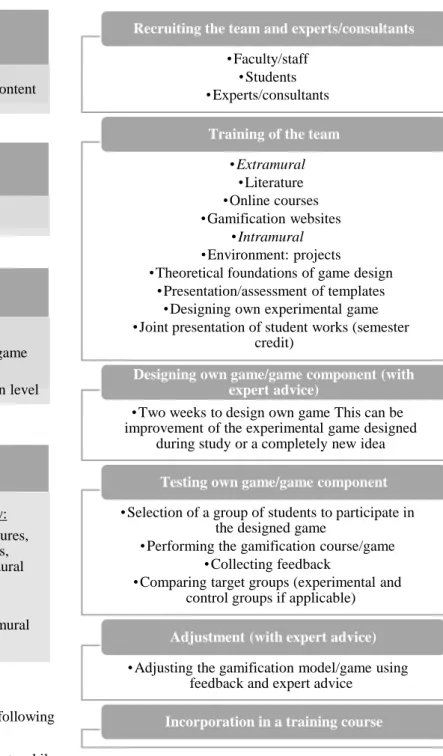
This methodology's algorithm consists of the following stages (Fig. 2):
Recruiting a team including teachers and students while simultaneously engaging outside (possibly inside) experts in game design as consultants.
Mode of study: intramural and extramural. Designing own game.
Testing. Adjustment.
Incorporation in a training course.
Let us further address this algorithm's main stages in detail.
Fig. 2. Gamification methodology algorithm diagram.
III. RECRUITING
A. Recruiting experts/consultants.
The role of experts/consultants can be filled with game design specialists from outside organizations. These can also be faculty of the institution that intends to implement this methodology who have experience in game design and completed relevant courses in gamification.
B. Recruiting the team.
Teachers can be selected according to preferred characteristics (Fig. 3): Methodical component Training aids: Information and telecommunication technologies Online educational resources Conventional instruction materials Modes of study: In-class work (lectures,
practical classes, intramural/extramural consultations) Teamwork Independent extramural teamwork Target component Goal:
Training staff in using gamification tools
Objectives: Developing basic game
design skills Increasing motivation level
Outside factors
Competitiveness FGOS
Conceptual framework
Rule of teacher-student
collaboration Rule of vessel and content
•Faculty/staff •Students •Experts/consultants
Recruiting the team and experts/consultants
•Extramural •Literature •Online courses •Gamification websites •Intramural •Environment: projects
•Theoretical foundations of game design •Presentation/assessment of templates
•Designing own experimental game •Joint presentation of student works (semester
credit)
Training of the team
•Two weeks to design own game This can be improvement of the experimental game designed
during study or a completely new idea
Designing own game/game component (with expert advice)
•Selection of a group of students to participate in the designed game
•Performing the gamification course/game •Collecting feedback
•Comparing target groups (experimental and control groups if applicable)
Testing own game/game component
•Adjusting the gamification model/game using feedback and expert advice
Adjustment (with expert advice)
‒ open mind;
‒ ability and willingness to work together with students; ‒ teamwork skills;
‒ flexibility;
‒ good knowledge of subject (discipline).
Fig. 3. Faculty/staff.
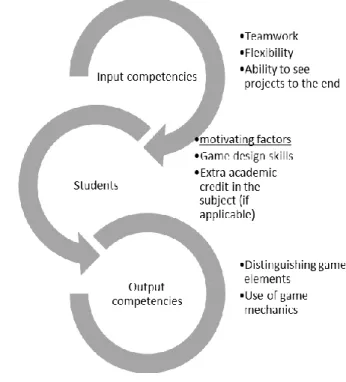
The influence of motivating factors such as monetary incentives, the need to comply to FGOS, and following pedagogical theory will help to shape teachers' output competencies: distinguishing game elements and applying game mechanics in own subject, which in its turn leads to achieving the goal – training personnel capable of using gamification tools [5].
Students can be selected according to preferred criteria: ‒ interest in game design;
‒ interest in particular subject;
‒ willingness to work in a team with a teacher.
Like teachers, students are also subject to certain requirements that are expressed as input competencies such as teamwork, flexibility, responsibility (ability to see a matter to its end). Motivating factors such as extra academic credit in a particular subject and development of game design skills will facilitate students' output competencies: distinguishing game elements and use of game mechanics (Fig. 4).
Fig. 4. Students: input and output competencies.
IV. TRAINING
Training according to the proposed methodology includes two units of intramural and extramural work.
During extramural study its participants familiarize with literature on the subject [6], complete online courses in gamification and browse websites offering examples of it. That is, before intramural training seminars the involved students and teachers are provided with a list of supplementary materials to study, links to additional online courses and other special resources. Given below is the list of supplementary literature:
Rules of Play: Game Design Fundamentals; Katie Salen, Eric Zimmerman.
The Art of Game Design: A Book of Lenses; Jesse Schell.
Level Up!: The Guide to Great Video Game Design; Scott Rogers.
A Theory of Fun for Game Design; Raph Koster. Game Design Workshop: A Playcentric Approach to
Creating Innovative Games, 2nd edition; Tracy Fullerton.
Following is the list of useful online resources and training courses:
Gamification course by Kevin Werbach: https://www.coursera.org/learn/gamification.
Mobile game websites: www.toucharcade.com; www.pocketgamer.co.uk; www.slidetoplay.com.
Websites with good news about games: a) www.ign.com – news, articles and reviews;
b) www.polygon.com – articles about games and game developers;
c) www.gamespot.com – a well-designed American website with a lot of news;
d) www.gametrailers.com – a collection of trailers; e) www.indiegames.com – a website with a lot of information about "indie" games.
f) websites of American game magazines: www.edge-online.com; www.escapistmagazine.com.
g) websites for game developers: www.gamasutra.com; www.gamedev.net; www.gamecareerguide.com; www.gamesauce.org/news.
Intramural training is the foundation of this gamification methodology. It represents a course that includes:
Introduction into game design: addressing particular game mechanics and elements of game theory.
Studying game forms and examples.
Practice: designing an experimental game in own discipline;
The concept of after-action review (AAR). Training in carrying out AAR after game.
Graduation work – fully designed and tested game. Training groups are organized in project teams that necessarily include a teacher and a student or several students, usually up to five persons.
A. Theoretical foundations of game design.
This unit includes introducing the notion of a game and studying its elements. The classification used in this methodology is based on the book "Game design workshop: a play centric approach to creating innovative games" by Tracy Fullerton and Kevin Werbach's gamification course [7]. B. Presentation of templates and examples of games.
This unit studies existing games and gamified platforms. The main objective here is to identify game elements and basic mechanics, and to analyze how this parts interact [8].
In doing this, sets of cards are handed out containing elements of games: plots, mechanics, rules, etc. Participants enlarge their collections as they study different games.
To create game templates, it is necessary to understand the structural components of any game that determine its functioning. Kevin Werbach suggests to consider all elements that a game consists of using a relative pyramid consisting of three layers. In this pyramid, Dynamics is at the top layer, Mechanics is at the middle, and Components is at the bottom (Fig.5).
Fig.5. Pyramid of game elements by Kevin Werbach.
It should be noted that a game is not limited only to these elements, and the pyramid is surrounded by the experience and impressions from the game. The "Dynamics" layer contains high-layer conceptual elements of a game that represent its "grammar", its concealed structure that produces impressions, makes the experience coherent, successive and harmonious. This layer includes:
Constraints. Each game has is constraints, because a game should offer significant choices and problems, thus limiting the players’ freedom.
Emotions. A game has its spectrum of emotions. However, there still remain enough emotional leverages that can enrich the experience and/or impressions:
Chronology (narrative) – the structure that unifies parts of a game into an integrated whole.
Progression – a crucial element of gamification is a player’s feeling of having the opportunity to improve and grow above the starting level.
Relationships – general relations between people. The "Mechanics" layer represents the actions that facilitate a game's activities, which includes:
Challenge – the goals of a game that players strive to achieve.
Chance – elements of luck and generation of random numbers and parameters.
Competition. Cooperation.
Feedback – the ability to see how a player is progressing in real time.
Obtaining resources – this is the process when players are given or collect the resources that further the game. Rewards.
Transactions – buying, selling, or exchanging something.
Components Mechanics Dynamics
Turns (sequence of players taking turns). Win state.
The "Components" layer represents the implementation of a game's dynamics and mechanics, and includes the following sections: Achievements. Avatars. Collections. Content unblocking. Gifting. Leaderboards. Levels. Points. Quests. Social graph. Teams.
Virtual goods, etc.
The pyramid of the game components implies that higher-level concepts should be supported and disclosed by one or several lower-level elements.
C. Review of the game template "Tesla BOOM". The game's description is as follows:
The game is aimed at the knowledge and understanding of the physical laws, as well as experimentation. The game is played by 4 teams.
The players' goal is to assemble a machine (at least 50% of its parts). There is a playing field and a deck of cards (108 pieces) of three kinds: "experimentation" cards, cards with entry questions, and cards with the "main" questions. Before the game starts, each team draws two experimentation cards. During the game, when a team arrives at a square that contains the instruction to "perform an experiment", they conduct one of these two experiments.
Teams take turns. A team makes a move one square ahead, draws a card that corresponds to the square, and answers the question (or performs an experiment). One minute is given to a team to prepare and give an answer. If a team answers a question, it receives a part of the
machine and proceeds to the next square.
If it doesn’t, it proceeds to the next square without a part. If the answer is correct, together with the part the team receives "money" in the amount indicated in the card. The team can use this "money" to buy a question which another team failed to answer. In case when several teams want to buy the same question, an auction is held.
A team can also use their "money" to buy a hint to their question. The price of the hint is indicated in the card. The first question is highly difficult. The team that
answers it receives three parts and is "teleported" to the main game. If a team does not answer the first question, it does not receive a part and moves on to the second square with entry questions.
After getting into the main game, players make progress in the following way: a team gets to the first "teleport" and carries out the first experiment that was described in the cards taken at the beginning of the game. They can teleport to the next circle only after coming to the "teleport" for the second time, which means that before getting to the inner circle, a team must complete the outer circle. Only after coming back to the second "teleport" after completing the inner circle, a team finishes the game.
The winning team is the one that collects more parts than the other teams, but no less than 50%. If none of the teams have collected more than a half of the machine’s parts, there are no winners.
According to the Pyramid of Game Elements by Kevin Werbach, a game contains the following elements:
Dynamics: a) constraints; b) chronology (narrative); c) progression; Mechanics: a) challenge; b) competition; c) cooperation; d) obtaining resources; e) feedback; f) rewards; g) transactions; h) turns; i) win state; Components: a) achievements; b) collections; c) levels; d) teams;
e) virtual goods, etc.
Competencies developed by the "Tesla BOOM" game: Data processing and analysis.
Ability to combine and apply multidisciplinary tools to carry out a task.
Ability to turn information into knowledge, use and share the knowledge gained.
Ability to make decisions when data is incomplete. Ability to make decisions under stress and limited time
control.
Ability to build logical connections.
Understanding of the assigned task when time is limited. Teamwork.
Ability to defend one's point of view, build one's case. Ability to use fundamental laws of physics to the extent
enough to independently combine and generate actual ideas.
Ability for creative self-expression.
Ability to independently carry out experimental and theoretical research to achieve scientific goals.
Ability to identify, collect, and synthesize factual evidence and make justified conclusions.
Ability to correctly apply specific skills and knowledge to analyze a situation.
In terms of such analysis, workshop participants identify specific components in the context of a particular game. Then, they are given a task to think about their own experimental game.
D. Experimental game design tutorial.
Using the experience of identifying game mechanics in existing games and gamified platforms, participants are offered to apply these mechanics to the subject matter of their disciplines [9].
E. Joint presentation of student works
This unit consists of two stages: in the first one participants try their games on other groups and in the second one they present their game designs: which elements and mechanics they used.
This approach allows to gain synergistic effect, a common field of game mechanics, and the opportunity to learn to use them better from other participants.
V. DESIGNING OWN GAME/GAMIFICATION MODEL
This stage of the methodology is devoted to designing participants' own games or game components. Approximately two weeks are given for this; the specific term is determined from the particular capabilities of participants and the institution implementing the methodology [10, 11].
Teams can also use an updated variant of their experimental game during this stage.
After the design phase, teams test and evaluate their game/game component and collect feedback from their game's participants. This feedback is then used in the following adjustment phase together with consultants [12]. This results in game components that are ready to be incorporated in the
process of education. In future, carrying out this stage will require administrative leverage. But this issue is outside of this paper's scope.
VI. EQUIPMENT AND FACILITIES
The basic requirements to organization and pedagogy necessary to implement this methodology have been identified. The main components and requirements to an educational medium are:
Spatial semantic component:
a) the organization of architecture and aesthetics of the living space does not imply specific requirements to interior architecture and design. Requirements to spatial structure of learning spaces: comfortable soft chairs with backrests, possibility of transforming the space if necessary ( Fig. 6), and a recreation room suitable for organizing coffee breaks. The need for flexible transformation of the learning space is caused by the need to carry out mobile activities in the course of study and while piloting new game components;
Fig.6. Requirements to spatial structure of learning spaces.
b) symbolic space implies the presence of the insignia of the company hosting the event, as well as of its partners;
Communication and organization component:
c) features of the subjects of the education medium assume the collaboration of faculty and students, their aim to learn from each other;
d) communication implies the interaction between the experts and the participants in the form of a game, lecture, or a free discussion;
e) requirements to organization suggest an initiative team from the responsible college department or another organization that is implementing a gamification course for its
students. Such team can act both as experts and as participants, depending on the level of their qualification.
Required facilities:
Room for 30 persons that can be easily modified: easily mobile desks and chairs.
Projector/electronic screen. Internet access (wi-fi hotspot). Stationery for every participant.
Computer if possible (use of personal equipment is expected).
VII. TEST RESULTS ANALYSIS AND EVALUATION OF THE EFFICIENCY OF GAMIFYING ACADEMIC DISCIPLINES
The game components designed in the course of implementing gamification in academic disciplines were tested within the framework of the disciplines of the EEE program in TPU. The total of 8 game components was tested in various disciplines: further mathematics, physics, linear algebra, management, etc. The test runs were aimed at obtaining qualitative and quantitative assessment of the influence of gamification on the process of education.
A. Quantitative outcomes of using game components in further mathematics.
Due to the complexity of determining the influence of the tested game components, it was decided to use the students' final result, i.e. the groups academic performance in the particular discipline, as the main criterion. This way, quantitative assessment is based on estimating and comparing grade point averages of students in the experimental and control groups according to their semester finals.
Quantitative outcomes were identified in four experimental and control groups. Each group consisted of 14 to 36 persons. Testing the game components and studying the results of finals produced by game participants and students who did not take part in the games yielded the following results. Below (Table I) shows students' grade point averages in their finals in corresponding disciplines.
Proceeding from the data (Table I), the conclusion can be made about the positive efficiency of introducing educational modules in game formats and gamification of academic disciplines, as well as that of their further incorporation in the process of education. Such efficiency is manifested in the increase of the experimental group's GPA in contrast to the control group.
Twenty-five students took part in the game component of "Jumanji Koshi" (discipline "Mathematical Analysis"). Their average result of the exam in this discipline was 4.41 points (traditional rating system) or 85 points (scoring system). In turn, the average result of 16 students of the control group was 4.16 points and 76.3 points according to the traditional and scoring system. Thus, the difference in results is significant: 0.25 and 8.7 points. Difference in results indicates the effectiveness of this gaming component for improving learning achievement.
TABLE I. Grade point averages of experimental and control groups
Discipline Game partici-pants' GPA (five-mark sys.) Game partici-pants' GPA (100 credits max.) Non- partici-pants' GPA (five-mark sys.) Non- parti-cipants' GPA (100 credits max.) Mathematical analysis (Jumanji Koshi) 4.41 85 4.16 76.3 Mathematical analysis (Mathemati-cal auction) 4.1 74 4.0 73.2 Linear algebra and analytic geometry (Line-up) 4.52 86.9 3.92 76 Physics (Expedition) 4.5 85 4.1 75.1
Thirty-six students took part in the game component of "Mathematical auction" (discipline "Mathematical Analysis"). Their average result of the exam in this discipline was 4.1 points (traditional rating system) or 74 points (scoring system). In turn, the average result of 13 students of the control group was 4.0 points and 73.2 points according to the traditional and scoring system. Thus, the difference in results is 0.1 and 0.8 points, which indicates the effectiveness of this gaming component for improving learning achievement.
Fourteen students took part in the game component of "Line-up" (discipline "Linear algebra and analytic geometry"). Their average result of the exam in this discipline was 4.52 points (traditional rating system) or 86.9 points (scoring system). The average result of 12 students of the control group was 3.92 points and 76.0 points according to the traditional and scoring system. The difference in results is 0.25 and 8.7 points. This implies the effectiveness of this gaming component for improving learning achievement.
Eight students took part in the game component of "Expedition" (discipline " Physics "). Their average result of the exam in this discipline was 4.5 points (traditional rating system) or 85 points (scoring system). In turn, the average result of 12 students of the control group was 4.1 points and 75.1 points according to the traditional and scoring system. Thus, the difference in results is significant: 0.4 and 8.9 points. Difference in results indicates the effectiveness of this gaming component for improving learning achievement.
Overall, the implementation of educational modules of the game format and gaming in the framework of academic disciplines is an effective method. The effectiveness of the method is expressed quantitatively in an increase of the average score of the performance of experimental group in comparison with the control group.
B. Qualitative outcomes of using game components in further mathematics.
Aside from the quantitative outcomes of implementing the proposed methodology, the research carried out during the test runs included questionnaires to identify the qualitative effect of gamification. By qualitative evaluation we mean the attitude of the participants towards having classes in the format of a game and to gamification as a whole. Provided below are the results of introducing game components in corresponding disciplines.
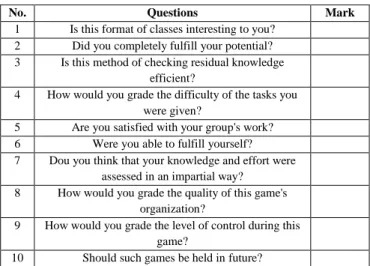
Game components were implemented in lectures and seminars. Students split into teams of 5-8 persons. After the games, the participants were given questionnaires (Table II). They were offered to evaluate on a scale from one to five such parameters as relevance and captivation of the game, the opportunity to fulfill one's potential, and the overall quality of organization [13].
TABLE II. Questions for the "Mathematical auction" game
No. Questions Mark
1 Is this format of classes interesting to you? 2 Did you completely fulfill your potential? 3 Is this method of checking residual knowledge
efficient?
4 How would you grade the difficulty of the tasks you were given?
5 Are you satisfied with your group's work? 6 Were you able to fulfill yourself? 7 Dou you think that your knowledge and effort were
assessed in an impartial way? 8 How would you grade the quality of this game's
organization?
9 How would you grade the level of control during this game?
10 Should such games be held in future?
In the end, the average participant grades were calculated for each question and a bar chart was built basing on the data obtained (Fig. 7), where the horizontal axis shows the number of the question and the vertical one indicates the average grade from students.
Fig.7. Participants' grades.
As the result of the poll it was determined that all students would advise others to take part in classes like this. Judging by their grades, most students are interested in obtaining new information according to the topic of the class and having academic events in such format, and they consider them practical.
Summarizing the outcomes, it can be said that the participants' interest in studying academic disciplines increased after holding classes in the format of a game. Enthusiasm was evident in the game's participants towards further taking part in such events. The quantitative indicators also show the feasibility of using game formats, since it turned out that the experimental groups' academic performance surpassed that of the control groups.
VIII. CONCLUSIONS
In conclusion it can be said that the total of eight game components were designed and tested, and testing results were used to adjust them. Guidelines were designed on how to carry them out in order to enable further use. The results of tests shown the relevance and efficiency of applying the proposed methodology in increasing students' performance.
Holding gamified educational courses is a good way of observing their participants' behavior and tracking the improvement of their competencies.
In the current moment, students lack the capability to efficiently fulfill their knowledge and skills in practice, which is a necessary quality in specialists in the modern competitive environment, and would facilitate the reduction of the period of adaptation during employment [14, 15]. A game, in its turn, produces the effect of a real-life situation, which encourages players to exhibit their knowledge in practice. Such effect produces the impression of the training environment becoming secondary and gives the playing students more freedom to express and use their skills and knowledge. As a result, students receive the opportunity to use the effectively, which, in the long run, decreases the aforementioned adaptation term at work.
ACKNOWLEDGMENT
The research is carried out at Tomsk Polytechnic University within the framework of Tomsk Polytechnic University Competitiveness Enhancement Program, Tempus Project.
REFERENCES
[1] Dichev, C., Dicheva, D.: Gamifying education: What is known, what is believed and what remains uncertain: a critical review. In: International Journal of Educational Technology in Higher Education. DOI: 10.1186/s41239-017-0042-5 (2017)
[2] Zamyatina, O.M., Mozgaleva, P.I., Gulyaeva, K.V.: Elite engineering education programme development based on CDIO standarts. In: Proceedings of 2014 International Conference on Interactive Collaborative Learning, ICL 2014, pp.919-923 (2015)
[3] Popova Yu . V ., O. G. Smolyaninova// Inês Vieira, Cláudia Urbano, Maria do Carmo da Silva Vieira, Luis Baptista (orgs.): Models of the assessment of multicultural competence within the framework of the project TEMPUS ALLMEET. In: Intercultural dialogue: learning, speaking and sharing: Proceedings of the international seminar and study visit in Lisbon ALLMEET ' 15.-Lisbon: CICS. NOVA, pp. 10-14. -ISBN: 978-989-20-6898-5 (2015)
[4] Caponetto, I., Earp, J., Ott, M.: Gamification and education: A literature review. In: Proceedings of the European Conference on Games-based Learning, 1, pp. 50-57 (2014)
[5] Christy, K.R., Fox, J.: Leaderboards in a virtual classroom: A test of stereotype threat and social comparison explanations for women's math performance. In: Computers and Education, 78, pp. 66-77 (2014) [6] De Sousa Borges, S., Durelli, V.H.S., Reis, H.M., Isotani, S.: A systematic
mapping on gamification applied to education. In: Proceedings of the ACM Symposium on Applied Computing, pp. 216-222 (2014) [7] Hamari, J., Keronen, L.: Why do people play games? A meta-analysis.
International Journal of Information Management 37(3), pp. 125-141 (2017)
[8] Faiella, F., Ricciardi, M.: Gamification and learning: A review of issues and research. In: Journal of E-Learning and Knowledge Society, 11 (3), pp. 13-21 (2015)
[9] Dichev, C., Dicheva, D., Angelova, G., Agre, G.: From gamification to gameful design and gameful experience in learning. In: Cybernetics and Information Technologies, 14 (4), pp. 80-100 (2014)
[10] Mozgaleva, P.I., Zamyatina, O.M., Gulyaeva, K.V.: Database design of information system for students' project activity management. In: Proceedings of 2014 International Conference on Interactive Collaborative Learning, ICL 2014, pp. 886-890 (2015)
[11] Dicheva, D., Dichev, C., Agre, G., Angelova, G.: Gamification in education: A systematic mapping study. In: Educational Technology and Society, 18 (3), pp. 75-88 (2015)
[12] Attali, Y., Arieli-Attali, M.: Gamification in assessment: Do points affect test performance? In: Computers and Education, 83, pp. 57-63 (2015) [13] Barata, G., Gama, S., Jorge, J., Gonçalves, D.: Studying student
differentiation in gamified education: A long-term study. In: Computers in Human Behavior, pp. 550-585 (2017)
[14] Auvinen, T., Hakulinen, L., Malmi, L.: Increasing Students' Awareness of Their Behavior in Online Learning Environments with Visualizations and Achievement Badges. In: IEEE Transactions on Learning Technologies, 8 (3), art. no. 7118184, pp. 261-273 (2015)
[15] Alves, G.R.,Restivo, M.T.,da Silva, J.B.: Special issue on engineering education: challenges for innovation. In: European Journal of Engineering Education, pp. 451-458 (2015)