MOVE
Measuring Social Impact
Rodrigo Duarte
Dissertation written under the supervision of Pietro Versari
Dissertation submitted in partial fulfilment of requirements for the
MSc in Management with Specialization in Strategy and
2
Abstract
Title: Measuring Social Impact
Author: Rodrigo Maria Guerreiro Duarte
This dissertation thesis focuses on the case of the nonprofit organization MOVE operating in São Tomé and Príncipe and East Timor. With the goal of fighting poverty through entrepreneurship, innovation and business management, MOVE’s board members aspire to make the best decisions in order to maximize the social value of their activities.
Keeping in mind that the most important question is “Which model is the best to measure MOVE social impact?”, the following managerial case study wishes to identify the main projects of the organization and what strategies can be used to measure their social value. This analysis will offer different tools, allowing board members to overcome challenges regarding qualitative results measurement. Furthermore, in a time where there is visible growth in the social sector, receiving increasing support, this thesis will enable a better understanding of the main challenges and goals in measuring social impact.
Key words MOVE Social Impact Theory of Change Table 1- Key words
3
Resumo
Título: Medição de Impacto Social Autor: Rodrigo Maria Guerreiro Duarte
A seguinte tese foca-se no caso da organização sem fins lucrativos, MOVE que opera em São Tomé e Príncipe e Timor-Leste. Com a missão de combater a pobreza através do empreendedorismo, inovação e gestão de negócios, a direção ambiciona tomar as melhores decisões para maximizar o valor social resultante das suas actividades.
Tendo em consideração a questão mais importante, “qual o melhor modelo para medir o impacto social do MOVE?”, o seguinte estudo pretende identificar os principais projectos da organização e as estratégias que podem ser usadas para medir o valor social dos mesmos. As análises realizadas oferecem diferentes ferramentas, permitindo à direção da organização ultrapassar os desafios de medição de resultados qualitativos. Para além disso, numa época na qual o sector social está a crescer recebendo cada vez mais apoios, esta tese permitirá uma melhor compreensão dos principais desafios e objectivos da medição de impacto social.
Palavras-chave MOVE Impacto Social Teoria de Mudança
4
Acknowledgements
First of all, I would like to thank my mentor, Pietro Versari, for his suggestions, shared knowledge and availability. His guidance and support were crucial to develop this dissertation and to make the most out of the research in support of the MOVE organization.
Secondly, I want to thank all my friends from MOVE, for their important contribution in writing the thesis, for their friendship and especially for teaching me every day to keep a watchful eye and be attentive to others.
Moreover, and from the heart, I would like to give a big thank you to my parents, for their investment in my education and for supporting me in every decision. I couldn’t be more grateful for their presence and love.
Finally, I want to thank God, for giving me the knowledge to write the thesis, for giving me Pietro as mentor, for giving me the opportunity to be part of MOVE, for giving me this family and for the gift of life.
5
Contents
Abstract ... 2 Resumo ... 3 Acknowledgements ... 4 List of Tables ... 7 List of Figures ... 7 1. Introduction ... 8 2. Case Study ... 10 2.1 History ... 11 2.2 MOVE in Portugal ... 12 2.3 Sustainability ... 13 2.4 Mozambique Island ... 142.5 São Tomé and Príncipe ... 14
2.6 East Timor ... 15
2.7 Current projects in São Tomé and Príncipe ... 15
2.8 Current projects in Timor ... 18
2.9 The Future... 20
2.9.1.New field ... 20
3. Literature Review ... 22
3.1 Social Impact ... 22
3.2 Importance of measure Social Impact ... 23
3.3 Challenges of measure Social Impact ... 24
3.4 Theory of Change ... 26
3.5 Stakeholders... 28
3.6 Measuring Social Impact (3 methods) ... 29
6
3.6.2 Comparing social value creation ... 31
3.6.3 Social Impact Analysis ... 32
4. Teaching Notes ... 34
4.1 Introduction ... 34
4.2 Learning objectives ... 34
4.3 Assignment questions ... 34
4.4 Class discussion ... 35
4.5 Guidelines for the instructor ... 35
4.6 Assignment questions ... 35
4.6.1 What is the importance of social measurement having in account characteristics of the organization? ... 35
4.6.2 How the Theory of Change applies to this organization? ... 37
4.6.3 What is the model to measure social impact that best applies to the organization? 39 4.7 Class conclusions ... 41
5. Conclusion ... 42
6. References ... 43
6.1 Case Study references ... 43
6.2 Literature Review Bibliography ... 43
7. Appendices ... 45
7.1 Appendix 1 ... 45
7.1 Appendix 2 ... 45
7.2 Appendix 3 ... 46
7
List of Tables
Table 1- Key words ... 2
Table 2 - Palavras-Chave ... 3
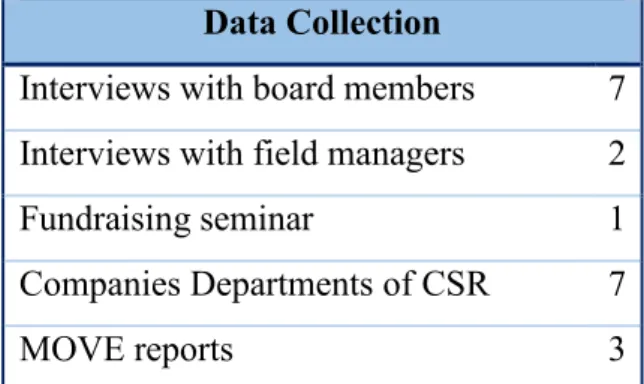
Table 3- Data Collection ... 8
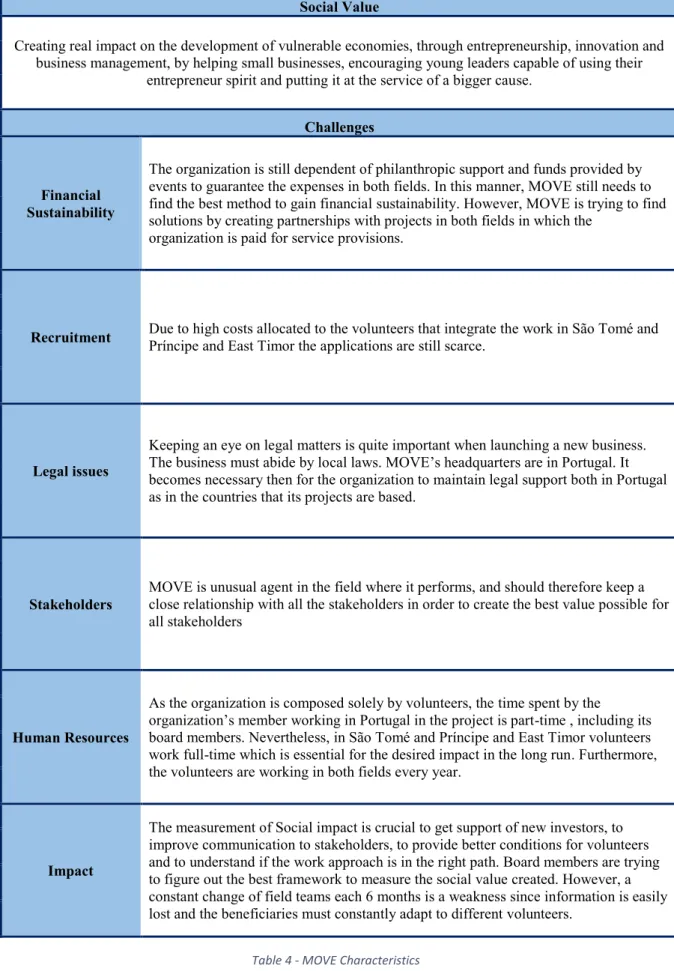
Table 4 - MOVE Characteristics ... 36
Table 5 - Impact Measurement ... 40
List of Figures
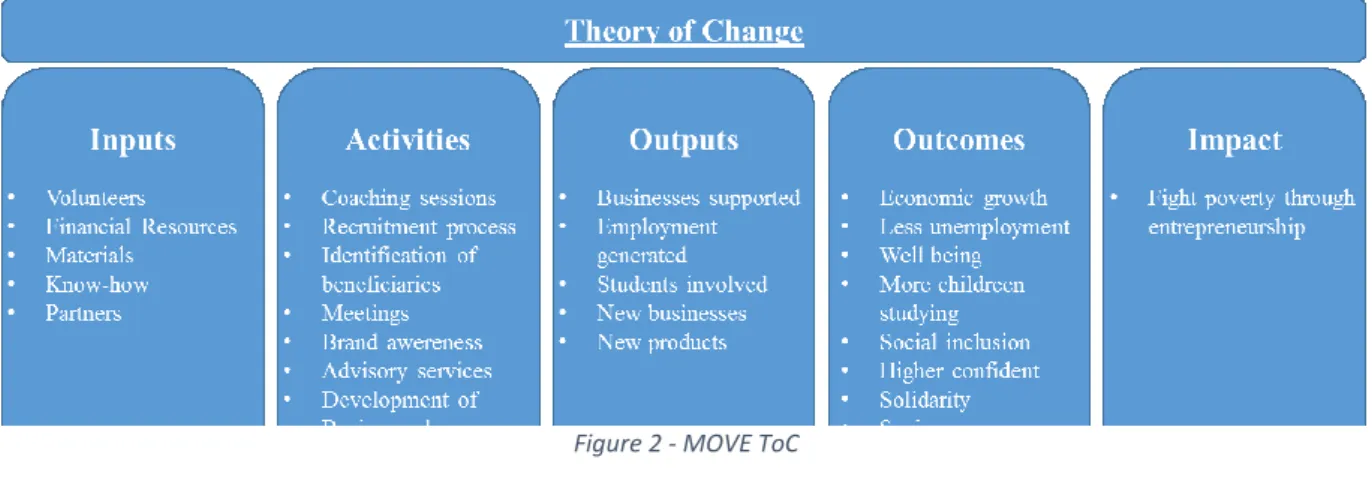
Figure 1- Theory of Change ... 26Figure 2 - MOVE ToC ... 37
8
1. Introduction
This managerial case study addresses the case of MOVE, a nonprofit organization that believes in entrepreneurship as a tool to fight poverty. The case study takes into consideration the impact of MOVE presence, in particular, in São Tomé and Príncipe, and East Timor. This study is also the result of my participation in the activities of MOVE, which I joined in 2014, becoming in 2017 one of its board members, and an active participant in the decision-making process. Measuring social impact is a very important matter that has gained special attention in the last years. Every organization striving to achieve social impact faces the difficulty of reporting the social changes that occur as results of its activities. With this in mind, this dissertation aims to provide a contribution by studying different types of frameworks and understanding which one best applies to MOVE. To do this, the following research question is addressed: “How should
MOVE measure social impact?”
To develop the case study, the contribution of all MOVE’s board members was enlisted, along with MOVE’s Field Managers, main responsible for the activities in São Tomé and Príncipe and East Timor, ensuring that all information was covered. Moreover, the study of the different contexts where the organization is present, helped to reaffirm the importance of how stakeholders should be involved. No less important to the development of this case study, was attending a fundraising seminar, and attending meetings with companies that highlight the importance of providing social impact reports. In the end, the position as a board member of the organization ensured privileged access to data, as well as a deep understanding of the organization’s history and activities.
Data Collection
Interviews with board members 7 Interviews with field managers 2 Fundraising seminar 1 Companies Departments of CSR 7
MOVE reports 3
9
Furthermore, an in depth study of the existing literature provided a better understanding of the meaning of social impact, and the goals and main challenges of measuring it. This was critical in finding different solutions.
The Teaching Notes provide the opportunity for students to reflect and find the model that best applies to MOVE’s case allowing measuring its social impact. The assignment questions have been developed to encourage students to match the case study characteristics with measuring tools explored in the literature review and, together with their managerial knowledge, find an appropriate solution.
Finally, the conclusion summarizes the main findings, and the main critical managerial case study issues to solve. In addition, it also intends on providing directives about the next steps board members should take to start the social impact measurement.
10
2. Case Study
During the last 8 years, between ten and fifteen volunteers, divided by Mozambique Island, São Tomé and Príncipe and East Timor, have been supporting projects, motivating local people to increase their life conditions through entrepreneurship. Each group of volunteers upon returning, shared their experiences and what they achieved with the locals.
The access to education and work opportunities in these three countries are scarce. The level of education is very low, and their culture motivates them to live each day without thinking about the future. Even facing these obstacles, volunteers have been working with proactive local entrepreneurs. These entrepreneurs show leadership skills, innovative business ideas and, above all, a strong desire to learn. The volunteers themselves face a demanding selection process and are chosen for their capabilities, knowledge, technical, and social skills. These skills are crucial to develop the activities.
In beginning of 2017, the board members of the organization, previous volunteers in the field, met to discuss some important issues regarding the activities developed in the context of their project. Their goal was to understand if the activities carried out in each area were creating positive changes in the community. This meeting was motivated by the managers’ concern about the project’s sustainability. They believed that the sustainability of a nonprofit organization could be influenced by the way it communicates its positive results. Moreover, they had noticed that the policy of companies supporting social projects had been changing. Nowadays, companies require more information about the effectiveness of social interventions. In fact, investors demand to clearly understand what they are helping.
Therefore, persuaded to strengthen the communication, managers decided that the route to follow would be to measure their impact.
They believed this measurement would bring great benefits. Investors were the primary concern, however, improvements in communication and brand awareness could result in more exposure to media, increasing the organization’s impact and credibility.
11 2.1 History
MOVE was founded in 2009 when two students from Católica Lisbon School of Business and Economics flew to Mozambique Island to investigate the local conditions and design a project that could help fight poverty. From the very beginning, they knew they wanted to build a project that could help people hone their entrepreneurial skills. With these objectives in mind, they chose microcredit as an approach.
To this end, they identified the main economic activities in the island and met some of its main entrepreneurs. When met with the community’s lack of knowledge, these two students realized that they could have a positive influence if they started working together with the entrepreneurs, teaching them some basic concepts of management and then helping them to apply those concepts to their own businesses. MOVE found its purpose in being business advisors in many different areas.
MOVE began offering consulting services for this community by providing volunteers with knowledge and with the capability to identify problems and to find new and innovative solutions. Partnerships with financial institutions were established to provide microcredits to entrepreneurs. MOVE volunteers focused in receiving applications of local entrepreneurs whose ideas of business were based on local resources. Once an idea was approved, and after building a business plan, MOVE granted them a loan. The idea was not only to provide microcredit, but also to give close support to help the entrepreneurs using the loan on an efficient way according to the business plan. Loans were given to create new businesses or to help growing businesses, stimulating entrepreneurship. These loans varied between 75 euros and 900 euros and were decided according to the business plan. The duration of the loan varied depending on the area of business, usually between 4 to 10 months. The reimbursement of benefits could be made, weekly, twice a month or monthly. The applied interest rate was 5% of the loan’s value.
12
Using these strategies, MOVE found a way to uphold its mission, to fight poverty through entrepreneurship. Through microcredit and consulting services, the project is desired to produce positive changes on the business, family and community.
Business - MOVE focuses essentially on innovative ideas with high ethical standards. MOVE believes that innovation leads to higher success and higher fulfillment of needs. Aiming for transparency in terms of prices charged, MOVE believes that it can bring knowledge and financial return long term.
Family- MOVE supports projects that represent another stable source of income for the family and, at the same time, provide better and more comfortable family environments. Furthermore, the organization intends to fight child labor and the exclusion of women. Community- Finally, MOVE has into account the impact on the community and on the surrounding businesses. MOVE recognizes that it is an unusual agent on the regular functioning of the economy and, for that reason, should understand the general impact that it has on the other agents.
In 2011 MOVE decided to extend activities to two other different countries. São Tomé and Príncipe and East Timor were the selected countries, and from that time, every 6 months, teams composed of 5 members have been developing projects with the same goal. In these two fields, volunteers focus on coaching and micro-consulting, since microcredit proved itself to be inefficient due to low commitment from the locals.
However, in 2016, a sad occurrence caused the end of the projects in Mozambique. Due to political instability in Mozambique and their diplomatic relations with Portugal, it became impossible for volunteers to get a visa for 6 months in the country. The consequence was the end of the intervention in Mozambique Island.
2.2 MOVE in Portugal
MOVE believes that the only way to have further impact is to keep their volunteers in the field supported by a team in Portugal, on a constant basis. This team is composed by 20 volunteers responsible for managing the areas of Marketing and Communications, Fundraising, Finance, Fields and Recruitment.
Marketing and Communication - The Marketing and Communication department is responsible for all campaigns to promote the project. It is responsible for social
13
networking (facebook, Instagram, LinkedIn) and for all campaigns, even those prepared by other departments. Furthermore, the preparation and promotion of events is also their responsibility.
Fundraising -MOVE constantly looks for partnerships with companies to guarantee the sustainability of the project. This department is responsible for meetings with potential investors and supporters, as well as setting up proposals and budgeting.
Finance- The financial manager is responsible for managing MOVE’s cash flow and transferring money between the different fields where MOVE is acting in accordance with its needs. Furthermore, the financial manager writes the financial report each year and they are in charge of communicating and calculating the annual budget for all projects.
Fields Department – Herein lie the volunteers responsible for each field. With previous experience, they keep a close relation with East Timor and São Tomé and Príncipe teams. Their work consists in analyzing the weekly report that is sent by the volunteers and preparing a meeting every week via Skype in which the volunteers share the recent developments.
Recruitment - Finally, the Recruitment Department has the responsibility of recruiting volunteers for MOVE. Students are the main target, and as such, the department is responsible for interacting with universities to promote the project, looking for opportunities in career fairs or by developing presentations. Moreover, MOVE uses a recruitment process composed by interviews and group dynamics. In this department, volunteers are responsible to prepare all recruitment stages and select the volunteers to become part of the team.
2.3 Sustainability
MOVE has an annual budget of 20.000 euros to support both fields, East Timor and São Tomé and Príncipe. To guarantee the sustainability of the project, MOVE receives support from companies’ donations, promoted events, crowdfunding campaigns, application of funds as well as money from services provided from the work developed in East Timor and São Tomé and Príncipe. The money is invested to guarantee the expenses associated with the work in both countries and to cover the rent of the house where the volunteers stay during their six months. In Portugal, the structure costs represent a small percentage of the money. The financial
14
resources are used to cover some activities prepared by the aforementioned departments and to guarantee coaching sessions for the volunteers selected for the program.
2.4 Mozambique Island
Mozambique Island is located in the North of the country in Nampula’s province, and was the first capital of Mozambique. In the 15th and 16th centuries, it was a strategic point for the trade
route from Portugal to India. As a consequence, the Netherlands attempted to occupy this area several times. At the same time, slave-trading for Brazil began in the Island.
Today, the fish in Mozambique Island is well known for its quality, being highly appreciated in cities such as Nampula or Nacala. It is a dynamic market in terms of demand since it is quite easy to sell them, however there are few people who have the capacity to make large investments in it. Moreover, the industry of chickens for fattening is another relevant activity. Even being a culture known for its fish, the chicken industry has higher value, its consumption varying with the consumers’ purchase power. Furthermore, the trade and resale of goods represent highly attractive areas. Locals replicate business models and trust in the apparent success. The low level of innovation is perceptible as well as the inexistence of differentiation.
2.5 São Tomé and Príncipe
São Tomé and Príncipe was discovered by two Portuguese men in the year of 1470-1471. The colonization started at the end of 15th century. At the time, the country was well known for its
great production of sugar, becoming a world leader, and representing an important port for Portuguese due to its strategic location. The strong competition of Brazilian sugar, years later, destroyed São Tomé’s production. However, the introduction of coffee and cocoa at the end of the 18th century and in the beginning of the 19th century respectively, helped them recover from
the socioeconomic crisis. Divided in Roças (farms with private owners) inhabited by Portuguese, São Tomé and Príncipe became a leader in cocoa exportation. The farms’ workers were under slavery conditions which translated in multiple popular uprisings. Later, with the Portuguese revolution of 1974, the country became independent, the owners left Roças and due to lack of knowledge of its farmers, São Tomé and Príncipe lost its world reputation. Today, 66% of the population live below poverty level and 63% is less than 24 years old.
15 2.6 East Timor
Timor is the youngest and one of the poorest countries in Asia. Its main languages are Tetum and Portuguese. In the year of 1512, the first Portuguese arrived to Timor. Encouraged by the natural resources they started the period of colonization. As Timor was also highly coveted by the Netherlands, both countries signed a treatise in 1914, to end a conflict regarding the boundaries that divided the island.
The Second World War, was a difficult time for Timor. The allied forces, the Dutch and the Australians, occupied the territory and had violent confrontations with the Japanese forces in Timorese soil.
Due to the Portuguese Revolution of 1974, Timor became independent. However, right after this proclamation, a civil war began when Indonesia invaded Timor. During 20 years of occupation, even while making big investments in infrastructures, the Timorese suffered multiple massacres. An intervention by the United Nations was fundamental for Timor to become definitively independent in 2002.
Today Timor is a country very dependent on imports. However, due to its proximity to the United Nations and to countries such as Australia, New Zealand and Indonesia, huge companies and nonprofit organizations with great financial power are investing in Timor.
2.7 Current projects in São Tomé and Príncipe
Elagric
Wally is the manager of the firm Elagric and he is one of the biggest experts in the manufacturing sector in São Tomé and Príncipe, using local resources such as coconuts, bananas, peanuts and cocoa. His production facility is nationally recognized by the quality of its products, flavor, consistency and creativity. The partnership between MOVE and Wally began in 2015. From that time, MOVE has provided a weekly management monitoring to guarantee financial and business growth sustainable for his firm. Furthermore, MOVE supported Wally in winning an international fund to get machinery needed for his production process.
Sex workers
The project in response to the efforts made in São Tomé and Príncipe against HIV epidemic began in June of 2013. The main goals were training and supporting the sex workers and young people with risky behaviors. This project is headed by the NGO Alisei. The beneficiaries
16
received technical training in sewing, in working on a beauty salon, on management coaching in micro businesses. They were provided with materials and financial support to begin the activity. MOVE is supporting the beneficiaries to become entrepreneurs for their professional and social reintegration.
Women´s Association of Vista Alegre
Vista Alegre is a small place in São Tomé and Príncipe in the Mé-Zochi district. It is also the name of a project composed only by women that have as their main activity the manufacturing of local products such as dried bananas in solar dryer, jams and flour. Currently, MOVE supports these women in growing their business market.
StartUp STP
The StartUp STP is the first big incubator of companies in São Tomé and Príncipe. Its main goal is to support the development and implementation of ideas that add value to the country. It does so by providing business education, and guidance on the business ideas of the selected entrepreneurs. MOVE launched the project in 2015 together with the Association of Entrepreneurs of São Tomé and Príncipe. MOVE is responsible for the incubator operationalization by selecting companies and ideas to integrate the project. It then supports and coaches the ideas’ development. High school Entrepreneurship Club
The project consists of an extracurricular activity to develop competences in the entrepreneurship matter, providing relevant and useful tools for the students’ future. MOVE´s main goal is to teach in a practical way concepts of management, which allow them to develop their entrepreneur competences and business ideas.
Qua Tela
Qua Tela is an NGO created to support local manufacturers. The main support given was the creation of the store Qua Tela as a delivery point, where the local manufacturers are allowed to sell their products. The results are significant and the partnership between MOVE and Qua Tela
17
began in 2013. Volunteers are responsible for the monitoring of the businesses and for the financial management, logistic and commercial of the store.
Salutar
Beginning with a project financed by the European Union and managed by two big NGOs in São Tomé and Príncipe, Marapa and Alisei, the reconstruction of the touristic complex Jalé Ecolodge was possible. It is composed by three bungalows, a catering facility and small structure for turtle protection. MOVE was approached in 2014 to support Nei, a Cape Verdean man, on the restaurant management. Currently, after the creation of the business plan together with Nei, MOVE has a strategic advisor role.
Firma Efraim
Firm Efraim was created in 2002 and represents the first autonomous private initiative of coffee production. The firm is managed by the entrepreneur Catoninho and has revealed itself to be an enterprise with ambition and with a good reputation within the community. From 2002 the project has grown with a sustainable development and is focused on four business segments, coffee and cocoa production, catering and recently opened a small guesthouse. MOVE is working since 2013 as an important strategic advisor of the company, in diversifying the business areas and on the financial control.
Glassware handicrafts
This project aims to promote in São Tomé and Príncipe a culture of reutilization of residues by converting recycled glass into handicrafts and costume jewellery. The first stage began with a training session for two people in Ghana where a MOVE volunteer was present. The session consisted in sharing knowledge about
important techniques. Currently, three craftsmen are responsible for the production and assembly of parts. With Santa Casa da Misericórdia and Cooperação Portuguesa as partners, MOVE is responsible for the operative management, the support of its sustainability and its business growth.
18
Hi! Lab
Hi!-Lab is a social project developed together with prisoners. The aim of the project is to provide coaching sessions to stimulate the commercialization and marketing of products. The main goal is to improve life conditions through entrepreneurship and promoting the social reintegration and personal development.
Snorkeling São Tomé and Príncipe
The Snorkeling firm was created in 2017 by Kener Roldão, a local entrepreneur. Due to the business being in its early stages, it requested MOVE support to guarantee financial sustainability, as well as the definition of business strategies and consequent implementation. The project has high potential since it provides a service very sought after by tourists and which is in limited supply.
Bô Energia
The project Bô Energia arose from the need to answer to environmental problems in São Tomé and Príncipe. Around 1 billion of people uses wood and coal every day to cook, which originates the loss of 3% of the world forests each year. At the same time, sawdust was identified as one of the most produced residues in São Tomé and Príncipe. Consequently, the great waste of sawdust become useful for the construction of briquette from biomass as an alternative to the coal. The project aims to raise awareness and enable the local population to use renewables energies. MOVE is working to make the business of sawdust safe, profitable and positive for São Tomé and Príncipe’s community.
2.8 Current projects in Timor
Empresa Diak
Empresa Diak is a nonprofit organization whose goal is support the sustainability and profitability of micro businesses to generate a positive social impact in the community, fighting poverty. The organization intends to teach local communities in developing their ideas and
19
creating a new source of income. MOVE has been supporting Diak since 2014 with consulting services. Furthermore, MOVE volunteers are responsible for the development of business plans, and for the logistics and commercialization of the products. The main products launched are coconuts, ducks, organic compound and algae.
National Center of employement and vocational training
The connection between MOVE and this institution started in 2012, in the early years of MOVE in Timor. The volunteers have been developing programs of financial records for the students, classes of Mathematic and good work policies. Today, MOVE is also involved in the program Micro-Enterprise Development Incubator inside the national center.
National Universiy of Timor-Lorosae
From 2011 MOVE is working together with the National University of Timor-Lorosae teaching the Management and Entrepreneurship Model. Today, the volunteers are responsible for two models, the initiate one and the advanced one. Both courses are part of the study program of the degree of Economics and Management of the University. Volunteers believe that these students are the future of the country. According to this assumption, a great importance in developing entrepreneurial mindsets is revealed.
Entrepreneurship Club
Recently, through the application of a fund provided by the Portuguese Cooperation, MOVE was able to build a project supported by a partnership with the University of Timor-Lorosae. The aim of the club is to provide universities the chance to understand, in practice, the process of implementing a real business. The goal of the club is to become an incubator of new business ideas and, at the same time, to prepare the students for the world of business by making them have contact with successful local entrepreneurs. The goal is to transform the club into national reference in launching innovative ideas.
Figos Sol Nascente
Supported by the Institution of Business Development, Mr. Hugo built their own project of figs production and other products with added value such as teas, dried figs, spices and jams. His efforts and dedication to learn were key references for MOVE to start developing a partnership with Mr. Hugo. The aim was to provide guidance in business strategies, promoting his products and finding new market opportunities. Today, Mr. Hugo, due to his business growth, has the
20
possibility to provide internships and coaching sessions. MOVE complements their support by offering training to young employees to develop their financial and logistics knowledge. Boneca de Atauro
With headquartes in Atauro Island, Dolly cooperative was born in 2007 and is composed today of 42 women. These women desired to create an area where they could guarantee financial independency. Having employees in all age categories, the oldest ones bring experience and patience while the youngest bring will, happiness and hope for the future. By producing educational games, rag dolls and wallets with a singular design, the activity directly affects around 200 women. Recently, the project opened a store in Dili. MOVE provides advise and training. So far, the work of the volunteers has consisted in analyzing the production costs, the digitalization of accounting systems and coaching in financial tools.
OTAS Magazine
The development of the magazines OTAS was started by a group of friends which detected the need to build a project where they could share information about art, culture and tourism in East Timor. With great creativity and dedication, the entrepreneurs still needed some advice in terms of financial sustainability. MOVE is supporting the group in creating a sustainable business and consequently contributing to spread culture through the Timorese population.
2.9 The Future
2.9.1 New field
After the Mozambique loss, MOVE’s structure has been discussing the possibility to start activities in Portugal, motivated by the will to have
an impact in its home country. In August of 2017, two volunteers flew to Azores, São Miguel Island, to study the possibility to design and create new projects on that region. A deep study of the main economic activities in the island was made. Moreover, by identifying different areas in need and social problems through the communication with local institutions and projects, it became possible to build partnerships with public entities, companies,
21
and social projects. Consequently, three projects were designed and will be launched in January 2018 with the first team. Volunteers will face an environment where 27% of the population between 18 and 24 years old leaves the school on the minimum level of education required by law, and where the population is one of the most dependent from state support in Portugal.
22
3. Literature Review
“(…) growth in the number of organizations and faith in the good intentions of everyone involved are not enough. Organizations need to develop the ability to know whether they’re making a difference and to know how to invest wisely so that they can do better over time”.
(Epstein & Yuthas, 2014)
Social impact is a concern that all corporations for profit and nonprofit are trying to measure while making their investments. These investments can be represented in many ways, namely, “time, expertise, material assets, network connections, reputation and other valuable
resources” (Epstein & Yuthas, 2014). Most of the time, board directors are not concerned with
improving efficiency in their organizations’ impact at the same level that they expect to have accurately predicted financial returns of investments to present to shareholders. (Ligane & Olsen, 2004).
Even so, it has been proven why measuring social impact represents such a valuable report for corporations. In the year of 2013 J.P. Morgan launched an article named “Perspectives on
Progress: The Impact Investor Survey” in which it was stated that more than 80% of investors
consider relevant impact measures for fundraising. (J.P.Morgan, 2013)
However, it has been proven that corporations face innumerable challenges in measuring their impact. For example, according to Inter-American Development Bank, “fewer than one-sixth
of its active projects had collected data on beneficiaries, and that only 3 percent had data on impacts on nonparticipants.” (Center for Global Development, 2006)
Practically speaking, however, what do authors and experts say about what social impact is, why is it important to measure it and what challenges do corporations face when measuring it?
3.1 Social Impact
“Social impacts are the societal and environmental changes created by activities and
investments. Societal impacts include such issues as equality, livelihoods, health, nutrition, poverty, security, and justice. Environmental impacts include such issues as conservation, energy use, waste, environmental health, resource depletion, and climate change.” (Epstein &
23
The measurement of social impact remains a monumental issue for all types of organizations and entities (Weber & Kroeger, 2014). It explains the influence of activities developed by a specific group of individuals by maintaining control of its outcomes (Potter, 2012)
Nonetheless, within nonprofit organizations, the challenge to understand the effectiveness of their actions is especially important. These organizations aim to fight social problems and to understand their performance while comparing them to similar activities. (Lingane & Olsen, 2004). Following this train of thought, nonprofits intend to clarify the social value they are creating, by measuring how much the beneficiaries are improving their well-being through its social actions. (Martin & Osberg, 2007)
Thus, if organizations desires to improve individuals’ life conditions, they put in an effort to reduce the difference between their goals and the current social situation as much as possible (Hannan & Freeman, 1977). Some investigators point out “innovativeness, proactiveness, risk
management” as an important criteria to identify the social value created (Bagnoli & Megali,
2011).
Social Impact Assessment (SIA) is a tool used by organizations to clarify and measure these changes. Vanclay says that SIA is like an “umbrella” that contemplates all the influences that all the changes have on people (Vanclay, 2003). Furthermore, SIA also covers the analysis and management of those “intended or unintended consequences” (Vanclay, 2003).
3.2 Importance of measure Social Impact
This new demand follows a variety of aspects that have been seen to be most effective for organizations.
In fact, measuring social value can bring benefits, such as:
Accounting for results that happened via external support, justifying the value that that support had on the community or environment. Consequently, organizations will gain more credibility. Furthermore, it can help in obtaining new partnerships because organizations can justify why they need it, predicting possible outcomes.
Organizations will also increase their credibility to request a funding round or another type of support. With a proven track record, organizations can justify the role of the investor. These investors will understand effectively what they are contributing for and it will be easier to trust in the organization.
24
Social impact will also facilitate organizations’ perception of which areas should receive more investment, allocating efforts in a more effective way.
Organizations will increase their capability to communicate impact and value. (Eurodiaconia, 2012)
Moreover, according to European Venture Philanthropy Association, “Social Impact
measurement is a fundamental part of the work of each social investor as you need to measure the impact you are generating to better use your resources” (EVPA, 2016), representing the
only method to understand if organizations are investing their resources in a focused direction in order to have the effectiveness they intend (Epstein & Yuthas, 2014).
In addition, “Social impact measurement complements an existing strategy based on personal
contacts and networking that aims at getting the attention of resource holders” (Arvidson &
Lyon, 2013). In this manner, one of the biggest key factors for organizations is to understand the investors and align strategies with them to have a better and bigger impact. By measuring and presenting the social value as a result of the investor’s role, organizations become more likely to keep their support and consequently to increase resources and tools to produce better outcomes. Additionally, by designing a method to measure the social impact, there is always the possibility to improve it and to avoid, as much as possible, negative impacts that could be bypassed. Janine highlights that “(…) we must also evaluate, study and learn from the work we
are doing in social impact so that we know what works and what doesn’t work, what is cost effective and what isn’t. Without measurement and study there is no learning and without learning there is no forward progress other than what might occur accidentally”. (Schooley,
2014)
3.3 Challenges of measure Social Impact
“One common problem is defining success in terms of what the organization produces rather than the impacts that result” (Epstein & Yuthas, 2014)
Measuring social impact does not represent an easy task for any organization. It requires many resources that usually organizations are not willing to spend even though, as seen before, it represents such an important tool. Furthermore, different stakeholders have their own
25
perspective of how to measure different projects (Kendall & Knapp, 2000) which requires a more careful analysis. (Arvidson & Lyon, 2013)
A study made by Idealware in 2012 named “The State of Nonprofit Data” concludes that “only
half of the nonprofit executives in a survey said that their organizations were collecting data on client’s outcomes” (Idealware, 2012). In addition, “70 percent of grant markets agreed that foundations lacked the data they need to effectively assess their performance” (Preston, 2010)
and one-fifth is the ratio of organizations that have professionals working on evaluating the impact of their activities (Wallace, 2012).
Many organizations do not measure their impact and some of them still believe that they can only do it with quantitative results. However, those who measured it found possible improvements to increase positive results of their work. Both Marc J. Epstein and Kristi Yuthas found four reasons explaining why organizations avoid measuring their impact.
Measurements are costly: organizations cannot allocate monetary resources to hire professionals to measure impact due to low budget (Epstein & Yuthas, 2014). Moreover, many organization give up on social measurement because they defend that different areas of intervention require different frameworks of measurement, resulting again in high costs (Nelson, 2012).
Measurements are misleading: social or environment results can be measured with “few simple metrics”, leading to wrong conclusions due to wrong “judgments and
actions” (Epstein & Yuthas, 2014).
Measures are dysfunctional: “people might change their focus to managing the
measures rather than managing the activities.” (Epstein & Yuthas, 2014). In fact,
organizations choose the way they want to measure the impact due to “lack of
consistency or agreement on what counts as good social impact evidence”. (Arvidson
& Lyon, 2013) Consequently, this results in doubt about the credibility of frameworks developed by organizations in which they can build their own structure and present results based on their own interests (Arvidson & Lyon, 2013).
Measurement is difficult: organizations have serious difficulties in realizing what kind of change they made due to their actions. “While projecting and measuring financial
results is commonplace, most organizations find social impact measurement significantly more difficult” (Epstein & Yuthas, 2014).
26 3.4 Theory of Change
To measure social impact there are multiple frameworks developed by specialists describing each step that should be used by organizations. Even being all different frameworks it seems that all have in common the Theory of Change (ToC). ToC represents “The description of a
sequence of events that is expected to lead to a particular desired outcome” (Davies, 2012).
The ToC started being developed in the year of 1960 and combines an approach that can be applied in multiple projects and organizations’ activities in order to understand what are the existing results of different initiatives (Funnell & Rogers, 2011) .The ToC helps us to identify behaviors and actions that will lead to an aspired transformation (Rossi & Freeman, 1985). Furthermore, it is a theory that intends to design what the main goals are and what kind of approach will be used to achieve them. (Bill & Melinda Gates Foundation, 2011). By developing the theory, organizations will be conscious of resources they need to have the desired change ( Kail & Lumley, 2012).
In order to develop the ToC, organizations must define what their inputs, activities, outputs, outcomes and Impact are.
1. Inputs
Stakeholders are key in developing the activities the organization has prepared. To do so, it is important to identify the way in which Stakeholders add value to the project (Nicholls, Lawlor, Neitzert, & Goodspeed, 2012). Inputs are provided by the Stakeholders and can be represented as the investment made by the organization for the project (PHINEO, 2016). The investment is translated into the available resources of the organization, such as materials, financial inputs, culture, human capital or knowledge (Epstein & Yuthas, 2014).
Identifying resources reveals a predominant approach for organizations because, first of all, it helps to demystify what resources are used for the activity and, secondly, it helps to analyze the efficacy of the activities, meaning that it becomes easier to understand what resources are producing what type of efficiency. Which means that, if the inputs are connected to the outputs,
27
outcomes and impacts, it becomes easier to identify what level of inputs are being used effectively (PHINEO, 2016).
Moreover, all the regulations, laws pertaining to the location where the organization is acting and the external and internal factors that can influence the way of work, are also considered inputs. It becomes relevant for the organization to manage the resources together with the restrictions to generate the more probable effect of its actions (Epstein & Yuthas, 2014).
2. Activities and Outputs
Activities are represented by the steps and procedures developed by the organizations in order to create the desired impact. These actions are developed using the inputs the organization has at its disposal (Epstein & Yuthas, 2014). The activities represent the development of products and services created to support the beneficiaries, consequently creating the outputs (PHINEO, 2016). Activities can be organized in different groups, representing each one, the different output and outcomes produced within the same group of activities. Thusly, “activities that lead
to the same outcome(s) may be grouped to capture the level of detail necessary for a particular audience” (Newcomer, Hatry, & Whole, 1999). Outputs are represented by the consequent
results of organization´s activities. These results can be represented as a product or service or even a support on a continuous basis for the beneficiaries (Epstein & Yuthas, 2014). Outputs represent the quantitative results of the actions (Nicholls, Lawlor, Neitzert, & Goodspeed, 2012) and their effectiveness is key in producing outcomes (PHINEO, 2016).
3. Outcomes
Moving from measuring outputs to outcomes is one of the most crucial and usually complex step for organizations. Outcomes represent the positive results of activities and outputs on the beneficiaries (PHINEO, 2016), representing the “intermediate effect”s on the beneficiaries. These effects can be represented as behavior, “attitudes, and skills, or on the condition of
specific social or environmental variables” (Epstein & Yuthas, 2014). For example, an
outcome can represent an improvement in life conditions through an increase in health or financial improvement of a business due to a training session.
4. Impact
Finally, “the impact is the ultimate goal of a social purpose organization, refers to systematic
and fundamental progress on a social issue” (Epstein & Yuthas, 2014). Impact represents the
28
have developed their actions (PHINEO, 2016). An example of impact achieved by an organization is the reduction of poverty in a particular area.
The components of the logical model described represent the different steps the organization must take and have in account in order to achieve the main goal and produce the impact intended. To achieve it, the direct linkage between each step is mandatory (W.K. Kellogg Foundation, 2004).
Another approach is the logframe. This model helps to better ensure the linkage between each step. It suggests a framework similar to the logical model of ToC but proposes first the definition of the ultimate goal and, in the end, the identification of indicators that demonstrate that the outcomes are being met. The framework is composed by the definition of goals, smart objectives, key outputs, Major activities and Indicators (Epstein & Yuthas, 2014).
On the EVPA side, aside from the ToC approach previously defined, it is essential to understand if outcomes are clearly producing the impact the organization desires. Thus, EVPA identified five main points to consider:
“Drop off” - pay attention to the impact the organization has overtime because impact
does not last forever;
“Displacement” - the positive impact in some beneficiaries can bring negative effects on other players;
“Deadweight”- what would happen if there was no intervention (both positive and negatives effects);
“Attribution” - studying the change that occurred due to the organization’s intervention; “Unintended consequences” - effects due to the organization’s intervention that were
not desired. (EVPA, 2016)
3.5 Stakeholders
“There are different categories of stakeholders (which are not necessarily mutually exclusive). Some contribute with inputs in the process, others contribute to or benefit from the results and/or impacts, and others only contribute to or benefit from the outcomes” (EVPA, 2016).
Before designing the logical model, it is essential to clearly understand who the stakeholders are and their own interests, given that they are the ones who will be affected by the outcomes
29
(beneficiaries) and those who will invest to produce the outcomes (investors). Both beneficiaries and investors represent the key stakeholders to generate the desired impact and organizations must keep with them a close relation and communication in order to align interests and expectations (Epstein & Yuthas, 2014).
3.6 Measuring Social Impact (3 methods)
3.6.1 Social Return on Investment
The effects of our decisions and consequent actions always lead to an increase or decrease of value. This value can be easily measured in terms of financial returns however, realistically, the value generated has a much broader impact.
Social Return on Investment helps to quantify the creation of value in terms of social, environmental and economic changes using monetary terms to translate the implications on these areas. Furthermore, SROI intends to explain how the value generated was created, explaining each action, “telling a story based on case studies and qualitative, quantitative and financial information”. Thusly, the Guide to Social Return on Investment has identified two different scenarios of SROI. The first is based on the value created by the actual outcomes and a second is based on predictions of possible value that can be generated if different actions and activities result on the desired outcomes. The following steps are the principles of SROI identified by the Guide of SROI in order to develop a framework based on social accounting and cost-benefit analysis:
Involve stakeholders; understand what changes; Value the things that matter; only include what is material; do not over-claim; be transparent; verify the result.
SROI analysis conducted by the Guide, suggests that organizations first define the scope and the stakeholders involved with the project. The organization should clarify what the goals are to measure it, to which public the organization intends to provide the analysis. It needs to clearly define the goals of the organization, the available resources, the main activities to focus the analysis on and the period of time and the type of SROI analysis.
Following this method, the next step suggests the identification of stakeholders that influence the activities of the organization, both positively and negatively, and to explain their role. In this stage, it is crucial to take in consideration in SROI the analysis of those involuntary positive and negative outcomes. When choosing the stakeholders, they should be involved, through events or interviews. After selecting the stakeholders, organizations are advised to define and
30
value the inputs provided. For example, if the volunteer’s time is an input, organizations should attribute a value to each hour of work, even if the volunteer is not paid, “it simply gives the input a value that can be added up with other inputs”. The inputs provide the tools that organizations need to develop the activities and, consequently, the outputs are represented by the quantitative results of the activities.
The last step of the ToC is to identify the outcomes, the consequences of the outputs. Usually this step is a hefty and complex challenge for organizations. The Guide however, suggest that it is not enough to identify only the outcomes. Organizations measuring the SROI should select the stakeholder responsible for the outcome, identify the indicator that is linked to the outcome and the way in which the organization collected that data.
Furthermore, outcomes are a result of the activities and outputs and, for that reason, do not last forever. In order for the organization to be more transparent, the Guide proposes that the duration of outcomes be tied with a rational explanation for it
“In SROI we use financial proxies to estimate the social value of non-traded goods to different stakeholders”. “Proxies” represent the costs and value associated with outcomes’ results. The goal of this review is to get a calculation of the social value generated by the actions (Appendix 1 provides some examples).
Before calculating the impact, the guide provides four different topics for organization analysis. As previously refereed, organizations should take in consideration the deadweight and displacement. Deadweight is based on estimation, and thusly, organizations should compare similar groups in different locations to conclude if the outcome would happen if there had been no action. Displacement occurs when an action has unpredicted outcomes. In these cases, the Guide recommends that companies alert their stakeholders of these outcomes. However, even if the outcomes do happen, there could be other initiatives that provoked those results. In this sense, organizations are challenged to calculate the percentage their action had in producing the outcomes – Attribution. In the end, the Drop-Off is the approach for organizations to include in their analysis the how long outcomes will last. In this final stage, organizations should include the Drop-Off (how long the outcomes will last) in their analysis.
To calculate the impact, organizations must multiply each outcome by the financial proxy, deduce the deadweight and apply the attribution percentage. To finally reach the SROI results, the authors propose the calculation of future projections, for organizations to deduce the drop-off percentage on the value of each outcome in each future year. Furthermore, the net present
31
value due to the use of a discount rate is, according to the authors, calculated using the value of impacts discounting over time and taking the investment for that value of the investment made. The division of the net present value by the value of inputs will finally result on the SROI. (Nicholls, Lawlor, Neitzert, & Goodspeed, 2012)
3.6.2 Comparing social value creation
To understand the “effectiveness of social interventions” of different organizations acting in different contexts, Anne Kroeger and Christiana Weber developed a framework that was published by the Academy of Management Review from Leibniz University. According to Anne Kroeger and Christiana Weber, many articles previously published had agreed that it was impossible to “compare social value creation of different, unrelated heterogonous
interventions”. (e.g., Austin, Stevenson, & WeiSkillern, 2006; Dacin, Dacin, & Matear, 2010;
Emerson, 2003; Mair & Marti, 2006; Nicholls, 2009; Polonsky & Grau, 2011; Ryan & Lyne, 2008; Zahra, Gedajlovic, Neubaum, & Schulman, 2009). The authors however believed their framework used a more effective approach to compare social value creation. To prove it, they used “subjective rating levels” in order for organizations in different contexts to classify their effectiveness and compare it with other industries’ effectiveness in the same sector. Thusly, the authors first created the degree of “mean life satisfaction” in order to classify the living conditions in regions and countries where the social intervention is being applied, and consequently, to understand the level of social intervention required in different beneficiary groups and regions. Moreover, using a functional model (e.g., Cunningham, 1977: 468; Matthews, 2011: 84) they found a way to measure the effectiveness of the social actions. Effectiveness, according to the functional model, is considered the “degree to which
organizations’ outputs benefit the society to which they belong” (Yuchtman & Seashore, 1967:
896; see also Connolly et al., 1980; Cunningham, 1977; Price, 1972).
In this way, Anne Kroeger and Christiana Weber built the SWB (“subjective well-being”), a framework focused on “perceptional judgments of well-being” (Diener & Suh, 1997: 201). Together with an emotional approach, SWB has in account both positive and negative influences on an individual, measuring their “pleasure feelings” (Bradburn, 1969). One of the primary focuses of this framework is to understand the LS (“life satisfaction”), calculating in “groups, regions and countries” the difference between what individuals desire and what they actually achieve. The authors believe this approach will help compare the heterogeneous social actions in different contexts with different beneficiaries. The “domain satisfaction” (DS) was
32
also developed by the authors in order to ascertain the level of satisfaction of each person regarding a specific need. Furthermore, to measure social need, Anne Kroeger and Christiana Weber created the “DS index threshold” which translates into the average of DS index of an individuals’ representation. In this way, the difference between the mean DS of a “treatment
group” and the “DS index threshold” results in the effectiveness of the social action. (Appendix
2). At the same time, the effectiveness obtained by this method should be seen in relative terms, since Anne Kroeger and Christiana Weber considered that the creation of social value is equal to the level of DS index improvement in the period 1 of a treatment group divided by the total social need (Appendix 3).
Social intervention, if effective, can create social value. However this social value can still increase due to external factors.In order to control the improvements of a social intervention, the authors suggests the comparison of the social need between a treatment and nontreatment group be made. If the level of LS of the treatment group is higher than the nontreatment’s, the intervention brought improvements.
(Weber & Kroeger, 2014)
3.6.3 Social Impact Analysis
Phineo built a report in 2016 with the goal of guiding nonprofit organizations in the implementation of their projects and their consequent analysis of impacts. Giving a higher emphasis on the tools provided for “social impact analysis”, the Guide intends to provide insights on how non-profit organizations should obtain information regarding outcomes and impacts that resulted from their intervention.
“Monitoring and Evaluation” is the first step mentioned in this analysis.. Monitoring focuses
on collecting data on inputs and outputs to obtain performance indexes. Evaluation requires analyzing AND studying the data to verify that the intervention was effective.
Stakeholders are key participants in the development of this process because of their experience and direct contact with the organization’s activities. With their support, it becomes easier to identify the “challenges and needs”, to determine the outputs generated and their conclusions, and to measure the performance of the logical model in terms of effectiveness of implementation and goals achieved.
33
The next step is the impact analysis. It consists of identifying indicators, and represents an important stage of the process. In it, organizations are challenged to determine what is happening around them and to evaluate the indicators after activities have been implemented. Indicators are also predominant when evaluating outcomes and impacts. They in fact determine the intervention’s effectiveness. When it comes to outputs and inputs, indicators provide information regarding the resources and activities that the organization has and if they are sufficient to produce the desired outcomes and impacts.
In the present stage, the information required for the impact analysis was defined. Henceforward starts the process of collecting the data on the information that was previously identified and that organizations need to then analyze. Data can be qualitative and quantitative and can be attained internally or externally . The guide provides the following possible examples of data collection: “questionnaires, individual interviews, expert interviews, focus
groups, informal discussions, systematic observations, tests and measurements, case studies and document analysis”. As the final step, there are some other important sub-steps mentioned
that aim to interpret the data collected: “processing data, plausibility check, data analysis and
conclusions and recommendations for actions” (Appendix 4).
(PHINEO, 2016)
34
4. Teaching Notes
4.1 IntroductionThe case study of MOVE describes the story of a nonprofit organization that, from 2009, has been working to fight poverty through entrepreneurship. In 2017, managers wanted to build a framework that would serve to measure the impact of the activities in São Tomé and Príncipe and East Timor. The goal of performing this measurement was to increase the effectiveness of the intervention and to attain new investors for the organization´s project. Thus, managers started to study which measurement model would better adapted to MOVE’s intervention, as well as trying to better understand the level of well-being of the beneficiaries involved.
4.2 Learning objectives
The challenge laid down by the case study contemplates the difficulties that organizations face when trying to measure social impact, in understanding the performance of their intervention. Students at the end of the case study should be able to understand:
- The meaning of social value for MOVE
- The way the Theory of Changes applies to MOVE’s intervention
- The impact measurement framework that best fits MOVE’s activities and organizational characteristics.
4.3 Assignment questions
The following questions intend to encourage students to apply the theoretical concepts to the case study. They were designed to promote the use of managerial knowledge to provide a solution for the case of measuring social impact.
The assignment questions are:
1. What is the importance of social measurement having in account characteristics of the organization?
2. How the Theory of Change applies to MOVE?
35 4.4 Class discussion
The assignment questions should be discussed during a class of 90 minutes that covers the main issues regarding social impact analysis.
4.5 Guidelines for the instructor
At the beginning of the class, the instructor should provide a brief, ten minute, introduction on the main goals of MOVE, highlighting how the organization is performing in regards to its mission. In this first stage, the aim of the following assignment questions is to understand how the literature review can be applied to the case study of MOVE. In the end, students must provide a solution using not only the information provided by the literature review and the case study, adding conclusions as well based on their managerial knowledge. These solutions can translate into future decisions by the managers of the organization.
4.6 Assignment questions
4.6.1 What is the importance of social measurement having in account characteristics of the organization?
For the first question students should spend fifteen minutes analyzing the structure of the organization. The instructor should foster discussion about the main challenges the organization faces, the aimed social value, and how social measurement can help surpass the challenges. In order answer successfully, students should carefully read the case study and understand the meaning of social value when reading the literature review.
36
Social Value
Creating real impact on the development of vulnerable economies, through entrepreneurship, innovation and business management, by helping small businesses, encouraging young leaders capable of using their
entrepreneur spirit and putting it at the service of a bigger cause.
Challenges
Financial Sustainability
The organization is still dependent of philanthropic support and funds provided by events to guarantee the expenses in both fields. In this manner, MOVE still needs to find the best method to gain financial sustainability. However, MOVE is trying to find solutions by creating partnerships with projects in both fields in which the
organization is paid for service provisions.
Recruitment Due to high costs allocated to the volunteers that integrate the work in São Tomé and Príncipe and East Timor the applications are still scarce.
Legal issues
Keeping an eye on legal matters is quite important when launching a new business. The business must abide by local laws. MOVE’s headquarters are in Portugal. It becomes necessary then for the organization to maintain legal support both in Portugal as in the countries that its projects are based.
Stakeholders
MOVE is unusual agent in the field where it performs, and should therefore keep a close relationship with all the stakeholders in order to create the best value possible for all stakeholders
Human Resources
As the organization is composed solely by volunteers, the time spent by the
organization’s member working in Portugal in the project is part-time , including its board members. Nevertheless, in São Tomé and Príncipe and East Timor volunteers work full-time which is essential for the desired impact in the long run. Furthermore, the volunteers are working in both fields every year.
Impact
The measurement of Social impact is crucial to get support of new investors, to improve communication to stakeholders, to provide better conditions for volunteers and to understand if the work approach is in the right path. Board members are trying to figure out the best framework to measure the social value created. However, a constant change of field teams each 6 months is a weakness since information is easily lost and the beneficiaries must constantly adapt to different volunteers.
37
After analyzing the organization, students should be able to recognize the importance of impact measurement to tackle the challenges identified in each area. The creation of partnerships with players that can add value to the organization is the key starting point to increase the organization´s performance. Nevertheless, they should also understand that key players are easier to find if the performance of the actions is reported. As a result, reporting positive changes in the communities would be key to gain financial sustainability and consequently improve volunteers’ conditions which would lead to receiving more applications and to an increase on the number of full-time employees. An increase in the number of applications would also increase the demands of the recruitment process, and, as a result, the selection of better candidates. In the end, students must conclude that reporting social impact can lead to an overall evolution of the organization’s activities.
4.6.2 How the Theory of Change applies to this organization?
The second question intends to challenge students to identify the different steps of the Theory of Change for the case of MOVE. The goal is for them to become aware of the changes that MOVE expects/desires to achieve as well as the available tools that they can employ in doing so.
In order to properly answer the question, the instructor should encourage students to carefully read the literature review and to understand the meaning of each stage of the Theory of Change. In the end, the case study provides the characteristics of the projects and students should match those characteristics with each stage of the Theory of Change.
It is suggested that the students be advised to complete the question in twenty minutes by drawing a table that depicts in each column the different topics of the Theory of Change.