PRODUCTION OF GLYCEROL AND 1,3-PROPANEDIOL FROM
RENEWABLE RESOURCES: STUDY OF NEW BIOCATALYSTS
AND PROCESS STRATEGIES
Thesis submitted to the Universidade Católica Portuguesa to attain the
degree of PhD in Biotechnology with specialization in Microbiology
by
Filipa Cristina Soares Mendes
PRODUCTION OF GLYCEROL AND 1,3-PROPANEDIOL FROM
RENEWABLE RESOURCES: STUDY OF NEW BIOCATALYSTS
AND PROCESS STRATEGIES
Thesis submitted to the Universidade Católica Portuguesa to attain the degree of
PhD in Biotechnology with specialization in Microbiology
By Filipa Cristina Soares Mendes
Under the supervision of Isabel M. Vasconcelos, Professor
arts.”
Aristóteles
Abstract
1,3-Propanediol can be biologically produced from glycerol by several microorganisms, namely clostridia. However, no natural microorganism is able to synthesize 1,3-propanediol from glucose. Different strategies have been tried to accomplish this conversion and set up a flexible process operating either on glycerol or glucose. In this work the production of 1,3 - propanediol from glucose and sugar cane molasses was investigated in a two-step process using two recombinant microorganisms. The first stage of the process was the conversion of glucose or other sugar into glycerol by a Saccharomyces cerevisiae strain. To increase glycerol production, different tpi1Δ mutant strains of S. cerevisiae, resulting from genetic engineering strategies, focused on the redirection of metabolic fluxes and overexpression of the key enzymes of the glycerol formation pathway, were tested. Best results were obtained with the mutant strain S.
cerevisiae HC42 which exhibits a glycerol yield of 0.46 g.g-1 glucose and a
productivity of 3.1 mmol glycerol.h-1.g-1 dry mass on 20 g.l-1 of glucose. Genomic analysis of this strain revealed that 384 genes had significantly changed in response to the genetic modifications introduced; also, the genetic strategy followed led to an intracellular glycerol concentration 10-fold higher than in the parent strain. To solve this issue, the overexpression of FPS1 was exploited in S.
cerevisiae HC42. A novel mutant strain FM62 was obtained; however no
significant differences on glycerol intracellular accumulation and production were reported. The strain HC42 was not able to grow on high glucose concentrations.
In order to increase the glycerol production, the strain was adapted to high glucose concentrations (> 200 g.l-1). The adapted strains FH100 and FH200 were able to grow on 100 and 200 g.l-1 glucose leading to final glycerol concentrations of 49.2 g.l-1 and 60.0 g.l-1 respectively. FH100 was also cultivated on sugar cane molasses media; the production of glycerol increased with the initial total sugars concentration and 47.1 g.l-1 of glycerol were produced when the strain was grown on 101.3 g.l-1 total sugars.
The second stage of the process was carried out by the engineered strain
Clostridium acetobutylicum DG1 (pSPD5) able to convert glycerol to
propanediol. This two-step strategy led to a flexible process, resulting in a 1,3-propanediol production and yield that depended on the initial sugar concentration. Below 56.2 g.l-1 of sugar concentration, cultivation on molasses or glucose showed no significant differences. However, at higher molasses concentrations glycerol initially produced by yeast could not be totally converted into 1,3-propanediol by C. acetobutylicum and a lower 1,3-1,3-propanediol overall yield was observed. Best results were obtained with an initial glucose concentration of 103 g.l-1, leading to a final 1,3-propanediol concentration of 25.5 g.l-1, a productivity of 0.16 g.l-1.h-1 and 1,3-propanediol yields of 0.56 g.g-1 glycerol and 0.24 g.g-1 sugar, which is, to our knowledge, the highest value reported for a two-step process. For an initial sugar concentration (from molasses) of 56.2 g.l-1, 27.4 g.l-1 of glycerol were produced, leading to 14.6 g.l-1 of 1.3-propanediol and similar values of productivity, 0.15 g.l-1.h-1, and overall yield, 0.26 g.g-1 sugar.
Resumo
O composto 1,3-propanodiol pode ser biologicamente produzido a partir de glicerol por vários microrganismos, nomeadamente clostridia. No entanto, nenhum microrganismo indígena é capaz de sintetizar 1,3-propanodiol a partir de glicose. Têm sido desenvolvidas diferentes estratégias tendo em vista esta conversão e a implementação de um processo flexível, operando quer a partir de glicerol quer a partir de glicose. Neste trabalho, foi investigada a produção de 1,3-pronanodiol a partir de glicose ou melaços de cana-de-açúcar, através de um processo em duas etapas, usando dois microrganismos geneticamente modificados. Na primeira etapa do processo a glicose, ou outro açúcar, foi convertido em glicerol por uma estirpe de Saccharomyces cerevisiae. Para aumentar a produção de glicerol, foram desenvolvidas e avaliadas diferentes estirpes mutantes tpi1Δ de S. cerevisiae, resultantes de estratégias de engenharia genética tendo em vista o redireccionamento dos fluxos metabólicos e a sobre-expressão de enzimas chave da via metabólica de produção de glicerol. Os melhores resultados foram obtidos com a estirpe mutante S. cerevisiae HC42, que apresentou um rendimento em glicerol de 0.46 g.g-1 glicose e uma produtividade de 3.1 mmol glicerol.h-1.g-1 peso seco, em 20 g.l-1 de glicose. A análise genómica desta estirpe revelou alterações na expressão de 384 genes em resposta às modificações genéticas introduzidas; para além disso, a estratégia genética seguida resultou numa concentração intracelular de glicerol 10 vezes maior do que na estirpe selvagem. Com o objectivo de resolver esta questão, foi investigada a
sobre-expressão de FPS1 em S. cerevisiae HC42, tendo-se obtido uma nova estirpe mutante, FM62; no entanto, não foram observadas diferenças significativas na produção e na acumulação intracelular de glicerol. A estirpe HC42 não era capaz de crescer em concentrações elevadas de glicose. Para aumentar a produção de glicerol, esta estirpe foi adaptada a elevadas concentrações de glicose (> 200 g.l-1). As estirpes adaptadas FH100 e FH200 foram capazes de crescer em 100 e 200 g.l-1 glicose, conduzindo a concentrações finais de glicerol de 49.2 g.l-1 e 60.0 g.l-1 respectivamente. A estirpe FH100 também foi cultivada em meio de melaços de cana-de-açúcar. A produção de glicerol aumentou com a concentração inicial de açúcares totais e foram produzidos 47.1 g.l-1 de glicerol quando a estirpe foi cultivada em 101.3 g.l-1 açúcar total.
A segunda etapa do processo foi realizada pela estirpe geneticamente modificada Clostridium acetobutylicum DG1 (pSPD5), capaz de converter glicerol em 1,3-propanediol. Esta estratégia em dois passos conduziu a um processo flexível, resultando numa produção e rendimento de 1,3-propanodiol dependentes da concentração inicial de açúcar no meio. Para concentrações de açúcar inferiores a 56.2 g.l-1 não foram encontradas diferenças entre os processos realizados com glicose ou com melaços. No entanto, para concentrações mais elevadas de melaços, o glicerol inicialmente produzido pela levedura não foi totalmente convertido em 1,3-propanodiol por C. acetobutylicum e observou-se um rendimento global em 1,3-propanodiol mais baixo. Os melhores resultados foram obtidos com uma concentração inicial de glicose de 103 g.l-1, que conduziu a uma concentração final de 1,3-propanodiol de 25.5 g.l-1, uma produtividade de
0.16 g.l-1.h-1 e rendimentos de 1,3-propanediol de 0.56 g.g-1 de glicerol e 0.24 g.g
-1 de açúcar, sendo este último o valor mais elevado obtido num processo em duas
etapas. Para um teor inicial de açúcar (de melaços) de 56.2 g.l-1, foram produzidos 27.4 g.l-1 de glicerol, que conduziram a uma concentração de 14.6 g.l-1 de 1,3-propanodiol, a valores similares de produtividade, 0.15 g.l-1.h-1, e a um rendimento global de 0.26 g.g-1 de açúcar.
Acknowledgements
To Universidade Católica Portuguesa - Escola Superior de Biotecnologia (ESB) for receiving me as a PhD student and for providing the necessary conditions for my work.
To Fundação para a Ciência e Tecnologia for the PhD grant awarded, for the financial support to international scientific congress, international internship and to the edition of this dissertation.
I am extremely grateful to my supervisor Isabel Vasconcelos for her guidance, advice and friendship at all times.
To Jean Marie François for giving me the opportunity to work with him and is group and for the many fruitful and inspiring discussions. The friendly and open-minded environment created at the lab, made me feel comfortable and facilitated the work and research. There were always around me people and conditions that provided me great help to undertake the research project.
To all my great colleagues and friends at ESB that have contributed in one way or another to the work that I had carried out in the last years. To Nathalie and Cristina Pina for introducing me to the “world of wine microbiology”. To my “environmental” friends and colleagues, Fátima, Rui, Anouk, Carlos, Ana Paula, Irina, Albina, Nadine and Ivone. I would like to thank to Anita Pintado, Marcela Segundo, Manuela Pintado, Ana Gomes, Célia Manaia, Paula Castro and José Couto for there friendship, help and knowledge support. To my great colleague and friend, Ana Matos, with whom I shared the lab at the end of my practical work.
To my “Clostridium” colleagues and friends Maria and Zé Carlos for all their help and guidance, and for all the moments….”fico à espera do nosso próximo passeio na Foz!” To all my international friends Andrea, Ildi, Zabi, Maria Emanuelson, Simon, Bego and Jan for all the nice shared moments. To all the technical staff, for their help, support and friendship: Ana, Cristina, Susana, Orlanda, António and Freitas. A special word of appreciation to Sr. Serpa, unconditionally, one of the persons that helped me more, whenever there were glitches and problems with the equipment.
Last, but certainly not least, I want to thank to my family; my mother, my sister and Marco for their continuous support, advice and encouragement. And especially to Soert, the one who patiently put up with my worst moments and frequent absence during all these years and still supporting me and encouraging me: “Bedankt voor alles”.
Contents
Introduction 1
Chapter 1. Literature review 9
1.1. Microorganisms and industry 11
1.1.1. Industrial (white) biotechnology 12
1.1.2. Genetic, metabolic and evolutionary engineering 13
1.2. Glycerol: Production and applications 15
1.2.1. Chemical synthesis 16
1.2.2. Production from fats and oils 16
1.2.3. Production by fermentation 17
1.2.3.1. Glycerol production by yeast 18
1.2.3.2. Glycerol production by bacteria 19
1.2.3.3. Glycerol production by algae 20
1.2.4. Applications and market situation 20
1.3. Glycerol production by Saccharomyces cerevisiae 22
1.3.1. Saccharomyces cerevisiae characterization 22
1.3.2. Biochemistry of Saccharomyces cerevisiae fermentation 23
1.3.3. Metabolic pathway for glycerol production 26
1.3.3.1. Redox metabolism 27
1.3.3.2. Osmoregulation 29
1.3.4 Factors affecting glycerol production 30
1.3.5. Strategies to enhance glycerol production by
1.4. 1,3-Propanediol. Production and applications 34
1.4.1. 1,3-Propanediol chemical synthesis 35
1.4.2. 1,3-Propanediol fermentative production 35
1.4.3. Applications and market situation 37
1.5. Biochemistry of 1,3-propanediol production 38
1.5.1. Enterobacteriaceae 39
1.5.2. Lactobacillus 42
1.5.3. Clostridium 42
1.5.3.1. Bacteria characterization 42
1.5.3.2. Fermentation end-products 44
1.6. Process strategies for 1,3-pronanediol fermentation 47
1.6.1. 1,3-Propanediol production from glycerol 48
1.6.2. 1,3-Propanediol production from glucose 52
Chapter 2. Materials and methods 55
2.1. Microorganisms 57
2.1.1. Yeast strains 57
2.1.2. Clostridium strain 57
2.2. Yeast mutant construction 58
2.2.1. Polymerase chain reaction (PCR) 59
2.3. Culture Media 60
2.3.1. Yeast Malt Broth 60
2.3.2. Yeast Peptone Dextrose medium 60
2.3.4. Medium for anaerobic cultivation of Saccharomyces
cerevisiae
63
2.3.5. Molasses medium 63
2.3.6. Basic medium for Clostridium acetobutylicum cultivation 64
2.4. Inocula preparation 65
2.4.1. Yeast 65
2.4.2. Clostridium acetobutylicum 65
2.5. Batch cultures 66
2.5.1. Yeast anaerobic cultures 66
2.5.2. Shake flasks cultivation 67
2.5.3. Bioreactor cultivation 67
2.6. Fed-batch cultures 68
2.7. DNA microarray analysis 68
2.7.1. RNA isolation, cDNA synthesis and hybridization 69
2.7.2. Transcript data acquisition and treatment 71
2.8. Analytical procedures 71
2.8.1. Cell concentration determination 71
2.8.1.1. Optical density 72
2.8.1.2. Cell dry weight 72
2.8.1.3. Colony Forming Units (CFU) 72
2.8.2. Analysis of substrates and fermentation end-products 72
2.8.2.1. HPLC analysis 72
2.8.3. Determination of enzyme activity 73 2.8.3.1. Cell extracts 73 2.8.3.2. Enzymatic assays 74 2.8.3.2.1. Glycerol-3-phosphate dehydrogenase 74 2.8.3.2.2. Glycerol-3-phosphate phosphatase 75 2.8.3.2.3. Glycerol dehydrogenase 75 2.8.3.2.4. Acetaldehyde dehydrogenase 76 2.8.3.2.5. Alcohol dehydrogenase 77 2.8.3.2.6. Glucose-6-phosphate dehydrogenase 77 2.8.3.2.7. Glucose-6-phosphate isomerase 78
2.8.4. Determination of protein content 79
2.8.5. Quantification of intracellular glycerol 79
2.8.6. Determination of intracellular nucleotide pools 80
2.8.6.1. Extraction procedure 80
2.8.6.2. Nucleotide pool assays 81
2.9. Calculations 83
Part I: Metabolic engineering of Saccharomyces cerevisiae for glycerol
overproduction 85
Chapter 3. Characterisation and evaluation of wild type and mutant strains of Saccharomyces cerevisiae for glycerol overproduction 87
3.1. Metabolic and physiologic studies of Saccharomyces cerevisiae
mutant strains for glycerol overproduction. 89
3.1.1.1. Anaerobic experiments 92
3.1.1.2. Aerobic experiments 93
3.1.2. Mutant strains description 94
3.1.3. Mutant strains evaluation and selection for glycerol
overproduction in shake flasks cultures 97
3.1.4. Enzymatic activities of engineered strains 99
3.2. Saccharomyces cerevisiae HC42 mutant strain cultivation in batch
bioreactor 101
3.2.1. Macrokinetic analysis of engineered strains for glycerol
overproduction 101
3.2.2. Yeast mutant constraints to enhance glycerol production 104
3.3. Discussion and conclusions 106
Chapter 4. Genomic analysis of Saccharomyces cerevisiae HC42 mutant
strain 111
4.1. Transcriptomic analysis of glycerol hyper-producer strain 113
4.1.1. Analysis of genes differentially expressed 114
4.1.1.1. Analysis by functional categories 114
4.1.1.2. Analysis of genes up and down-regulated 118
4.1.1.2.1. Effect of genetic modifications for glycerol overproduction on genes responsible for
metabolism and energy 118
4.1.1.2.2. Genes involved in cellular transport, transport
4.2. INO1 up-regulation in HC42 mutant 123
4.3. Discussion and conclusions 127
Chapter 5. Metabolic and physiologic effects of FPS1 overexpression on
Saccharomyces cerevisiae HC42 131
5.1. FM62 mutant strain construction 133
5.2. Batch cultivations of Saccharomyces cerevisiae FM62 mutant strain 136
5.2.1. Cultivation in SD medium 136
5.2.2. Cultivation in molasses medium 138
5.3. Discussion and conclusions 140
Part II: 1,3-propanediol production in a two-step process by Saccharomyces
cerevisiae HC42 and Clostridium acetobutylicum DG1 (pSPD5) 143
Chapter 6. Glycerol overproduction by Saccharomyces cerevisiae HC42 145 6.1. Saccharomyces cerevisiae HC42 adaptation to high glucose
concentrations 147
6.2. Parameters affecting glycerol production by Saccharomyces
cerevisiae HC42 mutant strain 148
6.2.1. pH 149
6.2.2. Agitation 150
6.2.3. Aeration 151
6.3. Glycerol production by adapted Saccharomyces cerevisiae strains to high glucose concentrations
153
6.3.1. Batch cultivation 153
6.3.2. Fed-batch cultivation 156
6.4. Cultivation of Saccharomyces cerevisiae HC42 and FH100 in
molasses media 157
6.4.1. Molasses fermentation by Saccharomyces cerevisiae HC42 158 6.4.2. Molasses fermentation by Saccharomyces cerevisiae
FH100 160
6.5. Discussion and conclusions 164
Chapter 7. 1,3-Propanediol production by Clostridium acetobutylicum DG1
(pSPD5) on Saccharomyces cerevisiae fermentation broth 167
7.1. The use of sugars for 1,3-propanediol production 169
7.2. 1,3-Propanediol production on yeast broths 171
7.2.1. 1,3-Propanediol production on yeast broth from glucose
fermentation 172
7.2.2. 1,3-Propanediol production on yeast broth from sugar cane
molasses fermentation 174
7.3. Discussion and conclusions 176
Chapter 8. General conclusions and future work 181
8.1. Saccharomyces cerevisiae as a glycerol over-producer 183
8.2. 1,3-Propanediol production in a two-step process 186
List of figures 193
List of tables 199
Symbols and abbreviations 205
References 213
Introduction
The state-of-the-art of white biotechnology with the possibility of using renewable feedstocks for the production of many interesting compounds and the present situation of crude oil market and environmental problems toughens industrial biotechnology as an alternative to the chemical industrial production of chemicals based on petrol and derivatives. One of these interesting compounds is 1,3-propanediol (1,3-PD). Due to its simple chemical structure, it can be used in a wide range of applications, and one of the most relevant is the production of polyesters, such as PTT (polytrimetylene terephthalate) used nowadays in the textile industry.
Traditional production of 1,3-PD is based on chemical synthesis, which requires expensive production processes, the use of petroleum derivatives and produces toxic intermediates. The microbial production of 1,3-PD is a very interesting process as low cost renewable resources can be used as fermentation substrates, which provides solutions to environmental pollution and petroleum depletion. According to some studies, biological 1,3-PD has properties equivalent or superior to chemically produced 1,3-PD. Polyesters based on biological 1,3PD are also most promising in terms of biodegradability.
One of the big challenges of white biotechnology is to find cheap production sources to reduce the cost of final products. A natural pathway for the production of 1,3-PD is from glycerol and occurs in a few species of bacteria such as Clostridium butyricum, Clostridium pasteurianum, Citrobacter freundii,
Klebsiella pneumoniae, Lactobacillus brevis, Lactobacillus buchneri, Bacillus
Introduction
microorganisms. With the development of biofuels production, glycerol has become a cheap source for the production of 1,3-PD. However, after the initial optimistic opinions on the use of biofuels, especially bioethanol, recent studies show new trends and some constraints concerning the benefits of biofuels. Facing the instability of the market, the study of other alternative cheap sources for the biological production of 1,3-PD should be considered.
Sugars are a desirable renewable carbon source, but till now no natural microorganism has been found to directly convert sugars to 1,3-PD. Different approaches have been suggested as possible solutions: (1) fermentation in a two-stage process where one microorganism ferments sugar to glycerol and another one converts glycerol to 1,3-PD, (2) a one stage process by mixed cultures (with genetically modified microorganisms to suppress the repression of 1,3-PD formation by glucose), (3) engineering the pathway for the conversion of sugars to 1,3-PD in a single organism. Based on these approaches, many attempts to convert sugar to 1,3-PD have been carried out in the last years with the development of metabolic and genetic engineering tools and new fermentation processes.
The aim of this work was to investigate the production of 1,3-PD from glucose and other sugar feedstocks, like sugar cane molasses, in a two-step process using two new biocatalysts. Also new strategies to obtain a
Saccharomyces cerevisiae strain able to overproduce glycerol were evaluated.
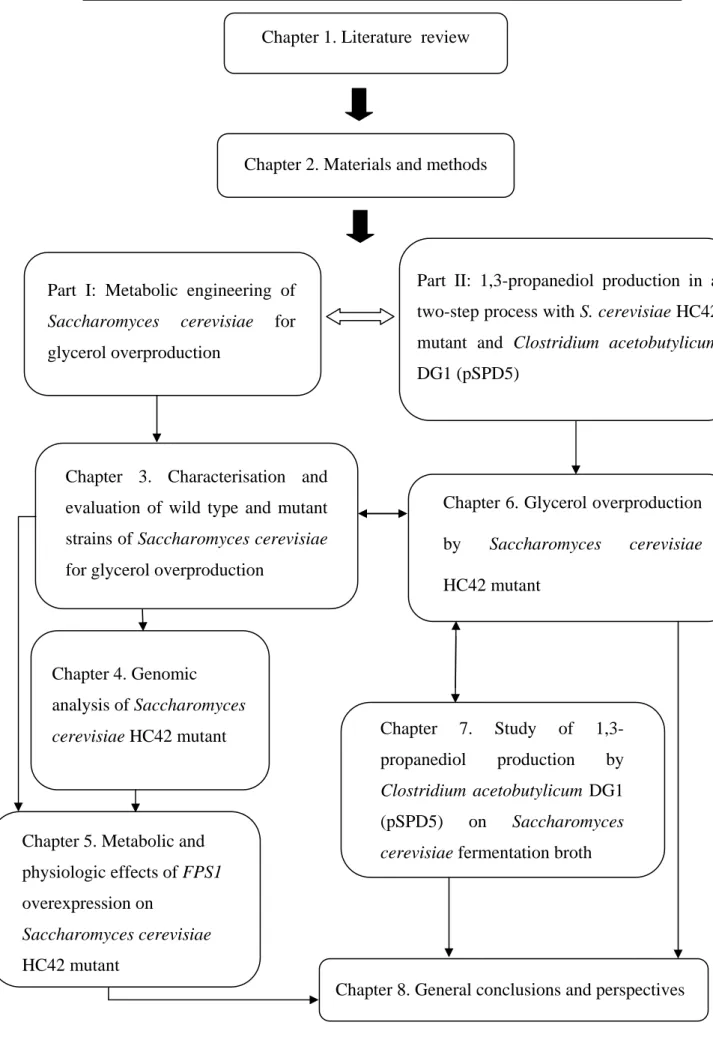
For this purpose, the current work was divided in two parts (schematic outline of the thesis presented in Figure 1). In the first part, the study focused on
Introduction
glycerol overproduction by Saccharomyces cerevisiae from glucose or sugar cane molasses. Several genetically engineered mutants of Saccharomyces cerevisiae were first tested in order to obtain the best glycerol overproducer (Chapter 3). The strain Saccharomyces cerevisiae HC42 was the most promising glycerol producer mutant and was chosen for further research. A metabolic and physiological study of this strain was undertaken during cultivation in bioreactors, in order to better evaluate its performance. A genomic study of this mutant, through the use of microarrays technique, is described in Chapter 4.
Some constraints to enhance the production of glycerol by the novel genetic engineered strain Saccharomyces cerevisiae HC42 were found. In order to avoid intracellular accumulation of glycerol, FPS1 was overexpressed in HC42 (Chapter 5). The result was the mutant strain Saccharomyces cerevisiae FM62. The physiological and metabolic characterisation of this strain was also carried out during cultivations on glucose or molasses media.
The second part of this work was focused on the production of 1,3-propanediol in a two-step process by S. cerevisiae HC42 mutant strain and by the genetically engineered strain Clostridium acetobutylicum DG1 (pSPD5). Different cultivation parameters and strategies were tested in order to improve glycerol yield and titer by the strain Saccharomyces cerevisiae HC42 (Chapter 6). In an attempt to reduce the final cost of the biologic process, a cheaper feedstock, such as sugar cane molasses, was also evaluated. The results of Clostridium acetobutylicum DG1 (pSPD5) cultivations on yeast broth from glucose and sugar cane molasses media are presented in Chapter 7.
Introduction
To finalise this thesis work, general conclusions and future work perspectives are presented in Chapter 8.
Introduction
Figure 1. Diagram representing the outline of the thesis. Chapter 1. Literature review
Chapter 2. Materials and methods
Part I: Metabolic engineering of
Saccharomyces cerevisiae for
glycerol overproduction
Chapter 3. Characterisation and evaluation of wild type and mutant strains of Saccharomyces cerevisiae for glycerol overproduction
Chapter 4. Genomic analysis of Saccharomyces
cerevisiae HC42 mutant
Chapter 6. Glycerol overproduction by Saccharomyces cerevisiae
HC42 mutant
Chapter 5. Metabolic and physiologic effects of FPS1 overexpression on Saccharomyces cerevisiae HC42 mutant Chapter 7. Study of 1,3-propanediol production by Clostridium acetobutylicum DG1 (pSPD5) on Saccharomyces
cerevisiae fermentation broth
Part II: 1,3-propanediol production in a two-step process with S. cerevisiae HC42 mutant and Clostridium acetobutylicum DG1 (pSPD5)
Chapter 1
Chapter 1 Literature review
Chapter 1 Literature review
1.1. Microorganisms and industry
For several thousand years microorganisms have been exploited to people’s benefit. Since the accidental discovery of the usefulness of fermentation processes, microorganisms have been used in the production of a wide range of products, such as foods and beverages (e.g. bread, yoghurt, cheese, beer, wine, etc), chemicals (acetone, butanol, ethanol, organic acids, L-glutamic acid, polyhydroxyalkanoates, etc) and pharmaceutical compounds (antibiotics, insulin, etc). Studies demonstrated that the yeast Saccharomyces cerevisiae was used by the Egyptians for wine fermentations by at least 3150 B.C. However, millennia passed before the discovery and identification of microorganims. It was Antonie van Leeuwenhoek, who for the first time, in 1675, observed microorganisms. But only in the nineteenth century Louis Pasteur, carrying out extensive physiological studies of fermentation, proved that microbial activity was the cause of fermentation.
For over 100 years microorganisms have been successfully used for industrial proposes and their economic potential is still enormous. Microorganisms can use cheap raw materials and convert them into valuable products. Various commercial products of economic value are the result of microbial activities, such as organic acids, enzymes, alcohols, proteins, antibiotics, vitamins, etc. It is estimated that their annual added value to the chemical industry alone is about €10 billion and, in the next 10 years, 60% of synthetic fine chemicals will rely on microbial conversion (Beloqui et al., 2008).
Chapter 1 Literature review
1.1.1. Industrial (white) biotechnology
In the beginning of the twentieth century in response to a demand of the World War I, scientists developed the novel industrial-scale fermentation process, the production of acetone-butanol using the bacterium Clostridium acetobutylicum. After this, further innovations in fermentation technology were applied to industry, especially in the 1940s with the production of penicillin, and biotechnology began to emerge. For years biotechnology could not economically compete with the petrochemical industry in the synthesis of many products that could be produced from oil. However, growing concerns about petroleum depletion and environmental awareness are increasing the relevance of using industrial or white biotechnology. Industrial biotechnology uses living cells and enzymes, the so-called biocatalysts, to synthesise bio-based chemicals, materials and fuels. Besides the fact that most of the time these products are easily degradable, industrial biotechnology processes are considered more environmentally sustainable because generally they are low energy consuming and create less waste than the traditional chemical processes they replace. The use of biomass like starch, molasses, cellulose, vegetable oils and agricultural waste by industrial biotechnology is another advantage of those processes (Fig. 1.1).
Nevertheless, industrial biotechnology still is a relatively young technology and many of the processes have not yet proven that they are economically sustainable (Frazzetto, 2003). Some of the problems to be solved are the low product concentration, low productivity and also the high recovery cost. Although molasses and other renewable resources are cheap, the cost of downstream
Chapter 1 Literature review
processing for these cases should not be neglected and can account for more then 50% of the total production cost. Research areas such as genetic and metabolic engineering have been developed and can contribute to the renewed interest in the production of chemicals from renewable resources.
Petrochemical Industry Industrial Biotechnology Crude oil and natural gas Plant biomass and wastes
Hydrocarbons Sugars, oils, etc.
Feedstocks and intermediates
Fuels: Gasoline, diesel Chemicals Materials Biofuels:Ethanol, biodiesel Chemicals Bio-based Materials Fuels
Bulk and Specialty Chemicals
Figure 1.1. Petrochemical and biotechnological processes.
1.1.2. Genetic, metabolic and evolutionary engineering
Fermentations used to be carried out spontaneously, and microorganisms were unknowingly transferred from fermentation to fermentation. The first pure yeast culture used for beverage production was obtained in 1883 by Emil Christian
Chapter 1 Literature review
Hansen from the Carlsberg Brewery and in 1890 a pure culture of a wine yeast was obtained by Muller-Thurgau from Geisenheim (Germany) (Dequin, 2001). Traditional techniques to improve the performance of microorganisms consisted of selecting the best producers for the desired phenotype. The evolution of microbial physiology knowledge, genetic manipulation, biochemistry advances and the development of fermentation technologies have contributed to obtain microorganisms or its derivatives capable of producing a final desired product with high efficiency, yields and titers. With genetic engineering, new tools were available for microorganisms genetic manipulation and transformation. It became possible to develop, improve, modify or eliminate metabolic pathways in order to increase the range of microbial native products as well as exogenous products commercially more viable. The new age of “omics”, including genomics, transcriptomics, proteomics and metabolomics, has brought many advances and advantages to the area of study called metabolic engineering and introduced by Bailey in 1991 (Chotani, 2000; Ostergaard, 2000; Schuller and Casal, 2005; Nevoigt 2008). Since its expansion there are many examples of emerging applications of biotechnology using metabolic engineering in the design of systems wide experiments for the production of chemicals, materials and medicines. A relevant example is the genetically engineered human insulin production, in the yeast Saccharomyces cerevisiae, in 1987 (Kjeldsen, 2000). However, genetic engineering is not always applicable or the sole solution. Sometimes, following the nature’s “engineering” process results in a complementary strategy. Evolutionary engineering offers compelling scientific
Chapter 1 Literature review
and applied advantages for strain development and process optimization and is able to reach the desired phenotype (Sauer, 2001).
1.2. Glycerol: Production and applications
Glycerol, also known as glycerine, glycerin or 1,2,3-propanetriol is a simple alcohol. At normal room conditions, glycerol is a high viscous, colourless, odourless, sweet warm tasting and hygroscopic liquid. Glycerol is soluble in water and alcohol, slightly soluble in diethyl ether, ethyl acetate and dioxane, and insoluble in hydrocarbons. It can form esters, ethers, halides, amines, aldehydes and also such unsaturated compounds as acrolein. It is low-boiling, non-toxic, emollient, a good solvent and easily biodegradable. Due to all these physical properties glycerol has a wide range of applications.
It was K.W. Scheele who first discovered glycerol, in 1779 (Rahmat et al., 2010). This compound can be produced either by chemical synthesis, as a by-product from fats and oils use, or by microbial fermentation. Glycerol plays essential roles in different vital physiological processes, in prokaryotes and eukaryotes (including mammals). It is an important carbon source for energy and biomass production by several species. The glycerol precursor glycerol 3-phosphate (G3P) is not just involved in acylglycerol synthesis but is also involved in an energy shuttle system in cells. This shuttle is a complex mechanism used to transfer NADH electrons from cytosol to mitochondrial electrons transport chain (Brisson et al., 2001).
Chapter 1 Literature review
1.2.1. Chemical synthesis
Different methods are available for glycerol synthesis by chemical route (using petrochemical feedstocks) all of them using propylene: from chlorination of propylene to allyl chloride, from acrolein formed from the oxidation of propylene and from propylene oxide (Huang, 2002). In 2001, around 25% of the world glycerol produced by chemical industry was via the oxidation or chlorination of propylene. However, since 1970 these routes are declining, not only because of the environmental problems caused, but also due to the increase of the price of propylene (Wang et al., 2001). Moreover, in the last years, the search for novel renewable energy sources promoted an enormous increase of biofuels production, causing an increase of crude glycerol in the market, and the chemical synthesis had to compete with it.
1.2.2. Production from fats and oils
Usually glycerol is found in plants and animals in the form of fatty acid esters, the triacylglycerols (triglycerides), or bonded to fatty acid and phosphate (phospholipids). Traditionally, glycerol was a by-product of soap and detergents made from oils and fats from plants and animals. To obtain glycerol through this production process, oils and fats must be split and separated by saponification (Figure 1.2.). In recent years, glycerol is also obtained as a co-product of triglyceride trans-esterification of oils and fats from plants and animals, during the production of biodiesel. The yield of glycerol is about 10 wt% of total biodiesel production (Rahmat et al., 2010).
Chapter 1 Literature review
1.2.3. Production by fermentation
Glycerol can also be produced by fermentation. Since the investigation of Pasteur in the 19th century, glycerol production by yeast fermentation is known. Glycerol is a by-product of yeast glucose fermentation (Gancedo et al., 1968). In addition to yeast, there are several microorganisms able to synthesise glycerol, such as bacteria, mold, protozoa and algae (Taherzadeh et al., 2002).
Figure 1.2. Production of glycerol from fats and oils (Yazdani and Gonzalez, 2007).
Chapter 1 Literature review
Glycerol was produced for the first time by fermentation in a large scale process during the World War I, using the so-called sulphite-steered yeast process, to supply the production of explosives. After the World War II, with the development of petrochemical synthesis of glycerol, the fermentation technology started to decline, since it was unable to compete with the new process, specially due to the inefficient down-stream technology, with a low yield and titer of glycerol from the fermentation broth (Wang et al., 2001).
1.2.3.1. Glycerol production by yeast
Among the microorganisms able to produce glycerol, yeasts, and especially Saccharomyces cerevisiae, are the most studied. Other osmophilic yeasts such as Candida, Debaryomyces, Hansenula, Pichia, Schizosaccharomyces,
Torulaspora and Zysaccharomyces were also investigated for glycerol production
(Ciani and Ferraro, 1996; Petrovska et al., 1999; Zhuge et al., 2001; Djelal et al., 2006; Liu et al. 2006).
Glycerol is one of the most important by-products of sugar conversion during alcoholic fermentation by yeasts. The accumulation of this metabolite in S.
cerevisiae can reach 10 g.l-1, under anaerobic conditions (Radler and Schütz, 1982; Ciani and Ferraro, 1996). This is mainly a consequence of maintaining the cellular redox balance by regenerating NADH excess associated to biomass production during fermentation (Overkamp et al., 2002; Remize et al., 1999). Glycerol is also involved in osmoregulation (Hohmann, 2002) and can act as a cryoprotectant like trehalose (Izawa et al., 2004). The osmotolerant yeast Candida
Chapter 1 Literature review
glycerinogenes, selected from an environment of high osmotic pressure, was able
to convert up to 64.5% (w/w) of the glucose present in the growth medium into glycerol, with a glycerol production of 137 g.l-1.
1.2.3.2. Glycerol production by bacteria
Different bacteria, such as Crithidia fasciculate, Bacillus subtilis, Bacillus
coli, Bacterium orleanense, Bacterium pasteurianum, Lactobacillus lycopersici,
among others, have been studied for the production of glycerol. However, the yields obtained were too low and fermentation rates too slow. B. subtilis, for instance, yielded 29.5% glycerol in a glucose-yeast extract medium within 8 days. According to these perspectives the production of glycerol by bacteria has not been seriously considered (Wang et al., 2001). However, in the last years, with the possibility of using glycerol as a feedstock for the production of new products economically advantageous, and with the help of genetic engineering, new generations of bacteria have been developed. Meynial-Salles et al. (2007) described a genetic engineered Escherichia coli that, without any fermentation process optimization, was able to produce glycerol from glucose with a yield of 1 mol.mol-1, titer of 130 g.l-1 and productivity up to 0.67 g.l-1h-1, in a fed-batch system.
1.2.3.3. Glycerol production by algae
The production of glycerol by algae has also been investigated. The use of
Chapter 1 Literature review
compounds is an interesting challenge. The most studied species belong to
Dunaliella. In these algae, glycerol is accumulated in the cells as a response to
high salinity in the growth media. Depending on the salt concentration in the growth medium, more than 50% of the dry weight of Dunaliella may be glycerol
(Kaçka and Dönmez, 2008). In a medium with 4 mol.l-1 NaCl D. tertiolecta,
immobilised in calcium alginate, produced up to 5 g.l-1 of glycerol (Grizeau and
Navarro, 1986). Kaçka and Dönmez (2008) also reported Dunaliella species
isolated from a hypersaline lake in Turkey that showed high glycerol production, i.e. 0.45 g.l-1 of culture broth at 20% NaCl concentration. Although the production of glycerol from Dunaliella species was shown to be technically possible, economic feasibility is still too low.
1.2.4. Applications and market situation
Glycerol has many different applications in several industries. It can be used as a basic material or as a chemical building block. Due to its molecular structure, glycerol is considered as a good starting material for the synthesis of many other chemicals and intermediates. The major applications of glycerol include food (when used as food additive, it is labelled as E number E422), pharmaceuticals, cosmetics, personal care and soaps, tobacco, polymers and explosives. Nevertheless, in the last years, the rise in world biodiesel production has created a glut of glycerol (Figure 1.3.).
Chapter 1 Literature review Glyce rol ann u al pr oduct ion (M il li on to n ) Glyce rol ann u al pr oduct ion (M il li on to n )
Figure 1.3. Global glycerol production (in Rahmat et al., 2010).
The direct effect of glycerol surplus is the decline of glycerol prices. As a consequence, new investments and efforts are now put up in research to develop new strategies and approaches for glycerol alternative applications. One of those ideas, based in the concept of “bio-refinery”, is the glycerol bioconversion into new products such as 1,3-propanediol, succinic acid, lactic acid, propionic acid, ethanol, dihydroxiacetone, citric acid, pigments, polyhydroxyalconate and biosurfactants (da Silva et al., 2009). The use of glycerol in chemical industry is also showing particular interest when glycerol is used into fuel additives. Glycerol ethers, acetyl glycerol and glycerol acetal have been identified as valuable replacements of fuel additives that are petroleum derivatives. These glycerol-based fuel additives have demonstrated a large potential for diesel and biodiesel
Chapter 1 Literature review
formulation that assist to a decreasing in particles, hydrocarbons, carbon monoxide and unregulated aldehydes emissions (Rahmat et al., 2010).
1.3. Glycerol production by Saccharomyces cerevisiae
S. cerevisiae is not the best glycerol producer. However, this yeast has
been intensively studied for several years, which resulted in a valuable knowledge about its physiology and metabolism. It is an excellent model system of the eukaryotic cell.
1.3.1. Saccharomyces cerevisiae characterization
S. cerevisiae is by far the most studied eukaryotic microorganism. It is
classified as facultative fermentative yeast, which means that can grow aerobically but in the presence of limited oxygen concentrations exhibits alcoholic fermentation (van Dijken and Scheffers, 1986). It is also a Crabtree-positive yeast, i.e., a mixed respiro-fermentative metabolism can occur under fully aerobic conditions, specifically when glucose concentration is higher than a certain threshold concentration or when the specific growth rate is above a specific value, usually higher than two-thirds of the maximum specific growth rate on glucose (Overkamp et al., 2000).
As in its natural environment of fruit and nectar the most abundant sugars are glucose and fructose, it is not surprising that S. cerevisiae prefers to consume these sugars. Other fermentable sugars such as galactose, sucrose and maltose, can only be used after glucose. Sucrose is extracellularly hydrolysed to glucose and
Chapter 1 Literature review
fructose by periplasmic invertases. The invertase enzymes are also responsible for degrading raffinose to melibiose and fructose. Pentose sugars such as xylose and arabinose cannot be consumed.
S. cerevisiae has been used in several industrial processes such as baking,
wine making and brewing (Nevoigt, 2008). Due to its long history of application in everyday life, it has been classified as a GRAS (Generally Regarded as Safe) organism. The nucleotide sequence of S. cerevisiae is available since 1996, when the completed sequence was published and diverse and efficient genetic tools are available to genetic engineering of this yeast (Ostergaard et al., 2000). S.
cerevisiae is relatively tolerant to low pH values and high sugar and ethanol
concentrations, characteristics that lower the risk of contamination in industrial environments. For all these reasons S. cerevisiae has been widely used in industrial biotechnology, for the production of valuable fermented products such as bioethanol, glycerol, propanediol, organic acids, sugar alcohols, steroids, etc. (Nevoit, 2008).
1.3.2. Biochemistry of Saccharomyces cerevisiae fermentation
After uptake, glucose is oxidized into two pyruvate molecules, through the glycolytic pathway, resulting in the net formation of two mole of ATP per mole of glucose. Depending on whether growth is respiratory or fermentative, the reducing and oxidative reactions occur via different metabolic pathways and this has large consequences on energy generation in the cell. During respiratory metabolism, pyruvate can be further oxidized in the tricarboxylic acid cycle. In the
Chapter 1 Literature review
fermentative metabolism, pyruvate is converted into ethanol by the activity of two enzymes: pyruvate decarboxylase and alcohol dehydrogenase. During this conversion, NADH is formed in glycolysis by glyceraldehyde-3-phosphate dehydrogenase. The redox balance is assured by formation of glycerol. Glycerol is the main by-product synthesised during fermentation (Fig. 1.4.). There are other possible products of sugars fermentation involved in yeast redox balance, like succinate, acetate, acetaldehyde, acetoin and 2,3-butanodiol. Acetaldehyde is formed by the decarboxilation of pyruvate catalysed by pyruvate dacarboxilase (PDC) and can be reduced into ethanol by the enzyme ethanol dehydrogenase, or oxidized into acetate by the enzyme acetaldehyde dehydrogenase, involving the
reduction of NAD(P)+ to NAD(P)H. Acetaldehyde can also be converted into
acetoin and 2,3-butanediol. Acetoin can be produced through 3 pathways (Romano and Suzzi, 1996). In a first pathway pyruvate is decarboxylated and originates an active acetaldehyde complex. Active acetaldehyde and pyruvate are then transformed into α-acetolactate by means of acetohydroxy acid synthetase. This compound can easily be converted to diacetyl or to acetoin, particularly in the presence of oxygen. Acetoin may also be synthesised in yeasts by condensation of active acetaldehyde with acetyl coenzyme A to form diacetyl, which is successively reduced to acetoin. The third route to form acetoin by yeast is by condensation of the active acetaldehyde (acetaldehyde-thiamine diphosphate complex) with free acetaldehyde formed from pyruvate, without the intermediate formation of α-acetolactate. 2,3-Butanodiol is formed by the reduction of acetoin
Chapter 1 Literature review
with the respective oxidation of NADH. This reaction is catalysed by the enzyme acetoin reductase. 14 NADH NAD+ Glucose Glucose-6-P Fructose-,6-P 3 ATP ADP 4 Fructose-1,6-bP 5 DHAP 6 Glyceraldehyde-3-P Glycerol-3-P Glycerol 15 NAD+ NADH 7 1,3P-Glycerate ADP ATP 8 9 3P-Glycerate ATP ADP 2 2P-Glycerate 10 ADP ATP 11 Phosphoenolpyruvate Pyruvate 12 CO2 Ethanol 13 Acetaldehyde
NAD+ NADH TCA cycle
ADP ATP NAD+NADH CO2 Mitochondrion 1 14 NADH NAD+ Glucose Glucose-6-P Fructose-,6-P 3 ATP ADP 4 Fructose-1,6-bP 5 DHAP 6 Glyceraldehyde-3-P Glycerol-3-P Glycerol 15 NAD+ NADH 7 1,3P-Glycerate ADP ATP 8 9 3P-Glycerate ATP ADP 2 2P-Glycerate 10 ADP ATP 11 Phosphoenolpyruvate Pyruvate 12 CO2 Ethanol 13 Acetaldehyde
NAD+ NADH TCA cycle
ADP ATP NAD+NADH CO2 Mitochondrion 1 14 NADH NAD+ 14 14 NADH NAD+ Glucose Glucose-6-P Fructose-,6-P 3 ATP ADP 4 Fructose-1,6-bP 5 5 DHAP 66 Glyceraldehyde-3-P Glycerol-3-P Glycerol 15 15 NAD+ NADH 7 1,3P-Glycerate ADP ATP 8 9 3P-Glycerate ATP ADP 2 2P-Glycerate 10 10 10 ADP ATP 11 ADP ATP ADP ATP 11 Phosphoenolpyruvate Pyruvate 12 12 CO2 Ethanol 1313 Acetaldehyde
NAD+ NADH TCA cycleTCA cycle
ADP ATP NAD+NADH CO2 Mitochondrion 1
Figure 1.4. S. cerevisiae glucose fermentative pathway. 1 - hexose, 2 -hexokinase, 3 - glucose-6-phosphate isomerase, 4 - 6-phosphate kinase, 5 – fructose-biphosphate aldolase, 6 - triose phosphate isomerise, 7 - glyceraldehyde-3-phosphate dehydrogenase, 8 – phosphoglycerate kinase, 9 - phosphoglycerate mutase, 10 - enolase, 11 - pyruvate kinase, 12 - pyruvate decarboxylase, 13 – alcohol dehydrogenase, 14 - 3-phosphate dehydrogenase, 15 - glycerol-3-phosphatase, TCA - Tricarboxylic Acid Cycle.
Chapter 1 Literature review
Under anaerobic conditions, succinate is mainly formed through the reductive branch of the Tricarboxylic Acid Cycle from malate via fumarate with the production of FAD+.
1.3.3. Metabolic pathway for glycerol production
In the yeast Saccharomyces cerevisiae glycerol is synthesized in a two-step reaction process, involving the reduction of dihydroxyacetone phosphate
(DHAP) by a NADdependent glycerol phosphate dehydrogenase (GPD), followed
by the dephosphorylation of glycerol 3-phosphate (G3P) by a glycerol phosphate phosphatase (GPP) (Albertyn et al., 1994b; Ansell et al., 1997; Pahlman et al., 2001). Figure 1.5. shows the metabolic pathway for the production of glycerol in the yeast. Two genes GPD1 and GPD2 encode two isoenzymes of GPD (Larsson
et al., 1993) and GPP1 and GPP2 encode two isoforms of GPP (Pahlman et al.,
2001). These genes are subject to different control, GPD1 and GPP2 being upregulated under osmotic stress, while GPD2 and GPP1 are induced under anaerobic condition (Albertyn et al., 1994b; Ansell et al., 1997; Costenoble et al., 2000; Pahlman et al., 2001). Based on these considerations and on additional genetic data, it is currently admitted that the couple Gpd1p/Gpp2p is the major route for glycerol production under aerobic condition, whereas Gpd2p/Gpp1p plays a specific role in redox balance under anaerobic growth conditions (Blomberg, 1997; Hohmann, 2002).
Chapter 1 Literature review
Figure 1.5. Metabolic reactions of importance in the glycerol metabolism of S.
cerevisiae (Scanes et al., 1998).
Additionally, the distinct localization of Gpd1p and Gpd2p may also explain that the former cannot substitute for the latter under mitochondrial defective strains (Valadi et al., 2004). Fps1p is described as the major glycerol facilitator through plasma membrane to the outside of cells (Luyten et al. 1995; Oliveira et al. 2003; Tamas et al. 1999).
1.3.3.1. Redox metabolism
Yeast growth is possible due to substrates oxidation. The transfer of electrons amongst metabolites is assured by the presence of transporters. In yeast
Chapter 1 Literature review
NADPH/NADP+. The first pair of cofactors participates in the catabolic and
anabolic reactions whereas the pair NADPH/NADP+ is related with the anabolic pathways. The maintenance of the redox balance is dependent on the equilibrium of these cofactors pools and is essential for cells survival. However,
NAD(P)H/NAD(P)+ are not able to cross cell membranes, inclusively the
mitochondrial inner membrane, and so, once reduced, the reoxidation of the cofactors has to occur in the same cell compartment. Furthermore, S. cerevisiae
lacks a transhydrogenase activity to convert NAD+ and NADPH to NADH and
NADP+. Most of the anabolic reactions involving NADPH oxidation take place in the cytosol, whereas NADH production occurs in the cytosol but also in mitochondria. During aerobic condition, cells have different systems coupled to the respiratory chain to reoxidize cytosolic and mitochondrial NADH. During anaerobic conditions, as the respiratory chain is not working, alternative pathways have to be used. One of the most important pathways for the reoxidation of cytosolic NADH is that involving glycerol production. Since sugars fermentation is a redox-neutral process, S. cerevisiae and other yeasts found as solution to this redox problem, the production of glycerol involving the reoxidation of NADH (Heux et al., 2006; Bakker et al., 2001).
Although NADH or NAD+ are not able to cross the mitochondrial inner
membrane under aerobic conditions, yeasts and other eukaryotes possess redox shuttle mechanisms that allow to transfer the redox equivalents of NADH across the mitochondrial membrane (Bakker et al., 2001). One of these shuttles is related to the glycerol metabolic pathway. It is the glycerol 3-phosphate shuttle which
Chapter 1 Literature review
indirectly oxidizes cytosolic NADH once that does not result in the translocation of redox equivalents but does bypass the NADH dehydrogenases. This mechanism
includes two components; the cytosolic NAD+ dependent GPD and the
mitochondrial GPD:ubiquinone oxidoreductase, also called mitochondrial glycerol-3-phosphate dehydrogenase. The latter enzyme is encoded by GUT2. It is FAD-linked and is located in the inner mitochondrial membrane. It transfers electrons from cytosolic GPD to ubiquinone in the respiratory chain.
1.3.3.2. Osmoregulation
When cells are exposed to hypertonic medium, there is a rapid diffusion of water from the cell into the surrounding medium. This process is driven by the difference between cell and environment water activities. Osmoregulation “is understood to be the cellular response directed at restoring and maintaining volume, turgor pressure and normal biological activities of the cell” ( Nevoigt and Stahl, 1997). To prevent the loss of water to the environment, yeast accumulates solutes, known as compatible solutes, to equilibrate the intra- and extracellular environment. Only some compounds are accumulated such as ions, amino acids and polyhydroxy compounds. The principal compound accumulated by S.
cerevisiae is glycerol. It is evident that the intracellular level of glycerol is
adjusted to external water activities and this is essential to growth under osmotically stressful conditions (Scanes et al., 1998). In a study reported by Petrovska et al. (1999) the glycerol yield in S. cerevisiae increased 2.4 times when
Chapter 1 Literature review
Glycerol was produced as a response to the osmotic pressure caused by salt addition.
1.3.4. Factors affecting glycerol production
There are several factors affecting glycerol production by yeast. Strain, inoculation level, pH, temperature, water activity, oxygen level and medium composition (initial sugar concentration and carbon/nitrogen ratio) can influence the production of glycerol by yeasts. Several studies described that temperature increase resulted in higher glycerol production. The optimal temperature for glycerol production was shown to be dependent on agitation time during cultivation (Scanes et al., 1998). However, Remize et al. (2000) observed that glycerol production increased by less than 15% when temperature increased from 18 to 28 ºC and agitation had only a slight positive effect on the amount of glycerol formed (0-13%). Studies related with pH and acidity revealed that higher glycerol yields were obtained with S. cerevisiae under alkaline conditions. It is reported that the optimum pH range for sulphite-directed glycerol production lies between 6.7 and 7.0.
As described before, glycerol is involved in the osmotic cell balance. It was noted that in order to compensate for the osmotic stress caused by the high sugar concentration of wine must (usually 200 g.l-1 or more), the yeast increased synthesis and accumulation of glycerol (Scanes et al., 1998). Nitrogen source is also reported to affect glycerol production. The glycerol yield achieved in cultures growing in ammonium was two-fold higher than the value obtained for yeast
Chapter 1 Literature review
growing in cultures with a mixture of amino acids as nitrogen source. This is related to the fact that ammonium-grown cultures require de novo synthesis of amino acids that generates a surplus of NADH, which must be reoxidized by glycerol synthesis. Other factor affecting glycerol production seems to be aeration. The production of glycerol is markedly affected by the degree of aeration in osmotolerant yeasts. Sahoo et al. (2001), in a study with a Candida magnoliae strain, observed that the higher oxygen availability increased the yields of cells mass and glycerol and reduced ethanol yield. When compared with this type of strains, the production of glycerol by S. cerevisiae seems to required oxygen-restricted condition (Wang et al., 2001). It is known that higher glycerol yields are obtained under anaerobic conditions compared with aerobic conditions.
1.3.5. Strategies to enhance glycerol production by Saccharomyces
cerevisiae
Though S. cerevisiae is likely not the best glycerol producer (Wang et al., 2001), is the most useful system to evaluate various engineering strategies to optimise its synthesis. Accordingly, over the past decade, there have been several attempts to manipulate yeast metabolism in order to optimise glycerol production, shifting from a bioprocess-mediated mode involving sulphite (Bisping and Rehm, 1988; Petrovska et al., 1999) towards a reprogramming of the cellular metabolism by recombinant DNA technology. In spite of the relative technological advantage or difficulties encountered in implementing the various genetic strategies, the final challenge is to get the maximal glycerol yield per mol glucose consumed. This
Chapter 1 Literature review
achievement notably requires a reduction of the contribution of assimilatory glucose metabolism to anabolic and maintenance purposes, an increase in the NADH availability and eventually an increase of the average productivity rates.
Comparing various strains of S. cerevisiae, Radler and Schütz (1982) found a glycerol production variation between 4.2 to 10.4 g.l-1. The authors also reported that increasing the initial amount of cells, used as inoculum, significantly increased the amount of glycerol produced. This fact is also reported by Munene
et al. (2002). An increase in pH medium can also result in high glycerol yields. In
the alkaline process, also known as Neuberg’s third form of fermentation, Na2CO3
is added to the medium to maintain the pH at 7-8 and to enhance the production of acetate, leading to an increase of NADH that has to be balanced by glycerol formation, under anaerobic conditions. However, for pH values higher than 6.0 S.
cerevisiae fermentation capacity decreased by more than 30% and so, the optimal
concentration of sodium carbonate was reported to be only 5% with a glycerol yield of 0.2 g.g-1 of sugar (Taherzadeh et al., 2002). In another study, medium pH was increased to 8.7 (the optimum for aldehyde dehydrogenase activity) using sodium hydroxide, reporting glycerol yields up to 40.5% of sugar consumed.
The overexpression of GPD1 in a wine yeast strain resulted in a 4-fold increase of glycerol production at the expense of ethanol. However, this mutation also resulted in the accumulation of other by-products such as pyruvate, acetate, acetoin, 2,3-butanediol and succinate (Michnick et al., 1997).
When triose phosphate isomerise gene (TPI1) was deleted, glycerol yield reached 80-90% of the theoretical maximum yield of 1 mol.mol-1 glucose. 0.46 g
Chapter 1 Literature review
glycerol. g-1glucose were obtained in shake flaks with glucose as the sole carbon source. However, the mutant growth rate was too slow when compared with the wild type strain (Compagno et al., 1996). Likely this result was caused by the accumulation of DHAP that has been shown to suppress the production of myo-inositol by inhibiting the enzyme myo-myo-inositol-3 phosphate synthase (Shi et al., 2005). The work described by Overkamp et al. (2002) raised the glycerol production from 0.25 g glycerol.g-1 glucose obtained by the sulphite bioprocess to 0.42 g glycerol.g-1 by metabolic engineering implicating the deletion of TPI1 encoding triose phosphate isomerase and removal of the cytosolic NADH reoxidation by mitochondrial redox shuttles. The two isogenes NDE1 and NDE2, encoding mitochondrial external NADH dehydrogenase, and GUT2, encoding the
FAD+-dependent mitochondrial GPD, were deleted. These mutations recovered
the myo-inositol defect caused by the deletion of TPI1. An evolutionary engineering strategy described by Overkamp et al. (2002) allowed selecting a strain with an increased growth rate producing glycerol at a molar yield of glycerol on glucose close to unity. The strategy involved the construction of a mutant pdc1Δ pdc5Δ pdc6Δ nde1Δ ned2Δ gut2Δ. In another work using the same mutant strain, combined with the overexpression of GPD2 and FDH1, it was possible to achieve a glycerol yield of 1.08 mol glycerol.mol-1 glucose by co-feeding the strain with formate. In this case, formate is an external source of cytosolic NADH (Geertman et al., 2006) (Table 1.1.).
Chapter 1 Literature review
Table 1.1. Glycerol final concentration, yield and productivity of different yeast fermentation processes .
Yeast/Fermentation process Glycerol (g/l) YGlycerol (g/g) rGlycerol (g/l/h) Reference S. cerevisiae
Sulfite, Batch 45 0.23 0.4 Freeman and Donald (1957)
Sulfite, Fed-batch under vacuum 82 0.25 1.35 Kalle and Naik (1985)
ADH deletion, Shake flask 4.6 0.26 0.1 Drewke et al. (1990)
pdc2Δ mutant, Shake flask 2.9 0.16 0.09 Nevoit and Stahl (1996)
tpiΔ mutant, Shake flask 36 0.46 1.5 Compagno et al. (1996)
tpiΔ mutant, Shake flask 63 0.44 1.5 Compagno et al. (1998)
GPD1 overproduction, Batch 25 0.12 0.18 Remize et al. (2001)
tpiΔnde1Δ ned2Δ gut2Δ mutant,
aerated batch 219 0.50 2.4 Overkamp et al. (2002)
pdc1Δ pdc5Δ pdc6Δ nde1Δ ned2Δ
gut2Δ mutant, aerated batch 46 0.46 0.3 Geertman et al. (2006)
pdc1Δ pdc5Δ pdc6Δ nde1Δ ned2Δ gut2 GPD2 FDH1 overexpression mutant, aerated chemostat cultivation formate co-feeding
8.3 0.55 0.2 Geertman et al. (2006)
C. magnoliae
Batch 80 0.32 0.65 Sahoo and Agarwal (2001)
C. glycerinogenes
Batch 137 0.64 1.7 Zhuge et al . (2001)
Y- Yield; r – Productivity
1.4. 1,3-Propanediol. Production and applications
1,3-propanediol is a three-carbon diol, colourless and odourless viscous liquid, miscible with water, alcohols, ethers and formamide.
August Freund, in 1881, identified the production of 1,3-propanediol, in a glycerol fermentation by a mixed culture containing Clostridium pasteurianum. It is one of the oldest known products of fermentation (Saxena et al., 2009).
1,3-Chapter 1 Literature review
propanediol has several applications and among them is the use as a building block for the production of polymers.
1,3-propanediol can be produced by chemical or microbiological route. In the past, 1,3-propanediol bio-production was considerable low, due to the high production costs. However, the situation has changed. The high demand for a new polyester based on terephthalic acid and 1,3-propanediol, the polytrimethylene terephthalate (PTT), turned the production of 1,3-propanediol very profitable and interesting (Biebl et al. 1999; González-Pajuelo et al. 2006; Rao et al. 2008).
1.4.1. 1,3-Propanediol chemical synthesis
Nowadays, there are two main chemical processes for 1,3-propanediol synthesis. The Degussa process, now owned by DuPont, Wilmington, DE, USA, is based on acrolein obtained by the catalytic oxidation of propylene. Acrolein is hydrated to 3-hydroxypropionaldehyde, followed by hydrogenation to produce 1,3-propanediol. The yield of 1,3-propanediol obtained in this process is 40%. The other major process is owned by Shell Chemicals, USA. The process of Shell starts with the hydroformylation of ethylene oxide, followed by hydrogenation. In this process a yield up to 80% can be obtained. Both processes involve high production costs and formation of toxic intermediates (Saxena et al., 2009), that probably induced DuPont to develop a biological process.
Chapter 1 Literature review
1.4.2. 1,3-Propanediol fermentative production
1,3-Propanediol can be naturally produced by microorganisms. The carbon source used is glycerol or sugar co-fermented with glycerol, but no natural microorganism can convert only sugar into 1,3-propanediol (Cameron et al., 1998). The natural pathway for the production of 1,3-PD is from glycerol and occurs in facultative aerobic or obligate anaerobic bacteria species. The facultative aerobic group includes microorganisms belonging to genera Klebsiella,
Citrobacter and Enterobacter (e.g. Citrobacter freundii, Klebsiella pneumoniae,
Enterobacter agglomerans). It was also shown that some lactobacilli species such
as Lactobacillus brevis, Lactobacillus buchneri and Bacillus welchii are able to produce 1,3-propanediol from glycerol, when cultivated with a co-substrate like glucose or fructose, under anaerobic conditions. The obligate anaerobic bacteria able to produce 1,3-propanediol are some clostridia species, like Clostridium
butyricum and Clostridium pasteurianum (Schütz and Radler, 1984; Forsberg,
1987; Homann et al., 1990; Biebl et al., 1992; Dabrock et al., 1992; Barbirato et
al., 1995; Daniel et al., 1995; Biebl et al., 1999). C. acetobutylicum was initially
included among these species (Forsberg, 1987), but later on it was found that this microorganism does not carry the metabolic pathway to produce 1,3-propanediol and is not able to grow on glycerol as the sole carbon source (Vasconcelos et al., 1994). During the last years, various studies have been carried out with these microorganisms, aiming 1,3-PD production (Boenigk et al., 1993; Daniel et al. 1995; Papanikolaou et al. 2000; Zeng and Biebl 2002; González-Pajuelo et al. 2006).
Chapter 1 Literature review
From all microorganisms tested for 1,3-PD production, K. pneumoniae and C.
butyricum have been widely studied. K. pneumoniae is an opportunistic
pathogenic microorganism and, consequently, C. butyricum is preferred for potential industrial applications.
1.4.3 Applications and market situation
The market situation of 1,3-propanediol has changed in recent years. New applications for this chemical resulted in higher interest and demand for propanediol. The production of a novel polyester increased the demanded of 1,3-PD and the market is growing rapidly. In the last years the development of new technologies and strategies to produce 1,3–PD resulted in a reduction of market prices. Currently the price of 1,3-PD is around $1.76 per kg and the production is over 45,400 tons per year with tendency to grow (Saxena et al., 2009).
Due to its simple chemical structure, 1,3-PD can be used in a wide range of applications. One of the most relevant is the production of polyesters, namely PTT (polytrimethylene terephthalate) (Biebl et al. 1999; González-Pajuelo et al. 2006; Rao et al. 2008). Polyester is the most widely used synthetic fiber in the world. Since its invention, the dominant polyester has been polyethylene terephthalate (PET). Comparing the properties of PTT fibers like Sorona®, the first polymer platform based on 1,3-PD commercialized by Dupont, with the conventional PET and nylon, it offers excellent and better physical and chemical properties. Among other, this fiber is highly resistant to most strains without the need for surface treatment with additives or coatings; it resists UV degradation better than other fibers, and shows both low water absorption and low electrostatic charging
Chapter 1 Literature review
(Kurian, 2005). PTT is used in the textile industry, with particular application in carpet manufacture, but it can also be used in food, cosmetics, adhesives, lubricants, laminates, solvents, antifreeze and medicines (one of its derivatives can be used to reduce rejection of transplanted organs (Németh and Sevella, 2008)). Traditional production of 1,3-PD is based on chemical synthesis from petroleum derivatives compounds, which requires expensive production processes and yields toxic intermediates, like acrolein. In contrast, 1,3-PD can be produced by fermentation of relatively low cost renewable carbon sources, and this process, though maybe more expensive than the chemical process, provides radical solutions to environmental pollution and petroleum depletion. The microbiologically produced 1,3-PD has properties superior to chemically synthesized 1,3-PD, such as a lower amount of impurities (Kurian, 2005). In addition, the polyesters based on the biological 1,3-PD are fully biodegradable.
1.5. Biochemistry of 1,3-propanediol production
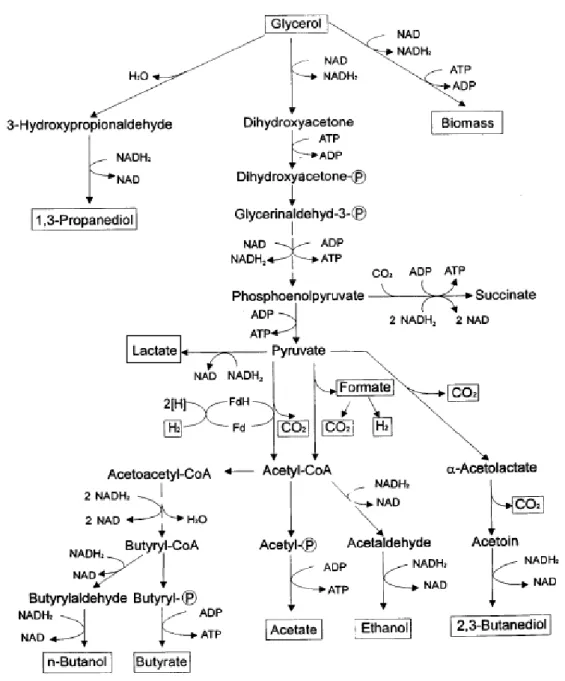
Microbial anaerobic glycerol fermentation involves an oxidative and a reductive pathway. 1,3-Propanediol is produced through the reductive pathway in two enzymatic steps. First, glycerol is dehydrated to 3-hydroxypropionaldehyde (3-HPA) by a glycerol dehydratase, followed by the reduction of the aldehyde to 1,3-propanediol by the enzyme 1,3-propanediol dehydrogenase under the oxidation of NADH. In the species K. pneumoniae (Forage and Lin, 1982) and C.
freundii, glycerol dehydratase is encoded by dhaB gene and is B12-dependent, and