DOI 10.3233/JAD-2010-091384 IOS Press
Review Article
Caffeine, Adenosine Receptors, and Synaptic
Plasticity
Ana Rita Costenla
a, Rodrigo A. Cunha
band Alexandre de Mendonc¸a
a,c,∗aInstitute of Pharmacology and Neurosciences, Faculty of Medicine and Unit of Neuroscience, Institute of
Molecular Medicine, University of Lisbon, Lisbon, Portugal
bCenter for Neuroscience of Coimbra, Institute of Biochemistry, Faculty of Medicine, University of Coimbra,
Coimbra, Portugal
cDepartment of Neurology, Faculty of Medicine, University of Lisbon, Lisbon, Portugal
Abstract. Few studies to date have looked at the effects of caffeine on synaptic plasticity, and those that did used very high
concentrations of caffeine, whereas the brain concentrations attained by regular coffee consumption in humans should be in the low micromolar range, where caffeine exerts pharmacological actions mainly by antagonizing adenosine receptors. Accordingly, rats drinking caffeine (1 g/L) for 3 weeks, displayed a concentration of caffeine of circa 22µM in the hippocampus. It is known that selective adenosine A1receptor antagonists facilitate, whereas selective adenosine A2Areceptor antagonists attenuate, long term potentiation (LTP) in the hippocampus. Although caffeine is a non-selective antagonist of adenosine receptors, it attenuates frequency-induced LTP in hippocampal slices in a manner similar to selective adenosine A2Areceptor antagonists. These effects of low micromolar concentration of caffeine (30µM) are maintained in aged animals, which is important when a possible beneficial effect for caffeine in age-related cognitive decline is proposed. Future studies will still be required to confirm and detail the involvement of A1and A2Areceptors in the effects of caffeine on hippocampal synaptic plasticity, using both pharmacological and genetic approaches.
Keywords: A1receptors, A2Areceptors, adenosine, aging, caffeine, long-term potentiation, hippocampus, synaptic plasticity
INTRODUCTION
The cognitive enhancing properties of caffeine have long been recognized, and are experienced daily by reg-ular coffee drinkers. Although it has been more diffi-cult to demonstrate these cognitive enhancing effects in a formal experimental setting, caffeine improves mood and enhances psychomotor and cognitive performance in healthy volunteers, particularly on tasks measuring typing speed, simple reaction time, sustained attention, memory, and logical reasoning, as well as simulated
∗Correspondence to: Alexandre de Mendonc¸ a, Laboratory of Neu-rosciences, Institute of Molecular Medicine, Av. Prof. Egas Mo-niz, 1649-028 Lisbon, Portugal. Tel.: +351 217985183; Fax: +351 217999454; E-mail: [email protected].
driving [1]. Since it is generally accepted that the neu-rophysiological basis for learning and memory involves long-term modifications in the efficiency of synapses integrated in networks caused by specific patterns of neuronal activity [2], it would appear obvious to test whether caffeine could facilitate long-term potentiation (LTP) and related phenomena of synaptic plasticity in brain areas important for learning and memory.
WHAT IS PRESENTLY KNOWN ABOUT THE EFFECTS OF CAFFEINE ON SYNAPTIC PLASTICITY?
Rather surprisingly, few studies looked at the ef-fects of caffeine on synaptic plasticity. In fact,
searchers characterizing the effects of adenosine recep-tors on synaptic plasticity generally used pharmacolog-ical tools that were as selective as they could get for the different adenosine receptors, and understandably neglected caffeine, which is a non-selective antagonist of adenosine receptors.
Furthermore, the few studies that looked at the ef-fects of caffeine on synaptic plasticity used very high concentrations of caffeine, compared to the plasma lev-els of caffeine attained by regular consumption of cof-fee and other caffeine-containing beverages. One study showed that application of caffeine could induce a ro-bust form of LTP at hippocampal Schaffer fibers/CA1 pyramid synapses in vitro. Caffeine was added to the recording chamber at a concentration of 10 mM [3]. Another in vitro study reported that caffeine could in-crease basal synaptic transmission and inhibit post-tetanic potentiation, but did not affect LTP, at the same synapses; the concentrations of caffeine tested in these experiments were 500µM and 10 mM [4]. Thus, the concentrations of caffeine used in these two studies were several orders of magnitude higher than the con-centration of caffeine attained in the plasma in humans by ingestion of moderate amounts of coffee, estimated to be 5–70µM (see [5–8]). The only pharmacolog-ical action known for caffeine at the low micromolar range is the antagonism of adenosine receptors, namely adenosine A1 and A2Areceptors [9,10], and possibly adenosine A3 receptors [11]. Other effects, like inhi-bition of phosphodiesterases, intracellular calcium re-lease and blockade of GABAAreceptors, require high-er concentrations of caffeine [10,12], although future studies still need to be carried out to either exclude or define the role of these putative targets in the central effects of caffeine. In any case, the estimation of the effects of acutely applied caffeine on LTP will first re-quire establishing the plasma and brain concentrations of caffeine.
WHAT CONCENTRATIONS SHOULD BE TESTED TO REFLECT THE CAFFEINE LEVELS IN THE BRAIN?
We have previously found that the administration of caffeine through the drinking water at a concentration of 1 g/L affords neuroprotection and prevents memory deficits in rodents upon different noxious brain insults mimicking conditions such as diabetes, stress, early life convulsions, or Alzheimer’s disease [13–15]. When allowed to have free access to caffeine in their drinking
water (1 g/L) for a period of 4 weeks, rats consumed an average amount of 73± 3 mg caffeine/kg/day (es-timation based on the average daily consumption of caffeinated water of the 6 animals during the last 2 weeks of the treatment). Upon HPLC evaluation (see e.g. [14]), these rats displayed a plasma concentration of caffeine of 32± 4 µM (n = 6), which is equivalent to the plasma concentration of caffeine found in hu-mans consuming circa 6 cups of coffee daily [5,7,8]. In the same rats, the concentration of caffeine in the cere-brospinal fluid was lower than in the plasma, reaching a value of 23± 3 µM (n = 6). Finally, 0.409 ± 0.011 µg of caffeine were recovered in the hippocampal extracts (n = 6); this corresponds to an estimated concentration of 22µM of caffeine, assuming a total hippocampal volume of 95µL [16,17]. Since the brain tion of caffeine is within 80% of its plasma concentra-tion, we would recommend a caffeine concentration of about 30µM to probe the effects of caffeine on synaptic plasticity in hippocampal slices.
EFFECTS OF ADENOSINE A1 RECEPTOR ANTAGONISTS AND ADENOSINE A2A RECEPTOR ANTAGONISTS ON SYNAPTIC PLASTICITY
Since, as mentioned above, caffeine is a non-selective adenosine A1 and A2A receptor antagonist, the putative effects of relevant concentrations of caf-feine on synaptic plasticity could to a certain extent be inferred from the known effects of selective adenosine A1 receptor antagonists and selective adenosine A2A receptor antagonists on synaptic plasticity. The modu-lation exerted by adenosine receptors on synaptic plas-ticity was previously reviewed [18], but a summary of the key finding will be presented.
Usually compounds that are agonists of adenosine A1 receptors, like adenosine itself, attenuate LTP, whereas selective antagonists of A1receptors, like 8-cyclopentyl-1,3-dipropylxanthine (DPCPX), facilitate LTP [18]. This facilitatory effect of A1receptor antag-onists is more evident when using relatively weak LTP induction protocols, namely theta burst stimulation, and may be more difficult to detect when using strong stim-ulation protocols, namely high frequency stimstim-ulation, closer to LTP saturation conditions. For example, a theta-burst stimulation protocol (only 3 trains of 3 stim-uli each) could not elicit LTP under control conditions in one pathway at Schaffer fibers/CA1 pyramid synaps-es in vitro, but was able to induce robust LTP either in
the same pathway, or in the other convergent pathway, after adding DPCPX (50 nM) to the superfusion medi-um [19]. The same selective adenosine receptor antag-onist could restore the LTP decay observed in Schaf-fer fibers/CA1 basal dendrite synapses in middle-aged animals [20]. This contrasts with our recent obser-vations that DPCPX has discrete effects on LTP am-plitude in middle aged rats and is virtually devoid of effects on LTP amplitude in hippocampal slices from aged rats [21].
The effects of compounds that act upon adenosine A2A receptors on phenomena of synaptic plasticity have been initially somewhat inconsistent, possibly be-cause of the moderate selectivity of the antagonists available at that time [18]. The A2A receptor ago-nist, CGS 21680, facilitated LTP at Schaffer fibers/CA1 pyramid synapses in hippocampal slices [22,23]. When tested at these same synapses, the highly selective A2A receptor antagonist, SCH 58261 (50 nM), attenuated LTP in vitro [21] and in vivo [24], an effect which was more prominent in aged animals [21]. The same A2A receptor antagonist also blocked LTP of N-methyl-D-aspartate (NMDA) mediated responses at mossy fibers/CA3 pyramid synapses in vitro [25]. These more recent data, taken together, suggest an important role for A2A receptors in controlling LTP at distinct hip-pocampal synapses.
Regarding adenosine A3receptors, their level of ex-pression in the brain is low [26], albeit they are locat-ed in hippocampal nerve terminals [27]. Nevertheless, one study showed that an adenosine A3 receptor ag-onist, Cl-IBMECA (100 nM), could increase LTP at Schaffer fibers/CA1 pyramid synapses in vitro, an ef-fect prevented by a selective A3 receptor antagonist, MRS 1191 (10µM). The antagonist was itself devoid of effect, suggesting that endogenous adenosine does not tonically modulate LTP in the hippocampus by ac-tivating A3receptors [28].
In conclusion, selective adenosine A1 receptor an-tagonists facilitate, whereas selective adenosine A2A receptor antagonists attenuate, LTP in the hippocam-pus. Pharmacological studies have shown that caffeine is a low affinity antagonist of both A1and A2A recep-tors, with slightly higher affinity for A2Areceptors in native brain preparations (e.g. [29]). Based on these pharmacological properties of caffeine, it would be dif-ficult to predict what could be its action on LTP at concentrations comparable to those attained by regular consumption in humans.
Preliminary evidence from our laboratories suggests that caffeine attenuates frequency-induced LTP in
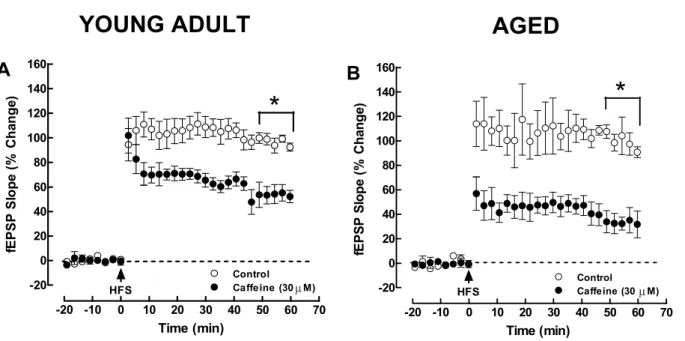
hip-pocampal slices in a manner similar to selective adeno-sine A2A receptor antagonists. Electrophysiological recordings of field excitatory postsynaptic potentials (fEPSP) were obtained from hippocampal slices tak-en from male Wistar rats as previously described [19]. Two separate sets of the Schaffer fibers/CA1 pyramid synapses (S1 and S2) were alternately stimulated at a basal frequency of 0.05 Hz. LTP was induced by high-frequency stimulation pattern (HFS, 1 train of 100 Hz, 100 stimuli) in one pathway (control) under control conditions, and afterwards in the other pathway (test) in the presence of caffeine (30µM). Caffeine was added at least 45 minutes before applying the HFS train to the test pathway and was present throughout the rest of the experiment. As depicted in Fig. 1A, when a HFS train was delivered to hippocampal slices taken from young adult rats (10–15 weeks), there was a sustained increase of synaptic efficiency, i.e., there was a LTP with a magnitude of 97.0± 3.8% over baseline (LTP quantified as the % increase in the average value of the fEPSP slope taken from 50 to 60 min after HFS in rela-tion to the average value of the fEPSP slope during the 10 min that preceded HFS;n = 5; Fig. 1A). Caffeine (30µM) decreased the magnitude of HFS-induced LTP to 53.4± 7.3% over baseline (n = 5, P < 0.05; paired two-tailed Student’st test; comparing the LTP values in the absence and in the presence of caffeine; Fig. 1A). Although the analogy of the inhibitory effects of caf-feine on high frequency-induced LTP with the known inhibitory effects of selective adenosine A2A receptor antagonists is striking, it should be experimentally con-firmed in the future. The prediction would be that the inhibitory effects of caffeine on LTP would be occluded when a selective adenosine A2Areceptor antagonist is applied throughout all the experiment.
ROLE OF ADENOSINE A1 AND A 2A
RECEPTORS IN YOUNG AND AGED ANIMALS
Similar experiments were performed in slices de-rived from aged rats (70–80 weeks old). HFS stimula-tion also triggered LTP, which reached a magnitude of 99.8± 7.3% over baseline in control conditions (n = 4; Fig. 1B). As occurred in young adult rats, caffeine (30µM) decreased the magnitude of HFS-induced LTP to 36.3± 8.2% of baseline (n = 4, P < 0.05; paired two-tailed Student’st test; Fig. 1B). These preliminary results thus suggest that the inhibitory effect of caffeine on the control of LTP magnitude is maintained both in young adult and in aged animals. Again it is
hy--20 -10 0 10 20 30 40 50 60 70 -20 0 20 40 60 80 100 120 140 160 Control Caffe ine (30 M) HFS
*
Time (min) fEPS P S lop e ( % Ch a n g e ) -20 -10 0 10 20 30 40 50 60 70 -20 0 20 40 60 80 100 120 140 160 Control Caffeine (30 M) HFS*
Time (min) fE PSP Sl ope ( % C h ange)A
B
YOUNG ADULT
AGED
µ µ
Fig. 1. Caffeine inhibits long-term potentiation (LTP). Caffeine (30µM, filled symbols) decreased the magnitude of high frequency stimulation (HFS)-induced long-term potentiation (LTP) of the field excitatory postsynaptic potentials (fEPSP) in the Schaffer pathway in hippocampal slices from both young adult (A) and aged rats (B). Data are mean± 1SEM of 4–5 experiments carried out in slices from different rats. *P < 0.05, LTP significantly different between control (absence of added drugs; open symbols) and the presence of 30µM caffeine (filled symbols), Student’s pairedt test.
pothesised that A2Areceptors may be the main target of caffeine to control of LTP in aged rats since there is an age-associated increase of A2A receptor density and function, associated with the decreased A1receptor density and function [21,30–33]. Thus, the effects of caffeine on LTP are preserved upon aging, a conclusion of main importance for the interpretation of the benefi-cial effects of caffeine in neurodegenerative conditions that are prevalent in the elderly.
DIFFERENTIAL ROLE OF ADENOSINE A1 AND A2A RECEPTORS UNDER CONDITIONS OF BASAL FREQUENCY STIMULATION AND HIGH FREQUENCY STIMULATION
Under conditions of high frequency-induced synap-tic plassynap-ticity, endogenous extracellular adenosine main-ly activates facilitatory A2Areceptors; in contrast, un-der conditions of basal frequency synaptic transmis-sion, endogenous extracellular adenosine predominant-ly activates inhibitory A1receptors (reviewed in [34]). Since the effects of caffeine could be largely directed by the physiological conditions that determine whether the predominant signaling is dominated by A1 recep-tors or by A2Areceptors (both of which can be antago-nized nearly equi-efficiently by caffeine),
understand-ing the different (and complementary) roles of A1and A2Areceptors in the control of basal frequency synaptic transmission and synaptic plasticity is required.
A series of different approaches have allowed de-vising a scenario supporting a differential role for A1 and A2A receptors in the control of basal frequency synaptic transmission and plasticity, which is essential-ly based on the different sources of adenosine respon-sible for the activation of both receptors together with a crosstalk between A1 and A2A receptors (reviewed in [34]). Thus, initial studies combining biochemical, neurochemical and electrophysiological studies have supported the idea that the activation of A2A recep-tors seems to require a particular source of adenosine, which is formed from the action of synaptically-located ecto-nucleotidases [35] upon extracellular catabolism of synaptically-released ATP [25,36]. Interestingly, the release of ATP from activated nerve terminals occurs in small amounts at low frequencies of stimulation but occurs in disproportionally larger amounts upon high frequency stimulation of nerve terminals [37–39]. This provides a neurochemical basis for the selective en-gagement of A2Areceptors at high rather than low fre-quencies of nerve stimulation [34], since only during the former, but not the latter, conditions is there a lo-calised synaptic formation of ATP-derived adenosine able to activate the A2A receptors that are highly
en-riched in synapses in the hippocampus [40]. In con-trast, A1 receptors are effectively activated by extra-cellular adenosine, which is either released as such or formed from ATP released from astrocytes [41] in a manner dependent on global nerve activity [42]. Thus, under basal frequency stimulation, there is an increase of extracellular adenosine levels [42] and an on-going inhibitory tonus provided by activation of inhibitory A1receptors [43]. This A1 receptor system is rather effective and able to completely block glutamatergic synaptic transmission in the hippocampus if maximally activated (see e.g. [44]). This poses a problem to under-stand the possibility of increasing the efficiency of hip-pocampal synapses, for instance upon high frequency stimulation (LTP). In other words, increased frequency of stimulation enhances the production of extracellu-lar adenosine [42], which would be expected to fully block synaptic transmission through A1receptor acti-vation. Therefore, the expression of enhanced synaptic transmission upon high frequency stimulation should require switching off A1 receptors. Interestingly, we have found that the activation of A2Areceptors is able to decrease functioning of A1receptors through alter-native (or combined) mechanisms involving a protein kinase C-mediated desensitization of A1receptors [45, 46] and a heteromerization of A1 and A2A receptors whereby the activation of A2A receptors switches off A1receptors [29]. Merging these two lines of evidences presented above, one ends up with a likely scenario able to explain the predominant role of A1 receptors under basal frequency stimulation and a predominant role of A2Areceptors in synapses undergoing plastici-ty changes upon high frequency stimulation (reviewed in [34]).
Adenosine A1 receptors are constitutively activat-ed in all glutamatergic synapses and act as a general threshold barrier that tonically restraints synaptic trans-mission and, to a lower extent, LTP (reviewed in [34]). In particular at synapses undergoing plastic changes, there is a large ATP release and the resulting locally formed adenosine selectively engages A2A receptors only in these ‘activated’ synapses to switch off A1 re-ceptors and assist implementation of LTP through po-tentiation of NMDA-mediated responses [25]. In par-allel, through heterosynaptic depression [47] involving the activation of the astrocytic syncytium surrounding the ‘activated’ synapse [48], more adenosine is gener-ated in neighbouring ‘non-activgener-ated’ synapses which are expected to suffer a greater A1 receptor-mediated inhibition [49]. Thus, the combined engagement of A2Areceptors in the activated synapses with the
glob-al increased activation of A1receptors in all synapses (except the activated synapses, where A1receptors are switched off) contributes to define salience in complex neuronal circuits where only one group of synapses is activated to encode relevant information (reviewed in [34]).
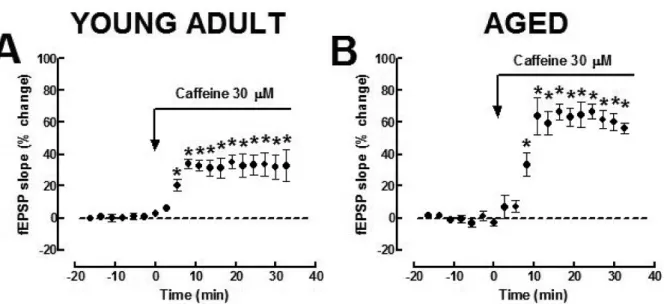
Following the previous discussion, we might expect that caffeine, beyond antagonizing adenosine A2A re-ceptors to modulate high frequency-induced synaptic plasticity, would also antagonize adenosine A1 recep-tors to control basal frequency synaptic transmission. Although this has not yet been confirmed experimen-tally, the available evidence is compatible with this hy-pothesis. Thus, caffeine, at low micromolar concen-trations, is known to increase basal frequency synaptic transmission in the Schaffer fibers likely through antag-onism of A1receptors [50]. Also in experiments from our laboratories, when applied acutely to hippocampal slices obtained from young adult rats (10–15 weeks), stimulated at a basal frequency of 0.05 Hz, caffeine (30µM) caused a facilitation of synaptic transmission that reached an amplitude of 34.8± 5.9% of baseline (facilitation quantified as the % increase in the average value of the fEPSP slope taken from 20 to 35 min after beginning application of caffeine in relation to the av-erage value of the fEPSP slope during the 10 min that preceded application of caffeine; n = 5, P < 0.05; paired two-tailed Student’st test; Fig. 2A). In a similar way, in slices derived from aged animals (70–80 weeks old), caffeine (30µM) also enhanced basal frequency synaptic transmission, a facilitation that reached an am-plitude of 55.7± 8.0% of baseline (n = 5; P <0.05; paired two-tailed Student’st test; Fig. 2B). This facili-tatory effect of caffeine on basal synaptic transmission is qualitatively similar to that obtained when applying a selective A1 receptor antagonist or upon removal of endogenous extracellular adenosine (using adenosine deaminase) in either young adult or aged rats [31].
POSSIBLE RELEVANCE OF THE EFFECTS OF CAFFEINE ON LTP FOR MEMORY
PERFORMANCE
Apart from its intrinsic scientific interest, the deter-mination of the effects of caffeine on synaptic trans-mission and plasticity are largely driven by the strik-ing ability of chronic caffeine consumption to pre-vent memory dysfunction in several animal models of disease [51,52]. This also seems to occur in hu-mans, where it is observed that caffeine consumption
Fig. 2. Caffeine facilitates basal synaptic transmission. A) Caffeine (30µM) enhanced the amplitude of the field excitatory postsynaptic potentials (fEPSP) in the Schaffer pathway upon basal stimulation (0.05 Hz) of hippocampal slices both from young adult (A) and from aged rats (B) in a manner similar to that caused by administration of selective A1 receptor antagonists (data not shown). Data are mean± 1SEM of 5 experiments carried out in slices from different rats. *P < 0.05, comparing the mean fEPSP slopes at different time points with the average value of the fEPSP slope during the 10 min that preceded application of caffeine,n = 5, Student’s two-tailed paired t test, no correction made for multiple comparisons.
may prevent age-related cognitive impairment [53] (but see [54]) and may be inversely associated with the in-cidence of Alzheimer’s disease [55,56]. Interestingly, animal studies have largely concluded that the benefits afforded by chronic caffeine consumption in terms of attenuating memory impairment upon several noxious stimuli [51,52] are mainly mimicked by selective an-tagonists of A2Arather than A1receptors. Given that LTP has been conceived as a possible neurophysiolog-ical correlate of learning and memory (see [2,57]), the present observation that the effect of caffeine on LTP is qualitatively similar to the effects of selective A2A receptor antagonists bolsters the hypothesis that this effect of caffeine on LTP may be related to the abil-ity of caffeine to attenuate the impairment of memo-ry performance. This parallel between the memomemo-ry- memory-restoring properties of caffeine (possibly through A2A receptor antagonism) and the presently observed inhi-bition of LTP by caffeine (also possibly through A2A receptor antagonism) makes it important to discuss a general incorrect assumption about a parallel relation-ship between the magnitude of LTP and memory per-formance. This widespread idea probably arose from the pioneering observations that manipulations block-ing LTP also severely reduced performance in learnblock-ing and memory-related tasks (reviewed in [2]). However, this sustains, at best, that LTP is required for memory processing but it should not be taken as evidence that
LTP and memory are linearly related. In fact, it has previously been elegantly discussed that correct pro-cessing of memory-related information should be de-pendent on defining the salience of information to be encoded, a process that requires not only potentiation of synaptic strength but also depression and depotenti-ation (e.g. [2,58,59]), both homosynaptic and heterosy-naptic (e.g. [60,61]). For that reason, there are several previous manipulations of different proteins that result-ed in an enhancresult-ed LTP couplresult-ed to decreasresult-ed perfor-mance in memory-related tasks (e.g. [62–66]). Thus, it is understandable that caffeine (possibly through A2A receptor antagonism) causes a decrease of LTP magni-tude while restoring memory dysfunction, if one con-siders that caffeine and A2Areceptor antagonists act as normalizers rather than facilitators of synaptic plastic-ity and memory (discussed in [34]; see also Cunha and Agostinho, this issue).
This discussion should not exclude the possibility that the effects of caffeine on memory performance might target brain structures apart from the hippocam-pus and involve the control of processes that indirect-ly regulate memory performance. For instance, caf-feine improves sustained attention [1], and attention effectively modulates the encoding and long-term re-trieval of memories (e.g. [67,68]). However, since it has been shown that caffeine can have additional ef-fects on memory performance apart from its efef-fects on
attention, motivation, vigilance and alertness (e.g. [69, 70]), it is expected that the effect of caffeine on mem-ory might also result from direct effects of caffeine on brain circuits directly related with memory processing amongst which stem hippocampal circuits.
SOME CONSIDERATIONS FOR FUTURE STUDIES OF CAFFEINE ON SYNAPTIC PLASTICITY
It should be noted that, so far, it was observed that caffeine attenuates frequency-induced LTP in the Schaffer pathway, but it would be interesting to test if similar effects of caffeine are also present in dif-ferent excitatory synapses, particularly at the mossy fibers/CA3 pyramid synapses, where a selective adeno-sine A2Areceptor antagonist could block LTP of NM-DA receptor-mediated responses [25].
Although we report that caffeine controlled LTP am-plitude when induced by high frequency stimulation, there are several patterns of frequency-induced synap-tic plassynap-ticity (e.g. theta-burst stimulation) where pos-sible effects of caffeine remain to be determined. In this respect, it should be emphasized that the activa-tion of adenosine A2Areceptors is not expected to be a mandatory process to implement LTP, unlike the re-cruitment of NMDA receptors. Instead, A2A recep-tors are expected to assist (or facilitate) the implemen-tation of LTP. And it still remains to be explored un-der which conditions of plasticity A2Areceptors might play determinant or passive roles. It must also be taken into account that caffeine is expected to cause a par-tial blockade of A2Areceptors, in contrast to selective A2Areceptor antagonists, which were used at a supra-maximal (but selective) concentration to nearly fully block A2Areceptors. For instance, the engagement of A2Areceptors at the neuromuscular junction was found to be possible only with intermittent burst of high fre-quency stimulation rather than with a single continuous train of high frequency stimulation [71], which might be related to a different pattern of ATP release with distinct types of synaptic plasticity induction protocols that may determine the recruitment of A2Areceptors.
In the in vitro experiments on synaptic plasticity de-scribed, caffeine is usually applied in the bath superfus-ing the slices. It would be important to know how a pro-longed and intermittent ingestion of caffeine in the ex-perimental animals, mimicking the caffeine consump-tion pattern in humans, would affect synaptic plasticity elicited in slices taken from these animals. In vivo
ex-periments in animals with chronically implanted elec-trodes would be particularly relevant for that purpose.
Another interesting point is that we have determined the effects of caffeine in male rats but it is not known what might be the effect of caffeine in female rats. This question is particularly important since there are numerous reports of sex differences in the ability of caffeine to afford neuroprotection. For instance, there is an inverse association between caffeine intake and the incidence of Parkinson’s disease, which is more evident in men than in women [72], possibly due to the interfering effect of estrogen replacement thera-pies [73], as also suggested in animal studies [74]. In contrast, the age-related cognitive decline was attenuat-ed by caffeine consumption in women in one study [53], whereas another study reported an inverse association between caffeine intake and the risk of dementia that was stronger in men [56]. Future work should explore whether there are differences between the effects of caffeine both on learning and memory performance and on synaptic plasticity between males and females, to help clarify this sex difference issue.
Finally, it would be of interest to test if caffeine se-lectively modulates long term depression and depoten-tiation as well as other types of shorter or longer plas-ticity phenomena, and to explore the mechanisms link-ing the control by caffeine of synaptic plasticity and its ability to modulate learning and memory performance.
CONCLUSIONS
Concentrations of caffeine above 50µM, used in pre-vious studies describing the effects of caffeine on LTP, are probably not representative of the brain concen-trations of caffeine obtained by ingestion of moderate amounts of coffee and caffeine-containing beverages in humans. The present study provides the first descrip-tion that relevant concentradescrip-tions of caffeine inhibit the magnitude of LTP triggered by high-frequency stimu-lation (possibly via A2Areceptors), in contrast to the excitatory effects of caffeine on basal synaptic trans-mission (possibly via A1receptor antagonism). These effects of caffeine appear to be maintained in aged an-imals, possibly as a result of balanced change of the density and efficiency of A1and A2Areceptors [30–33] and of the sources of endogenous extracellular adeno-sine [75]. This observation is of particular importance when considering the possible beneficial effect for caf-feine in age-related cognitive decline. Future studies will still be required to confirm and detail the
involve-ment of A1 and A2A receptors in the effects of caf-feine on hippocampal synaptic plasticity, using both pharmacological and genetic approaches.
ACKNOWLEDGMENTS
The authors wish to thank Luisa V. Lopes and Maria Jos´e Di´ogenes for helpful discussions of the results. The experimental efforts of Jo ˜ao M.N. Duarte, Manuel-la Kaster and Gianna Cognato in the initial optimization of dosages of caffeine applied in the drinking water in different rodent models of neurodegenerative disorders are greatly appreciated. The work was supported by Fundac¸˜ao para a Ciˆencia e Tecnologia and Fundac¸ ˜ao Oriente.
Authors’ disclosures are available online (http:// www.j-alz.com/disclosures/view.php?id=241).
REFERENCES
[1] Rogers PJ, Dernoncourt C (1998) Regular caffeine consump-tion: a balance of adverse and beneficial effects for mood and psychomotor performance. Pharmacol Biochem Behav 59, 1039-1045.
[2] Martin SJ, Grimwood PD, Morris RGM (2000) Synaptic plas-ticity and memory: an evaluation of the hypothesis. Ann Rev
Neurosci 23, 649-711.
[3] Mart´ın ED, Bu˜no W (2003) Caffeine-mediated presynaptic long-term potentiation in hippocampal CA1 pyramidal neu-rons. J Neurophysiol 89, 3029-3038.
[4] Lee W-L, Anwyl R, Rowan M (1987) Caffeine inhibits post-tetanic potentiation but does not alter long-term potentiation in the rat hippocampal slice. Brain Res 426, 250-256. [5] Lelo A, Birkett DJ, Robson RA, Miners JO (1986)
Compara-tive pharmacokinetics of caffeine and its primary demethylat-ed metabolites paraxanthine, theobromine and theophylline in man. Br J Clin Pharmacol 22, 177-182.
[6] Kaplan GB, Greenblatt DJ, Leduc BW, Thompson ML, Shader RI (1989) Relationship of plasma and brain concentrations of caffeine and metabolites to benzodiazepine receptor binding and locomotor activity. J Pharmacol Exp Ther 248, 1078-1083.
[7] Denaro CP, Brown CR, Wilson M, Jacob P 3rd, Benowitz NL (1990) Dose-dependency of caffeine metabolism with repeat-ed dosing. Clin Pharmacol Ther 48, 277-285.
[8] Benowitz NL, Jacob P 3rd, Mayan H, Denaro C (1995) Sym-pathomimetic effects of paraxanthine and caffeine in humans.
Clin Pharmacol Ther 58, 684-691.
[9] Daly JW, Butts-Lamb P, Padgett W (1983) Subclasses of adenosine receptors in the central nervous system: interaction with caffeine and related methylxanthines. Cell Mol Neurobiol 3, 69-80.
[10] Fredholm BB, Battig K, Holmen J, Nehlig A, Zvartau EE (1999) Actions of caffeine in the brain with special reference to factors that contribute to its widespread use. Pharmacol Rev 51, 83-133.
[11] Bj¨orklund O, Halldner-Henriksson L, Yang J, Eriksson TM, Jacobson MA, Dar´e E, Fredholm BB (2008) Decreased behav-ioral activation following caffeine, amphetamine and darkness in A3adenosine receptor knock-out mice. Physiol Behav 95, 668-676.
[12] Nehlig A, Daval JL, Debry G (1992) Caffeine and the central nervous system: mechanisms of action, biochemical, metabol-ic and psychostimulant effects. Brain Res Rev 17, 139-170. [13] Cunha RA, Cognato GP, Kaster MP, Duarte JMN, Canas
PM (2008) Chronic caffeine consumption prevents memory deficits in animal models of diabetic neuropathy, chronic un-predictable stress or juvenile convulsions. Soc Neurosci Abstr, Program No. 291.2.
[14] Duarte JMN, Carvalho RA, Cunha RA, Gruetter R (2009) Caffeine consumption attenuates neurochemical modifications in the hippocampus of streptozotocin-induced diabetic rats. J
Neurochem 111, 368-379.
[15] Cognato GP, Agostinho PM, Hockemeyer J, M¨uller CE, Souza DO, Cunha RA (2010) Caffeine and adenosine A2Areceptor antagonists prevent memory impairment and synaptotoxicity in adult rats triggered by a convulsive episode in early life. J
Neurochem 112, 453-462.
[16] Wolf OT, Dyakin V, Vadasz C, de Leon MJ, McEwen BS, Bul-loch K (2002) Volumetric measurement of the hippocampus, the anterior cingulate cortex, and the retrosplenial granular cortex of the rat using structural MRI. Brain Res Protoc 10, 41-46.
[17] Wolf OT, Dyakin V, Patel A, Vadasz C, de Leon MJ, McEwen BS, Bulloch K (2002) Volumetric structural magnetic reso-nance imaging (MRI) of the rat hippocampus following kainic acid (KA) treatment. Brain Res 934, 87-96.
[18] de Mendonc¸a A, Ribeiro JA (2001) Adenosine and synaptic plasticity. Drug Dev Res 52, 283-290.
[19] Costenla AR, de Mendonc¸a A, Ribeiro JA (1999) Adenosine modulates synaptic plasticity in hippocampal slices from aged rats. Brain Res 851, 228-234.
[20] Rex CS, Kram´ar EA, Colgin LL, Lin B, Gall CM, Lynch G (2005) Long-term potentiation is impaired in middle-aged rats: regional specificity and reversal by adenosine receptor antagonists. J Neurosci 25, 5956-5966.
[21] Costenla AR, Di´ogenes MJ, Ribeiro JA, Cunha RA, de Mendonc¸a A (2008) Enhanced role of adenosine A2A recep-tors on long-term potentiation in the rat hippocampus upon aging. Soc Neurosci Abstr, Program No. 541.18.
[22] de Mendonc¸a A, Ribeiro JA (1994) Endogenous adenosine modulates long-term potentiation in the hippocampus.
Neuro-science 62, 385-390.
[23] Almeida T, Rodrigues RJ, de Mendonc¸a A, Ribeiro JA, Cunha RA (2003) Purinergic P2receptors trigger adenosine release leading to adenosine A2Areceptor activation and facilitation of long-term potentiation in rat hippocampal slices.
Neuro-science 122, 111-121.
[24] Fontinha BM, Delgado-Garc´ıa JM, Madro˜nal N, Ribeiro JA, Sebasti˜ao AM, Gruartet A (2009) Adenosine A2Areceptor modulation of hippocampal CA3-CA1 synapse plasticity dur-ing associative learndur-ing in behavdur-ing mice.
Neuropsychophar-macology 34, 1865-1874.
[25] Rebola N, Lujan R, Cunha RA, Mulle C (2008) Adeno-sine A2Areceptors are essential for long-term potentiation of NMDA-EPSCs at hippocampal mossy fiber synapses. Neuron 57, 121-134.
[26] Rivkees SA, Thevananther S, Hao H (2000) Are A3adenosine receptors expressed in the brain? Neuroreport 11, 1025-1030.
[27] Lopes LV, Rebola N, Costenla AR, Halldner L, Jacobson MA, Oliveira CR, Richardson PJ, Fredholm BB, Ribeiro JA, Cunha RA (2003) Adenosine A3receptors in the rat hippocampus: lack of interaction with A1receptors. Drug Dev Res 58, 428-438.
[28] Costenla AR, Lopes LV, de Mendonc¸a A, Ribeiro JA (2001) A functional role for adenosine A3receptors: modulation of synaptic plasticity in the rat hippocampus. Neurosci Lett 302, 53-57.
[29] Ciruela F, Casad´o V, Rodrigues RJ, Luj´an R, Burgue˜no J, Canals M, Borycz J, Rebola N, Goldberg SR, Mallol J, Cort´es A, Canela EI, Lopez-Gimenez JF, Milligan G, Lluis C, Cun-ha RA, Ferr´e S, Franco R (2006) Presynaptic control of stri-atal glutamatergic neurotransmission by adenosine A1-A2A receptor heteromers. J Neurosci 26, 2080-2087.
[30] Cunha RA, Constantino MC, Sebasti˜ao AM, Ribeiro JA (1995) Modification of A1 and A2a adenosine receptor binding in aged striatum, hippocampus and cortex of the rat. Neuroreport 6, 1583-1588.
[31] Sebasti˜ao AM, Cunha RA, de Mendonc¸a A, Ribeiro JA (2000) Modification of adenosine modulation of synaptic transmis-sion in the hippocampus of aged rats. Br J Pharmacol 131, 1629-1634.
[32] Rebola N, Sebasti˜ao AM, de Mendonc¸a A, Oliveira CR, Ribeiro JA, Cunha RA (2003) Enhanced adenosine A2A re-ceptor facilitation of synaptic transmission in the hippocampus of aged rats. J Neurophysiol 90, 1295-1303.
[33] Canas PM, Duarte JMN, Rodrigues RJ, K¨ofalvi A, Cunha RA (2009) Modification upon aging of the density of presynaptic modulation systems in the hippocampus. Neurobiol Aging 30, 1877-1884.
[34] Cunha RA (2008) Different cellular sources and different roles of adenosine: A1receptor-mediated inhibition through astrocytic-driven volume transmission and synapse-restricted A2Areceptor-mediated facilitation of plasticity. Neurochem
Int 52, 65-72.
[35] Cunha RA (2001) Regulation of the ecto-nucleotidase pathway in rat hippocampal nerve terminals. Neurochem Res 26, 979-991.
[36] Cunha RA, Correia-de-S´a P, Sebasti˜ao AM, Ribeiro JA (1996) Preferential activation of excitatory adenosine receptors at rat hippocampal and neuromuscular synapses by adenosine formed from released adenine nucleotides. Br J Pharmacol 119, 253-260.
[37] Wieraszko A, Goldsmith G, Seyfried TN (1989) Stimulation-dependent release of adenosine triphosphate from hippocam-pal slices. Brain Res 485, 244-250.
[38] Cunha RA, Vizi ES, Ribeiro JA, Sebasti˜ao AM (1996) Pref-erential release of ATP and its extracellular catabolism as a source of adenosine upon high- but not low-frequency stimu-lation of rat hippocampal slices. J Neurochem 67, 2180-2187. [39] Pankratov Y, Lalo U, Verkhratsky A, North RA (2007) Quantal release of ATP in mouse cortex. J Gen Physiol 129, 257-65 [40] Rebola N, Canas PM, Oliveira CR, Cunha RA (2005)
Differ-ent synaptic and subsynaptic localization of adenosine A2A receptors in the hippocampus and striatum of the rat.
Neuro-science 132, 893-903.
[41] Pascual O, Casper KB, Kubera C, Zhang J, Revilla-Sanchez R, Sul JY, Takano H, Moss SJ, McCarthy K, Haydon PG (2005) Astrocytic purinergic signaling coordinates synaptic networks.
Science 310, 113-116.
[42] Mitchell JB, Lupica CR, Dunwiddie TV (1993) Activity-dependent release of endogenous adenosine modulates
synap-tic responses in the rat hippocampus. J Neurosci 13, 3439-3447.
[43] Dunwiddie TV (1980) Endogenously released adenosine reg-ulates excitability in the in vitro hippocampus. Epilepsia 21, 541-548.
[44] Sebasti˜ao AM, Stone TW, Ribeiro JA (1990) The inhibito-ry adenosine receptor at the neuromuscular junction and hip-pocampus of the rat: antagonism by 1,3,8-substituted xan-thines. Br J Pharmacol 101, 453-459.
[45] Dixon AK, Widdowson L, Richardson PJ (1997) Desensitisa-tion of the adenosine A1receptor by the A2Areceptor in the rat striatum. J Neurochem 69, 315-321.
[46] Lopes LV, Cunha RA, Ribeiro JA (1999) Crosstalk between A1 and A2Aadenosine receptors in the hippocampus and cortex of young adult and old rats. J Neurophysiol 82, 3196-3203. [47] Lynch GS, Dunwiddie T, Gribkoff V (1977) Heterosynaptic
depression: a postsynaptic correlate of long-term potentiation.
Nature 266, 737-739.
[48] Serrano A, Haddjeri N, Lacaille JC, Robitaille R (2006) GABAergic network activation of glial cells underlies hip-pocampal heterosynaptic depression. J Neurosci 26, 5370-5382.
[49] Manzoni OJ, Manabe T, Nicoll RA (1994) Release of adeno-sine by activation of NMDA receptors in the hippocampus.
Science 265, 2098-101
[50] Greene RW, Haas HL, Hermann A (1985) Effects of caffeine on hippocampal pyramidal cells in vitro. Br J Pharmacol 85, 163-169.
[51] Cunha RA (2008) Cafe´ına, receptores de adenosina, memoria y enfermedad de Alzheimer. Med Clin 131, 790-795. [52] Takahashi RN, Pamplona FA, Prediger RD (2008) Adenosine
receptor antagonists for cognitive dysfunction: a review of animal studies. Front Biosci 13, 2614-2632.
[53] Ritchie K, Carri`ere I, de Mendonc¸a A, Portet F, Dartigues JF, Rouaud O, Barberger-Gateau P, Ancelin ML (2007) The neuroprotective effects of caffeine: a prospective population study (the Three City Study). Neurology 69, 536-545. [54] Laitala VS, Kaprio J, Koskenvuo M, R¨aih¨a I, Rinne JO,
Sil-ventoinen K (2009) Coffee drinking in middle age is not asso-ciated with cognitive performance in old age. Am J Clin Nutr 90, 640-646.
[55] Maia L, de Mendonc¸a A (2002) Does caffeine intake protect from Alzheimer’s disease? Eur J Neurol 9, 377-382. [56] Eskelinen MH, Ngandu T, Tuomilehto J, Soininen H, Kivipelto
M (2009) Midlife coffee and tea drinking and the risk of late-life dementia: a population-based CAIDE study. J Alzheimers
Dis 16, 85-91.
[57] Lynch MA (2004) Long-term potentiation and memory.
Phys-iol Rev 84, 87-136.
[58] Govindarajan A, Kelleher RJ, Tonegawa S (2006) A clustered plasticity model of long-term memory engrams. Nat Rev
Neu-rosci 7, 575-583.
[59] Kemp A, Manahan-Vaughan D (2007) Hippocampal long-term depression: master or minion in declarative memory pro-cesses. Trends Neurosci 30, 111-118.
[60] Remondes M, Schuman EM (2004) Role for a cortical input to hippocampal area CA1 in the consolidation of long-term memory. Nature 431, 699-703.
[61] Izumi Y, Zorumski CF (2008) Direct cortical inputs erase long-term potentiation at Schaffer collateral synapses. J Neurosci 28, 9557-9563.
[62] Migaud M, Charlesworth P, Dempster M, Webster LC, Watabe AM, Makhinson M, He Y, Ramsay MF, Morris RG, Morrison JH, O’Dell TJ, Grant SG (1998) Enhanced long-term
potenti-ation and impaired learning in mice with mutant postsynaptic density-95 protein. Nature 396, 433-439.
[63] Jolas T, Zhang XS, Zhang Q, Wong G, DelVecchio R, Gold L, Priestley T (2002) Long-term potentiation is increased in the CA1 area of the hippocampus of APP(swe/ind) CRND8 mice.
Neurobiol Dis 11, 394-409.
[64] Vaillend C, Billard JM, Laroche S (2004) Impaired long-term spatial and recognition memory and enhanced CA1 hippocam-pal LTP in the dystrophin-deficient Dmd(mdx) mouse.
Neuro-biol Dis 17, 10-20.
[65] Sah´un I, Delgado-Garc´ıa JM, Amador-Arjona A, Giralt A, Al-berch J, Dierssen M, Gruart A (2007) Dissociation between CA3-CA1 synaptic plasticity and associative learning in TgN-TRK3 transgenic mice. J Neurosci 27, 2253-2260.
[66] Ehninger D, Han S, Shilyansky C, Zhou Y, Li W, Kwiatkowski DJ, Ramesh V, Silva AJ (2008) Reversal of learning deficits in a Tsc2+/- mouse model of tuberous sclerosis. Nat Med 14, 843-848.
[67] Muzzio IA, Levita L, Kulkarni J, Monaco J, Kentros C, Stead M, Abbott LF, Kandel ER (2009) Attention enhances the re-trieval and stability of visuospatial and olfactory representa-tions in the dorsal hippocampus. PLoS Biol 7, e1000140. [68] Jensen O, Kaiser J, Lachaux JP (2007) Human
gamma-frequency oscillations associated with attention and memory.
Trends Neurosci 30, 317-324.
[69] Hameleers PA, Van Boxtel MP, Hogervorst E, Riedel WJ, Houx PJ, Buntinx F, Jolles J (2000) Habitual caffeine
con-sumption and its relation to memory, attention, planning capacity and psychomotor performance across multiple age groups. Hum Psychopharmacol 15, 573-581.
[70] Hewlett P, Smith A (2007) Effects of repeated doses of caf-feine on performance and alertness: new data and secondary analyses. Hum Psychopharmacol 22, 339-350.
[71] Correia-de-S´a P, Tim ´oteo MA, Ribeiro JA (1996) Presynaptic A1inhibitory/A2Afacilitatory adenosine receptor activation balance depends on motor nerve stimulation paradigm at the rat hemidiaphragm. J Neurophysiol 76, 3910-3919. [72] Ascherio A, Zhang SM, Hern´an MA, Kawachi I, Colditz GA,
Speizer FE, Willett WC (2001) Prospective study of caffeine consumption and risk of Parkinson’s disease in men and wom-en. Ann Neurol 50, 56-63.
[73] Ascherio A, Weisskopf MG, O’Reilly EJ, McCullough ML, Calle EE, Rodriguez C, Thun MJ (2004) Coffee consumption, gender, and Parkinson’s disease mortality in the cancer pre-vention study II cohort: the modifying effects of estrogen. Am
J Epidemiol 160, 977-984.
[74] Xu K, Xu Y, Brown-Jermyn D, Chen JF, Ascherio A, Dluzen DE, Schwarzschild MA (2006) Estrogen prevents neuropro-tection by caffeine in the mouse 1-methyl-4-phenyl-1,2,3,6-tetrahydropyridine model of Parkinson’s disease. J Neurosci 26, 535-441.
[75] Cunha RA, Almeida T, Ribeiro JA (2001) Parallel modification of adenosine extracellular metabolism and modulatory action in the hippocampus of aged rats. J Neurochem 76, 372-382.