Repositório ISCTE-IUL
Deposited in Repositório ISCTE-IUL: 2018-11-07
Deposited version: Post-print
Peer-review status of attached file: Peer-reviewed
Citation for published item:
Graça, J., Oliveira, A. & Calheiros, M. M. (2015). Meat, beyond the plate: data-driven hypotheses for understanding consumer willingness to adopt a more plant-based diet. Appetite. 90, 80-90
Further information on publisher's website: 10.1016/j.appet.2015.02.037
Publisher's copyright statement:
This is the peer reviewed version of the following article: Graça, J., Oliveira, A. & Calheiros, M. M. (2015). Meat, beyond the plate: data-driven hypotheses for understanding consumer willingness to adopt a more plant-based diet. Appetite. 90, 80-90, which has been published in final form at https://dx.doi.org/10.1016/j.appet.2015.02.037. This article may be used for non-commercial purposes in accordance with the Publisher's Terms and Conditions for self-archiving.
Use policy
Creative Commons CC BY 4.0
The full-text may be used and/or reproduced, and given to third parties in any format or medium, without prior permission or charge, for personal research or study, educational, or not-for-profit purposes provided that:
• a full bibliographic reference is made to the original source • a link is made to the metadata record in the Repository • the full-text is not changed in any way
The full-text must not be sold in any format or medium without the formal permission of the copyright holders. Serviços de Informação e Documentação, Instituto Universitário de Lisboa (ISCTE-IUL)
Av. das Forças Armadas, Edifício II, 1649-026 Lisboa Portugal Phone: +(351) 217 903 024 | e-mail: [email protected]
1
Running head: MEAT, BEYOND THE PLATE
1
2
3
4
5
Meat, beyond the plate: Data-driven hypotheses for understanding consumer
6
willingness to adopt a more plant-based diet.
7
2
Abstract
9
A shift towards reduced meat consumption and a more plant-based diet is
10
endorsed to promote sustainability, improve public health, and minimize animal
11
suffering. However, large segments of consumers do not seem willing to make such
12
transition. While it may take a profound societal change to achieve significant
13
progresses on this regard, there have been limited attempts to understand the
14
psychosocial processes that may hinder or facilitate this shift. This study provides an
in-15
depth exploration of how consumer representations of meat, the impact of meat, and
16
rationales for changing or not habits relate with willingness to adopt a more plant-based
17
diet. Multiple Correspondence Analysis was employed to examine participant responses
18
(N = 410) to a set of open-ended questions, free word association tasks and closed
19
questions. Three clusters with two hallmarks each were identified: (1) a pattern of
20
disgust towards meat coupled with moral internalization; (2) a pattern of low affective
21
connection towards meat and willingness to change habits; and (3) a pattern of
22
attachment to meat and unwillingness to change habits. The findings raise two main
23
propositions. The first is that an affective connection towards meat relates to the
24
perception of the impacts of meat and to willingness to change consumption habits. The
25
second proposition is that a set of rationales resembling moral disengagement
26
mechanisms (e.g., pro-meat justifications; self-exonerations) arise when some
27
consumers contemplate the consequences of meat production and consumption, and the
28
possibility of changing habits.
29
30
Keywords: Plant-based diets; Meat; Consumer attitudes; Meat attachment;
31
Meat disgust; Moral disengagement.
32
33 34
3
Meat, beyond the plate: Data-driven hypotheses for understanding consumer
35
willingness to adopt a more plant-based diet.
36
37
1 INTRODUCTION
38
During the last century there was a massive and unprecedented increase in the
39
frequency and amount of consumption of animal-based products, materializing in an
40
ongoing global approach to the standards and lifestyles of industrialized western
41
countries (Delgado, Rosegrant, Steinfeld, Ehui, & Curbois, 1999). This transition
42
characterizes a rise in the consumption of livestock products and a shift away from
43
grains and vegetables as societies become more affluent (Pokpin, 2011). As a result, this
44
global lifestyle change directly opposes the growing scientific consensus that
plant-45
based diets (i.e., those diets which have the bulk of calories from plants sources while
46
limiting or avoiding animal sources) are more sustainable (e.g., de Boer & Haiking,
47
2011; Pimentel & Pimentel, 2003), more healthy (e.g., American Dietetic Association,
48
2003; Sabaté, 2003), and alleviate animal suffering (e.g., Foer, 2010; Singer & Mason,
49
2006).
50
In spite of these benefits, large segments of consumers in western societies do
51
not seem willing to eat a plant-based diet (Lea, Crawford, & Worsley, 2006a, 2006b) or
52
reduce meat consumption (Latvala et al., 2012; Schösler, de Boer, & Boersema, 2012).
53
Several scholars have been alerting that it may take a profound societal transition to
54
achieve significant progresses on this regard (Dagevos & Voordouw, 2013; Schösler et
55
al., 2012). However, evidence concerning the psychosocial processes which affect this
56
shift remains sparse and insufficient relating to changes at the societal level (Cole &
57
McCoskey, 2013; Stehfest et al., 2009). We believe that by converging two recent lines
58
of research we will be able to provide new insights and improve theoretical integration
4
of consumer motivations, thus better explaining consumer willingness and resistance to
60
change. More specifically we refer to studies on willingness to eat plant-based diets and
61
meat substitutes, and findings on the different contexts in which consumers expect meat
62
as a food item. To provide an integrative framework from which to add to current
63
knowledge, pertinent research and propositions on each of these topics are briefly
64
summarized below.
65
66
1.1 Willingness to Eat Plant-based Diets and Meat Substitutes
67
To our knowledge, only a pair of studies conducted in Australia have
68
specifically addressed consumer willingness to eat plant-based diets (Lea et al., 2006a,
69
2006b). Although observing that some consumers perceived several benefits in such
70
diets, conclusions were that the large majority of the population was not ready to move
71
away from meat. Significant perceived barriers included lack of dietary information,
72
lack of desire to change habits, lack of options when eating out, and health concerns.
73
However, the majority of participants in these studies actually disagreed that these were
74
barriers to eating a plant-based diet, even though they were not following and not
75
willing to follow one. Lea et al. called for more research to further understand their
76
findings, and raised the possibility that there are other barriers to consumption that were
77
not assessed in their studies.
78
Although not specifically targeted at plant-based diets, another set of studies
79
exploring consumer acceptance of environmentally sustainable meat substitutes may
80
provide insight into this issue (Elzerman, Hoek, van Boekel, & Luning, 2011; Hoek et
81
al., 2011; Hoek et al., 2013; Schösler et al., 2012). For instance, persons who did not
82
use meat substitutes or had a “light/medium” usage (i.e., less than once per month; once
83
per month or more, but less than once per week) failed to accept the meat substitutes as
5
viable alternatives to meat despite acknowledging ethical and weight control advantages
85
which may accompany higher use of meat substitutes (Hoek et al., 2011). The key
86
barriers found to hinder meat substitute acceptance were related to the product, namely
87
unfamiliarity and low sensory appeal compared to meat. In order to make meat
88
substitutes more attractive to meat consumers, product developers are thus called to
89
significantly improve the sensory quality and resemblance to meat (Hoek et al., 2011;
90
Tucker, 2014). Likewise, the most promising pathways to encourage large-scale shifts
91
towards more plant-based diets are likely the ones that do not challenge existing meal
92
formats and hierarchies, in which meat occupies a central role (Schösler et al., 2012).
93
Indeed, meat still occupies a central position in Western food culture and is
94
depicted as the centre of meals (Barrena & Sánchez, 2009; Fiddes, 1991; Holm & Møhl,
95
2000; Twigg, 1984). There is also evidence of the belief that meat is necessary and seen
96
as an irreplaceable source of force and vitality, coupled with the idea that plant-based
97
meals are nutritionally deficient (Lea & Worsley, 2001). Gender plays an important role
98
in this issue, with studies consistently showing higher levels in frequency and amount of
99
meat consumption among men, and higher willingness to eat plant-based meals among
100
women (e.g., Beardsworth & Keil, 1991; Prättälä et al., 2007; Rothgerber, 2012; Ruby,
101
2012; Santos & Booth, 1996). Furthermore, consumers identify that meat has unique
102
sensory properties in terms of texture and taste (Grunert, Bredahl, & Brunsø, 2004;
103
Kenyon & Barker, 1999). Additionally, meat substitutes tend to rank lower than meat
104
overall, but in particular the substitutes fail with regard to sensory appreciation and
105
other attributes such as value and luxury (Hoek et al., 2011).
106
107
1.2 Meat in Context: Different Framings May Help Explain Incongruences
6
Following a review on consumer perceptions of risk and safety issues
109
surrounding meat, Korzen and Lassen (2010) commented on the conflict between
110
attitudes and behaviours, and the assumption in the reviewed studies that people should
111
be consistent in what they say and do. Likewise, several studies have been showing that
112
although many consumers express health, environmental and animal welfare-related
113
concerns about meat, their behaviour is often not in accordance with their concerns
114
(Holm & Møhl 2000; Hoogland, de Boer, & Boersema, 2005; Verbeke et al., 2010 ).
115
Introducing context as a methodological and analytical tool may facilitate a better
116
understanding of consumer perceptions and make sense of some of these apparent
117
inconsistencies (Korzen & Lassen, 2010). For example, meat in the context of everyday
118
food practices may emerge for consumers anchored in a particular frame of reference
119
(e.g., taste preferences, price, buying, or cooking), and exclude other framings
120
associated with the impacts of current patterns of production and consumption (e.g.,
121
environment, health, or animal welfare). Harmonizing concerns people have and the
122
choices people make as consumers may thus benefit from an improved understanding
123
on how these different framings interact.
124
Although to our knowledge no studies have specifically addressed these
125
interactions, recent evidence on what is called the “meat paradox” (i.e., people enjoying
126
eating meat but disapproving of harming animals; see Loughnan, Bastian, & Haslam,
127
2014) does provide some insights. Specifically, overlapping the framings of meat as
128
food and meat as animal seems to evoke dissonance in the moral domain. For instance,
129
categorization as food was found to reduce animals’ perceived capacity to suffer and
130
restrict moral concern for animals (Baratanova, Loughnan, & Bastian, 2011). Likewise,
131
it was observed that eating meat reduces moral concern for animals in general, the
132
perceived moral status of animals used for meat, and the ascription of mental states
7
necessary to experience suffering (Loughnan, Haslam, & Bastian, 2010). In contrast,
134
having people first reflect on their own perceptions of animals’ mental attributes
135
subsequently increases feelings of disgust at the thought of eating animals (Ruby &
136
Heine, 2012). Disgust is an emotional aversion and a critical factor in determining
137
people’s willingness to ingest a given food (Rozin & Fallon, 1987). It also plays a key
138
role in moral judgment (Pizarro, Inbar, & Helion, 2011; Rozin, Markwith, & Stoess,
139
1997). Denying animals certain psychological characteristics has indeed been identified
140
as a mechanism of moral disengagement among meat eaters (Bilewicz, Imhoff, &
141
Drogosz, 2011).
142
143
1.3 Current Study – Research Questions and Objectives
144
Plant-based diets and alternatives to meat are increasingly associated with
145
several benefits, but a high consumption of meat and a low regard for meat substitutes is
146
still the dominant cultural pattern in most western societies. Most consumers do not
147
seem willing to shift towards a more plant-based diet. Our general aim is to contribute
148
to a further understanding of the psychosocial processes that hinder or facilitate this
149
transition.We will draw on qualitative data and use multiple correspondence analysis to
150
detect and represent underlying structures in the dataset, as a way to provide
151
opportunities to identify key issues, raise data-driven propositions and derive
152
hypotheses to be tested in further research. Specifically, we address three main research
153
questions regarding the representations, impacts and rationales of diet with regard to
154
meat consumption.
155
156
1) How do representations of meat relate with willingness to adopt a more
157
plant-based diet?
8
Meat’s central role and special status are suggested to play a part in
159
hindering a large-scale shift towards plant-based diets, but moving down to the
160
level of the consumer, meat’s role and status are only reflective of its appraisal
161
by individuals within a culture. Thus, moving beyond the abstract notion of meat
162
as the dominant food (alongside with other animal-based products), it is the core
163
of that appraisal that must be investigated (Fiddes, 1991). Our objective is to
164
unpack what specific thoughts, ideas and feelings about meat are associated with
165
personal willingness to follow a more plant-based diet. Here we contemplate
166
representations of meat framed in the context of everyday food practices.
167
168
2) How do perceived impacts of meat relate with willingness to adopt a more
169
plant-based diet?
170
We give sequence to the notion that putting meat in context may help
171
explaining consumer perceptions on its risks and impacts, and extend this
172
proposition to the understanding of meat substitution. By addressing this
173
question, our objective is to explore how perceptions on the impacts of meat (to
174
the environment, health, and animals) emerge associated with personal
175
willingness to follow a more plant-based diet. Here we contemplate
176
representations of meat framed in the context of its impacts.
177
178
3) How do personal rationales for changing or not changing consumption habits
179
relate with willingness to adopt a more plant-based diet?
180
Previous studies on willingness to eat a plant-based diet and on
181
acceptance of meat substitutes point towards several barriers among the majority
182
of consumers (e.g., Hoek et al., 2011; Lea et al., 2006), but these papers do not
9
consider how consumers may react to the consequences of meat consumption
184
when they are called upon to consider changing their habits. We intend to look at
185
the interplay between the different frames of reference for meat consumption
186
and discover how the rationales for eating meat emerge in response to changing
187
consumption habits – two key concepts not covered previously in the literature.
188
189
2 METHODS
190
2.1 Participants and procedure
191
In an effort to include a wider range of backgrounds and geographical locations
192
(Gosling, Vazire, Srivastava, & John, 2004), this study was conducted through an
193
internet platform and promoted through advertisements on social media. The survey
194
was hosted online by Qualtrics.com and advertised to Portuguese users. A brief
195
recruitment note presented the study as “exploring people’s opinions on several issues
196
related with society and different social practices, lifestyles and consumption habits”.
197
Participation was rewarded with the option of registering in a draw to win a 9” tablet.
198
To minimize self-selection biases, no references were made in the advertisement and
199
cover page to the specific goals of the study.
200
The survey was accessible for eight weeks between May and July 2013. During
201
this period 1180 people clicked on the link to the survey and 410 participants (aged
202
between 18 and 69 years, M = 30.2, SD = 10.9) completed all the measures from the
203
questionnaire. An overview of the sample’s characteristics concerning gender, age,
204
education, occupation, place of residence, self-reported diet and eating habits is
205
provided in Table 1. There were concerns about the low completion rate and biases in
206
terms of gender, age and education level. The biases were in line with a trend found in
207
previous online studies and might be consequence of having chosen an online
10
recruitment platform (Cardoso et al. 2013; Geeroms, Verbeke, & Van Kenhove, 2008).
209
The low completion rate was possibly due to the nature of the survey (i.e., mostly
210
constituted by open-ended questions and word association tasks; see description of the
211
measures in section 2.2 Measurement). With respect to other variables, the present
212
sample showed diversity in terms of employment status (i.e., employed, unemployed,
213
student) and covered a range of occupations, including administrative/technical staff
214
(e.g., customer support, office employees), skilled workers (e.g., teachers, computer
215
programmers) and sales/non-qualified staff (e.g. shop clerks, cleaning staff). Table 1
216
demonstrates that the sample pool was diverse in terms of background and meat
217
consumption.
218
We used two ways to address the four attributes of qualitative data: credibility,
219
transferability, dependability and confirmability (Shenton, 2004). We drew upon
220
established methods and analytic procedures to bolster the credibility of the research.
221
However, as this is new research, in order to boost the other three we have been explicit
222
and detailed regarding the measures and analytical procedures.
223 224 [INSERT TABLE 1] 225 226 2.2 Measurement 227
Data concerning representations of meat, perceived impact, behavioural
228
intentions, willingness to change and rationales used when facing impacts of meat were
229
collected using a set of free word association tasks, open-ended and closed questions.
230
231
Meat Representations. Participants’ representations (i.e., ideas, thoughts, and
232
feelings or emotions) about meat were retrieved by means of two word association
233
tasks. Word association tasks have been widely used in the context of social
11
representations but also in studies on food related thinking based upon different
235
theoretical frameworks (e.g., Mäkiniemi, Pirttilä-Backman, & Pieri, 2011). Participants
236
were asked to write up to eight words or concepts that came to mind with the following
237
instructions: (1) “Meat makes me think, feel or imagine…” and (2) “If I was forced to
238
stop eating meat I would feel…”. Below each stimulus were eight lines with bullet
239
points in which respondents could write their answers.
240
241
Perceived Impact of Meat. The perceived impact of meat was retrieved by means
242
of three open-ended questions. Participants were asked to briefly indicate their opinion
243
about how meat consumption may impact (1) nature and the environment, (2) public
244
health and (3) animals. Below each of the topics there were three lines in which
245
participants could write their answers.
246
247
Behavioural Intentions: Willingness to Change and Rationales Used When
248
Facing Impacts of Meat. In the end of the questionnaire participants read a small text
249
mentioning consequences associated with current meat production and consumption
250
standards. Below we quote from the text.
251
In recent years several organizations, entities and scientific studies have been
252
associating current patterns of meat production and consumption to several
253
consequences. Among these consequences there are different impacts to:
254
• Animals: for instance, deprivation of outdoor contexts and contact with natural
255
living environments, impossibility of engaging in natural behaviours, mutilation,
256
overcrowding and inadequate living conditions, infliction of pain and suffering,
257
disruption of natural maternal cycles and offspring development;
12
• Nature and the environment: for instance, pollution of rivers and groundwater
259
tables, deforestation, less sustainability and higher environmental costs in
260
comparison with nutritionally equivalent plant-based foods;
261
• Public health: for instance, marked increase in heart diseases, high blood
262
pressure and overweight, and some types of cancer.
263
After reading the text, participants were asked to indicate their intentions and
264
rationales to change or maintain habits: “Do you intend to maintain your current levels
265
of meat consumption?” Yes/No; “Please indicate the reasons that explain your choice”
266
Open-ended with three lines in which participants could write their answers; “Are you
267
willing to reduce your current levels of meat consumption, for example, by half?”
268
Yes/No; “Are you willing to follow a Plant-Based Diet (i.e., in which meat is
269
excluded/avoided or its consumption is infrequent and in small portions)?” Yes/No.
270
271
Demographic Information and Eating Habits. Demographic information
272
included participants’ gender, age, current residence, place of birth (i.e., rural or urban)
273
and education (i.e., basic, secondary, or higher). Eating habits included self-reported
274
diet (i.e., omnivore, vegetarian, or vegan) and frequency of consumption of several food
275
items – “In an ordinary week, how often do you eat: red meat (e.g., pork, beef), white
276
meat (e.g., chicken, turkey), fish, fruits and vegetables, grain legumes (e.g., beans,
277
chickpeas), meat substitutes (e.g., tofu, seitan)”. Response scale had three levels (1 –
278
Often/most days; 2 – Seldom/one or two times per week; 3 – Never).
279
280
Additional Measures. Additionally participants were asked in the beginning of
281
the survey to fill out a preliminary free word association task and write as many as six
282
short examples of good and bad practices regarding health, the environment, and
13
animals. However, initial analyses showed this question did not discriminate among the
284
participants. Given the lack of discriminatory value and to reduce the complexity of the
285
dataset this variable was not included in subsequent analysis.1
286
287
2.3 Data Analyses
288
Given the diversity of measures employed in the present study, different
289
analytical procedures were used in preparing the data for identification of patterns in the
290
dataset.
291
Data retrieved in the free word association tasks (i.e., representations of meat)
292
was converged firstly by putting words in the singular (noun) or infinitive (verb). A
293
total of 939 words (mentioned 2530 times) were retrieved. Words with only one
294
occurrence were then dropped. To ensure preservation of the meanings conveyed by the
295
participants, aggregation in categories occurred in words referring to the same meaning
296
(e.g., category “weak” aggregates “fragile” and “weak”) or words from the same family
297
(e.g., category “food” aggregates “meal” and “steak”). A total of 375 words were thus
298
aggregated in 41 categories (mentioned 1703 times). Participants’ answers were then
299
coded in the dataset according to the presence or absence of each category (1 =
300
mentioned; 2 = not mentioned).
301
Data from the open ended questions (i.e., perceived impacts of meat and
302
rationales used when facing impacts of meat) was thematically analysed using
303
MAXQDA v.10 and followed the five steps of the procedure proposed by Braun &
304
Clarke (2006): (1) initial data review by reading for meanings and patterns; (2)
305
generation of initial codes using semantic criteria; (3) search for themes by code
306
collation; (4) review and revision of the themes based on an adequate fit between the
307
1 However, to meet the criteria for trustworthiness in qualitative research, the measure is nonetheless
14
thematic map and the data set; (5) naming of the data set themes by identifying the core
308
meaning of each theme. To ensure preservation of the original meanings conveyed by
309
the participants, in step three the collation of codes into potential themes was done using
310
semantic criteria (Boyatzis, 1998). A total of 42 themes (mentioned 2309 times) were
311
thus identified in the data from the four open-ended questions. Participants’ answers
312
were coded as categories in the dataset according to the presence or absence of each
313
theme (1 = mentioned; 2 = not mentioned).
314
To favour a parsimonious solution and avoid residual categories that could be
315
problematic when running subsequent analyses, only the categories from the word
316
association tasks and open ended questions that were mentioned by at least near 10% of
317
the participants were retained, included in the analyses and considered for interpretation
318
purposes. The category system thus comprised 38 categories that were mentioned 2531
319
times (Table 2). To test the reliability of this category system we randomly selected 30
320
units of analysis from each measure (total of 180 units of analysis) that were
321
subsequently coded by an independent judge, enabling the determination of the
inter-322
rater agreement (Cohens’ kappa ranging from .87 to 1, p < .001).
323
After determining the inter-rater agreement value we performed a multiple
324
correspondence analysis (MCA) and a hierarchical cluster analysis (HCA). MCA was
325
used to explore the interrelationships between the categorical variables (Greenacre,
326
2007) and the HCA was performed in order to validate the MCA pattern solution (Hair,
327
Black, Babin, & Anderson, 2010), while using MCA standardized object scores as input
328
variables (Bernardes et al., 2014). The HCA was suited by a k-means algorithm
(non-329
hierarchical clustering method). Analyses were performed using IBM SPSS Statistics
330
(version 20).
331
15
3 RESULTS
333
This study explored how representations of meat, perceived impacts of meat, and
334
rationales for changing/not changing habits emerge associated with willingness to adopt
335
a more plant-based diet (i.e., intention to change habits, willingness to reduce meat
336
consumption, and willingness to follow a plant-based diet). We began by providing a
337
brief description of the participants’ answers in terms of frequency and semantic
338
content, and then proceeded to the interpretation of the dimensions identified in the
339
MCA. Finally, we presented the topological representation of the interrelationships
340
between categories and also described the results from the HCA.
341
342
3.1 Descriptive Results
343
Table 2 shows the most frequent categories that emerged from the participants’
344
responses to each of the tasks in study. In the first task (Table 2, Representations of
345
Meat - Meat) meat was mostly invested with hedonic feelings (i.e., Pleasure, Satiated)
346
and emerged as a symbol of food and eating (i.e., Food). But meat was also invested
347
with negative feelings (i.e., Suffering, Disgust) and associated with Death and Animals.
348
In the second task (Table 2, Representations of Meat – No Meat), the perspective of not
349
eating meat was mostly invested with negative feelings related with grief, pointing to an
350
emotional/affective connection with meat (i.e., Sad, Bad, Missing Something) feelings
351
of weakness (i.e., Weak), but also positive feelings and well-being (i.e., Well, Clear
352
Conscience). There were also more neutral expressions of acceptance and indifference
353
(i.e., Indifferent, Would Adapt). Concerning the perceptions on how meat impacts
354
animals (Table 2, Perceived Impacts – Animals), participants often referred to mass
355
production and artificial methods (i.e., Industry) and several negative consequences
356
(i.e., Suffering, Disrespect, Abuse, Poor Conditions). However, some also referred to
16
livestock animals as serving the purpose of meat extraction (i.e., Purpose) or
358
conditionally acknowledged impacts only if production/consumption is unregulated or
359
in excess (i.e., If Unregulated). Regarding perceived impacts on nature and the
360
environment (Table 2, Perceived impacts – Nature), most references concerned
361
pollution and depletion of natural resources (i.e., Pollution, Depletion), and mass
362
production and artificial methods (i.e., Industry). Some participants acknowledged
363
impacts to nature and the environment only if production/consumption is unregulated or
364
in excess (i.e., If Unregulated), while the denial of impacts was also observed (i.e., No
365
Impact). As to perceived impacts on health (Table 2, Perceived impacts – Health), most
366
references concerned risk for Diseases, Food Insecurity and Contamination. Again,
367
participants also referred to mass production and artificial methods (i.e., Industry) and
368
the denial of impacts to health was also observed (i.e., No Impact). Concerning
369
rationales to change/not change behaviour after reading a brief paragraph quoting
370
impacts associated with current meat production and consumption patterns (Table 2,
371
Rationales), answers referred to pro-meat justifications (i.e., Meat Necessary, Meat
372
Pleasure), self-exonerations (i.e., Not My Fault, No Alternative), but also references to
373
avoiding or minimizing harm to animals and public health (i.e., Animals, Health).
374
In terms of content, answers provided by the participants pointed towards the
375
existence of different patterns or profiles in relation to representations of meat,
376
perceived impacts, rationales and behavioural intentions. This possibility was
377
subsequently supported and revealed in the MCA.
378
379
[INSERT TABLE 2]
380 381
3.2 Dimensions Identified in the MCA
17
The MCA identified two relevant dimensions accounting for 16,5% and 6,1% of
383
the total variance, respectively. Both dimension one and two differentiate individuals
384
based on their relative affective connection towards meat and willingness to change.
385
However, dimension one measures the valence of the affective connection and
386
dimension two measures the intensity of the affective connection. Discrimination
387
measures of each variable for the two dimensions are presented in Table 2 (see
388
Dimensions column). When describing each dimension, values above inertia (variance
389
mean value) were considered, which are set in boldface. The coordinates for each
390
category were also considered in order to describe patterns of association and
391
opposition. Although these coordinates are not shown in Table 2, they are subsequently
392
illustrated in the topological representation provided in Figure 1.
393
Dimension one seems to differentiate individuals in terms of affective
394
connection towards meat and willingness to change. In one of the poles of the axis there
395
is an association between categories referring to feelings of disgust and signs of
396
negative affect towards meat, references to negative impacts and to animals as victims,
397
willingness to change consumption habits, and also the absence of meat consumption.
398
In opposition, in the other pole of the axis an association emerges among hedonic
399
feelings and signs of dependency towards meat, lack of willingness to follow a PBD and
400
to reduce meat consumption, and the intention to maintain current habits.
401
In turn, dimension two differentiates individuals in terms of intensity of the
402
affective connection towards meat, intentions to change and willingness to reduce meat
403
consumption. In one of the poles of the axis the most distinctive trait is a sign of
404
detachment towards meat, but also an association with references to mass production
405
systems and artificial methods, contamination and food insecurity, and the intention to
406
change consumption habits, specifically reducing meat consumption, as a way to
18
minimize harm to animals and health. The opposite pole includes categories referring to
408
the lack of willingness to reduce meat consumption and the intention to maintain current
409
habits, although not as distinctive attributes of this dimension.
410
411
3.3 Topological Configuration and Projection of Clusters
412
In order to identify different profiles of consumers with regard to the issues in
413
this study, we explored the intersection between the two dimensions that differentiated
414
participants. We used a topological display of the coordinates provided by the MCA.
415
For purposes of clarity the results are presented side by side in different frames due to
416
the high number of categories analysed. However, all frames refer to the same MCA.
417
Each frame presents a set of categories. Frame one (F1) shows categories that emerged
418
in representations of meat (i.e., “Meat makes me think, feel or imagine…” and “If I was
419
forced to stop eating meat I would feel…”). Frame two (F2) presents categories that
420
emerged based on the perceived impacts of meat (i.e., “Please indicate your opinion
421
about how meat consumption may impact: nature and the environment; public health;
422
and animals”). Frame three (F3) shows categories for the rationales and willingness to
423
change (i.e., “Do you intend to maintain your current levels of meat consumption?” ;
424
“Please indicate the reasons that explain your choice”; “Are you willing to reduce your
425
current levels of meat consumption, for example, by half?”; “Are you willing to follow
426
a Plant-Based Diet (i.e., in which meat is excluded/avoided or its consumption is
427
infrequent and in small portions)?”). Finally, frame four (F4) displays (a posteriori, as
428
passive variables, thus not actively contributing to the association patterns) the
429
coordinates from the three clusters identified in the space defined in the MCA.
430
While the graphic representation of Figure 1 includes all variables, in the brief
431
description of the results we consider the ones that contribute the most to the definition
19
of the two dimensions (i.e. variables that have a discrimination measure greater than the
433
inertia value for the respective dimension; and that the categories present higher
434
contributions taking as reference the average contribution – in this case 0.012 = 1/84,
435
one being the sum of the contributions for each dimension, and 84 the total number of
436 categories). 437 438 [INSERT FIGURE 1] 439 440
Figure 1 thus shows the topological configuration of the intersection between
441
dimension one (i.e., valence of affective connection towards meat; >0 referring to
442
positive affect, <0 referring to negative affect) and dimension two (i.e., intensity of the
443
affective connection; >0 referring to higher intensity, <0 referring to lower intensity).
444
The responses were nicely bounded into three groups in three main spaces along the
445
different frames, corresponding to the higher-right, higher-left and lower-left quadrants.
446
The border of each group is represented by a different hash pattern. In the higher-right
447
quadrant of each frame (i.e., positive affect and higher intensity) is group three,
448
combining categories referring to meat attachment (F1) and the denial and legitimation
449
of impacts (F2). This association also includes lack of willingness to reduce
450
consumption and the intention to maintain habits, using a set of pro-meat arguments as
451
rationale (F3). In opposition, in the higher-left quadrant of each frame (i.e., negative
452
affect and higher intensity) is group one, combining a set of categories referring to
453
disgust towards meat (F1), the affirmation of harm with an emphasis on animals as
454
victims (F2), and (more distantly) the absence of meat consumption by the time of
455
completion of the questionnaire (F3). In turn, near the lower-left quadrant but closer to
456
the centre in the axis of dimension one (i.e., neutral to negative affect and lower
457
intensity) is group two, combining detachment towards meat (F1) and the affirmation of
20
impacts with reference to mass production systems, artificial methods and food
459
insecurity (F2). This association also includes willingness to reduce meat consumption
460
and intentions to change habits, mentioning the avoidance/minimization of harm to
461
animals and health as rationales for change (F3).
462
Finally, the results of the HCA validated the MCA solution and yielded three
463
clusters of participants matching the three groups that emerged on the MCA (F4).
464
Cluster three included almost half of the participants and referred to the pattern of
465
attachment to meat, unwillingness to change, and a set of rationales when considering
466
impacts and the possibility of changing habits (group three). Cluster two included
467
around a third of the participants, referring to the pattern of low affective connection
468
towards meat and willingness to change habits to avoid or minimize harm for animals
469
and health (group two). Cluster one included a minority of participants and referred to
470
disgust towards meat and moral internalization (group one). Table 3 characterizes each
471
of the three clusters in terms of demographic variables and eating habits. Chi-square
472
analyses suggested significant differences between the three clusters in all variables
473
measured except place of residence (urban vs. rural).
474 475 [INSERT TABLE 3] 476 477 4 CONCLUSIONS 478
To our knowledge, this study is the first to provide an in-depth enquiry of
479
consumer representations of meat, perceived impacts of meat, and rationales used when
480
called upon to consider changing consumption habits after exposure to information on
481
the impact of meat. It explores how each of these relates with each other and with
482
willingness to follow a more plant-based diet. The findings raise two main propositions,
21
once concerning an affective connection and the other the rationales of meat
484
consumption.
485
The first proposition is that an affective connection towards meat relates to how
486
impacts of meat are perceived and to willingness to change consumption habits. In this
487
regard, three different clusters of consumers were identified, referring to a pattern of
488
attachment to meat (positive valence and higher affective intensity), a pattern of disgust
489
(negative valence and higher affective intensity), and a pattern of avoidance (neutral to
490
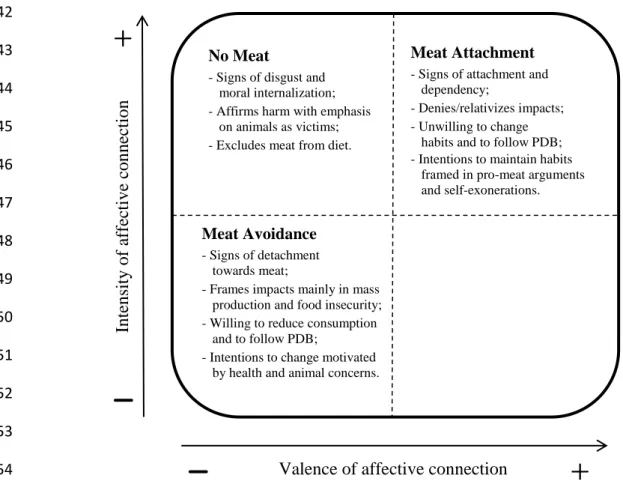
negative valence and lower affective intensity). A simplified graphic illustration
491
depicting the interplay between the variables and the positions of the clusters along the
492
axes of valence and intensity of affective connection is provided in Figure 2.
493
[FIGURE 2]
494
The existence of an affective connection towards meat has been previously
495
established, namely a pattern of disgust (e.g., Rozin et al. 1997). Results from the
496
present study add to this knowledge suggesting that affective connection towards meat
497
may actually be a continuum in which one end refers to disgust (i.e., negative affect and
498
repulsion, related with moral internalization), while the other shows an attachment
499
pattern (i.e., positive affect and dependency, related with feelings of sadness and
500
deprivation when considering abstaining from meat consumption) that may prevent a
501
change consumption habits.
502
The identification of three distinct profiles along the axes of intensity and
503
valence of affective connection to meat provides insights for increased understanding of
504
the psychology of meat consumption and meat substitution. Likewise, it points towards
505
the importance of designing tailored initiatives when encouraging a shift towards a
506
more plant-based diet. For instance, consumers holding a pattern referred to as meat
507
avoidance may be the segment of most interest, since it apparently is the most open to
22
information on the impacts of meat and the benefits of changing habits. Targeted
509
communication for this segment may include information on the issues surrounding
510
industrial production framed by health and animal concerns, since these emerged as
511
motivators to adopt a more plant-based diet. It is known, however, that changing eating
512
behaviours requires more than simply formulating intentions (e.g., Godinho, Alvarez,
513
Lima, & Schwarzer, 2014). The identification of this segment of consumers framed in
514
the axes of affective connection is merely a starting point. It calls for further studies to
515
explore the intersections among recent trends towards eating less meat that are being
516
observed and labelled under different terms in the literature (e.g., meat avoidance,
517
Beardsworth & Keil, 1991; meat-reduced diet, Hayley et al., 2015; flexitarianism,
518
Raphaely & Marinova, 2014; conscious omnivorism, Rothgerber 2015). Likewise, it
519
calls for more research to learn how to empower these consumers to effectively make
520
sustained and lasting changes in their habits.
521
As for consumers holding a pattern of attachment to meat, the results raise the
522
hypothesis that mere exposure to information on the impacts of current patterns of
523
production and consumption may not to be sufficient to elicit willingness to change.
524
Instead, as Rothgerber (2014) suggests, it is possible that some initiatives to encourage
525
reducing meat-eating may actually increase entrenchment in meat-eating justifications,
526
and it may be the case that this is particularly true among more attached consumers. If
527
so, it would be expected that trying to reach these consumers without triggering defence
528
or loss-aversion mechanisms should benefit from more indirect approaches, such as
529
facilitating structural changes that make plant-based meals more accessible and
530
increasingly mainstream (Vinnari & Vinnari, 2014). On this note, it is worth recalling
531
that large-scale transitions in food consumption patterns usually happen by way of
532
substitution with a food that can take over the function of the foodstuff that fell away
23
(Montanari, 1994). It has been established that besides meeting basic needs for energy
534
and nutrition, food habits play numerous other roles in people’s lives (Fieldhouse,
535
1995). Likewise, choices and preferences are often anchored in values, meanings and
536
shared conventions going beyond the biological function they ensure (Beardsworth &
537
Keil, 2002). In terms of product development, if meat does play an affective role to
538
some consumers, one of the key challenges may be in creating alternatives that are also
539
invested with a special role beyond nutrition. For instance, when developing and
540
launching meat substitutes, it may be of relevance to pay special attention not only to
541
physical attributes such as taste and texture (Hoek et al., 2011; Tucker, 2014), but also
542
on how these products are marketed, positioned and distributed. Taking this hypothesis
543
one step ahead, perhaps for consumers exhibiting high attachment to meat, instead of
544
challenging the centrality of meat it may be a more fruitful first step to try to expand the
545
concept of meat in order to encompass also non-animal based substitutes (i.e., a small
546
portion of meat as a central protein source, surrounded by plant based proteins). More
547
research is needed to expand on these possibilities and increase understanding on these
548
consumers’ perspectives about meat consumption, and the issues underpinning a
549
transition towards a more plant-based diet. Drawing from recent findings, these may
550
include volitional factors such as perceived behavioural control, changing deep-rooted
551
habits and beliefs about potential health benefits and challenges (e.g., Zur & Klöckner,
552
2014), but also ideological concerns such as dominance ideologies and resistance to
553
cultural change (e.g., Dhont & Hodson, 2014).
554
The second main proposition that this study raises is that different consumers
555
hold on to different rationales when contemplating the consequences of current meat
556
production and consumption patterns, and the possibility of changing habits. Previous
557
evidence provides support for the role of dissonance reduction in facilitating the practice
24
of meat eating (Loughnan et al., 2014). In this study, when the framing of meat as food
559
overlaps with the framing of meat as impacting animals, the environment and public
560
health, participants resolved the tension by two different paths. Specifically, individuals
561
holding a negative to neutral pattern of affective connection towards meat (i.e., the
562
cluster referred to as meat avoidance) appeared to resolve eventual dissonance by
563
expressing willingness to reduce consumption and to adopt a PBD. In contrast,
564
consumers with a pattern of attachment towards meat appeared to resolve this
565
dissonance by resorting to pro-meat justifications and self-exonerations resembling a
566
process of moral disengagement.
567
Moral disengagement theory proposes that individuals will be particularly
568
motivated to resort to disengagement mechanisms when adopting or maintaining
569
harmful behaviours that are valued and desired (i.e., self-serving) (Bandura, 1999&
570
2002). In line with the results from the present study, a considerable amount of evidence
571
on the centrality of meat in conventional (western) diets suggests that it is often invested
572
with a higher status in comparison to other food products (Fiddes, 1991; Schösler et al.,
573
2012). Assuming that individuals will be particularly motivated to use disengagement
574
mechanisms when adopting or maintaining harmful but cherished behaviours, moral
575
disengagement may indeed play a role when considering the damage currently
576
associated with meat in light of the possibility of changing personal habits.
577
Reflecting on the “meat paradox”, Loughnan et al. (2014) note that most people
578
find animal suffering emotionally disturbing and do not want to see animals harmed, but
579
engage in a diet that requires them to be killed and usually to suffer (Herzog, 2010; Joy,
580
2010; Singer, 1975). Moral disengagement (as a process of preventing or reducing
581
dissonance in the moral domain) may thus create conditions for current patterns of meat
582
consumption to endure even among people who subscribe to concerns about animal
25
suffering, but also to the environment and/or public health. If this is the case, pro-meat
584
justifications (i.e., “Meat is necessary”, “Meat is pleasure”) may serve as cognitive
585
reframing in which the ends justify the means, and self-exonerations (i.e., “Not my
586
fault”, “No alternative”) may discard and displace personal responsibility concerning
587
harm and the possibility of changing habits. In addition, failing to acknowledge
588
consequences (i.e., “No impact”) and excluding farm animals from the scope of moral
589
concern (i.e., “It’s their purpose”) may also operate to prevent or reduce dissonance in
590
the moral domain. Future research could thus explore the connection between an
591
affective connection towards meat (i.e., disgust vs. attachment) and the morality of meat
592
(i.e., moral internalization vs. moral disengagement). This research will add to the
593
knowledge of the role of self-consistency motives and dissonance reduction in meat
594
consumption and willingness to follow a plant-based diet (Bastian et al., 2012; Prunty,
595
& Apple, 2013; Rothgerber, 2014).
596
In this study we drew on qualitative data as a way to provide opportunities to
597
identify key issues, raise data-driven propositions and derive hypotheses to increase
598
understanding on the psychology of meat consumption and substitution. Beyond the
599
main propositions advanced, results echoed additional findings from previous studies
600
exploring this issue.
601
For instance, meat is often portrayed as a symbol of virility (Rothgerber, 2012;
602
Ruby & Heine, 2011) and tends to be depicted as a typical male food, in contrast with
603
fruits and vegetables, which are typically considered more feminine (O’Doherty &
604
Holm, 1999). Likewise, there is evidence suggesting that vegetarian men may be
605
subjected to efforts in reconciling their gender identity with their dietary identity
606
(Beardsworth & Keil, 1992; Rothberger, 2013; Ruby & Heine, 2011). In this study, the
607
clusters of participants mostly associated with willingness to avoid/reduce meat
26
consumption and follow a plant-based diet (i.e., no meat and meat avoidance) consisted
609
almost solely of women, while the cluster associated with unwillingness to change (i.e.,
610
attachment to meat) was more balanced in terms of participants’ gender. The notion that
611
meat and meat substitution are not gender neutral thus found additional support in the
612
present results. Moreover, while our findings reinforce the view that meat’s special
613
status may play a role in hindering a large-scale shift towards a more plant-based diet,
614
they also suggest that this status is possibly being challenged in emerging clusters of
615
consumers expressing higher awareness on the impact of meat and willingness to move
616
towards less animal-based diets (Schösler et al., 2012).
617
Given the exploratory nature of this work, it is important to highlight that all
618
propositions are tentative. Likewise, it is clear that much more research is needed to
619
keep advancing in the understanding of the psychosocial processes that may hinder or
620
engage a shift towards a more plant-based diet. Even so, one main limitation of this
621
work should be discussed from the outset, which is the bias in terms of participants’
622
gender, age and education. On the one hand, in generating data-driven propositions our
623
primary interest was to observe data structures, and there is no strong reason to believe
624
that the associations observed between the categorical variables may have been
625
compromised by this bias. Some of the smaller proportions of participants (e.g., males)
626
are nonetheless represented by considerable absolute numbers, and the identification of
627
three well-delineated segments with clearly distinguished patterns of response is an
628
indication of discriminatory value. Likewise, the current sample did show considerable
629
diversity in other variables, including meat consumption habits, and the skew towards
630
female, young, and higher educated participants was also observed in a previous online
631
study taken as indicative of the food preferences and patterns of the Portuguese
632
population (Cardoso et al., 2013). On the other hand, however, information on the
27
clusters’ dimension and demographic characteristics would be different if a
634
representative sample had been used (e.g., considering the pattern of results, the third
635
cluster might be constituted mostly by men). Accordingly, a description on the
636
dimension and demographic characteristics was provided in the results but no inferences
637
were made in that regard. Still, the descriptive information must be read with special
638
prudence and future studies in this topic should strive to ensure the recruitment of more
639
balanced samples. As for the hypotheses advanced in this work, they open up several
640
possibilities for further research and ought to be tested in the near future.
641
642
Acknowledgments
643
The authors are thankful to all study participants. The authors are also thankful
644
to four anonymous reviewers who provided important feedback to improve the paper.
645
This work was supported by a grant from the Portuguese Foundation for Science
646
and Technology (FCT; Reference SFRH/BD/79487/2011), awarded to the first author.
647
648
References
649
American Dietetic Association (2003). Position of the American Dietetic Association
650
and Dieticians of Canada. Vegetarian diets. Journal of American Dietetic
651
Association, 103(6), 748–765.
652
Bandura, A. (1999). Moral disengagement in the perpetration of inhumanities.
653
Personality and social psychology review, 3(3), 193-209.
654
Bandura, A. (2002). Selective moral disengagement in the exercise of moral agency.
655
Journal of moral education, 31(2), 101-119.
656
Barrena, R., & Sánchez, M. (2009). Consumption frequency and degree of abstraction.
657
A study using the laddering technique on beef consumers. Food Quality and
658
Preference, 20, 144–155.
28
Bastian, B., Loughnan, S., Haslam, N., & Radke, H. R. M. (2012). Don’t mind meat?
660
The denial of mind to animals used for human consumption. Personality &
661
Social Psychology Bulletin, 38(2), 247–56.
662
Beardsworth, A. D., & Keil, E. T. (1991). Vegetarianism, veganism, and meat
663
avoidance: Recent trends and findings. British Food Journal, 93(4), 19-24.
664
Beardsworth, A., & Keil, T. (1992). The vegetarian option: varieties, conversions,
665
motives and careers. The Sociological Review, 40(2), 253-293.
666
Beardsworth, A., & Keil, T. (2002). Sociology on the menu: An invitation to the study of
667
food and society. Routledge.
668
Bernardes, S. F., Silva, S. A., Carvalho, H., Costa, M., & Pereira, S. (2014). Is it a
669
(fe)male pain? Portuguese nurses' and laypeople's gendered representations of
670
common pains. European Journal of Pain, 18(4), 530-539.
671
Bilewicz, M., Imhoff, R., & Drogosz, M. (2011). The humanity of what we eat:
672
Conceptions of human uniqueness among vegetarians and omnivores. European
673
Journal of Social Psychology, 41(2), 201-209.
674
Boyatzis, R. (1998). Transforming qualitative information: Thematic analysis and code
675
development. Thousand Oaks: Sage.
676
Bratanova, B., Loughnan, S., & Bastian, B. (2011). The effect of categorization as food
677
on the perceived moral standing of animals. Appetite, 57(1), 193–196.
678
Braun, V., & Clarke, V. (2006). Using thematic analysis in psychology. Qualitative
679
Research in Psychology, 3(2), 77–101.
680
Cardoso, C., Lourenço, H., Costa, S., Gonçalves, S., & Nunes, M. L. (2013). Survey
681
into the seafood consumption preferences and patterns in the portuguese
682
population. Gender and regional variability. Appetite, 64, 20-31.
29
Cole, J., & McCoskey, S. (2013). Does global meat consumption follow an
684
environmental Kuznets curve. Sustainability: Science, Practice, & Policy, 9(2),
685
26-36.
686
Dagevos, H., & Voordouw, J. (2013). Sustainability and meat consumption: is reduction
687
realistic. Sustainability: Science, Practice, & Policy, 9(2), 60-69.
688
de Boer, J., & Aiking, H. (2011). On the merits of plant-based proteins for global food
689
security: marrying macro and micro perspectives. Ecological Economics, 70(7),
690
1259-1265.
691
Delgado, C., Rosegrant, M., Steinfeld, H., Ehui, S., Courbois, C. (1999). Livestock to
692
2020: the next food revolution. IFPRI Food, Agriculture, and the Environment
693
Discussion Paper 28. Washington, D.C.: IFPRI.
694
Dhont, K., & Hodson, G. (2014). Why do right-wing adherents engage in more animal
695
exploitation and meat consumption?. Personality and Individual Differences, 64,
696
12-17.
697
Elzerman, J. E., Hoek, A. C., van Boekel, M. A. J. S., & Luning, P. A. (2011).
698
Consumer acceptance and appropriateness of meat substitutes in a meal context.
699
Food Quality and Preference, 22(3), 233–240.
700
Fiddes, N. (1991). Meat: A natural symbol. New York: Routledge.
701
Fieldhouse, P. (1995). Food and nutrition: Customs and culture. London: Chapman &
702
Hall.
703
Foer, J. S. (2010). Eating animals. London: Penguin Books.
704
Geeroms, N., Verbeke, W., & Van Kenhove, P. (2008). Consumers’ health-related
705
motive orientations and ready meal consumption behaviour. Appetite, 51(3),
706
704-712.
30
Godinho, C. A., Alvarez, M. J., Lima, M. L., & Schwarzer, R. (2014). Will is not
708
enough: Coping planning and action control as mediators in the prediction of
709
fruit and vegetable intake. British Journal of Health Psychology, 19(4),
856-710
870.
711
Gosling, S. D., Vazire, S., Srivastava, S., & John, O. P. (2004). Should we trust
web-712
based studies? A comparative analysis of six preconceptions about internet
713
questionnaires. American Psychologist, 59(2), 93-104.
714
Greenacre, M. (2010). Correspondence Analysis in Practice. London: CRC Press.
715
Grunert, K. G., Bredahl, L., & Brunsø, K. (2004). Consumer perception of meat quality
716
and implications for product development in the meat sector - A review. Meat
717
Science, 66(2), 259-272.
718
Hair, J. F., Black, W. C., Babin, B. J., & Anderson, R. E. (2010). Multivariate data
719
analysis (7th ed.). Englewood Cliffs: Prentice Hall.
720
Hayley, A., Zinkiewicz, L., & Hardiman, K. (2015). Values, attitudes, and frequency of
721
meat consumption. Predicting meat-reduced diet in Australians. Appetite, 84,
722
98-106.
723
Herzog, H. (2010). Some we love, some we hate, some we eat: Why it’s so hard to think
724
straight about animals. New York, NY: Harper Collins.
725
Hoek, A. C., Luning, P. A, Weijzen, P., Engels, W., Kok, F. J., & de Graaf, C. (2011).
726
Replacement of meat by meat substitutes. A survey on person- and
product-727
related factors in consumer acceptance. Appetite, 56(3), 662–73.
728
Holm, L., & Møhl, M. (2000). The role of meat in everyday food culture. An analysis of
729
an interview study in Copenhagen. Appetite, 34, 277–283.
730
Hoogland, C. T., de Boer, J., & Boersema, J. J. (2005). Transparency of the meat chain
731
in the light of food culture and history. Appetite, 45, 15–23.
31
Joy, M. (2010). Why we love dogs, eat pigs, and wear cows: An introduction to carnism.
733
San Francisco, CA: Conari Press.
734
Kenyon, P. M., & Barker, M. E. (1998). Attitudes towards meat-eating in vegetarian
735
and non-vegetarian teenage girls in England - An ethnographic approach.
736
Appetite, 30(2), 185-198.
737
Korzen, S., & Lassen, J. (2010). Meat in context. On the relation between perceptions
738
and contexts. Appetite, 54(2), 274–281.
739
Latvala, T., Niva, M., Mäkelä, J., Pouta, E., Heikkilä, J., Kotro, J., & Forsman-Hugg, S.
740
(2012). Diversifying meat consumption patterns: Consumers’ self-reported past
741
behaviour and intentions for change. Meat Science, 92(1), 71–77.
742
Lea, E. J., Crawford, D., & Worsley, A. (2006a). Consumers’ readiness to eat a
plant-743
based diet. European Journal of Clinical Nutrition, 60(3), 342–351.
744
Lea, E. J., Crawford, D., & Worsley, A. (2006b). Public views of the benefits and
745
barriers to the consumption of a plant-based diet. European Journal of Clinical
746
Nutrition, 60(7), 828–837.
747
Lea, E., & Worsley, A. (2001). Influences on meat consumption in Australia. Appetite,
748
36(2), 127–136.
749
Lea, E., & Worsley, A. (2003). Benefits and barriers to the consumption of a vegetarian
750
diet in Australia. Public Health Nutrition, 6(05), 505-511.
751
Loughnan, S., Bastian, B., & Haslam, N. (2014). The Psychology of Eating Animals.
752
Current Directions in Psychological Science, 23(2), 104-108.
753
Loughnan, S., Haslam, N., & Bastian, B. (2010). The role of meat consumption in the
754
denial of moral status and mind to meat animals. Appetite, 55(1), 156–159.
32
Mäkiniemi, J. P., Pirttilä-Backman, A. M., & Pieri, M. (2011). Ethical and unethical
756
food. Social representations among Finnish, Danish and Italian students.
757
Appetite, 56(2), 495-502.
758
Montanari, M. (1994). The culture of food (La fame e l’abbondanza. Storia
759
dell’alimentazione in Europa) (Carl Ipsen, Trans.). Oxford: Blackwell (Original
760
work published in 1993).
761
O'Doherty, J. K., & Holm, L. (1999). Preferences, quantities and concerns:
socio-762
cultural perspectives on the gendered consumption of foods. European journal
763
of clinical nutrition, 53(5), 351-359.
764
Pimentel, D. & Pimentel, M. 2003. Sustainability of meat-based and plant-based diets
765
and the environment. American Journal of Clinical Nutrition, 78(S3), S660–
766
S663.
767
Pizarro, D., Inbar, Y., & Helion, C. (2011). On disgust and moral judgment. Emotion
768
Review, 3(3), 267-268.
769
Popkin, B. (2001). The nutrition transition and its relationship to demographic change.
770
In R. Semba & M. Bloem (Eds.), Nutrition and Health in Developing Countries.
771
pp. 427–445. Totowa, NJ: Humana Press.
772
Prättälä, R., Paalanen, L., Grinberga, D., Helasoja, V., Kasmel, A., & Petkeviciene, J.
773
(2007). Gender differences in the consumption of meat, fruit and vegetables are
774
similar in Finland and the Baltic countries. The European Journal of Public
775
Health, 17(5), 520-525.
776
Prunty, J., & Apple, K. J. (2013). Painfully Aware: The Effects of Dissonance on
777
Attitudes toward Factory Farming. Anthrozoos: A Multidisciplinary Journal of
778
the Interactions of People & Animals, 26(2), 265-278.