ORIGIN
AL RESEAR
CH
1Master’s degree in Public Health, Universidad Americana – Assunção, Paraguai.
2Undergraduate degree in Physiotherapy Centro Universitário Santo Agostinho (UNIFSA) – Teresina (PI), Brasil.
3Master’s degree in Public Health, Faculdade de Saúde Pública da Universidade de São Paulo (FSP-USP) – São Paulo (SP), Brasil. 4Professor at Universidade Estadual do Piauí (UESPI) – Teresina (PI), Brasil.
315
Corresponding address: Luciane Marta Neiva de Oliveira – Av. Dom Severino, 2875, Horto Florestal – Teresina (PI), Brazil – Zip Code: 64052-535 – E-mail: [email protected] – Finance source: Nothing to declare – Conflict of interest: Nothing to declare – Presentation: Feb. 1th, 2017 – Accepted for publication: June 19th,2018 – Approved by the Research
Ethics Committee of the Centro Universitário Santo Agostinho, under opinion nº 439.909.
ABSTRACT | This study aimed to verify the effect of the Pilates method (PM) on the body posture of elderly women in a community. A non-randomized controlled clinical trial was conducted in 40 elderly women aged between 60 and 80 years, divided equally into Intervention Group (IG) and Control Group (CG). The groups answered a sociodemographic questionnaire and were evaluated, in pre- and post-intervention moments, using biophotogrammetry, through the software SAPO. The IG performed a program of 12 Pilates exercises, twice a week, with duration of 50 minutes, for 12 weeks. A nonparametric statistical analysis was performed using Mann-Whitney test with significance value of p<0.05. The results showed before the intervention the distance between the acromions, epicondyles and styloid process were lower in the CG, in relation to the IG; however, after the intervention, no significant difference was observed between the groups. After the intervention, a statistically significant difference was observed in the variables: distance from the superior (p=0.01) and inferior angle of scapula (p=0.02) of the IG in relation to the CG. The conclusion was that Pilates promoted a positive effect on some variables of the postural profile of the elderly women, being suitable for community groups for practice of physical activities.
Keywords | Techniques of Exercise and Movement; Health Services for elderlies; Posture.
RESUMO | O objetivo deste estudo foi verificar o efeito do método Pilates (MP) na postura de idosas em uma comunidade. Realizou-se um ensaio clínico controlado, não randomizado, em amostra de 40 idosas
de idades entre 60 e 80 anos, divididas igualmente em Grupo Pilates (GP) e Grupo Controle (GC). Os grupos responderam questionário sociodemográfico e foram avaliados, em momentos pré e pós-intervenção, utilizando biofotogrametria, a partir do software SAPO. O GP executou um protocolo de 12 exercícios do MP, duas vezes por semana, durante 50 minutos, por 12 semanas. Realizou-se análise estatística não paramétrica aplicando-se o teste U Mann-Whitney com valor p<0,05 para significância. Os resultados obtidos mostraram que, na visão anterior, no momento antes da intervenção, a distância entre os acrômios, epicôndilos e processo estiloide foram menores no GC, em relação ao GP. Verificou-se que após a intervenção não houve diferença significativa entre os grupos. Na visão posterior observou-se diferença estatisticamente significativa nas variáveis: distância do ângulo superior (p=0,01) e inferior da escápula (p=0,02) do GP em relação ao GC. Concluiu-se que o MP promoveu efeito positivo em algumas variáveis do perfil postural de idosas, podendo ser empregado em grupos de práticas corporais comunitárias.
Descritores | Técnicas de Exercício e de Movimento; Serviços de Saúde para Idosos; Postura.
RESUMEN | El objetivo de este estudio ha sido certificar el efecto del método Pilates (MP) en la postura de ancianas en una comunidad. Se ha realizado un ensayo clínico controlado, no aleatorizado, en muestra de 40 ancianas de edades entre 60 y 80 años, divididas igualmente en Grupo Pilates (GP) y Grupo control (GC). Los grupos
Pilates method in the community: effect on the body
posture of elderly women
Método Pilates na comunidade: efeito sobre a postura corporal de idosas
El método Pilates en la comunidad: el efecto sobre la postura corporal de ancianas
INTRODUCTION
Aging is characterized by physiological changes such as a reduction in strength, flexibility, agility and motor skills, hindering the daily life activities1. These changes
reduce willingness and health, resulting in increased sedentarism and endangering quality of life2.
According to the Brazilian Institute of Geography and Statistics (IBGE), Brazil is following in the footsteps of developed countries by having a population whose majority is elderly3, the estimation is that this group
will compose one-third of the Brazilian inhabitants in 20604. In view of this, the elderly issue has aroused
more and more interest from society5.
A common problem related to aging is the change in the body posture4. These changes are inevitable,
occur over the years, change the normal curvature of the spine, cause misalignments, affecting livinghabits5,6,
and may cause difficulties in balance and locomotion7,
and frequent falls8. Considering that, several types of
body practices aim to provide a healthy lifestyle to the elderly, and Pilates method (PM) is one of them9.
Created by Joseph Pilates, PM consists of physical exercises whose main practices are the resistance training and the dynamic stretching, performed along with breathing and respecting the principles of control, precision, centralization, movement fluidity, concentration and breathing10,11. These exercises require
stability of the center of the body and focus on muscle control, body posture and breathing, improving the body alignment and preventing lesions12.
Considering this new demographic reality, the race toward practices aimed at preventing functional disability in the elderly and promoting healthy aging, this study aimed to analyze the effects of PM on the postural
profile of elderly women from São Pedro district, in Teresina (PI), Brazil.
METHODOLOGY
Study design
A non-randomized and single-blind controlled clinical trial was conducted from November 2013 to January 2014.
Population and sample
The population was composed of 40 elderly women; 20 in the intervention group and 20 in the control group. The intervention group was composed of 20 participants enrolled in the extension project Rosas do Entardecer, from Centro Universitário Santo Agostinho.
Elderly women from control group were selected from the registers in the Family Health Strategy (Estratégia Saúde da Família) and their contact information was obtained from the service medical records and statistics of the Basic Health Unit (UBS), after due approval of the project by Fundação Municipal de Saúde de Teresina. Each of the elderly women was identified by a code, and the groups were divided by drawing lot (random formation). The drawn women who did not meet the criteria for inclusion were replaced with others by drawing lot.
The intervention group had as inclusion criteria: age over 60 years old, female, absence of osteoarticular disease, resident of San Pedro, Teresina, participant of the extension group Rosas do Entardecer. For the control group, not undertaking physical activity completed the inclusion criteria.
han respondido cuestionario sociodemográfico y han sido evaluados, en momentos pre y pos intervención, utilizando bio fotogrametría, desde el programa SAPO. El GP ha ejecutado un protocolo de 12 ejercicios del MP, dos veces por semana, durante 50 minutos, por 12 semanas. Se ha realizado el análisis estadístico no paramétrico aplicándose la prueba U Mann-Whitney con valor p<0,05 para significancia. Los resultados que han sido obtenidos han mostrado que, en la visión anterior, en el momento antes de la intervención, la distancia entre los acromios, epicóndilos y proceso estiloide han sido menores en el GC, en relación al
GP. Se ha certificado que después de la intervención no hubo diferencia significativa entre los grupos. En la visión posterior se ha observado la diferencia estadísticamente significativa en las variables: la distancia del ángulo superior (p=0,01) e inferior de la escápula (p=0,02) del GP en relación al GC. Se ha concluido que el MP ha promocionado efecto positivo en algunas variables del perfil postural de ancianas, pudiendo ser empleado en grupos de prácticas corporales comunitarias.
The study had as exclusion criteria for both groups: presence of orthopedic disorders caused by innate posture mistakes (spondylolysis, spondylolisthesis, bone tuberculosis and huge discrepancies in the lower limbs), use of metal prostheses of knee and hip, as well as the presence of labyrinth.
The research started after approval by the Ethics Committee of the Centro Universitário Santo Agostinho under CAAE 22728413.9.0000.5602 and Approval No. 439.909, being published in the Brazilian record of clinical trials under the identification RBR-9trcpn. All the participants signed an informed consent form, through which they were adequately informed about the goals and procedures of the study, explaining that they could, at any time, give up of attending the study and providing data, according to the resolution No. 466/2012 of the Brazilian National Health Council.
Intervention
Initially, the participants answered a sociodemographic questionnaire in the form of interview containing questions about name, age, gender, origin and address.
Posture analysis was performed using the following instruments: digital camera Sony Cyber-shot DSC-P9
16MP, tripod, plumb line and Postural Assessment Software (SAPO). The elderly were instructed to wear light clothing and position themselves standing, with arms outstretched along the body parallel to the feet, positioned in a place delimited on the floor with a duct tape.
Using styrofoam balls of 25 mm in diameter glued with double-sided tape, the following anatomical points were demarcated for the anterior view: glabella; right and left tragus; mentum; right and left acromion; right and left lateral epicondyle; right and left styloid process; angle between the manubrium of the sternum and the epicondyles; horizontal alignment of the head; horizontal alignment of the acromion; horizontal alignment of the anterior superior iliac spines; angle between the two acromions and the two anterior superior iliac spines. The reference points for the evaluation in the posterior view were: right and left tragus; right and left acromion; superior angle of the right and left scapula (SA); inferior angle of the right and left scapula (IA); right and left lateral epicondyle; right and left styloid process; spinous process T1 and T12; angle between T1 and IA; angle between T12 and trochanters (Figure 1).
After demarcating the points, the participants were photographed with a digital camera positioned on a tripod, approximately from half of the participant’s height, in a distance of two meters, according to recommendations by the software SAPO, in the anterior and posterior views. Posture analysis was performed before and after the last intervention, by the same evaluator, blindly.
The program of the intervention was composed of 10 Pilates exercises (Chart 1) performed on the ground, using a mat and a small ball (20 cm in diameter), twice a week, with duration of 50 minutes.
The exercises were performed alternately, totaling 10 modes in each day of intervention. Each of the
exercises was described in detail and performed, initially, by the instructor-researcher, serving as a basis for their correct execution by participants. The activities were standardized and planned in three phases: initial complete body stretching (10 minutes), general conditioning phase (30 minutes), final stretching and relaxation (10 minutes), according to protocols used by Barnett et al. 13. Conditioning exercises was aimed
at full body strengthening, joint mobilization and waist dissociation. The participants were guided and accompanied by a physical therapist trained in PM in all days of conduction of the study.
Chart 1. Detailed program of exercises of the Pilates method performed in this study
Exercise Instructions
1. Spine stretch forward Sitting with your body aligned, spine straight, lower limbs extended, feet in plantar flexion, arms outstretched and raised to shoulder level, bend your spine forwards, then return to the starting position.
2. Saw
Sitting in axial alignment, arms outstretched and abducted at 90 degrees, knees extended, legs separated to hip level, rotate your upper body, with your pelvis stabilized to the right, bringing your right hand towards the left foot, then, stop towards your right foot and return to starting position.
3. Leg circles In dorsal decubitus, with your upper limbs outstretched beside your body, legs outstretched on the ground, bend your hip and make circles with your legs.
4. The hundred
In dorsal decubitus, with your arms and legs at 90 degrees, flex your hips at 45 degrees with your knees extended, bring your chin towards your chest and raise your shoulders, bring your arms beside your body, then return to the starting position.
5. Shoulder bridge In dorsal decubitus, with neutral spine and pelvis, and your knees bent, feet slightly separated, legs parallel, raise your hips losing the contact with the ground and return to the starting position.
6. Spinal rotation
In lateral decubitus, with your arms extended forward at the level of your shoulders, the palms of your hand joined and your knees bent, rotate your arm and upper body towards the opposite direction of the initial one and return to the original position. Repeat it on both sides.
7. Abdominal exercise with ball
In dorsal decubitus, with your knees bent, feet flat on the ground and aligned with your hips, hands at 90 degrees holding the ball, shoulders stabilized, cervical spine stretched, raise your arms and shoulders toward your knees. Return to the starting position.
8. Hip rolling
In dorsal decubitus, with neutral pelvis and spine, with your knees bent, feet separated and aligned with your hips, place the ball between your knees and press it. Raise your spine pressing the ball and return to the starting position.
9. Squat Standing, holding the ball, with neutral spine and pelvis, arms at 90 degrees, arms legs and feet separated, bend your knees at 60 degrees, avoiding overload and return to the starting position.
10. Side kicks: up and down In lateral decubitus, with your forearm bent and your hand placed under your head, legs outstretched, perform circles with your upper leg, repeat it to your opposite leg.
Statistical analysis
The homogeneity analysis of sociodemographic characteristics and clinical history of illness through analysis tables and Fisher’s exact test or Chi-square was carried out, with odds ratio calculation. For the
95% (p<0.05) was considered. BioEstat 5.3 and Microsoft Office Excel 2007 were the programs used for analysis.
RESULTS
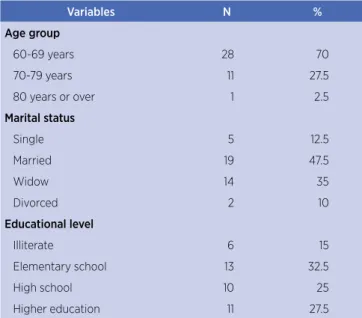
Table 1 shows sociodemographic variables in the control (CG) and Intervention group (IG), observed in the total population studied. According to the results shown, the majority aged between 60 and 69 years, and 47.5% of the elderly women were married. Most of them had some degree of education: 32.5% had only elementary school, 25% had completed high school, and 27.5% had completed higher education. The exclusively female sample was chosen for a better homogenization. In addition, it shows a reality increasingly more expressive, in which a greater adherence to body practices by women is observed.
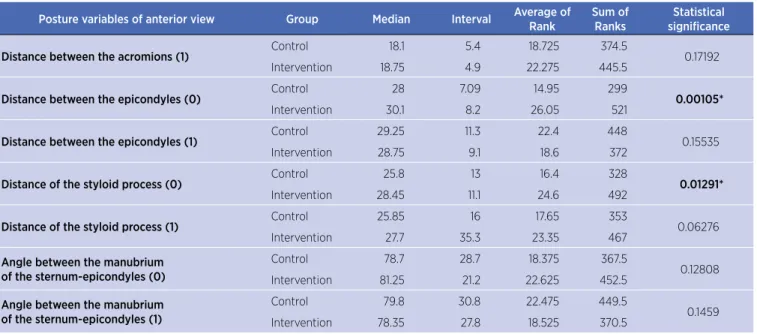
Table 2 shows the analysis of posture variables between CG and IG, in the anterior view, obtained through photogrammetry (SAPO), in the moments before and after the intervention, in which it is possible to affirm, with 95% confidence, that in the moment before the intervention, the distance between acromions, the distance between epicondyles or distance the between styloid process are smaller in the CG in relation to the IG in the anterior view. After the intervention, however, no statistically significant difference of the variables was found between the groups. Statistically significant changes were not observed in the other posture variables in both moments when comparing the groups. Based on these results, we have seen that, in relation to posture variables, a discreet
change occurred in favor of IG, despite the absence of statistical significance, which can be observed in the median values of each group.
Table 1. Distribution of the sample studied according to sociodemographic variables (n = 40)
Variables N %
Age group
60-69 years 28 70
70-79 years 11 27.5
80 years or over 1 2.5
Marital status
Single 5 12.5
Married 19 47.5
Widow 14 35
Divorced 2 10
Educational level
Illiterate 6 15
Elementary school 13 32.5
High school 10 25
Higher education 11 27.5
Table 3 shows the analysis of the posture variables between CG and IG, in the posterior view, obtained through photogrammetry (SAPO), in the moments before and after the intervention, noting that a statistically significant difference was only observed in the variables of distance between SA and IA, when compared with the CG in the moments before and after intervention, not showing statistically significant results in the other variables. This result showed the PM had positive effect on the alignment of the shoulder blades when compared with the CG.
Table 2. Distribution of the sample according to Mann-Whitney U Test for comparison of posture variables (anterior view) between the Control Group and Intervention Group in the moments before (0) and after (1) the intervention
Posture variables of anterior view Group Median Interval Average of
Rank
Sum of Ranks
Statistical significance
Horizontal alignment of the head (0) Control 0 13.9 19.525 390.5 0.3017
Intervention 0 10.7 21.475 429.5
Horizontal alignment of the head (1) Control 1.25 10.5 21.975 439.5 0.2163
Intervention 0 15.3 19.025 380.5
Horizontal alignment of the acromions (0) Control 0 9.4 20.425 408.5 0.4866
Intervention 0 9.5 20.575 411.5
Horizontal alignment of the acromions (1) Control 0.65 12 21.575 431.5 0.2845
Intervention 0.25 9.8 19.425 388.5
Distance between the acromions (0) Control 17.1 4 16.975 339.5 0.02822
Intervention 18.15 10.7 24.025 480.5
Posture variables of anterior view Group Median Interval Average of Rank
Sum of Ranks
Statistical significance
Distance between the acromions (1) Control 18.1 5.4 18.725 374.5 0.17192
Intervention 18.75 4.9 22.275 445.5
Distance between the epicondyles (0) Control 28 7.09 14.95 299 0.00105*
Intervention 30.1 8.2 26.05 521
Distance between the epicondyles (1) Control 29.25 11.3 22.4 448 0.15535
Intervention 28.75 9.1 18.6 372
Distance of the styloid process (0) Control 25.8 13 16.4 328 0.01291*
Intervention 28.45 11.1 24.6 492
Distance of the styloid process (1) Control 25.85 16 17.65 353 0.06276
Intervention 27.7 35.3 23.35 467
Angle between the manubrium of the sternum-epicondyles (0)
Control 78.7 28.7 18.375 367.5
0.12808
Intervention 81.25 21.2 22.625 452.5
Angle between the manubrium of the sternum-epicondyles (1)
Control 79.8 30.8 22.475 449.5
0.1459
Intervention 78.35 27.8 18.525 370.5
*Values<0.05 show significant difference
Table 3. Distribution of the sample according to Mann-Whitney U Test for comparison of posture variables (anterior view) between the Control Group and Intervention Group in the moments before (0) and after (1) the intervention
Posture variables of posterior view Group Median Interval Average of
Rank Sum of Ranks
Statistical significance
Distance between the superior angles of the scapula (0)
Control 10.05 9.4 19.375 387.5
0.27552
Intervention 10.40 4.7 21.625 432.5
Distance between the superior angles of the scapula (1)
Control 10.05 8.4 24.325 486.5
0.01904*
Intervention 9.15 6.1 16.675 333.5
Distance between the inferior angles of the scapula (0)
Control 9.50 8.3 18.125 362.5
0.10167
Intervention 9.9 5.1 22.875 457.5
Distance between the inferior angles of the scapula (1)
Control 10 7 24.125 482.5
0.02488*
Intervention 8.25 5.5 16.875 337.5
Angle between vertebra T1 - inferior angle of the scapula (0)
Control 51 46.9 19.525 390.5
0.30315
Intervention 49.05 25.1 21.475 429.5
Angle between vertebra T1 - inferior angle of the scapula (1)
Control 55.25 36.5 21.25 425
0.34653
Intervention 49.75 39.7 19.75 395
Angle between vertebra T12 - trochanters (0) Control 49.2 20.8 20.1 402 0.41766
Intervention 49.4 23.2 20.9 418
Angle between vertebra T12 - trochanters (1) Control
Intervention
52.9 52.5
20.4 31.9
20.9 20.1
418
402 0.41788
*Values<0.05 show significant difference.
DISCUSSION
Kloubec14 conducted a controlled study with 50
individuals, composed of active middle-aged men and women, who performed 25 Pilates exercises for 12 weeks, twice a week, and he noted significant improvement (p≤0.05) in almost all variables, except for posture and balance. Sinzato et al.15, in their controlled and randomized
pilot study, examined the effects of 20 sessions of PM on the posture alignment and flexibility of 30 young women aged between 18 to 25 years. However, these authors did not observe influence on the posture alignment.
doing it more frequently and increasing the period to perform the exercises to more than three months. However, considering that a reference standard of symmetrical posture does not exist is necessary16 and,
based on the assumption that individuals are not “built” as identical anatomical elements, a “normal” posture is not morphologically identical between different individuals17, so that the lack of a model close to the
reality regarding posture realignment causes difficulty in comparing the data obtained through the many variables of a photogrammetric assessment.
Nascimento and Lima19, in their study conducted
during the extension project “Pilates e o idoso: contribuições para o equilíbrio corporal”(Pilates and the elderly: contributions to the body balance), analyzed the effect of a program of PM on posture, strength, flexibility and balance of 70 elderly people aged between 60 and 80 years, using an exercise program performed on the ground using a ball, adapted according to the age group, twice a week, with duration of 60 minutes, and in group, for 10 months. At the end of this period, the elderly were evaluated through functional tests, obtaining improvement in balance, flexibility, stretching, and strength.
The alignment of the body posture is established by musculoskeletal structures interacting among them throughout our lives, according to their demands20.
Therefore, flexibility and muscular action provide greater stability to backbone and resistance to the compressive forces necessary to counter the effects of gravity and maintain a good posture. In addition, the reduction in muscle strength and flexibility, which characterizes the physiological process of aging, affects the functional capacity. Thus, improving these parameters will contribute to a life with more autonomy and independence, improving the quality of life of the elderly people21.
Guimarães et al.22 conducted a controlled experimental
study with 60 elderly, in which they applied a program of PM exercises performed on the ground, using a ball and accessories, with duration of 60 minutes, for 12 weeks. At the end, a statistically significant difference (p=0.001) in shoulder flexibility was observed, concluding that elderly people who regularly practice any type of physical activity tend to have a greater degree of flexibility in the shoulder, and the PM is a good way to prevent and improve this limitation, inducing a greater functional mobility.
In a randomized controlled clinical trial conducted by Junges et al.23 with 41 women aged between 59 and
58 years, an exercise program was performed for 30 weeks, resulting in a reduction in the angle of kyphosis,
significant improvement of the flexibility of all neck and hip movements, as well as small difference between the shoulders and pectoral girdle, concluding that the PM has an important role in flexibility and posture change. As in this study, these results suggest the PM may be effective in the shoulder alignment, although the data of this study reflect modest gains, which could probably be enhanced with an increase in the period of performance of the technique.
Analyzing the benefit of the results observed and its repercussions from another evaluation point of view, the emphasis is that the reduction in shoulder angles can reflect a proposal of prevention and mitigation of the consequences of another problem associated with the aging process, which is the increase in the curvature of the dorsal region, usually accompanied by the abduction of the pectoral girdle, characterizing the thoracic kyphosis, a typical third-age posture change24.
Also, positive effects may be produced on the flexibility21,26, factor that has direct influence on the posture
pattern26, studies indicate that the PM can be used for
optimization of quality of life24,25 and may be an option of
collective work, conducted in groups in the communities, since it does not require specialized environments or equipment, is easy to be implemented and has no additional costs to health teams as well as demand for qualified health professionals. This could represent an important contribution concerning the expansion of the range of body practices in collective health. Although it was not a parameter directly evaluated in this study, the results of these practices could positively impact on daily life activities in elderly populations.
A limitation of this study was the fact that the sample was composed of elderly women who already showed, due to the physiological aging process, structured posture changes arising from changes in the musculoskeletal system during life and difficult to be modified, including with techniques such as PM.
CONCLUSION
with increased frequency, duration and standardization of the exercises and greater fidelity to the principles of the PM are needed for the obtainment of better results in the body posture of the elderly.
REFERENCES
1. Santos ECC, Barbosa MC, Medeiros JD, Granja KSB, Constant MHL, Calles ACN. Declínio da capacidade de independência funcional em indivíduos idosos hospitalizados. Cad Grad Ciênc Biol Saúde. 2013;1(3):91-100.
2. Alves RV, Mota J, Costa MC, Alves, JGB. Aptidão física relacionada à saúde de idosos: influência da hidroginástica. Rev Bras Med Esporte. 2004;10(1):31-7. doi:10.1590/S1517-86922004000100003. 3. Instituto Brasileiro de Geografia e Estatística. População
brasileira envelhece em ritmo acelerado. Brasília, DF: IBGE; 2010. [citado 2018 set 10]. Disponível em: <http://www.ibge. gov.br>.
4. Instituto Brasileiro de Geografia e Estatística. Projeção da população do Brasil por sexo e idade: 2000-2060. Brasília, DF: IBGE; 2010. [citado 2018 set 10]. Disponível em: <https://bit. ly/2Djirc8>.
5. Hein MA, Aragaki SS. Saúde e envelhecimento: um estudo de dissertações de mestrado brasileiras (2000-2009). Ciênc Saúde Coletiva. 2012;17(8):2141-50. doi:10.1590/ S1413-81232012000800024.
6. Ota S, Goto H, Noda Y, Fujita R, Matsui, Y. Relationship between standing postural alignments and physical function among elderly women using day service centers in Japan. J Back Muscul Rehabil. 2015;28(1):111-7. doi:10.3233/BMR-140498.
7. Grabiec JD, Snela S, Rykała J, Podgórska J, Banaś A. Changes in the body posture of women occurring with age. BMC Geriatrics. 2013;13(1):108. doi:10.1186/1471-2318-13-108.
8. Silveira MM, Pasqualotti A, Colussi EL, Wibelinger LM. Envelhecimento humano e as alterações na postura corporal do idoso. Rev Atenção Saúde. 2011;8(26):52-8. doi:10.13037/ rbcs.vol8n26.1081.
9. Silva TL, Martinez EZ, Souza Junior AP, Manço ARX, Arruda MF. A associação entre a ocorrência de quedas e a alteração de equilíbrio e marcha em idosos. Saúde Pesqui. 2014;7(1):25-34. 10. Siqueira FV, Facchini LA, Piccini RX, Tomasi E, Thumé E, Silveira
DS, Vieira V, Hallal PC. Prevalência de quedas em idosos e fatores associados. Rev Saúde Pública. 2007;41(5):749-56. doi:10.1590/ S0034-89102007000500009.
11. Curi Pérez VS, Haas AN, Wolff SS. Analysis of activities in the daily lives of older adults exposed to the Pilates method. J Bodyw Mov Ther. 2014;18(3):326-31. doi:10.1016/j.jbmt.2013.10.004. 12. Anderson BD, Spector A. Introduction to Pilates-based
rehabilitation. Orthop Phys Ther Clin N Am. 2005;9(3):395-410. 13. Barnett A, Smith B, Lord SR, Williams M, Baumand A. Community-based group exercise improves balance and reduces falls in at-risk older people: a randomized controlled trial. Age Ageing. 2003;32(4):407-14. doi:10.1093/ageing/32.4.407.
14. Kloubec JA. Pilates for improvement of muscle endurance, flexibility, balance, and posture. J Strength Conditioning Res. 2010;24(3):661-7. doi:10.1519/JSC.0b013e3181c277a6.
15. Sinzato CR, Taciro C, Pio CA, Toledo AM, Cardoso JR, Carregaro RL. Efeitos de 20 sessões do método Pilates no alinhamento postural e flexibilidade de mulheres jovens: estudo piloto. Fisioter Pesqui. 2013;20(2):143-50. doi:10.1590/S1809-29502013000200008. 16. Ferreira AC, Fernandes J, Kuo YL, Bernardo LM, Fernandes O,
Laranjo L, Silva A. Does Pilates-based exercise improve postural alignment in adult women? Women Health. 2013;53(6):597-611. doi:10.1080/03630242.2013.817505.
17. Kendall FP, Mccreary EK, Provance PG. Músculos: provas e funções. 4.ed. São Paulo: Manole; 1995.
18. Lapierre A. A reeducação física. 6. ed. São Paulo: Manole, 1982. 19. Nascimento MM, Lima RKR. Envelhecendo equilibradamente:
considerações de um programa de atividade física para idosos fundamentado no método Pilates. Extramuros-Rev de Extensão Univasf. 2013;1(1):108-23.
20. Takahashi K, Suda M, Usuba M, Wasai Y, Tsukayama H. Postural adjustment to the line of center of gravity. J Phys Ther Sci. 1995;7(2):65-9. doi:10.1589/jpts.7.65.
21. Maciel MG. Atividade física e funcionalidade do idoso. Motriz: Rev Educ Fis. 2010;16(4):1024-32. doi:10.5016/ 1980-6574.2010v16n4p1024.
22. Guimarães ACA, Azevedo SF, Simas JPN, Machado Z, Jonck VTF. The effect of Pilates method on elderly flexibility. Fisioter Mov. 2014;27(2):181-8. doi:10.1590/0103-5150.027.002.AO03. 23. Junges S, Gottlieb MG, Baptista RR, Quadros CBD, Resende
TDL, Gomes I. Effectiveness of Pilates method for the posture and flexibility of women with hyperkyphosis. Rev Bras Cienc Mov. 2012; 20(1):21-33.
24. Navega MT, Furlanetto MG, Lorenzo DM, Morcelli MH, Tozim BM. Efeitos do método Pilates solo no equilíbrio e na hipercifose torácica em idosas: ensaio clínico controlado randomizado. Rev Bras Geriatr Gerontol. 2016;19(3):465-72. doi:10.1590/1809-98232016019.150022.
25. Rodrigues BGS, Cader SA, Torres NVOB, Oliveira EM, Dantas EHM. Autonomia funcional de idosas praticantes de Pilates. Fisioter Pesqui. 2010;17(4):300-5. doi:10.1590/ S1809-29502010000400003.
26. Küçükçakır N, Altan L, Korkmaz N. Effects of Pilates exercises on pain, functional status and quality of life in women with postmenopausal osteoporosis. J Bodywork Mov Ther. 2013;17(2):204-11. doi:10.1016/j.jbmt.2012.07.003.
27. Natour J, Cazotti LA, Ribeiro LH, Baptista AS, Jones A. Pilates improves pain, function and quality of life in patients with chronic low back pain: a randomized controlled trial. Clin Rehabil. 2015;29(1):59-68. doi:10.1177/0269215514538981.
28. Lima MCC, Miranda AM, Martins PPC, Fittipaldi EOS. Doença de Parkinson: alterações funcionais e potencial aplicação do método Pilates. Geriatr Gerontol Aging. 2009;3(1),33-40. 29. Pacheco JFR, Guimarães ACA, Kraeski MH, Kraeski AC, Souza