Acta Scientiarum. Agronomy Maringá, v. 32, n. 4, p. 743-748, 2010
Nitrate leaching from a Latosol after application of liquid swine
manures in different pH values and organic matter contents
Antonio Carlos Saraiva da Costa1* and Edleusa Pereira Seidel2
1
Laboratório de Química e Mineralogia de Solos, Departamento de Agronomia, Universidade Estadual de Maringá, Av. Colombo,
5790, 87020-190, Maringá, Paraná, Brazil. 2Universidade Estadual do Oeste do Paraná, Marechal Candido Rondon, Paraná,
Brazil. *Author for correspondence. E-mail: [email protected]
ABSTRACT.Liquid swine manures are produced in large volumes in the western Paraná and Santa Catarina states and are reused as a source of nutrients. This study aimed to evaluate the losses of nitrate (N-NO3-1) after application of liquid swine manures in three
samples of a Latosol (Rhodic Eutrudox) with different levels of soil organic matter and pH collected at different depths. The experimental design was completely randomized with one soil, three levels of soil organic matter (34.09, 22.36 and 8.6 g dm-3), four pH in CaCl
2 (4.0,
5.0, 6.0 and 7.0) conditions and three replications. Each experimental unit contained 450 cm3 of soil that received a dose of liquid swine manures equivalent to 120,000 dm-3 ha-1.
The concentration of N-NO3-1 was evaluated in the leaching solution after the weekly
application of water equivalent to 150 mm for a period of 35 days. The amount of N-NO3 -1
leached increased with soil organic matter content and soil pH. The amount of nitrate leached tends to be maximum at pH close to or above 7.0.
Key words: animal wastes, anion exchange capacity, nitrogen, swine manure.
RESUMO.Lixiviação de nitrato em Latossolo após aplicação de dejetos líquidos de suínos com diferentes valores de pH e teores de matéria orgânica. Dejetos líquidos de suínos são produzidos em grandes volumes no oeste dos Estados do Paraná e Santa Catarina e reutilizados como fonte de nutrientes. Este trabalho teve por objetivo avaliar as perdas de N-NO3-1 após aplicação de dejetos líquidos de suínos em três amostras
de um Latossolo Vermelho eutroférrico com diferentes teores de matéria orgânica e valores de pH, coletadas em diferentes profundidades. O delineamento experimental utilizado foi o completamento casualizado com um solo, três teores de matéria orgânica (34,09; 22,36 e 8,6 g dm-3), quatro níveis de pH em CaCl
2 (4,0; 5,0; 6,0 e 7,0) e três repetições. Cada unidade
experimental continha 450 cm3 de solo que recebeu uma dose de DLS equivalente a 120.000
dm-3 ha-1. Avaliou-se a concentração de nitrato (N-NO
3-1) na solução lixiviada após a
aplicação, semanalmente, de uma lâmina de água equivalente a precipitação de 150 mm, por um período de 35 dias. As quantidades de N-NO3-1 lixiviadas aumentaram com o teor de
matéria orgânica e com o pH do solo. A quantidade de nitrato lixiviado tende ser máxima em valores de pH próximos ou acima de 7,0.
Palavras chave: resíduos orgânicos, capacidade de troca aniônica, nitrogênio, resíduos de suínos.
Introduction
The current high costs of mineral fertilizers, including nitrogen, may be one of the main factors limiting the current level of crops productivity. Losses of nitrogen as nitrate leaching are of concern and it is affected by several soil and climate factors. The nitrate anion (N-NO3-1) has a negative surface
charge and preferably forms outer-sphere complexes with the surface functional groups present on soils colloids (DYNIA, 2000; SPOSITO, 1989; LUCHESE et al., 2008; STRAHN; HARRISON, 2006; WONG; WITTWER, 2009). In humid tropical and subtropical climates, soils have negative charge balance on the soil surface due to the higher
contents of soil organic matter (SOM) and the presence of small amounts of 2:1 clay minerals (COSTA et al., 2004). But, in acid, sub-surface Oxisols (Latosols), Ultisols (Nitosols/Argisols) and Andisols, the amount of positive charges tends to increase and delta pH values decreases and tends to zero or is positive (DONN; MENZIES, 2005; EMBRAPA, 1984).
(AlOH2+) (COSTA; BIGHAM, 2009), that increase
their anion adsorption capacity (AEC), specially in the sub-surface more acid horizons (KINJO; PRATT, 1971; QAFOKU et al., 2000). Besides the PZC, the actual pH (KINJO; PRATT, 1971), electrolyte concentration (ANJOS; MATTIAZZO, 2000; OLIVEIRA et al., 2001) and valence of the counter ion define the net soil surface charge. Kinjo and Pratt (1971), observed that nitrate adsorption increased exponentially from pH 6 to 3 and for solutions with higher nitrate concentrations. Anjos and Mattiazzo (2000), Oliveira et al. (2001), and Luchese et al. (2008), all studied the leaching of nitrate in soils treated with different organic residues and observed an increase in the concentrations of N-NO3-1 from the waters percolated through
different soils. Di and Cameron (2002) and Bakhsh et al. (2005), observed N-NO3-1 leaching
throughout the soil profiles with predominant 2:1 clay mineralogy. The above publications show that the concentration of N-NO3-1 in the waters
percolated through the soil is usually directly proportional to the rate of N applied and that this concentration may exceed the limit of 10 mg dm-3
allowed by environmental laws to drinking water. In Australia, Wong and Wittwer (2009), observed soils with variable charge that delay nitrate leaching from the first 1 m depth by up to 12.5 pore volumes.
Western Paraná has soils developed from basalts (COSTA et al., 1999b). Agricultural areas, in this region, usually have Latosols associated with Nitosols. The Latosols are very deep profiles (> 2 m), with an A, AB, and Bw sequence of horizons, very uniform in particle size distribution (> 600 g of clay kg-1 soil) and soil mineralogy (COSTA et al.,
1999a, 1999b; EMBRAPA, 1984). Cation exchange capacity (CEC) is pH dependent and decrease, with depth, with the SOM content and pH. The clay fraction has kaolinite (> 600 g kg-1 clay), iron oxides
(> 200 g kg-1 clay), 2:1 clay minerals and gibbsite
(< 200 g kg-1 clay). The red color of the whole soil
profile is associated with the presence of hematite and maghemite (> 800 g kg-1 of iron oxides)
(COSTA et al., 1999b). The objective of this study was to evaluate the effect of SOM content and pH values on the nitrate leaching of a Latosol (Rhodic Eutrudox) after application of liquid swine manures.
Material and methods
This study was conducted with a clayey soil, classified as Latossolo Vermelho eutroférrico (EMBRAPA, 2006) or Rhodic Eutrudox (SOIL
SURVEY STAFF, 1994), collected at Marechal Cândido Rondon County, Western region of Paraná State. Soil samples were collected in one single profile (2 x 2 x 2 m3) to avoid differences in particle
size distribution and soil mineralogy (EMBRAPA, 1984), in an area under no-tillage cultivation at different depths. Soil samples (≈ 10 kg) were air dried, sieved (2 mm) and analyzed for carbon content according to the Walkey and Black procedure (RAIJ et al., 1987). Samples from the layers 0 - 0.10, 0.20 - 0.30 and 1.0 - 1.5 m were chosen for further work due to small variation in most physical and mineralogical attributes. Soil pH was determined in CaCl2 (1:2.5) and KCl 1 M (1:2.5), H+Al
determined in SMP solution, P, K and micronutrients were extracted with Mehlich-1 solution, Al, Ca and Mg were extracted with KCl 1 mol L-1 (EMBRAPA,
1999). The analytical results of the selected soil samples are presented in Table 1.
Following the regression procedure of Bennema (1966), it was possible to observe that the cation exchange capacity (CEC) of all soils samples and carbon (C) content presented a significant (R2 =
0.99; p < 0.01) linear relationship (CEC = 5.94 + 4.469C) indicating the dependence of the CEC on the organic matter content and the homogeneity of the soils particle size distribution and mineralogy of clay fractions. This regression model has similar coefficients to the general regression model obtained for all Latosols of the Paraná State (COSTA et al., 1999a). X-rays diffraction analysis of the 2 μm fraction (data not shown) confirmed this and presented a similar distribution along the profile of the following minerals: kaolinite, hematite, maghemite, smectite and small amounts (< 5%) of gibbsite (COSTA et al., 1999b).
The LSM was also sampled in Marechal Cândido Rondon County from a tank in a farm that works with swine animals with 22 to 110 pounds. The collected material was packed in plastic 2000 cm3 bottles, cooled immediately and sent to the
laboratory for analysis. Sub-samples of the manure were taken to determine moisture content (65oC),
total and volatile solids and pH (SCHERER et al., 1996). Results show pH value of 6.8, and dry matter, moisture, total and volatile solids of 6.9, 93, 7, and 74%, respectively. Total, ammonia (N-NH3) and
nitrate (N-NO3-1) nitrogen forms of the LSM
determined using the semi-micro Kjeldahl method (TEDESCO et al., 1995) are 3, 1.8 and 0.05 kg m-3,
respectively. Macroelements (P, Ca, Mg,and K) and microelements (Fe, Zn, Cu, and Mn) determined in a nitric-perchloric digestion procedure (EMBRAPA, 1999) are for the macroelements: 5.4, 25, 4.8, and 11.7 g dm-3, respectively; and for the microelements:
Acta Scientiarum. Agronomy Maringá, v. 32, n. 4, p. 743-748, 2010 Table 1. Chemical properties of a Latosol (Rhodic Eutrudox).
Depth pH(1) SOM(2) P(3) Al+3 H +Al K+ Ca+2 Mg+2 SB(4) CEC(5) V(6) Zn Cu Mn
m g dm-3
mg dm-3
---cmolc dm
-3
--- % ----mg kg-1
---
0 - 0.10 5.0 34.09 5.0 0.0 4.96 0.92 6.51 2.20 9.63 14.59 66 19.2 41.3 417
0.20 - 0.30 5.4 22.36 2.0 0.0 3.97 0.28 6.54 1.72 8.54 12.51 68 12.3 27.45 140
1.00 - 1.50 5.3 8.60 3.0 0.0 3.42 0.08 2.92 1.32 4.32 7.74 56 2.44 14.7 80
1pH in CaCl
2.2Soil organic matter. 3Mehlich-1. 4Sum of bases. 5Cation exchange capacity. 6Base saturation.
The three soil samples with different levels of SOM were separated into four parts; each one treated with necessary volumes of HCl 0.01 mol dm-3 or NaOH 0.01 mol L-1 to achieve pH values of
4.0, 5.0, 6.0 and 7.0 and incubated for fifteen days. Each sample, according to the SOM content, was divided into three sub-samples with 450 cm3,
considered repetitions, and they were all packed into 2,000 cm-3 plastic bottles. All the treatments received
27 cm-3 of LSM, equivalent to the application
120,000 dm-3 ha-1. Weekly (7, 14, 21, 28 e 35 days),
for 35 days (Figures 1 and 2), water (294 cm-3 of
deionized water) was added to the soil surface of each experimental unit and the leaching solution was collected in plastic container and immediately analyzed for N-NO3-1 (TEDESCO et al., 1995). The
amount of water added took into consideration the average rainfall of a month (150 mm) of western Paraná State. Linear, simple, multiple, potential and exponential regression models were all done using the following routines: PROC REG (stepwise) from the SAS (1999) and all others with the Origin 8.0 softwares.
Results and discussion
Instantaneous N-NO3-1 leaching was fast and
most of it occurred in the first two extractions (Figure 1), because the outer-sphere complexes formed between N-NO3-1 and the surface charges
on the soil colloids is weak due to electrostatic forces (DYNIA, 2000; LUCHESE et al., 2008). Instantaneous and accumulative biggest losses of nitrate occurred in the ERL with the SOM = 34.09 g kg-1 and soil pH 7.0 (Figures 1 and 2). The
addition of pure bi-distilled water decreased the soil solution ionic strength and the AEC, as a result, N-NO3-1 weakly held at positively charged exchange
sites was released into the soil solution and leached (DONN; MENZIES, 2005). This behavior is even stronger as the amount of SOM and pH increases (ANJOS; MATTIAZZO, 2000; OLIVEIRA et al., 2001). Data in Figure 1 were successfully described, with statistical significance (p < 0.05), for most samples, as power regression curves, but at pH 6 and 7 with 34.09 g SOM kg-1, in the second extraction,
there was an increase in the N-NO3-1 leached due
to, probably, intense biological activity under
optimal pH and high SOM content which promote the nitrification of other nitrogen forms present in the soil and the LSM (BRADY; WEILL, 2009).
N
-N
O3 -1
(mg L
-1 )
y = 20.3525x-0.5071 R2 = 0.05 ns y = 111.9017x-0.4524 R2 = 0.82 *
y = 141.1040x-0.4732 R2 = 0.44 * y = 172.4060x-0.4461 R2 = 0.36*
0 50 100 150
0 10 20 30 40
4
5
6
7
SOM=34.09 yˆ
yˆ
yˆ
yˆ
Time (days)
N
-N
O3 -1
(mg L
-1 )
y = 11.7059x-0.3640 R2 = 0.85 * y = 454.0870x-1.1542 R2 = 0.98 * y = 208.8581x-0.7676 R2 = 0.82 * y = 210.6877x-0.6615 R2 = 0.86 *
0 50 100 150
0 10 20 30 40
4 5
6 7
SOM=22.36
Time (days)
N
-N
O3 -1
(mg L
-1 )
y = 4.9136x-0.2042 R2 = -0.26 ns y = 240.9282x-0.9827 R2 = 0.91 * y = 155.9960x-0.7646 R2 = 0.96 * y = 206.6808x-0.8057 R2 = 0.96 *
0 50 100 150
0 10 20 30 40
4
5
6
7
SOM=8.6
Time (days)
Figure 1. Instantaneous nitrate (N-NO3-1) leached from a
Latosol (Rhodic Eutrudox) for different SOM contents and pH
values (CaCl2). ns non significative regression models (p > 0.05).
*Significative regression models (p < 0.05).
Instantaneous N-NO3-1 leaching at pH 4 was so
small and almost invariant with time that no statistical difference (p > 0.05) was observed when a power
yˆ yˆ yˆ yˆ
yˆ yˆ yˆ yˆ
SOM = 34.09
SOM = 22.36
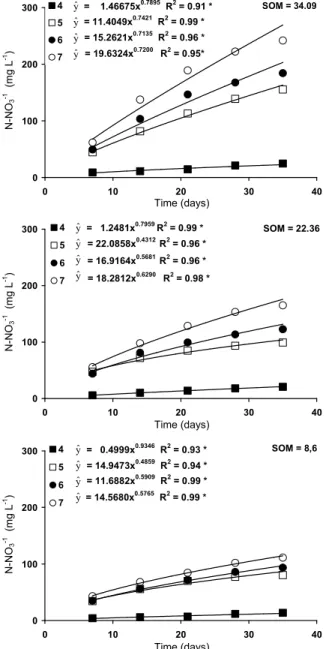
(Figure 1) or linear regression model (data not shown) were used. Accumulative N-NO3-1 leaching (Figure 2)
were also described with a power regression models (R2 > 0.9, p < 0.05) and are, in the present
experimental conditions, good prediction models to evaluate the amount of N-NO3-1 accumulative leached
to a subsequent deeper layer. At pH 7.0, it was observed a steady increase on the linear regression coefficients (14.5680, 18.2812 and 19.6324) of the regression models (Figure 2) and on the exponential coefficients (0.5765, 0.6290, and 0.7200) as SOM increases from 8.6 to 34.09 g SOM kg-1 of soil,
respectively (ANJOS; MATTIAZZO, 2000; LUCHESE et al., 2008; OLIVEIRA et al., 2001).
N
-NO
3
-1
(mg L
-1)
y = 1.46675x0.7895 R2 = 0.91 *
y = 11.4049x0.7421 R2 = 0.99 * y = 15.2621x0.7135 R2 = 0.96 *
y = 19.6324x0.7200 R2 = 0.95*
0 100 200 300
0 10 20 30 40
4 5 6 7
SOM=34.09
Time (days)
N
-NO
3
-1
(mg L
-1)
y = 1.2481x0.7959 R2 = 0.99 * y = 22.0858x0.4312 R2 = 0.96 * y = 16.9164x0.5681 R2 = 0.96 * y = 18.2812x0.6290 R2 = 0.98 *
0 100 200 300
0 10 20 30 40
4
5
6
7
SOM=22.36
Time (days)
N
-NO
3
-1
(mg L
-1)
y = 0.4999x0.9346 R2 = 0.93 * y = 14.9473x0.4859 R2 = 0.94 *
y = 11.6882x0.5909 R2 = 0.99 * y = 14.5680x0.5765 R2 = 0.99 *
0 100 200 300
0 10 20 30 40
4
5
6
7
SOM=8.6
Time (days)
Figure 2. Accumulated nitrate (N-NO3-1) leached from a Latosol
(Rhodic Eutrudox) for different SOM contents and pH values
(CaCl2). *Significative regression models (p < 0.05).
Statistical analysis of the final accumulative N-NO3-1 leached show no statistical difference
(p > 0.05) in the total amount leached at pH 4, independent of the SOM content, but statistically significant (p < 0.05) different amounts were leached when comparing among SOM contents at the other pH values (QAFOKU et al., 2000).
The Pearson correlation coefficient for all data shows that N-NO3-1 was positively correlated with
the SOM content (r = 0.46, p = 0.0046) and pH values (r = 0.80, p < 0.0001); therefore, the pH treatments contribute more to the leaching behavior of the soils than the actual SOM content (KINJO; PRATT, 1971).
In fact, the stepwise multiple linear-regression model obtained to predict N-NO3-1 leaching related
to the SOM contents (g kg-1 soil) and pH (CaCl 2
0.01 mol L-1) values (N-NO
3-1 = -219.92
+2.98SOM + 48.11pH) has the multiple (0.84) and partial correlation coefficients (R2) statistically
significant (p < 0.05), but with higher partial contribution from the pH (0.63) than the SOM (0.21). These parameters, even though, accounted for most of the N-NO3-1 leaching, are empirical and
remain to be tested under different soils and manures conditions.
Figure 3 shows very different behavior for N-NO3-1 leaching for both variables. While the pH x
N-NO3-1 leaching data can be represented by a
second order polynomial regression model, the N-NO3-1 x SOM data are better adjusted to an
exponential regression model. Therefore, it is possible to derivate the N-NO3-1 x pH regression
models and calculate the pH where maximum N-NO3-1 leaching occurs. From the N-NO3-1 x SOM
regression models, there will be an indefinite increase in the amount of N-NO3-1 leaching with
increasing SOM content, at any pH value. For the 34.09 and 22.36 g SOM kg-1 soils (Figure 3a) the pH
for the maximum N-NO3-1 loss are 7.4 and 8.0,
respectively; therefore, out of the range of pH values tested. But for the treatment with 8.6 g SOM kg-1 of
soil, the pH for maximum N-NO3-1 leaching is 6.7.
At neutral or basic pH, nitrogen losses might be more and more associated with gaseous forms such as ammonia (NH3) rather than by nitrate (BASSO
et al., 2004). As the amount of SOM and pH increases (Figure 3b) from 4 to 7 and beyond, there are increasing amounts of negative surface charges that enhance negative N-NO3-1 adsorption (KINJO;
PRATT, 1971), and, therefore, nitrate leaching. Therefore, N-NO3-1 leaching will be favored, on
the top soil, when conservation soil management techniques such as liming (increase soil pH) and no-tillage (increase SOM content) are used. Since CEC
yˆ yˆ yˆ yˆ
yˆ yˆ yˆ yˆ
yˆ yˆ yˆ yˆ
SOM = 34.09
SOM = 22.36
Acta Scientiarum. Agronomy Maringá, v. 32, n. 4, p. 743-748, 2010 and AEC are linked, small CEC increases
(1 - 2 cmolc kg-1 soil) due to liming will correspond to
a decrease in the AEC; therefore, if soil pH increases, anions held to the soil positive charges, by electrostatic forces, will be desorbed upon decrease in the AEC and are free to be leached with percolating water (GILLMAN et al., 1989; GILLMAN; BRISTOW, 1990).
These conclusions reinforce why nitrate leaching of temperate climate soils, such as Mollisols, Alfisols, Vertisols, Aridisols, will be favored throughout the soil profile (BAKHSH et al., 2005; DI; CAMERON, 2002) due to an excess of negative charge on the colloidal particles associated with, either, higher SOM content, neutral pH and predominance of smectites and vermiculites in the clay size fraction (with permanent negative surface charge).
N
-N
O3 -1 (m
g
L
-1 )
y = -751.5800 + 268.6165x -18.2325x2 R2 = 0.95 *
y = - 411.7290 + 145.2545x -9.0525x2 R2 = 0.96 *
y = - 446.9570 + 164.6290x -12.1850x2 R2 = 0.96 *
0 100 200 300 400
3 4 5 6 7 8
34,09 22,36 8,6
A
pH (CaCl2, 0.01M)
N
-N
O3 -1
(mg L
-1 )
y = 11.5520e0.0233x R2 = 0.96 * y = 61.6671e0.0256x R2 = 0.94 *
y = 72.3512e0.0264x R2 = 0.98 * y = 85.0520e0.0304x R2 = 0.99 *
0 100 200 300 400
0 10 20 30 40
pH=4
pH=5
pH=6
pH=7
B
Soil organic matter (g dm-3)
Figure 3. Accumulated nitrate (N-NO3-1) leached from a Latosol
(Rhodic Eutrudox) as a function of pH (CaCl2) (A) and SOM
contents (B). *Significative regression models (p < 0.05).
Now, for Oxisols and Ultisols of the humid tropical and subtropical climates and Andisols, Spodosols, and part of the Inceptsols soil orders (SOIL SURVEY STAFF, 1994) with predominant pH dependent charge associated with the presence of kaolinite and amorphous and crystalline iron and aluminum oxides, subsurface soil horizons have usually small content of SOM and are usually more
acid, favoring the predominance of anion exchange capacity (AEC) that will retain the N-NO3-1 leached
from the upper organic rich horizons, turning these subsurface layers into a reservoir of this important nutrient, available to crops with deep root system such as sugar cane (DYNIA, 2000; RASIAH et al., 2003), and eucalyptus (STRAHN; HARRISON, 2006); therefore reducing the risk of contamination of water bodies.
Conclusion
There is a positive effect between levels of SOM and pH values on the amounts of N-NO3-1 leached
with the eluted solutions. Soil pH (CaCl2) has
greater influence on the concentration of N-NO3-1
leached when compared with the SOM content. The amount of N-NO3-1 leached tends to maximum
values around pH 7.0 or above.
References
ANJOS, A. R. M; MATTIAZZO, M. E. Lixiviação de íons inorgânicos em solos repetidamente tratados com biossólido. Revista Brasileira de Ciência do Solo, v. 24, n. 4, p. 927-938, 2000.
BAKHSH, A.; KANWAR, R. S.; KARLEN, D. L. Effects of liquid swine manure application on NO3-N leaching
losses to subsurface drainage water from loamy soils in Iowa. Agriculture, Ecosystems and Environment, v. 109, n. 1-2, p. 118-128, 2005.
BASSO, C. J.; CERETTA, C. A.; PAVINATO, P. S. Perdas de nitrogênio de dejeto líquido de suínos por volatilização de amônia. Ciência Rural, v. 34, n. 6, p. 1773-1778, 2004.
BENNEMA, J. The calculation of CEC for 100 grams clay corrected for organic carbon, in classification of Brazilian soils. Roma: FAO, 1966. (p. 27-30. EPTA, Report; 2197).
BRADY, N. C.; WEILL, R. C. Elements of the nature and properties of soils. 3rd ed. New York: Prentice Hall, 2009.
COSTA, A. C. S.; BIGHAM, J. M. Óxidos de ferro. In: MELO, V. F.; ALLEONI, L. R. F. (Ed.). Química e mineralogia do solo. I. conceitos básicos. Viçosa: Sociedade Brasileira de Ciência do Solo, 2009. p. 505-572. COSTA, A. C. S.; TORINO, C. A.; RAK, J. G. Capacidade de troca catiônica dos colóides orgânicos e inorgânicos de latossolos do Estado do Paraná. Acta Scientiarum. Agronomy, v. 21, n. 3, p. 491-496, 1999a. COSTA, A. C. S.; BIGHAM, J. M.; RHOTON, F. E.;
TRAINA, S. J. Quantification and characterization of
maghemite in soils derived from volcanic rocks in southern Brazil. Clays and Clay Minerals, v. 47, n. 4, p. 466-473, 1999b.
COSTA, A. C. S.; BIGHAM, J. M.; TORMENA, C. A.; PINTRO, J. C. Clay mineralogy and cation exchange capacity of Brazilian soils from water contents determined
yˆ y yˆ
by thermal analysis. Thermochimica Acta, v. 413, n. 1-2, p. 73-79, 2004.
DI, H. J.; CAMERON, K. C. Nitrate leaching and pasture production from different nitrogen sources on a shallow stoney soil under flood-irrigated dairy pasture. Australian Journal of Soil Research, v. 40, n. 2, p. 317-334, 2002. DONN, M. J.; MENZIES, N. W. Simulated rainwater effects on anion exchange capacity and nitrate retention in Ferrosols. Australian Journal of Soil Science, v. 43, n. 1, p. 33-42, 2005.
DYNIA, J. F. Nitrate retention and leaching in variable charge soils of a watershed in São Paulo, Brazil. Communications in Soil Science and Plant Analysis, v. 31, n. 5-6, p. 777-791, 2000.
EMBRAPA-Empresa Brasileira de Pesquisa Agropecuária. Serviço Nacional de Levantamento e Conservação de Solo. Instituto Agronômico do Paraná. Levantamento de reconhecimento dos solos do Estado do Paraná. Londrina: Embrapa, 1984.
EMBRAPA-Empresa Brasileira de Pesquisa Agropecuária. Serviço Nacional de Levantamento e Conservação de Solos. Manual de métodos de análise de solos. Rio de Janeiro: Embrapa, 1999.
EMBRAPA-Empresa Brasileira de Pesquisa Agropecuária. Centro Nacional de Pesquisa de Solos. Sistema brasileiro de classificação de solos. 2. ed. Rio de Janeiro: Embrapa, 2006.
GILLMAN, G. P.; BRISTOW, K. K. Effect of surface application of urea, ammonium sulphate and lime on exchangeable cation distribution in an inceptsol in humid tropical Queensland. Australian Journal of Soil Research, v. 28, n. 1, p. 39-53, 1990.
GILLMAN, G. P.; BRISTOW, K. L.; HALLMAN, M. J. Leaching of applied calcium and potassium from an oxisol in humid tropical Queensland. Australian Journal of Soil Research, v. 27, n. 1, p. 83-198, 1989.
KINJO, T.; PRATT, P. F. Nitrate adsorption: I. Some acid soils of Mexico and South America. Soil Science Society of America Proceedings, v. 35, n. 5, p. 722-725, 1971. LUCHESE, A. V.; COSTA, A. C. S.; SOUZA JUNIOR, I. G. Lixiviação de íons após a aplicação de resíduos orgânicos de uma indústria farmoquímica. Revista Brasileira de Engenharia Agrícola e Ambiental, v. 12, n. 2, p. 189-199, 2008.
OLIVEIRA, F. C.; MATTIAZZO, M. E.; MARCIANO, C. R.; MORAES, S. O. Percolação de nitrato em Latossolo Amarelo distrófico afetada pela aplicação de composto de lixo urbano e adubação mineral. Revista Brasileira de Ciência do Solo, v. 25, n. 3, p. 731-741, 2001.
QAFOKU, N. P.; SUMNER, M. E.; RADCLIFFE, D. E. Anion transport in columns of variable charge subsoils: nitrate and chloride. Journal of Environmental Quality, v. 29, n. 2, p. 484-493, 2000.
RAIJ, B. Van; QUAGGIO, J. A.; CANTARELLA, H.; FERREIRA, M. E.; LOPES, A. S.; BATAGLIA, O. C. Análise química do solo para fins de fertilidade. Campinas: Fundação Cargill, 1987.
RASIAH, D.; ARMOURA, J. D.; MENZIESB, N. W.; HEINERA, D. H.; DONNB, M. J.; MAHENDRARAJAH, S. Nitrate retention under sugarcane in wet tropical Queensland deep soil profiles. Australian Journal of Soil Research, v. 41, n. 6, p. 1145-1161, 2003.
SAS-Statistics Analysis Institute. User´s guide. Cary: Statistical Analysis System Institute, 1999.
SCHERER, E. E.; AITA, C.; BALDISSERA, I. T. Avaliação da qualidade do esterco da região oeste catarinense para fins de utilização como fertilizante. Florianópolis: Empresa de Pesquisa Agropecuária e Difusão de Tecnologia de Santa Catarina, 1996. (Boletim Técnico, 79).
SOIL SURVEY STAFF. Keys to soil taxonomy. Agency for International Development. US Department of Agriculture. Soil Conservation Service/Soil Management Support Service. Blacksburg: Pocahontas Press, 1994. SPOSITO, G. The chemistry of soils. New York: Oxford University Press, 1989.
STRAHN, B. D.; HARRISON, R. B. Nitrate sorption in a variable charge forest soil of the pacific northwest. Soil Science, v. 171, n. 4, p. 313-321, 2006.
TEDESCO, M. J.; GIANELLO, C.; BISSANI, C. A.; BOHNEN, H.; VOLKWEISS, S. J. Análises de solo, plantas e outros materiais. Porto Alegre: Universidade Federal do Rio Grande do Sul, 1995. (Boletim Técnico, n. 5). WONG, M. T. F.; WITTWER, K. Positive charge discovered across Western Australian wheat belt soils challenges key soil and nitrogen management assumptions. Australian Journal of Soil Research, v. 47, n. 1, p. 127-135, 2009.
Received on May 3, 2010. Accepted on November 3, 2010.