www.scielo.br/aabc
Brain serotonin depletion enhances the sodium appetite
induced by sodium depletion or beta-adrenergic stimulation
HAWLINSTON R. C. LIMA, HAERISHTON R. CAVALCANTE-LIMA, PEDRO L. CEDRAZ-MERCEZ, RICARDO H. COSTA-E-SOUSA, EMERSON L. OLIVARES, DANIEL BADAUÊ-PASSOS-Jr,
MAGDA A. MEDEIROS, WELLINGTON S. CÔRTES and LUÍS C. REIS
Department of Physiological Sciences, Institute of Biology, UFRRJ, 23890-000 Seropédica, RJ, Brasil
Manuscript received on July 14, 2003; accepted for publication on October 1, 2003; presented byGerhard Malnic
ABSTRACT
We investigate the influence of brain serotonin depletion on the sodium appetite. Rats depleted of serotonin through the systemic administration of p-chlorophenylalanine (300 mg/kg,ip, for 2 days) showed an intense natriorexigenic response induced by sodium depletion (furosemide, 20 mg/kg,sc, 24 h before water and 1.8% NaCl presentation). Intake of 1.8% NaCl was always higher than that observed for the control group (12.9±1.4 and 21.4±3.0 mLvs5.7±1.2 and 12.7±1.6 mL, 30 and 300 min after water and saline presentation). After 24 h, the natriorexigenic response continued to be significantly higher compared to control (33.6±5.1vs21.9±3.6 mL,P <0.05). Fourteen days after p-chlorophenylalanine administration, 1.8% NaCl intake did not differ from controls. Serotonin-depleted rats expressed an early natriorexigenic response after isoproterenol administration on the third day after the first injection of p-chlorophenylalanine. An increase in 1.8% NaCl intake was first observed at 120 min (1.9±0.2vs0.45±0.3 mL,P <0.05) and remained high up to the end of the 24-h observation period (17.3±3.2vs1.1±0.5 mL,P <0.05). After 7 and 14 days, the natriorexigenic response became comparable to that of control animals. Present results show that brain serotonin depletion exaggerates the sodium appetite induced by the paradigm of sodium depletion or after beta-adrenergic stimulation.
Key words:sodium appetite, brain serotonin depletion, sodium and water depletion, isoproterenol, seroton-ergic system.
INTRODUCTION
Serotonergic circuits originating from the mesen-cephalic raphe have been implicated in water-electrolyte homeostasis (Reis et al. 1994, Franchini et al. 2002, McCann et al. 2003). Electrolytic lesions in the dorsal raphe nucleus (DRN) induce a drastic decrease in the release of atrial natriuretic peptide under basal conditions or after blood volume expansion (Reis et al. 1994). Rats with electrolytic
Correspondence to: Luís Carlos Reis E-mail: [email protected]
administration of 5-HT2 serotonergic agonists (Reis et al. 1991). Recently, our laboratory obtained new evidence for a role of the DRN in this context. Elec-trolytic or excitotoxic lesions produced with the ex-citatory amino acid, ibotenic acid, induced an in-crease in spontaneous sodium appetite after volume depletion or after stimulation with elicitors of sys-temic angiotensin II (ANG II) production (submitted for publication).
Brain serotonergic hypofunction has been im-plicated in the genesis of affective disorders such as anxiety and depression (Meltzer and Lowy 1987, Curzon 1988, Charney et al. 1990). Within this context, humans showing signs of anxiety and de-pression have an increased risk of developing hy-pertension (Jonas and Lando 2002, Zamorski and Ward 2000, Ostroumova et al. 2002, Rutledge and Hogan 2002). Sodium appetite represents a home-ostatic behavior which is suggested to play a role in the regulation of extracellular fluid volume; thus, in-creased ingestion of sodium chloride may contribute to the induction of water-electrolyte and cardiovas-cular alterations, followed by hypertension (Denton et al. 1984, 1995, Fitzsimons 1998).
The objective of the present study was to de-termine the influence of brain serotonin depletion on sodium appetite induced by volume depletion or after systemicβ-adrenergic stimulation. Brain sero-tonin depletion is a classical experimental paradigm used in neurobiological studies and is induced by the administration of p-chlorophenylalanine, a com-petitor of tryptophan and an irreversible inhibitor of tryptophan hydroxylase (TPO) (Koe and Weissman 1966, Cooper et al. 1996).
MATERIALS AND METHODS
Male Wistar rats weighing 300 to 350 g housed in a room under a controlled light-dark cycle (12 h light/12 h dark) and at a controlled temperature of 25◦C were used. All experiments were performed according to current Brazilian legislation on ani-mal experimentation. The aniani-mals selected for the experiments were first accommodated to metabolic
cages equipped with a food container and two vol-umetric drinking bottles, with rat chow, water and 1.8% NaCl being availablead libitum. NaCl at a concentration of 1.8% is aversive to the taste but is consumed under experimental conditions of body sodium and water depletion, with a subsequent at-tenuation of aversion and increase in sodium in-take (natriorexigenic response) (Menani et al. 1996, Fitzsimons 1998, Badauê-Passos et al. 2003). Brain serotonin depletion was induced by treatment with p-chlorophenylalanine methylester hydrochloride (PCPA; Sigma, St. Louis, MO, USA) at the dose of 300 mg/kg,ip, for 2 days. PCPA is a modified amino acid that competes with tryptophan for the same transporter on serotonergic neurons. In addition, af-ter neuronal uptake PCPA irreversibly inhibits TPO. This experimental maneuver induces a drastic de-crease in serotonin content, possibly reproducing clinical conditions in which this brain indolamine becomes deficient and which have been implicated in the genesis of affective disorders (Cooper et al. 1996).
The animals were divided into the following groups:
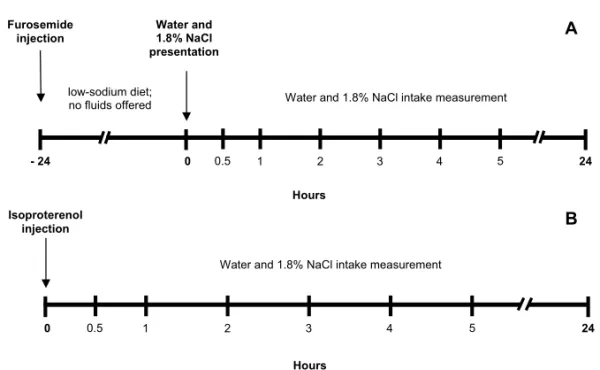
I) Rats treated with isotonic saline (1 mL/kg,sc, N = 9) or PCPA (n =11) were injected with furosemide (Lasix, Aventis, Suzano, SP, Bra-zil) (20 mg/kg, sc) on the second, sixth and thirteenth day after the first injection of PCPA. For the following 24 h, the animals only re-ceived a low-sodium diet (maize flour cooked with little distilled water and without salt). On the next day, water and 1.8% NaCl were rein-troduced in the drinking bottles for the assess-ment of water intake and sodium appetite at 60-min intervals for 300 min and after 24 h as described elsewhere (Menani et al. 1996, de Luca et al. 2002) (see protocol in the Fig. 1A).
II) Rats received isotonic saline (1 mL/kg,sc,n=
This β-adrenergic agonist is a potent dipso-genic agent whose action is dependent on the systemic release of renin and on the afferent activation of baroreceptors after a fall in arte-rial pressure (Houpt and Epstein 1971, Reis et al. 1992, Fitzsimons 1998). Immediately after isoproterenol injection, the animals were re-turned to the metabolic cages and submitted to the same procedures for the assessment of wa-ter and 1.8% NaCl intake as described above.
The results are reported as means±SE. The paired or unpaired Studentt-test was used when ap-propriate. Comparisons between groups were made by two-tailed ANOVA and differences between means were considered to be significant whenP ≤
0.05.
RESULTS
Rats treated with PCPA and depleted of sodium and water by previous administration of furosemide de-veloped an intense sodium appetite 3 days after ad-ministration of the TPO inhibitor. Intake of 1.8% NaCl reached mean values always higher than those observed for the control group (12.9±1.4 and 21.4±
3.0 mLvs5.7±1.2 and 12.7±1.6 mL, 30 and 300 min after fluid presentation,P <0.05). At the end of the 24-h observation period, the natriorexigenic response continued to be significantly higher com-pared to control (33.6±5.1vs21.9±3.6 mL,P < 0.05) (Fig. 2). The dipsogenic response showed a similar ingestion pattern (Fig. 3). Seven days after the administration of PCPA, 1.8% NaCl and water intake did not differ from the values obtained for the control group (Figs. 2 and 3). Interestingly, 7 days after treatment wit PCPA, the natriorexigenic response elicited by furosemide was found to be be-low control levels (5.9±0.9vs12.7±1.6 mL, at 300 min,P <0.05), while after 14 days the difference was no longer significant (9.1±1.8vs12.7±1.6 mL, at 300 min,P >0.05) (Fig. 2).
Serotonin-depleted rats showed an early natri-orexigenic response after the administration of iso-proterenol on the third day after the first injection of
PCPA (Fig. 4). The increase in 1.8% NaCl intake was first observed at 120 min after fluid presenta-tion (1.9±0.3vs0.45±0.3 mL,P < 0.05) and continued to be elevated up to the end of the 24-h observation period (17.3±3.2 vs 1.1±0.5 mL, P <0.05). After 7 and 14 days, the natriorexigenic response became comparable to that observed for the control group (Fig. 4).
Similarly, the dipsogenic response and the re-sulting water intake after isoproterenol administra-tion were more intense than those observed in con-trol animals under the same conditions (Fig. 5). Again, after 7 and 14 days the dipsogenic response induced byβ-adrenergic stimulation did not differ from controls (Fig. 5b).
DISCUSSION
Furosemide injection
- 24
low-sodium diet; no fluids offered
0 24
Water and 1.8% NaCl presentation
0.5 1 2 3 4 5
Hours
Water and 1.8% NaCl intake measurement
24 0
Isoproterenol injection
0.5 1 2 3 4 5
Hours
Water and 1.8% NaCl intake measurement
A
B
Fig. 1 – Schematic representation of the experimental protocols used in the evaluation of 1.8% NaCl and water intake in rats treated with p-chlorophenylalanine (PCPA) and depleted of sodium by furosemide (A) or injected with isoproterenol (B).
0
60 120 180 240 300
0
5
10
15
20
25
30
35
40
Controls
PCPA - 3 d
PCPA - 7 d
PCPA - 14 d
1380
1440
1500
* *
*
* *
* *
*
*
*
*
*
*
*
*
Furosemide
Minutes
1.
8
%
N
a
Cl
i
n
ta
ke
(
m
L
)
Fig. 2 – Chronic effect of treatment with p-chlorophenylalanine (PCPA, 300 mg/kg,ip, for 2 days), 3, 7 and 14 days after the first injection, on the natriorexi-genic response induced by sodium depletion mediated by furosemide (20 mg/kg, sc, 24 h before beginning of experiment). Mean values represent cumulative 1.8% NaCl intake from 30 min up to 24 h. Data are reported as means±SE.
∗
0
60 120 180 240 300
0
10
20
30
40
Controls
PCPA - 3 d
PCPA - 7 d
PCPA - 14 d
1380
1440
1500
* * * *
*
* *
*
Furosemide
Minutes
W
a
te
r in
ta
k
e
(m
L
)
Fig. 3 – Chronic effect of treatment with p-chlorophenylalanine (PCPA, 300 mg/kg,ip, for 2 days), 3, 7 and 14 days after the first injection, on the dipsogenic response induced by sodium depletion mediated by furosemide (20 mg/kg,sc, 24 h before beginning of experiment). Mean values represent cumulative water intake from 30 min up to 24 h. Data are reported as means±SE.∗P <0.05 compared to controls.
0
60 120 180 240 300
0
10
20
30
Controls
PCPA - 3d
1380
1440
1500
* * * *
*
Isoproterenol
PCPA - 7d
PCPA - 14d
Minutes
1
.8
%
N
a
C
l in
ta
k
e
(m
L
)
0
60 120 180 240 300
0
15
30
45
60
75
90
Controls
PCPA - 3d
1380
1440
1500
* *
* * *
*
*
Isoproterenol
PCPA - 7d
PCPA - 14d
Minutes
Wa
te
r in
ta
k
e
(
m
L
)
Fig. 5 – Chronic effect of treatment with p-chlorophenylalanine (PCPA, 300 mg/kg,ip, for 2 days), 3, 7 and 14 days after the first injection, on the dipsogenic response induced after treatment with isoproterenol (300µg/kg,sc). Mean values represent cumulative water intake from 30 min up to 24 h. Data are reported as means±SE.∗P <0.05 compared to controls.
lower magnitude in normal rats (Fitzsimons 1998). In both conditions, the systemic generation of ANG II is augmented and, at least in the case of sodium and water depletion, the angiotensinergic activity of prosencephalic loci involved in sodium appetite expression also shows a concomitant increase (De Luca et al. 1992, Fitzsimons 1998). These obser-vations support evidence recently obtained in our laboratory (submitted for publication) demonstrat-ing that the deficit in brain serotonergic transmis-sion after electrolytic or ibotenic letransmis-sion of the DRN exacerbates brain angiotensinergic activity, with a consequent increase of the natriorexigenic response. A single injection of PCPA induces a decrease in brain serotonin content to levels below 20% two days after administration (Cooper et al. 1996). In the present model, the reduction in brain serotonin content possibly compromised ascending seroton-ergic transmission mediated by homeostatic mecha-nisms of water-electrolyte and cardiovascular regu-lation originating from viscerosensory information and from prosencephalic integrative processes.
One finding that called our attention was the de-crease in the natriorexigenic response in rats treated with PCPA to levels below those observed for con-trol animals 7 days after the first injection. We be-lieve that this is due to a rebound effect resulting from the adaptive plasticity of serotonergic neurons stimulated by serotonin depletion. Probably, this response involves overexpression of the TPO gene
andde novosynthesis of the enzyme (Richard et al.
1990). In addition, serotonergic plasticity involves a concomitant increase in postsynaptic activity. Brain serotonin depletion promotes the upregulation of 5-HT2C receptors and a subsequent increase in post-synaptic activation, factors that further explain our results (Fiorella et al. 1995). Recent data from our laboratory have demonstrated that stimulation of 5-HT2C receptors modulates sodium appetite in-duced by paradigms of sodium and water depletion in rats with serotonergic hypofunction during hy-pothyroidism (Badauê-Passos et al. 2003).
appetite in paradigms of sodium and water depletion or afterβ-adrenergic stimulation, with an increase in brain angiotensinergic sensitivity/excitability be-ing observed in both situations (Fitzsimons 1998). Deficient brain serotonergic function has been re-lated to the development of anxiety and depression (Meltzer and Lowy 1987, Curzon 1988, Charney et al. 1990). It remains to be investigated whether maintenance of the serotonergic hypofunction sta-tus for prolonged periods of time is accompanied by increased sodium appetite and by the development of cardiovascular alterations. An increase in NaCl intake is known to contribute to the induction of water-electrolyte and cardiovascular alterations fol-lowed by hypertension (Denton et al. 1984, 1995, Fitzsimons 1998). Thus, an increased risk of de-veloping hypertension is present during the course of anxiety and depression (Jonas and Lando 2002, Zamorski and Ward 2000, Ostroumova et al. 2002, Rutledge and Hogan 2002).
Future studies should focus on other paradigms of serotonin depletion in order to elucidate the mechanisms responsible for the alterations in water-electrolyte homeostasis and sodium appetite, and to establish straighter correlations with the cardiovas-cular hypertensive disturbances that develop in af-fective disorders originating during serotonergic hypofunction.
ACKNOWLEDGMENTS
This research was supported by PRONEX (CNPq/
MCT). Hawlinston R. Cavalcante Lima, and
Haerishton R. Cavalcante-Lima and Pedro L. Cedraz-Mercez were recipients of Scientific Initi-ation Fellowships from CNPq and FAPERJ, respec-tively.
RESUMO
Objetivamos avaliar a influência da depleção cerebral de
serotonina no apetite por sódio. Ratos depletados de
sero-tonina através da administração sistêmica de
paraclorofe-nilalanina (300 mg/kg,ip, por 2 dias) exibiram intensa
resposta natriorexigênica induzida pela depleção de
só-dio (furosemida, 20 mg/kg,sc, 24 h antes da oferta de água
e NaCl 1.8%). A ingestão de NaCl 1,8% atingiu valores
sempre acima do grupo controle (12,9±1,4 e 21,4±3,0
mLvs5,7±1,2 e 12,7±1,6 mL, 30 e 300 min após
apresentação de água e salina hipertônica,P < 0,05).
Ao final de 24 h a resposta natriorexigênica ainda
man-tinha-se significativamente mais elevada em relação aos
controles (33,6±5,1vs21,9±3,6 mL,P <0,05) e
comparável aos controles no 14◦dia. Ratos depletados
de serotonina exibiram uma precoce resposta
natriorexi-gênica após administração de isoproterenol, no terceiro
dia após a primeira injeção de paraclorofenilalanina. O
aumento da ingestão de NaCl 1,8% iniciou-se aos 120 min
(1,9±0,3vs0,45±0,3 mL,P <0,05) e manteve-se
elevada ao final de 24 h (17,3±3,2vs1,1±0,5 mL,
P <0,05) após a oferta de fluidos. Decorridos sete e 14
dias a resposta natriorexigênica tornou-se comparável à
dos controles. Os dados apresentados demonstram que a
depleção de serotonina cerebral com
paraclorofenilalani-na, exagera o apetite por sódio em paradigma de depleção
de sódio ou após estimulaçãoβ-adrenérgica.
Palavras-chave:apetite por sódio, depleção cerebral de serotonina, depleção de sódio e água, isoproterenol,
sis-tema serotonérgico.
REFERENCES
Badauê-Passos D Jr, Ventura RR, Silva LFS,
Oli-vares EL and Reis LC. 2003. Effect of brain
sero-toninergic stimulation on sodium appetite in euthy-roid and hypothyeuthy-roid rats. Exp Physiol 88: 251-260.
Charney DS, Woods SW, Krystal JH and Heninger
GR. 1990. Serotonin function and human anxiety
disorders. In: Whitaker-Azmitia PM and Per-outka SJ.(Eds.), The neuropharmacology of
sero-tonin, Ann NY Acad Sci, New York, p. 558-573.
Cooper JR, Bloom FE and Roth RH. 1996. Serotonin
(5-Hydroxytryptamine) and Histamine. In: Bloom FE. et al. (Eds.), The Biochemical basis of
neu-ropharmacology, 7th ed., New York: Oxford Uni-versity Press, p. 352-409.
Curzon G. 1988. Serotonergic mechanisms of
depres-sion. Clin Neuropharmacol 11 (Suppl 2): S11-S20.
De Luca LA Jr, Galaverna O, Schulkin J, Yao SZ
third ventricle and the angiotensinergic component of need-induced sodium intake in the rat. Brain Res Bull 28: 73-87.
De Luca LA Jr, Xu Z, Schoorlemmer GH, Thunhorst
RL, Beltz TG, Menani JV and Johnson AK. 2002.
Water deprivation-induced sodium appetite: humoral and cardiovascular mediators and immediate early genes. Am J Physiol 282: R552-R559.
Denton DA, Coghlan JP, Fei DT, McKinley M,
Nelson J, Scoggins B, Tarjan E, Tregear GW,
Tresham JJ and Weisinger R. 1984. Stress, ACTH,
salt intake and high blood pressure. Clin Exp Hyper-tens A 6: 403-415.
Denton DA, Weinsiger R, Mundy NI, Wickings EJ,
Dixson A, Moisson P, Pingard AM, Shade R,
Carey D, Ardaillou R, Paillard F, Chapman J,
Thillet J and Michel JB. 1995. The effect of
in-creased salt intake on blood pressure of chimpanzees. Nat Med 1: 1009-1016.
Fiorella D, Helsley S, Lorrain DS, Rabin RA and
Winter JC. 1995. The role of the HT2A and
5-HT2C receptors in the stimulus effects of hallucino-genic drugs. III: The mechanistic basis for super-sensitivity to the LSD stimulus following serotonin depletion. Psychopharmacology 121: 364-372.
Fitzsimons JT. 1998. Angiotensin, thirst, and sodium
appetite. Physiol Rev 78: 583-686.
Franchini LF, Johnson AK and Vivas L. 2002. Sodium
appetite and Fos activation in serotonergic neurons. Am J Physiol 282: R235-R243.
Houpt KA and Epstein AN. 1971. The complete
depen-dence ofβ-adrenergic drinking on the renal dipsogen. Physiol Behav 7: 897-902.
Jonas BS and Lando JF. 2002. Negative affect as a
prospective risk factor for hypertension. Psychosom Med 62: 188-196.
Koe KB and Weissman A. 1966.
p-Chlorophenyl-alanine: a specific depletory of brain serotonin. J Pharmacol Exp Ther 154: 499-516.
McCann SM, Gutkowska J and
Antunes-Rodri-gues J. 2003. Neuroendocrine control of body fluid
homeostasis. Braz J Med Biol Res 36: 165-181.
Meltzer HY and Lowy MT. 1987. The Serotonin
hy-pothesis of depression. In:Meltzer HY.(Ed.), Psy-chopharmacology: The third generation of progress, New York: Raven Press, p. 513-526.
Menani JV, Thunhorst RL and Johnson AK. 1996.
Lateral parabrachial nucleus and serotonergic mech-anisms in the control of salt appetite in rats. Am J Physiol 270: R162-R168.
Ostroumova OD, Mamaev VI, Pervichko EI and
Baranovskaia VV. 2002. Hypertension and
anxi-ety states. Kardiologiia 42: 95-98.
Reis LC, Ramalho MJ and Antunes-Rodrigues J.
1991. Effect of central administration of serotonin-ergic agonists on electrolyte excretion control. Braz J Med Biol Res 24: 633-641.
Reis LC, Ramalho MJ and Antunes-Rodrigues J.
1992. Brain serotoninergic stimulation reduces the water intake induced by systemic and central beta-adrenergic administration. Braz J Med Biol Res 25: 529-536.
Reis LC, Ramalho MJ, Favaretto AL, Gutkowska
J, McCann SM and Antunes-Rodrigues J. 1994.
Participation of the ascending serotonergic system in the stimulation of atrial natriuretic peptide release. Proc Natl Acad Sci USA 91: 12022-12026.
Richard F, Sanne JL, Bourde O, Weissman D, Ehret
M, Casch C, Maitre M and Pujol JF. 1990.
Vari-ation of tryptophan-5-hydroxylase concentrVari-ation in the rat raphe dorsalis nucleus after p-chlorophenyl-alanine administration. I. A model to study the turn-over of the enzymatic protein. Brain Res 536: 41-45.
Rutledge T and Hogan BE. 2002. A quantitative
re-view of prospective evidence linking psychological factors with hypertension development. Psychosom Med 64: 758-766.
Zamorski MA and Ward RK. 2000. Social anxiety