Repositório ISCTE-IUL
Deposited in Repositório ISCTE-IUL:
2018-12-11Deposited version:
Post-printPeer-review status of attached file:
Peer-reviewedCitation for published item:
Pinheiro, B. R. P., Rebola, J. L. & Cartaxo, A. V. T. (2018). Inter-core crosstalk dependence on design parameters in coherent detection weakly-coupled multicore fiber systems. In 20th International Conference on Transparent Optical Networks, ICTON 2018. Bucharest: IEEE.
Further information on publisher's website:
10.1109/ICTON.2018.8473840Publisher's copyright statement:
This is the peer reviewed version of the following article: Pinheiro, B. R. P., Rebola, J. L. & Cartaxo, A. V. T. (2018). Inter-core crosstalk dependence on design parameters in coherent detection weakly-coupled multicore fiber systems. In 20th International Conference on Transparent Optical Networks, ICTON 2018. Bucharest: IEEE., which has been published in final form at
https://dx.doi.org/10.1109/ICTON.2018.8473840. This article may be used for non-commercial purposes in accordance with the Publisher's Terms and Conditions for self-archiving.
Use policy
Creative Commons CC BY 4.0
The full-text may be used and/or reproduced, and given to third parties in any format or medium, without prior permission or charge, for personal research or study, educational, or not-for-profit purposes provided that:
• a full bibliographic reference is made to the original source • a link is made to the metadata record in the Repository • the full-text is not changed in any way
The full-text must not be sold in any format or medium without the formal permission of the copyright holders.
Serviços de Informação e Documentação, Instituto Universitário de Lisboa (ISCTE-IUL) Av. das Forças Armadas, Edifício II, 1649-026 Lisboa Portugal
Phone: +(351) 217 903 024 | e-mail: [email protected] https://repositorio.iscte-iul.pt
Inter-core Crosstalk Dependence on Design Parameters in
Coherent Detection Weakly-Coupled Multicore Fiber Systems
Bruno R. P. Pinheiro1,2, João L. Rebola1,2, Adolfo V. T. Cartaxo1,2
1Optical Communications and Photonics Group, Instituto de Telecomunicações, Lisboa, Portugal 2 ISCTE-Instituto Universitário de Lisboa, Lisboa, Portugal
e-mail: [email protected], [email protected], [email protected] ABSTRACT
We assess, through numerical simulation, the dependence of the variance of the inter-core crosstalk (ICXT) and the maximum allowable ICXT level on the design parameters of coherent detection MCF systems. The analysed design parameters are the order of the quadrature amplitude modulation (QAM) signals, roll-off factor, time misalignment between the signal in different cores and skew between cores. The results show that, when the roll-off factor is 0, the maximum allowable ICXT level is independent of the skew and decreases for higher QAM orders. For a roll-off factor of 1, the maximum allowable ICXT level depends on the skew and time misalignment of core signals. In this case, the maximum allowable ICXT level increases by 3.6 dB relative to the case of roll-off factor of 0 with null skew, and by 2 dB, when the skew is much higher than the symbol period.
Keywords: coherent detection, inter-core crosstalk, Monte-Carlo simulation, multicore fiber.
1. INTRODUCTION
The multi-core fiber (MCF) has been studied as a transmission media for space division multiplexing in order to overcome the ever-increasing demand for transmission capacity in telecommunication networks [1]. MCF is composed of several spatially separated cores, that can be weakly or strongly coupled [2]. The performance of the optical networks using weakly-coupled MCFs can be highly impaired by inter-core crosstalk (ICXT) [1],[2]. The influence of the ICXT on the performance of MCF systems has been studied in several works [3-4]. In [3] is proposed a theoretical model of the behaviour of ICXT. This model allows to study the influence of ICXT on the performance degradation of MCF systems, and for different modulations formats as those that are typically used in coherent detection, as studied in [3] and [4]. In [5], the ICXT model presented in [3] is improved by considering the dual-polarization ICXT and its dependence on the group velocity dispersion and skew between cores. Despite the influence of the QAM order on the performance of coherent detection MCF system is studied in [4] and [5], the impact on the optical signal-to-noise (OSNR) penalty due to the roll-off factor and the time misalignment between the signals transmitted in the MCF cores is still to be assessed.
In this work, we numerically study through Monte-Carlo (MC) simulation, the variance of the coherently detect ICXT and the influence of ICXT on the OSNR penalty of the coherent detection MCF system, considering different orders of quadrature amplitude modulation (QAM) signals with raised-cosine (RC) pulse shape, roll-off factors, fiber core skews and with time misalignments between the signals transmitted in each MCF core, thereby, extending the results of [4].
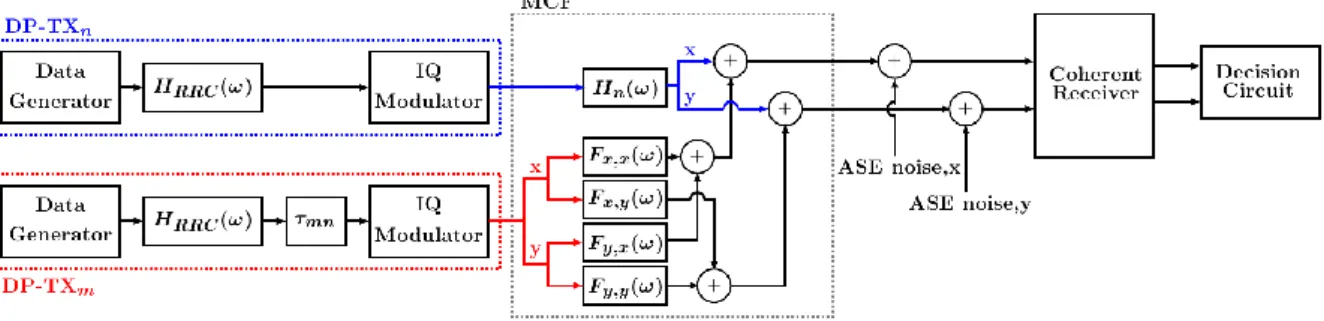
Figure 1. Equivalent simulation model of the MCF system used in this work.
2. SYSTEM SIMULATION MODEL
Figure 1 depicts the simulation model used to assess the dependence of the ICXT on the design parameters of the coherent detection MCF system. The core n is the tested core and the interfering core is core m. Both cores are fed by the corresponding dual polarization-transmitter (DP-TX). Each DP-TX produces, in the data generator, a polarization-division multiplexing (PDM)-M-QAM symbol sequence. Then, each sequence is filtered by a root raised-cosine (RRC) filter, HRRC(ω), with transfer function √HRC(ω), where HRC(ω) denotes the transfer function
of the RC filter, presented in [6], and ω is the angular frequency. The in-phase (I) and quadrature (Q) modulator converts the M-QAM electrical signal to the optical domain. These optical signals are transmitted in the
corresponding MCF core. To simulate the time difference between the transmission of the optical signals at the MCF input, a τmn delay is considered in the electrical signal of the DP-TX launched in core m.
The propagation of the signal in core n is modelled by the transfer function Hn(ω) = e-jβ̅n(ω)L, where β̅n(ω) is the
average of the propagation constants of core n and L is the length of the MCF. A Taylor series expansion up to the 2nd order of β̅
n(ω) is considered. In weakly-coupled MCF operating in the phase-matching region, the ICXT signal
field in each polarization direction is generated by filtering the signal transmitted in each polarization direction of core m by the transfer function Fa,b(ω) defined as [5]
N k j z j L j nm b a k b a k mn n e e e K j F 1 ) ( ) ( , ) ( , 2 ) (
(1)where a,b ∈ {x,y}, N is the number of phase-matching points (PMPs), K̅nm is the average of the discrete coupling
coefficient over the two polarization directions, and Δβ̅mn(ω) is the difference between the propagation constant
averages of cores m and n given by Δβ̅mn(ω) = ∆β̅0,mn+dmnω+(∆Dmnλ2ω2)/(4πc), where ∆β̅0,mn is the difference of
propagation constant averages at zero frequency, 𝑑mn is the walkoff parameter between cores m and n, ∆Dmn is the
difference of the dispersion parameters of core m and core n, c is the speed of light in a vacuum, and λ is the wavelength [7]. In this work, ∆β̅0,mn and ∆Dmn are 0. The skew, Smn, between the cores m and n is given by dmnL.
The angle
ϕ
a,b(k) represents the k-th random phase-shift that occurs between two consecutive PMPs, and is a uniformly distributed random variable between 0 and 2π. zk is the k-th random coordinate that is uniformlydistributed between (k-1)L/N and kL/N. Eq. (1) assumes that the MCF realizations are obtained at time instants, separated by intervals much longer than the correlation time. The transfer functions Fx,x(ω) and Fy,x(ω) model the ICXT from polarizations x and y of core m to the polarization x of the interfered core n, respectively, whereas
Fx,y(ω) and Fy,y(ω) model the ICXT from polarizations x and y of core m to the polarization y of the interfered core n. The amount of ICXT can be quantified by the ICXT level, Xc, which is related to the parameters of Eq. (1)
by Xc=N|K̅nm|2.
We assume that the core loss is compensated by optical amplification. Still, the amplification also adds amplified spontaneous emission (ASE) noise to the signal. This noise field is modelled as additive white Gaussian noise for each polarization direction. The coherent receiver detects the PDM-M-QAM signal and ideally compensates the chromatic dispersion. The detected signal is filtered by HRRC(ω), to produce a RC signal at the decision circuit
input. The model of the coherent receiver is the same as the one presented in Fig. 9 of [8].
The system performance is assessed through MC simulation and the bit error rate (BER) is estimated using direct error counting. The MC simulation starts with the random generation of two different M-QAM symbol sequences for the optical signal transmitted in core m, one for each polarization direction. Then, in each realization of ICXT in the MCF, four different functions Fa,b(ω) are used as filters to obtain the ICXT field in each polarization
direction, as shown in Fig. 1. The resulted ICXT fields are added to the transmitted signal in the tested core. In addition, an ASE noise sample function is added to the optical signal in each polarization direction. Then, the resulting signal is passed by the coherent receiver and the BER corresponding to the MCF realization is estimated.
3. RESULTS AND DISCUSSION
In this section, the variance of the coherently detected ICXT, for 4, 16 and 64-QAM formats, different roll-off factors, time misalignments between signals and skew between fiber cores is analysed. In order to quantify the impact of the ICXT on the performance, we estimate the BER, the OSNR penalty and the maximum allowable ICXT level, Xc,max, which is the Xc that leads to a 1 dB OSNR penalty. The OSNR penalty is defined as the ratio
between the required OSNR with ICXT and without ICXT, OSNRR, to achieve a specific target BER [4]. A hard
decision FEC with a target BER of 10-3 is assumed [4].
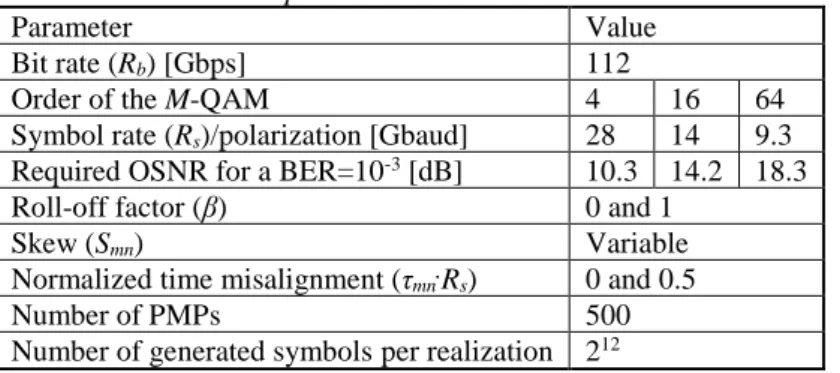
Table 1 shows the MC simulation parameters used to assess the performance of MCF system with coherent receiver impaired by ICXT and ASE noise. The OSNRR, shown in Table 1, agrees with the theoretical OSNRR [6].
Two roll-off factors (0 and 1) of the RC signals are used in the simulation results.
Table 1. MC simulation parameters.
Parameter Value
Bit rate (Rb) [Gbps] 112
Order of the M-QAM 4 16 64
Symbol rate (Rs)/polarization [Gbaud] 28 14 9.3
Required OSNR for a BER=10-3 [dB] 10.3 14.2 18.3
Roll-off factor (β) 0 and 1
Skew (Smn) Variable
Normalized time misalignment (τmn.Rs) 0 and 0.5
Number of PMPs 500
3.1 Detected ICXT Variance
In this subsection, we study the influence of the modulation format, roll-off factor, skew and time misalignment on the variance of the detected ICXT. Fig. 2 depicts the variance of the ICXT normalized to its maximum value as a function of the skew, Smn, for 4, 16 and 64-QAM formats and of 0 and 1.
Figs. 2(a) and 2(b) correspond to a normalized time misalignment to the symbol period, respectively, of 0 and 0.5. In Fig. 2, it can be observed that, when β = 0, the variance of the ICXT is practically constant as a function of the skew and is also independent of the QAM order. In Fig. 2(a), for RC signals with β = 1 and τmn.Rs = 0, the
variance of the ICXT decreases until a minimum for skews of 25, 50 and 75 ps, respectively, for the 4, 16 and 64-QAM signals. These values of skew correspond to 0.7/Rs. For higher skew values, the variance of the ICXT shows
an oscillatory behaviour and tends to 0.75 for higher skews, regardless the QAM order.
In Fig. 2(b), for τmn.Rs = 0.5 and β = 1, the minimum variance of ICXT occurs at skews of zero for 4, 16 and
64--QAM. Then, the variance increases until it reaches its maximum value at 25, 50 and 75 ps for 4,16 and 64-QAM, respectively. From Fig. 2, it can be concluded that the time misalignment between the signals in different cores, leads to a substantial variation of the ICXT variance that can reach one half of the maximum value.
3.2 Bit error rate estimation
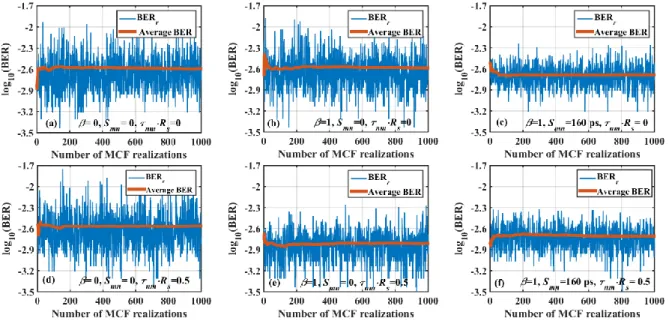
In this subsection, we estimate the influence of the ICXT generated in each MCF realization on the BER, which we define as BERr, and obtain the average BER. Fig. 3 depicts the BERr and the average BER as a function of the
number of MCF realizations for different values of skew, time misalignments and roll-off factors, considering the
16-QAM with OSNR of 14.2 dB and an ICXT level of -23 dB. Figs. 3(a)-(c) consider τmn.Rs = 0, while, in
Figs. 3(d)-(f), the τmn.Rs is set to 0.5. Figs. 3(a) and (d) consider β = 0 and Smn = 0, Figs. 3(b) and (e) consider
β = 0 and Smn = 0 and Figs. 3(c) and (f) consider β = 0 and Smn = 160 ps. The analysis of Fig. 3 shows that the
random nature of the ICXT in each MCF realization leads to considerable differences of the BER in each MCF realization. The BER can vary between -1.7 to -3.5. Moreover, as it can be noticed in Fig. 3, the average BER can be considered stable after 200 realizations for all the scenarios of Fig. 3.
Figure 2. Normalized variance of the ICXT as a function of the skew, roll-off factor of 0 and 1 and (a) τmn.Rs=0, (b) τmn.Rs=0.5. 4-QAM (blue), 16-QAM (red) and 64-QAM (green).
Figure 3: Average BER (red) and BER per MCF realization (blue) as a function of the MCF realization considering 16-QAM with ICXT level =–23 dB and τmn.Rs=0 (a)-(c) and τmn.Rs=0.5 (d)-(f).
3.3 Maximum allowable ICXT level
In this subsection, we study the influence of the skew, time misalignment between signals, modulation format orders and signal roll-off factors on the maximum allowable ICXT level in coherent detection MCF systems. Fig. 4 depicts the maximum allowable ICXT level, as a function of the skew for 4, 16 and 64-QAM signals, the roll-off factors of the RC signals and the time misalignment. Fig. 4(a) refers to τmn.Rs = 0, while, in Fig. 4(b), τmn.Rs =
0.5. From Fig. 4, it can be noticed that, when = 0 and τmn.Rs of 0 or 0.5, the maximum allowable ICXT level is
practically constant as a function of the skew. The Xc,max for RC signals with β = 0 is 16.7, 23.5 and 30 dB for
4, 16 and 64-QAM, respectively. These results agree with the ones found in [4] and [5]. In Fig. 4(a), it can be observed that, if β = 1 and skew of 150 ps, the allowable ICXT level improves by 0.7, 1.5 and 2 dB respectively, for 4, 16 and 64-QAM, in comparison to the Xc,max values obtained for null skew. In Fig. 3(b), for τmn.Rs=0.5 and
β = 1 shows that with a null skew, the Xc,max is 2.4, 3 and 3.6 dB higher than the ones obtained in Fig. 3(a) for the
same skew, as the Xc,max obtained are 14.3, 20.5 and -26.4 dB for 4, 16, and 64-QAM, correspondingly. For
higher skews, it is noticed a Xc,max improvement of about 2 dB, regardless the QAM order.
Figure 4: Maximum allowable ICXT level as a function of the skew for 4-QAM, 16-QAM and 64-QAM signals with roll-off factors of = 0 and = 1 and (a) τmn.Rs=0, (b) τmn.Rs=0.5.
4. CONCLUSIONS
A MC simulator has been developed to estimate the variance of the ICXT and the maximum allowable ICXT level of coherent detection MCF system for 4, 16 and 64-QAM RC signals with different roll-off factors and different time misalignments as a function of the skew. It has been shown that the roll-off factor of 0 leads to a maximum allowable ICXT level independent of the skew and decreases for higher QAM orders. For a roll-off factor of 1, the maximum allowable ICXT level depends on the skew and on the time misalignment of core signals. In this case, the maximum allowable ICXT level increases by 3.6 dB in comparison to the case of roll-off factor of 0 with null skew. When the skew is much higher than the symbol period, the maximum allowable ICXT level increases only by 2 dB. Those results show that, for signals with high roll-off factors, the time misalignment between the transmitted signals maybe used as an ICXT mitigation technique.
ACKNOWLEDGEMENTS
This work was supported in part by Fundação para a Ciência e a Tecnologia (FCT) from Portugal under the project of Instituto de Telecomunicações AMEN-UID/EEA/50008/2013 and the ISCTE-IUL BM-ISCTE-2016.
REFERENCES
[1] W. Klaus et al., “Advanced space division multiplexing technologies for optical networks,” J. Opt.
Commun. Netw., vol. 9, no. 4, pp. C1-C11, Apr. 2017.
[2] K. Saitoh, “Multicore fiber technology,” J. Lightw. Technol., vol. 34, no. 1, pp. 55-66, Jan. 1 2016. [3] T. Hayashi, T. Sasaki, and E. Sasaoka, “Behavior of inter-core crosstalk as a noise and its effect on Q-factor
in multi-core fiber,” IEICE Trans. Commun., vol. E97–B, no. 5, pp. 936–944, May 2014.
[4] B. Puttnam et al., “Impact of inter-core crosstalk on the transmission distance of QAM formats in multi-core fibers,” IEEE Photon. J., vol. 8, no. 2, Apr. 2016, Art. no. 0601109.
[5] T. M. F. Alves and A. V. T. Cartaxo, “Intercore crosstalk in homogeneous multicore fibers: theoretical characterization of stochastic time evolution,” J. Lightw. Technol., vol. 35, no. 21, pp. 4613–4623, Nov. 1, 2017.
[6] P. Crilly, and A. B. Carlson, “Communication Systems: An Introduction to Signals and Noise in Electrical Communication,” 4th Ed., McGraw-Hill Education, 2002, ch. 11, sec. 3, p. 463.
[7] A. V. T. Cartaxo et al., “Dispersion impact on the crosstalk amplitude response of homogeneous multi-core fibers,” IEEE Photon. Technol. Lett., vol. 28, no. 17, pp. 1858– 1861, Sep. 2016.
[8] K. Kikuchi, “Fundamentals of coherent optical fiber communications,” J. Lightw. Technol., vol. 34, no. 1, pp. 157–179, Jan. 1 2016.