Faculdade de Medicina Veterinária
Consumers’ Willingness to Pay for
Safer, Cleaner and Animal Friendlier Beef
Inês Ferreira ViegasDOUTORAMENTO EM CIÊNCIAS VETERINÁRIAS ESPECIALIDADE DE PRODUÇÃO ANIMAL
2013 LISBOA Constituiçãodo Jurí
Presidente
reitorda universidadede Lisboa vogais
Doutor Luís Miguel Rainho Capela Nunes Doutor José Manuel Osório de Barros de Lima e Santos
Doutor José Pedro da Costa Cardoso de Lemos Doutora Lívia Maria Costa Madureira
Doutora Magda Alexandra Nobre Martins Aguiar de Andrade Fontes
orientador
Doutora Magda Alexandra Nobre Martins Aguiar de Andrade Fontes
Co-orientador
Doutor José Manuel Osório de Barros de Lima e Santos
This work was funded by Fundação para a Ciência e a Tecnologia,
grant SFRH/BD/37715/2007
Aos meus
Agradecimentos
Presumo que a sensação de começar um texto de agradecimentos seja sempre esta. Não saber por onde começar e pensar que temos medo de deixar alguém de fora. Mas se todos os que pegarem nestas páginas me conhecerem, sabem que isto vai sair assim de repente. Saberão também que estas palavras não podem nunca espelhar o verdadeiro sentimento que vai muito além da gratidão, e se dirige muito mais para… muito mais.À família não se agradece. São família e pronto. Somos parte deles e eles são parte de nós. Seria uma tarefa incomensurável agradecer a todos por tudo. Pais, avós, irmão, tios. Sou como sou por tudo e por todos eles. Se bem que tenho muitas saudades da avó Raquel e do avô Hélder e do avô Henrique e não lhes posso mostrar quanto deles está nestas páginas. E estes são os que vêm antes de mim. Agora já tenho um depois. Nuno, tu sabes o que eu sei. E temos os Abus, pelos quais, esses sim, tenho que estar sempre grata. E que em tão pouco tempo já fizeram tanto do que sou hoje, e por quem está tanto neste trabalho.
Isabel, Luís, Diogo, gosto muito de vocês, mesmo quando tenho mau feitio.
Agora os amigos, a começar pelos que tão bem me acolheram vinda sabe-se lá de onde, aqui no seu seio. Que me deixaram arrumar a sala e por coisas no lixo. Que me deixaram falar quando eu mais precisei (e precisei muito, preciso sempre muito de falar). Meninas (e alguns meninos) tem sido um prazer e uma honra ser vossa amiga.
Ricardo, ninguém acaba um doutoramento antes do tempo, por favor!
Ana Vieira, boa sorte para o caminho que ainda vais trilhar, acredita que quando estiveres farta já vais estar quase, quase.
Lena, D. Paula, o mundo é um lugar mais perto do que devia ser por vossa causa.
Professora Magda, Professor Lima Santos, nem sei que vos diga. Espero que não se sintam intrujados pelo agradecimento na “zona” dos amigos, mas um agradecimento institucional saberia a pouco, principalmente se pensar em todo o apoio e em tudo o que aprendi. Espero não vos desiludir.
Pedro, Ema, André, Ana, tanto, por tudo, há tanto tempo. Teresa, ainda há mais tempo. Tiago, tenho tantas saudades tuas. Ricardo, já não tenho dores de costas. Tânia, Lucas “tu é que és nossa amiga” vale muito mais do que vocês pensam. Rita, mais que uma vizinha.
A Faculdade de Medicina Veterinária também tem o seu lugar aqui. Pelo acolhimento e por todos os que tem cá dentro. E tenho que agradecer também aos Professores Luís Catela Nunes e Lívia Madureira por tanto me ensinarem e ajudarem.
Disposição dos consumidores a pagar
por carne de bovino
com maiores níveis de segurança sanitária,
bem -estar animal
e proteção do ambiente
RESUMO
A variedade de produtos alimentares disponíveis nas prateleiras dos supermercados é interminável, satisfazendo necessidades que vão muito além da necessidade alimentar. Nesta perspetiva, há uma infinidade de produtos que podem ser valorizados pelos consumidores, mas que não estão disponíveis nos mercados. Paralelamente a este potencial, os consumidores têm aumentado os seus níveis de consciência e preocupação com a forma como os alimentos são produzidos, nomeadamente em relação a produtos alimentares de origem animal. Alguns segmentos de consumidores estão mesmo dispostos a pagar mais por produtos produzidos sob padrões que eles consideram atender às suas preocupações.Neste contexto, o tema de investigação desta tese envolve a valoração económica de produtos de carne bovina, que são diferenciados pela presença de atributos relacionados com a segurança sanitária da carne, bem-estar animal e proteção ambiental.
Portanto, a questão central desta pesquisa é: estarão os consumidores dispostos a pagar por produtos de carne de bovino com atributos específicos, tais como a segurança sanitária, bem-estar animal ou normas ambientais, que vão além dos requisitos mínimos legalmente impostos? Esta pergunta foi respondida tendo em vista os seguintes objetivos específicos: a revisão das questões técnicas mais relevantes a serem resolvidas tendo em conta a sua relevância para os consumidores; a realização de grupos de discussão para avaliar quais as principais preocupações dos consumidores sobre bem-estar animal, segurança sanitária da carne e meio ambiente no contexto da produção de carne de bovino; a implementação de um estudo de experiências de escolha para permitir estimar (através da utilização de um modelo MNL) o quanto, em média, estão os consumidores dispostos a sacrificar dos seus orçamentos familiares, a fim de comprarem esta carne diferenciada.
Esta amostra de consumidores portugueses declarou estar disposta a pagar mais pela carne diferenciada. A elevada significância das estimativas MNL alcançada sugere a necessidade de valorar em conjunto atributos intimamente relacionados, nomeadamente devido à presença esperada de interações negativas muito significativas.
As conclusões incluem a sugestão de que algumas das preferências dos consumidores são na realidade preferências de cidadãos, o que pode advir da indiscutível natureza pública da segurança sanitária, bem-estar animal e meio ambiente.
Finalmente, do ponto de vista empresarial, esta pesquisa mostra algumas estratégias de diferenciação possíveis, que podem ser implementadas com base em atributos como a origem nacional e os sistemas de produção tradicionais.
PALAVRAS-CHAVE
Atributos acreditados; carne de bovino; disposição a pagar; experiências de escolha; grupos de discussão; multinomial logit; preferências declaradas; preferências do consumidor.Consumers’ Willingness to Pay
for Safer, Cleaner and
Animal Friendlier Beef
ABSTRACT
The variety of food products available in supermarkets shelves is endless, fulfilling necessities that go beyond the need for food. In such perspective, there are an infinite number of products that might be valued by consumers, but are not available in markets, i.e. non-market goods. Alongside these potential, consumers have increased levels of awareness and concern about the way food is produced, namely food products of animal origin. Some consumer segments are even willing to pay more for products produced under standards they consider to meet their concerns.Within this framework, this thesis’ research topic involves the economic valuation of beef products which are differentiated through the presence of attributes related with beef safety, animal welfare an environmental protection.
Therefore, the question central to this research is: Are consumers willing to pay for beef products with specific attributes such as food safety, animal welfare or environmental standards, going beyond legally imposed minimums? This question was answered having in mind the following specific goals: the review of the most relevant technical issues still to be solved and worth analyzing; the discussion during focus groups of consumers’ main concerns regarding animal welfare, food safety and the environment related with beef production and beef products; the implementation of a choice-experiment survey to allow estimating how much, on average, are consumers’ willing to sacrifice from their households’ budgets in order to buy this differentiated beef product, through the use of a MNL model.
Our sample of Portuguese consumers stated they are willing to pay a premium for differentiated beef. A high significance for the MNL estimates was achieved and we found evidence of the need to jointly value closely related attributes namely due to the expected presence of very significant negative interactions.
Additional conclusions include the suggestion that some of the stated consumer preferences are in fact citizens’ preferences, which may arise from the undisputable public nature of food safety, animal welfare and the environment.
Finally, from a corporate perspective, this research shows some potentially differentiating strategies that could be implemented based on attributes such as national origin and traditional production systems.
KEYWORDS
Beef; choice-experiments; consumer preferences; credence attributes; focus groups; multinomial logit; stated preferences; willingness to pay.Table of Contents
List of Figures XVII List of Tables XIX List of Graphs XXIII List of Abbreviations and Symbols XXV List of Publications XXVIIPART I 1
Chapter 1 A debate on markets for beef products 3
1.1 Globalization, dynamic societies and changing consumers . . . 3
1.2 A note on food production and public policies in the European Union . . . . 5
Chapter 2 Does it all fit in a beef? Food quality attributes and consumers’ perceptions 9
2.1 Food Quality Attributes . . . 9
2.2 Consumers’ perceptions of beef quality attributes – meat safety, animal welfare and the environment . . . 11
2.3 A duality between consumers and citizens . . . 14
Chapter 3 Economic valuation of non-market goods 17
3.1 Private goods with affiliated public good attributes . . . 18
3.2 A brief approach to revealed preferences and to non-use values . . . 19
3.3 Stated preference methods . . . 21
3.4 Common grounds for the Contingent Valuation Method and Choice-Experiments . . . 22
3.5 Choice-experiments: methodological aspects and design . . . 24
Chapter 4 Objectives, organisation and structure 29
4.1 Stimulus, choices and relevance . . . 29
4.2 Main goals . . . 31
Chapter 5
Portuguese beef market – potential for differentiated products 39
5.1 Introduction . . . 39
5.2 Methods . . . 41
5.3 The Common Agricultural Policy and the Portuguese beef sector . . . 41
5.4 Portuguese beef sector characterization . . . 44
5.4.1 The beef sector within the Portuguese economy . . . 44
5.4.2 Portuguese beef sector production . . . 44
5.4.3 Portuguese beef trade . . . 46
5.4.4 Beef consumption in Portugal. . . 46
5.5 The Portuguese differentiated beef sector . . . 49
5.5.1 Other differentiated beef products in Portugal . . . 52
5.6 Constraints and perspectives for the differentiated beef sector . . . 52
5.7 Conclusions . . . 55
Chapter 6 Meat Safety: a Brief Review on Concerns Common to Science and Consumers 57
6.1 Introduction . . . 57
6.2 European Consumers’ Concerns about Meat Safety – a Brief Review . . . 59
6.3 Are Antibacterials’ Residues in Meat a Concern? . . . 62
6.4 European Union Legal Framework on Antibacterial and Other Residues in Meat . . . 65
6.5 Conclusions . . . 67
Chapter 7 Is there a link between animal welfare in traditional beef systems and beef quality? 71
7.1 Introduction . . . 71
7.2 Animal welfare – definition and legislative framework . . . 73
7.3 Beef production systems in Portugal – a descriptive analysis . . . 76
7.3.1 “Semi-extensive” beef production system . . . 79
7.3.2 Intensive beef production systems . . . 80
7.4 Portuguese beef production systems welfare status and possible control points . 81 7.5 Portuguese beef cattle welfare – objective quality and user-oriented quality . . . 86
Chapter 8
Beef Production in traditional Montados – A second best for the environment? 89
8.1 Introduction . . . 89
8.2 Traditional silvopastoral systems in Mediterranean areas of Europe – a brief overview . . . 91
8.3 Portuguese traditional silvopastoral systems . . . 93
8.4 Marginalisation, land abandonment and desertification of agricultural territories: environmental and societal problems . . . 95
8.5 Strategies to avoid land abandonment and protect biodiversity in traditional agricultural systems . . . 99
8.5.1 The intensification route . . . 99
8.5.2 Sown Biodiverse Permanent Pastures . . . .100
8.5.3 Preserving Montados together with beef cattle production . . . .100
8.6 Conclusions . . . 101
PART III 105
Chapter 9 Joint production of safer, cleaner and animal friendlier beef: do consumers join it too? 107
9.1 Introduction . . . 107
9.2 Methods . . . .109
9.3 Results . . . . 110
9.4 Discussion and conclusions . . . . 115
Chapter 10 Consumers` perceptions towards beef safety, animal welfare and environment: getting insights and choice scenarios from focus groups 119
10.1 Introduction . . . 119
10.2 Methodology . . . . 121
10.2.1 Focus Groups: participants, discussion guide, questionnaire and limitations . . . . 121
10.2.2 Data Analysis and limitations of the study . . . 124
10.3 Results . . . 124
10.3.1 Perceptions of beef safety . . . .125
10.3.2 Perceptions of animal welfare . . . .126
10.3.3 Perceptions of the environment . . . 127
10.3.4 Choice exercises results . . . .129
Do they really care? Insights on Consumers’ Perceptions and Concerns Associated with Beef
Credence Attributes 135
11.1 Introduction . . . .135
11.2 Methods . . . .136
11.3 Results . . . .138
11.3.1 Beef buying and consumption habits . . . .138
11.3.2 Behaviours related with animal welfare, environment and altruism . . . .139
11.3.3 Concerns related with the beef production chain . . . .140
11.3.4 Preferences for differentiated beef . . . 141
11.4 Discussion and conclusion . . . 142
Chapter 12 Beef Credence Attributes: Implications of Substitution Effects on Consumers` WTP 145
12.1 Introduction . . . .145 12.2 Methods . . . .148 12.2.1 Choice modelling . . . .148 12.2.2 Survey design . . . .150 12.3 Results . . . .152 12.4 Discussion . . . .155 12.4.1 Substitution effects . . . .155 12.5 Concluding remarks . . . .156 12.5.1 Context dependency and other possible explanations for negative interactions . . . .156
12.5.2 Practical applications of joint valuation . . . .158
PART IV 163
Chapter 13 General discussion and conclusion 165
13.1 Main theoretical and methodological results . . . .165
13.2 Practical applications . . . .167
13.3 Limitations of the research work and the results presented . . . 170
13.4 Scientific innovation . . . 173
Chapter 14 Future research perspectives 175
References 179 Appendix 1 201 Appendix 2 203 Appendix 3 213 Appendix 4 215 Appendix 5 217
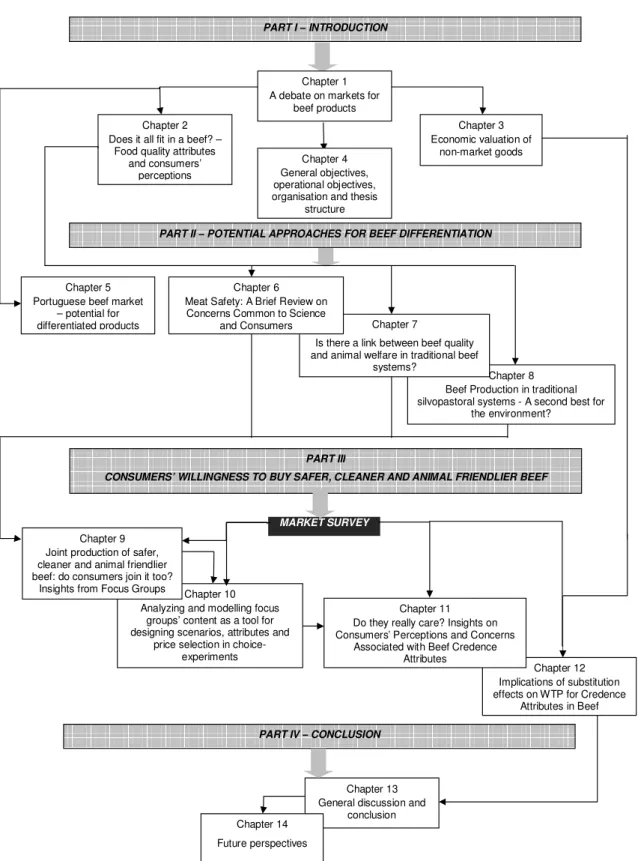
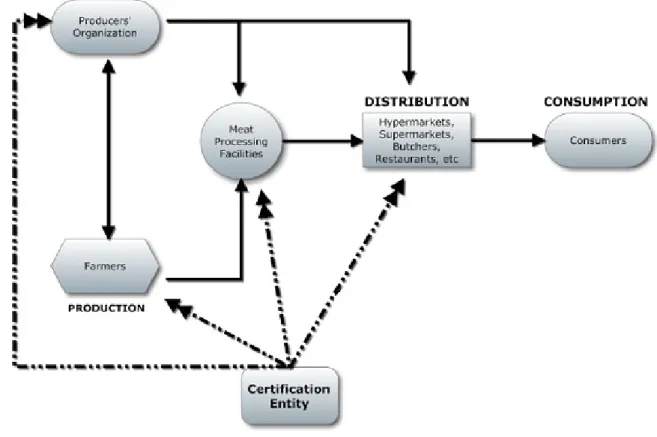
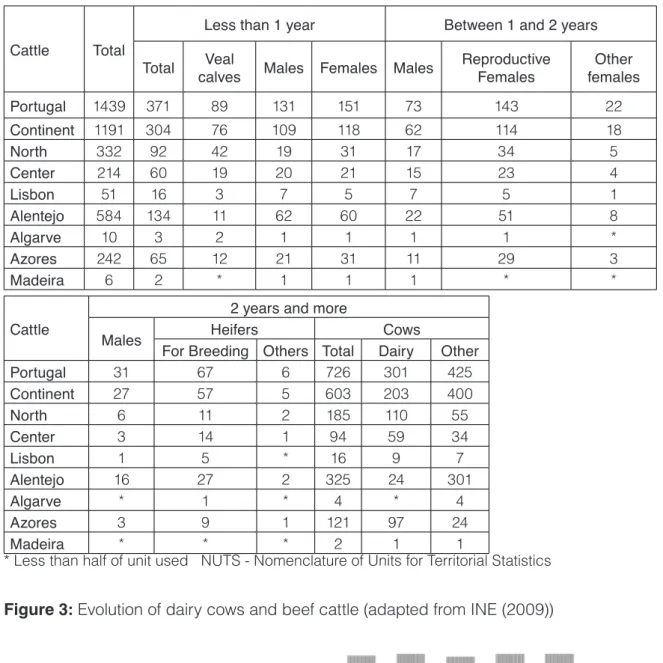
Figure 1: Thesis structure 32 Figure 2: General organisational framework for a PDO beef production and distribution (adapted from Barreira et al. (2009)) 50 Figure 3: Evolution of dairy cows and beef cattle (adapted from INE (2009)) 77 Figure 4: Evolution of the number of farms in the different portuguese regions, by NUTSII (adapted from INE (2009)) 78 Figure 5: Evolution of the number of animals per farm by NUTSII (adapted from INE (INE, 2009)) 78 Figure 6: Sylvopastoral systems’ schematic representation (adapted from Pinto-Correia and Vos (2004)) 92 Figure 7: Figure 1: Example of a choice exercise sheet 123 Figure 8: Beef differentiation cycle based on traditional beef production systems (adapted from Napolitano, Girolami, & Braghieri (2010)) 169
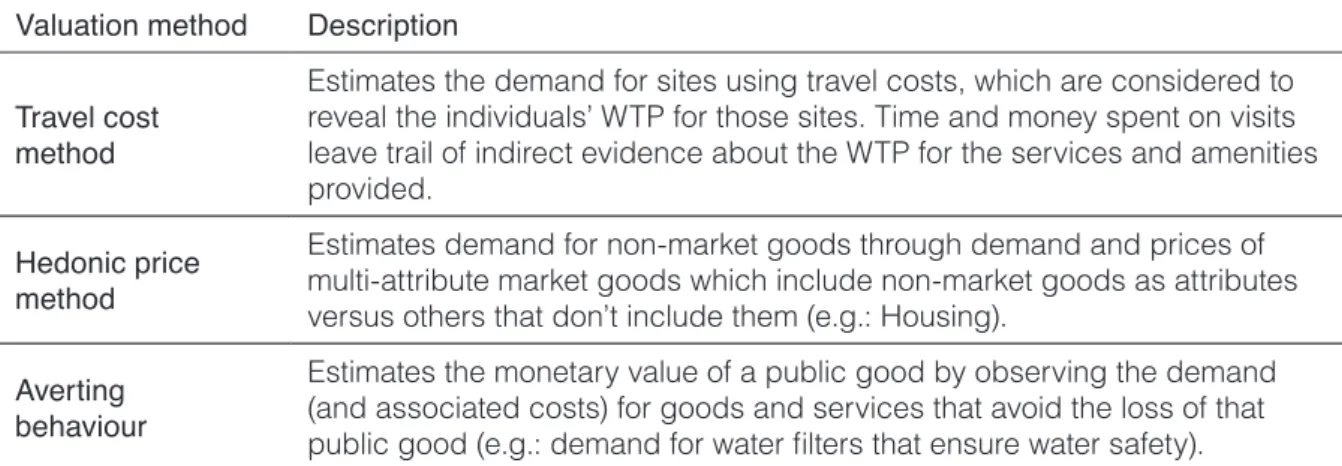
Table 1: Revealed preferences methods (adapted from Madureira et al (2007)) 20
Table 2: Non-use values (adapted from Mitchell and Carson (1989) and Lazo, McClelland and Schulze (1997)) 20
Table 3: Stated preference methods 21
Table 4: Stages of a CE design (adapted from Hanley, Mourato and Wright (2001)) 26
Table 5: Beef sector SWOT analysis (Aguiar Fontes, et al , 2008; Banovic, et al , 2006; European Commission, 2007; GPPAA, 2004, 2005, 2006; IDRHa, 2001, 2002, 2003, 2004a, 2004b, 2005, 2006, 2007; INE, 2002, 2004, 2005, 2006, 2007, 2008a, 2008b, 2012; Progect AGRO 422, 2004-2006) 48
Table 6: Most relevant legislation regulating and controlling the use of antibacterial drugs in meat production, as well as the presence of drug residues in meat products throughout the EU 66
Table 7: Overview of animal welfare main legislative references within the European Union (adapted from Blandford et al (2002), European Commission (2010) and Veissier et al (2008)) 75
Table 8: Distribution of animals by the different portuguese geographical regions by NUTS II in 2008, (Unit - 1 000 heads) (adapted from INE (2009)) 77
Table 9: Characteristics of the Portuguese “semi-extensive” Production Systems (adapted from Rodrigues, Pinto de Andrade, and Várzea Rodrigues (1998)) 79
Table 10: Intensive production systems’ characteristics in Portugal. 81
Table 11: The Five Freedoms and Provisions (FAWC, 2010) 82
Table 12: Freedom from Hunger and Thirst 83
Table 13: Freedom from discomfort 83
Table 14: Freedom from pain, injury and disease 84
Table 15: Freedom to express normal behaviour 84
Table 16: Freedom from fear and distress 85
Table 17: Participants demographic characteristics 109
List of Tables
Table 19: Specific aspects regarding beef safety 111
Table 20: Specific aspects regarding the environment 112
Table 21: Specific aspects regarding animal welfare 113
Table 22: Aspects debated regarding beef labels 114
Table 23: Focus groups participants` profile 122
Table 24: Price sets used in choice exercises 4 and 5 124
Table 25: Beef safety perceptions, associations and concerns 125
Table 26: Animal welfare perceptions, associations and concerns 127
Table 27: Environmental perceptions, associations and concerns 128
Table 28: Logistic regression results 129
Table 29: Attribute’s mean WTP 130
Table 30: Price range values 131
Table 31: Potential scenarios for choice experiments: beef attributes 132
Table 32: Provisory price range and survey bids 133
Table 33: Summary statistics for demographic variables 137
Table 34: Beef buying habits 138
Table 35: Beef consumption habits 138
Table 36: Reported behaviours 139
Table 37: Concerns and responsibilities related with the beef production chain 140
Table 38: Differentiated beef ranking 141
Table 39: Beef credence attributes 151
Table 40: Summary statistics for demographic variables 152
Table 41: Main effect multinomial logit estimation 153
Table 43: Inclusion sequences 154
Table 44: WTP for animal welfare 154
Table 45: WTP for the environment 154
Graph 1: Evolution in calve, suckler cow and dairy cow herds (Unit – 1000 heads) (INE, 2004, 2005, 2006, 2007, 2008a, 2008b, 2012) 42 Graph 2: Evolution in slaughtered calves, heifers and adult (INE, 2004, 2005, 2006, 2007, 2008a, 2008b, 2012) 45 Graph 3: Percentage weight of animal food products in gross human apparent consumption per capita in EU18 and in Portugal (EUROSTAT, 2008) 47 Graph 4: PDO beef production value in Portugal (real prices) (IDRHa, 2001, 2002, 2003, 2004a, 2004b, 2005, 2006, 2007; INE, 2002) 51 Graph 5: PDO beef production quantities in Portugal (tonnes) (IDRHa, 2001, 2002, 2003, 2004a, 2004b, 2005, 2006, 2007; INE, 2002) 51 Graph 6: Production shares of PDO beef producers in Portugal, 2005 (IDRHa, 2001, 2002, 2003, 2004a, 2004b, 2005, 2006, 2007) 53
List of Abbreviations and Symbols
AW Animal welfare
BRC British Retail Consortium
BSE Bovine Spongiform Encephalopathy
CAP Common agricultural policy
CCP Critical control points
CE Choice experiments
CP Control points
CVM Contingent valuation method
EDU Economic Dimension Units
EFSA European Food Safety Agency
EFSIS European Food Safety Inspection Service
ENV Environment
EU European Union
EUREPGAP Euro-Retails Produce Working Group
FAO Food and Agriculture Organisation of the United Nations
FAWC Farm Animal Welfare Council
FFP Five Freedoms and Provisions
FS Food safety
GAP Good Agricultural Practice
GDP Gross Domestic Product
GFSI Global Food Safety Initiative
GLOBALG.A.P. Global Good Agricultural Practice
GMO Genetically Modified Organism
GPP Gabinete de Planeamento e Políticas
GVA Gross Value Added
HACCP Hazard analysis and critical control point
IDRHa Instituto de Desenvolvimento Rural e Hidráulica
IFS International Food Standard
IIA Independence from irrelevant alternatives
INE Instituto Nacional de Estatística
ISO International Organization for Standardization
MNL Multinomial Logit Model
NOAA National Oceanic and Atmospheric Administration
OIE World Organisation for Animal Health
PDO Protected designation of origin
PGI Protected geographical indication
RP Revealed preference
SP Stated preference
UK United Kingdom
USA United States of America
WHO World Health Organization
WTO World Trade Organization
List of Publications
This thesis was based on the following manuscripts
(international peer-reviewed papers): Viegas, I., Vieira, A., Stilwell, G., Santos, J.L., Aguiar Fontes, M. (2011) Is there a link between
beef quality and animal welfare in traditional beef systems? New Medit, 3/2001: 17-25.
Viegas, I., J.L.Santos, M. Aguiar Fontes (2011) Joint production of safer, cleaner and animal friendlier beef: do consumers join it too? Insights from Focus Groups. Proceedings of the EAAE Congress 2011, European Association of Agricultural Economists, Zurich.
URL: http://ageconsearch umn edu/bitstream/115551/2/Viegas_Ines_60 pdf
Viegas, I., J.L.Santos, M. Aguiar Fontes (2012) Portuguese beef market – potential for differentiated products. RPSC, 111 (581-582): 91-100.
URL: http://www fmv utl pt/spcv/PDF/pdf6_2012/91-100 pdf
Viegas, I., J.L.Santos, A.Barreto, M. Aguiar Fontes (2012) Meat Safety: A Brief Review on Concerns Common to Science and Consumers. International Journal of Sociology of Agriculture and Food, 19(2): 275-288.
URL: http://ijsaf org/archive/19/2/viegas pdf
Viegas, I., J.L.Santos, M. Aguiar Fontes (2013) Do they really care? Insights on Consumers’ Perceptions and Concerns Associated with Beef Credence Attributes. Proceedings of the International Food Marketing Research Symposium, Budapest.
Viegas, I., M. Aguiar Fontes, J.L.Santos. Beef Production in traditional silvopastoral systems - A second best for the environment? Submitted to the journal Ecosystem Services, April 2013. Viegas, I., Santos, J.L. and M. Aguiar Fontes. “Consumers` perceptions towards beef safety, animal welfare and environment: getting insights and choice scenarios from focus groups”. Submitted to the Journal of Agricultural Economics, July 2013.
Viegas, I., L.C.Nunes, L.Madureira, M. Aguiar Fontes, and J.L. Santos. Beef Credence Attributes: Implications of Substitution Effects on Consumers` WTP.” Submitted to the Journal of Agricultural Economics, July 2013.
and oral presentations
Viegas, I., J.L.Santos, M. Aguiar Fontes (2009) “Carne de Bovino Diferenciada, Novas oportunidades para o Médico Veterinário”. Poster presented at the VI Congresso da Ordem dos Médicos Veterinários, Ordem dos Médicos Veterinários, October 3 to 5, Lisboa, Portugal. Viegas, I., J.L.Santos, M. Aguiar Fontes (2010) “Consumers’ willingness to pay for safer, cleaner and animal friendlier beef. Insights from focus groups”. Poster presented at The 84th Annual Conference of the Agricultural Economics Society. March 29-31, Edinburgh, UK.Viegas, I., J.L.Santos, M. Aguiar Fontes (2010) “Are there connections between animal welfare in traditional Portuguese beef production systems and beef quality?” Oral communication presented at the 61st Annual Meeting of the European Association for Animal Production. August 23-27, Heraklion, Crete.
Viegas, I., J.L.Santos, M. Aguiar Fontes (2011) “O bem-estar dos bovinos e a qualidade da carne, Perspetivas de grupos de discussão” Oral communication presented at the Curso “Comportamento e Bem-Estar de Ruminantes”, May 13th, Faculdade de Medicina Veterinária, Lisboa, Portugal.
Viegas, I., J.L.Santos, M. Aguiar Fontes (2011) “Joint production of safer, cleaner and animal friendlier beef: do consumers join it too? Insights from Focus Groups” Poster presented at the European Association of Agricultural Economists Congress 2011, August 30 – September 2, Zurich, Switzerland
Part I is devoted to the Introduction and it includes a debate on societies, markets and food consumption, a review on the concepts related with food quality and an analysis of the methodologies that can be used to assess consumers’ preferences and willingness to pay for food products.
Globalization, dynamic societies and changing consumers
Chapter 1
A debate on markets for beef products
1.1 Globalization, dynamic societies and changing consumers
“The sheer novelty and glamour of the Western diet, with its seventeen thousand new food products every year and the marketing power – thirty-two billion dollars a year – used to sell us those products, has overwhelmed the force of tradition and left us where we now find ourselves: relying on science and journalism and government and marketing to help us decide what to eat.”
– Michael Pollan, in Defence of Food: An Eater’s Manifesto, 2008.
The more classic approach to the economics of food consumption states that consumers’ income and prices are among the most important determinants of food choice. As income rises, the weight of food expenditure in the total households’ expenditure decreases. In Portugal, the share of expenditure on food products decreased from 18.7% of the total expenditure in 2000 to 13.3% in 2010/2011 (INE, 2012).
One of the consequences of this income rise is that with lower income restrictions, families get to diversify and broaden the bundle of food purchases (Blaylock, Smallwood, Kassel, Variyam, & Aldrich, 1999), and factors such as consumers’ preferences, beliefs and concerns play a more dominant role. Meat, for example, is more frequently part of meals as incomes grow – as the impressive change in China’s previously predominantly vegetarian diet shows (Delgado, 2003).
As such, the most fundamental concepts surrounding food consumption have been changing for a while now, and consumers are increasingly choosing their food taking into consideration physiologic, psychological or sociological factors (Blaylock, et al., 1999).
Some socio-demographic changes in today’s societies are playing an important role. Western societies are getting older, families are becoming smaller, and women are working more. People (old and young) are increasingly sedentary and moving away from rural areas. A more positive perspective shows that societies in developed economies are becoming generically more educated, better informed and more diverse.
All these changes across societies have impacted food consumption in almost all the possible perspectives, namely the time dedicated to shopping, confection and eating. Time for these activities is very scarce for most segments of society, and convenience has become
a very important factor for shopping decisions. But if convenience is important, quality is a characteristic that consumers consider more and more indispensable and unquestionable as they get better off.
Consumers with higher incomes are more prone to buy premium products, and even for products that are typically seen as having a low degree of differentiation, like meat (and beef in particular), quality characteristics (in a broad sense of the word, as it will be discussed further ahead) are increasingly of interest.
Furthermore, consumers are also looking for new food indulgencies and discoveries, such as new flavours (or foreign flavours), new textures or new packages. Also, the aspects of food related to health are ever more relevant for consumers’ choices, leading to concerns with nutritional, safety and functional aspects of food (see chapter 6 for a review on consumers’ concerns related with meat safety and e.g. Verbeke, Frewer, Scholderer and De Brabander (2007) for work on consumers’ behaviour with respect to food safety and risk information). Finally, altruistic interests related with the way food is produced also influence consumers’ choices, namely those related with sustainability (see, e.g., Aldanondo-Ochoa and Almansa-Sáez (2009) for a discussion on consumer’s interest for environmentally friendlier food products and Lusk and Norwood (2012) for a debate on altruistic concerns about farm animal welfare).
Easier access to information – namely since the ubiquitous internet phenomenon – allows consumers to search for all these food products with the characteristics they are looking for, and to verify whether (whatever sort of) allegations are true.
As a response to these eager necessities of today’s societies – or on another perspective, as a motor to generate them (Caswell & Joseph, 2007) – food products are more and more differentiated, with more value-added features, trying to reach (and to be specific) a wider variety of consumer segments. As markets turn global and miles turn shorter, the competition increases. Driven by markets’ competition and consumers’ demand, new products’ development keeps generating new goods1, and in some cases price isn’t a limitation (Grunert, Bredhal, & Brunso, 2004)2.
Food companies and retailers strategies are now shaping products’ prices and availability. Marketing strategies are in many cases carving consumers’ needs, perceptions and motivations, thus changing shopping behaviours and consumption patterns. This marketing environment is also providing incentives for food producers to differentiate their products, even at the farm level.
So, food is changing from a production perspective too. For better or worse, the technological evolution has led food to a completely different place than where it was a few decades ago. As in many other aspects of society, the last fifty years have seen more change, than the fifty centuries before.
Food is now safer, that is indisputable. It’s mostly sold under proper conditions so it is unlikely to find unsound food at supermarket shelves. It’s better looking, easier to prepare and eat (consider, for example, boneless hake or cod), more accessible to different income
1 However, the failure rate for new food products is stated to be between 60 and 80% (Grunert & Valli, 2001).
2 Worth mentioning that the income constraint will always play a role in food choices, and that the economic crisis that many European countries are going through will most certainly have reflexes on food consumption habits and on many products’ sales – specially those more differentiated and premium priced.
A note on food production and public policies in the European Union
segments and in a wider location range (kiwis from New Zealand in the antipode Portugal are a very good example). But it is also unhealthy in many aspects (Silver & Bassett, 2008), as it is more processed, has more additives and preservatives.
Finally, food is increasingly less sustainable. The food chain is increasingly longer and produces more waste and disposable by-products. Producing food consumes more resources than ever (although the efficiency levels are indisputably higher than ever), namely water and energy. This is particularly significant if one considers the entire chain of harmful effects of the production of food products of animal origin, which is responsible for growing levels of air, water and soil pollution3.
Many food production sectors are also responsible for rearing livestock under conditions that are debatable, to say the least. Often, the need to gain efficiency and reduce production costs has lead to inhumane rearing conditions for many farm animal species.
Still, as for all the other aspects, societies, markets and consumers evolved, producing, regulating and searching for food products that are safer and produced in environmentally and animal benign ways. Organic food, natural food, local products, free-range products are just examples of such food products that try to counteract these unsustainable and deleterious aspects of the food production, namely that of animal origin.
Nevertheless, there is evidence showing that supply and demand haven’t completely ajust to safer, cleaner and animal friendlier food products, and it is this issue that has become central to this research.
1.2 A note on food production
and public policies in the European Union
Not only because of the previously mentioned deleterious aspects of food production, public policies also had their say on the food sector. Public interventions have focused on establishing production standards (labour regulations, environmental and livestock protection standards, etc), food safety regulations and publicity control, just to name a few examples (Caswell, 1998).For example, European Union (EU) food producers are subject to a demanding regulatory framework, as farmers have to comply with many standards to be eligible for Common Agricultural Policy (CAP) income support4, to operate within the law and even to get 3 Chapter 8 includes a brief review on the environmental impact of livestock production. For an exhaustive and disturbing review consider Steinfeld et al. (2006).
4 “The cross compliance mechanism’s objective is to contribute to the development of sustainable agriculture and making the CAP more compatible with the expectations of society at large. It was firstly introduced on a voluntary basis in the Agenda 2000 and was further developed in the 2003 CAP reform for all the Member States (art. 3-9, Council Regulation No 1782/2003, repealed by Council Regulation (EC) No 73/2009). Cross compliance creates a link between the full payment of support under the CAP’s first pillar and under some rural development measures (CAP’s second pillar). In order to get payments farmers shall be compliance with parts of 19 existing and already implemented regulations or directives (the so-called Statutory Management Requirements) which cover rules relating to agricultural productions, lands and activities in the three areas of the environment, the public, animal and plant health and the animal welfare. Furthermore, farmers must guarantee that their land is in Good Agricultural and Environmental Conditions, which concern the issues of soil erosion, soil organic matter, soil structure, minimum level of maintenance, protection and management of water and maintaining the total area of permanent pasture. http:// ec.europa.eu/agriculture/envir/cross-compliance/index_en.htm
contracted by increasingly demanding retailers. Animal production farms are no exception to this. As all agricultural operations in the EU, they must comply with a set of regulations, which define minimums for food safety, the environment and animal welfare.
Either by direct regulation of price formation structures or by conditioning production costs, these regulations really influence production costs – namely in aspects related with food safety, animal welfare and the environment – and are hence part of the price formation system for food within the European market (Olynk & Ortega, 2013).
Considering the cases for which the EU market is more protected (namely as it is for beef, our case-study’s object) higher costs due to regulation are usually transferred to consumers through higher prices. However, not all food products reach the market with the same production costs, once different economies are subject to different levels of regulation, wages, or any other relevant conditions.
If it is assumed the future will bring increased levels of world trade liberalization and consequently less protected markets in Europe for beef and other food items, production costs and the price formation mechanisms become even more relevant, as they may determine whether European food producers will be able to compete (through product differentiation or other possible ways) with imports coming from countries with lower regulatory levels5.
It is thus clear that public regulations with consequences on food products can have effects on consumers’ choices, either by influencing prices or by impacting food product’s availability. Equally relevant is the influence such regulations have had on many dimensions of food products’ quality6.
5 Regulatory impositions related with food safety, animal welfare and the environment are increasingly considered as non-tariff barriers to trade by the World Trade Organization (WTO) as they are seen as means to hinder free trade. The trend will most likely be towards their end, i.e., countries with high regulatory levels will increasingly be forced to accept the import of products produced under lower levels of regulation (Blandford, 2006; Fraser, 2008).
6 A note should probably be made at this point on the differences between European and American consumers. Even if one considers only food consumption, there are obviously many differences between intra-European consumers, due to countless country-specific products, habits, preferences, etc. However, the difference between Europe and the United Stated of America (USA) is probably deeper and is reflected in the scientific literature. For example, in the USA it is possible to administer beef cattle with growth hormones, which is forbidden within the European Union. And whereas within the EU it is mandatory to include beef origin on labels, this is still an open discussion in the USA Accordingly, the evaluation of consumers’ concerns related with beef safety need necessarily to be different. Another example can be found on the awareness about the environmental impact of beef production. Beef production in the USA is very different from the EU, which implies different consumers’ and citizens’ perceptions and concerns.
Therefore, most of the scientific literature here quoted involves research made in the EU and based on European consumers and should be interpreted within such geographical borders. The most frequent exceptions involve methodological issues, for which the research location has little impact.
Food Quality Attributes
Chapter 2
Does it all fit in a beef?
Food quality attributes and consumers’ perceptions
2.1 Food Quality Attributes
Along with the changes on the relationship between consumers’ and food, there has been an evolution of the notion of food quality itself. As such, when it comes to food, society is ever more aware of issues other than simple availability, and the inferred quality dimensions of a product depend on consumers’ experience, knowledge, and beliefs, which can vary significantly from one person to another (Alfnes, 2004).Quality dimensions can thus be defined as “product-specific characterisations that consumers form based on a product’s attributes and that they believe indicate the usefulness of the product in fulfilling purchase motives” (Bech, Grunert, Bredhal, Juhl, & Poulsen, 2001)7. If different characteristics of food production – such as the welfare of production animals – are considered food attributes as perceived and valued by consumers, then they will determine a product’s quality (Grunert, 2005).
Also, according to Grunert (2005), it should always be taken into account that there are two different meanings for quality: objective quality (which regards the physical characteristics of a food product) and subjective quality (which is the quality as perceived by consumers). Objective quality must be translated into quality attributes that consumers’ subjectively evaluate through different types of cues (Brunso, Bredhal, Grunert, & Scholderer, 2005; Grunert, 2005).
Food quality attributes can be classified under several different perspectives (Fontes, Seabra, & Lemos, 2011)8:
• Process or product attributes;
• Search, experience or credence attributes.
Product attributes are related with physical characteristics of the food products and with the way those characteristics are communicated to consumers. Process attributes are related to characteristics of the production process, like production with due concern for food safety, animal welfare and the environment, and they do not necessarily lead to a different final product (Caswell, Bredahl, & Hooker, 1998; Northen, 2000). Although they are not explicit within the product, they can influence the consumer’s welfare if properly communicated.
A different perspective into food quality attributes classifies them as either search, experience or credence attributes. Search attributes can be ascertained at the time of purchase. Experience attributes are those which are only ascertainable after purchase and consumption. Finally, credence attributes are those which consumers can never ascertain by
7 This definition is very much related with Lancaster’s Consumer Theory whose main concept was not to view the consumer as choosing between different goods but between different characteristics which the goods themselves provided (Lancaster, 1966). The relevance of Lancaster’s Theory will be fully considered in chapters 3 and 12.
8 For a complete review on the main concepts and definitions related with food products’ quality from the consumers’ perspective see Fontes et al. (2011)
themselves, having to trust the quality judgement of others (Bech, et al., 2001; Nelson, 1970; Northen, 2000).
Many process-related quality dimensions, as well as some product-related ones, are credence dimensions (Bech, et al., 2001; Grunert, et al., 2004) and consumers must rely on quality cues, which in fact are search attributes (as first defined by Steenkamp (1990)) , in order to choose which product is expected to have the quality dimensions they wish to purchase. These search attributes, or cues, can also be distinguished as intrinsic and extrinsic. Intrinsic quality cues are part of the physical product such as colour or fat content, and cannot be altered without changing the characteristics of the product itself. Extrinsic quality cues deal with everything else that is product-related, such as price, brand or packaging (Bredhal, 2003; Olson & Jacoby, 1972).
Price effects as quality cues are ambiguous (Rao & Monroe, 1989; Zeithaml, 1988), but brands have undisputable effects on perceived quality9 (Bredhal, 2003). Either way, they are used by consumers – together with many other possible cues – to make inferences about a food product’s quality (Grunert, 2005)10.
Concerning the beef attributes central to this research – i.e. food safety, animal welfare and the environment – there are some aspects worth debating, namely regarding their classification according to the aforementioned definitions. Such assortment has implications not only for the understanding of consumers’ attitudes, but also in methodological discussions that will be held further ahead (chapters 3 and 12).
Food safety, animal welfare and the environment are credence attributes. There is no way for the consumer to verify whether production methods were animal friendly or environmentally sustainable. The only available option is to trust the information provided.
But food safety could be considered to be an experience attribute as well. If it is considered that a deleterious effect could be somewhat immediate after a food product’s consumption (stomach flu would be an appropriate example) it can be argued that food safety is experienced after consumption. However, as there are many food safety hazards that would only be detectable in the long run, food safety is considered a credence attribute (Grunert, 2002). Consumers can only trust, and have no way to verify (at least on the short term) that their food is safe. It is worth mentioning that consumers’ awareness degree is permanently shifting and is greatly influenced by close and recent food scares (Grunert, 2005).
In the perspective of the definition by Caswell et al. (1998), food safety also presents some degree of duality. It is a process-related attribute (as are animal welfare and the environment), but it is also a product attribute – through a health-related quality dimension (Grunert, 2005; Northen, 2000). Here lies a major difference between food safety and the other two attributes with consequences for this research. As food safety is a characteristic of the final product, it can be sold directly through the selling of food as a private good, and hence it has also a higher direct market-creation potential11.
9 “The ``perceived quality’’ approach analyses product quality from the viewpoint of the consumer, making quality a subjective assessment dependent on perceptions, needs and goals of individuals” (Northen, 2000).
10 See chapters 9 and 10 for insights on Portuguese consumers about prices and brands associated with beef quality. 11 For a more elaborate discussion of the classification of food safety, animal welfare and the environment as private or public goods see chapter 3.
Consumers’ perceptions of beef quality attributes – meat safety, animal welfare and the environment
Nevertheless, meat is a food category where consumers face particular difficulties in forming quality judgements, especially because meat is mostly sold unbranded (Bredhal, 2003; Grunert & Valli, 2001). Moreover, it is worth mentioning that consumers have been known to make some inferences that may not be particularly reasonable and are indicative of the level of uncertainty that is faced while shopping for this kind of food (Verbeke, Frewer, Scholderer, & De Brabander, 2007). Thus, there are still many doubts about the existence of an indirect market for these attributes.
Therefore, once food safety, animal welfare and environmental protection are three concerns consumers have about modern food production systems (Madureira, Rambonilaza, & Karpinski, 2007; Napolitano, Girolami, & Braghieri, 2010), the question still to be answered is if it is possible to indirectly sell them through marketable food (e.g. differentiated beef)?
2.2 Consumers’ perceptions of beef quality attributes
– meat safety, animal welfare and the environment
Indisputably, consumers search for process-related quality dimensions has increased for the last decades (Grunert, et al., 2004; Olynk & Ortega, 2013; Verbeke, Wezemael, et al., 2010). Even more, Resurreccion (2003) claimed that the decline in the consumption of meat products in the UK was related to consumer concerns about food safety, animal welfare and the environmental effects of beef production.There is thus a stimulus for food products differentiation, as increases in organic products’ sales and other quality labels based on credence process attributes – like Protected Designation of Origin (PDO) – seem to confirm (Grunert, 2005; Pouta, Heikkilä, Forsman-Hugg, Isoniemi, & Mäkelä, 2010)12.
There has been a somewhat constant research on what are the attributes that consumers consider to be relevant when shopping for beef and many attributes have been pointed out as influencing the quality perception of beef, as consumers consider meat to be an important part of their diets (Verbeke, Pérez-Cueto, De Barcellos, & Krystallis, 2010), and beef to be a particularly appreciated type of meat (Verbeke & Vackier, 2004).
There are many reports on consumers’ expressed concerns relative to meat safety, the welfare of production animals and the environmental impact of food production, which can be summarized as ethical and altruistic concerns (Bernués, Olaizola, & Corcoran, 2003a; Brom, 2000; Harvey & Hubbard, 2013). Nevertheless, production related concerns are often more associated with inferences about the safety of food products (Bernués, et al., 2003a; Lusk & Norwood, 2012; Verbeke, Pérez-Cueto, et al., 2010)13.
In this perspective, lack of naturalness in the production process, excessive preparation and manipulation are negative characteristics for consumers, due to the association with negative impacts for health (Angulo & Gil, 2007; Verbeke, Pérez-Cueto, et al., 2010).
There are also frequent concerns related with the presence of drug residues (Olynk &
12 See chapter 5 for some data on Portuguese market for differentiated beef products. 13 A more elaborate enunciation of this inference process can be found in chapter 12.
Ortega, 2013; Vanhonacker, Poucke, Tuyttens, & Verbeke, 2010), although often consumers don’t have the ability to specify which substances they are concerned with14.
The last two decades have been proliferous in meat related food scares, with increased public awareness (Fearne, Hornibrook, & Dedman, 2001; Wezemael, Verbeke, Kügler, de Barcellos, & Grunert, 2010)15. Beef products have sadly been associated with the probably most severe of these situations, Bovine Spongiform Encephalopathy (BSE). It is likely that safety related attributes in beef products have since then assumed a particular relevance (Grunert, 2002; Verbeke & Viaene, 1999), even if market shares have been slowly recovering across Europe (though still below the initial consumption levels).
The public intervention – namely within the EU – has also significantly increased subsequently (Knowles, Moody, & McEachern, 2007)16 as have privately managed quality (and safety) assurance schemes (Fearne, et al., 2001; Verbeke, Pérez-Cueto, et al., 2010). However, the mandatory traceability information can have little value as a safety cue (Angulo & Gil, 2007; Verbeke & Roosen, 2009), contrasting with the expiration date that is used by many consumers as a proxy for freshness and safety (Angulo & Gil, 2007; Verbeke & Ward, 2006)17.
Either way, beef safety is considered difficult to assess by many consumers and choosing a butcher as a source of trust and guaranteed safety is not unusual (Grunert & Valli, 2001; Wezemael, et al., 2010). About 50% of Portuguese consumers still made this choice in 2007 (Project AGRO 422, 2004-2007). Also worth mentioning is the fact that most consumers don’t consider to have a relevant degree of responsibility for the safety of the beef they eat (and for any other food items, for all that matters) (Verbeke, et al., 2007; Wezemael, et al., 2010).
Another attribute that has been used by consumers, who consider it to be a cue for higher quality, is the place-of-origin (Bernués, Olaizola, & Corcoran, 2003b; Sepúlveda, Maza, & Mantecón, 2008; Verbeke & Roosen, 2009). There are several different possible origin denominations, related with regions or countries, and some are even subject to EU’s regulations (namely the PDO and the Protected Geographical Indication – PGI)18.
In many cases, origin (namely the country of origin) is an important cue for consumers to assess the safety of beef (Henson & Northen, 2000; Verbeke & Ward, 2006), and a national product is often considered safer19. Consumers also regard origin as a quality attribute due to strong association to the protection of local values and heritage (Acebrón & Dopico, 2000; Bernués, et al., 2003a).
In spite of all the described preoccupations and inferences related with beef safety, the fact is that consumers consider that if a given food product is available for purchase, it must
14 Chapter 6 discloses in detail the main concerns consumers seem to have about meat safety and points out some misconceptions behind those concerns.
15 For a comprehensive insight about the current debates about meat safety issues see chapter 6.
16 Chapter 6 also includes a review on the most relevant body of legislation impacting on food safety in general and meat safety in particular.
17 A more detailed analysis of what consumers use as cues for beef safety was achieved during the focus groups discussions held within this research framework. The qualitative results are presented in chapters 9 and 10.
18 The legal framework concerning PDO products is described in chapter 5.
19 This particular conception was very much patent during the focus groups discussion held within this research framework – see chapters 9 and 10.
Consumers’ perceptions of beef quality attributes – meat safety, animal welfare and the environment
be safe (Verbeke, Pérez-Cueto, et al., 2010; Wezemael, et al., 2010). This feeling moves away safety concerns during shopping decisions – with exception of the cases when a recent food scare occurred (Angulo & Gil, 2007; Verbeke, et al., 2007).
The same sort of dissociation between stated concerns and shopping decisions is also patent in the case of animal welfare and the environment. A well know and described phenomenon of voluntary ignorance allows consumers not to think about uncomfortable matters while making shopping decisions (Lagerkvist & Hess, 2011; Ngapo, et al., 2003; Vanhonacker, et al., 2010).
Still, it is very likely that most consumers are unaware of the true environmental consequences of livestock production (Vanhonacker, Van Loo, Gellynck, & Verbeke, 2013). Nevertheless, considerable consumer segments are increasingly concerned with this deleterious impact – and of bovine cattle production in particular – due to its contribution to climate change (Troy & Kerry, 2010) and thus some are willing to make environmentally friendlier choices.
Regarding the welfare of production animals, consumers are demanding that animals are reared, transported and slaughtered in humane conditions (Troy & Kerry, 2010; Vanhonacker, et al., 2010). In the case of beef, besides the ones previously mentioned, particular concerns relate with the wish to see animals grazing in good life conditions and low stocking densities, as opposed to industrial fattening operations20.
Additionally, there are also references to consumers who associate higher welfare standards to an increased sensorial quality of beef (Vanhonacker, et al., 2010), which is to some extent supported by scientific evidence (Blokhuis, Keeling, Gavinelli, & Serratosa, 2008)21. If it is considered that experienced quality is one of the most important characteristics for most consumers in terms of repeating a purchase (Banovic, Grunert, Barreira, & Aguiar Fontes, 2010; Verbeke, Wezemael, et al., 2010)22, animal welfare as a quality attribute gains increased
relevance.
It should also be stressed that the organic denomination is a quality attribute from which consumers make many inferences (Grunert, 2002; Hughner, McDonagh, Prothero, Schultz II, & Stanton, 2007). Although some of those inferences are not scientifically supported, the fact is that many consumers regard organic meat as safer (namely due to lower levels of drug residues) and to be produced in more humane and environmentally friendlier way (Aldanondo-Ochoa & Almansa-Sáez, 2009; Hughner, et al., 2007).
Still, if there are all these cares and concerns about the environmental and animal impact of food production, the fact is that they aren’t translated into higher market shares for differentiated products like organic ones.
20 Chapters 9 and 10 describe consumers’ descriptions of what they consider animal welfare to be.
21 An up to date review of the relation between beef cattle welfare and the quality of beef products can be found in chapter 7.
22 For an extensive work on beef quality perception, namely related with experienced quality see the work of Banovic et al. (2010) and Banovic et al. (2009).
2.3 A duality between consumers and citizens
All these consumer stated concerns can sometimes be a mirror of their worries as citizens (Brom, 2000; Verbeke, Pérez-Cueto, et al., 2010). This duality explains why many consumers hold (sometimes strong) negative views about the way animals are produced and about the negative environmental impact of such products but still consume meat products (Mørkbak, Christensen, & Gyrd-Hansen, 2010; Napolitano, et al., 2010; Verbeke, Pérez-Cueto, et al., 2010). Moreover, when animal or eco friendlier products are available (but somewhat more expensive), many consumers are unwilling to purchase them, even if their ethical convictions as citizens are supportive of such sounder production methods (Vanhonacker, et al., 2010).Public concerns about beef quality may therefore change depending whether they are assessing it on an everyday purchase context or on a production evaluation context, in what is translated into a paradox of incoherence in sayings-doings (Korzen & Lassen, 2010).
Furthermore, many consumers actually think that the responsibility for assuring that food is safe and that animals and the environment are properly protected belongs, in fact, to the Government (Verbeke, Pérez-Cueto, et al., 2010), which coincides with the reasoning that these process attributes are, at least to some extent, public goods (Harvey & Hubbard, 2013)23.
The work here presented focuses mostly on presenting to consumers beef products (that are differentiated due to the presence of credence attributes) in a market setting. However, it would be likely that significantly different results would be obtained if the setting was one of a referendum. Such setting would lead consumers to act as citizens in a voting situation, rather than making a purchase decision (Korzen & Lassen, 2010; Olynk & Ortega, 2013). The final paragraphs of chapter 3 elaborate on some of the work undertaken in this direction, but that was abandoned early in this research.
Nevertheless, it is important to stress that the economic valuation tools that will be described subsequently would allow the distinction between these two different mind-sets and a very rich field of investigation lies on the comparison between what people want to pay as consumers and as citizens.
23 As previously noted, a more elaborate discussion on the classification of food safety, animal welfare and the environment as private or public goods can be found on chapter 3
non-use values associated with them. Furthermore, non-market valuation methods are described in detail.
Chapter 3
Economic valuation of non-market goods
As it has been shown, there are many new food products with many new different attributes constantly becoming available for consumers, who may be willing to pay for them. Such willingness to pay represents the amount of money a person would be willing to sacrifice in order to receive a good, attribute or service24In such a context, the search for new differentiated products with attributes valued by consumers (or at least by some consumer segments) is endless. Therefore, there are food attributes and food products that might be valued by consumers, but are not available in markets (at least yet), which fits the definition of non-market goods25.
In private markets the more common transactions involve private goods which are routinely bought and sold in the marketplace and raise very few questions about the possibility of assigning them a monetary value. The possibility of a transaction actually occurring is influenced, among other things, by the good’s attributes. However, for non-market goods there are doubts on whether it is possible to sell them or to capture their whole value through private markets.
Along this research it was intended to broaden this concept somewhat further by considering that the credence attributes involved in this research – i.e. food safety, animal welfare and the environment – can be considered non-market attributes of beef products (which are market goods)26. A considerable part of their relative unavailability in private markets is the public good character associated with the production of these three attributes.
24 More precisely, and going beyond the strict context of food consumption, willingness to pay is the amount of money a person would be willing to sacrifice in order to receive a good, attribute or service, or to avoid something undesired (such as pollution, for example) and have their utility remain the same. Therefore, willingness to pay can be formulated by looking into the indirect utility function: U = V(Y,S,Q), where U=utility, Y=income, S=demographic/economic variables, Q=level of provision of the goods/attributes/services.
The maximum willingness to pay (WTP) (or Compensating Variation; see Bateman et al. (2002) for a detailed explanation on the WTP and compensating variation concepts and other related issues), is denoted as C, ,and is defined as the value of C that ensures the following equality: V(Y -C, S, Q1) = V(Y,S,Q0). Thus WTP is the amount of payment which, combined with the
presence of the good, gives the person the same level of utility as would occur if there were no payment and no acquisition of the good.
25 For some research areas this definition may sound somewhat abusive. However, it’s commonly accepted throughout the literature related with the valuation of environmental goods, which are usually not traded in markets. The use of the term applied along this thesis suggests that these non-market goods (goods not traded in markets) can be conveyed through their association with private goods, commonly traded in markets, and for which there is a market price. We believe that, for example, part of the value of an eco-friendly product comes from the product itself, but that some of the value comes from that non-market good that is being delivered through a private good.
26 The concept is far from new (see, e.g. Lusk, Nilsson and Foster (2007); Lusk et al. (2007) refer to “private goods with affiliated public good attributes” and has extensively analyzed the availability and transaction of such public attributes through private goods) , but may raise some argument in other research areas. For example, in public transport services, there is a concept of minimum public service obligation, which guarantees that the private good (a transport service) includes attributes (a minimum service and / or operating hours, for example) that fulfill public standards. Still, the underlying reasoning is the same: there is a need to fulfill the demand for desired attributes, whose provision is difficult to guarantee exclusively under pure market conditions.
3.1 Private goods with affiliated public good attributes
Pure public goods are characterized by the conditions of non-excludability (in that individuals cannot be effectively excluded from use) and of non-rivalry (where use by one individual does not reduce availability to others) (Samuelson & Nordhaus, 2009). These characteristics make it very difficult to capture their whole value through market transactions (namely due to free-riders, who benefit from the good without paying for it) and to fully compensate the public goods’ producers (Lagerkvist & Hess, 2011)27.Focusing on livestock production practices and in goods with affiliated public-goods attributes (such as beef and the attributes under research), markets cannot or are unwilling to supply the levels desired by society of food safety, animal welfare or environmental protection, which justifies the need to regulate livestock production practices. Public intervention is thus necessary to guarantee the desired level of provision that matches societies’ demand (Baldcock, Hart, & Scheele, 2011; Harvey & Hubbard, 2013).
However, sales of private goods with public goods’ attributes have notably increased in recent years (Lusk, et al., 2007). In fact, Harvey and Hubbard (2013) point out that “the extent of consumers’ willingness to pay for improved animal welfare products can indicate the extent of market failure”, i.e. how much animal welfare is not being provided to fulfil societies’ demand (Lusk & Norwood, 2012). The same reasoning can be extrapolated for the environment and food safety.
In fact, traditionally food safety has been thought of as a public good (e.g., BSE control regulations in the EU were governmentally imposed and the consequent food safety is non excludable). However, it has been described as an income-elastic (as income increases, demand for food safety is likely to rise) and price-inelastic good (consumers would be willing to pay premiums for safer products) (Swinbank, 1993). Market would therefore theoretically allow consumers to buy a product they consider safer (for example, organic meat) at a higher price. This would give food safety a more private character, as it would have rivalry and excludability characteristics.
Having these private characteristics – and because it has a direct and sometimes immediate repercussion on consumers’ welfare and health – food safety is therefore, somewhat “easier to sell” than the other two attributes. Therefore, even if societies’ demand can’t be left entirely on the hands of market forces (Mørkbak, Christensen, & Gyrd-Hansen, 2010), by being easier to sell it is possible that real willingness to pay (WTP) for food safety will be easier to disclose through valuation methods28 .
27 This leads to the definition of market failure, i.e. a situation where the allocation of goods and services by a free market is not efficient. Markets fail to provide an efficient allocation of resources in the presence of imperfect competition, information asymmetry or externalities. Relevant for our discussion are externalities, which arise when activities impose costs or bestow benefits that are not paid for in the marketplace. Governments may decide to step in and regulate these situations (Samuelson & Nordhaus, 2009).
28 This private versus public ambiguity may have helped to the existing variety of willingness to pay reports – see chapter 6.
A brief approach to revealed preferences and to non-use values
Animal welfare and the environment – which have more moral and ethical considerations – are more prone to incomplete capture by market prices. Thus it is more a matter of indirectly selling a public good through a private good market. It will never be possible to capture the whole value of these goods, once there will always be expected free-riding (Lusk & Norwood, 2012). There will always exist beneficiaries of the provision of animal welfare and the environment who don’t even buy the private good (vegetarians would be a good example for the case of beef).
However, even if without full production costs’ recovery, it may be possible to finance at least part of these public goods through private markets (Lusk & Norwood, 2012). For example, it is recognized that organic meat has the potential to correct at least part of the market failure associated with the public nature of environmental externalities of agriculture (Aldanondo-Ochoa & Almansa-Sáez, 2009).
Resuming the discussion on non-market goods (private or public), if they have a positive influence to consumers’ welfare, they have economic value and a monetary value can be determined. Economic valuation is the tool which allows the assignment of monetary values to these non-market goods (Bateman, et al., 2002).
In general, it is possible to determine the economic value of any of these non-market goods by one of two ways: revealed preference (RP) techniques and stated preference (SP) techniques. RP techniques value preferences through the analysis of real – revealed – market behaviours and seek to verify whether the demand for the non-market good under valuation has effects on associated goods’ markets.
SP techniques ask people how much economic value they think the non-market good has (Bateman, et al., 2002), by asking them to declare how they would behave in an hypothetical situation.