STUDY OF MOTOR SKILL IN ELDERS FOR THE DEVELOPMENT OF A
HIERARCHY OF REQUISITES TO THE DESIGN OF PRODUCTS
Ramon MELO¹, Alexandre dos REIS¹, Flávio dos SANTOS¹ e Michaelle BOSSE¹
¹ Universidade do Estado de Santa Catarina (University of the State of Santa Catarina)
SUMMARY
This article gives examples on how to use knowledge related to human abilities on the development of a hierarchy of users’ request, helping and guiding an ergonomic project. The article presents different methods of classification of the human abilities and exemplifies with a tool that correlates aged users’ requests with the abilities needed to interact with automatic teller machines of banks.
KEYWORDS
Ergonomics, Aged, Motor Skills, Design Requisites.
1. INTRODUCTION
Ergonomics is tied with the concept of design making it hard to analyze them in separate. Being the industrial design a social science that works with the man interaction with artifacts, it is understood that the ergonomic and the human factors are intrinsic to the design creation. Itiro Iida (2005) defines the object of study of ergonomics as the interaction man-‐machine-‐environment. A machine is understood as all and any artifact for human usage that targets the execution of a function.
Even if Ergonomics is being considered a science just recently, the interaction of the man with artifacts and environment was always an essential field of study for the design and material production. The design of an artifact can’t neglect the interaction of it with both man and environment.
Each human being behaves in a different way and has different abilities and levels of accuracy. Several factors influence the capabilities of human interaction, being the age one of the most determinant ones. From childhood to maturity, the human being has distinct abilities and limitations in both motor and cognitive aspect that, on an alternate or cumulative way, develop in their life time. It is common that aged users pile up several restrictions on those aspects.
2. ELDERLY AND USABILITY
Defining usability as an expression that deals with the easy handling and interaction of the user with an artifact aiming to perform a given task, it may be inferred that the elder public must receive special attention on this restrain due to the common functional limitations inherent to the degenerations that come with the age.
In 1950 the world had 204 million elders and in 1998, almost five decades later, this number reached 579 million people, an increase of almost eight million aged people by year. The projections show that, in 2050, the elder population will be of 1.9 billion people (IBGE, 2002).
Since the growing of the aged population, both in absolute and relative numbers is a phenomenon without precedents in global scale, it becomes a priority to pay attention for these population needs of usability by the developers of new products and technologies.
A large part of the aged users also shows difficulties of interaction due to not knowing the technological codes usually present in some industrialized products. Cognitive, cultural and movement limitations may difficult and sometimes avoid the aged user of having an effective interaction with many of the products available today. Perhaps the identification of the attributes needed for an efficient usability by aged consumers during the project phases of those products may provide an expansion on the number of potential users, as well as their satisfaction.
It is known that the new generations, generally speaking, have an easy transit with the new technologies, they have an easy traffic on the transition for devices with every time more technological resources, the observations suggest that, besides the high ability for learning that is a characteristic of the childhood and young, those abilities are also the result of a continuous training, motivated by the entertainment, sometimes ludic and even magical, that those technological resources make available. In other words, what is observed on those interactions is not a natural familiarity between people and objects, an innate apprehension, but an interaction based on codes, languages and practices continuously exercised, that smooth the facility of those interactions. In that way, the most adequate utilization of a huge part of the products currently being sold, specially the electronic and computing ones, is accessible only to a small parcel of the potential consumers, only those that have the proper “training” to decode and use them. According to Coughlin (2010) researchers, entrepreneurs and the government must work together to develop and implement this technology, besides practicing solutions to face those challenges. That way, the life of the elders and their relatives may be made better, entrepreneurs might transform the ageing of the world population in market innovations and the government may ensure an effective and equal delivery of the public programs.
The usability focused on the elders is a small, however complex part of this system. A possible way to analyze the usability of those users with old ages is through a classification of the human abilities that suffer more with the degenerations that come with the age.
4. ACTIONS OF ANALYSIS AND ABILITIES CLASSIFICATION
Based on Rozenfeld et al. (2006), it is possibly to initially divide the ergonomic study in two schools, distinct but complementary. The first one, called Physics Ergonomics, deals with the physical interaction of the individual with the system. It deals with anthropometric and environmental aspects of this relationship, like human relations, physical strength, thermic and acoustic comfort, etc. On the other hand, the Cognitive Ergonomics deals with interactions between man and system through the analysis of the information exchange between the user and the system, defining the best way to transmit and receive the information, with the goal of reaching the task objectives.
According to Kroemer and Grandjean (2005) until recently it was possible to do a division of mental and manual work. Today this division is not as evident as it was until a recent past. According to the authors the mental activity may be classified on two categories:
• Strict Brain Work: The worker receives information that must be compared and combined with the previous knowledge, being then memorized on its new configuration. It is a process of thinking that demands a creativity on different levels of complexity;
• Data Processing as part of the man-‐machine system: The essential questions for the information processing are the perception, interpretation and processing of the information transmitted by the sense organs. The activity consists on combining the new information with the previous one, creating on that way a foundation for decisions making.
Gomes Filho (2006) states that with respect to the physics interaction, one of the scopes of the ergonomics is the analysis of the handling actions by the user. The handling may be defined as the group of physical actions related with the usage of any object. The author suggests a qualification of five levels of handling:
• Very Careful Handling: demands a lot of ability, precision and sensibility; • Careful Handling: action that demands ability, precision and sensibility;
• Average Handling: demands some strength, ability, precision, training and experience;
• Rough Handling: activity that demands some more strength, some precision, low training and experience;
• Very Rough Handling: action that demands some ability, much strength, precision, training and experience.
Analyzing the different factors related with handling actions, it is possible to reach the conclusion that even a simple task may involve several aspects, either cognitive or physical in different levels of complexity. There are handling actions that are executed almost automatically, like to pull a zipper, open a door or button a shirt, actions that do not require complex care or huge physical and mental efforts to realize them. Other tasks like flying an airplane, perform a surgery or compete in a sports competition demand a higher number of operational acts and eventually a higher speed, time, strength, mental focus and physical endurance (GOMES FILHO, 2006).
In a phase of the informational project of products, the identification of those users’ requisites is essential to define the characteristics that the product must have. If this product aims to have a good usability by elders, it must be defined which characteristics of this consumer may interfere or even prevent the interaction with the product.
5. CLASSIFICATION AND DEFINITION OF MOTOR SKILLS
SCHMIDT and WRISBERG (2010) conceptualize the ability as a task or skill that a person uses to execute a movement (2010).
MAGILL (2000) differentiates ability of motor skills, the first one being defined as a task with a specific goal to be reached and the second ones as abilities that demands volunteer movements of the body and/or members to reach the goal.
Each task executed has unique characteristics, and because of that the researcher must have the capacity to identify the main characteristics that differentiate one ability of the other (SCHMIDT and WRISBERG, 2010).
There is a huge amount of schemas to categorize the human movement abilities. Most of them are one-‐ dimensional and represents only one aspect of a movement ability. The two-‐dimensional models are different from the one-‐dimensional by their scope, because they display on a more real way the situations of movement, crossing two aspects of movement abilities. There are yet the multidimensional models that have the capacity of visualization of the movement abilities in three or more dimensions.
One-‐dimensional categorizations
According to Richard A. Magill (2000) the theorists classify the motor skills according to an attribute similar to one of another motor skill. A commonly used characteristic to describe a motor skill is the kind of muscular group needed to execute a given task. The realization of tasks that demand a larger utilization of the big muscles and that not demand a great precision of movements is classified as a rough motor skill. Contrary, the execution of activities that demand a greater control of small muscular groups is called discreet motor skill. Another way that the author presents for the identification of the motor skills relates with the different movements executed to perform this ability. An ability that demands a differentiated movement that has beginning and end points very well defined is called discreet motor skill. When the activity demands a repetition of different motor skills either in sequence or in series, this ability is defined as a serial motor skill. When the activity demands repetitive movements it is called continuous motor skill. According with the stability of the environment where the task is executed it is possible to classify the
or the context changes during the execution of the ability. An ability executed in a stable environment where the context and the object don’t change during the task may be defined as closed motor skill.
The authors Richard A. Schmidt and Craig A. Wrisberg (2010) propose the split of the categories according to the movement organization (discreet, serial and continuous) and by the level of environmental predictability (open and closed).
Gentile Categorization
On the two-‐dimensional categorization of Gentile (GENTILE, 1987 apud MAGILL, 2000) two general characteristics are considered for all abilities, the first one being the environmental context where the person does the task and the second a function of the action that characterizes the ability. On the environmental context there are two categories – regulation conditions (still or moving) and intertrial variability (yes and no). On the context of the function of the action two categories are identified – body transport (yes and no) and object manipulation (yes and no), resulting on a taxonomy of sixteen different categories of abilities
Two-‐dimensional Categorization of Gallahue
On the categorization model proposed by Gallahue (2002) the relationship of the intentional function of the movement task (stability, locomotion and manipulation) with the phases of motor development based on its complexity (reflexive phase, rudimentary, fundamental and specialized movement) is verified.
Multidimensional Categorization
According to Gallahue (2002), the multidimensional categorizations or schemas allow the visualization of the movement in three or more dimensions. In that case one ability of movement may be observed on his muscular aspect (rough/fine), temporal (discreet, serial or continuous), environmental (open and closed), functional (stability, of locomotion or manipulation) and of development (reflexive, rudimentary, fundamental or specialized).
With an analysis of three or more dimensions of movement abilities it is possible to group kinds of movements and to categorize them in a way that makes possible to have a hierarchy of motor difficulties commonly suffered by aged people.
6. MOTOR SKILLS ON ELDERS USERS
According to Santos and Sala (2010) there are several relevant factors on the development of a project of products that has among its consumers aged users.
Hearing
The hearing is commonly used on industrialized products with a function of feedback, which means, waiting for a return to the user of the actions executed by it. Elders have disadvantages on this, once that it is quite common the deterioration of the hearing system of those individuals. Another fact to be considered on that scope is the balance difficulties of the user due to the common deterioration of the inner ear of the elder. (SANTOS and SALA, 2010)
Vision
According to Santos e Sala (2010), consumers over 60 years of age commonly have a reduction on the visual acuity, higher difficulty to focus on a given point of the vision, problems with colors perception (specially green, blue and violet) and loss of the periphery vision due to glaucoma.
Tact
A large part of the interaction of users with industrial products happens through the tact and the handling of the objects. It is common that elders show problems with smooth handling, hands shaking, loss of strength and losses of the spatial vision.
Locomotion
Slower and less sharp movements are common in people over 60 years. Products that demand a continuous and open motor skill may be a challenge for an aged consumer.
7. A PROPOSAL FOR A MULTI-‐DIMENSIONAL ANALYSIS AND ABILITIES HIERARCHIZATION FOR
THE USAGE OF AUTOMATIC TELLER MACHINES BY ELDERS
The man has limited resources of perception and cognition, and this factor must always be relevant in a project of daily usage. Those limitations change from person to person, as a result of individual characteristics such as formation, experience, culture, age and knowledge of the technological codes. As a result of those conception problems of the objects, there may be constrains and inabilities to handle those devices. (ABRAHÃO, SILVINO e SARMET, 2005)
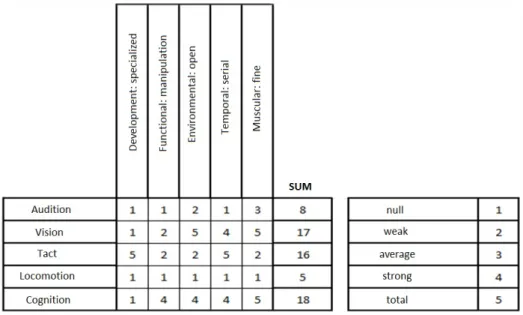
According to the proposal of Gallahue (2002) it is possible to identify the motor skills needed to pick-‐up money in an Automatic Teller Machine (ATM) according to the five aspects proposed by Gallahue, not considering the locomotion until the auto-‐service point:
• Muscular: fine • Temporal: serial • Environmental: open • Functional: manipulation • Development: specialized
Identifying five items commonly observed as the source of difficulties faced by the aged (Audition, Vision, Tact, Locomotion and Cognition) it is possible to verify, in relation to the results of Gallahue’s classification, which items have higher correlation, therefore suggesting an hierarchy of the requisites of the aged users for this kind of equipment. As can be seen on table 1.
Table 1: Correlation among limitations and motor skills
As a result of the correlation it is possible to notice a hierarchy of the five items evaluated, with regard to the requisites of aged consumers:
1. Cognition 2. Vision 3. Tact 4. Audition 5. Locomotion
The example, even in a simplified way, shows the more relevant items for a project of ATMs, it can be used as a tool during the phases of the informational project for a better identification of the functional elements of the object.
8. CONCLUSIONS
The definition of the ergonomic requisites may be quite complex on the development of a project of industrial products, however, several tools and methods may help the designer in this task. The simple definition of a hierarchy of the main requisites of the users may help to set the direction of this analysis. The example presented here aims to demonstrate on a simplified way a connection of a classification of abilities widely used (Gallahue) with an analysis of the struggles faced by an specific segment of consumers. Ergonomics has the fundamental role to adapt the object to the man and its surroundings, as is of extreme importance for the designer or ergonomist the preoccupation with the right application of the available knowledge for a more effective usability of the industrialized products.
9. BIBLIOGRAPHY
ABRAHÃO, J. I., SILVINO, A. M. D., SARMET, M. M. Ergonomia, Cognição e Trabalho Informatizado. Psicologia: Teoria e Pesquisa Mai-‐Ago 2005, Vol. 21 n. 2, PP. 163-‐171.
COUGHLIN, Joseph F. “Understanding the Janus Face of Technology and Ageing: Implications for Older Consumers, Business Innovation and Society“ International Journal of Emerging Technologies and Society, Vol. 8, No. 2, 62 – 67, 2010
GALLAHUE, D. L. A Classificação das Habilidades de Movimento: um caso para Modelos Multidimensionais. Revista da Educação Física – UEM. Maringá, v. 13, n. 2, p. 105-‐111, 2 period 2002.
GOMES FILHO, João. Design do objeto: Bases Conceituais. São Paulo: Escrituras Editora, 2006.
Instituto Brasileiro de Geografia e Estatística (IBGE). Perfil dos idosos responsáveis pelos domicílios no Brasil – 2000. Rio de Janeiro; 2002.
IIDA, I. Ergonomia :projeto e producao. São Paulo : Edgard Blucher, 1993.
KROEMER, K. H. E.;GRANDJEAN, E. Manual de ergonomia:adaptando o trabalho ao homem. 5. ed. Porto Alegre: Bookman, 2005.
MAGILL, Richard A. Aprendizagem Motora: Conceitos e Aplicações. São Paulo: Edgar Blücher, 2000.
ROZENFELD, H. et al. Gestão de Desenvolvimento de Produtos -‐ Uma referência para a melhoria do processo. São Paulo, Saraiva, 2006.
SANTOS, F. A. N. V. ; SALA, Silvia F. . Ergonomia e terceira idade: aspectos relevantes para o projeto de produtos para pessoas idosas. In: ABERGO 2010 -‐ ULAERGO 2010 / XVI Congresso Brasileiro de Ergonomia e III Congresso Latino Americano de Ergonomia, 2010, Rio de Janeiro. Anais do ABERGO 2010 -‐ ULAERGO 2010 / XVI Congresso Brasileiro de Ergonomia e III Congresso Latino Americano de Ergonomia, 2010.
SANTOS, Suely. TANI, Go (Editor). Comportamento Motor: Aprendizagem e Desenvolvimento. Rio. de Janeiro: Guanabara Koogan, 2008.
SCHMIDT, Richard A. e WRISBERG, Craig A. Aprendizagem e Performance Motora: Uma Abordagem da Aprendizagem Baseada na Situação. 4.ed. Porto Alegre: Artmed, 2010.