Julián Keppl1; Martin Šichman2; Lukáš Šíp3 1
Prof. Ing. arch. CSc., Head of Institute of Ecologic and Experimental Architecture 2
Mgr. art., Doctoral student at Institute of Ecologi 3
Ing. arch. PhD., Research assistant at Institute Faculty of Architecture STU
[email protected] [email protected] [email protected]
Learning from Markethall
Abstract
Faculty of Architecture in cooperation student studio project. Its main topic of Old Market hall in Bratislava. Objective operational and social qualities to this work ranged from analytical to the realization 1:1 scale or prototypes of critical details signed architectural interventions, solved quently constructed those details in the tails often resulted in the change of studio aimed at promoting active work ing the design process.
Keywords: Markethall, architecture, interventions,
279
of Ecologic and Experimental Architecture
of Ecologic and Experimental Architecture ( Faculty of Institute of Ecologic and Experimental Architecture.
cooperation with the Alliance Old Market hall initiated a was architectural interventions to the building Objective was to bring new aesthetic, functional, this historic piece of architecture. Scope of studio realization phase. The results were prototypes in details of the designed architecture. Students
de-solved critical construction details and subse-the workshop. Adjusting or correcting subse-these de-of the whole architectural concept. This design work with construction details and prototypes
of Old Market hall in Bratislava. Objective was to bring new aesthetic, functional, operational and social qualities to this historic piece of architecture. Scope of studio work ranged from analytical to the realization phase. The results were prototypes in 1:1 scale or prototypes of critical details of the designed architecture.
This article deals with the possibilities of implementation of the Research by Design methodology into educational process, namely through the retrospective analysis of already completed student projects. Article originated as a pedagogical report on these unconventional student projects. One of the objectives was to combine the Research by Design methodology with other alternative design methods, e.g. with participatory design or socially focused research.
FIG.1: Interior and main facade view of Old Markethall in Bratislava. (photos: Martin Šichman, Michal Kotvan)
Participatory Design and Creating Program
Participatory design is an approach to design attempting to actively involve all stake-holders (e.g. employees, partners, customers, citizens, end users) in the design pro-cess to help ensure the result meets their needs [CPSR 2005]. Regarding the "Old Markethall revitalization" project, all Alliance Old Markethall members, tenants of lease areas in the market hall, supplier firms and finally the public during the student projects exhibition, actively participated in it. The students were instructed to take into account in their designs incentives, inputs and suggestions of all participants.
281 Case study 1: Winter Garden on the Roof of Old Markethall (author: Katarína Šoltýsová)
The project of Winter garden - plastic greenhouse - on the roof of the Old Markethall took into account several interests of the different participants. Alliance Old Markethall demanded the effective use of spatial building capacities, low-cost solutions, reduce- reuse- recycle design principles and temporary design solutions. One of the tenants intends to operate a cooking school and therefore needs a space for planting. Building energy analysis showed significant weaknesses in the outer wall in terms of thermal insulation, particularly in the roof of the building.
The result of this student project is a concept of growing plants on the roof of mar-ketplace in the winter garden or plastic greenhouse. Winter garden will work as a thermal buffer zone, reducing heat loses through the roof. It will be possible to grow certain types of plants and herbs on-site to ensure the needs of cooking school. Win-ter Garden will use rainwaWin-ter for waWin-tering the plants. This project also follows the history of the building, as historical photographs proved that the roof of marketplace was used as space for growing.
FIG.2: Winter garden project presented by visualization of inner space and physical model. (visualization and photo: Katarína Šoltýsová)
FIG.3: Energy buffer zone concept: a – obtaining solar energy for heating in winter, b – cooling in summer (schemes: Katarína Šoltýsová)
FIG.4: Prototype of wooden frames joint (photo: Katarína Šoltýsová)
According to Webster´s Dictionary, Architecture is the art and science of designing and erecting buildings [Merriam-Webster online, n.d.]. While seeking architectural expression is mostly art work, constructing a building is a matter of science. The most difficult task for the students was to find "their own" assignment in the main project topic. Particular form, exact location and size of the architectural interventions were not specified. Complexity of this task lies in the necessity to think outside of the field of architectural design and to use other than a form-shaping creativity.
283 Architectural assignment typically contains program - functional content, or simply purpose of designed architecture. The function is one of the pillars of architecture, the interpretation of the Vitruvius notion of "utilitas". The architect has to be able to evaluate social and cultural aspects of the place and suggest optimal location pro-gram. The program itself can be the subject of research. Research by Design method is engaged primarily in the form or construction of architecture. However, search and optimization of architectural program can be just as valuable research objective. Par-ticipatory design is one of the possible tools to achieve this objective. Architecture–no matter how attractive–is unsustainable without a functional program, especially if the end-user is a wider public.
Case Study 2: Revitalization of Roof Skylights (author: Lucia Trangošová)
The main idea of this project was to change the color and to control the amount of incoming light inside the Markethall. In the present, the main hall is illuminated through the long line of windows located on both sides above the lower roof level. This belt of windows makes sufficient, but uniform and monotonous light. Student has re-designed the roof skylights for this purpose by creating a structure inside each skylight, which can change the character and color of incoming light and also improve thermal condition of the building.
One part of this revitalization is shading system on the outer site of the roof lantern. It consists of four individual insulated shading panels. Each of them has two parts: exte-rior insulating material and inteexte-rior mirror board. All the panels can be opened or closed, according to actual sun position and weather situation.
FIG.5: Roof skylight design presented by a – visualization from interior, b – physical model (visualization and photo: Lucia Trangošová)
FIG.6: Variability of skylights is presented through schemes: a – night schema: panels are closed, light from lamp is reflected back to the interior, b – night schema: panels are open and lamp is creating an light effect above the markethall, c – sunny summer day: incoming light is regulated by shading devices, d – sunny day: most of direct sunlight is entering into the object, e – cloudy sky: light is coming from all the sky and position of mirror panels helps to reflect most of the light into the building. (schema: Lucia Trangošová)
FIG.7: Construction parts of skylight. (schema: Lucia Trangošová)
Research by Design, Learning-by-Doing
Research by Design is any kind of inquiry in which design is a substantial part of the research process. In Research by Design, the architectural design process forms a pathway through which new insights, knowledge, practices or products come into being [ResEAAErch, 2011]. The concept of learning-by-doing is described by Aristotle: “for the things we have to learn before we can do them, we learn by doing them” [goodreads n.d.].
The results of this Design studio projects are prototypes in 1:1 scale or prototypes of critical details of the designed architecture. Students designed architectural interven-tions, solved critical construction details and subsequently constructed those details in the workshop. Adjusting or correcting these details often resulted in the change of the whole architectural concept.
285 Case Study 3: Inflatable Acoustic Wall (author: Dominika Szabová)
Old Markethall building will be used for different cultural activities, such as concerts, workshops, presentations etc. The unfavorable acoustics in the main hall is caused by the geometry of the space itself, and also by glazed walls along the gallery on the se-cond floor. In such space, it is necessary to use sound absorbing materials, which reduce the reverberation time.
The project involves a series of inflatable bags from recycled material – billboard ban-ners. Prototyping showed problem areas in the principles of its operation. Subsequent optimization of the shape and mutual position of inflatable parts directly alter the visual concept of the work - its expression. In this case, the solution of detail changed an overall form of the inflatable walls.
FIG.8: Process of final prototype constructing: cutting and linking banners – connecting with source of inflating – preparation of supporting structure – inflating the prototype. (photos: Dominika Szabová)
FIG.9: Various positions of inflatable parts of the wall during the prototyping process. (photos: Dominika Szabová)
FIG.10: Inflatable wall during the student exhibition in Old Markethall. (photo: Lukáš Šíp)
Instruction Manual
One of the results of each project is an instruction manual, which contains a list of used materials, optimal manufacturing process or e.g. list of connecting elements, glues etc.
287 During their studies, students usually do not end up with a 1:1 scale model of their design. The result of their work remains in the two-dimensional plane of the paper. They usually copy the construction details from the technical data sheets of the sup-plier of a particular product or in an “ideal case” they combine several of these details into one functioning whole. Details are drawn "eventually", just before handing over the work and therefore their reverse incorporation into the design concept is no long-er possible. Thus, the students essentially lack an actual "work with detail". Howevlong-er, as the relationship whole –detail is essentially relative, the detail can be sufficiently pedagogically conveyed in a lesser extent.
“Fabrication” of architecture or its details may initiate a positive relationship to 1:1 scale for the students and allow them to understand its potential. This design studio aimed at promoting active work with construction details and prototypes during the design process.
Case Study 4: Acoustic Honeycomb Folders (author: Pavlína Voštinárová)
Some projects could not exist without communication with suppliers of materials and external consulting companies, for example in the field of acoustics. Project called "Honeycomb Folders” directly reflects the results of the acoustic analysis of Old Markethall interior, which was elaborated by an external firm.
Student used structures that exist for thousands of years – honeycomb structures come from bee hive. This structure is very strong and highly indented, so it is good from the acoustic point of view. The result is a series of movable elements, such as expenda-ble acoustic wall, blinds and seating furniture. These elements can create chill out zones inside the main market hall, and simultaneously improve its acoustics. This pro-ject also contains instruction manual for creating these structures.
FIG.11: Visualization of the interior with Acoustic folders installation. (visualization: Pavlína Voštinárová)
FIG.12: Photos of the prototype. (photos: Pavlína Voštinárová)
FIG.13: Instruction manual for Honeycomb folders project. (schema: Pavlína Voštinárová)
Physical versus Digital Model
Physical model of architecture ceases to be an instrument of creation. It becomes a tool for presentation, "Appendix" to the graphical part of the design. Architect-student builds up a model at the end of the creative process, only after all major deci-sions about architectural form had been already made. Some studios do not use model at all. Is the physical model obsolete in these digital architecture times?
289
FIG.14: Digital versus physical model of architecture (source: www.hoklife.com, photo: Lukáš Šíp)
Let us imagine a studio in which only sketches and working model would be allowed. The sketch-scale designing would not let student work on "banalities" and working with physical model would force him/her to keep seeking an optimal architectural form. The procedure "solve the disposition – architecture will come out" would not be possible. Abstracting from the disposition or construction details would give the stu-dents more space for conceptual creativity. The output of this design studio could be a series of sketches and working models that would be gradually specified during the semester. The emphasis would be on design process, more than on design result. Today we can only assume the impact of the absence of physical models on the crea-tive process and the final quality of the architecture. Automatic production of models via3D printers is changing parameters of design process.
Research by Design methodology does not preclude using other supporting proce-dures, e.g. digital or parametric architecture methods. One of the projects was based on a mathematical algorithm (programmed in Grasshopper plug-in for Rhinoceros) that calculated reflections of sunrays from a series of mirrors on the facade of the Old Market hall.
light and bring attention to the building during the market and other activities that may take place inside or outside on the square in front of the market.
To analyze sun movement at the specific time student used mathematical representa-tion (Grasshopper plug-in for Rhinoceros) of the sun posirepresenta-tion during the year at the place it was designed for. It allowed the student to find a suitable place in front of the building and the angles of mirrors tilt. The design and the shape of reflective panels were achieved by parametric approach and Voronoi diagram. Therefore all panels had the same area and were stackable.
FIG.15: Sunlight reflector presented in visualization and final prototype during the exhibition. (visualization and photo: Michal Kotvan)
291
FIG.16: Grasshopper plug-in for Rhinoceros is calculating angles of mirror tilts. (graphic: Michal Kotvan)
FIG.17: Sunlight reflector principles. (graphic: Michal Kotvan)
Presentation and Self-Reflection as Designing Instruments
One part of this student design studio was a series of several presentations during the semester: from standard “work in progress controls”, through repeated presenta-tions in front of the participants, to the public exhibition during the event Christmas Good Market 2013. An important part of the process was self-reflection, in this case an evaluation of end-user’s inputs and incorporation of their feedback into project design. One of the positive consequences of this step was an excellent quality of the final presentations at the end of semester –graphic and verbal.
Is verification of the design process outcome through public presentation also valua-ble tool of Research by Design methodology? The issue of the position of social re-search is thus raised.
Student projects were also communicated to the experts. We asked Berlin based studio RaumLaborBerlin for the cooperation and comments on each individual
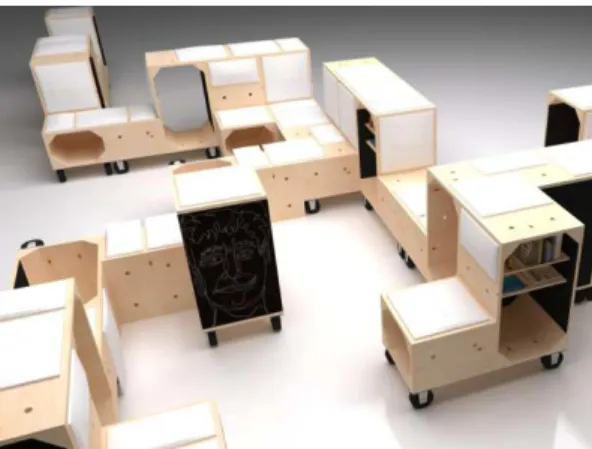
pro-Fun_Play is not just a chair – it is more like a piece of a construction set, where you can create your own space according to your needs or imagination. A playground should not be fixed in its form, as it is meant for children to play with. Using it is easy and simple. You can move and turn around the pieces – individual chairs – and then pin them to-gether with a seat cushion. Thanks to this flexibility, it is possible to create a unique playground, private library or “living” space. This furniture is made of recycled wood from discharged old furniture.
The most important moment during the design process was an exhibition, where public could test this furniture and the designer could see how they were using it. In this par-ticular project, end-user interventions into the design process completely changed the appearance and construction of these elements, and also changed the designer’s future thinking about the design for a public use.
FIG. 18: Visualization of Fun_Play elements based playground. (visualization: Danka Blaškovičová)
293
FIG. 19: Fun_Play elements in use. (photos: Danka Blaškovičová)
Sustainability
Part of this project’s assignment was to take energy efficiency and sustainability of the proposed solutions into account. In some cases, improvement of the energy bal-ance of the Old Markethall building was a part of the concept, in the other, this condi-tion was fulfilled vicariously. Energy resources can be saved by recycling, by using of what mainstream culture considered as waste. Students worked with the phenome-non of recycling, using recyclable or already recycled materials. Could Research by Design methodology serve as one of the sustainable design solutions?
Student design studio supervisor: prof. Ing.arch. Julián Keppl, CSc. Student design studio leaders:
GoodReads, Learning by doing definition, accessed 6 June 2014
Merriam-Webster’s online n.d., Architecture definition, accessed 6 June 2014
ResEAAErch – EAAE/AEEA Research Charter 2011, Research by Design definition, accessed 7 June 2011